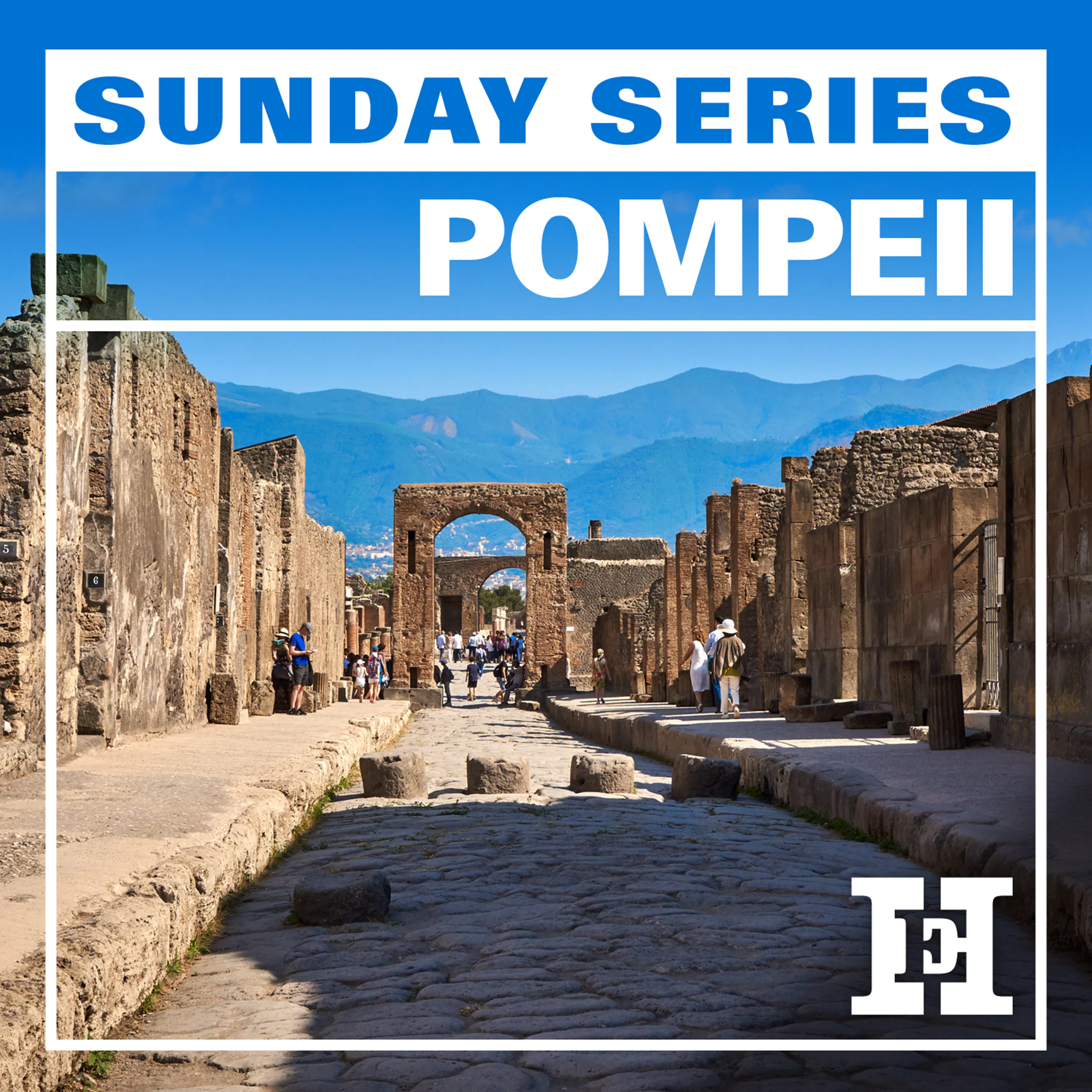
This podcast episode discusses the aftermath of the Vesuvius eruption in AD 79, focusing on the Roman response and the long-term fate of Pompeii. Emperor Titus swiftly initiated relief efforts, dispatching officials to assess the damage, allocating funds for refugees, and resettling survivors in nearby towns. However, the scale of destruction made rebuilding impossible, leading to state-sponsored and private salvage operations where people tunneled into the ash to recover valuable materials like marble and bronze. Over the following centuries, Pompeii and Herculaneum faded from common knowledge, surviving only in local legend and historical texts like Pliny's letters. The cities were accidentally rediscovered centuries later, with systematic excavations beginning under King Charles of Bourbon in the 1740s. The discussion also notes the challenges in estimating survivor numbers and how Romans likely viewed the eruption as an act of divine wrath, though direct evidence for widespread religious atonement is scarce. Early archaeological work was often destructive looting, which compromised the sites' historical record.
Welcome to the History Extra Podcast. Today, in the third installment of our Sunday series, chronicling the tragic final days of Pompeii, we're going to return to Jess Vener and Kev Lottchen, who are going to explore what happened after Vesuvius erupted, and how the city eventually became the archaeological marvel we know today. Once a thriving Roman city, life stops suddenly in Pompeii in AD 79, when nearby volcano Vesuvius erupted, burying its inhabitants and preserving their world underneath meters of ash. I'm Kev Lottchen, and I'm joined by Dr. Jess Vener, a historian of the Roman world and an expert on Pompeii. Welcome back, Jess. Thank you. Today, we're going to be talking about the aftermath of the eruption. How is it viewed in Rome and how long does it take for that news of a disaster that's performed in the Bay of Naples to actually reach the eternal city? Yes, so it's very rapid. They would have been sending messages to Rome, probably on very fast horses, so I imagine they would have found out pretty quick. Obviously, people were also moving themselves too, but they realized quite quickly that there was a terrible, terrible thing that had happened. The Emperor Titus was the Emperor. The Emperor for very long. This isn't a good start for him, and he was really trying to change things after Nero, so. But yes, so they found out that it had been buried. These cities had been buried that they knew of, and Pompeii was famous. Herculaneum was famous. And so they were going to try and help with relief efforts, and that's something that Titus starts to do. So what are those relief efforts? What did they look like? Yes, so the relief efforts are quite quick. So Titus wants to be this wonderful new leader. So he hears about it, and he's like, right, let's get going. We need to go and help these people. We need to sort out the refugees. So we hear from Swetonius and Cassius Dio that he is doing this. So we've got quite good records of this response to this natural disaster. So Titus dispatches ex-consoles to the Bay of Naples to have a look at what's happened, and also to organise rescue operations. They have no idea how bad it is until they get there. They also want to provide aid, and they want to assess the damage and see if anything can be rebuilt or salvaged. And they realise pretty quickly that that's not going to happen. So they're going to salvage instead. He then started allocating huge amounts of money to support the refugees that are coming from the Bay of Naples to help them rebuild, and he's also trying to resettle them as well. So he's resettling them in different towns that are at least sort of local that haven't been so much affected. So people are dispersing. They can't be any room for them. But it suggests that there's a lot of survivors, actually. That's a really interesting point to pick up, because I think there's kind of this idea that like, Bombay, Hurricane wiped out, and then it's all gone. But there are survivors and there are refugees. Yes, exactly. They have to go somewhere. And of course, they've lost all of their property. And if you were an heir, you would have wanted that property as well. So they've got to restart. And there's all these sort of things you don't think about is the aftermath. Really, it's never really discussed what happened to these people. Titus was remitting taxes, and he was suspending tribute payments for the region, so that they would be able to recover, because you have to pay tribute to Rome to be a part of it. And he was like, okay, that's kind of ridiculous, because what are they going to pay with? It's quite a big deal, remitting the taxes, I don't know. Yes, yeah, a huge deal. Oh, yeah, they love to tax the Romans. They would tax everything down to Eurin, even though it was a tax fall. We should segue if we can. Eurin tax tells about that. Eurin tax. They basically realised that Eurin was quite a valuable resource. I think it was Nero, actually, that did it. It was one of the empress, the earlier empress, who realised that tax, taxing Eurin was a really good idea, because you wash your clothes with Eurin. Which sounds bananas. Yes, it does, but it was very effective, and they used to do the smell, so the ammonia smell. But apparently it wasn't too smelly, I don't know, but they used to leave pots out on the street for people to use, and then the fullers would go and collect these pots. So they started taxing the Eurin, anyway, that's an aside. So yes, they were very big on taxes. Very big on taxes, but taxes are kind of remissed for this time, so the people of the campaign are resumed presumably, can get back on their feet. Do we have a sense of how many survivors and refugees there are? It's really, really hard to gather. So much of the land around Pompeii and Herculaneum in the other towns has been rebuilt on, so we don't know how many people are underneath those. We can't account for the population in the countryside. We don't know exactly how big that was. Slaves weren't counted. We don't know how many of them were there. So in Pompeii, we have about, I think in 2002, we had 1049 bodies, and since then more have been found. We've also got only a third of the city that's still to be excavated, so there's more bodies going to be under there inevitably. So we've got about 1600 to 1700 bodies. So in comparison to 20,000 population potentially, that's about 8 to 11% mortality rate. There's a huge number, and I can't inform. We just don't know the ratio, I suppose, things like how many might be deceased but unfound versus lived full some lives afterwards. Exactly. Yeah, they could, you know, all of those people could have got out. We have no idea, but a lot of them would have been caught escaping on the roads out of the cities around Vesuvius. So Titus has done this kind of almost relief plan, at least financially. Is there any kind of blowback for him in Rome itself? Yeah, so he was trying to be like really, really magnanimous. Is that the right word? Leader, the ideal humane leader, and he really wanted to show that he was different to Nero with how he dealt with the great fire of Rome, because Nero didn't deal with that very well. He started building himself of nice big palace where everyone's houses had burned down, and so they weren't too keen on that. So he was like, right, this is going to be very, very different, but he did go and actually visit the disaster zone himself. Oh, right. Okay. Yes. So it's very, very much like a politician. I will go to this disaster zone and I will look like I'm getting involved. So that was again a big contrast. And Cassius Dio says he was deeply moved as if it were a calamity affecting his own family. Now, once again, we have writers that are choosing to depict him one way or another. Titus wasn't very popular as an emperor, and none of them were actually, none of them really were until later. So initially he is being depicted as this humane emperor, and they're like, great, this might be a bit different. One thing we spoke about with the kind of the way people viewed the eruption happening around them was they were kind of calling on the gods or that the gods had actually abandoned them. Do you think there was any sense in the wider Roman world than that once this has also happened? This was somehow a linked two to gods. Yeah. I think so. When there's a gap in knowledge, you sort of turn to gods or mythology, and religion is a very big part of this to understand why things are happening. So the Romans always sought divine meaning in things, and they would have seen this probably as divine displeasure, the sort of the wrath of the gods, particularly as some of them thought that there were potentially giants underneath, and they would try to escape, and I mentioned how some people potentially saw, they think they saw giants in the clouds coming out of Vesuvius during the eruption. So yeah, they're very much trying to find reason in it, and yeah, they would have probably thought actually we've done something wrong here, and there's a reason we're being punished, because they wouldn't have understood why it was happening necessarily. And with that, would there have been any, have we seen the evidence for any kind of like, I know, change in behaviour, or kind of like celebration in the gods, that kind of way almost like a piecing them? That's really interesting. Not that I know of, you'll be very hard to track, because as we mentioned, we don't know where these people went, and anyone that wasn't there wouldn't have been bothered, because they weren't affected by it directly. So all they're seeing is all these people settling in other places, and this fallout, and the loss of Campania, which was a huge source of food. So from that perspective, that's probably more the way they saw it, rather than trying to respond with religion, they probably would have made more offerings to sort of prevent this from happening further, but it would be very hard to trace. I wish we could. Yeah, that'd be fascinating, wouldn't it? One thing I had in mind to ask you was about attempts to maybe reset or clear upon pain. You kind of mentioned a tyroscon and it became a salvage operation. So are we saying that Titus and his consoles they looked at and gone, this is beyond repair, let's go into asset stripping? Essentially, yes. That is exactly what they did. So they started tunneling down trying to find materials. So the Romans were incredibly resourceful with materials. They would melt down bronze, they would reuse marble. You often see, and it happened right into when Christianity started appearing in Italy, they started reusing epitaphs to build walls because they were marble, you know, like they were valuable. So you've got people's epitaphs on the back of church walls or whatever. This was happening from before. They're very resourceful. So they're trying to tunnel down. So if you can imagine the top of Pompeii covered in this volcanic material, we've got about, you know, varies from four to six meters. This is pretty high, but that means you've, you've had the top layers of the buildings taken out by these pyroclastic flows in general. Big features are poking out. It's a bit like a graveyard. So you can see where the amphitheatre is, for example, that's a big feature. You can probably see the top of like the temple of Jupiter Circus. That was, that was tall as well. So you sort of know. So this thing like, essentially the church spy, if you like, like stuck peeping above the. It's exactly like that. That's exactly it. Yes, exactly. So they've got an idea of where things are. Finding individual houses, like your own house would be really tricky, but I think people did try. We have tunnels going through these houses, actual holes and walls. And this happened later as well because they were looters. We find there's been skeletons that have been found that aren't of AD 79. So those are people who've gone into salvage or loot and then so things happen to them. Exactly. Yes. Yeah. And we've got graffiti from later excavators and stuff. It's completely mad. We also haven't got as many statues as we think we should have in certain places because they've gone. And it's very unlikely they were doing this during the eruption. So, but yeah, tunnels were a good indicator of that. I wouldn't like to be carrying a massive statue, I don't know, Apollo, during the pitch black. Probably not. No. No. It sounds a bit like almost like a prison escape, but you kind of tunnel down and then you kind of come in and it's like, oh, this is my house, I mean, like find the next one. Yeah. Is this kind of state sponsor then as in like the state is digging tunnels to asset strip and get all this marble? Or is it is it kind of like, you know, we're residents of Pompeii. We've lost everything we want to go back. I know get our strong box and trying to find our own stuff. Yeah. It would have been a bit like that as well because what else do they have? We've got these relief efforts from Titus, but we don't know how much they were given. How one would prove that they were a refugee of Pompeii. Does anyone go go, I can say like I was in Pompeii, give me a hand out. Exactly. How on earth would they prove it? And I think it wouldn't have probably been as successful as Titus would have hoped. And probably not as helpful as the people of Pompeii and the surrounding region would have hoped. So they wouldn't have had anything necessarily. If they'd had the foresight to think where I'm going to take these documents or my jewelry, a lot of people did try and escape with jewelry and precious materials and a lot of people had pouches of money on them. You find a lot of people with loads of jewelry on, so that makes sense. If they did have any, it seems. I always say to them, there's like, I've got three rings on each and my ten fingers kind of on. Yeah, yeah, it feels like that to me because they're running around in this eruption like with loads of jewelry on, like you know it. And there's a whole family that's been found on the Via del Abondanza, which is the Street of Abundance. It's the one where we've got the shopping street strip and there's a house on that street and there's this family of people that have been found and they all have loads of jewelry on, but they were there right up until the end of the eruption. So they weren't necessarily in the business of escaping at that point that they were hiding. How much time passes between these kind of attempts at aid and reclamation to the city being not lost, but it's not as famous as Pompeii anymore. Yeah, so it's still in living memory for a little while, obviously. At first, the second century's AD, it's still talked of, but then it seems to just sort of trail off of the maps, sadly. So they know of it, but it starts being called Chivita. So like the place of where people lived on maps, there's a map called the Tabula Putingeriana. I don't know if I'm saying that right. And it notes the location of Pompeii is about right and it says Chivita. So it's it's acknowledging that there was a city there and clearly it's in local legend that there was one, but it's not a significant settlement anymore. So it sort of just disappears. Yeah, it's so interesting. It's something like it's not the ruin of Pompeii. It is city sat on it. Yeah, really sad. Yeah. So it just disappears. And does the same thing happen with Herculaneum as well? Yeah, so it's a similar process. Yeah. Herculaneum is so so buried. There is no getting down into that. Pompeii is much more, so it's like four to six meters, whereas Herculaneum is 20 meters deep. There's just no getting down into that. That's just just so they don't tunnel. They don't reclaim in the same way. Not that I know of. No, Pompeii was it was a lot more common. And as time went on, there was a lot of rain. Another reason to think it was later in the year, actually, the eruption. There was a lot of rain and that solidified the volcanic material. And so after a while, it wasn't actually possible to get down with tools that they had. And then much later when excavators discovered it, that was that was when they started tunneling again and again, getting down into the proper layers. Does that difference in depth? I mean, Herculaneum is actually better preserved than Pompeii. So you were looters and scavengers into it. Well, yes, yeah. Because it's really difficult at Pompeii because early excavators weren't very keen on certain materials. So they were treasure hunting essentially. So they won't record things properly. Very, very hard for archaeologists like myself. And really they're not using the most finesse tools if they're looking for one specific thing. No, no, no, they're doing it as quick as possible. Find the good stuff, get out. You know, they would literally destroy frescoes. And they would just find like glitzy stuff and go fabulous. Let's keep that. Sell it on, give it to the, you know, the king or whatever. Bones were all discarded as well. They were sort of just like bundled in together. So all this context from a lot of the cities just totally been lost because of this looting by so-called archaeologists. So-called archaeologists who'd have them. We've got to the point where Pompeii, Herculaneum, they are no longer remembered by those names. Did they kind of take on a kind of folkloric kind of aspect within the Roman world, like the people remember what happened here or is it just calling them like, oh, no, these are just ruins? Yeah, I mean, the thing is in the medieval period, obviously we have them transcribing Pliny's letters. So they would have known about it. In that sense, it would have been a legend, I guess. But in terms of like living memory, I don't know of any circumstances necessarily where, I think it's sort of like every now and again mentioned and then it just stops being mentioned. So we've got Pliny writing his letters 20 years later. So Tacitus for some reason is interested in this, that much time later. But it does just trail off. They just stop talking about it. But absolutely in the area, there would have been a memory that would have been passed on, passed on, passed on, and that would have become legend because a lot of them would have tried to resettle in the area because as we've talked about before, it's very, very fertile. So you need to make the most of that and you know, it's very, very occupied now in the area. And so yeah, they would have gone back and they would have talked about this and passed the stories down. Yeah, and as you say to me, oh yeah, this is like kind of like where else would I go kind of an until I feel like this is my land. Yeah, exactly. And then there's free land there. Like it's going to be Roman's state would have snapped it up. But yeah, I mean, where else would you go? You're lively, heard your occupation, your family are all there. So yeah, where else would you go? So Pompo is lost as it were. I'm using I would very loosely. There's a point there gets I suppose rediscovered again, I use that word very loosely. But when does that story pick up in terms of the modern European knowledge? So there's this lovely character called Domenico Fontana who was an architect and he was quite busy in Roman Naples and he was digging a canal to divert the River Sano, which we know now was right next to Pompo. So he was diverting that and he was going through and all of the people tunneling found some ancient walls and sort of frescoes and inscriptions. And they were like, well, this is very odd. This is amazing. And they just covered it back up again. They were like, you know, whatever. And this was in 1592 really, really long time ago. And then later on, 1709, we're in Herculani area. Someone's digging a well and they find something again. And this marks the first true discovery of Herculanium. Because this time they don't cover it up. No, I think they have a little look and they're like, hold on a minute, something good here. So it's 1738. We have Charles of Bourbon in charge and he was the king of Naples and he was really keen on doing what a lot of people in these positions of power have done at linking himself to classical ideas of brilliant leaders. This happens a lot. So he's like fantastic. Let's go. Let's start excavating this thing and see what is there. So he goes down and they start doing these excavations quite methodically. And then we get to 10 years later and they start excavating at Pompo. So this is 1748 now. So there's a huge gap between 1592 and 1748. They actually thought that it was Stabii or it was Herculanium. Some people. So and then it was only later that they found an inscription in 1763. A lot of dates here. And there's an inscription which said of the Republic of the Pompeians. And now we know this is Pompo. And they were like, well wait, this is Pompo. And we know of Pompo because it's in letters by Pliny, for example, or Tacitus or Pliny. The elders talked about their cherries or things like other herdequin. And so, oh God, this is Pompo. So at that point, the knowledge of Pompo and what happened, that was known, but it's precisely occasion of involves. So something it's like, ah, here we are. Yeah, it's like finding Atlantis, you know, which doesn't exist. Or does it? Yeah, well exactly, but it's the same sort of thing where they had this legend. And like you said, they didn't know where it was. And then suddenly they were like, wait, this is Pompo. This is great. And they were excited presumably, but I know the story of the way. Oh, yeah, massively. Yes. And it became this wonderful like idealized place with all the frescoes that were coming out. And particularly the treasure we've just talked about. And they would take those treasures back to the King's house. And he would display them to his friends. And so he was like, quick, quick, get some more treasure. Yeah. Just be tunneling like Madden, getting one of the good stuff out. So Charles Bourbon, very happy. I'm curious. I don't associate his name so strongly with Pompo. Is he as well known as he should be for that? There's different people involved in Pompo's history throughout the years. So we've got him. And then we've got Queen Maria Carolina of Austria. She was the wife of third and then the fourth of Naples. So Charles Bourbon was doing this for like 20 years, 1730s to 50s. Yeah. And then Maria comes after this. And she was really interested. She was actually his daughter, I think. So she was like, okay, we need to be quicker here. So she starts getting them to work quicker on these excavations. She's like awful for people like me. We're like, no, don't rush it for goodness sake. But she turned Pompo into a really fashionable spot for the grand tour. Okay. That's when that started happening. So she's making it really fashionable. And then they started tightening control on the fines, i.e. they wanted it for themselves and their palaces. So that was interesting. But yeah, then we've got lots of different other characters all trying to relate it to their dynastic prestige. You know, I am discovering this Roman city. This is mine. There's a lot of flag planting going on. There's a lot. There's a lot of that. There's a lot of competition. It's who can do this the quickest, who can find the best thing. It's fabulous because the Bourbons especially would be doing these excavations. They'd find something wonderful and they go, whoa, whoa, the King's coming in a couple of days. Let's cover that up. And when he comes, he can discover it with us. Someone's like, put a blank out of it. I wonder what happens if you move it this. I just don't know. I would just stage it and he'd be like, oh, well, you see, I was here for that. So it was ridiculous really when you think about it. That is wild. I mean, I'm really surprised that Napoleon doesn't get in on this as well. Oh, Napoleon, yeah. Because he loves a bit of classical fame and for like appropriation. He's on it. Yeah. Yeah. Yeah. He is. Yeah. He very much thought of himself as the new Augustus. Yeah. Yeah. And then we've got Mussolini as well who who does this again. So he sort of tries to as well, like Napoleon, this re-classical rebirth, reclaiming the classical period for our people. So it's like a messy sort of thing really. Because there's all these different people coming in through the years that are trying to put their own mark on to Pompeii, which affects how things are coming out of it and what's happening to them. A lot of things ended up being sold on the black market or put into their palaces. And we don't know where they came from. What houses, what context. Who they were found by. Yeah. So if you walk around the Naples archaeological museum, fantastic museum. Often the labels are just Pompeii. Because they actually don't know where it's come from. Somewhere in Pompeii. But whoever. Yeah. But who knows. Temple House, don't know. So is there a kind of like a, almost a black market of Pompeii and antiquity center? Like I associate that kind of like wide scale routine with Egyptology. Certainly. Yeah. Does the same thing happen with Pompeii and Herculineum? Yes, sadly, yes. Yes. Still happens now because people obviously dig into their own properties and find things. So there's like a legend in the area when I was digging at a plantus, somebody told me about this wonderful story because it's a mad story. Excellent. A little mad story. Where this local Italian man, he was digging in his garden for some reason as they tend to do, you know, digging wells or whatever and they see because they're going deep and they can find something. The legend is that he found this room and the Americans, this is the story, were like, oh, can we buy that? It's a room. Yeah. So he sold the room. I told you it was mad. And now that funded his move to America. And now he has a really popular piece of chain in America, funded with this room. So okay. So I don't know if it's true, but that's the sort of legends that come out where it's just so easy to find things. I'm just so intrigued. Like we've said, we've been to the consensus room, the physical room. Like you took the balls and went, right, there you go. Yes, that's what I have in my head. I think they took the whole entirety of this room. And I don't know what this room was or what was in it or what it consisted of, but that's how extreme it can go. Yeah. It's, yeah, it's pretty extreme. But yes, there are sadly things sold on the black market. And I still see things pop up on like supposedly, you know, like auction sites or eBay or whatever, which say that they are from Pompeii. I mean, how you would prove that I don't know is probably not true most of the time, but it is a problem because they shouldn't, they shouldn't be there at all in these situations. In terms of the modern excavation, how far along, how we might get, I think it's like two thirds, you would say? Yes, two thirds. We've got a third to go. There's good reasons that we haven't excavated those areas. But yeah, we started again in 2018. And if you go to the site today, you can see them ongoing. So they're trying to, they're doing a, there's a huge amount of effort. The director, Gabriel Zuckertregel is, I hope you've said his name right is doing amazing work on giving it back to the people, particularly the local people because locally in Herculaneum and Pompeii, there's been this feeling that, oh, these cities are getting so much income, so much attention. And around them, there was all this poverty and they weren't really getting anything from the sites historically. That has changed in recent years. So Francesco Serrano Herculaneum, the director, has also done this. They started building a park around it and things. So the people are starting to feel really proud of that. So yes, there is a third to go. And we have made sure that that's been the case. Because as I said, there was like this huge rush, particularly 18th and 19th century, to excavate Pompeii and find treasure. We, as humanity, it's a really important thing to not rush these things because you don't necessarily have the technology, the money to preserve what you get out, you know, you go there now. And there's all these paintings that have been lost because they couldn't be preserved because they didn't have the money or the resources, whatever. So it's really important that we don't rush these things. But saying that, the excavations that are being done now are done so methodically and recorded properly, thankfully. So people like myself can go to that data and say we can reconstruct life from that. We're getting a lot of lower-class examples of life now as well, which is really nice because that wasn't a focus previously. It was more about what the elite's doing. And that has skewed our image or Pompeii. So now we're starting to find different things and it's fascinating. What would be the thing that you think is missing that we haven't found yet that you'd really like to find? I am an archae botanist, so I specialize in urban agriculture and what people ate, how it affected their lives, that sort of thing. I think there's loads of vineyards left to be found. I hope anyway. But I think that's a really important part of Pompeii in life because as I mentioned, they're very agricultural as a society. And, you know, historically from an archaeological point of view, it's been overlooked the importance of producing your own food. Vineyards orchards, vegetable plots, that sort of thing. So I think we may find more of those because it's in that part of the city where we've got the agricultural district and we're going just above that. So this is the south-eastern corner. The north-eastern corner hasn't been touched yet. So we could find all sorts. We recently found a private bathhouse in a house, yeah, which is so rare. So so rare. Yes, it is. Yeah, you have to have a huge amount of resources to have one of those yourself. And yeah, I was actually privileged to see this coming out of the ground, as in I didn't I didn't end up going in the end for various reasons, but I was asked to tell them what was what was happening and what was going to come out, sort of like predicting whether it was a garden or not based on what they discovered. So that's still being excavated now. But you have this issue where of course the pumice is in these spaces. So let's picture a courtyard with a garden in the middle. So it's a peristal garden. You have the columns around the edge. Of course that's going to fill with pumice. And it's just going to fill and fill and fill. So you're just going to have pumice. So that's then supporting the columns that have collapsed during the tremors or over time, whatever. Because then it's got more material on top of it. So when you take that pumice away, you don't want it to all fall in. Yeah. So you get to this situation where you're like, ah, this is an open space. We need to reinforce the buildings and then we can dig. So it's not as straightforward as it seems. It's there's all these processes that you have to go through hugely complicated process. It is. It is hugely complicated. Yes. Yeah. Now if you want to know more about how these archaeological digs have transformed our understanding of Pompeii, then you can read an excellent article on that by historian Sophie Hay in the history extra app. It's part of my Beyond the Podcast picks. You can find a link to that in the episode description. Speaking of the Roman world in general, I am a huge historical history and TV fan. I would really love to know your favourite representations of Rome, the Empire, not just Pompeii in on self-escreen or small screen. Oh, yeah. So do you know what? I love the obviously gladiator is going to be in there. Of course, I really enjoyed the latest one. Actually, it's like really good fun. It's completely nuts, but it's fun. So that would be up there. I think the eagle from years ago with Channing Tasm, I loved that when it came. I think it was like in 2002 or something. I really enjoyed it. I thought it was really good because it's set in Britain as well. So it's quite nice to see how they sort of like would have looked at the Britons, but I've got to mention HBO's Rome. Yes, a classic. Oh my god. It's such a good series. I only watched it for the first time a couple of years ago, I think, and never finished it actually. That's not a reflection on how good it was. It's started so well. It was one of those where you're just like, "Why didn't I finish that?" But loved it. I just like the amount that they put into that and the sets. Oh my god, the sets. I've been to that set as well in Italy. I know why. Yes, Chinachita. And the set is still there. It's amazing. It's lifted up. Yeah. I think that's incredible. They sometimes use it for stuff. So you probably. Do you see another show? It's just stuck around, but I don't know. Yeah, I'll wait. That looks familiar. Yeah, exactly. And it's got the temple and the forum and the calendar up and everything is pretty. This would be a great time to talk about our graffiti of the week. Yes, it would. Yes. I have been asking you every episode to pick a piece of graffiti you found, particularly exciting, enlightening, another verb of your choosing. What have you found for us this week? So I have found a piece of graffiti that seems to show some gladiators in victory. Yes. So again, someone's taking a lot of time to draw this out and they've got different types of gladiators and they're holding like palm fronds, which is the sign of victory. I re-foot you in a say sword. No, no, they're not in this situation actually. There seems to be walking down like stairs or ramps. So that might be the stairs in the amphitheater. It's not clear where it is, but they seem to be on these different levels and there's three gladiators. And underneath it says companions, in our victory, you perished with the new serians. This is interesting for a couple of reasons. The companions were sort of seen as a collective body, but we don't know who this is referring to in this because you would usually fight other towns as gladiators. You'd have the Pompeian's fight in the new serians and it got very much like football today where they would support certain gladiators and sort of follow them through their career. So this is a good example of like basically the Pompeians being like, well, ha, we beat the new serians. This is important for another reason because the Pompeians had a really big brawl with the new serians after a gladiator fight. There was a riot at the amphitheater and it went terribly. It went downhill so so quick because it was in 59 AD. And they basically ended up fighting the new serians. They were throwing rocks. Some people were maimed and injured so badly that they had to go to Rome to be fixed. Yeah, it was really bad. And there apparently were mortalities as well. There's gladiator of graffiti all over Pompeii. And like this one, they sort of depict the gladiators in quite good detail with the specific types of gladiators as well and what they would be holding and you know, who they were and they'd put their names above them and say, this is so and so he's he's one 12 times, this is so and so he's new and he's just beat the person that's one 12 times and never lost before, you know, gets really, really specific. But yeah, this one's nice because it seems to be alluding to this rivalry that they seem to have with new seria. So this is something that's very personal to them. Just like it is today when you support a team in any sport, it's something that becomes a bit of your identity. So I think it's a really, really nice image into something that meant a lot to them. Gladiator fights and games in general were so important to the Romans. So yeah, we're seeing something very vivid here, a little vivid image into their rivalries and pettiness as well, which I really, really love. Brilliant. Jess, thank you very much. You're so welcome. It's been a joy again. Next time we're going to be talking in more detail about what's been unearthed from Pompeii, but until then go beyond the podcast in the history action app where I've created some extra reading around Pompeii, Vesuvius and the wide of Roman Empire. You can find a link to that in the episode description below.
Podcast Summary
Key Points:
The Roman Emperor Titus organized rapid relief efforts after the Vesuvius eruption in AD 79, including sending officials, providing financial aid, and resettling refugees.
Survivors and later looters attempted to salvage materials from the buried city through tunneling, as the sites were deemed unrecoverable for rebuilding.
The cities of Pompeii and Herculaneum faded from common memory over centuries, with Pompeii being more looted due to its shallower burial, before their rediscovery in the 16th-18th centuries.
The Roman populace likely interpreted the disaster as divine punishment, but widespread religious responses are hard to trace due to population dispersal.
Early modern excavations, beginning in earnest in the 18th century, were often treasure-hunting operations that damaged archaeological context.
Summary:
This podcast episode discusses the aftermath of the Vesuvius eruption in AD 79, focusing on the Roman response and the long-term fate of Pompeii. Emperor Titus swiftly initiated relief efforts, dispatching officials to assess the damage, allocating funds for refugees, and resettling survivors in nearby towns. However, the scale of destruction made rebuilding impossible, leading to state-sponsored and private salvage operations where people tunneled into the ash to recover valuable materials like marble and bronze.
Over the following centuries, Pompeii and Herculaneum faded from common knowledge, surviving only in local legend and historical texts like Pliny's letters. The cities were accidentally rediscovered centuries later, with systematic excavations beginning under King Charles of Bourbon in the 1740s. The discussion also notes the challenges in estimating survivor numbers and how Romans likely viewed the eruption as an act of divine wrath, though direct evidence for widespread religious atonement is scarce.
Early archaeological work was often destructive looting, which compromised the sites' historical record.
FAQs
News traveled rapidly to Rome, likely via fast horses, so the city learned of the disaster pretty quickly.
Titus dispatched ex-consuls to assess damage, organized rescue operations, allocated funds for refugees, and remitted taxes to help the region recover.
Yes, there were survivors and refugees, though exact numbers are unknown due to unexcavated areas and uncounted populations like slaves.
Many Romans likely saw it as divine displeasure or wrath of the gods, seeking religious explanations for the disaster.
They were largely abandoned, with Pompeii becoming known as 'Civita' on maps and eventually fading from common memory until rediscovery centuries later.
Pompeii was first noted in 1592 during canal digging, but systematic excavations began in 1748 under King Charles of Bourbon, with confirmation via an inscription in 1763.
Chat with AI
Loading...
Pro features
Go deeper with this episode
Unlock creator-grade tools that turn any transcript into show notes and subtitle files.
 PodcastTranscript AI