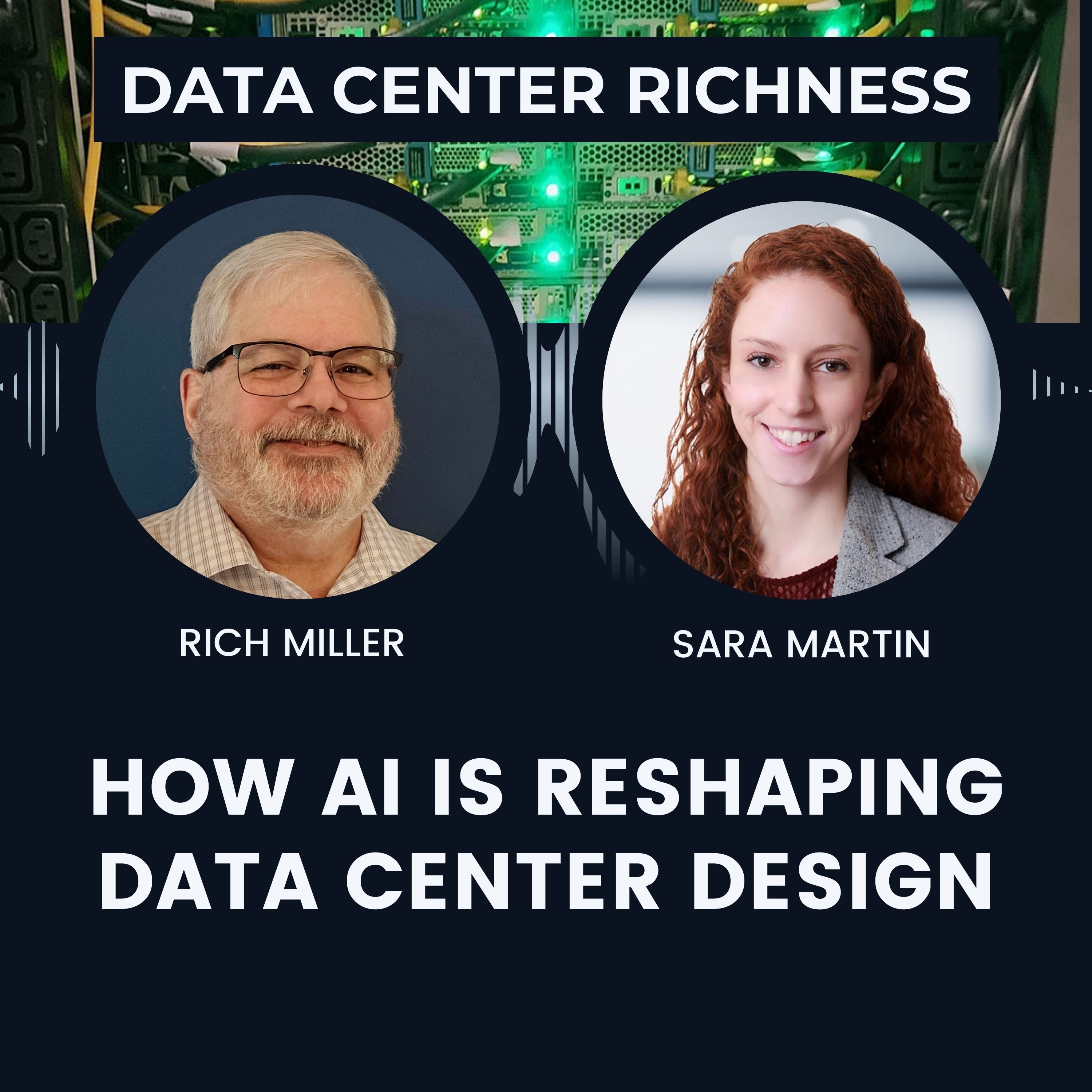
The transcript begins with an advertisement for podcast marketing via LibSyn Ads, highlighting its reach to engaged audiences. The core content features a podcast interview with Sarah Martin, an associate principal at design firm HED, discussing data center design in the era of AI and cloud computing. She explains that the industry faces tension between supporting traditional cloud workloads and new, high-density AI infrastructure, which often requires liquid cooling. To address this, her firm focuses on modular, flexible designs that allow multi-tenant data centers to accommodate both air-cooled and liquid-cooled systems from the outset, avoiding costly future renovations. Martin stresses the importance of future-proofing and sustainability, noting that rapid innovation—such as rising rack densities and new cooling technologies—demands designs that can adapt through component swaps rather than demolition. She also observes a trend toward full-building construction over phased shells, driven by hyperscaler demand, and shorter leases as companies seek flexibility. The conversation underscores how client collaboration and strategic space planning are crucial for building data centers that can evolve with technological advancements.
Marketing is hard. But I'll tell you a little secret. It doesn't have to be. Let me point something out. You're listening to a podcast right now and it's great. You love the host. You seek it out and download it. You listen to it while driving, working out, cooking, even going to the bathroom. Podcasts are a pretty close companion. And this is a podcast ad. Did I get your attention? You can reach great listeners like yourself with podcast advertising from Lib Sin ads. Choose from hundreds of top podcasts offering host endorsements or run a pre-produced ad like this one. Across thousands of shows to reach your target audience and their favorite podcasts with Lib Sin ads. Go to LibSyn ads.com. That's L-I-B-S-Y-N. Ads.com today. AI is changing the way we design and build data centers. Meanwhile, cloud computing and enterprise companies continue to need lots of IT capacity. This creates a challenge for the teams that design data centers who need to navigate rapid change in workloads and technologies. AI or cloud. Air cooled or liquid cooled. This is Sarah Martin's world. Sarah is an associate principal at HED, a design firm that works with many data center clients. On today's podcast, Sarah provides an inside look at how the rise of AI is creating new challenges and how leading data centers are using design to build for the future in a period of big fast change. Let's get started. Welcome to Data Center Richness. I'm Rich Miller and I've spent 25 years telling the story of data centers, cloud computing and AI infrastructure. In this podcast, I'm sharing conversations with the innovators building our digital future. Now here's our show. Sarah Martin, welcome to Data Center Richness. Thanks, Rich. Thanks for having me here today. Excited to be here. We always start out with what we describe as the data center journey. We ask each of our guests to sort of share a little bit about how you found the data center industry and how you came to your current position and what it is that you do. Sounds good. So for first question on how I found the data center industry, I honestly got a little bit lucky and I stumbled right into it right out of college. I went to school for architecture but I was pretty burnt out from architecture and so I was trying to find something that was obviously in line with my degree and I could get a job, but also something that was a little bit different and an area that I could learn and branch out into something new. And I found integrated design group who later was acquired by HID, who I currently work for. And they, at the time, they only design data centers. So I applied there because I was like, "Okay, this is going to be engineering focused. Maybe this will be something that's new problem solving areas and that's really what kind of drove me into architecture to begin with." And the role at the time was an assistant project manager role. So I went straight into project management and skipped kind of the architecture side of things which honestly was great for my career and great for what I really needed at the time which was new challenges, right? And so from there I went into managing a number of MEP projects with that client we were able to bring back A&E so we started doing A&E services in-house. So I learned a lot about the MEP systems throughout that time and throughout my career have kind of grown into more client management side of things and overall sector leadership side of things which at HID is essentially a little bit of thought leadership. But primarily a lot of client management and understanding and partnering with them and understanding what they need as a client and especially in this industry is things are changing and evolving rapidly. It's working with them to really understand where they're aiming to go. What are the problems they're looking to solve where the clients they're partnering with, what are their ultimate issues that they're trying to solve? And so it's been a lot of fun and constantly evolving infrastructure and being able to continue to learn and learn as the prototypes or the design typologies have changed over the years. So HID as a whole is an integrated architecture and engineering design company. So we provide full services from architecture, mechanical, electrical, plumbing, fire protection, structural, pretty much everything except for civil engineering. And we do everything from site due diligence efforts to all the way through construction close out and the typical CA processes type of thing. So we can do a ground greenfields. We can do your EFOs which is your electrical fitouts which is really the IT fitouts for say you have a multi-tentative data center provider and they have a client come in and they want to do a specific design within their facility. Well, we can do those as well. So we do pretty much everything you can do on the architecture and engineering side of things of the industry. This is kind of an interesting moment for data center design and engineering. A lot of tensions between a couple of different sort of big picture trends that we have going on. Cloud is still growing strongly but AI is all the new hotness and requires a slightly different type of infrastructure. That's brought about discussions and some challenges around some facilities are air cooled, some workloads need liquid cooling. What's your take on kind of where we are in a design and engineering perspective and how you think about designing for the different kind of workloads that are driving business right now. Yeah, so as I mentioned in my intro, a lot of my role is client relationships. And so for AGD in particular, partnership is very important in understanding where our clients are trying to go. It helps us help them develop their prototypes, new designs, modified designs for certain tenants, all that kind of stuff. So as you mentioned, there's a lot changing and a lot happening, especially in the, I mean, I guess it's a little bit too full, right? There's the multi-tentative data center side of things. There's a lot that they have to cover the grounds with, right? They can choose some of the companies like Corriev are kind of basically saying they're the AI cloud provider, right? But a lot of the companies are juggling both of the demands in the industry, which is cloud, which as you mentioned, is still a line share of the market. But then there's also these AI developments that are coming in and how do you do both, right? And so one of the things that we really work with our clients on is developing kit of parts that build in that modularity or flexibility from day one. And the goal with that is not only from a future-proofing sense, but also from a sustainability sense, developing a facility that is only going to need to be basically demolished in two years because of this evolving technology doesn't do anyone any benefits. And it's also not great from an environmental or sustainable perspective as well. So we work with the clients to a day one kind of understand where they're trying to work with. Who are their tenants that they're looking to bring in and be able to support their ultimate needs or if it's hyper-skiller. It's more on the AI side of things typically. And so it's really starting to look at pushing that needle. So when it comes to multi-tenant data center providers, a lot of them are still in this hybrid model. And I would say that that's probably going to be the truth for the next few years as these technologies evolve and especially as the chip manufacturers are continuing to push the industry. There is a lot of unknowns. There's a lot of what works today may not necessarily work in 12 months when your building is actually developed. So if you don't go into it with a future-proofing mindset and the ability to have either an air-cooled system and a liquid-cooled system, then you're limiting who you can potentially market yourself to as a data center provider. So we work with them to kind of develop those kid-of-parts to customize a design that will ultimately allow them that flexibility for the most part. Some of them will choose some of the lower-density customers but for the most part, they're looking for to be able to do both sides of things. So like I mentioned that essentially results in, you would need to be able to do air-cooled and liquid-cooled. You need to have the air-cooled for your lower-density options but then you also need to have liquid-cooled for your higher-density options. And for some clients, there's a little bit more clarity in what that looks like but a lot of them are kind of working through exactly what their systems are going to be, who they're partnering with with their vendors and how do you develop a system that is going to have your craws or crack units and then you're also going to be have space for your CDUs and is that a one-for-one swap or is that something that you have to be able to maintain both of them for your ultimate flexibility type of thing. So we work through with them to make sure that when we're doing space planning, we're accounting for all those factors as well as everything else that's kind of evolving in the industry where it's before your connectivity may have not been as robust. So now we need more and more space above the racks for--
multiple tiers of cable tray. We need space for the liquid cooling pipe being. We need space for potential controls to make sure that where the liquid cooling isn't having issues from basically leakage and all that kind of stuff, right? And so it's making sure that while we are all talking about higher densities and people naturally think that that means, okay, that's a smaller building and in some ways it definitely can be. But it also means that you have to make sure you're prevent. You're not just removing space that you're like, okay, cool, we don't need this anymore. You do want to make sure you're continuing to have that future-proofing and have the space remaining that's not going to lock you into a design that, like I mentioned earlier, could potentially need to be demoed or heavily renovated in the next few years. A couple of questions there. The first is you mentioned the multi-tenant facilities. And I'm curious about that because if you're a hyperscaler, you're controlling the design of the whole building for your gear, then it's easy to kind of say, well, here's a zone that's going to be for a one-area. And then we're going to do the liquid cooling over here and work with the network on that. Because that's traditionally when you've had a couple of different kind of workloads, data centers will look to, but the high density stuff in one area where maybe you can do something a little bit different with having water to the racks and such. For multi-tenant clients, are they able to sort of organize the space in the same way where they can zone things? Because obviously, they don't know what the clients there have, but, you know, kind of will determine how much density they need. And I guess then the challenge I'm curious about is how the multi-tenant providers then sort of who goes where and how that works with what their cooling priorities are? Yeah, and ironically, I think a lot of the problems that AI faces inherently aligns with some of the issues that multi-tenant data center providers are going to have, right? Because you have such a big kind of range of low density to high density, and even in AI, you could potentially still have that with storage racks being lower density and your compute racks being higher density. So that is kind of inherently multi-tenant data centers are well positioned to be able to handle both because they have to go into the AI design with that flexibility. And now they have to go into lower, even if it's a traditional co-lo or traditional cloud that is going to go into those facilities. It's a lower density, right? And so they still have to be able to provide that air, but they also need to be able to adapt to liquid cooling. So some of them are going ahead and putting liquid cooling direct in, but I would say a lot of them are still on the air side of things with the space planning and provisioning for either additional CDs, or like I mentioned earlier, the one-for-one swap of units to be able to quickly adapt to that liquid cooling infrastructure. The thing that with multi-tenant data centers, and honestly, I think this is evolving and changing, but previously, a lot of times they did shells first, right? And so when you did a master plan, you would do a master plan for what your mechanical system is going to be your electrical systems, all that kind of stuff. So when we talk about design in the future, beautiful sense, a lot of that's still happening, but what is interesting and what's changing and evolving quickly is that the demand is not a six megawatt block anymore. It's on an eight megawatt block anymore. They're buying full buildings. So where you might have seen a hesitation of a multi-tenant data center provider to build a full building and the data halls within it previously, now that is becoming less and less of a thing. You're still seeing people build shells to kind of get there, especially some of the newer providers to the industry. They're going to build shells because they need to get their name out there to be able to say, "Hey, we have space. Do you want to either take this base?" Because some of the hyper-scalers will come in and do the actual fit out of that shell. Or we have a shell. It's only going to be X amount of months before we can have the data centers. Right. There is still that area, but I would say a lot of the bigger companies that are doing the multi-tenant data center providers, they're already having conversations with the hyper-scalers months ago. They're ready to just go from zero to 100 now. Less of that phasing that, historically, it was okay, we're only selling it off in chunks. We'll build data centers as we need to. We'll build the actual data halls, I guess it's just a better way to say that. The data halls within the shell, as we need to, now it's like, "Hey, this 36-megawatt building is nothing to this provider. We need three of those, so here, let's go. We're building the full thing type of thing." Because of that, that inherently becomes a little bit more, your prototype is designed to be able to do air or liquid, but now you know day one who the tenant's going to be. Now you can start customizing to that from even when you're developing your shell or your master planning efforts. The pace of change seems to be a challenge for everyone right now. The interesting thing is a lot of this has been driven by the AI workloads, particularly Nvidia. They put their roadmaps out there, which on the one hand, help people know what's coming, but on the other hand, I think there were a lot of freak outs when they first began talking about 600 kilowatt racks in two years. So there's been a lot of, I guess I'm interested in how that works into your job, what the challenges when folks have these roadmaps where you're not having to deal with that workload now, but you have to think about in two years, given that this building is going to be a valuable asset for years to come. How do you manage the pace of change as you think about building a long-term asset with a client? It's crazy to think that we're heading towards a 600 KW rack in the near future. I've also heard a 1Gigawatt rack, which is mind-boggling to me, although the ones that I've seen for the 1Gigawatt are basically three racks wide, so it's like, okay, so that's three 300 KW racks noted type of thing. Yeah, but I think a lot of what I kind of touched on initially is exactly why we're seeing a lot of this in the industry of this future-proofing thought process. One of the huge things that we are continuously talking about and pushing the needle on is modularity, and the reason for that, and that goes hand-in-hand with the kind of the kit of parts things that I was describing in the beginning. But the reason for that is that, say you do a design now that's based off of a three megawatt generator backup system, right? The hope in the goal is that we're developing systems and solutions that instead of demoing the building in the future, you're doing a swap out, right? So if that generator size increases over time in the capacity from a capacity perspective versus a footprint perspective, the hope is that you're now just doing a one-for-one swap in being able to upsize the density in the facility, which is essentially where the industry is going. And the goal there is really the sustainability sense, right? You know, data centers are very power-hungry, and think a lot of times that gives it a bad wrap, unfortunately, because for the rest of the world, that means that you're wasteful. And it's like, well, you have to think about it differently. This building isn't heating and cooling to an individual's likeness, right? It's not designed for humans, it's designed for servers, right? And so it's a server that itself's that are power-hungry. It's not necessarily the systems, right? But as we continue to push that needle on sustainability, we are trying to make sure that we're future-proofing is a fundamental part of that because these systems are going to continue to get more efficient. We're going to need to be doing upgrades to be able to meet the next. Is it a 600kW rack? Is it something different? Microsoft is talking about a chip that, as opposed to the cold-played systems that we currently have, where it's liquid cooling to the cold-play, they're designing a chip that has cooling direct to the chip in the sense that there's kind of pathways engraved underneath the chip that you're bringing the cooling directly to the chip as opposed to like an immersion system. So there's a lot of evolution that's going to be happening in the next few years. So being able to do that future-proofing and making sure that you're not designing a building that has too many restrictions, maybe you're upsizing your structural components to be able to take on higher-density racks that are inherently heavier or more connectivity in a certain area that now you're going to have more cable-tra hanging off of all those types of things go into ensuring that the design is going to be able to take on the next phase is, right? I think the racks themselves and the innovation there is going to continue to push the needle, but we're also seeing shorter leases come into play. We used to be at a lease that was, you know, to the time of the infrastructure itself would be kind of at its
end of life for like a 15 year, 20 year lease. Now we're starting to see shorter leases because companies are either using them for AI deployment or training, but not necessarily seeing that as a long-term thing. And or because they're trying to future proof for themselves, knowing that, hey, this system works for now, but to your point, we might have 600 KW racks in two years, so we don't want a 15 year lease. We want to have a shorter lease. So it's, it's trying to build basically a shell that you can retrofit with ease, which is where the modularity parts come in pretty significantly. And the more you can kind of push those boundaries of what that is, you know, a lot of companies are coming out with hack systems that are fully supporting everything from the liquid cooling, the cable trays, the pack itself. So those kind of modular components not only help with the speed of construction, they also help from a plug-and-play perspective in making sure that these facilities are not going to be able to withstand. And you don't necessarily need as much of a hanging load because really everything's being hung off of that hack system. And so it's kind of understanding what the intent is with that client, like I mentioned previously, in understanding their goals, understanding where they're looking to go, are they do they have strong partnerships where they can lean on these vendors to help them with the plug-and-play, and then us having conversations with them as well to kind of help understand the best use cases of the latest technologies or, you know, a new product that a company is coming forward with type of thing. One of the challenges, I guess, that we've seen, you mentioned, you know, the power of peace of sustainability. And I think part of that is that people see these huge numbers for the amount of energy that's being used and don't, as you said, don't think about the amount of business that's taking place in these facilities that I think is really the factor that gets lost in the sauce. But one of the areas where there's been a lot of focus and I think a tremendous pushback from communities is about water. And the areas that have really critical issues regarding water and how the industry and any new facility kind of thinks about that, what's your sense on where we're at in water management and whether it's the industry is kind of stepping up to the challenge of operating at, you know, gigawatt scale and doing this responsibly with the water usage. Yeah, I think it's not dissimilar to the power conversation where there's a little bit of a misnomer. And I don't mean not in a sense of to dismiss it whatsoever because I think part of a designer's role, part of the industry's role is to be taking the community's feedback and helping with the community engagement. It's very important from an H&E perspective, it's also very important to me personally and making sure that, you know, as we're designing these facilities, they're not ignoring the potential impact to the environment and to people's lives. But I think the misnomer part that comes in is that a lot of the numbers that get thrown around are based off of either older facilities or based off of evaporative systems, which essentially it's the difference between a closed loop system and an open loop system. And the reason that that's an important thing to kind of flag and note is that a closed loop system you fill it once and that's the utilization of the water, right? Whereas an open loop system or an evaporative system is a continuous drain on the community. And if you are not, you know, positioning that in an area where you're not taking environmental impacts into consideration that can be harmful, there's one in Oregon right now that I don't know enough of the details around, but at least the way that it's being communicated is they're pointing all this, you know, concern or ill will towards the data centers for exacerbating an issue that the farmland around it have created a containment or contamination of the water supply. And then now you have an evaporative system that is taking that water supply and concentrating it down or concentrating it down to a lot of the contaminants because it's evaporating off a lot of the water. So that is kind of a worst case. And if that's, you know, the reality of what's happening, it's at least how it's being portrayed in the news, that's the worst case scenario, right? You don't want to use a system that's not going to either clean the water supply while before it utilizes it to remove some of those contaminants or you also want to consider a different use case or a different mechanical system in that situation. So it's, to me it's important that we are taking this feedback as an industry and making sure that we aren't repeating things, right? If that's all the reality of what's happening or even on a stadium, it's not even slightly different than that, understanding that that's a factor that as the industry grows as we branch out to these more rural communities and we, you know, AI is kind of driving to wherever there is power, not necessarily the telecom factor that was previously driving location. And so as we move out to these rural communities, making sure that our impact is not such that it's, it's negatively impacting the environment. So it's the importance of, you know, the bringing mechanical engineers in with the expertise that understand the potential impacts of that. It's also the importance of bringing an environmental engineers in that have a better sense of the local community, what the potentials impacts are, what are the concerns of the area? Are there already contaminations in the area that we need to be aware of all that kind of stuff? So I think holistically it's a very important thing in the industry for us to be talking about and making sure that we are being conscious of it. And, you know, I think sometimes people just say data centers are bad period and that's kind of the end of the story, but it's also the education of the community, right? There have been plenty of articles over the years about data centers are just Bitcoin mines. They're not like we wouldn't be able to record this podcast without it. We wouldn't be able to stream Netflix, we wouldn't be able to do TikTok. There's a lot of things that, you know, the whole community would not be happy about if they went away. If we didn't have data centers continuing to push this needle and especially with the conversation of cloud is still the majority of the data center industry, that points towards a lot of it's not just AI, right? And so a lot of it is the things that we use every day on our phones. You know, if you want to be able to get a new bird, kind of have to have a data center to be able to connect and have that network behind it to find a new bird, right? So there's a lot of things there that I think need to, the industry is working on and continuing to do to educate people, but it's also also making sure we're taking the feedback in. We're learning critical lessons that are potentially happening through this fast development and ensuring that us as designers were, you know, putting our our best foot forward as a company and helping our clients make sure that we're not repeating some things that we're also seeing elsewhere in the industry. Let me ask about that because granted that the industry hasn't always done a great job telling its story, I always felt like, you know, during the pandemic when all of a sudden, everybody needed data centers to kind of as they'll sort of lifelines to the world, that maybe they would have been a better sense of the critical role of these facilities in the economy. But part of the water conversation that I always hear is that there's folks who are aware of closed loop cooling as a concept, but say, well, nobody's really doing that, you know, that's overstated. Because of course, all the numbers based on the evaporative cooling are ones that are driving a lot of the discussion right now. It's always, you know, seem to me in the, with the announcements that I've seen that most of the new sort of AI and hyper-scale facilities being built are thinking about and using closed loop systems, sometimes there's a geography component to it. What's your sense of the adoption of these approaches that have less water impact and whether this is really sort of the new standard or whether it's more mixed picture than that? It's interesting because I think the majority of the industry has, if you take it by company, I think the majority of the industry has shifted towards closed loop systems. The issue or the driver, I guess, for evaporative is coming from some of the hyperscalers. And so while the industry as a whole has kind of been like, hey, you know, we're going away from that. We understand there's a water demand issue. We are already a power demanded currently. We are trying to, you know, make sure that we are putting our best foot forward. And also from an efficiency perspective, there's a lot of benefit from using closed loop systems. But then there's also some, unfortunately, some hyperscalers who are continuing to use evaporative systems. So there is a little bit of, like, you know, I guess, tension there in the industry of, of a number of companies or the majority of companies pushing in the opposite direction. And there are even multi-tenant data center providers who are providing for those, those end-use
or those multi-hyperscaylers. And there's still doing closed new systems, so it's clear that it's possible, right, with those hyperscalers, but I think there's always the change takes time, unfortunately, and for a lot of companies that have pre-established providers for their systems and pre-established relationships that they know that they can now turn to X, Y, and Z company to get those mechanical systems quickly. It, you know, not to say that there's no benefit for them to change, but it becomes a, this is what we do, this is why we do it, and it takes time to pivot away from that, right? And I do think, at least from my perspective and what I've seen in the industry, I would not be surprised if we continue to see a evaporative to disappear over the next few years. I think the industry is getting enough pushback, you know, a number of the hyperscalers have had to either abandon campuses they've bought or back out of deals that they were about to buy because of pushback in communities across the states. And I think the more that happens and the more people get educated around the, like even just what we're talking about, right, the difference between closed loop and an evaporative system. The more people understand those things, the more there's going to be pushback for specific companies and not just, you know, the holistic data centers are bad, right? I think people are starting to get wise to the issues behind having data centers near them and now the next phase is, you know, the education of, of the communities to make sure that they understand when there's a provider who is doing the best they can to ensure that it's not going to be taxing or impact the communities around them. But then there's also going to be ones that aren't. And so finding that balance and finding ways to help educate the community, and one of the things that I'm part of is us, is seven by 24. So the seven by 24 in New England chapter, we did a hackathon for high schoolers and taught them what data centers were and then had them design a data center in space. I will say these kids are geniuses. The stuff that they came up with in a couple of hours was insane. We had one kid model, a data center, like an actual 3D model on the computer, data center in space within that timeline. And so that gives me a lot of hope for the future of the industry is the more we have these programs that are helping educate everyone, the more we're getting younger individuals or individuals with different backgrounds who can bring in new ideas to the industry. We'll continue to help kind of that conversation, both educating the community, but also with new innovation, new ideas around how we, you know, how do we power these facilities without taxing the grid? How do we do mechanical systems that are more and more efficient, all that kind of stuff? So yeah, I think it's an ever evolving conversation, but unfortunately it's a little bit of a, there's a lot of historical evaporative systems and now it's the shift away from that and getting the companies to do that type of thing. - You know, there's always the old jokes about, you know, everybody in the data center industry loves innovation, you know, after they've seen it, running somebody else's data center for 10 years or something like that. But the demands lately in terms of both the kind of scale of the campuses that folks are thinking about as well as the fact that particularly with AI workloads where folks have paid a bunch of money for some, you know, GPUs and such, there's a real pressure on the speed to market and this has brought some new players in, it's not always easy for new ideas to succeed, but it seems like the speed of change has got the industry that maybe sit up and pay a little bit more attention and be more open to doing things differently when the conditions demand it. I'm curious what your take is on how the data center industry is doing on being able to adapt to some of the, the new speed of AI and what they're doing and what this means for the road ahead and what data centers might, you know, look like in a few years. - Yeah, I think you hit the nail on the head there of, you know, there's new individuals coming into the industry and that's gonna continue to create churn, right? So there's a lot of companies wanting to further hat and wanting to help, or want to get involved 'cause unfortunately, and unfortunately, it's a money thing, right? And they wanna get involved and they wanna be in the industry that has all the money, but I think it is doing a number of things. One, a lot of those companies tend to be the ones who are willing to take the risk. A lot of them come from some of the hyperscalers, you know, they're people who are starting their own data center development company or whether it be design firms or owners wrap firms who are helping guide kind of the newer developers who might be used to doing housing or, like industrial or something along those lines, they're kind of partnering with them to help kind of take their capital and ship it into this growing market. So there's a lot of tension there, right? There's the companies who are to your point, they know what they're doing. They've done it for years and they're kind of, you know, moving in that direction, they're getting pushed, right? 'Cause now they have to change both because of the industry and the demands of AI, but they also have to change because if they don't, these other companies are coming for them basically. And so there's a lot of, in my mind, it's a great problem to have, right? There, it means that there's a lot of people focusing on the innovations of what's coming next, right? You have, like I mentioned earlier, Microsoft looking at new chips, pretty much every one of the hyperscalers is looking at their own versions of chips because they are looking at new video chips that are in very much power hungry. And so they're trying to look for more efficient chips, but they're also looking for new technologies that are helping with their bottom line, but also gonna help overall with the demand in the industry because it's ultimately, how do we utilize less power, right? So more efficient cooling systems, right? So the shift between air to liquid cooling is not just a capacity thing, it's also an efficiency thing. More efficient systems, there's potential to shift for immersion cooling. I'm a little bit more questionable and if that's gonna be happening anytime soon, just based off of the designs that are happening now and you know, that 18 month life cycle of between the startup design and construction, I see liquid cooling being kind of the dominant one over the next few years because of that, we're designing for what's gonna be built in the next few years now. And so it's still a lot of that hybrid. And to me, it seems like liquid cooling is well positioned because currently you're seeing a lot of single phase liquid cooling. It's likely that two phase liquid cooling is gonna come into play as the density increases and that's kind of a, seems like a no brainer of a shift, because it already gets you to the next level of a higher density without necessarily changing technology too much. Whereas immersion would be a completely different system, different requirements for the facility, all that kind of stuff. But then you're also looking at potentially shifting in how we're doing electrical design. We traditionally have had the transition from AC conversion over to DC. Now you're starting having companies looking at potentially doing just DC power systems, power designs. I'm really curious about what that's gonna look like 'cause I think, as we talked about the mechanical models where it's already looking at a hybrid of making sure you can do air and liquid cooling. I think you might run into the same issue with AC and DC whereas when you move straight to DC, you're potentially looking at higher loads. Well, what happens to the traditional cloud market, right? Is that something that that solution can potentially still work for them or is that gonna run into issues? But that being said, if we do end up pushing that forward, it is another way to continue to make your systems more efficient. You're not gonna potentially have that power loss between AC to DC conversion and you're utilizing the full power at that point. So yeah, I think there's a lot of newcomers to the industry that are both bringing their own ideas but they're also pushing kind of the people who know what they're doing and do it very well right now, even further. And the timelines that, you know, I'm still using an 18 month timeline but I think that's becoming less and less of a thing, right? We're looking more towards 12 months and even shorter than that, depending on how modular your facility is and how much you can bring to the site and essentially you're just throwing up a shell and then you plug and play all your systems. There's a lot of efficiencies that are happening there and there's a lot of innovation that's happening there to kind of push that needle and hopefully bring more and more to the industry in a insustainable way. - Just one last item I'm curious about you. We've talked a lot about modular design as a way to adapt to the speed of change. One of the challenges we always have with the data center construction these days, particularly with the amount of data
demand is supply chains, the availability of the right kind of equipment. What are the supply chains for modular capacity look like and can they accelerate some of the things that are happening beyond the facility level or is the delivery still tied to transformers or something like that that's got a ridiculous time one? I think it's a little bit of yes and in that situation. I think the industry itself learned a lot during COVID. When COVID hit, there was a lot of supply chain issues. The industry doesn't do well with that. There's too much demand for the industry to slow down because of supply chain or I think there was a boat that got stuck in a channel years ago that slowed down a number of things being brought that has kind of been a part of the reason why it's opening the door to individuals getting involved in the industry because people are learning you need to have a diversification strategy. You can't just rely on one partner and it's it does a lot of things for the industry. There are organizations like OCP who are working on standards across the industry, right? And so if you have in OCP's just an example, right? There's a lot of them. But if you have an organization like that who is driving kind of help developing the standards, then now you have vendors who are looking to align with those standards, which then then results in being able to make your supply chain more resilient because you're not relying on just one partner anymore. You're not relying on just one area of the industry. There's been a lot of conversation on if the tariff conversation was going to slow down the industry, but that hasn't really happened. So I think there has been a lot of lessons learned across the industry that came out of COVID and being like, hey, we can't do this anymore. We need to be more diverse in who we're partnering with. We need to be more transparent about what's coming next. Sometimes what's coming next is, hey, we need a lot and that's the best they got. But it's still more of that conversation is happening compared to previous years, especially with the quote unquote AI race, right? Now the companies want to be the last in that conversation. So they want to make sure that they're having good relationships with their partners. They want to make sure that they can call in their partner and be like, hey, I need your support with this. Or I need to make sure that my design is flexible enough that I can lean on these five different vendors who can potentially provide the PDU types that I need and meet all the requirements that I need for my design type of thing. So yeah, there's been there's, there's, I guess, still a little bit of an une situation, right? Because there is a lot going on and you do need to make sure you're getting your orders and early and all that. But I think there was a lot of lessons learned from prior years and the, I guess, more senior developers, right? The developers who have been doing this for years have positioned themselves well in the industry to make sure that they're not going to run into a, hey, I can't provide my data center in time because I don't have X, Y and Z equipment. They've already have, in some cases, they have equipment sitting in warehouses to make sure that that's there and they have the supply for the next six months or whatever it is. Well, listen, Sarah, I always enjoy a great conversation about design. And so I appreciate you coming on and taking the time with us to help the our audience understand what's going on in the data center design and maybe a little bit about what happens next. So thank you very much. Thanks so much for having me, Rich. It was a great conversation. And to our audience, thank you for tuning in, listening to our conversation today. If you enjoyed it, please give it a like, smash that like button and one thing you can do that helps us support our work and have more of these conversations is just to subscribe to our channel so that you'll be the first to know and you won't miss any of our future content here on Data Center Richness.
Podcast Summary
Key Points:
Podcast advertising is presented as an effective marketing channel, with LibSyn Ads offering targeted placements in popular podcasts.
The discussion centers on data center design challenges driven by AI growth, cloud computing demands, and the need to accommodate both air-cooled and liquid-cooled systems.
Sarah Martin emphasizes future-proofing through modular design, flexibility for multi-tenant providers, and sustainability to adapt to rapid technological changes like higher-density racks.
The industry is shifting from phased construction to full-building deployments, with shorter leases and evolving client partnerships influencing design strategies.
Summary:
The transcript begins with an advertisement for podcast marketing via LibSyn Ads, highlighting its reach to engaged audiences. The core content features a podcast interview with Sarah Martin, an associate principal at design firm HED, discussing data center design in the era of AI and cloud computing. She explains that the industry faces tension between supporting traditional cloud workloads and new, high-density AI infrastructure, which often requires liquid cooling.
To address this, her firm focuses on modular, flexible designs that allow multi-tenant data centers to accommodate both air-cooled and liquid-cooled systems from the outset, avoiding costly future renovations. Martin stresses the importance of future-proofing and sustainability, noting that rapid innovation—such as rising rack densities and new cooling technologies—demands designs that can adapt through component swaps rather than demolition. She also observes a trend toward full-building construction over phased shells, driven by hyperscaler demand, and shorter leases as companies seek flexibility.
The conversation underscores how client collaboration and strategic space planning are crucial for building data centers that can evolve with technological advancements.
FAQs
LibSyn Ads is a podcast advertising platform that allows you to reach engaged listeners through host endorsements or pre-produced ads across hundreds of top podcasts.
AI is creating new challenges by driving demand for different infrastructure, such as higher-density racks and liquid cooling, which requires data centers to adapt designs for rapid technological change.
An associate principal focuses on client management and sector leadership, partnering with clients to understand their needs, develop prototypes, and navigate evolving industry demands like AI and cloud workloads.
Data centers can incorporate modularity and flexibility from day one, using a 'kit of parts' approach to support both air-cooled and liquid-cooled systems, ensuring they can adapt to varying tenant requirements.
They must balance low-density and high-density demands, often requiring designs that accommodate both air and liquid cooling while maintaining flexibility for unknown future tenant needs.
Future-proofing involves designing for modularity and flexibility, allowing components like generators or cooling systems to be swapped out easily to support higher densities or new technologies without major renovations.
Chat with AI
Loading...
Pro features
Go deeper with this episode
Unlock creator-grade tools that turn any transcript into show notes and subtitle files.
 PodcastTranscript AI