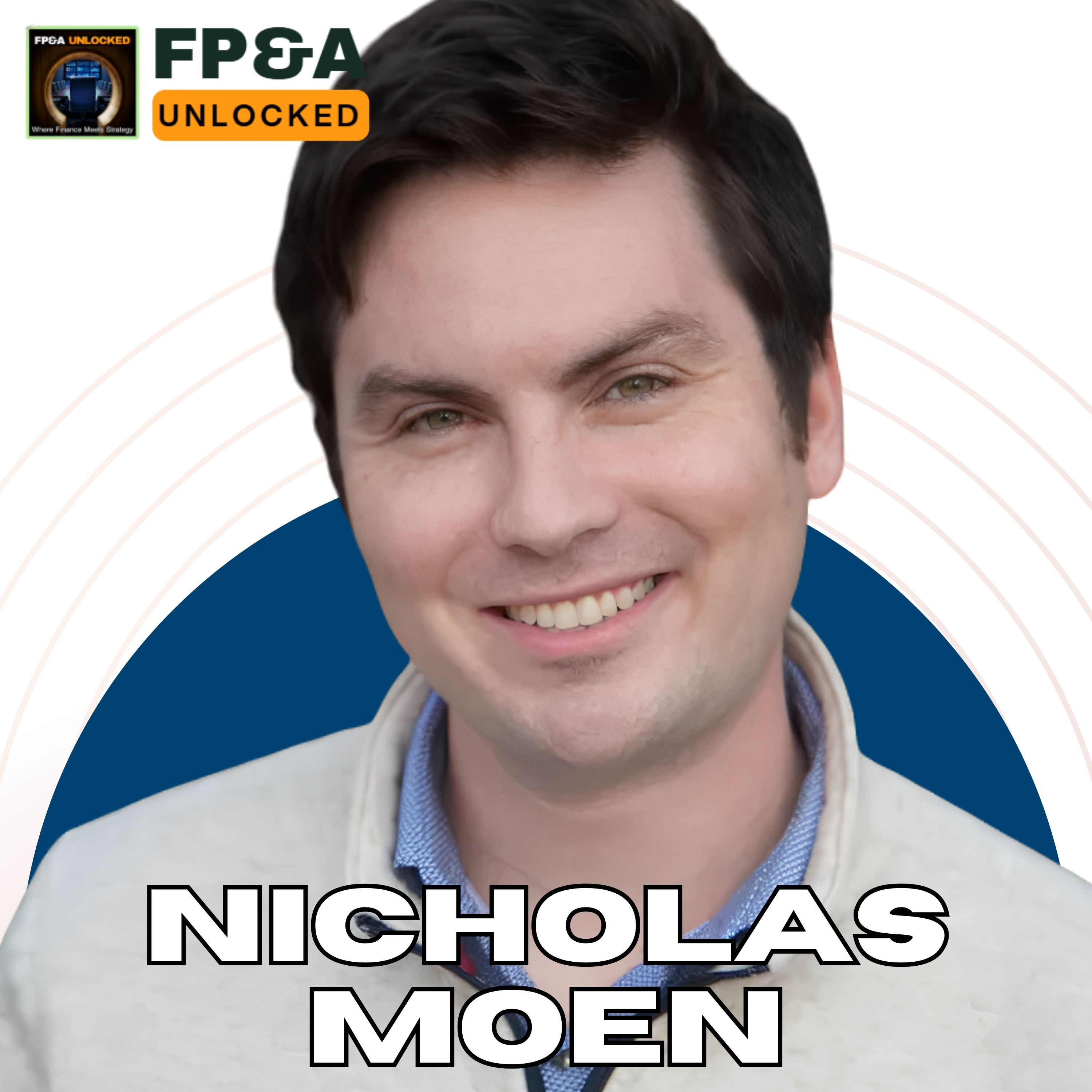
How AI is Being Used to Make Better Decisions and Build Faster Models with Nicholas Moen
from FP&A Unlocked
46m 39s
The conversation highlights how AI tools like Claude and Lovable are transforming FP&A work. Nick Moan describes a shift from manual spreadsheet modeling to using Claude to build and iterate financial models rapidly, achieving 80% completion before final tweaks in Google Sheets. He stresses treating AI like a junior analyst: it handles framing and bones, but humans must validate assumptions and formatting, especially for high-stakes outputs. A key technique is asking AI to self-check its work multiple times to catch errors. For custom app development, Lovable empowers non-coders to create bespoke micro-SaaS solutions—such as an inventory tracker or commission software—in minutes, though these should be considered MVPs rather than production-grade. Nick advises starting small by automating low-value tasks (e.g., email summaries) to reclaim time for strategic business partnering. The overarching theme is that AI acts as a velocity tool, allowing FP&A professionals to focus on decision frameworks and align with faster-moving business units, ultimately returning to the core value of FP&A: partnering with the business.
What's great about a tool like Lovable, you can use cloud for this as well. This is what I've challenged my team to use this stuff for is Lovable is great for making that micro app that's completely bespoke to who you are. So if you have that one process that's just uniquely you and you'll, I wish there's software for this, but no one's going to make it. That's what Lovable can do. Like it can make those like little micro SaaS apps that you always wanted, but never could have because no one's going to build it. There's not a big enough market for it. And an engineer is not going to build it for you internally because it's just so, like nuance to bespoke. Welcome to S PNA unlocked. I'm your host Paul Barnhurst. And this podcast is all about F PNA. It's where finance meets strategy each week. We bring you conversations and practical advice from thought leaders, industry experts and practitioners who are reshaping the role of F PNA in today's business world. Speaking of strategic impact we have here with us today, Nick Moan, Nick, welcome to the show. Thanks for having me. Very excited to have you. So we're, uh, we're continuing our series for those who are wondering around AI. We got a lot of episodes where we're going to be talking about people that are leaning in heavily AI. So before I get into that, let's go ahead and introduce Nick. Share a little bit of his, his bio and his background. So Nick Moan is a CMA and director of finance at section. An AI software company that helps enterprises, enterprise organizations deploy AI to their workforces at section Nick runs finance people, ops and operations actively deploying, agent work flows and an AI native tech stack across all three functions, rethinking how each operates before section Nick spent nearly six years as a finance operator at waste technology company where he built and scaled financial systems and teams across to combine hardware, software and services model. He has a track record of seen through operational complexity, identifying bottlenecks and building systems to eliminate them. Love the background. And once again, welcome. Thank you. Alrighty. We're going to start with this question. I always love to see how people answer it. In your opinion or kind of from your view, what does great FPNA look like? How would you define it? I think nowadays a question, the answer to it is a bit of a moving target. And what I mean by that is feel like with AI and how it's rapidly iterating. Because I remember when opus on cloud opus 4.6 came out, I was not using a cloud. I was using a different model and that wasn't really doing as much finance, but opus 4.6 really transformed how I interact with finances. And it's almost completely reoriented. How I work. So I'm going a bit of a long way around this. But even in the past five years, I've worked. I've gotten a little bit more removed, especially with AI from the day to day, weeds, maybe Excel spreadsheet building or anything like that. And moving more and more towards essentially the decision framework of FPNA. So when I think FPNA, I think this is kind of always been what FPNA has been about. But I think it's more about is how can we reach the right decisions and information in the business? And AI is really pushing us to that. So in my mind, great FPNA today is what great FPNA always been. But just bless them, the modeling more of like the analysis, deciding what the decisions are. What are the key levers to the business and just rapidly getting there more quickly and just focusing more on that? And I think it's just going to continue to be pushing teams into that direction. As AI just gets more advanced because one of the businesses just going to move faster to because finance is not the only it's not the only part that's getting impacted by AI. And if AI is like velocity, you can do more quicker. That's going to impact the rest of the business. And I mean, if you're working alongside marketing sales, you know, the more high velocity teams as finance, you kind of always like me, sometimes I feel like I'm trying to keep up. They're going to move faster to. So I think FPNA teams will need to move faster to keep up with the rest of the business, but they do, they will be able to and I think the AI will be a good equalizer between that. So in my mind, a great FPNA is back to what FPNA is on a fundamental level, which is business partnering and be able to be in lockstep with the rest of the business. And I honestly think that's AI is going to be the almost catalyst to that. Yeah, I've heard a lot of people say something similar of it really allows us to focus on what we should have up and focusing on all along and less of the data prep and the cleaning and all the fun things that we all enjoy. Right. I love it too. Yeah, I love doing that stuff. And it's kind of like it's like a bittersweet. It's like you kind of give it up, but at the same time, you're kind of doing what really drives the value to. It's exciting for sure. All right. Let's get into AI and cloud. You know, you talked about kind of AI is a velocity tool. So, you know, when you and I chatted and I want to start with this question, you mentioned that you haven't used a spreadsheet for a new analysis in a few months. I think he said since like January or something, but basically since you began using cloud, talk about that. I would say again, it was like opus 4.6 was the turning point for me. Like I stopped making spreadsheets and I stopped using them by stop making them. And at a certain point, I just started asking cloud to make them. Now, I gave it all the information, all the context it needs. But I started to realize that what clouds, like the, it's the first version it makes is actually pretty good, especially if you tell with the right things. You kind of have to treat it like an intern still, maybe not even an intern. I think it's gotten a little better than like if you grade these competencies based off. It might be the career. Yeah. Yeah. It's more of like a junior role now. It's kind of getting a little bit more smart. It's it's done with college. It kind of has a few reps under its belt. And it's like you can probably give it a task and can give some fairly coherent. Yeah. It's I think it's at that point now. Now, I don't think it actually nails it right out of the gate. Usually I have to take the last mile. It gets me 80% of the way there. And then I bring it into a spreadsheet and we use Google sheets. So I bring it to Google sheets and modify it. It challenges assumptions, many tweak assumptions, maybe fix some kind of dumb formulas that it did. But I think for the most part, it does a lot of the bones and the framing quite well. And that's time. Like if you open up a new spreadsheet, you have to build that. And like I'm assuming you've done a lot of modeling, but it's and I'm sure a lot of people listening have done a lot of modeling. Those frameings are not like exciting work or anything like that. You're building out your assumption rows and your tabs and all that. And especially if you can give Claude kind of your way of modeling, you can especially replicate that. It can build that like version one for you. And then you can take it and mount it from there. And it's a meaningful amount of time. And especially when I'm building and I'm I kind of have an idea of what I need to model. But it's not fully formed. So it helps me talk it out with Claude. That's kind of like I kind of like go back and forth. It gives me kind of like a mock up and I'm like, no, that's not it. That's not it. That's not it. I need to. What if we change this variable? Like, no, we need to rethink how we waterfall this out. I was actually doing that today. And it can reiterate and even rebuild an entire model a lot quicker than I could rebuild an entire model. So if I just start off a bad way of my assumptions were just all wrong and then when we built it out, it's like, no, it's not working. We need to go. It can just take it apart and rebuild it a lot faster than I can. And then why I feel like I actually have something good, then I bring it over and then I own the spread sheet, especially it's like a reoccurring model. Then I refine it. I get the formatting correctly is I will say Claude is still bad on the formatting. It's really bad in formatting actually. But that's okay. That's an easy fix. I can do that part. I still do that. Like I still haven't had a reason to change that method. It allows me to build things a lot more quickly. And how much time do you spend validating? Because we all know Claude or any AI makes mistakes. How do you think about that with all of it? Yeah. I think that's a good question. I spend a good amount time validating it. But I put it kind of on a sliding scale of like who is using this information and what decisions is it driving? If it's pretty low stakes, yeah, I'll go look through the rev assumptions. And make sure the formula is tight on everything like that. But like if this is for like let's do an extreme example. If this is for like reporting numbers to the board or CEO, yeah, I'm probably going to take pretty pretty hard and just check everything else out. But I'd be doing the same thing with any employee as well. I kind of see that the same thing. And it's really like it's a balancing act of like how high stakes is this information? There's this health or you need to be. Because one thing I also do is I'll take the model and have Claude or you can use chat, you, you're doing anything. And I'll tell it, okay, now go check your work. Like go look at everything. Go look at the formulas and actually does come back. It's like, oh, I made a mistake. Let me go fix that real quick. And
you do that a few more times and say, "Okay, now go check your mistakes, go review your work." You can even copy and paste the prompt and it's going to keep doing it over and over again. Eventually, you'll say, "Yeah, everything looks good." Then you can take that and then you could maybe save yourself some, "You can still check everything. You're still going to want to check everything." But it's going to be pretty clear, especially if you tell it to design it in a more, I'm very much a fan of the Kiss Principle. I want to keep things as simple as possible because it makes it as easy to audit. If you have a design, it's also a lot easier to validate everything as well, especially if you have assumptions flow instead of having one behemoth of a formula. Makes sense. I've heard someone else say to me, "If you're using AI, make sure you ask it to check itself at least three times for model building." It goes in line with what you said and it will find mistakes and get better. We asked one to figure out, early on none of them could tell me why the balance sheet didn't balance. We'd always asked them the correct answer. The favorite answer I got along the way was, "Your balance sheet is out by 1.2 million. That's only 30 basis points. That's an acceptable error rate. You don't understand how balance sheet works. That is not acceptable." You're no longer the balance sheet. You are fired. Yeah. Actually, I think it was early. We may have been using cloth. It wasn't cloths Excel, but they were using one of their early models. This was six months ago now. But even a little longer and it was like, "Boy, we got a ways to go if this is type of answers you were getting." Yeah. One thing is, actually, I got this from our CTO. I quite love this prompt. He just simply says, "What would you do if you were me?" Simple thing. Especially since these tools are kind of understanding who you are as a person and more than you use it, they kind of understand you. They know, "Hey, I'm Nick, Director of Finance, and it kind of gets my analytical profile." It will just run through the same things. Maybe you'll take it from my perspective, kind of like that prompting method where you sign a persona. You're doing that in a way. Your persona to the cloth or chat GPT. It's going to take that approach and think of it from what it thinks my perspective is. Again, copy and paste that three more times. It's going to keep running through and running through. It's actually quite effective. One of those classes cases is a very simple thing you can say that's very powerful. I haven't tried that exact one, so I'll have to give that a try. I was already thinking to my hand, "I wonder what I would say about this." Thank you for that. It's a good one. The other one is just you. I'm reminded to keep checking. I think we'll keep going here, but it sounds like in the spreadsheet, your advice to people is just start using IAI to help you build. I think that really what it comes down to is, don't try to boil the ocean. Don't take your most complicated thing and try to have I do it. Keep that to yourself. That's okay. Make that your special sauce. Try to eliminate all those little things that you don't, maybe you're not as value-ad. It doesn't even need to be FPM. It could be your emails. Get an agent to run through your emails. It could be having it summarize if you have Slack and integrate with Slack. Have it summarize your Slack messages for the day. Maybe teams. Anything that's not, so to speak, to that special sauce. Try to get rid of that. You can focus on those things that are really valuable, especially if going back to what great FPNA looks like. Anything that gets you closer to business partnering? I think that's really how in a great way to start using IAI is try to eliminate those. It might be a few five minutes here. It might be 10 minutes there, maybe 30 minutes there. All those minutes add up to hours over the course of the month, which gives you more time to actually put your brain power to something that's actually valuable and that requires brain power. That's good advice. I know you mentioned you've been using cloud code and lovable quite a bit. Had you ever written code before you started using them? I was fine. Decent EVBA. Not going to say I'm the best. Enough to kind of hack together solutions. Stuggle through SQL SQL. Enough to accomplish a few projects, but I'm not going to say I could probably look at SQL code and be like, that looks like jibber's nowadays. I'll do that. No, I don't code. I never really had strong desire to learn. So with vibe coding, I know it's making code. I don't know what it kind of means. I could probably read some variables, especially with this string text. You could probably work your way backwards. I've modified string text, but yeah, I'm not a coder by any means. Or would I have her claim to be one? So what made you decide, hey, I'm going to try to code some stuff. Was there a need where you thought, hey, this is supposed to be good enough? I can solve a problem. Or it was just like, hey, this looks interesting. So how did you decide a coding using lovable to others could potentially help me in my work? Yeah. I was given a lovable subscription. So I decided to try to use it. The real story is it was some, it was an AI summit, and they had a vibe coding. Here's lovable and we're going to vibe code. It's like, okay, well, I'm here. I'm going to do it. And I was blown away that I could have a mockup app in five minutes of prompting. I'm talking like an actual SaaS app. It was a mockup. It's not nothing, nothing production. It was, I believe, what is an inventory tracker for my sister's nonprofit where she clicks baby supplies for families that need it. She has like a bunch of supplies and just random bits and end, but she doesn't have a way to track it. So it wasn't a Google Sheeners kind of a mess. I'm like, it was a great use case. It's pretty low stakes. And let's see if I can get some inventory tracking. It did it so well. And I was like, this is crazy. Like, it is so easy. And then to iterate on it, if you're using chat, GPT, or cloud, you can use lovable. It's the exact same method. It's just this exact same prompting methodology. And just because it's writing code is not really any way to be intimidated by it. It's doing that for you. Don't even have to worry about it. I'm not going to say the code's great. I've heard from engineers I've talked to. It's not good code. So if you're trying to make it like a app to sell on like to the world, you may want to engineer to take that code and make it not breakable. Sure. You might want to treat it as an MVP. Exactly. Or wireframe or where you want to call it, but not production ready, so to speak. Right. Exactly. And there may be a time when it gets there. I don't think it's that time right now. Especially if people are going to pay you money for the app. But it's pretty simple and pretty quick to use. It's just, I think for me, it was starting because it felt intimidating. It's like, I can't build an app. That's not my skill set. And then when I did like one in five minutes, I'm like, Oh, I can build an app. This is different. This is way different. Yeah. No, make makes a lot of sense. I know you. So you end up building a commission software for the company. How long that take you? Less than 60 minutes, honestly. And how often are you using it? We're using every commission cycle now. It is completely calculates our commissions. And did an engineer have to do any coding with her? You did 100% of it. Is it sitting in the cloud? Talk a little bit about that. Yeah. So what we did, and we're iterating on it. But you're not going to claim it's perfect. No, it's not perfect. The calculations are perfect. I'm going to make that clear. Our reps are being paid accurately. But that being said, I would say the app is not. The clarification point. I'm just listening right now going, what? The apps are good for media use. I would not give it to somebody else because it's a bit more of my brain as an app and no one wants that. But that being said, how actually went about it is we have, you know, I don't want to say it's a simple commission structure, but it's a very nuanced one. And there's multiple triggers. I gave, I actually did this at two part mostly because I loveable has more expensive ideas, but I gave Claude our commission agreement and basically pulled the calculations out in the triggers, analyze it, understand it, then give me a prompt that I can get to lovable. Right. I did actually say, give me prompt took that prompt copy paste in the lovable and lovable gave me basically something that was accurate in the first prompt. But it wasn't quite what I needed to be because I couldn't finesse it as I need like a hard code of the rates. I didn't want a hard code rate. So I want to be able to change those. So this would have been a very complicated workbook to make. And that's actually what kind of started it as I started making the workbook. And I'm like, I don't want to do this. This is so much, I would have to do this per rep. And there's just so much I'd have to build out. This is at least 300 rows. So I'm like, you know what? Let's try it at worst. I'm 30 minutes out of my day if it doesn't work. But if it does work, I am sitting pretty. So I gave it to Claude and gave it to lovable. I'm like, this is way easier. No, I'm already thinking of I've been meaning to there's some there's two things I'm wanting to buy code and I just need to sit down and do it. Or those things. They're they're not FPDA things. They're just some stuff for my business. Yeah. Process things that some someone want to get on my website. You know, basically some questions you'd fill out. It would give you different options. Type of things. So yeah, kind of questionnaires to give you options. So. That's a great use case for this as well. Yeah, no, I think it will be good. I have the data now. I've done a lot of the work on all the backend stuff. And I'm like, okay, I'm sure it could help write some of the logic and just work through it all.
and see what I can build. It's just time, you know how it is. He's gotta say, "Daddy, we'll do it." We all pick where we spend our time and I haven't spent enough time on it. - Well, I think the touch doesn't get a point. Like what's great about a tool like Lavable, you can use Cloud for this as well. This is what I've challenged my team to use this stuff for. Is Lavable is great from making that micro app that's completely bespoke to who you are. So if you have that one process that's just uniquely you, and you wish, I wish there was software for this, but no one's gonna make it. That's what Lavable can do. Like it can make those little micro SaaS apps that you always wanted but never could have because no one's gonna build it. And an engineer's not gonna build it for you internally because it's just so nuanced and bespoke. That's where I'm finding a lot of power in it. It's just something that's, I need this automated, especially with Agents nowadays. Agents also kind of filling that gap as well. - All right, so when you and I chatted a few weeks ago, you mentioned you finished an analysis for the CEO, using Claude on your phone while putting your son to bed. Tell us the story. - Yeah, yeah, so this was like classic end of day request. - That's like it. - It's like it's, okay, I was gonna log off and go make dinner. Obviously I realized that this needs to be done. - Yep, they wanted it yesterday. - That's right, yep. So what I did was, it wasn't like one of those things where it's like, okay, I'm gonna just get this done in 30 minutes. This was like a pretty massive deep dive in our model assumptions. So I gave Claude like all the documents it would need. That's on my computer. I gave her a model, I gave it other supporting documents, anything that it would need to do. Need to have for this analysis, it had it as a conversation. And then I closed my laptop, made dinner, played with the kids for the evening. My youngest is two, so we still put him to bed. And like any two year old, he lays there awake for an hour, just not going to sleep. So I knew that, okay, I had all the context I needed in the chat. So I start, I pull out my phone and I just start prompting. Like it has the context so now let's work through the analysis. I'm just telling it, this is how you analyze it. This is how you should look at it. And okay, now build a spreadsheet. And I'm like reviewing the spreadsheet on my phone. And I was painful, but I wasn't pecking it at least. And I was, I was understanding the assumptions, the model, like redoing it. Essentially that we were supposed to, like we wanted to view some cost assumptions in buckets we didn't really have it modeled out and viewed. It basically just described everything it needs to think through and how it can pull assumptions. Where it can pull the assumptions. And how it can organize those assumptions better based off like the vendor or the supposed vendor. Then structure that into an output that I can give back to the CEO. It's a bit more to the point, cut all the fluff and get to the point. And I did that over the course of just the night. Just putting my son to bed. I didn't need my laptop or anything. I think that to me was like, this is a completely different way to work. I never thought I could do a full financial analysis on my phone. Yeah, right. I'm gonna get creative when you have kids. I'll work and I say, I do have a daughter, but who older now? She's 13. So she puts herself to bed. What's your thoughts on the whole idea of AI is going to take our jobs? I think the answer is nuance. I feel like that's just a bad framing in general. It's kind of, I'm not going to say it's not going to eliminate jobs. Of course, it's going to eliminate jobs. But I think it's not as simple as it's just going to completely decimate work. And to be clear, I think any company right now is saying, are we eliminated so many jobs? So we're layoffs because of AI? That's not, that's falsely. They just overhired. That's not the case. They're just using, they just found it. They found a serendipitous moment where they could have a reasonable excuse to just lay off 20,000 people. I said that was my view on when I'm squared in that. A lot of people disagreed with me. Some agreed. I, I could believe there's some that are due to AI. But when you're making huge cuts and saying it's all AI, you overhired. That's not right. Yeah. So I mostly with you. I think it's new on, but yes. There's definitely an overhired component. No, I do think they have AI gains. Sure. And maybe some of those roles were actually cut because of AI. But not 50%? No, I don't think so. I would like to be very interested in how they've utilized AI if they cut 50% of their work. I would as well. And I agree with you. I mean, I talked to somebody who is very close to the investment banking industry and it's talking to the banks all the time. He said right now they can't eliminate a single position because of AI. Now they have people that are all being more efficient, but they're not at a point where they can actually cut people. Now will they get there? I'd say yes. I think most, most areas will get where there could be cuts. But this idea that, you know, huge layoffs are all due to AI. I'm with you. I don't, I don't buy it. I think it's a messaging versus reality for the most part. I think where the answer gets more nuanced is I think it's going to have a reckoning on entry-level work. Yes. I've had a lot of discussion around that. And I think it's going to be a question, I think collectively as people how we figure that one out because obviously if you don't have entry-level workers coming in, you don't have people to train up to be back into the middle career or senior career. So you basically severed the top of the funnel so there's nothing going in the funnel. I don't think I have an answer to that. Very hard answer to find. Because what a lot of AI is really good at nowadays is the entry-level work. Yeah. I've said, okay, there has to be some changes the way we do education. There's a question of how much time you have to invest in somebody and fundamentals. What does that look like? If you think of a lot of skill trades, you do an apprenticeship for several years. Is there almost going to be some kind of apprenticeship type thing where you're working along AI so you get those good fundamentals? It'll be interesting to see, but I'm with you something has to change. I don't know the answer either, but it's a fascinating thing to discuss and to think about. Because I think education has to change. I think for ready companies that entry hiring also has to change. How much of each, what does that final look like? I don't know. I don't think anyone knows yet. I think to the point entry-level work exists, you just raised the floor to be more complicated. Of course, then you have the problem of having people have the skill sets to do that. The apprenticeship is a very interesting concept. I'd be willing to bet that companies would be more and more interested in that as a recruiting tactic. It's not like, oh, we're going to just take these unskilled people and get no value from them. It's very much an intentional investment approach. I think you see that with bigger companies that have rotational job programs for new workers and stuff like that. They exist. It's probably just going to have to be more of it. It also creates a little more risk in that the underwork forced terms jobs a lot more than be used to historically. If that first year you're getting less value, you're taking more risk in the sense of knowing they could leave early. Be interesting to see how they work through all that. At this point, we're getting out of finance, stock, and more. Talent retention, but I think that's to your point though. It becomes a function of how do you retain talent now? You got to be a bit more competitive. Right, but at the end of the day, it's an FP&A show and many of us leave people. These are things we have to start thinking about. I mean, it's on FP&A as well, but definitely we've got a little out of the typical lane, but I'm trying to bring it back. I think even for my team, I do think very consciously how to keep them retained and keep them engaged. A lot of work to recruit and retain very exceptional people. Hiring people is expensive. It's easy enough to make mistakes. You don't want it to compound and so you got to think about these things. Yeah. I think that's what AI is going to push us more into as well, especially as senior leaders, is we're going to have to think more about our teams too. I mean, we already do, but I think we're going to have to do more of it, especially in the early days when we especially have to, if people are good at AI, we want to make sure we want to keep them because it's hard to replace that. Many of the more time that one's normalized a little bit. Sure. Right now, it's like anything early computer, early spreadsheet. There's a new technology you want to keep that person that knows it well because it's going to be hard to replace them. Five years from now, it could be a very different story. Okay, out of time. I've got to change the frameworks every six months. It's a time of incredible change. Part of me is like, man, I would love to be working for somebody and kind of elevating and seeing all this and there's another part of me. It was like, no, I wouldn't. You know, like I would say that the other day because that is someone explaining to me the stuff he's doing with Claude. He has to be in the one tenth of one percent of finance people, if not even higher. I mean, the way he's thinking about the stuff he's doing is just off the charts. And it's like, that would be really cool. And then I'm like, that'd be a ton of work. But I'm figuring out more and more use cases. So kind of speaking about use cases, I want to ask a question here on that and then we're going to go back to training for a minute. But it's a little different aspect to talking about the whole new employees. So what's the one workflow that you think every FPNA person should automate first? Where would you say they should start? I mean, obviously, I know it's not going to apply to everybody, but what's kind of that low-hanging fruit that you say, if you're not doing this, try it. This might be a little bit of a different answer, but. For me, context is everything, especially when I'm building assumptions, trying to understand things. So getting a lot of the business partnering, so one thing that I utilize a lot is a software called granola. And I mean, I think we've all been on calls, sales calls, or any type of call road that like a bot comes in and just records everything. - Yeah, I join every call now and there's usually some note taker before there's a person. I'm like, I'm here with your three AI tools. Thanks for joining. - Yeah, and they're five minutes late, so you're just kind of seeing awkwardly with the robot. - Or saying things to it. If they notice. - You have to test their recap notes. But granola is a little bit different. It sits on your machine and it transcribes. So it doesn't actually need access to the meeting. It just, I'm assuming it takes in the audio from the meeting and just transcribes. And it's actually pretty good. It's actually really accurate. And one thing I like about it is to completely agnostic what you, so if you need to do a Teams call and it's not on your calendar, it'll pick it up and start recording. Why this is like probably one of the most key linchpin's pieces to software for me lately is I take all the information I get from granola and feed it back into cloud because they have an MCP that can connect. I have it query a lot of the context that I propel from meetings. So I don't need to really focus on note taker and I can just be engaged with the conversation. I mean, today I was building out an assumption model and I already had a lot of conversations about this assumption model. So now that I'm actually building it, I'm querying cloud that's pulling from my granola, get all the conversations and put everything in a neat, tidy format so I can just jog my memory. I think that's something like that is incredibly helpful for me to be more effective at picking smart assumptions, building out things that are actually impactful to business. And more importantly, just gets everything grounded back to reality. Because I can think of all the assumptions and how things should be done, but it's a mic-tice and quote, everybody has a plan to get punched in the face. It's kind of the same with my plan's perfect until it hits operational reality and then all the assumptions go to Opsie, Terby. That to me has probably been the biggest lift for finances, even if it's not a finance workflow. - So I appreciate that. Thanks for sharing that. Let's talk training. How are you training your team? Any tips? I mean, obviously you guys have been using this pretty heavily. You have several people kind of rolling into you. So how are you going about training? I'm making sure your finance team is using AI and that you're consistent across the org. - Yeah. Well, I want to like qualify this as a very fortunate that the company I work at. I know everybody has different security policies, especially depending how large they are. We're AI transformation companies. So naturally we're going to use any AI tool we have because it's a strategic advantage. So I have access to a lot of AI tools. That being said, how I get my team to use it more often, I do have kind of a advantage that my team is motivated to use it because it's kind of big bait in agriculture. But tactically, I think one big thing is hackathons, like teen hackathons. This is a sit down, carve out some time and like let's pick a level as example. It's like you pick a use case that you need, start by coding levelable. We'll all do this together. We'll do our own thing. We'll do a show and tell at the end. See which one people like. And I like this approach for two reasons. Once it gets people actually using it. And I think a lot of part of AI is just people not familiar with it. It's a tool, it's a software, but it's not like traditional SAS. It's a completely different kind of software. So the only way to get used to it is to use it. So that gets people to use it. It gets past the point I had with levelable of like the starter gun. Like at the beginning of the race, it's like, okay, now when I start running, I can finish the race. It gets people started on it. So they feel less intimidated. And then it has the second thing is it gets people to show what people have made. And then you can ask questions, well, why did you do it that way? Or how did you even do that? And then people start knowledge sharing. 'Cause I think that's the other component of getting your team's trained. Is you want them to share knowledge? There is no progress in training if people are like hoarding AI knowledge themselves whether intentionally or unintentionally. So knowledge sharing is quite important. It's like, hey, I did this. Or I noticed that AI can do this now. Like, and that has almost like a compounding effect on learning because now people, I mean, this is also just kind of basic learning principles in general, but when people can work off of each other, they can move a lot more quickly, a lot more fluidly. So instead of, because now, let's say I have a team of five, and they're all just in isolation using AI, every discovery is just them learning more. Versus if they learn different discoveries from the four other teammates, now you have five other potential events of discovery on how to use AI. And I'm gonna speak to you about AI too, is I don't think everyone's quite even fully realized what it's capable of. - Yeah, I would agree. I mean, we're still all learning. I don't think anyone, anyone who claims they fully understand the capability is lying. That would be my opinion. But, nope, there's people are quite good at it. I'll give them that, but yeah, I don't, I think we're seeing where it's an iceberg where we're just seeing the top of it. - Well, it's a lot like Excel. If anyone tells me they understand all the formulas, all the functions, all the languages, they're an expert in everything in Excel. - I call BS. - Now multiply that times 10 for AI. I mean, the best in the world is maybe using 20% of Excel. Best in the world might be using two to three percent of pride. What all the use cases and capabilities are for AI. - I thought it was pretty good Excel, and I watched the Excel championships. I'm like, I don't think I'm good at Excel. - Yeah, I've interviewed several of the world champions, and you want to be humbled on your Excel skills. Watch them for about two minutes. - Yeah, I felt that way when I tuned into the, there's a few years ago. - I was like, wow. - You want a great video on all of that, huh? - I'll share this to anybody. I'm, so last year's world champion, he's been a world champion before, dimmerly, durmiet early, he's originally from Ireland, he lives in New York, and he's a Microsoft MVP, and he recorded a video with Nadella, right? The CEO, where he's showing him about the formula he did, he's teaching Nadella Excel, and he's looking at, he has this look on his face like, wow, you could write something like that, you could do that. I mean, it's just a classic, like what better promotion video can you have than you're teaching the CEO of Microsoft. How to use Excel? Almost, you know? Like you could see him just having this look like, wow, you're doing that in Excel. - That'd be a great moment. - Yeah, it's a really good go out on you, you just put it up this week, go out on LinkedIn, and you'll see. - Okay. - Yeah, I'll expect that. - It's worth watching. It's just two minutes long, but it's a good little video. I know the guy I've interviewed him, great guy, but we digress there, so there's an example. All right, so we're getting close to our time, so I'm gonna pick a few more questions here. First, I liked to ask a couple FPNA questions, so I'm gonna ask two, and then we're gonna get to do a couple of good to know your questions. What's the number one soft-scale FPNA professional semester? - Yeah, I'm gonna give you two answers, try and make them quick. I think the one is kind of obvious, is partnerships, AI is gonna really stress that. We're gonna have to be very good partners, because that's the one thing AI can't do. I'm still on the belief that people want to talk to people generally, so I agree with this. So I'm banking on that, but I think the other soft-scale is learn how to be a product manager, because the way, and I've been fortunate to work with product managers, and if you're not in tech, it's just basically the person that helps design the product and gives the schematic engineering. They take what a customer wants, understands what they need, and then has the engineer in to build, so a good product manager can build, sus out what a customer needs. AI is very structured to think that way, at least right now it is, is being able to understand a question behind the question, or like a need behind the need, and essentially ask really small questions, really think through things in a very nuanced, even first principles way, and describe things in a articulate, clear manner. You can almost think of your LLM as the engineer, so you need to be able to translate a vision, the thought into something that cloud or chat you PT can understand and build correctly. And I think that type of skill will extremely benefit anybody in finance as they're trying to build things, especially having a model being built into a spreadsheet. Promptiness will live or die, how good that model will be. - What about technical skill? - I still bank that understanding data structure is probably one of the biggest technical skills, probably even before AI. I went pretty hard, I don't know data scientists, but I got pretty good, at least competent enough to navigate data schemas to at least understand it. And I think that's just compounded pretty massively, just being able to understand how data structured, especially with AI and be able to structure it, so it's contextable for AI, it can understand it a bit more clearly, messy data, it's adaged garbage in, garbage out, so you know, the structure is. - When I'm interviewing people that are using AI a lot, that is becoming a more and more common act, so some kind of data thinking, systems thinking, you know, understanding data structure, what they all answered a different way, but that theme, I might have heard it once in the last year, I've now had it three times in the last week, and that's scenario I had always prided myself, I was a little bit more of a data person in FPNA, and I'm seeing now, I've always said that's a very important skill, and it's just getting raised up the list. - It's gonna be a lot of potential. - So we're hearing Excel, is the number one technical skill. It's really interesting to watch this transition. - Yeah. - All right, we're gonna get to it.
to know you a little bit. And I might tweak some of the questions I have here. I might have a little bit of fun. You're a music person. - I love to listen to music. I've tried and failed to learn an instrument. I do get and do enjoy music theory, even if I can't quite grasp it fully. - We'll go with the music question then. You could only listen to one album for the rest of your life. What album are you picking? - This is like, pick my favorite child. - Yes, what is your favorite child? - I'm a gypskin. - Go on, let's get that on record. - And then it's to your wife. - Yeah, I told my kids I'm gonna be on YouTube. Let's get that on record. Yeah, so, what's my favorite album? - I will say, I'm gonna do a cheap thing. I would say one of my favorite albums right now that I could listen frequently 'cause I just started getting, I just got a record player and started collecting records. The one I'm listening to a lot, it's black holes and revelations by me is. It's a phenomenal on record. I've been listening to Muse for quite some time and it's just, it's a great end to end album. You can listen from beginning to end and it's just the story that built itself. - Nice, all right. This is gonna be another kind of fun one but it's much easier answer. I even though you haven't prepped. Claude, he, she or it. - I think I say it more than anything. - And have you named any of your agents? - Oh, okay, so, this is lame to admit. I have an agent that helps me fill out bank forms because I got sick of writing bank forms for vendors or excuse me, customers. So I made an agent that could fill out the forms for me. Phyllis, that's in Phyllis form. - Ace. (laughing) - Oh, fun. And then last personal one and then we'll wrap up here. If you could go anywhere in the world tomorrow, you're taking a two week vacation, where are you going? - Maui. - Maui, have you been before? - I've lived there for about five years. - Oh, I got it. - I know it on a local level and it's one of those places that will probably never be replaced as my top destination point. - Alrighty, as we wrap up, first one, any parting advice you wanna give our audience around being a better business partner? As we know, that's becoming more and more important. Any advice you give? - Yeah, I would say learn some skills from your sales team. Good ones. - Good, and let me-- - Not the Diva ones in case anyone wants. - Not the Diva ones, no. The ones that are really good at selling and you'll know why they're good at selling is they're very good listeners. They really try to understand what your problem is and understand the pain that they're trying to solve. And they really, let's someone would say this to me all the time is, listen to understand not to respond. So being able to really pay attention and understand what people are saying, understanding their issues or what they're thinking or where their mind is, and not trying to sound smart or anything, just really trying to understand and listen, is gonna probably do more things than any other skill or technique you could ever do when it comes to parting. - What you said there, the way I sum it up is on the listening, one of the best ways I've heard is, is Steve Darkhavi, seven habits of highly effective people. Seek first to understand then to be understood. - Yeah, I just, that's what I always think of when I hear that. It's just so critical and I forget myself doing it, but you wanna learn to get better at listening, do 400 podcast episodes. - It's a skill too. It's a skill that you have to develop. It's not something, I mean, some people in part come across it actually, but it is a skill that you have to develop and can develop. It's, there's techniques out there, you can look it up, but how did, how to kind of develop that, but it does something very, anyone can do? - 100% agree. It is a skill that can be learned. Different people are better at certain aspects of it than others naturally, just like some people are better athletes in certain ways than others. We all have our strengths and weaknesses, but most everything can be learned in life, I believe. - Yeah, that's right. - Not everything, our exceptions. But all right, well, we'll go ahead and wrap up here. I think this is a good place to stop. So if anyone wants to get in touch with you, learn more about you, Lincoln, the best way to do that, or how should they reach out? - Lincoln's always great. Just tell me that you message me or connect with me. Just message that you heard me from the podcast, or else I'm just, you're just gonna probably go into my BDR purgatory. And that's, that's all I'm just familiar. - So just saying you heard about Nick, you're excited because you saw him talk to some guy with a big beard. - Yeah, yeah. - Well, because we'll say, he'll be like, "Hey, big, wow, I'm gonna read this." Just an hashtag, hashtag big beard. I don't know who you heard me from. - Well, you do know, I'm not sure if you're a basketball person at all, but you know who James Harden is? - I don't know. I do not know. - Okay, so he's a huge basketball player, and his Twitter handle is The Beard. - There you go. - Well, look him up online. He has a huge beard. - Oh, that's great branding. - His name, so. I'm like, 'cause people have said you need that, and he already has it. - Yeah. - And take his handle. So it's like, you need to do a commercial with, you know, the joke, James Harden, you know, great, and I just got a laugh. So anyway. - Well, I think we've covered beard, we've covered education system, we've even covered some FPNA, we've covered coding. Do you ever think you'd be on an FPNA podcast and cover those topics? - I don't even think I was gonna be on any podcast. (laughing) - Well, there you go. Well, thank you for joining me. I've really enjoyed it. And good luck with things. Continue to build out AI and exciting times. So thank you again. - Thank you and thank you for having me. - That's it for today's episode of FPNA Unlocked. If you enjoy FPNA Unlocked, please take a moment to leave a five-star rating and review. It's the best way to support the FPNA guy and help more FPNA professionals discover the show. Remember, you can earn CPE credit for this episode by visiting earmarkcpe.com, downloading the app and completing the quiz. If you need continuing education credits for the FPAC certification, complete the quiz and reach out to me directly. Thanks for listening. I'm Paul Barnhurst, the FPNA guy, and I'll see you next time. (upbeat music)
Podcast Summary
Key Points:
Lovable enables the creation of bespoke micro-SaaS apps for unique business processes that lack commercial software solutions.
Nick Moan, director of finance at Section, emphasizes that AI (especially Claude) has shifted his focus from spreadsheet modeling to decision-making and business partnering.
Claude excels at rapidly building and iterating financial models, though users must validate outputs and handle the "last mile" of formatting and assumption checks.
AI tools like Lovable allow non-coders to build functional apps (e.g., commission software) in under 60 minutes, though these are best treated as MVPs, not production-ready.
Validation effort should scale with stakes
Nick advises starting small by eliminating low-value tasks (e.g., email summaries, Slack recaps) to free time for high-impact business partnering.
Summary:
The conversation highlights how AI tools like Claude and Lovable are transforming FP&A work. Nick Moan describes a shift from manual spreadsheet modeling to using Claude to build and iterate financial models rapidly, achieving 80% completion before final tweaks in Google Sheets. He stresses treating AI like a junior analyst: it handles framing and bones, but humans must validate assumptions and formatting, especially for high-stakes outputs.
A key technique is asking AI to self-check its work multiple times to catch errors. For custom app development, Lovable empowers non-coders to create bespoke micro-SaaS solutions—such as an inventory tracker or commission software—in minutes, though these should be considered MVPs rather than production-grade. , email summaries) to reclaim time for strategic business partnering.
The overarching theme is that AI acts as a velocity tool, allowing FP&A professionals to focus on decision frameworks and align with faster-moving business units, ultimately returning to the core value of FP&A: partnering with the business.
FAQs
Lovable is great for making micro apps or bespoke software for unique processes that no one else will build due to a small market or internal resource constraints.
Great FP&A focuses on business partnering and decision-making, using AI to move away from spreadsheet building and toward analyzing key business levers and driving strategic decisions.
The speaker began using Claude after Opus 4.6, asking it to build spreadsheets from scratch. Claude gets about 80% of the way there, and the speaker then refines it in Google Sheets.
Validation depends on stake level; for low stakes, a quick check suffices, while for board reports, thorough review is done. The speaker also has AI check its own work multiple times.
This prompt helps AI adopt the user's perspective and analytical profile, leading to more tailored and effective responses, especially when repeated to refine outputs.
Start small by automating low-value tasks like emails or Slack summaries, not complex models. This frees up time for higher-value business partnering work.
Chat with AI
Loading...
Pro features
Go deeper with this episode
Unlock creator-grade tools that turn any transcript into show notes and subtitle files.
 PodcastTranscript AI