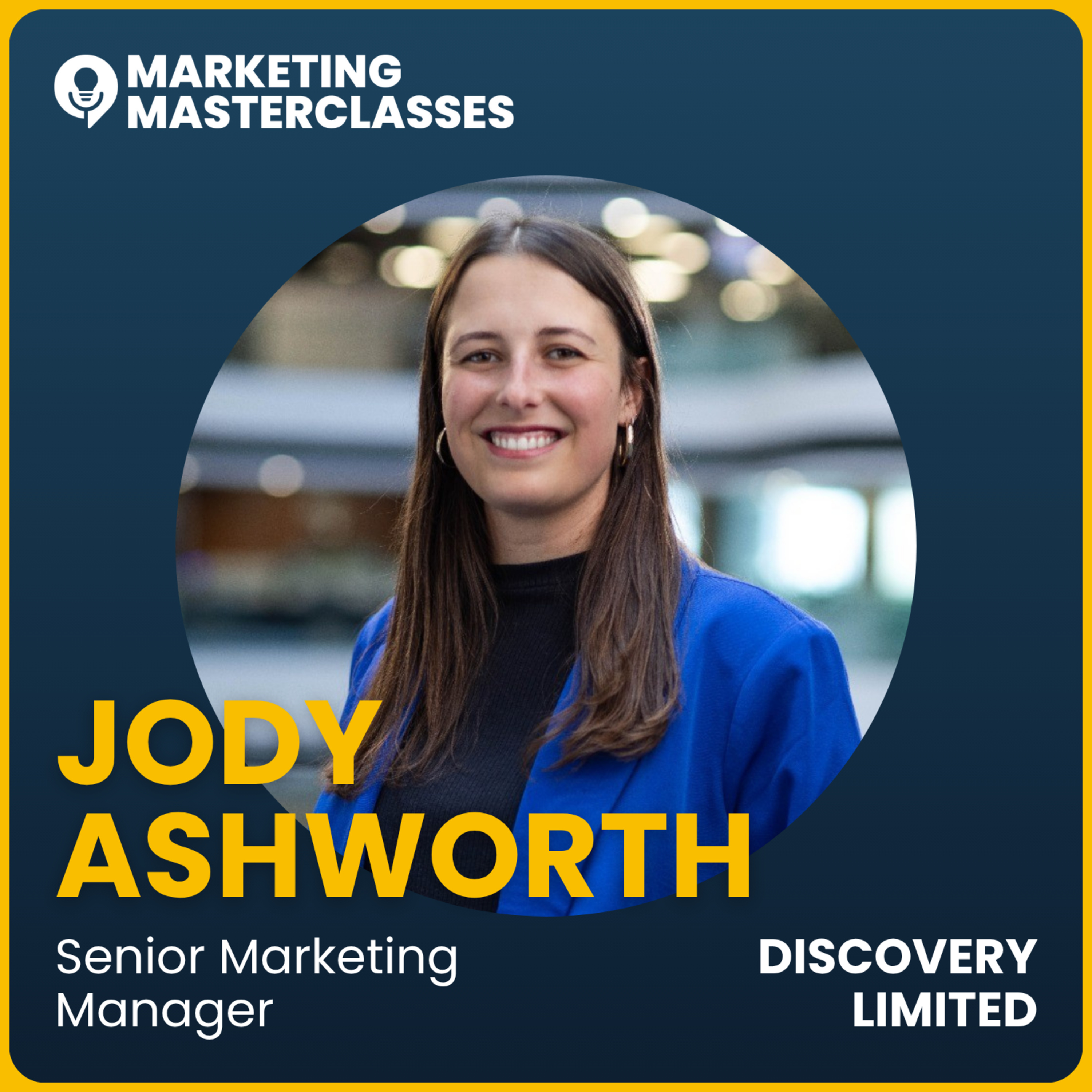
102. How AI and Behavioural Science are Changing the Future of Banking with Discovery's Jody Ashworth
40m 58s
Jody Ashworth, Senior Marketing Manager at Discovery Bank, shares her career journey from university internships to her current role, emphasizing the value of hands-on experience. She discusses Discovery's purpose-driven culture, where innovation and leadership from the top foster a collaborative environment. Ashworth highlights key hiring traits like attitude and curiosity, and explains how using the Enneagram personality framework (she is a Type 9 Peacemaker) has improved team communication and self-awareness. She advocates for leadership that combines bravery and coaching, creating a "thinking environment" to empower teams. In marketing, she stresses customer-centricity, leveraging data—such as spending trend reports—to inform campaigns and address consumer behaviors. Examples include projects like the vaccination site journey design and the Discovery Bank mascot, illustrating how creativity and behavioral insights drive impact.
Welcome to Marketing Masterclasses, the podcast where we sit down with top marketers and unpack how they got to where they are, one pivot, one lesson, one breakthrough at a time. Today we're honored to welcome Jody Ashworth, Senior Marketing Manager at Discovery Bank, the world's first behavioral bank and one of South Africa's most innovative financial brands. Since joining Discovery, Jody has been part of the team driving growth and evolution at Discovery Bank, redefining House of Africans think about financial well-being. Her impact has not gone unnoticed. She was recently recognised as the rising star of the year at the South African Marketing Achievement Awards. Whether you're forging your own career path or finding new ways to level up, lean in, this conversation will give you ideas, encouragement and maybe even a fresh lens on your next move. Let's get into it. Jody, welcome. Thank you. Good to be here. So happy to have you here. I think the best way to start is just by you telling us a little bit more about your career journey. How did you end up where you are? I studied a business degree and I loved it. While I was there, I did as many extracurricular things as I could. I did lots of internships and our jobs and I think that was really great in just helping me understand the world a little bit more. I could understand what was out there, what I liked and mainly jobs that I didn't like because that's also always good to know as well. Then I ended up doing an internship at Discovery. I was really lucky to be placed on the internship and I then started out in the sponsorships and experiential marketing team. I worked in that team as an intern for a little bit and I then had a permanent job. I had permanent in that team and I then moved to the Vitality Marketing team and to the Discovery Bank Marketing team where I worked on the acquisition portfolio and in the rewards portfolio. That's where I am today. Amazing. It's been such an interesting journey so far. How did you end up at Discovery and what was it that attracted you to that initial role? When I was at university, I remember when the kind of rips from Discovery came to speak to us. They had a little bit of an overview about Discovery being a behavioural business and how they use a lot of data to understand their clients and to nudge people towards doing the right behaviours. I've always been interested in understanding behaviour. At one point, someone actually advised that I be a psychiatrist which never worked out because I can't handle blood or studying medicine at all. That was just interesting to hear and I didn't really know a whole lot about Discovery but then I did a two week grad programme while I was still studying and I learnt a lot more about the company. It really was just amazing because there are so many different brands that are part of the Discovery group. So it's been an amazing journey since then. If you are looking to build a team for yourself, what kind of characteristics are you looking for somebody when you're hiring? Definitely attitude is a huge one. I think being willing to get your hands dirty on anything is really important and you can see that when you interview people. I think all of my teammates are really, really helpful and we all just want to get the job done about what that means. And heads of my department that I've worked with before have been incredible at just carrying boxes on the way to an event or doing whatever they need to do to get it done. So that's really amazing. I think being able to ask questions, having interests and lots of different things is really good. If you weren't at Discovery in marketing, what do you think you would be doing right now? And then a follow-up question from that is just speaking about behaviour. I believe that you are a big fan of the NEOGRAM. I'm reaching a little bit on the NEOGRAM, what NEOGRAM type. You on and how that has helped you and your team at Discovery. So what I'd be doing if I wasn't a market at Discovery, I really do love marketing. So there's so many amazing brands around the world. I have to shout out Tony's chocolate only that I'm a chocolate hot like so. They're amazing, doing amazing, impactful things. But when I was little, I wanted to be a farmer and interestingly enough, it sounds ridiculous to say but I think it's because you got and produced things. So you go out and you create, you know, go and work with the cows and produce milk or at the end of the season come out with a whole bunch of crops. And there's something, it sounds silly, but there's something to that. And in marketing, you go out and produce an advert. Or you, yeah, there's so many things you go out and convince clients to do a particular thing. That's good for them from your communication. So it's really what attractive to me and in a silly way. But on the NEOGRAM, I have had a really amazing journey with it. And my team did a whole personality typing session last year. So basically the NEOGRAM is, it's exactly that. It's a personality type scoring system where you get rated from an on a number from one to nine and each number represents a different type of personality. And the idea isn't that you're boxed in and that that number is who you are and who you always will be. But it's just that it defines kind of your main fears, your main ambitions and things like that. So my team did this and I was quite surprised at the beginning because I didn't really understand what it meant. So I basically got scored a number nine, which is adaptive peacemaker, adaptive peacemaker. And and yeah, it's just been a really interesting journey to understand what that means. A lot of it is that it means that one of your core fears for a number nine is that you really, really don't like conflict. And I could have told you that from a mile away. But it is something that kind of just sticks out in every day of your life. If you're at work or at home or wherever you are, you do have other fears and other aspirations and everything, but that's kind of the main thing that drives you is to try and for me, it's to try and make peace. And then has a different, a different driving behavior that that's what it's really about. And what was special with my team is that we all had a really open conversation about our numbers and what it means to us and how it plays out in work. So I could understand with people where might have had a little bit tension with them. I can understand why they would actually be behaving in a certain way and they can understand me a little bit more. So now where someone might think, you know what, I'm not being forthcoming and I'm not coming to speak to them about a situation. Now they have a bit more insight and they understand that I really don't like conflict. And I'm maybe avoiding them just because it's difficult for me to deal with. I think I've come a long way and I'm now a lot more assertive than I was at the beginning of this journey. But it's really an amazing process to understand, especially go through with a team of people. So this is a good segue into the next question that I have. Culture feels vital to a company's success. How do you approach culture? What has worked and what really what hasn't worked? I think biggest learning that I've had is that leaders in the company are what really drives culture. And all the employees on the other in the company are what makes the culture the way that it is. But the way that leaders behave is what's so important for it. But discovery, I think it's very well known that it's a purpose led organization. It's all about shared value and how everything that we do as a company comes back to our core purpose, which is to make people healthier and enhance and protect their lives. Which is very important and it really is something we discuss and talk about every single day. And I think I mean we see with a lot of the work that we do. And it really motivates us when people can get behind it and really know that they believe in what they're doing. And it makes them get up every day and come to work with a smile, which is really great. Innovation is a really big one in my workplace. We are really encouraged and motivated to be as innovative as possible. And I've really seen that that's a freeing environment. It really pushes us to be creative. And we're given the freedom to come up with ideas, not be afraid to come forward and kind of air them in a big group forum, which is really great. We have different innovation sessions where we just throw out ideas. Most of them you laugh at. But one or two will be really great, which is amazing. An example of that was the discovery bank buddy, which is it's not very well known yet, but it's discovery banks mascot. And the insight that happened there was we realized that people were struggling to relate to discovery bank because it's a very serious financial services organization. And a lot of other brands in the world have had amazing success with mascots. And just by having a character that's really personable, you can relate to, you can see the character doing different things that just makes a little bit more relatable, which is really great. And I came forward with this and suggested it. And I mean, at this point we have a for me to statue in our office, which is really great. And just goes to show that, you know, we are the company really encourages people coming up with ideas and makes them happen and believes in them, which is great. It's so amazing to hear more about discoveries culture because they're clearly doing such amazing work in South Africa and full South Africa's people. And it's so great to hear that that is also reflected in what they're creating for the employees. I think the fact that you have been there for as many years as you have. And then it really was one of your first jobs straight out of university speaks to that. And you said so many interesting things now that one thing I want to go back and touch more on is leadership. You spoke about how leadership informs culture and how important it is that that is from the top down. So what is your view?
great leadership. What does that look like? And, yeah, have you had any great leaders during your your kind of time so far that you'd want to reflect on? I have had some incredible managers that I've worked with which has been amazing. I think you learn something from every single person that you work with and in my day-to-day job I think of so many different people and managers that I've worked with all the time which is amazing. So all of them they're all part of it. And but I have to mention my parents. They are incredible leaders in my life who I've learned so much from. They are actually both former captains of basketball springback teams which is amazing. I'm super proud of both of them and I clearly haven't got the jeans. I'm not a springback but they are amazing and they've taught me so much about teamwork and you know what it really means to create something with a team of people and diligence and all sorts of things. So they're amazing. My dad's also a businessman and he's the biggest optimist I know so he's amazing and my mom is a teacher and she's coached many sports teams and she's really amazing at bringing people together and seeing a common goal and getting everyone involved. So they are incredible and I've known so much from them. Just other things on leadership that I think are really important. It's important to be brave and to be curious as a leader. So being brave can mean being brave enough to have a new idea and take it to the market or fight for it in a boardroom. But it can also mean being brave enough to back your team, back your team members, back them for promotions and just stand up for them because if you're a brave it'll mean that other people are brave enough as well. And being curious is important as well. I think some of the people that I respect the most are not afraid to ask a question in a huge room of people. Even if it's a silly thing like what does that acronym mean? Because if you don't ask the question when people are talking, when people are having a conversation and it actually means that you can't follow because you don't know what they're talking about and then you're holding yourself back because you can't add to that conversation. So always better to be curious and as a marketer we definitely need to be curious about our target audience. We need to understand them. We need to know that we don't understand them fully. It can be a little bit arrogant to just think, oh I understand how this works. Let's just keep moving and just do this campaign like this, but you should actually be brave enough to be curious to ask questions. You've recently graduated with distinction from a postgraduate diploma in management practice. Could you tell us a bit more about this experience and how would shape your views on managing a team since then? So that's right. I did study a postgraduate diploma at Haley Business School, which is an incredible place to do a postgrad. They are really all about continuous learning. They have amazing lecturers and they bring in all sorts of different people to have different conversations and you really driven to really interact with your peers, the other students with you, which is so amazing. So I was grateful for just the way that they set up the learning. It was really amazing. I was in a class with everyone else in the class also had a full-time job at Discovery as well, which was really interesting. So even though we were all from Discovery, we all worked in completely different parts of the business. So I was in marketing. They were people from finance and they were lawyers. They were all sorts of people. So it brought us together and we had so many interesting different conversations, which was really interesting. Something that has changed the way that I am as a leader, which I learned from this course, is how to be a coach as a leader and it comes back to the thinking environment, which is a principle that I think was created by Nancy Klein. The basic idea is that in order to help somebody else or someone in your team or someone you're working with, think to their best ability, you need to create an environment in which they feel most comfortable to think with their best ability. Which is quite transformative because often if you have a conversation with somebody, it's easy to interrupt them or to give them if they ask for advice, it's easy for you to just tell them, I think you should do it like this or why aren't you doing it like this. But I've realised that it can actually be a disservice to do that. It's better to help people think through their problem, it can be good to help people think through their problems by themselves. And to do that, there's a few different principles here that you follow. The one is attention. So by giving someone your full attention, putting your phone away, looking at them in the eyes is really, really helpful being encouraging and believing that this one principle is equality and it's believing that they are as equal as you are to come up with a good idea. If you interrupt them and tell them what you think, that doesn't actually help them. And so it's been amazing to use this in my day-to-day life as a manager and just see whether it's with the people I'm managing or not, just with other people to enable them to think just by the way that I'm giving them attention, which doesn't seem like it's helping, but it actually has a really big impact. Aside from managing a team and the people side of your job, what else do you really love about your current job? I feel lucky enough to be able to work on what feel like really big projects. And what I love most about them is that they often combine creativity with impact, which is amazing. And so I feel that lots of the projects I work on can have an impact on lots, if not millions of people, which is really amazing. And I mean, it's always called to see results in real time. So something I love about marketing is getting to see results and very quickly and you can actually see where the watch you're doing is working, which is amazing. But yeah, it's really great. I've been exposed to some of the South Africa's biggest brands, got to work with me to Google, Apple, all sorts of different companies, which is really Chikers, Woolies, I mean, it's all our favorite companies that are really, really awesome. So that's been special. But I'll give you an example. I mentioned the vaccination sites. My team was responsible for looking after the journey that a client takes through the vaccination site. And so we designed a whole journey that a client would go on and go through the site. And we worked with a behavioral linguistics specialist company, which was really interesting. So every single site, that every single word that was at the site was carefully thought out to encourage people to feel safe and relaxed, because that was a really big issue we were having is that people didn't want to get the COVID-19 vaccination. So it was really important to take them through the process carefully. And so and it had really, really great results. We saw loads of vaccinations. So that was great. You know, you often hear people say that they're not really sure if marketing works. And we've spoken a lot about marketing today, obviously. I guess I would love to know from you, what do you think works and what isn't working? You know, the world today is very different than it was even five, 10 years ago. So what do you think of some of those challenges and how do we break through? So for me, the biggest thing is customer centricity, which is really amazing. And I think discovery does it excellently. And we have access to a lot of data, which is great. And we use it for good to understand our customers and to make sure that our products and our benefits are centered around them. And something that I worked on previously was the spend trend report, which was a really great, it's a collaboration between Discovery Bank and Visa. And it's a report on transactional spending data in South Africa from Discovery Bank clients and clients from lots of other banks. And to understand changes in behavior over the past year and how South Africans are choosing to spend their money differently. And it came out with some really interesting insights. And this is great because it helps inform us about our customers and what they love doing. So some of the interesting ones and where that's the most popular time for South Africans to go grocery shopping is that 11/8 am on a Sunday. And I'm often there at that time and the cues are very long. And the most popular day of the week for South Africans to fill up on fuel and their cars is on a Friday. So we do have a campaign called Fuel Friday's, which works nicely. And another one is that most people buy unhealthy groceries on a Friday or a Saturday. So those are just really interesting insights that have come from it. And it's great to inform lots of our campaigns. And just something else to mention as well is Discovery's recent research on sleep. They've recently had a sleep summit, which has been amazing. I feel very lucky to be involved in a company that's a thought leader in a lot of ways. And so Discovery has traditionally done, had a lot of research and rewards programs that focus on nutrition and exercise. But we are now bringing sleep into the ecosystem as well because there's research that shows that the quality of your sleep and the regularity of your sleep and all sorts of different things about sleep really do impact your longevity in life and your long-term health. So it's really interesting that Discovery's been able to be so a customer's entry can realize that this is something that is really important going forward for people's health. And there's now a new benefit where you can get an aura ring with Discovery, which is a new device that can measure your sleep. So it's awesome to see when companies do really follow what's important for customers. I'm obsessed with that. I'm obsessed with tracking my sleep. Last night, for the first time ever, I had a highly restorative sleep, which was excellent. And I got 100% body
battery off the back of it. That is super exciting and I can't wait for that one to drop. Do you do touch on this, but Discovery Bank talks about being the world's first behavioral bank? You did touch on what that actually means when it's putting practice. But how is behavioral science shaped the way you think about money and customers and product design? The way that I think about money is very interesting. I think for me being able to improve something is all about understanding it first. That's a lot of how Discovery is built. Just getting access to knowing how you're spending your money is a huge, hugely important thing. On Discovery Bank's app, there is a whole budgeting tool, the Vitality Money Financial Analyzer. That's really great because you can actually understand where your money is going. Getting access to things like that that actually inform you is the first step in understanding anything. I know Discovery Bank's Vitality Money programme has been amazingly successful in actually nudging people's behaviour. There's a course through worth. It's a financial education course, which has had huge success in shifting people's understanding of how to, and responsibly, and have good financial behaviours. It was last year or this year, can't quite remember. But Queen Maximer of the Netherlands, who is the United Nations Secretary-General Special Advocate for Financial Health, actually came out to South Africa and visited Discovery Bank because she was really impressed by Discovery Bank's Vitality Money programme. She interviewed a bunch of Discovery Bank clients to understand how their lives have changed after they've been involved in this programme. That's really been amazing, just to see how things like that have really changed people's lives. It's really taken a seat on the world's stage, which is amazing. Yeah, it was amazing to see. I mean, I'm definitely one of those. I've completely brought into the Discovery model. I'm in Bank, I'm in Health, I'm on Diamond States, I play the game for it every week. It's also completely changed the way I think about money and healthy living, so goodos to you and the team. I have to jump in and say me too, you know this by now. I am with every single Discovery product. The Diamond Staters, I can't compete with though, I'm not quite there. One of the things that's so awesome about Discovery and they are many, but the fact that it's proudly South African, knowing that you've spent time overseas, you've studied and worked overseas in the past. What do you think it is about South Africa that has enabled us to create something so world first? I'm very privileged to have had those overseas experiences and I did a semester abroad at the University of Amsterdam, as Specs mentioned, and I worked during a ski season in the States, which was really special. I think those experiences were amazing because I met so many diverse people. I got lots of different perspectives on things that was really, really special. They were also very, very tough times. It is difficult being in a place where nobody knows where you're from, nobody can relate to you. It's tough. So many wonderful things about South Africa, but I think first and foremost, being in a place where you relate to people, you feel a sense of belonging is really, really helpful. I also think that South Africans are incredible. We have an entrepreneurial spirit, which is all about how do we make a plan, how do we get things done, and there's so much opportunity here. I know a lot of leaders often say, "There's still so much to be done in South Africa," and I think it's really true. There's a lot of opportunity here. There's so many ways that we can innovate, so many amazing things to do. I really do love being in South Africa and it's a beautiful place. It feels like discovery really harness that hustle mentality and that entrepreneurial spirit. Absolutely. It feels like every day when I'm at my office, it feels like we're at a start-up, which might sound silly, but discovery bank really does feel like a start-up. We are really doing innovative things every day. I will say that I think it is amazing compared to a lot of some of the overseas companies that I've banked with before. They are incredible ones, but I think we are really being part of what's a good banking in the world, which is great. Some ones told me that challenges are just opportunities in disguise. As a South African and a South African bank, what do you think will be the biggest challenges that banks face in the coming decade? I think that one of the biggest challenges that a lot of companies face is the huge variety of choice that they're giving customers. There's so many companies in the world. There's so many competitors all with a slightly different offering. It's really about how they position themselves here of anyone else. As customers, we have so much to choose from. It's how do we really stand out? That's a big one. I think also in this new age of technology, being able to cater to new generations, generation Z, generation alpha is really important. There's a lot of research that's going into all of that. Discovery has recently launched Discovery AI, which is available via WhatsApp. Pretty amazing tool. I'm not going to lie. Having moved from one of the other big banks in South Africa about a year ago to Discovery Bank, the app was one of the big draw cards. The new addition of Discovery AI and the fact that I can literally send a voice note and get back what I want is amazing. I'm curious, your personal, all professional opinion, what do you think about AI? Should we be scared? Should we be harnessing it? Should we run away? That's really interesting. Discovery AI is incredible. The way that we think about it is that it's democratizing private banking because now you don't need to have a big fan seat account, account with lots of fees and pay a banker a lot of money every month, but you can get these personalized insights right for you. Right for you, just on WhatsApp, which is amazing. I love about Discovery AI. Like you said, Bix is you can send a voice note, which I'm really excited about from an accessability perspective because it means that anyone, even if you can't type or you have struggle with eyesight and it's difficult for you to type out a message, you can actually send a voice note, which is amazing. Discovery AI can understand, I don't know exactly how many sort of code me, but it's about more than 40 languages, which is really amazing. So it's going to be doing amazing things in the future. Just generally on AI, so I really love it. I'm using it on a day-to-day perspective in my day-to-day work. I'm finding that it is definitely cutting down the amount of time that I spend on things, which is fantastic. And I think there's so much potential for us to use, that I mean, we're using it to create content, draft scripts, even create ads some of the time, which is really amazing. And I think what's important for us as marketers is to keep up with all the latest tools and really try them out, which is awesome. I heard an analogy the other day, and it's not my own analogy, so I definitely can't take credit for it. But it's that using AI is similar to using a calculator when you start out at school. In the way that when you're a kid, you need to learn to do arithmetic and add up numbers in your head just so that you understand how it basically works and get a basic understanding. But when you're older, you can use a calculator because you can understand it and you know generally how it works. And I really do think that that's true of AI. It's good to have a basic understanding of how things work so that you can be able to discern what's good and what's bad. Let's say you're writing a news article or something. And if you've written it yourself, you're able to say, well, is this good? Is this bad? Is it doing what I wanted to do? But if you never ever develop that skill and then you just ask AI to do it, then you're just going to learn what AI shows you and you're not going to be able to tell the difference of good, verse bad. And so that's definitely something that I'm thinking about in my job. Yes, definitely better to use it as a sounding board. And as a tool, just like a calculator. Yes. If we fast forward five years, what do you hope people will say about discovery, banks impact and what advice will you give to young professionals wanting to make their mark in the financial or marketing world? I definitely think that it would be amazing. And I hope that people already saying this about discovery bank, but that we're having a huge impact on people's financial health and making them a bank better and prepare more for their futures and understand their banking better because that is what I think it is doing. And so I hope that continues. And so on some advice that I would give some young professionals, it's definitely about backing yourself and believing in your gut. And I know Lauren, we've had a similar discussion about this before on the power of your gut, but it's really important to believe in your gut instinct and hone it. So what I mean by that is when I mean as marketers, we're looking at things all the time and we need to judge, are they good? Are they bad? Whether it's a design, whether it's a photo, whether it's a piece of content. And over time you develop, it feels ridiculous, it feels unnatural because you can look at something and just say, this one's great, this one's not. But it's important that you develop that and you keep training yourself with which things are good, why isn't it good? Be curious, ask those questions, unpack it and then believe in yourself. That's one of the biggest
since I've learned is just believe in yourself, believe in your opinion, have that opinion, say it out loud, if everyone else disagrees with you, understand why, and because that's the only way that you're gonna get better and make a bigger impact in the world because people are being gonna trust your got to, which is really important. - It feels like you know this from a learning experience. So is there anybody that's helped you train your gut? - One of my previous managers would, I would come to her and show her different options of, let's say, a design that we're looking at. And she would always just believe in me. She would say, what's your favorite? Why? Okay, use that one. And that was really amazing. Because she, firstly, she showed me that I should believe in my own gut. Secondly, she sometimes would say, well, I don't agree, but still let's use your one because if you're wrong, or if it doesn't work out, you need to learn that and that was really great. And, and yeah, you can, I mean, I couldn't believe this five years ago because I would, when I started out looking at designs, I'd just say, well, they all look fine. How am I supposed to know? They all look fine. But the more you look at them, the more you understand. You know, there isn't a right or wrong answer, but you form an opinion. And I think it's because of, it's like small things that you've picked up in your environment. You sometimes can't even explain it. That's why I'm struggling to explain it. But it's just what comes to mind because of a few things that you've picked up in your environment. - Totally, and it's also, it's an accumulation of what you experience. - For sure. - So how do you balance trusting your gut and trusting the data? - For me, it's important to think about what your gut instinct is when you're faced with a problem. Remember what that answer is, and then go and look at the data, unpack it. And if it doesn't come out with the same answer as what you initially thought, then understand why. Because most often, you'll look at a problem, think, you know, instinctually, I think that this is the answer, and the data will back it up. Then nine times out of 10, you've got it exactly right. And, but I think it's always a good idea just to think, since check, what do I think the answer is first, and then go and sort of check with the data after that. - Let's talk a little about you. What is one financial habit that you swear by? - The biggest thing is, as soon as you get paid, put your savings away, on the day that you get paid, because if you get your money, and then whether it's from your job or from your parents or wherever you're getting your income from, and then you go through the month, and you pay for all your expenses and wait to make your savings. At the end of the month, you're probably not gonna have any savings left. - What do you do to switch off and recharge? - I love going for walks and listening to podcasts while I go for walks. And so I am a big fan of podcasts. I mean, I think like everyone else in the world, I love Diode of a CEO by Steven Bartlett. It is amazing. But I really love that. I really love to paint as well. I don't make enough time for it, but that is also a really important way to recharge. - Is there any book or podcast that has changed the way you think about leadership? - This isn't about leadership. But one of my favorite books is Atomic Habits by James Clear, which is amazing. I mean, it's all about habit formation. Very, very simple thing that I do, which has changed my life, is the way that I set an alarm. The premise of this is that in order to change a habit, or to form a habit, you need to change the stimulus that you're getting with that habit. And because basically if every time you see a red traffic light, you pick up your phone while you're driving, that's really bad, 'cause then you're always gonna be on your phone and you can't avoid red traffic lights. And so what I did with my habit was that I realized that I'd often get into bed at night, pick up my phone and all of a sudden half an hour later, I was still on Instagram, scrolling through all the wonderful ads in the world. But and I realized that the stimulus that was setting me off was that as I'd get into bed, I'd set my alarm on my phone and put it next to my bed. And then my phone was right there, so I could easily pick it up whenever I wanted to look at it. So how I changed this was that I charged my phone on the other side of my room now and I actually have an old-fashioned alarm clock that is from the 1960s with batteries next to my bed. So that if I feel like I just need to look at my phone 'cause it's next to my bed, it's actually not there. So I need to get out of bed and walk across my room to go find it, which is a much bigger thing to do than to just roll over and grab your phone. - And this is gonna improve your sleep. - Exactly, it's all about good sleep and living longer. - If you could head your bets against one marketing channel, what would it be? - I have to say it took dark. And because I know that there is a huge number of, the younger generation that are spending lots of time on there. And it's video content is really an incredible way to reach audiences because if you compare it to something like a blog article, where you're just communicating people with written word. In a video, you're communicating them with them visually, with the imagery or footage that they're seeing verbally with what they're hearing and then also with written titles that are on the screen. So it's a much richer way to communicate. And yeah, TikTok is really amazing at that. - And what are just some content creators? - I think it's content creators are, is a huge rise. We've seen that absolutely. The way that the world is changing is really amazing because we can communicate with people in ways that are relatable to them. Instead of just what our messaging as a brand is, creators can tell their stories, they can tell testimonials, which is really great in video content and it comes across really well. And yeah, I think there's a lot of growth that's gonna happen. And what's been exciting with my team is that we've also been able to play around with employee-generated content, which is, I can tell you three years ago, it's not something that we ever thought was gonna be possible. Or be something that our brand would play into. But we've had huge success and also just a lot of fun. With having our own people, our own staff members be in our videos. I mean, I think for quite a serious financial services brand, we do need to be serious 'cause we're looking after people's money and that's always the priority. But we wanna come across seriously. And the traditional view is that we never are too personal. But I've been so inspired to see a lot of really great encouragement from within the business that I work in when we've created this employee content. And it's really done well, it's been fun. And it's really not so serious, which is great. - So have you done some of this content? - You can see me online if you go to our channels. - I may have spied you there. - We're gonna drop a link in the comments for those of you who wanna come and check the ads. - So outside of the employee content that Discovery Bank has been creating, what's your general approach to content creation as a brand and as a business? - So we do have quite a strong corporate identity, which is really important for any big brand. There needs to be rules in place 'cause otherwise you'd have hundreds of people creating content that all looks completely different. But I think my team has been lucky enough to be able to push the envelope a little bit and try things out. I think especially on newer channels that are coming out like TikTok, what really does well for content creation is not having a very formulaic approach. It needs to be different. It needs to have different intros, it needs to have different outros, different music, all sorts of things. And what's great about it is that you can test it. You can get general learnings, which is really important for future. And also to realize that your learnings at one time will change. And what might be working today might not be working tomorrow. So it's great to be really adaptive with that. - Joe, do you strike me as such an academic if you choose to go back to study? What would you choose to invest your time in? - I would love to study again. I really do love studying and I think it's so important throughout your life to always study. When I was younger, I wasn't sure what I wanted to do. And I was told that some people to be a psychiatrist or a doctor, some people to be an actually or a finance person. And for some reason, none of these things stood out to me. And my dad, who's in finance and has been very successful said, I think you're gonna hate it. You should not do finance at all. And you should do marketing. And I'm so glad that I did because it's what I really love is, it's all just brought together in one place from the numbers and kind of financial side of things. Combined with the artistic side, which is just really amazing. I really do love economics, which is very cool and it does play into a lot of the behavioral things at Discovery, which is amazing. Game theory is a great subject that I'd love to kind of learn more on. And yeah, I think also possibly AI, it's a huge thing to understand. And it's not going away the quicker we can understand at the better, so it'd be great to learn more about it. So those listening that don't know what game theory is, what is that? Game theory is understanding how people make decisions in strategic interaction. And it focuses on understanding rational decision making and unpacking that to understand how people would react if they were rational. So that's just one of the things that would be cool to unpack a little bit more and understand deeper, but I'm sure there's lots more.
So if you had one message that you could tell millions of people across South Africa, what would it be? Probably just to believe in yourself. And you know, I've had a big journey and confidence over my whole life. And I think it's something that's just so underrated and it's so important to just believe in yourself. Anything is possible. And you might as well just put yourself out there and try things because you never know I'll come with it. I love it out. Believe in yourself and pay yourself first. Yes, pay yourself first. Absolutely. Love that. Listening to you today, I'm just so inspired by your passion. You're so passionate about your job, you're passionate about your company, you're passionate about learning and that's it's been really incredible to to speak with you. Yeah, from us, EVD, thank you so much. Thank you for joining us today. Thank you.
Podcast Summary
Key Points:
Jody Ashworth's career began with a business degree and internships, leading to a role at Discovery Bank where she progressed through sponsorships, experiential marketing, and Vitality Marketing teams.
She emphasizes the importance of attitude, willingness to collaborate, and curiosity when hiring, and highlights how personality assessments like the Enneagram (specifically Type 9, the Peacemaker) improve team dynamics and self-awareness.
Ashworth believes company culture is driven by purpose-led leadership, innovation, and psychological safety, enabling creative projects like the Discovery Bank mascot.
Effective leadership involves bravery, curiosity, and coaching—creating a "thinking environment" to help team members solve problems independently.
Customer-centricity and data-driven insights, such as spending trend reports and sleep research, are crucial for impactful marketing that addresses real consumer behaviors and needs.
Summary:
Jody Ashworth, Senior Marketing Manager at Discovery Bank, shares her career journey from university internships to her current role, emphasizing the value of hands-on experience. She discusses Discovery's purpose-driven culture, where innovation and leadership from the top foster a collaborative environment. Ashworth highlights key hiring traits like attitude and curiosity, and explains how using the Enneagram personality framework (she is a Type 9 Peacemaker) has improved team communication and self-awareness.
She advocates for leadership that combines bravery and coaching, creating a "thinking environment" to empower teams. In marketing, she stresses customer-centricity, leveraging data—such as spending trend reports—to inform campaigns and address consumer behaviors. Examples include projects like the vaccination site journey design and the Discovery Bank mascot, illustrating how creativity and behavioral insights drive impact.
FAQs
Discovery Bank is the world's first behavioral bank, using data to understand clients and nudge positive behaviors. It's part of Discovery, a purpose-led organization focused on enhancing financial well-being and health.
Jody began with an internship at Discovery after university, initially in the sponsorships and experiential marketing team. She later moved to the Vitality Marketing team and then to Discovery Bank Marketing.
She prioritizes attitude, willingness to get hands dirty, helpfulness, and the ability to ask questions. A collaborative mindset and diverse interests are also important.
Her team did a personality typing session with the Enneagram to understand each other's fears, ambitions, and behaviors. This helps reduce tension and improve communication by fostering mutual understanding.
She believes leaders drive culture, and a purpose-led environment encourages innovation. Great leaders are brave, curious, and supportive, backing their teams and fostering a thinking environment.
She learned coaching techniques, like creating a 'thinking environment' to help team members solve problems independently. This involves giving full attention, encouragement, and treating others as equals.
Chat with AI
Loading...
Pro features
Go deeper with this episode
Unlock creator-grade tools that turn any transcript into show notes and subtitle files.
 PodcastTranscript AI