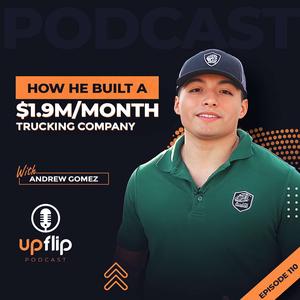
110. How a 17-Year-Old Built a $1.9 Million/Year Trucking Business!
25m 54s
Andrew Gomez founded AJG Transport as a teenager in 2016, leveraging his family's trucking background and identifying a specific opportunity with Amazon contracts, particularly overnight routes others avoided. Starting with two financed trucks, he faced significant startup costs and early financial hardships, including major repair bills, but persevered by reinvesting profits. His company now operates a large fleet with monthly revenues around $1.9 million, serving Fortune 500 clients. Gomez attributes growth to focusing on consistent, dependable service, strategic cost management, and proactive relationship-building, such as in-person meetings to secure major contracts. He advises aspiring trucking entrepreneurs to first gain operational experience, secure reliable contracts before investing in trucks, and carefully assess market conditions and equipment purchases to mitigate risks in the capital-intensive, cyclical transportation industry.
Andrew Gomez was still a teenager when he bought his first two trucks to start AJG Transport. Seven years later, they've become the go-to delivery provider for fortune 500 companies, bringing in a seven-figure monthly revenue from dozens of trucks in their fleet. This is Alex Freeman and you're listening to the Uplift podcast where we uncover how great businesses are built. Keep listening to hear how Andrew landed top-tier jobs that drove this impressive revenue growth, how we lead the team of people who are older than himself, and how you can follow in his footsteps. Andrew, welcome to the show. Thanks so much for joining us. Alex, great to be here. Great to continue where we left off. Hopefully we get to continue regards to you guys watching the YouTube video and hopefully get to show you some color into what we're doing. Yeah, absolutely. And for those listeners who haven't had a chance yet to head over to youtube.com/upflip, watch the YouTube video that we were able to do with you. Can you give us a bit of your background about yourself and how you started the business? So basically I started out roughly around 17, 18 years old, 2016. I saw that there was a lot of potential in regards to some Amazon contracts. And so I've been around trucking my entire life. And so overall whenever I saw this opportunity, I went after it with all I possibly could and so far it's gotten me where we are today. But there is a lot of strife and a lot of detail and a lot of grit to go over in order to get to where we are. So 17, 18 obviously a very young age to start a business of any kind. What was it about your kind of upbringing that made you want to start your own business? How did you kind of end up there? Overall, my family has always been entrepreneurial. I mean, it started with my dad. He was always out there before I was awake at school. And then also when it came to him coming back in, he was always there really late. And he would have maybe four or five hours and have to be one of the first out there in order to get his loads as he had his own truck. And so in regards to trucking, that's always been in our blood. But at the same time after that wanting to grow comes from just our humble beginnings. What's one pain that you enjoy having? What's the good problem that you encounter in your business? A good problem that I encounter is having not enough trucks for the amount of work that I have. So at this point today, I need about 145 percent of the capacity that I currently have. And that's a blessing. And also is something that makes me want to overlever it. But at the same time, we still have our safety parameters. And that's really a good thing to have. But only based off of our reputation and based off of our service. I think that a lot of guys want to work with us right now, which is amazing. It's a blessing. But at the same time, we take it with a grain of salt. And we always say, Hey, let's look at it from a long-term perspective. I'm focused on five years from now. Are we going to be enjoying the same environment? Absolutely not. But we want to make sure that we're taking care of you in any environment. And that's one thing I think a lot of guys appreciate. I want to kind of dive into the beginnings there a little bit from a different angle now as well. Talking about those first two trucks. You started off with two trucks. What did that cost? How did you kind of finance those trucks? And what other startup expenses should somebody be planning for if they want to start a transportation business? Oh, man. I mean, that's a level question. So initially, I would say 2016 back then, I was able to look back at some of my numbers. And I was thinking, you know, whenever I bought my first two trucks, I was only trying to get one truck at the time because I saw that my brother had financed through a freight liner of Congress Texas. And I would always talk to Frank. He was a good financier. He was the guy that always worked with him. And I started talking to him. I started picking his brain on how I can, you know, build on this. We would talk every now and then they would see that we were building up some additional units on my brother's side. So then I said, you know, Hey, what do I need to do in order to get, you know, zero down and get two trucks? And that was my goal. And so overall, as I continued to talk to them, we eventually figured out, you know, they had two used units that they wanted to get rid of them and we ended up getting something to where they basically made a killing off me. I looked at it. I recently paid it off just last year. How about that 72 months for seven percent interest, they made a killing in interest. But at the same time, it was what I had to do because I didn't have any prior experience. I didn't have any driving experience back then. That was of course legal anyways. And basically that after I went through that system, my cost ended up being roughly like two grand for the truck payment. And then you had to go through progressive because there were the only company for insurance that would take you as a new company. The Barrett entry was very high. And that was roughly around $1,500 a month. And back then, I looked at the fuel and it's roughly around eight grand a month. I was running about 24, 2500 miles a week per unit. And then, you know, you had your other operational costs, which were six or seven percent of any of your revenue or it could be more if you had any breakdowns. So the bottom line I looked at everything, the total cost that you're looking at was like, you know, 13 to $20,000 a month if you had repairs. But your total revenue that I had was, you know, I was running with Amazon and they were running at $3, $4,000 a mile at times, you know? And so basically, you're making on two units roughly around anywhere between 35 to 57,000 to contract varied based off of the amount of volume you had that week. And everything else that I had, all the spread that I had, I put it in an investment account to get the next truck. And that was it. I want to ask you about those Amazon contracts in a minute here, but how is that different today? What would it look like for somebody wanting to get started today from your experience? You had the COVID boom of everything being expensive. Now we're leveling off. You're seeing a lot of, the use truck market is finally coming down a little bit. You're seeing guys who bought a brand new freightliner, God bless their soul in COVID time for $230,000. And now it's worth 175. And so, since we're starting to see that, if you're coming in brand new, I mean, most of the time guys will try and go, they'll say, hey, go to Facebook Marketplace, you know, see some guys will sell them to you via owner finance and that buyer beware. The one thing I always recommend with guys who want to come in and do this without any experience is go get some experience, you know, via operations. But if you're really tempted to do this, then go and get a, you know, a repairman, someone who does mobile road service or a local repair shop to inspect the unit before you get that unit. Because I guarantee you, it's a lot of these guys, they use trucks that they have, they keep if they're running correctly. Trucking companies only sell their problems. That's one thing I learned after a while doing this business. And right now, there are some tricks of the trade, such as buying from bigger fleets, but at the same time, you know, if you're trying to buy it from somebody, you know, another owner operator, etc. Odds are, he's probably had the truck in the shop, etc. So you just have to be wary of that. The cost itself, you know, you're looking at, you know, an average of $3,310 a gallon, especially if you don't have fuel cuts based off of, you know, fuel discounts, you're looking at insurance being still an unregulated business, which will average you roughly around the $10, $12,000 a year per truck. You're not going to see $3 a mile ever again. You know, that same contract that I had is getting ran for $500. You know, so it's a different market. There's different niches, of course, but at the same time, there's a lot of headwinds. But I will say, like I said in the video, and in regards to YouTube video, find the opportunity first, figure out, see how it works, get the contacts, and then get the truck. Because I guarantee you, if you get the truck first, you're kind of scrambling a little bit. It's basically one of the only reasons why I was successful in general was because I saw the potential somewhere, and then I executed on it. Listeners, if you want more of the nuts and bolts advice on these steps to start a trucking business, check out the uplift blog post that we've linked in the description of this episode where you'll learn about getting a CDL industry regulations, and how to land your first jobs along with a bunch of other helpful info. Are you looking to launch an e-commerce store? Want to learn how to do that from those who've been there and done it? On the e-commerce master plan podcast, you'll hear e-commerce and DTC founders sharing their journey from start-up to multi-million dollar success story. Every episode is packed with tactics, strategies, and tips to help you follow in their footsteps. Find it all on the e-commerce master plan podcast. What's been the biggest failure or your lowest point as a business owner so far? I would think my lowest point was whenever I remember it to this day, I was still living with my parents, and overall I just had way too much month at the end of the money. I knew for a fact I had a truck that was down that basically it needed an entire infram, which basically meant at that time I didn't even know what that meant, but all I knew was that that was five figures of money that I needed to repair and replace, and then I had another unit that basically was always giving me problems in regards to the DPF unit. Overall, I would say the DPF system is a very common issue that trucking companies would have to deal with, especially with freight liners, etc., but that's a whole lot of conversation, but back then it was just too much. At that point, there wasn't many times where I had to get away for a second, but I just took a walk and I said there's got to be an answer. We huddled up, I talked to my brother about it as well, and tried to figure stuff out with him as well, and bottom line is I scrounged up money from whatever possible savings I possibly could scroung it from. I sold off a few personal belongings and I made it happen that month, and that was something that I'll take to get to this point. I'll always think about that point in my life where I think it was around 15 units, and I just didn't know what to do next, because I will always say there's always 12 payments you have to worry about. Andrew, let's talk about that Amazon contract that kind of started things out for you. How did you land that contract and what made them such a good fit for kind of your first jobs? Initially, whenever you're trying to find some additional business, usually what will happen is you're picking up freight from the loadboard via a broker and some sort. Basically, what would happen was what I figured out was the potential of our Amazon contracts was that there was always a lane in San Antonio where nobody wanted to take, and it was that one in 3am every single morning, and sometimes by the time you get to the fourth quarter of the year, there was probably four or five of them that you could take at one or two or 3am, but no trucking company is awake. And nobody had access to those loadboards because back then they were still kind of relatively a new feature to the industry. And so for the most part, what we saw was I was the only guy who was awake at that point, and basically I would send out all my units accordingly. I knew that they would have the freight either to San Antonio to use in or San Antonio to dial us and back, and I was, you know, just running power only, which stood for just a trailer. We would use an Amazon trailer for their freight, and we would just drop an hooket, come straight back, be done, and, you know, roughly around nine to 11 hours. And so that consistently happened until we met with Amazon logistics. When did you realize that the company was ready to grow beyond just those Amazon jobs? And I guess kind of more generally, what are some of those signs that a trucking company is ready for more growth, bigger jobs, adding a truck? What are kind of those signs that somebody should be looking at to know that it's time we can grow now? Absolutely. I think that whenever you're figuring out consistency, trucking is a cyclical market, and that's one thing that has always been a problem for trucking companies, whenever I've seen a lot of people that I used to know that used to be trucking company owners fail, because they would leverage on something that was not going to last. And so whenever you're finding an area where you could grow your business, you have to keep in mind the consistency portion of that business. Is it going to last through, you know, the next two years? Is it a six month contract? Is it a small project with the promise of other projects? Those are the type of things you need to think about before growing. And so your risk management perspective is going to be can this sustain me for the next 12 months. And then as you continue on that process, you can't get comfortable. And so in my opinion, your growth phase comes from answering those questions. Is can this sustain me for 12 months? Can I leverage even more in this contract as a customer? And lastly, is there anything set in place to protect me from, you know, any type of unforeseen circumstances such as COVID, such as anything? Andrew, let's talk some numbers here a little bit. You mentioned some earlier numbers. What is the revenue looking like in a typical month today? And like how do profit margins work on that in a transport company? Yeah, I mean, so at this point, you're looking at for all of the units in my fleets roughly around 1.9 million a month and that averages to roughly around 20 to 23 million a year. And overall, whenever you're looking at that, you're talking about all of the supply chains that I've been in control of and that varies. But I will say trucking is a capital intensive environment, you know, you're paying drivers, you're paying trucks, you do have all these payments. And you're of course building equity every single month, including trailers. We have about 150 of them so far. And so your net margin on a lot of that should be roughly around 6.2 to 7%. And that's what we like to stay best we can in order to continue to fast it for growth. I've focused on trying to build at least an 18 to 20% year over year growth. And that's just basically from a safety risk management standpoint as long as I have the business to support that growth. What are you doing to control costs, especially fuel being one of those major expenses that can be highly variable? What are you doing to kind of control costs as much as possible? Man, when I tell you that I am on the phone with my love's travel stop rep trying to hammer him and tell him that I will go to this other guy to get a lower discount every single month, I am doing that. I mean, everything possible because the worst thing you're going to get is a no, but at the same time, it is really a struggle, you know, for fleets these days. The way that I see it, the way I make it as a metaphor is that my ship has a lot of leaks and my team, my administration and my executives alongside me focus on plugging a lot of the leaks, so we're looking at all of the costs that we have and what we can mitigate or what we can put together. And that requires a lot of auditing and also a lot of thinking outside the box. Yeah, I think that's a really, really good point because I think that what gets lost a lot of the times is that so much of business is those relationships is trust, especially like in terms of this relationship between the transport company and the company that has things that need to be transported. They have to trust that the thing will get from A to B in a way that's safe, not damaged, won't do anything, any damage to the reputation on time, all of those things that you can't ultimately know until it's done, but to land the business. You have to have the trust in the relationship with I know who I'm going to call if something goes wrong. Absolutely. And I think developing that reputation starts with showing that you're different. You're outside of the usual span of what a trucking company was, whatever your service industry is. And then your reputation is based off of action only. I mean, whenever they think about Gomez here in San Antonio, people are thinking dependability, they're thinking on time performance, people will love working with me because I make sure that I do people's jobs for them. And because that's my standard, that's my standard for my team now. But that only comes after an insane amount of road building is how I call it. And the road building is the hardest part, getting other employees to buy in and drive those roads is relatively easier. And how did you prepare yourself for that first meeting? Because I mean, so many people are just incredibly intimidated by what you described as having done, get on a plane, go ahead and say, hey, no, I'm here because I want your business. And let's go over to Applebee and have a meal and talk this out. Like, how did you prepare to go do that? One thing that I learned from Jim Rohn is if you want to be something or want to gain something, you have to make it a study. And so, you know, at first I was talking to myself in the shower and that general answer would get me as far as I could. But the bottom line is I started going to business networking meetings. I mean, I'm talking the local business networking people who have maybe 10 or 12 members, but they're trying to practice their personas for business networking. Yes, you're going to get millions and millions of business owners selling you insurance, you know, the selling your credit card processors. Yes, all that stuff. And I understand I took all their cards, you know, politely. And at the same time, I started to express my business persona and started to communicate from a professional standpoint at 18, 19. So this is going to bring us to the section of our show that we call our fan blitz questions. These come from our YouTube community listeners. You can head over to youtube.com/upflip, post questions to future podcast, guests, Andrew. We've got four questions here. We're going to try and get through in about a minute. Are you ready? Let's do it. All right. Biggest purchase you've ever made. My fourplex that I just bought as my first home. What's the biggest purchase you regret? I'm going to regret buying the cyber truck whenever it comes out, but I already if you had to come up with a slogan for the year 2024, what would it be? Embrace the discomfort. That's what it's going to be. Oh, great one. Great one. If you can go back in time and tell your younger self, don't do this thing. What would it be? I would say, again, stay off your phone. I was on my phone way too much whenever I was younger. I love it. That's the fan blitz questions. I think you might have said a record of actually staying in the time second in the time limit there for any of our guests. Well done. Well done. Let's talk about some of those corporate clients. Talk me through the process of landing those first big name Fortune 500 type companies. How did you identify it was going to be the right company to connect with? And then how did you go about securing the contract as a relatively new delivery business? I majored in marketing when I was in college. I knew for a fact that there was something there because I loved figuring out what we could do in regards to getting our company out there, building our brand. And so my first thing that I always tell people who are in business, especially if you're business a business, but business consumers are quiet. If you have it, I don't your dinosaur is getting your Google business listing out there. And that's something that you don't need to go hire somebody for. It's literally just go log into Google business manager and get it and then take the video of your little area that you have your address and then submit it. That's the first thing because getting your name out there is the first piece of the puzzle. Whenever I think about owners, executives, CEOs, what's the first thing that they're going to look at? They're going to look at whether or not you have a website, whether or not you have a footprint because they want to know your legit. And for the most part, what I saw is I also made a rinky dink little website off of Squarespace and one of the executives from a major automotive maker saw it and he gave me a call and then we worked with them on a couple a couple of spot loads. But then I was like, man, we could really capitalize on this. This could be something that could make us something in the future. And so the second piece to that question is when it comes to executives that could be decision makers, any logistics managers, you are going to have a very low success rate if you just call them or send them an email with an offer. And the bottom line is you are going to have a higher success rate if you think outside the box with these guys. I had never been on an airplane or I'd only been on an airplane once in my life. The second time was whenever I went out there to Nashville, Tennessee and I went to these business executives. I had my first suit on my gray suit that I got for buying a tuxedo for high school prom. I got an extra super free and I went over there and I talked to these business executives and they thought I was applying for an internship. But I said, hey, no, I just did a couple of load for you guys and I talked to one of your logistical managers down south and I want your business. I want to be here for the long term. I want to show you guys that I'm serious and their jaws are dropped. We went out there to the local Apple bees and I've talked to them just like, you know, you would anybody else. You know, they found out they were really nice Christian loving people, Christian values and they gave us a shot. And from that point after, I've had a relationship for the past seven years. I also know that you do a lot of things in house that other trucking companies are outsourcing like the repair shop. What are some of the pros and cons of keeping that in house as opposed to outsourcing? There's a lot more pros and cons. I would say the pros in general or you have your mechanics who can also buy into the campaign. You know, they really care about what they're doing and their work. They also work on different fleets. They work on additional outside fleets that we make additional revenue as well. But it allows you more control in regards to what's important and it allows you to get the trucks that you want out. Having gone through that, what advice do you have for other business outers on getting through and past and recovering from those low points? Well, the one thing that I always say was a common thing that business owners will do is we have our anxiety that focuses on the future. And we think that the future ideals that we have in our head is going to end up happening. And so say, for example, if I felt like I wasn't going to make it, I felt like I was going to sell all my trucks. I was already my brain already went to who I'm selling the trucks to which bank is going to come at me first, et cetera. You know, when the insurance is going to cancel, all of these things start to attack you. And so my advice is really to focus on the action now. So that's why I took a walk. I got outside of where I was at my little fortress of solitude and got a different perspective. I prayed, of course, and we figured it out after, you know, we got through all the worrying and the anxieties. I feel like a lot of that is common with business owners in high capital intensive environments because in trucking a lot of these companies, you give them two weeks. They are definitely under because you just can't go a couple weeks without having the truck roll. And so overall, I think that's the biggest thing is focusing on shortening your thoughts in regards to time for the future and focusing on the actions that you can provide now and continuing those actions until you figure out the answer. Hiring is something that is a challenge across a lot of industries right now. What advice do you have for building an excellent team and finding the right talent for the open roles at your company? So a lot of times business owners want to solve problems and then just have this automation thought. You know, and one thing that I thought of was I'm a road builder. So whenever came to that road building, when I talk about previously, is let me partner up with you so that we can do the job. I'm going to show you how I would do it for a consistent amount of time. And then you're going to take it over once I'm comfortable giving it to you. And I think that whenever I have that mindset, I'm able to hire somebody who particularly might not have the industry experience, but they have the drive. And that's what I call it. I mean, if they have the drive, the thought process of I'm pushing my ego aside, I want to be successful in this industry. I want to be successful in your team. That's invaluable. I think that's the number one thing that most business owners should look at. If you could pick the one thing that listeners take away from this interview, what would it be? Number one would definitely be embracing discomfort. That's my motto for the next year, but at the same time, it's something that is ring true from all the way back then to right now, because my problems have only increased in size and my ability to handle said problems has increased as well. So those problems that I have are of course easier to deal with because I have the experience of going through them. And definitely number two would be resilience. And when I say resilience, I think that you're focused on action and action now action immediate. One thing that I've seen so often with guys who want to come in. Hey, let me go buy trucks with you. Let me go do this is that their motivation stops after a couple of days. I want you to make the repetitions. I want you to go and hear the podcasts. Hear all the uplift podcasts. Hear all of the, you know, every single one when you're driving, etc, into work and out of work. And if you don't have success after 50 100 podcasts, I don't know. I don't think that that's as likely as if you didn't listen to them. It's the first step. You're the wisdom of the world available. And that's number two. Number three, I would say make your profession a study and make also what is important to you a study. And it's all there. And most of it's free. And I just can't say that enough. Most of all, chat GBT gives it to you in a silver platter these days. So I don't even know what else to tell you. Andrew, where can listeners connect with you and learn more about what you and AJG transporter up to? Yeah, absolutely. Follow us on AJG transport on Instagram. We're also on Facebook as well. You can follow me as well on Instagram at Andrew underscore J Gomez. And for the most part, you'll see kind of how I'm doing things alongside of my business nowadays on there. And you'll see we're kind of focused on the next steps of our growth. And I have some pretty exciting things to post here upcoming anyway. So I'm always there for connecting in regards to like-minded individuals, giving you guys some wisdom. I'm creating a small little system as well on YouTube where you'll be able to see kind of how I've done success through consistency. And that's one thing that we're going to start growing here as well. Creating a small little channel for like-minded individuals trying to beat the rat race, especially in today's economy. That was my conversation with Andrew Gomez of AJG transport. A couple of different things that I really appreciated about that conversation. One of them being the idea of looking to your roots for your entrepreneurial inspiration. And that not just the drive to grow that Andrew talked about, but finding that opportunity in an industry that he was raised in. So he was raised around trucking and he was able to find an opportunity to build a business within trucking within an industry that he and his family knows giving him a lot of access to mentorship and other opportunities that way. So it's a great spot to be looking is what's the family business. And the other thing he talked about was always be seeking. How can you create a business that is going to last not just one that will make you some money today? What is that thing that you can find that is going to build you something sustainable? And on that topic of sustainability, also the way he talked about risk management that a lot of trucking companies that he's seen have gone out of business because they've leveraged something that isn't going to last that they get a big contract leveraged against that. And then what do they do in that contract isn't sustainable, doesn't renew, etc. So like looking at the things that you have, are they sustainable? Will this sustain me for a year? Is their growth potential here? Great. Once we've answered those questions, now I can leverage against that. Really great conversation, lots of stuff applicable to a lot of industries there. Really, really loved it. Listeners, if you want more advice for how to start a business the right way, check out the Uflip Hub. And if you want more tips on how to start a trucking business, check out episode 28 of this podcast from Mikhail Sont shares how he started a $75,000 a month trucking business. And your go-bass of AJG Transport, thank you so much for joining us. Glad to be here. Thanks for the time.
Podcast Summary
Key Points:
Andrew Gomez started AJG Transport at age 17-18 in 2016, inspired by family entrepreneurial background and spotting an opportunity in Amazon delivery contracts.
Initial growth involved high startup costs, strategic financing of two trucks, and overcoming early financial struggles, leading to a current fleet generating ~$1.9M monthly revenue.
Success is attributed to identifying consistent, niche opportunities (e.g., overnight Amazon routes), rigorous cost control, building a reputation for reliability, and strategic relationship-building with large clients.
Key challenges include managing cyclical market risks, variable expenses like fuel and insurance, and scaling only when business sustainability is secured for the long term.
Advice for new entrants emphasizes gaining experience first, securing contracts before assets, and thorough due diligence when purchasing equipment.
Summary:
Andrew Gomez founded AJG Transport as a teenager in 2016, leveraging his family's trucking background and identifying a specific opportunity with Amazon contracts, particularly overnight routes others avoided. Starting with two financed trucks, he faced significant startup costs and early financial hardships, including major repair bills, but persevered by reinvesting profits. 9 million, serving Fortune 500 clients.
Gomez attributes growth to focusing on consistent, dependable service, strategic cost management, and proactive relationship-building, such as in-person meetings to secure major contracts. He advises aspiring trucking entrepreneurs to first gain operational experience, secure reliable contracts before investing in trucks, and carefully assess market conditions and equipment purchases to mitigate risks in the capital-intensive, cyclical transportation industry.
FAQs
He started AJG Transport at age 17-18 in 2016 by purchasing his first two trucks, motivated by family entrepreneurial influence and spotting an opportunity with Amazon contracts.
Initial costs include truck payments (around $2,000/month), insurance (about $1,500/month), fuel (roughly $8,000/month), and operational expenses, totaling approximately $13,000-$20,000 monthly, with revenue varying based on contracts.
He identified an underserved early morning lane in San Antonio by monitoring load boards when competitors were inactive, allowing him to consistently secure freight using Amazon trailers on a power-only basis.
Growth readiness depends on consistent, sustainable contracts that can last at least 12 months, along with having risk management plans for unforeseen events like market downturns or disruptions.
AJG Transport generates about $1.9 million monthly, with annual revenue around $20-23 million, and net profit margins typically ranging from 6.2% to 7% after accounting for capital-intensive expenses.
He actively negotiates with fuel providers for discounts, audits all expenses regularly, and encourages his team to think creatively to mitigate costs and plug financial 'leaks'.
Chat with AI
Loading...
Pro features
Go deeper with this episode
Unlock creator-grade tools that turn any transcript into show notes and subtitle files.
 PodcastTranscript AI