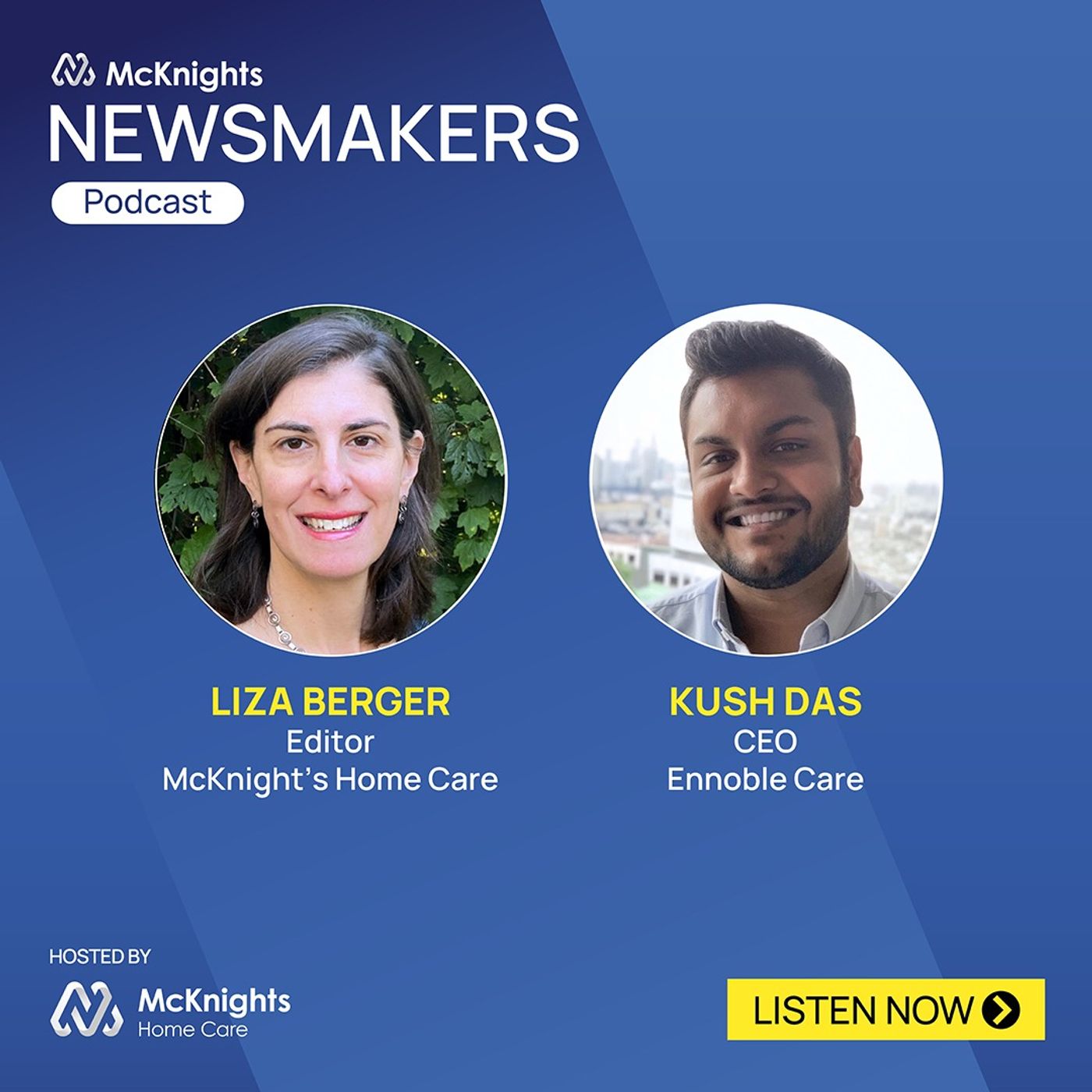
House call firm Ennoble Care finds success serving high-needs Medicare patients
20m 23s
Ennoble Care, led by CEO Kush Das, delivers home-based primary care, hospice, and palliative care to high-needs Medicare patients, many of whom are frail, elderly, and homebound. The company serves over 50,000 patients across 15 states and D.C., addressing a critical gap where only one in five eligible patients receives such care. Das emphasizes the importance of meeting patients where they are, providing comprehensive services like prescriptions, labs, and radiology at home, and coordinating care to reduce hospital visits. Ennoble Care participates in value-based models like ACO REACH and supports the new LEAD model, appreciating its 10-year stability and focus on high-needs populations. The company prioritizes in-person care, with over 95% of visits conducted physically at home, which Das argues leads to better outcomes, including a 25% reduction in hospitalizations in year one and 63% in year two. Financially, the business faces thin margins and working capital challenges, but Ennoble Care has grown by partnering with existing house call practices, keeping providers and patients intact. The company recently doubled in size, entering new states like Florida and Texas, and plans to continue expanding into underserved areas. Das’s background as an EMT and healthcare attorney inspired his mission to serve patients who otherwise rely on emergency rooms, ensuring they can age in place comfortably.
we bring the most skilled clinicians to your house to provide essentially a doctor's office
during a two-hour window we have the conversation with them about what they need we handle their
prescriptions we see them on a monthly basis sometimes even more often when they're extra
sick or extra frail only one in five of these frail homebound patients that could get home-based
primary care even getting home-based primary care right now and that is a real problem
hospitals it's not an easy business to be in the margins are incredibly thin we often in the early
days have had working capital challenges where we're just making sure that we're actually
collecting enough to pay our payroll out i'm liza burger editor of mcknight's home care
a noble care a house calls company for high needs medicare patients serves over 50 000 patients in
15 states in the district of columbia
but there is plenty of room for growth ceo kushtas told me only one in five frail homebound
patients is getting home-based primary care right now he said here's more great to have you on the
podcast kush thank you for having me appreciate it great so a noble care of which your ceo and
chairman of is a home-based primary care hospice palliative care provider for high needs medicare
patients what does this mean exactly it's a great question i have always communicated it in one
sentence as we bring the most skilled clinicians to your house to provide essentially a doctor's
office inside of your house that slowly progresses into more longitudinal care with nurses and social
workers and care managers supporting them so that you really don't have to leave your house for care
unless it's something that requires a surgery or a type of advanced device that for example
literally cannot be brought to your house but our job is to coordinate your care as much as possible
from where you live which is what we do you're helping about 50 000 patients currently in 15
states per your latest quality report along with the district of columbia why is there a need for
a noble care right now i mean if you think about our patient population we are serving
the folks in their last three to 10 years of life, people that are very frail, very elderly,
that often have trouble leaving the house. These people typically cost Medicare something like two
to three times the amount of annual spend as the average Medicare beneficiary. And at the same time,
they're also really unserved by the providers in the market that's out there right now. I mean,
no one wants to actually go to the hospital for care. No one wants to spend four hours in an ER.
My background, I was a EMS provider. I used to drive ambulances around for many, many years.
And we used to take the same patients from their house to the ER because that was the only place
where they could get any care and the only place where they would be able to actually get out of
their house to get care. My COO, Molly, she was a nurse and was actually an ER nurse. And so she
saw the other side, right? The same folks coming into the ER to be triaged, spending four hours
in a waiting line, then going and spending seven days in the hospital. That patient population,
is entirely underserved by the facilities and by the buildings, basically, that are providing
healthcare today. And our mission is to meet them where they are. So we come to their home,
we hopefully meet them in their comfort zone. All they have to do in terms of being ready for
our care is to say, hey, I will be home at this time. For a lot of folks, they're ready at home.
And so that makes it easy. The activation energy is much lower to show up. We come to them during
a two-hour window. We have the conversation with them about what they need to do. We have the
conversation with them about what they need. We handle their prescriptions. We see them on a
monthly basis, sometimes even more often when they're extra sick or extra frail,
handle things like mobile radiology and mobile labs and mobile pharmacy and make sure they're
getting all the things they need to actually age in place, in the place that they are comfortable,
which is the whole reason why we exist. And frankly, there's so many more patients to serve.
Our goal is to make sure that we're able to be around for our patients for a long time and
frankly, serve as many of them as need the help. To be clear, are you serving just Medicare
fee-for-service beneficiaries or also Medicare Advantage beneficiaries?
We do both. It really follows the payer mix of the market. So the way you think about it is in
some markets, it's a lot of virtual Medicare just because that's how the market is. In some markets,
it's a nice 50-50 mix. So we do both and we serve all of our patients exactly the same way,
regardless of whether they're in Medicare or Medicare Advantage. And we also serve all of
our patients the same way, regardless of whether we're at risk with them or not at risk with them
from a value-based care perspective. You're also part of the ACO
REACH model. How much of your patient population is in this model?
So far, about one in every two of our original Medicare patients are in the model,
which turns out to be about a quarter of our total population because of the Medicare Advantage
population that we have. And yes, we've been in ACO REACH for quite some time. Actually,
the way this all started was we were one of the original 50 direct contracting entities
that were awarded a license way back in 2020. We decided that we wanted to start by
actually delivering great care before going to risk. So we did much more of like a crawl,
walk, run approach. So we built a panel of patients that we were serving and then really
started taking on meaningful amounts of upside and downside value-based care risk in 2023. And
we've been successful in the program since then. I think our view of ACO REACH is that it just
allows us to serve our patients even better. The things you can do around the beneficiary waivers,
the things you can do by coordinating care for us, all of it becomes just about the care and
the outcomes instead of being. So much about the fee-for-service side of the business, although the way we think about it is
our fee-for-service approach actually is, in fact, also always going to deliver better outcomes,
which is why we serve all of our patients the same way.
You, along with companies like Harmony Cares and Bloom, are part of the Complex Care Alliance.
Yes.
The Alliance advocated for an extension of Ravicio REACH, which
serves the frailest homebound Medicare beneficiaries beyond 2026.
What do you think of the upcoming LEAD model, which is going to be replacing REACH?
First of all, I'm very proud of the work the Complex Care Alliance has done. I think there's
a couple of thought leaders in the space that have really pushed home-based primary care,
but also just how to serve high-needs frail populations really well. I think a lot of
us are involved in the Complex Care Alliance, so very proud of the work that's been done in the
last couple of years. And then I do want to say, it could have gotten a lot of ways, LEAD model,
in terms of how it built off of ACO REACH.
On an overall basis, I'm tremendously happy with where it ended up. I think there's some
focus and real understanding that is new to Medicare in the last five years around the
high-needs population, and how to make sure there is a risk model that can serve the high-needs
population. I think you're seeing that in the LEAD model. You're also seeing some of these
changes in MSSP that are also pretty supportive of providers that serve the high-needs and the
low-needs population. So I'm super proud of it. I think it's going to be really interesting to see
how it shakes out over the next five to 10 years. I think one of the things that LEAD does, which is
that 10-year program, is fascinating to me because the other side of CMMI is that when CMMI changes
things on an every-couple-years basis, I think it does cause a lot of uncertainty. So stability in
the program is going to be the thing that we care most deeply about. The program's going to come
out with rules. They should be fair rules, but they should have the whole 10-year period to be
evaluated versus having a bunch of changes in between. I think if CMMI can have that kind of
stability, I think LEAD has enormous potential, truly. Cool. And CMMI is Center for Medicare and
Medicaid Innovation. Given your part, just going more along the lines of your work in ACOs,
given your participation and reach, what were your thoughts about the latest
physician fee proposed rule, which seemed to really be bolstering accountable care and primary
care? I thought it was fascinating. I, again, find that the combined set of the last 10 years
worth of Medicare policy have been driving towards this real depth of understanding of saying,
how do we figure out which patients are costing the system the most, that are most underserved
by the system? And then on the other hand, what are the vehicles through which
we actually need those patients to be served? And I think even in the last few years, seeing the
care management approaches that are coming out to the physician fee schedule, then seeing the most
recent changes, which are actually helping per practices that are in value-based care, get more
capitated payments that are going to be front-loaded to actually help support the kind of comprehensive
care management that we're talking about. I mean, that is incredibly encouraging. I'll tell you,
having been at House Calls for a while now, House Calls is not an easy business to be in.
The margins are incredibly thin. We often in the early days have had working capital challenges where we're
just making sure that we're actually collecting enough to pay our payroll out. We're not the kind
of business that decided to take huge amounts of venture capital money and go into a place where we
were burning capital in order to survive. We really wanted to be self-sustainable, so we existed
forever. And I think that acknowledgement of how hard House Calls is and how hard it is to serve
these populations now is showing up in the things like the MSSP changes that are coming on with the
basic e-schedule, the MSSP changes that are coming on with the higher risk core cap, the lead changes
around having the blended benchmark between the high needs population and the standard population.
And as you mentioned, the physician fee schedule changes that just say if you're in an ACO, hey, guess
what? We believe that you're doing things for better outcomes and we're going to actually give you credit for
that. That is incredible stuff. So you are pleased with that proposed role?
Yeah. I mean, a lot of things around the edges that we're going to comment on, right? I think
we do feel that there's more work to be done, frankly, for this patient population. I mean,
my math, only one in five of these frail homebound patients that could get home-based
primary care are even getting home-based primary care right now. And that is a real problem,
right? If we can just figure out how to get more providers into these folks' homes, it's going to
go a tremendously long way. And so us having kind of scratched our way through it for the last
five years, I think now I feel in some ways very optimistic about what the future looks like,
which is great. Let me just ask, where do you come up with the one in five?
Yeah. So roughly when we think about it, the whole Medicare population, there's about
7 million truly homebound patients in Medicare. And there's about double of that. That is the
semi-homebound population. There's not a good word for it, a good classification, but they're folks that
are almost homebound adjacent. Of those patients, the American Academy of Home Care Medicine did a
study a few years ago, which these numbers might be a little bit stale, but when they were doing
that study, what they found was there's about 2,300 house call practices in the country and
the median practice size is 700 patients, right? So these are mom and pop folks that are serving
these patients. They're doing an incredible job with small practices, a handful of nurse practitioners
that are going out to people's homes and doing great work. That population is not big enough to
serve more than one in five of those.
And so I think that's the place where we're just trying to make sure that people understand that
the opportunity to serve home-based, frail, homebound patients is still tremendous. And the
more Medicare can do to support it, the more that the trust fund is going to be well-served,
frankly, over the long term.
You certainly know your stuff, Kush.
Oh, thank you. Those numbers have been in my head for a long time. They sometimes keep you up at
night, but they're definitely keeping me excited all the time. So. Well, I want to talk a little bit more, a little lighter topic on your background. But
going back to your quality report that's being publicly released this week, I noticed that you
had said that more than 95% of clinical visits are delivered physically at home for your company
versus telemedicine. And I thought that was interesting, just given how much companies
are moving towards telemedicine and care. Why are you sort of sticking to a more conventional
model of care? Yeah. Five years ago, if you'd asked me,
right before COVID, which was when we were getting started, I would have told you that
I really fundamentally believed that the senior population, the same folks that I used to take
to the hospital, they were not ready to have a primarily digital point of interaction with
healthcare. That's what I would have told you, right? Because having taken so many of them to
the hospital, they're using flip phones in many cases. And I think having the idea of holding a
phone up to your face just doesn't create the same level of an interaction that having an in-person
provider does. So we took a very. Clear-line position early on that we would try to do in the home physically whenever
possible. We have held to it until now, which we're still very, very proud of. I'll tell you,
we also have expanded a lot of our digital capabilities. So we are doing more urgent
visits and more difficult to schedule visits by telemedicine, but the patient has to accept
it. The patient has to opt in to telemedicine or we do not force telemedicine on any of
our patients. We still go physically in the home whenever we can.
And I think for anyone who's been in a home environment, whether it's
home health or EMS or hospice, you just learn more when you're physically there. You can see
what their house is like. You can see where the spot is on their stairs that could be dangerous
for them on fall risk. You can see whether their medications are being taken or not. You can see
whether they have enough food in the fridge. Those are all things, frankly, that you can't do
on a telemedicine visit. I take a lot of pride in the fact that you're having people drive around,
spending many hours in the car, our providers, our clinicians that actually show up in a people's
house, feel comfortable with that person. And I think that's one of the things that
we can do. And I'll tell you, I think the hospitalization risk that we see, the 25%
reduction in hospitalizations that we drive, the stiff reductions that we drive, all of
that is a direct result of that physical in-home presence.
Yeah. I noticed that you've got some pretty powerful statistics in the report,
as you alluded to. Hospital admissions fall by 25% in year one with the Noble, 63% in
year two. And the hospital spend is about $500 per member per month in year two. And
that's a lot of money. And I think that's a lot of money to be able to get a hospital in the first place.
Yeah. Yeah. Exactly. And I think the real thing behind that,
not to oversimplify it, is that we have clinicians that get to know our patients over time. And they
get to really know them when they're in the home with them. And you have, just as an example,
one of our nurse practitioners is only going to have about 150 patients at any given time. That's
a really small panel compared to when you think about primary care that typically has 1,000
patients or 2,000 patients, right? We're able to know all of their stories, able to know their
family members, able to understand what they need and what they want and how they think. And I think
that makes the world's worth of difference. You pair that with a care coordinator who's able to
also have that same 150 patients one-to-one with the provider. It's able to call all the time and
actually figure out whether the hospital bed was delivered on time, whether mobile radiology showed
up, whether the phlebotomist. Actually drew the labs. That's the follow-up that's required. We have eight touch points a
month. We spend multiple hours with our patients every month. That's the stuff that creates
incredible hospital outcomes. This is our first time publishing a quality report, to be honest.
We've had this data and studied this data rigorously for the last five years, but it's
incredible to sometimes see it on paper. We spend so much time with our heads down just trying to
make sure our patient gets a visit. It's really cool when you see it on a composite basis.
Your company really has grown pretty steadily. You were founded in 2017.
Yeah. I founded the ACO a little bit after that, actually, and then brought together a bunch of the
first house call practices. One of those was a noble care, which we ended up taking the brand of,
but the ACO itself was founded in 2019, which I consider the founding date of the entire company.
Then what we ended up doing, which we still do today, is we're helping house call practices
actually self-sustain by joining our platform. They end up joining us. We keep the providers,
we keep the patients, we keep the patient-provider relationships intact. We have a full stack EHR,
chronic health record software, that we built in-house that is specifically for house calls.
That technology stack really helps us be efficient when delivering our care. It helps us coordinate
our care better. It actually helps us work amongst our different clinicians, of which we have now
nearly 1,700. The way we think about the whole practice as we've grown over time is to bring
on other practices that really fit the model really well.
What does your growth trajectory look like in the next year or so?
We just doubled again in the last 12 months, which feels really good. I think we're going to
continue on a relatively similar trajectory in the next couple of years. We have entered
six states in the last 12 or so months, which we're very proud of. We're continuing to enter
adjacent states, moving from the East Coast more towards the Midwest and the Southeast and the
South. I think we'll continue that westward trajectory. Mostly, we are looking for places
where there is a clear need.
If there is an underserved area, if you have someone in a market, for example, that is
not able to take care of a growing frail population, that's where we're going to go.
That's why we entered Florida recently, we entered Texas recently, and we'll continue on
into those markets where there's real clear need.
Is that moratorium holding you back at all, or is it a little bit of a different model
and it doesn't apply?
No, the hospice moratorium does apply to us. We have both parts of our
organization. Our first part is our home-based physician practice. Our second
part is our home-based physician practice. Our second part is our hospice. And so, yes, we have hospice in seven of those states,
so in seven of the total states that we're serving right now. And so, we want to expand
our hospice footprint. We find that the last three to six months of life, hospice is actually
the best mitigant of cost of care and also the absolute best service profile for patients that
are in their last three to six months of life. If I take a massive step back, though, I am happy
that CMS is fighting fraud, waste, and abuse. I am actually quite happy that there's a more
rigor going on towards hospice licensure. I think there should be. I would hope that CMS keeps the
moratorium to be temporary, and I hope that allows good hospice providers to continue to succeed.
But generally speaking, I'm a former healthcare lawyer. I did a lot of fraud,
abuse, and regulatory work when I was a healthcare lawyer. And so, I do somewhat
find it refreshing when CMS decides to go and do their duty and make sure we're protecting
the beneficiaries. On the other hand, we are doing great work. We're quite compliant. We feel really
good about our position in that market. So, we just hope the moratorium is lifted at some point
so we can start growing our hospice again.
Okay. And then finally, I did want to touch on your background, and thank you for sharing that
about your past as an attorney. Where did your desire to begin this business come from just in
a few seconds? Yeah. So, I got started in healthcare driving ambulances. I was an EMT,
and I had essentially like a couple patients that I would see over and over again for many years.
And those patients we used to call, which I'm sure is a pejorative term. It was a
frequent flyer is what we used to call them. What they really are and what they really were
is patients that had no other point of care in healthcare. They had no other place to go but
calling 911 and having an ambulance take them to the ER. And that's just wrong. And frankly,
that's the reason why I thought about this in some way of serving that high-needs patient
population. I stumbled across House Calls while I was a healthcare attorney and later as a healthcare
consultant and realized that this is the perfect model to help serve these populations at risk.
And the system doesn't want them in the ER and the hospital.
The hospital barely wants them in the ER and the hospital. And the patient, much more importantly,
does not want to be in the ER and the hospital. And so, our whole goal was to figure out how to
serve them in the home.
never end up there. And that's the genesis of the entire idea, right, is how do we actually do that
for the many 10 million plus Medicare beneficiaries that deserve this care? Well, it's been a real
pleasure to talk with you, Kush Das, CEO and Chairman of Ennoble Care. Thank you so much.
Thanks, Liza. Great to talk to you as well. Appreciate the time.
Podcast Summary
Key Points:
Ennoble Care provides home-based primary care, hospice, and palliative care to high-needs Medicare patients, serving over 50,000 patients across 15 states and D.C.
Only one in five frail homebound patients who could benefit from home-based primary care currently receives it, highlighting a significant gap in care.
The company participates in ACO REACH and supports the upcoming LEAD model, valuing program stability and policies that support high-needs populations.
Ennoble Care prioritizes in-person visits, with over 95% of clinical visits delivered at home, leading to a 25% reduction in hospitalizations in year one and 63% in year two.
The business model involves partnering with existing house call practices, maintaining patient-provider relationships, and using a proprietary EHR system for efficiency.
Growth plans include expanding into underserved markets, particularly in the Midwest, Southeast, and South, while navigating the hospice moratorium.
Summary:
Ennoble Care, led by CEO Kush Das, delivers home-based primary care, hospice, and palliative care to high-needs Medicare patients, many of whom are frail, elderly, and homebound. , addressing a critical gap where only one in five eligible patients receives such care. Das emphasizes the importance of meeting patients where they are, providing comprehensive services like prescriptions, labs, and radiology at home, and coordinating care to reduce hospital visits.
Ennoble Care participates in value-based models like ACO REACH and supports the new LEAD model, appreciating its 10-year stability and focus on high-needs populations. The company prioritizes in-person care, with over 95% of visits conducted physically at home, which Das argues leads to better outcomes, including a 25% reduction in hospitalizations in year one and 63% in year two. Financially, the business faces thin margins and working capital challenges, but Ennoble Care has grown by partnering with existing house call practices, keeping providers and patients intact.
The company recently doubled in size, entering new states like Florida and Texas, and plans to continue expanding into underserved areas. Das’s background as an EMT and healthcare attorney inspired his mission to serve patients who otherwise rely on emergency rooms, ensuring they can age in place comfortably.
FAQs
Ennoble Care is a home-based primary care, hospice, and palliative care provider for high-needs Medicare patients. They bring skilled clinicians to patients' homes to provide a doctor's office experience, including prescriptions and monthly visits.
Ennoble Care serves over 50,000 patients across 15 states and the District of Columbia. They have recently expanded into states like Florida and Texas.
They serve frail, elderly patients in their last 3 to 10 years of life who often have trouble leaving the house. These patients cost Medicare two to three times more than the average beneficiary and are underserved by traditional healthcare facilities.
Yes, Ennoble Care serves both Medicare fee-for-service and Medicare Advantage beneficiaries. They treat all patients the same way regardless of their payer type or risk model.
About half of their original Medicare patients are in the ACO REACH model, totaling about a quarter of their total population. They were one of the original direct contracting entities and took on meaningful value-based care risk starting in 2023.
Ennoble Care delivers over 95% of clinical visits physically at home because in-person care allows clinicians to observe the home environment, such as fall risks, medication adherence, and food availability. They believe this contributes to better outcomes, including a 25% reduction in hospitalizations in year one.
Chat with AI
Loading...
Pro features
Go deeper with this episode
Unlock creator-grade tools that turn any transcript into show notes and subtitle files.
 PodcastTranscript AI