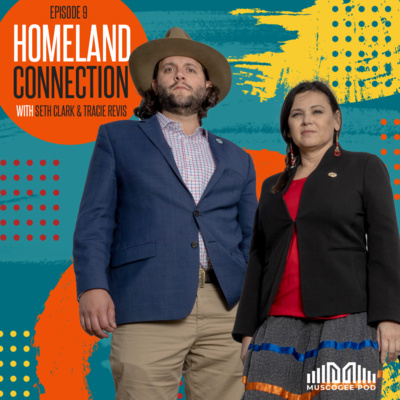
Homeland Connection with Seth Clark & Tracie Revis
46m 57s
The Alpmolge National Park and Preserve Initiative (ONPPI) is leading a vital effort to reestablish authentic, culturally respectful stewardship of ancestral Muscogee Creek lands in the Southeast. Rooted in deep historical connection, the initiative emphasizes that no narrative or development in the Alpmolge River corridor should proceed without meaningful consultation and collaboration with the Muscogee Nation. After centuries of land desecration—including colonial excavation, burial mound destruction, and development projects—this project represents both a healing and an act of atonement. The proposed designation of a National Park and Preserve would protect over 70,000 acres, including 130 acres owned by the Muscogee Nation, and establish co-management with federal and state agencies. Key victories include a major land acquisition through a partnership with the Open Space Institute, preventing industrialization, and a growing coalition of support from Congress and federal leadership. The initiative also includes a public education campaign to share Muscogee language, place names, and cultural identity, challenging historical erasure and promoting accurate narratives. With strong tribal leadership, including Tracy Revis and Seth Clark, and the alignment of Native representation in federal offices, this effort embodies a new era of tribal self-determination and cultural resurgence in Indian Country.
We are live on the Muscogee Reservation and you are on the Muscogee Pod.
We've got a great episode today. I'm excited about this one. A lot of people think about Native history,
Omogee history, Muscogee history in the southeast. We're talking about the mountains, which was the place where, you know, we came from.
That's our original ancestral homelands, Muscogee Creek people. The Muscogee Confederacy all started and, you know, to go back
and do reconnection, like we've done recently, as we talked about with Anne on a recent episode.
But as we have went back to reconnect with that place, with the AGB's festival in Oxford, Alabama, and then Georgia and everything like that,
you can't get away from the Omogee National Park and Preserve Institute, which does a great job, not only right there in the word,
preserve and preserving and making sure that we're advancing that mission. But what another thing that they've done that's so great,
which brings them on this episode today, is that they've decided that they're not going to do a thing in that region.
They're not going to tell a story in that region without consultation and collaboration with the Muscogee Creek Nation.
And I think that that's so powerful to talk about an organization like that that's main goal is to get it right, understanding what it takes to do that.
And so they're talking with our historic and cultural preservation department. They're talking to the right folks and making sure that it's accurate.
Yeah, absolutely. I know we miss Tracy around here at these parts, but they couldn't have gotten a better person to take that role.
Sure. And so excited and full of passion to tell the story and to tell it right.
If anybody knows Tracy, she's very dedicated to making sure things are accurate.
And I think that's really good, and you pair her with someone like Seth, that's from Middle Georgia and is saying,
"Look, I'm bringing a new perspective to this, and together we're going to make it happen."
And it's really, really exciting. So we definitely had to reach out, bring in Alpmolge National Park and Preserve Initiative or ONPPI if you're in the loop.
Yes.
And one of the cool kids that they sing about.
And so without further ado, let's get started with this conversation from our reservation. And it's with Tracy Revis and Seth Clark from the Alpmolge National Park and Preserve.
And so glad to have with us in the podk for the Muscogee pod today, all the way from Macon, Georgia, the Alpmolge National Park and Preserve Initiative. We have with us the Executive Director and the Director of Advocacy. And I'll start off with the Director of Advocacy because she is actually one of ours.
And she comes to Macon by way of Alpmolge, by way of California, by way of Kansas. She's been everywhere like Johnny Cash, Ms. Tracy Revis. Tracy, thanks for being with us today along with your Director, Seth Clark. So glad to have you guys with us today.
Thank you. We're excited to be here and to be home.
Yeah, absolutely. What about you, Seth? First time here at the Muscogee Nation?
No, this is my third time out here. Awesome.
Okay, what do you think of the Oklahoma weather right now? Oh, it is beautiful. It's very similar to making weather right now.
Yeah, exactly. And what they say here is, if you don't like it, just hang around for 15 minutes. It'll change. So just be patient with it.
No, but it's great to have you all in a studio with us because this is such a great time for the Alpmolge National Park and Preserve Initiative.
And for us at Muscogee Nation and that interconnection there. But before we start anything, I just want to start off both of you.
Kind of give us your stories about how you came to your current positions with the initiative. So Seth, get us started out on how you got started with Alpmolge National Park and Preserve.
Sure. Well, I grew up in middle Georgia. I'm born and raised there right along the banks of the Alpmolge River, which flows right through downtown Macon.
I worked in conservation for a number of years and just a really avid hunter and fisherman along the banks of the Alpmolge.
It's just really close to my family. My grandparents taught me how to fish and hunt there. And just professionally, it's what's kind of driven my advocacy and my work.
This job to be the director opened up about a year ago. And I think that the connection of the lands that were incredibly important to me and the sacred nature of the sites there along the formal tribal towns that align the river.
It's just an incredible opportunity to jump on board and really make sure it gets the attention it needs as a National Park and Preserve.
Yeah. And Tracy, we sort of know, you know, you going over here just pretty recently. But I think what makes your appointment there so special is that your sort of involvement with the initiative kind of started as your job with chief hills administration and that reconnection to the southeast.
And take us through your journey and kind of how you sort of fell in love with Macon in the story there and being able to go back and be an advocate now.
Absolutely. Well, this is such an exciting time right now, but really it began when I was working with chief hills administration.
And one of chief hills big campaign platforms was really preserving our homelands in the southeast and making sure we have a stronger presence in the southeast.
And when I was working as chief of staff for chief hill, we did several trips to the southeast and one of the trips we went to make into shoot an interview piece for some funding.
And we were out on the mound and we were with it was with chief hills second chief beaver and former chief James Floyd.
And we were walking and we were visiting with the open space institute and different groups and we were just hearing all of the opportunities that these civic groups and these cultural or these preservation groups were saying to the nation of how much they really wanted to work with us and to make sure that we had an opportunity to capture what was ours.
Under chief Floyd administration, the nation actually purchased an acquired land on the Mogey corridor that we own about 130 acres.
And that was to preserve that land itself. And so the nation owns land. We have groups that are involved that really want to make sure that we have a place in the city of Macon.
So how we were there, we were all standing on top of the great temple mound at the park and we were looking out and it was just it was such an incredible opportunity for me as a first female chief of staff for the nation to be on top of the great temple mound where a woman wouldn't have had that type of role in that government structure.
It was an incredible moving time for me and there there wasn't always the idea of how what would this look like to return to Macon. And for me growing up at the ceremonial grounds, the first time I was I was there I was walking through the park and I could smell some of our roots and some of our medicines.
It was very powerful for me just to think and look out and imagine what are people look like in this civilization. Well, then we went into the visitor center there at the park and my family's photos are hanging on the wall.
And so there's a large photo of my aunt who served as a cultural interpreter at the park and several of my family members who have been down there and trips at the nation is made down there.
This is opportunity of what do we do to connect Macon to the Muscovy Creek Nation and what do we do to connect Altmoggi River to Altmoggi, Oklahoma.
And from that meeting, we tossed around some ideas and I talked to Chief Hill about the idea of actually formalizing a relationship with the city of Macon so that we have a place to come home to.
Over the rest of my tenure with the nation, we did several visits to follow up on a few other events we came up with the idea to do a sister city to create with the city of Macon.
And so I went back to visit on that and then a few other things to check on our property and then a few other opportunities this just kept coming together and then I ended up ultimately in Macon because we had met Seth.
Seth had come to the nation after he came on with OMPPI our acronym so we don't say the full thing.
And when he came on with OMPPI, his first task when he was asked what do you want to do first, he said I need to get to Oklahoma, I need to go meet the people.
And so he came in and I remember meeting Seth and he was with Chief Lloyd and we were sitting in Chief's conference room and we really didn't know what the meeting was going to be that day.
It was just on our calendar and how many times that happened all the time around here, such a busy busy moving place around here.
But so we sat and we visited and we talked about possibilities and so one of the things that we're going to I think talk a little bit about another opportunity that's coming for the nation that Seth brought to us and we just kept doing these trips back and forth and looking at our land and.
When I was there in November the nation, we did a big Southeast tour, which is where the Oxford trip came from and we went over to Macon and I was with Ray Lynn and Turner and John Adev.
And I went over to visit Macon and I wanted to show them the property that the nation owns and we were visiting and I was talking to some folks from OMPPI and they said well what do you need now.
If you had a magic wand, what does the nation need right now? I said we need boots on the ground, we need someone here representing us and explaining who.
We are here now and as the fates would have it, Seth was executive director and was working on a few things and the opportunity arose and to have someone from the nation no longer directly a part of the nation, but a part of this has previously been a part of this administration to come and to speak and to make sure that our voice has heard and every meeting.
Yeah, it's perfect to have a footprint there. I mean, that was the whole goal of reconnecting with the southeast. So many people go see the spiritual aspect of it. Oh, you're going back to your homelands. Yes, but we're going back to establish presence and and be there.
And it's interesting what Tracy says about the fact of having boots on the ground to tell our story to be there to make sure that our people are not forgotten, but they're accurately portrayed and that kind of brings me to you, Seth, because I'm fascinated by the fact that you grew up there.
All your life around the old Mulgee River and making and everything like that. I wonder what was the experience like for you? I mean, were you in in grain with the story of the Muscogee people? Was that something that you had to reach out on your own in your own academia to to get all of that? I mean, what was the condition like for educating folks in that area about the Muscogee story?
It's still growing up. It was the entracial can talk a little bit more eloquently than I can about this for the mounds themselves weaker up saying the Indian mounds just generally the Indian mounds. And I think that by itself speaks to how the story of the Muscogee Creek people and their ancestors are told.
I think that there is a deep longing to understand what happened before colonization there. I don't I don't think I know that. I mean, I know our community is feels a void in the story of Middle Georgia.
And it is because it is the teaching of what happened before colonization and the teaching of removal is dry. It is something you have to seek out.
Not too nuanced. I mean, and no, and I get that because but I also understand what you're saying and come back up what you're saying because I took that trip as well to the southeast. I went to Oxford. I went to Montgomery, all the stops that we made and everywhere we went.
I didn't find the people the non native people I mean that are in that area now. I didn't find the people that were saying we've got it all figured out we know it let us bring you in to show you how you know we can do this or whatever it was.
Tell us what you need. We want to tell this story. There was like you said there was a longing for understanding but also like to make amends. I mean, look at what the Alabama Supreme Court did. Look at what the Alabama House of Representatives did with the resolution and then a formal apology letter.
They want to I think set a standard moving forward from here and that that's what that that's what this project is in the same vein as that this. These these lands, the ancient Muscogee Creek lands that make up the Altmogee Corridor.
The making sure that the federal government gives it the vaulted vaulted status of the National Park and preserve which is a status that it does deserve is incredibly important to our community because this is not this is a.
It's not just an act of changing a designation from National Historical Park to National Park and preserve this is an act of atonement an act of healing for our community.
And it's an act of atonement and a healing that is really been a long time coming into the community feels but um but to back up just a second to that what the story sound like.
Um or don't sound like it's not when the visitation numbers are a perfect example of there there's an independent study that was commissioned by the National Park Conservation Association and funded by the night foundation.
They um they so visitorship for the park is estimated now roughly 200 to 300 thousand visitors if we change to a National Park and preserve and not National Park and preserve that number will go up to 1.4 million people annually that is 1.4 million people that are going to see a story and it is not my story to tell it is our mission to preserve these lands.
It is absolutely our mission and intention to make sure that the story is told by the people who are its original stewards and to make sure that they we have a coalition moving forward that includes those original stewards as current and future stewards as well.
That's what this project really is about and I think I think both esoterically and functionally as well.
Yeah and Tracy you hear that number 1.4 million and the opportunity that that represents can you imagine having that type of number where we can start accurately and the ripple effect that that has in it that's like a seismic shift in education and understanding of native peoples for generations to come I mean it's an incredible opportunity.
Absolutely and economically there's a lot of benefits and there are economic benefits are cultural benefits there are educational benefits there's conservation benefits but I think if we back up a minute I think it's important for all of our listeners to understand the history of the park
and to really understand who and what the Moghi park is give us the elevator pitch so let's let's back it up a hundred years yeah let's go back a little bit farther than that we have a we have a time machine actually here.
So going back as the nation but when we were still in the Confederacy before we were really considered the nation the different groups that would sign off the different groups.
That would sign off the different tribal towns that would sign off we never would give up the Moghi old fields that's what they're called and that's along the Moghi River.
So we kept giving we kept losing land seeding land moving farther from the coast all the way over losing moving losing moving eventually where we're passing out Moghi River we're getting closer to the Chattahoochi River.
The Moghi old fields were always preserved and that's critical for our people to understand is that we we always designated that that land is so special and so critical to our history and our story that we preserved it we wouldn't see that area until the final treaty of 1821 the fraudulent treaty of Indian Springs when it was all seated over and then that was eventually nullified and then another treaty was put into place but it was protected.
So we that final treaty is 18 23 24 someone will get on to me for saying that wrong so I know that I'm accurate on that but when the second treaty was ratified and we were eventually were started removing into Oklahoma.
That land was immediately and Seth can talk to the about this a little bit but it was immediately sold and became a cotton field.
And so what our mounds were our ancestors were there been continuous habitation for 17,000 years became cotton fields and it was plowed and it was just the land was just torn up well then eventually as it gets sold the mounds themselves over to the years became racetracks that people would run motorcycles up and down the mountains.
A train came through in 1848 and desecrated the one of the burial mounds the lesser temple mound as it's called today was cut in half I mean they just it just went straight through.
Well the reason they wanted us out of that area if you go back to history and federal trade road and everything where the Mogey River and where the mound sit are just below the fall line.
So you've got the Piedmont and then you've got the fall line and then you go into the lowlands and we are right there and so that's prime territory.
It was a flowing river it was a beautiful river there was a lot of natural just lush greenery around there and so as we start losing it they start destroying it in 1934 under Roosevelt.
The largest archaeological dig begins out there in 1936 it becomes a park and under the antiquities act it becomes the national monument so the Mogey National Monument is what it becomes because Roosevelt spent a lot of time in Georgia and so he was out there and he designated it as a national monument so it gets protected.
The largest archaeological dig in the United States happens at that point two and a half million artifacts have been found out of that one little area.
The park was designated about 702 acres is what's been protected who was doing the digging.
It was non native folks there was no that's an incredibly important aspect and the foundational for a future conversation the largest dig in American history was it was on ancient tribal land without tribal consultation and it was funded by the American government.
I'm not shocked right no no I thought that was important to jump in there and ask because I think people still don't realize that even today still we're still dealing with no native representation or no native involvement and things like that even as far back as then to now so go ahead Tracy I'm sorry.
The national parks it was under it was under the auspices of the national parks but it what it is not a national park like you think of your somebody and some of the other parks.
Fast forward there have been several atrocious exhibits at the park one that they had plexiglass over the burial mounds and you could see down into it there just no cultural sensitivity and understanding of who the people were.
And so as it progresses in the seventies the park rangers they kind of catch when and if you.
think about where we're at with the Indian history and what
happened across Indian country legally in the '70s.
So now we're going into Indian Civil Rights Act in the '60s,
late '60s, and we're going into self-determination and
education.
And as the country starts waking up to this native
population that has decided it is no longer going to be
quiet, they're like, hey, we've got to get some native
people over here.
And so they started doing these cultural interpretation
programs at the park that they would bring in people, citizens
from the nation, and bring them to Georgia and let them come
and walk around and talk about our history and how we would
use plants and just talk about the mountains and different
different things out there.
And so then that kind of went away.
And in the early '90s, one of the park rangers created an
event out there.
It's called-- they call it the 'Op Moghi Indian Celebration'.
I'll get to that in a minute, because I think a name is
important.
So the 'Op Moghi Indian Celebration', and that they would
bring in different groups to come in and come back.
You've seen a lot of power people out there.
You've seen a lot of different tribes that aren't necessarily
specific to that area.
But it was an attempt to tell a story.
And so I think Seth growing up, that's what he saw.
As students, they would take classrooms and go over to the
park and they were like, oh, the Indian mountains.
Let's go look at the Indians.
As if we are a historic, fictional--
we're the dinosaurs.
Hosting.
Yes, that's right.
Appropriation.
And what was, not at all learning about what is, who people are.
It's like the scene in a social network.
Whenever he goes to the party, and he's like, I can't--
he's supposed to be at Caribbean night.
And he's like, I can't stand here another minute and look
at that video of Niagara Falls that has nothing to do
with the Caribbean.
You know what I mean?
It's like, I would imagine that I would be like that as a
shocking creek that knows about our traditions and what we
actually are at the Indian celebration.
Seeing, as Tracy said, people that had no connection to the land
or customs that would like planes, cultures.
And in the southeast, that would be totally misplaced.
Absolutely.
Well, and so in 2019, well, so before that, there was a big
effort that the nation actually stepped in and that in the
development of Macon, there was a freeway that was being built,
or a highway that was being built.
And the plan was that he would actually cut through the park
and do some more desecration.
That area was actually preserved under a TCP,
traditional cultural property, which is through the National
Parks, which kind of stopped it.
The nation stepped in and really advocated to stop that
freeway.
The following freeway was stopped.
And it just basically dead ends now in Macon.
And I still hear people come up to me and they say, there
was a freeway we're going to build.
And I don't know why the Indians wanted to stop it, but they
did.
Oh, man, and I think that goes to where we came up to 2019.
So under the Dingo Act, which is leading into this project,
the Dingo Act was passed to 2019.
The park, actually, the designation changes from National
Monument to National Historical Park.
So now it has changed.
It's a different designation.
And Congress commissioned a study to look down the river to
figure out if we could create a national park there.
And there's several steps that go into creating a
national park, but that's kind of where we're headed.
And what the goal is right now, what OMPPI, what we're
doing, and the reason that I'm involved in this is to create
Georgia's first national park--
Make it a park.
Make it a park.
Make it a park.
And the mounds are kind of the apex of it.
And so we are the center of it.
And this would be the first, to my knowledge, the first
national park that have mounds in them.
And it would be the first in Georgia.
Georgia has more mound sites than any other state, which
is critical.
And through the study that was commissioned--
and I'll let Seth talk about this, because the ecology and
everything down, the whole Mogey corridor is just--
it's an amazing property.
But there are known, when they did the study, the nation
worked with those that were conducting the study to look
at the different cultural sites, look at national
significance, what's important, and why does the nation
care?
And why does a group that's been gone for 200 years care
about this property?
And so when they did the survey, there are in our little
region of the 7002 acres, there are about a handful of
known cultural sites.
Whether or not they calculated the whole mound is one, I'm
not exactly sure.
But when they went down 54 river miles down to Hawkinsville,
there are about 895 known cultural sites that have not
been excavated, researched, or preserved.
And a lot of these may or may not either be in state land.
They may be in Fish and Wildlife, for 300 federal, or they
could be in private land.
And here's the bittersweet part about all of this.
While we haven't always had the best history with the
National Park, had it not been for the National Park?
Who knows how much that land would have been bulldozed?
And we would have had a large building there.
No, I mean, I just thought about that, the development that
could have taken place.
And going forward, stacking all these things that you guys
have been talking about, we know what's been done in the past.
We know that we can't get that back.
We can't get back the excavations, anything like that.
Or the plexiglass over the funerary objects and things
like that.
But I think if you talk about the steps that are being made,
the survey, Tracy's involvement, the tribes involvement,
set that sounds like we're getting it fixed to where we can
go forward with things being done the right way.
That's exactly right.
And one of my keen interest in making sure that somebody from
the nation was in making was, I do believe that this is
going to become a National Park and Reserve.
Whether Seth Clark and Tracy Revis are involved in that
process, or not, this is the study is going well.
There is interest in the Department of Interior.
There is strong interest in our congressional delegation.
Both our United States Senators and the proposed park area
is represented by two members of Congress, both are in
support of this.
This is going to happen.
And so it needed stewards that were interested in that
partnership moving forward.
And it needed stewards that were going to be careful in
making sure that the future management, because we're
talking about 70,000 acres here, known from roughly 2,800
acres to 70,000 acres, 130, I guess, of which are owned
by the Muscogee Creek Nation.
The Muscogee Creek Nation has absolute legal standing.
And even if they didn't own 130 acres in Middle Georgia,
they would have ancestral standing to be co-managers of this
sacred land.
It's going to take really strong intention to make sure
that the co-manage we're talking about, the State
Department of Natural Resources, the United States Fish and
Wildlife, the Department of Interior to the National Park
Service, the Department of Defense, simply because we have
one of the largest air force bases in the southeast in the
corridor, Robyn's Air Force Base, and the Muscogee
Creek Nation.
We have to iron out those service agreements to make sure
that this land is managed.
This is not a simple consultation when you buy a land.
It's not-- we don't fly somebody out from Oklahoma for a two-hour
walkabout on 700 acres we just purchased.
That is not adequate.
But that is what you get when you don't put the intention
before these parks go into place.
And so that's what we're doing.
We're making sure that those mistakes, some intentional,
some unintentional, that happened before I was born.
And while I'm alive, we are trying to lay a foundation
to mitigate that moving forward.
And I think it's going to be successful.
I hope it is.
And it sounds like we've got the right people in the right.
Sometimes it just takes the right timing.
I think so too.
And the right folks coming together.
And I really believe that-- Tracy and I talked about that
anyway when she went, which was an appointed time to mean
and stars lining up and everything like that.
And so talk about where we go from here.
What are the main objectives now moving forward with you all
that we have here in the windshield?
It sounds simple, but it is not.
There are a lot of moving parts.
No.
Congress has to pass a bill.
That's the start to sound simple that is not.
OK.
Yeah, so Congress has to present the bill.
We are waiting for the final recommendation
to come from the park from the study.
So the three years is up.
They commissioned the study.
Congress required.
The study is up.
And now we're expecting the finding
to come from the National Parks to the Secretary of Interior.
And here's the benefit right now.
We have two natives in those roles.
We have director Chuck Sam's, which
is an incredible opportunity to have a native person
in that role.
And then now we have Secretary Holland,
a native person in charge of a secretary of the interior.
Well, an interior has already gotten
busy under her guidance with National Parks
and returning things of the way that this should be.
Yes, exactly.
Well, this administration, too, is realigned.
There's-- they have a program.
And it changes names quite often.
America, the beautiful 30 by 30.
It's basically the same program.
But the goal is to preserve 30% of the continental United
States in conservation in some way.
Secretary Holland has really led the way
in prioritizing the preservation of tribal lands in that
because it is such--
there's such an opportunity and such an excitement
about the conservation and preservation
and tribal ancestral lands that--
I mean, it's really--
this is, to your point earlier, stars align.
And this feels right.
I mean, and so you have to grab it right now
to make sure that it-- once folks like Tracy and I
are gone, that it's the foundation set up.
but it is managed well.
- Let's say this, and we've got a vast audience.
We've got people that listen to the Muscogee pod all over.
And they're gonna have a vested interest
in seeing you all's work advanced.
What can Indian country kind of do to sort of mobilize?
Is there anything that they can do to help this in Congress?
And like I said, can they talk to their delegations
and their respective folks,
or maybe even the interior, whatever?
- So one of the things that's going to be critical
is after the Secretary Holland makes her recommendation
over to Congress, that's when we get a bill.
And fingers crossed, it comes later this year.
And then that's when we need Indian country
to motivate their delegation, their senators,
their Congress people to get them to vote
and pass this bill, that's what we need.
So we are actually meeting,
we've met with several of the Georgia delegation.
We're also involving Oklahoma delegation
because there is a direct nexus between Georgia
to Oklahoma.
And one of the things that we are working on
besides the bill, what we can do is to get the word out
and to help educate people to understand
why this is so critical, right?
To speak to our hundreds of fishermen
who think that a national park means
that they don't get to hunt
and we're taking their lands away.
This is a park and preserve.
And that park and preserve means that there are
certain areas that will still be allowed
to hunt and fish right. - And that's why
we're very interested in the continued management
for the State Department of Natural Resources
that the wildlife managed areas down river.
They do an incredible job managing species,
hunting seasons, managing the ecosystem
that has to be perfect for these species.
And any disruption in that management
would be devastating for the ecosystem
that is the ultimate goal of preservation.
And so to Tracy's point,
when we're getting the word out of what this is
for everyone, that's really making sure
that we reach out to everyone of the parties
that are involved, the hunters and fishermen,
the Indian country, national park advocates.
I mean, that's a whole group unto itself.
So just making sure that everyone understands
that this park is incredibly multifaceted.
- And for people that want to stay plugged in with you guys,
how are they going to do that?
I mean, throw out some of your social media sites.
Some of your. - Yeah, we would follow us on Facebook
at the Elmogi National Park and Preserve Initiative.
I think that's where we update the most.
We're updating our website right now,
which is Elmogipark.org.
And yeah, those are the two main places.
And just to, and look for, you know,
when you see, we're like I said,
we're in the middle of getting the word out right now.
Thanks to a grant from the night foundation
that is helping us elevate these stories.
- Okay.
- So just, you know, keep a word,
keep a watch out and share if you like.
- Yeah.
- So we put them in all of our episodes.
We put some liner notes and it always includes
follow information to where people can just subscribe
to you guys right then and there.
So we'll put all that out there.
- But I would also add that we are going to,
we're coming to the people through social media
to talk about the names.
This is going to be really critical.
And I want to kind of circle back to the names, please.
So when we left Georgia and Alabama,
when we got to Oklahoma,
we named everything in Oklahoma from our towns
in the Southeast, right?
- Yeah, that's why you see all the similar names.
- That's why the folks in Georgia and Middle Georgia
and all over the Southeast have our names.
And when I was driving,
I think one of the first times I was in make
and I was driving and I passed the softy industrial park.
And I just, I did a double take and I'm like,
did that really say softy?
- Like it was S-O-F-K-E.
- S-O-F-E. - Wow.
- And so I cracked up, I turned around,
I took a picture and sent it to chief
because you know, chief loves a softy every week.
And so I sent it to him and I was talking to folks
in Georgia and Seth and I have talked about this
and I said, do you even know what softy is?
- Yeah.
- And they don't.
- No, we did not.
- They don't.
And there are, they have a town.
- It's an acquired taste.
- So along the Elmolia River,
there was a lot of the lower creek from the Confederacy.
And so Broken Arrow was there.
A-Koeta, U-Gee.
So those are areas that were coming directly
on the Elmolia River.
Well, we were talking, Seth and I were talking
and he was like, oh, we have a Kaueta.
- No way.
Say it, Seth.
Kaueta.
Nice.
- Yes.
- My grandma would say Kaueta.
Kaueta.
- Mm-hmm.
- But those are our words that they don't know
what those words mean.
And so we are going to work on, work with the nation
to put out a social media campaign to explain
the direct connection in the next-
- Oh, that's cool.
- Yeah, that's good.
- And that is that, making to Muscogee,
or Mogito-Moggi connection.
- You wouldn't believe how many people,
when I was in Alabama, I was telling them,
like I'm from U-Fala, Oklahoma.
And I would tell people down there,
I was like, I'm from U-Fala.
And they were like, ho, ho.
- Where'd you go?
- I got cousin in U-Fala.
And I was like, I'm not that one.
But I was like, when we got U-Fala in Oklahoma.
And they were like, wow, spelled the same and everything.
And I was like, yes, it literally is yours.
And like when we were driving over here
the very first time last year,
we were in Chief Floyd's truck.
And we were driving through downtown Mogi
where the road names are in Creek.
And Muscogee, excuse me, and I don't remember what word it was
if it was a Higiti or Tal-Liger or something.
I saw it.
And these are words that were etched on our souls
when we were growing up.
But we didn't know why.
But that's the end, trying to understand that
about what it means to us as middle Georgians.
This is how we understand it.
And making sure that the park advocacy effort
has authentic Indian voices, the Skogi Creek voices,
is the only way that we can understand our own history.
And then the next step is grappling with it
figuring out how we deal with what our ancestors did
and how we want to talk about it.
And we can't have resolution.
We can't have healing unless we work on projects
instead of foundation moving forward together like this.
- I tell you what, it's so cool to me
that the two of you working on this initiative
because your stories are so, to me, really,
like it's this parallel, but in totally different ways
which make it completely awesome
that like bring it together, the whole reason
we're doing this in the first place.
I mean, we've got a middle Georgian, you know,
like as you said, searching for the resolution
of the past there and now doing your part
and we've got a traditional, you know, a Creek Gucci
and that's saying, look, I want to go back
to where we were originally from, reconnect my heart
to that and help advance it in that way.
It couldn't be any different,
but it also is coming together at this focal point
at the end of it making it an incredible story.
That's why we got you sitting here
talking on the Muscogee pod right now.
I mean, it's really, really fascinating
and I want to commend both of you for the work
that you're doing.
It's exciting to see what we're gonna be seeing in the future.
Just based on what we've seen in the past, shoot,
since Tracy's been there, you know,
she's been sharing things with me
and I've seen so much movement
in just that small amount of time.
And if you think about what we've got coming up
at the end of this year
with a possible congressional vote on this study,
which you've said and you've said as well,
admittedly going very well and doing everything
it needed to do and all the boxes are checked
and the stars are aligned.
We've got the right department of the interior in place.
We've got the right people in that area
and the right people.
- We have the right partners nationally too.
- Yeah, you bet.
- We were very, I mean, one thing that we have not talked about
yet is about three months ago,
we more than double the size of the park
with a major land acquisition.
And we went through a partnership
with the Open Space Institute.
We are the original Altmogi old fields.
When you look at the old reserve map
that was carved out of the treaties up until 1821
as too important to seed or too important to be taken away.
That land is almost reconnected
and without the support of these national partners
and state partners coming together
and make sure that this land does not get
'cause it was slated for industrialization.
It was slated there.
I mean, this was going to happen.
And that is, I can't tell you how important it is
momentum-wise for Congress
and for the Secretary of Interior's office
and for the National Park Service
to see that sort of effort
and that sort of collaboration come together.
And the Muscogee Creek Nation is not a key partner in that
or is not a partner in that.
They are a bee key partner.
I mean, that's the, I think that's the point
that's kind of been missing in projects
like this in the Southeast for some time.
- Fantastic.
- I think one of the big things that has made
this kind of really come alive for us
has been that the nation didn't just step back
and say, "Here, you guys handle this for us," right?
The nation said, "No, we are now in a position
"to step forward and we are taking back our seat
"at the table.
"We will be in every conversation.
"We will be a part of the beginning of this."
And so that's so critical right now
and I think that's what's catching fire right now.
And I believe it is catching fire.
I think we are, this is a new day in Indian Country.
If you look out and you are,
it's just, it looks completely different.
And we are taking our voices back
and we are taking our names back.
And it's little things here and there
that all throughout making and different areas,
we try to say, and I say this at every one of my talks,
Please stop calling at the end.
Indian Mounts. These are the Mugi Mounts. These are the formal ancestral homes of the
Muscogee Creek, the YouTube people who came through here. And those are our
places. They say our names do not rob us of a name because we are modern people.
We're the fourth largest tribe. We have 90, almost 96,000. The last number I heard
citizens. It's growing every day. Yes. It's crazy. And you know we are a power
player now. And we are taking back our name and our image. And so that's the
critical piece of it. But it really does take partners, people who have true
hearts to want to hear the story, who want to, we can't change the past,
unfortunately. It is what it is. But where we go from here is what's
creating the history today. And that's what we're trying to do is we're trying
to change the narrative. And you know, with partnerships, like we have right
now going on in Georgia, it's an incredible opportunity. Yeah. Like you said,
it's all about the partnership because it takes the Muscogee Nation being the
way that you described. And it takes Seth and people like him being the way
that they are and open and willing and ready to make amends on that and move
forward and doing the things we have to do to make this just a glorious,
glorious project, which is going to be Kyle put it in the liner notes, some of
the links about the great acquisition that you spoke of just a moment ago.
There's a lot of great material and stories out there on that. Guys, just thank
you so much for being on the Muscogee pod today. And if you're, if you're
listening to this and they said earlier, they're on Facebook. The now I give
us the website one more time, Mogey Park dot org.
Oh, Mogey Park, a Mogey Park dot org. That's O C M. Yeah, the O C, the real
spelling right there. So Seth, Tracy, so good to see you both. We see you all
the time, you know, out there on the inner webs doing your work and doing your
excellent work. But to have you guys in studio with this physically here on the
pod in the pod cave, man, so great. And I do miss you. I miss our arguments, you
know what I mean? That's what I miss the most. Tracy's an attorney too. So she
likes a good argument. And I like to fashion myself as a unpracticing
attorney. I don't have the credentials or the title, but I like to just draw up a
good argument. So we would, we would argue over everything like, you know, whatever
came up, it didn't matter. So a lot of things that her and I got a chance to
work on together. So we were working hand in hand just about every day. And so
when she left, it was kind of, it was weird for me because I was like, man, you
know, it's like almost like cutting off my left foot or something like that.
So, but it's been great to see you're doing a great job at O N P P I that I do
that right? You nailed it. Yes. All right, because I got tired of saying the
whole thing. As a matter of fact, every time I said it, I was like, I think I'm
going to forget a word here. So good thing. All right, Seth Tracy, thank you
guys so much for being on the Muscogee pod and having a conversation from our
reservation. Yeah, thank you all. Thank you.
Great job. There's Seth Clark and Tracy Revis coming in, chopping it up with
this about all the great things at Old Mogey National Park and Preserve
initiative. And I got to tell you Anthony, you know, it's an exciting time. You
could tell that they're they're ready to fire it up. Yeah, they're ready to roll.
And it's a pivotal work that they're doing, but it's also enjoyable. And I
think cathartic for Tracy, for sure. And really Seth as well, you know, like I
said, his journey to me, that was important to talk about in our conversation,
was, you know, the parallels of he and Tracy and also just sort of the
differences. Yeah. And their store is getting to this point. And it's just seems
like the perfect store. Yeah, it's really beautiful. And I think the perfect
storm is the right phrase. Yeah, yeah, I mean, and like I said, the momentums
there and they're doing national advocacy, legislative advocacy, you know, it
all goes hand in hand when you're trying to get things done like this. And we
just saw, you know, some great press about it as well. So, you know, there's a
lot of things happening. Nationwide, it's got the attention and the eyes of
everyone on this, this effort here. Yeah, absolutely. Guys, check out the
pod notes. Kyle's really good about placing those. There's some really good
reads on there. And keep following the Mugi Mounds. Yeah, and the history of it,
you know, get involved and educating yourself. If you don't know the history of
that region. And why we're here now and why we were there to begin with. And
and what life was like there. Yeah, I think that's important to for the folks
that are still in that area to go this all this wasn't always just like this
and and everything like that. There was a, you know, well-established life and
communal structure and just things that they've never before been seen in that
region. And very, very civilized, I would say. Yes, I would say to you know, and
and so for me, that's why I always kind of scoff at the uncivilized. I'm like,
come on in. Yeah, come on in. Yeah. So anyway, great episode. Want to think Tracy and
Seth for stepping in with us did a great job. And they're going to continue to do
a great job. And we'll keep an eye on them for the Old Mugi National Park and
Preserve initiative and all the things that they're doing Owen PPI. I actually
saw that they've got a canoe going now. John John Brown from the Muscogee
Creek Nation Cultural Center in Archives. Yes. Actually went down there. He's
teaming up with a guy. I believe is a Florida Seminole. They're converging
there at their place to do a canoe, a dugout canoe. So that's going to be a great job.
Yeah, man, they like went, they showed the whole thing on social media. You got to
go check them out. Yeah, that's all in the notes as well. So check all that out.
They got, they go from like log to canoe. They're going to document the
whole journey. That's really cool. Okay. All right, man. Anthony got anything you
want to add for we get out of it. I just want to say again, we missed Tracy. Yeah,
but she's doing doing great work up there. If she's not here, she might as well be
doing that. Absolutely, brother. Yeah. All right, guys, well, this has been a
conversation from our reservation that you can only find right here on the
Muscogee pod. Keep it with us. We'll keep you entertained. We'll keep you locked
into Indian country. Anthony Nieto on the board. I'm Jason Salzman and we'll see you
next time.
[BLANK_AUDIO]
Podcast Summary
Key Points:
The Alpmolge National Park and Preserve Initiative (ONPPI) is collaborating with the Muscogee Creek Nation to ensure accurate, culturally respectful storytelling and land stewardship in the Southeast.
A core principle of ONPPI is that no narrative or project in the region will be developed without meaningful consultation and co-ownership with the Muscogee people.
The initiative seeks to elevate the Alpmolge River corridor into a National Park and Preserve, recognizing its deep historical, cultural, and ancestral significance to the Muscogee Creek people.
The land has faced centuries of desecration, including colonial excavation, destruction of burial mounds, and development projects, emphasizing the need for healing and restoration.
The proposed park would protect over 70,000 acres, including 130 acres owned by the Muscogee Nation, and would establish co-management with federal, state, and tribal entities.
A major land acquisition in partnership with the Open Space Institute has reconnected ancestral lands, preventing industrial development and strengthening the project’s momentum.
The campaign includes a social media initiative to educate the public about Muscogee place names and cultural heritage, ensuring authentic representation and reclamation of identity.
Congressional support, strong tribal leadership, and the appointment of Native officials in key federal roles create a unique convergence of timing, leadership, and opportunity for success.
Summary:
The Alpmolge National Park and Preserve Initiative (ONPPI) is leading a vital effort to reestablish authentic, culturally respectful stewardship of ancestral Muscogee Creek lands in the Southeast. Rooted in deep historical connection, the initiative emphasizes that no narrative or development in the Alpmolge River corridor should proceed without meaningful consultation and collaboration with the Muscogee Nation. After centuries of land desecration—including colonial excavation, burial mound destruction, and development projects—this project represents both a healing and an act of atonement.
The proposed designation of a National Park and Preserve would protect over 70,000 acres, including 130 acres owned by the Muscogee Nation, and establish co-management with federal and state agencies. Key victories include a major land acquisition through a partnership with the Open Space Institute, preventing industrialization, and a growing coalition of support from Congress and federal leadership. The initiative also includes a public education campaign to share Muscogee language, place names, and cultural identity, challenging historical erasure and promoting accurate narratives.
With strong tribal leadership, including Tracy Revis and Seth Clark, and the alignment of Native representation in federal offices, this effort embodies a new era of tribal self-determination and cultural resurgence in Indian Country.
FAQs
ONPPI ensures accurate representation by consulting directly with the Muscogee Creek Nation before telling any story related to the region. They work with the nation’s cultural preservation department to ensure all narratives are authentic and led by original stewards.
The designation is an act of atonement and healing for the community, recognizing the long history of land desecration and cultural erasure. It reclaims ancestral lands and affirms the Muscogee people’s rightful connection to the region.
The nation is actively included in every stage of planning, from land acquisition to cultural research. The Muscogee Creek Nation has legal and ancestral standing to co-manage the park, ensuring decisions reflect their sovereignty and traditions.
Historical injustices include the 1934–1936 archaeological dig conducted without tribal consultation, the desecration of burial mounds, and the use of plexiglass over sacred sites. These actions were carried out by non-native entities without cultural sensitivity or tribal input.
Benefits include increased visitor numbers—projected to rise from 200,000 to 1.4 million annually—and significant cultural, educational, and economic impacts, while preserving over 895 unexcavated cultural sites.
The stories are being revived through cultural education, naming initiatives, and public campaigns that connect modern place names in Georgia and Oklahoma to ancestral Muscogee words and identities.
Chat with AI
Loading...
Pro features
Go deeper with this episode
Unlock creator-grade tools that turn any transcript into show notes and subtitle files.
 PodcastTranscript AI