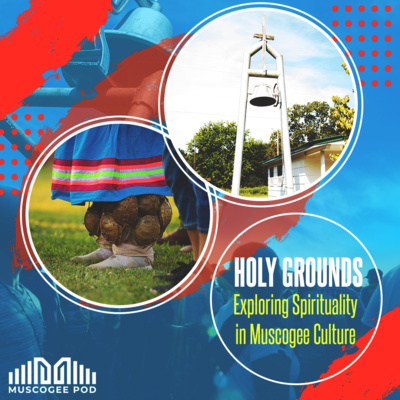
Holy Grounds: Exploring Spirituality in Muscogee Culture
50m 55s
This podcast episode from the Muscogee Reservation delves into the complex landscape of spirituality within the Muscogee Creek Nation. The host introduces the topic of "holy grounds," aiming to explore the often-undiscussed relationship between traditional indigenous ceremonial life and introduced Christian church traditions. The guest, Chabon Cornell, is uniquely positioned for this dialogue as both a clergy member in the Indian United Methodist Church and an active participant in traditional ceremonial grounds. Cornell recounts his personal spiritual journey, describing how his deep study of Christian history and its colonial roots—including debates on whether Indigenous peoples had souls—led to a crisis. This propelled him to intentionally reconnect with and protect Muscogee language, ceremonies, and cosmology from what he terms "spiritual violence." The discussion emphasizes that these two spiritual paths are not necessarily in opposition but require careful boundaries to prevent the erosion of traditional understandings. The episode underscores the ongoing effort to piece together a fragmented cultural identity post-colonization, advocating for respectful exploration of these sacred aspects of Muscogee life.
That's what my hope is. Before it slips out of our hand, we will be able to enjoy the fullness and begin to walk in that harmony again that existed here for thousands of years. We are live on the Muscogee Reservation and you are on the Muscogee Pod. So excited about today's episode, we are talking holy grounds and exploration of spirituality in the Muscogee Creek Nation. And we've got an interesting guest today and it's a very interesting topic. A lot of you have listened and I've talked about it a little bit in other episodes but for several years I did a television show for the Muscogee Creek Nation. We did very similar things that we do with the podcast. We talk to interesting people about different things that go on in the Muscogee Creek Nation but also sort of indigenous life in general and different parts of the culture and how things sort of are similar and then how some things are similar in nature but they're very different in practice. And so when I started thinking about what would be the next episode I went back and started kind of cataloging all the things that I wanted to explore when we were doing the show. And I thought about doing a documentary on this even and sort of exploring it in that way because this is something that's sort of like long form really takes time to sort of break down a lot of the history and a lot of the practice of these things. But I always wanted to sort of do this documentary on spirituality in creek life. And I know so many different tribes are, you know, we fight this a lot in Indian country with like all Indian tribes are the same. They do the same things. They have the same rituals and the same traditions and whatnot. And that couldn't be further from the truth. We're very, very eclectic in just the way that each culture sort of manifests itself. And for us spiritually there's really kind of two choices. You're either traditional or your church. And I think some people are both, some people are one or the other. And that's what was fascinating to me about that. And I always wanted to kind of sit down sort of clergy on this side and sort of traditional leaders and traditional people. That have spent their entire life in that capacity to talk about this and sort of get it on the table and not really talk through anything. But just sort of like we say in the title, exploring it, you know, taking conversation and just sort of seeing where we're at and where there's common ground and maybe where there's misconceived notions or whatever. And so when I started thinking about this episode, I wanted to get someone that's from both worlds. I wanted to get somebody that was involved both in our traditional and ceremonial stomped dance grounds, but also heavily involved in our Native American churches and the Christian aspect in our culture. And I found the perfect person not only is he clergy in the Indian United Methodist Church, but he's also very active in his ceremonial grounds. And that's Mr. Chabon Cornell and Chabon is well traveled around the world. In fact, when I hit him up, we talk about this a little bit, but when I hit him up, it was in Germany. And he does a lot of work at Emory University, but don't want to give away too much from the conversation. But I just felt like that would be the perfect person to kind of explore this with me and talk it out. There are things that we talk about as Native people that sometimes where sometimes maybe we talk about them a little more than others. And sometimes things are kind of just like just under the surface. They're there, but we don't really discuss it too much. So with that in mind, that's what we wanted to do on this episode. We wanted to bring a dialogue on something that is very, very sacred to so many people. In fact, maybe the most sacred. We have traditional stomped dance songs. We also have traditional church hymns. And that's just one example of the two sides to the spirituality and creak culture. And so we definitely wanted to explore that, and that's what we did in this conversation from our reservation. It's holy grounds, and it starts right now. And I'm so pleased to have in the pod cave today a good buddy of mine and a lot of people know him. Mr. Chabon Cornell, and he is clergy with the Indian United Methodist Church, but he's also a member of Hilobys ceremonial ground. Chabon, thank you so much for being with us today. No, it's my pleasure. I know we've been talking about it for almost many years. Yeah, man. It's good to be here. Yeah, no, and you know, that's a little bit before we started. That's kind of what I talked to you about with season two and storytellers and sort of getting down to some of the things that a lot of Muscogee people and Indian people too, in general, there are these things out there that, you know, we know they exist and sort of not taboo, but just not talked about as much in the open and everything like that. And I thought that would be a fantastic episode, and I wanted to find somebody from both worlds, and you fit the bill perfectly. And like I said, I didn't mean to shortchange it because I gave you the lead in, but you do actually a lot of things. You're heavily involved in some of the Muscogee Creek Nation, getting down back into the homelands and having a presence at Emory University there in Atlanta. Talk about, before we get started, talk about a little bit of your work with that and what you've been doing lately. No, I do have my finger in the bowl of a lot of things across the country here. And really, for me, the sole agenda that it goes back to is really the preservation of our place in the world as Indigenous people, as to Jody people, as a Muscogee people. And one of the components of that that has developed over the past 12 months has been kind of these, but I've just coined a term kind of migrations back to our homelands. And I know I've been real sensitive to the diversity of thought on going back. I want to respect everyone's protocol and opinions because some of us, you know, we have an understanding about going back to our homelands. And so the way I kind of articulated it is, I thought it would just be nice for us to know of the rich identity that we come from prior to displacement and dispossession of territories. You know, the intimacy that we had with this earth in terms of plant life, in terms of just sustainable living and on and on and on, is that that's something we've been removed from. And even we kind of have to challenge what has happened in history because how convenient is it for those persons who established the United States, you can say colonizers, for that narrative to be there. For us not to know how many thousands upon thousands of years our presence is there all throughout the Southeast. So that's kind of what we've been doing and connecting with universities, even just visiting sites and beginning the process of let's just dream together what that relationship can look like in the future for our children and our elders in ourselves. Absolutely. And like I said, keep up with all of it. It's going on. It's out in the news and everything like that with what's happening with our partnerships there and everything like that. You've been all over the world too. When I talked to you about coming on this program, I think you were over in Germany. Was that right? That is correct. I was in Germany. I was like, oh my gosh. I mean, I was like, hey, I just hit him up on messenger. I'm like, Hey, Chabana. And he's like, well, you know, I'm in Germany right now. And the first thing I thought was, oh my God, did I, did I just hit you up at like, you know, 334 in the morning. Luckily, I think it was a 10 p.m. or something like that. It wasn't too bad. One too bad. No, got him right before bedtime. But no, I appreciate you coming on today. And like I said, we're talking today about, you know, when people think of the Muscogee Creek Nation culture, language, traditions, things like that. And, you know, with any culture of people, the people that want to talk about them or learn about them or research or whatever, they talk about their religious practices, their religions. And for the Muscogee Creek Nation, we're very unique in the fact that we have a history with church religion and then traditional religion, our creek churches, our, our Muscogee hymns, the rich, you know, heritage and tradition of that and how people still hold on to that, we sing hymns at our events, we, we open things with prayer, you know, things like that. But also the traditional aspect in our ceremonial grounds and the creator giving the ceremonial fires and how that's become also something that people have held on to very strongly. And we talk about, it's not one against the other. I know we have, when we talked about this, the conversation was, you know, it's not this versus this, but there are some that sort of feel like you can't have one and the other and everything like that. So talk to us a little bit about how you were sort of came to be both in the traditional world and a clergy with the Indian United Methodist. I know it's a long story, not trying to be a very short in telling it you go right ahead. At some point we are working on documenting kind of a book that kind of helps to articulate how complex this this moment was in my life and I'm thankful that, you know, starting out as a clergy person. That this was kind of how I was raised, but I'm thankful that, you know, my grandfather and others that we were ceremonial people and so we always had that in our lives. Yes, we didn't take advantage of it like we should have during that time and there was always a preference in my home for being a part of the church. So this was the environment that I was raised in and even, you know, I have several, I mean, just a ton of good memories of coming here, fellowshiping with our other churches, you know, even I have so many events that have happened to me here at our Methodist District Center at Preston, just up the road here. And this was kind of a thinking that was ingrained in me and even I can remember as a teenager, people would come up and say, well, you're going to make a good preacher one day and I said, don't do that to me. I just want to be honest, I just want to be faithful and whatever it is that I'm learning. And as time went on, I actually went to school and was heading to law school. I had completed my undergrad and taken my, taken my LSAT test and that was everything that was getting ready for and all of a sudden I felt something compelling me that it wasn't going to satisfy me. And so at that point I decided to go to graduate school to seminary and it was there that something, I don't want to say cataclysmic, cataclysmic had happened as I began to study the history of Christianity. As I began to even study the origins of biblical text, something happened that I didn't feel like I was told the whole truth. I wasn't told everything about the beauty of who I am as an indigenous person. We still harbor these thoughts that were kind of less than concepts in the church they call it like original sin. All of these things permeate are thinking from Bible studies to sermons, to vacation Bible schools on and on and on and we're indoctrinated with that. And as I did my studies, I began to think, oh, someone didn't tell me that Christianity evolved from a very different understanding. And then even how diverse Christianity is today that there's multiple understandings of how to express that belief system, how to express that spirituality. And at that moment really what had happened was I think I was in theology class but also in my intro to New Testament course and they were going over the origins of like Luke and Acts. And I sat there and we were in class, you know, other classmates, you know, I'm a grown man sitting here taking these courses and the instructor who's a scholar, all of these kinds of things they're talking well, you know, Luke did not write. They're gospel of Luke. No one had ever told me something like that. Why do they call it Luke? And that's exactly what was in my mind. I mean, we had been taught of the concept is inerrancy that this is God's voice talking to our people. And as we went through our courses, we began to examine that it was something a correspondence that evolved over hundreds and hundreds of years. And even thousands of years before it bleached our people, I needless to say I was kind of shocked, almost devastated. I'm like, wait a second. What am I doing here? Right. And when it really hit home was when I began to study the history of Christianity and how it came into this part of the world and that there were actually debates from Spain and Portugal on whether these creatures were actually human beings. Meaning indigenous peoples that they were encountering. And there was a debate that went on in the church. And I sat there with all of this going through my mind like, what right do you have to debate on indigenous peoples ancestors? If we were human, but also the debate was did they have a soul or not and were they worthy of missionary endeavors of salvation? And I was so, you know, more than offended. I said, maybe I need to walk away from this colonizing religion and embrace everything there is about our way of life as Muscogee people, as southeastern people. And in fact, that's really at that moment when I started doing. And I tried to do everything within my power to eliminate that type of in my term that I use is called spiritual violence. I tried to eliminate that from my household so that my children would not have been indoctrinated with those kind of ideologies the same way. And so we started taking everything in our, every opportunity in our power to begin to embrace, you know, look at our language, look at our ceremonial life and to come back to the things that our ancestors had passed on to us. And only by the grace of the creator, we found that opportunity. And today I'm eternally thankful because I wouldn't be here if it wasn't for elders, if it wasn't for those leaders who took time to, you know, give me encouragement in this path. And that was over 20 something years ago. And so here we are in 2022, we're trying to piece together a fragmented identity and history because of colonization because of the term is dispossession but displacement. Everything that has happened in history, I think there's so many of our people were just trying to figure it out. Where do we go now? Yeah. And through tough times, you know, and they say that, you know, when you go through traumatic events, it can change you, it can make you go a certain way, it can make you do things that maybe you wouldn't think to do before. But, you know, we talk about removal and the trail and the songs and everything that came over, but you can easily see how those things happen. What I wonder about when you're talking about your journey and your story and everything that is fascinating to know that that's sort of what crafted it. And that's the conclusion that you came to because that's the very essence of the discussion and the conversation we're having here today is that inner struggle or that, you know, inner turmoil of is going this path, taking away from who I really am. And is who I really am, you know, separating me from God or Christianity or the things that some people hold so dear in their life. And so I kind of, you know, when we talk about that, do you, do you talk to people, I guess, what I want to know is do you talk to people and do you counsel folks that will say, because I am traditional. That's, that was given me that religion was given to me directly from the creator. He handed it down and said, these are your ways. These, these are how you will give offerings to the creator to me as a creator and everything like that instead of where as Christianity and missionary work and things like that. That was just something brought to you and told to you, like, this is the way, do this. Forget about all that stuff that you got directly, you know, a mainline from the creator. There's now a middleman here telling you that this isn't, there's another way that's better for you. Do you come across that sort of that way of thinking and how do you, how do you sort of reason with it? I think that's, I come across that every moment that because I am employed by the United Methodist Church today as one of our, I guess they call them executive officials for the entire denomination. And really, I understand that as my calling to still maintain my presence within Christianity is to help with those notions of, and it's really exclusivism is what they call it. Saying that this is the only voice of God. This is the only way to worship. This is the only answer. And our people all across the country, not just from the Skogi people, but our people all across the country, some are taking it full force in believing that and others are struggling with it. And believe me, we have enough struggles as it is with all of the social economic issues that play guard communities that this isn't something we want to add on it, but it is. And I think it's the source of a lot of pain that we have to work through. So, so for me, as we tried to do the best we can to protect our way of life, something that still is under threat, our ceremonial life, our traditions, what I've tried, what I've had to do is try to make a healthy boundary between the two faiths. Because it is my opinion that Christianity has already influenced our ceremonial life enough. And not just the Skogi people, I do worship with other communities, whether it's sweat launch or whether it's Native American church or the peyote religion. My been elders have been kind enough to invite me to those types of prayer services and worship services. And I've seen an enormous impact of Christian understanding into each individual cosmology. And so that's kind of something that really concerns me as we try to protect really the concepts that we've held since before contact with any person. And right now, with any colonizing entities, and right now, those are kind of under threat, is that even as we try to, I know our linguists, we have some Mahayas here, even as they do their teaching, it's real easy to say to use an English concept, to give a definition for a Skogi word. It's really cumbersome. So I've tried to make a boundary to say, here's where we believe. So if you visit us at ceremonial ways or you see me or hear me share some words, it won't have anything. Christian connotations or anything because of the sanctity of our way of life. You realize where it separates. I realize where it separates. And even sometimes it gets a little clouded. Oh, no, and I was just about to ask you, you know, you said you recognize the ways that ceremonial life has been influenced by the other and how maybe the other influences and vice versa, really. Can you kind of go into that a little bit about how you seen that? Yes. And even just the concept and where I, what I've talked with my family about is even like concepts of the afterlife. You know, when we think of this spirit, how do we delve into the spirit world or this other place, this other town, that, you know, I've seen it even interpreted easy. Oh, it's just heaven. It's heaven. Well, heaven has different connotations if you say it that way. And I've seen that many times, you know, and just for the sake of time and the sake of just being able to give it some type of translation. And even in the concepts that I meditate about, and this isn't something that I do to convert people by no means. It's just something I think about when I think of these mentioned our Muscogee hymns, and we have the, you know, the song of Jesus Miko, that in our elders, in our ancestors, that were first language speakers for generations, they had a different concept of a Mikogee and what they meant and what they stood for. And so I often think I wish I could have these conversations and say, well, how did you understand this historical person of Jesus as opposed to modern translations of the concept of Miko, which is like they like to say King or something like this. And that's not, that's really foreign to our cosmology as Muscogee people. So those kinds of things, you know, we're not here to dominate, you know, to be kingly over lands and have subjects. That's not how we understand things. You're saying the tables round. There's room for all of us and an equality at that table. I get that. And I, like you said, there are those things because I do, you know, whenever we do have, unfortunately, a loved one pass and it's a loved one from a very traditional family. And I don't, and I don't want to say the word like reject here, but they just have a mentality of, you know, we don't, we don't do church. We do stop dance. And so, but even in those families, when there's a death, the terms of, and the terming of, you know, they're going to be with the ancestors. They're going now to be with all those that have gone on before them. I do see what you're saying there because it's the exact same concept of a Christian heaven. You know, where you're taught that that's what we will do now. We will, we will leave from this life and will go be with everybody again. And so there are those similarities in there. And I think you can take from, like you said, you can take from both of them and have a happy existence. I mean, you're living proof. I'm walking the, the path as best as I can. Yeah. And it's kind of funny that we're not funny, but it's, I thought you were going to say you're walking the red road. We do have concepts of that red, but it's kind of convenient or it's important that you brought up death because we do have ways in a ceremonial way of acknowledging that passing from this moment to the next moment. That's embedded in our speeches that, that we give. But that's probably one of the areas where it has become clouded because my, my companion in our years and years ago, she kind of teased me and we joked about it. She said, you know, you're going to be the one that, because I've gone through this training, I have this experience that does the weddings and the funerals of our traditional people. Right. Because I have that experience in both contexts to know how to respect our way of life. But then I have the formality to say, oh, you know, we need a obituary, we need this kind of thing in place and to meet with funeral homes, that kind of thing. And as sad as it makes me, that's coming to fruition today. And I have had families who they didn't want, not want anything that was Christian or the church included in that, including the hymns. And I've been able to help out as best as I can. And in that case, what we usually do is we have speakers that come up and share and we made it through it. But then there's been others that I've even seen some of our own traditional people. They're okay with just doing it in the same format and the church with hymns, sitting up that kind of thing. And there's an understanding there with some with some. And even the beautiful thing, and this is where, you know, we really need to immerse ourselves in this day and age back to our language and our way of life, that even in some of those church hymns is the cosmology of Muscogee people, is the beauty of who we are, is us praying, is us encouraging each other that we do find in ceremonial life. And that's one of the beautiful things that, you know, some of our, you know, some of our young people in their pursuit to really kind of have a radical message about colonization and decolonizing is what they say. They missed that point that there's concepts that bridged over that even non-native American people couldn't see non-Muscogee people couldn't see that, but our people did. And I think that's a great point because we can focus all day long and some people like to on the things that separate us, divide us and that don't keep us together. But if we find, I guess you could call it a common holy ground, I think we find ways that where we're both similar, you reach that consensus a little bit better and it's a little bit easier to have that understanding. Let's flip it real quick because we talked about, we've already talked about, you know, the traditional people that may look at the church and go, oh, you know, that's really not the right way, that's not for me, that's not, we were given that by the white man, we were given that by a missionary, it's not what we were supposed to have. Let's flip it the other way because there are church folks that look at the traditional world and say, you know, that's witchcraft, you know, that's dancing around a fire, there's elements of that that I can't, you know, reason with as a Christian person. And we know that exists. I mean, I'm sure you've heard that too. How do you do that with members of your, you know, congregation or people in the Christian side of things that will look at traditional ways and look at them as, you know, I can't be a part of that because it's, it will literally, you know, take my faith away from me. I will note as we're flipping the context just a little bit that over the decades and years, I've never really heard a broad hostility from traditional people to the church. I've always felt there was a love and a respect for those that chose to worship that way. And I have seen those that have kind of done both as they best they could. Now, that's not necessarily something that I'm saying is going to be best for us because I really feel that the beauty in our way of life is sufficient enough. If we begin to understand the wellness that it projects into our lives, that's all we need and we don't need anything else. Now to go to the church, I have heard that time and time again. And even, you know, there was a time when we were practicing fully, you know, these things and I was serving a congregation. And I would leave and head straight to a Sunday morning service. It was over time when I said, well, I can't keep doing that because why am I doing that? And so this is where we began to iron out things now. What is it that you believe in your walk that you found in Christianity? Because one of the things that we began to look at as people who have been missionized is that we were forced to believe one way of Christianity, not even understanding that there are thousands of beliefs all across the world. And this is something that I only began to be exposed to over the recent years. Yes. And, you know, when I looked at the form of Christianity that is being executed in Native American context here in the United States, it's very much one of dominance. It's very much one that's territorial. And in many cases, it is this kind of abusive relationship that this is the only way to believe. And out of that kind of context, you hear these comments that says you can't do that. That's evil demonizing, you know, these types of things. And so that's where my scholarship is kind of centers around is that what was really going on in that ancient world that after three centuries birthed Christianity that, you know, even in the ancient world, if you talk about, you know, it's supposedly based on the life of a person named Jesus. If you look at that moment in time that it took three centuries before the context of Christianity became the church. If we were, if the United States was in that ancient world, we would not be the church yet because this country is only 247 years old, something like that. And the first rules that were established that began was under the Emperor Constantine in the fourth century, three 25 common era. So just to give you some context, when it came here, we were told this is how it's supposed to be. You guys got it wrong. Even though our cultures had been here for thousands upon thousands of years and even what we've done is now because of scholars, because of our people all across this country and the world, we're beginning to put the pieces back together of what was really going on when missionaries and countries wanted to explore. It wasn't for the benefit of the human species. It was for financial gain. It was to commodify resources. It was to take land. It was to take resources. Absolutely. And even, that's even more so after this past year, we've been studying about, the world has been studying about boarding schools and residential schools. We see that embedded in the Bureau of Indian Affairs report that came out in May where it said the major policy behind that process of taking our children was the dispossession of land to take us from everything. Even you think about our children were forbidden to talk their language, even embedded in that language is an intimacy with this mother earth that teaches us day in and day out how to respect each other, how to respect the role of indigenous women in our language. And it was taken from us. And there were so many things done in that era that are verifiable in those reports. We knew them before the reports came out. Absolutely. But there are so many things from that era that were done under the guise of good intentions like we are trying to better these people. We're trying to save the man, if you will, member of the old saying there, by converting them away from sort of a life of uncivilization and getting them to where they can thrive and live in this world. But like you said, there's always that there's always that ulterior motive back there. Basically, the execution of it was way off, but it all sounds good, right? I mean, in a utopian world, that sounds like you're doing you're trying to do some good, even if you did bad, it sounds like your motives were there. But we always find at the end of it, though, there's always got to be those ulterior motives, like you said, the taking of land, the erasure of the people. Basically, wanting what's there for you, but in convenience for us, there's already some people here. Yes, absolutely. I mean, you cover a lot of that probably in your study. I do, and even there's times when we, I'm asked to teach courses, so like graduate courses where we start piecing that together. It goes all the way back to Christopher Columbus. It goes all the way back to the church issuing papal bulls in the 15th century, two of them, that in essence gives those explorers the right to seize properties that is deemed pagan or sericent as the terminology that they use. Or property that's non-Christian, and so that's the justification, and that's where it began, even the stealing of human people into the slave trade, and on and on and on that has led it to us here today beginning to resist, rebel, and reject those concepts. Man, this conversation we're having today, folks, I'm not going to try to just give us a plug for nothing, but this is why you've got to listen to the Muscogee Pod. I mean, these are things that we all have known and have been out there that we just need to start having conversations on. I mean, you know, there's been so many points that you've made today that I never even thought of that when I, and I've thought about, I told you about this, I've thought about this issue for as long as I can remember, because it was always fascinating to me. When people ask about, you know, the Muscogee Creek people, it's like, what religion do you all practice? And I go, well, there's kind of two of them, you know what I mean? And they kind of, sometimes they coexist, sometimes maybe they don't. And until you actually talk about it, you really don't sort of get the ball rolling. And I wonder, you know, we're having this conversation today, Chabon, but how much is this conversation being had as you all in the top levels of the ministry in Indian Methodist Church? How much are we tackling these issues on that level when we have conferences, when we have, I mean, are we talking about it at that level or is it something we probably need to even get better at and talk about more? I think in this day and age, now it kind of depends on who you're talking to. If you see someone like me doing the things that have been asked to me by my community, I'm always going to carry it with me and bring it to the forefront. And what I'm finding is that there's a hunger for more of the honesty, but also in conceptualizing, how do we build a future together for our people that doesn't do harm? I sit here and I think about all my relatives, all the people that I serve in the ceremonial world who have lost their lives to violence, who have maybe their substance abuse there that we need more opportunities to heal and to come out of those situations, not less. And so I carry it with me everywhere I go. And I'm thankful that because of that, I'm seeing, you know, non-native American entities, agencies who are at the forefront who are trying to do things like giving land back. My offices have helped with the returning of acreages in a wine dot country and also we're trying to get it done in a black-feet country, but they're also partnering with other entities that are affirming the giving of land back. And how do we piece back together our cosmology as people who have been colonized? And I think that's the biggest burden that I carry is that we live in a world today where social media is dominant, even as we're talking on a podcast. That, you know, we have people out there who believe that they're influencers and they have a right to be cultural informants, but they haven't been raised around our understanding of life. And that's really hurtful today because I don't want to be mean, I want to encourage people, but they don't know the things that our elders had passed on. And so that's something that we have to be very delicate and respectful for, but also understand that if we weren't raised a certain way or had these voices nurturing and cultivating us year after year, and like I said, even I only sit here because there were people kind enough to walk with me. Over the years, you know, I think about all my old preachers, you know, I think of the John Rose, the Harry Longs of the world, who they were persons who sat down with me. And you know, even just singing are hymns that they would print it out for me. I remember sitting there and he had a chalkboard. And you know, even back in a similar nation country, I'm a Gene Harjo, you know, sitting there at the, I was a little kid putting a chalkboard up there just saying, here's our songs. And, but it's time that, you know, we have to do our due diligence while we still have a moment to say, here's what it means to be Muscogee, this is our way of life. And so that's what my hope is, you know, maybe this podcast or however we can keep pointing back to how we're supposed to exist, because, you know, my hope is that, you know, we would continue to have the same fellowship that informed us in the old ways. Yeah, where we sit there, you know, maybe it's overnight, maybe it's visiting another ceremonial ground, maybe it's over the breaking of bread and eating a meal together, maybe it's just having an event for our children where there we just watched them laugh and enjoy life and be safe, the way they need to be safe. Those kinds of things were the environment, you know, that we were in every moment and we began to figure out things and today in today's world, you know, we kind of see that being altered massively with everything that goes on and I don't even keep up with it. The way I should, but with the media president, social media president. And it sort of goes along with society as a whole right now. It's like everybody's being asked to choose one side or another, you know what I mean? Are you red? Are you blue? Yes. You know, are you black? Are you white? I mean, are you for this side? Are you for this side? Because you can't be both. You've got, you've got to choose and then once you choose, you got to put your head down, dig your feet in the ground and be stubborn about the fact that you're not going to be open to any other ideologies. Or any other sort of worldviews or ways of thinking that runs right along with what you're saying the fact that, you know, reject that what I'm saying is reject that way of thinking people we cannot continue to be in those bases because we can go nowhere as a society as long as we continue to do that. That's my Ted talk for no absolutely. It's going to invoke more commentary for me. And I think, too, what you were saying about influencers and people doing podcasts and everything like that. Look, I'm nothing. I'm literally somebody sitting here trying to find the best people to come on here because they are the ones that need to tell these stories. They are the ones that know what they're talking about. That's why I get you Chabon. That's why I get people like Ed mouse and them that were there when the Constitution was drafted. It's not anything about, you know, the host or anything. It's about the content and the guest and what they're getting out there. And that's why we try so hard to come up with the best episodes. We like to to us were like, as a Muscogee citizen, let's just try to crawl into every head space of Muscogee citizen out there and think about what are some of the things that they want to hear a park bitch conversation about, you know what I mean. And so that's kind of what was our way of thinking. And I think, man, I'm just so appreciative of your courage because I'm telling you, not everybody would talk about these things. Especially sort of the discrepancy between one and another and how they can get muddied and how there can be a little bit of, I don't want to say conflict, but just differences that get in the way of each of them. And when I started thinking about this episode, I thought about the episode first. I thought about the subject matter first. I didn't think about the guest. And I just started racking my brain for everybody that I knew that sort of had an interest and a vested life in both things. And our principal chief is one of them just like you that is very much active in the church and the ceremonial ground. And is that brain ceremonial, but he's also in church. And so I started thinking about people like that. And I'm like, I know I'm not going to get chief, you know, he's already been on the show. People see him enough, you know, he's got his picture out there enough. But man, I said, I got to get a hold of your bond. And I was like, man, I hope he's not in Germany. No, I'm just kidding. And there you were, you know, I'm like, he's like, well, I'm on the auto bond right now. And I really can't know. But no, but I just really appreciate your willingness to do this. And I think right off the bat, like right when I asked you, you were like, yep, because that's something we need to talk about. I think I just know there's a need. So it's so great of just trying to put the pieces back together. You know, even I've talked with even Dr. Monty Randall at the College of Muscogee Nation and just contemplated and dreamed what would it be like to have some type of biblical literacy courses that can help our people. Because I think this is the dilemma that we're in is that we only receive, well, in many of our churches, we don't even go through educational processes before we serve in the pulpit or in the capacity of ministry. And the way that I look at that is because of the history, I think everyone has to go through some type of training before you get up there. One of the things that I have been a part of, many trainings over the years, I've been a part of the white, bison organization, well, variety movements. And one of the things they talk about is that the attitudes and perceptions that surround us every day formulates our belief system of ourselves and the world. And if we're hearing something every day, then that's what we believe. And so it's been my, my, my pursuit is to surround us with continually inundating with our people that we have a right to exist, we have a way of life. And even if those that choose to stay or to find a spiritual home in Christianity, ask yourself why? Because in this day and age, in my opinion, it's insufficient and this might make some people upset, but I don't mean it in this way. I say it out of the love of my heart is there's more to it than just heaven and hell. In fact, if you do your scholarship, if you do your studies, you'll start to see there was a broader vision of what this movement came out of, of working for equality in society, working for justice, the role of genders in the ancient world. And all those things that we're still working for today. So there's a way you can express yourself in this Christian movement. But what I say is that don't perpetuate the violence, don't perpetuate the harm that we've seen generation after generation. I mean, I mean, there's so many concepts that when I was serving a local church which I've done for over a decade, I would have sermons, I would have teachings that talked about the multiple and even linguistic differences that were translated as hell. And I would say, well, here's this, this is what's out there. And, you know, let's build something together in our belief system. Not simply just because mom and dad, grandma and grandpa said you have to do this. And even I was one that less my mom, she's passed on now, but she raised me that way. You didn't go to church today, banging on my door and it's like, oh, I'm sorry. I'm keeping up. You got that attendance record. But I ask, tell me what you're looking for. Because if you walk in that faith and you say, I'm going to give water to the thirsty, I don't have a problem with that. I'm going to give food to the hungry. I'm going to show kindness to our children. Then I don't have a problem with that. But it's when it becomes violent and you start to say, well, you're over there worshiping evenly. You're over there worshiping. I mean, I have heard concepts like worshiping the devil. And I sit down and I'm like, well, no, I'm saying this is something like we were created this way. We were given this way. And so this being that Christianity calls God, we have our own words in our language that we reflect to this energy, this power, this deity. And so what you're telling me is that if we were meant to be someone else, if we were meant to speak another language, that deity, that God made a mistake, we have a way of life. And I'm not a mistake. We're not a mistake. We have a way of existing in this world. And that's what my hope is before it slips out of our hands that we will be able to enjoy the fullness and begin to walk in that harmony again that existed here for thousands of years before this 247 year old country came around. And I could go further into that. But I'll pause there. Relatively young. Chabon, Colonel, you are a complete community servant within a heart for the advancement of your people. I can't tell you how much we appreciate you coming in and being with us on this episode today. And I know you're a busy man. So I'm not going to hold you up any longer. But I just can't tell you how much I appreciate the conversation. And I literally, I hope we can do it again. I hope we can do this a lot. Because I think there's so much education that can happen in these kind of conversations and so many things that can enrich people's lives to hear so many different histories and perspectives and all of that come together to reach some common ground. Absolutely. Thank you, Jason, for the invitation. And it's my my pleasure to do whatever we can to make this walk of life a little bit easier for each other. So I'm just happy to be here. And our thanks to Chabon, for joining us in the pod cave and really breaking down something that, like I said, for many years, I wanted to talk about that, explore it, get it on a kind of mass communications level to where a lot of people can hear the conversation or, you know, just sort of take away from it what they will. And I think that's what I want people to do just just sort of listen and to the conversation. And then, you know, one thing is we're not saying that there's a right way, a wrong way. This is the better way. This is the preference, anything like that. I think, you know, as is the case in lots of people spirituality. I think it's up to you as an individual. What your path is. And I think it's very beautiful in our culture as Muscogee Creek people that we sort of have these two wonderful things to where some people, you know, sort of subscribe to this way of thinking and others this. And some people both. And I think that's what's really cool. And that's why it was so important for me to get an example of somebody that says, you know what, I do both. And it feels my life with what I need from that aspect of it. And so I thought, you know, that's definitely the kind of guests we want to get. And so I want to thank Shabon for coming in and being with us on this episode. And, you know, I think to this will be one of those episodes where I just, you know, it will sort of age well, you know, people can always come back and check it out and everything like that. So that was important to me too, you know, always getting content that, you know, just kind of will hold up and the subject matters is always going to be there and that, you know, spirituality for us. It is always going to be there. It's who we are. You know, all of our, you know, Creek hymns, things like that. And even the stomp dance songs, they tell stories, you know, and they tell sometimes they tell stories of joy and triumph. But other times they tell stories of struggle and trying to get to that joy and triumph. But it's all, you know, sort of food for the soul, no matter which way you slice it or which side you would you subscribe to or any or if you do both. So I think it was very helpful to have that conversation and we're glad to be able to do it on the pod today. If you're out there and you like the storyteller series, we're glad that you've been joining us for season two. We're well into season two now. We've got some great content in the last two episodes, but we got some great content coming up on a lot more things. So you're going to have to stick with us and you're going to have to tell people out there that you know podcast. Check out the Muscogee pod, you know, subscribe and give us a rating. Let us know how we're doing. And it's always good to hear from people on social media too. A lot of the folks that I've talked to that listen to the podcast. They really love it, but they also, you know, they're it's neat when they when they say like, hey, what if you tried this one or like I was always wanting to know about this and sometimes things, you know, you throw a bunch of things on the wall and some of them stick. But some of the things are really good ideas. So that's a big part of what we're doing, you know, we want to hear from you want to input. We want you to be engaged want this to be your podcast want you to feel like that ownership in it. And so definitely whenever we post or we put out a promotion or whatever feel free, you know, to throw things out there that you'd love to hear because really it is about the audience. And we want you to, you know, always be able to say, hey, when I need that when I need that content or that entertainment or whatever, however, I look at podcasting whether it's something to relax me, something to, you know, get me through those delays at the airport or chores around the house, whatever we want to be able to make that a time that goes by with some, you know, some content that really feeds your soul and makes you think and makes you talk with others around you. And have conversations. That's what we're all about here. So we're going to get out of here. That's our time for this week. And we're certainly happy to be able to provide this for everyone we hope you enjoyed it. Let everybody know and keep sharing us and keep the good word going about Muscogee pod. And these are conversations from our reservation. We'll see you next time.
Podcast Summary
Key Points:
The episode explores spirituality in the Muscogee Creek Nation, focusing on the coexistence and tension between traditional ceremonial practices and Christian church traditions.
Hosts interview Chabon Cornell, a figure uniquely involved in both the Indian United Methodist Church and traditional stomp dance ceremonial grounds.
Cornell shares his personal journey from a Christian upbringing to a crisis of faith upon studying colonial history and Christian origins, leading him to actively reclaim and protect traditional Muscogee spirituality.
The conversation highlights the challenge of preserving indigenous identity and ceremonial practices from Christian influence while navigating a community where many people engage with both spiritual paths.
There is a focus on the importance of dialogue, understanding the distinct cosmologies, and addressing the "spiritual violence" and exclusivism imposed by colonization.
Summary:
This podcast episode from the Muscogee Reservation delves into the complex landscape of spirituality within the Muscogee Creek Nation. The host introduces the topic of "holy grounds," aiming to explore the often-undiscussed relationship between traditional indigenous ceremonial life and introduced Christian church traditions. The guest, Chabon Cornell, is uniquely positioned for this dialogue as both a clergy member in the Indian United Methodist Church and an active participant in traditional ceremonial grounds.
Cornell recounts his personal spiritual journey, describing how his deep study of Christian history and its colonial roots—including debates on whether Indigenous peoples had souls—led to a crisis. " The discussion emphasizes that these two spiritual paths are not necessarily in opposition but require careful boundaries to prevent the erosion of traditional understandings. The episode underscores the ongoing effort to piece together a fragmented cultural identity post-colonization, advocating for respectful exploration of these sacred aspects of Muscogee life.
FAQs
The episode explores spirituality in the Muscogee Creek Nation, focusing on the interplay between traditional ceremonial practices and Christian church influences.
The guest is Mr. Chabon Cornell, who is both clergy in the Indian United Methodist Church and an active member of Hilobys ceremonial ground.
The host emphasizes that Native tribes are not all the same; they have eclectic cultures with unique rituals and traditions, contrary to common misconceptions.
During his seminary studies, he questioned the historical narratives of Christianity and felt compelled to reconnect with his indigenous roots, leading him to integrate both traditions.
He refers to the harmful indoctrination of ideologies like original sin in Christianity, which can undermine indigenous identity and spirituality.
He establishes healthy boundaries to protect traditional practices from Christian influences, ensuring concepts like the afterlife are understood within their original cultural context.
Chat with AI
Loading...
Pro features
Go deeper with this episode
Unlock creator-grade tools that turn any transcript into show notes and subtitle files.
 PodcastTranscript AI