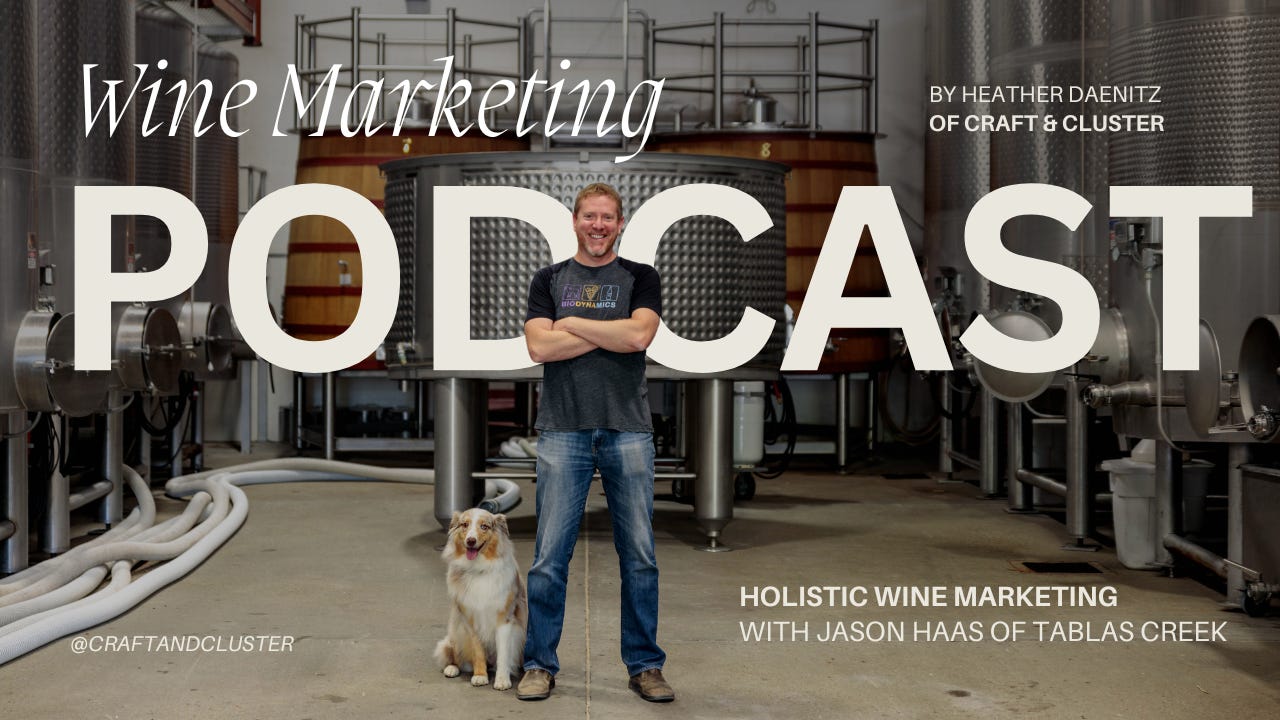
Holistic Wine Marketing with Jason Haas of Tablas Creek
59m 10s
In this podcast episode, Heather Danetz interviews Jason Haas, partner and general manager of Tablas Creek Vineyard, about their innovative marketing and community-building strategies. Jason credits long-tenured staff and a culture that encourages career growth and cross-departmental collaboration as foundational to their success. He discusses the winery's blog, started in 2007, which mixes annual cyclical topics like bud break and harvest with reactive thought pieces that often generate the most engagement. The blog personalizes the business and builds relationships with writers and consumers alike. During COVID, Jason launched an Instagram Live series featuring team members and later external guests like authors and winemakers; it continues because he enjoys it and it fosters meaningful industry connections. Jason also explains the inspiration behind their premium boxed wine, which came from a carbon footprint audit showing packaging's major impact. Despite initial skepticism, the $95 box sold out in hours, and while it faces critiques about plastic, Jason argues it's a better alternative than glass given current recycling limitations. He highlights their Regenerative Organic Certification as both rigorous and broad, making it easy to communicate without greenwashing. Finally, Jason advises smaller wineries to focus on authenticity—sharing what they care about and worry about—but to have trusted advisors to guide what's appropriate to publish.
Hello and welcome back to the Wine Marketing Podcast. I'm your host Heather Danetz and today I am joined by Jason Haas, who is the partner and general manager of Tablets Creek Vineyard in Passerubles, California. Hi, Jason. Hi Heather. Thanks for doing the presentation. Thank you so much. I've talked, yeah, I'm so glad to have you here. I've talked a lot on this podcast and just kind of like in general on my social media and everything about how much I admire you and Ian and everything that you guys are doing with the marketing at Tablets Creek. I mean, I feel like you guys are the gold standard of DTC marketing and community building in wine. So I'm so excited to have you here to kind of dive into that a bit. Well, thank you. So I did talk to Ian on the previous iteration of this podcast back in 2021 in Console, who is the your director of marketing. And we kind of we talked a little bit about everything, but we also talked a lot about why company culture matters. And I think that that's like a really something that I noticed a lot when I, you know, being a third party that comes into a winery setting, I can tell right away if people actually like working with each other. And it's so clear that you guys love working with each other that you have a lot of fun with that. And so, um, guy, just again, I feel like I'm just word vomiting all of the things that I love about Tablets Creek. So one of the things that we inherit really from my dad is and it's true really in every business that he started is that he figured out a way that people could make a real career in the businesses that he started. So the like super long tenure at places is something that from the import company that he built to his short stint as a wholesaler. Like even then, like there's people in that company who are still there 40 years after he was, he was working there. And then at Tablets Creek, we've got a lot of people who've been here. Like I've been here 23 years and we have a lot of people who've been here longer than I have. I think building a place where people first of all feel inspired to contribute to what the goal and mission is of the company, but also within which they feel like they have the ability to grow and to advance their own careers is such an important piece of it. You need both, I think. Yeah. Yeah. I agree 100%. I mean, having long tenure, inspiring people to be involved in all aspects of the business is really just takes things to the next level because I, you know, I know some wineries and some companies in general that they've had folks that have worked with the company for a really long time, but they're still so disconnected from like each department, other departments that are not their own department. And it's, it's clear that when all of those things come together, it just works so much better. So that's another thing I just really admire about you guys. I feel like you, you really have buy in from, from everyone on your staff. It's something that I feel like maybe happens more normally when you're little and you have to be more conscious about building as you grow. It's been one of what, one of my main focuses over the last decade is as we've gotten a little bigger and a little more specialized. We actually have a marketing department. We didn't have that 10 years ago. Yeah. And as people get sort of head down in their own projects, just taking the opportunities to remind everyone what the big picture is and why we're all on the same team and, and creating the, the opportunities that happen organically in a, in a small company to share what you're working on and share your excitement and share the things that like maybe you don't know how to address and realize that everybody else on the team, like even if that's not their specific area of focus, chances are pretty good that they'll have thought about it at some point and have some suggestions that are useful. So it's, it doesn't just happen and, and, and it's something that I feel like we've had, we've recognized that we've had to work on and we've worked. Well, I appreciate that about you guys because they feel like you're, you're always continuing to innovate and from the virtual tastings and the Instagram lives that, you know, we're going to get into a little bit later. But then also the boxed wine and the wine club share program that you guys have become a part of, it's really, I just really, yeah, I really appreciate that you're always bringing those, those ideas in and, and being receptive to that. And then, and also fostering a culture where that's possible and intentionally fostering that culture. I think it's important to remind people that there is always something next to do. You can't just do what you've always done and try to do it a little bit better, though I am a huge believer in that. I'm a believer in the power of incremental improvements. But still, and that's one of the things that I mean, I'm fortunate for the great people we have in charge of the different departments that they, that they do feel that they still have room to innovate. And I feel like a lot of my job is to, to make sure that they know that that is not just permitted, but encouraged and will be supported because there is always something to do. Yeah, absolutely. Well, I think that kind of leads us pretty well into a couple of the questions that I have for you here. So I find that a lot of wineries are, they're really focused on kind of like immediate sales or short-term tactics. But I feel like Tablus Creek does a really, really good job of being patient. And as I said earlier, very intentional about how you're marketing and innovating with Tablus Creek. Where does that come from? And, and how do you kind of balance that long-term vision with like the short-term needs? Um, I am, I'm really stubborn. It's one of the things that I know, I know about myself and I have to work on is that I, I am not very good at saying, okay, I am no longer willing to do that. And so it does mean that I have to make sure that I am careful about the things that I start because I don't just do something a couple of times and then be like, that didn't work. I probably should be better at that. But I do think that in a lot of cases, those goals are not in conflict with one another. It just may take a while for some of the longer term things to show up in the results. Like one of the great examples I have of that is, is the blog that we started. I started back in 2007. So it's been almost 20 years. And I remember it was like a year in and I had gotten, I think two comments on posting a blog every week. The, the reason that I started it was I had had a conversation with Mark Perran, one of the, one of the members of the parent family who, who we are partners with in Tobels Creek, and they had done a blog for Fermi Perran back, starting in 0405. And he said, you should really, you should try a blog. It'll be great for your search engine positioning. And I'm like, okay. That sounds like it makes sense. Why not? We'll try it. But it turned out that I found real value in sharing the things that I was excited about sharing the things that maybe were keeping me up at night, sharing the things that I thought that people deserve to know. And so just the writing process was valuable. And I'm not sure that I could have told you at the beginning what the marketing goal was of doing this other than the search engine piece. But it turned out that one of the, one of the audiences that are interested in writing about wine are other writers. And so it ended up helping me build these connections to other members of the wine writing community. So that was again, not anticipated, but it was it turned out to be the first real value of it. And gradually we built it up into things that are valuable to other wineries, things that are valuable to other wine lovers. And then once social media came about all of a sudden, like the demand for content became so great that all of a sudden it was very clear what value the blog brought. But again, it was something that I was doing because it was of interest and of value to me personally. And I figured that in the long run, we would figure out how to make it valuable to the business. And I think there's lots of things like that where if, if it's something that somebody cares about, it's something that someone is excited about, I'm happy to have them dive in and we'll figure out how to make it useful later. But I feel like those are sort of separate things and not neither in conflict with, not in conflict with at least the shorter term goals of marketing and sales. Obviously you have to have promotions or things that bring attention to the wines you need to sell. You have to have, I'm a huge proponent of posting something every day on our, our social media feeds because it's mind share that you're competing for. Those things have to happen. But it's not like they have to happen to the exclusion of of these longer term projects, like the blog, like video projects, like any of the other bigger, bigger things that we've backed it. Yeah. Yeah. I mean, I love your blog. I'm in this is coming from somebody who also enjoys blogging. And it's exactly what you said. It's like the things that are keeping me up at night, the things that are just running in, in the back of my head when I'm out with my clients or like just out in the world, experiencing marketing from other companies as a consumer. I'm just constantly, I have like all the stuff in my head and it's a means for me to get out and, and, you know, and of course, the benefit of the, the SEO and all that. I'm wondering with, with the blogs specifically what, as you said, it's the things they're keeping you up, but it's also
What are other things that help you decide what goes on the blog? There are some things that happen every year. That's one of the nice things about being a part of a business that's on an annual cycle. There are things there every year you have butt break, every year you have a variation, every year we do blending. So probably we try to post every week and of those 50-ish posts a year, probably 30 are some variation of something that happens every year. Obviously every year is different and in many ways it's the opportunity to contrast what's happening this year with what may have happened last year or previous years that gives a particular post its relevance. You can't write the same thing. Here's what variation is. You can't just write that every year, it's boring. But you can talk about how variation, introduce people to what variation is and then talk about how variation this year compares with variation in previous years, what got us there, what that means. There is an annual cycle piece. We also try to do these series and this is something that I think is important in social media also. You don't want to have to come up with a new idea every time. So one of the things that we do is we've figured out ways to work through our library of older wines. So at the beginning of every year we do a horizontal tasting. So a tasting of everyone that we made 10 vintages ago. And then I write that up on the blog and that becomes the starting point for a public tasting that we do in February. Every summer we do a vertical tasting. So pick one wine and do every vintage that we made of that one wine and then write that up on the blog and then that becomes the beginnings for a vertical for a public event that we do for our micro members and their guests. So that's not again not the same piece but it's the same idea. Every year we have a wine clubs shipment in the spring and a wine clubs shipment in the fall. Like we do all of the tasting notes for that. That becomes a block piece. So again, there are cyclical things that mean we don't have to come up with ideas every time. But I think those and then there are the periodic show people what's going on in the vineyard like take it's so visually appealing. How do we bring people into that world? So that happens probably maybe not quite once a month but every six weeks or so throughout the year. And so that leaves maybe a dozen posts where I try to do a deep dive into something that I haven't talked about before. And sometimes that comes out of panels that I'm asked to speak on. And sometimes that comes out of news of what's going on in the world of wine or in the world of wine business. Sometimes it's an article that I've read that just seems like it demands a response. So I find that those are the ones that are the most valuable over time. They may not be the ones that are the most relevant to our marketing in the short term. But they're the ones that I go back to and that I find often lead later to invitations to speak in other places or the most engagement on some of the more business related forums, the LinkedIn's and some of the other wine business sorts of forums. So there those are the ones that take the most time. But they're also the ones that end up I think having the longest lifespan and being the most valuable. Yeah. Yeah. I've got to start to when the, you know, again, I keep saying this with like the things that keep me up at night, the things that things that I need to respond to because of something I read or something I experienced or whatever those are the articles that I've written on my substock that just perform the best. They get the most comments. They get the most shares from people. I get like a ton of emails to responding to them, which is really, always really, really fun to get that. So yeah, I agree. I agree. I think those are also, I think maybe the most fun for people to read because it's sort of like a peak inside your brain. A lot of people will talk about the seasonal things that are going on and there's only so much. And that's like a whole other question that we could get into is like, how do you, how do you take these cyclical things these, you know, feel like if I write another post about bud break, I'm going to lose my mind, you know? So I, how do you take those things that are different or those that are the same and make them different every single year? So I find that the ones that are sort of like spur of the moment, almost like reactive tend to be the most fun for me to write and then the most fun for people to read. Are you experiencing that as well? It's interesting. I did a, I did a blog. I think when I got to the thousandth blog post that we had put up that seemed like a milestone worth celebrating. So I did a, kind of a dozen highlights from a thousand blog posts post last year. I, I almost all the ones that I picked were ones like you described and like we just talked about. They're the ones that were these thought pieces that were in response to something, something important going on in the world. They're in the world of wine. And those are the ones that stick with me. But looking at the comments that I got on that post, there were a number of comments that were along the lines of, yeah, these are great. But the ones that I really look forward to are these beautiful pictures of your vineyard and what's going on in your world. So I think, I think they're valuable in different ways to different audiences and the variety is one of the things that's important. And what's one of the other things that I've learned is that it takes a while to find your voice when you're blogging. Of course, it also, it has to feel like you are talking directly to someone and it takes a while for a voice for you to figure out what that voice is. It took me about a year and a half, I felt before it was comfortable. More and more, we've also incorporated other people's voices in the blog. Other Tablets Creek people, I think we've had at this point maybe more than 10 people who have contributed at least one blog and a number of whom have done a series starting with my dad, of course, but not just. And everybody's voice is going to be a little bit different. And in a blog, that's great because one of the values that a blog does, I think this is one of the values that social media can have done right also, is that it personalizes a business. It puts a personal face that people can relate to because people don't relate to companies. I don't think it's sure you can have a, you can have a specific ethos, you can have a specific look and feel, but still people relate to other people. And having that voice, having the opportunity to communicate that voice is like what a privilege that we've actually developed an audience that wants to read my thoughts on all of these things. And our thoughts on all of these things, I don't know that answered your question exactly, but I think that different sorts of posts have different sorts of value to different sorts of people. And the audience for wine is very heterogeneous. It's not a single audience member. They're different ages. They come from different aspects of the industry. I know I have writers who are looking for something different than consumers who are looking for something different than people who work at other wineries and trying to make sure that we have a variety of different posts and even a variety of different voices from a public creek who have the opportunity to contribute to that feels like it's going to make it more valuable. I find that even though it sounds like you're kind of talking to a few different, you know, for the sake of marketing terms, call them avatars, but a few different groups of people. But it doesn't feel disconnected. Like it all feels really connected to me. Like I enjoy the posts that are clearly not made for someone like me who's maybe a little bit further along in my wine journey. I enjoy them just as much as those that are. And sometimes more, like I sometimes enjoy those posts and those, just the content that is clearly made for somebody who's maybe kind of like just starting out on their wine journey and they're just looking for information. I just find that it's so friendly. You talk to people in a way that's really, it doesn't dumb it down. It's accessible, but it's also not like infantil. I see. Yeah. There was a conversation I got involved in on LinkedIn recently that was about the kind of, I think, mistaken idea that wine needs to be simplified in order to reach a broader audience. And the conclusion of the writer and a hundred percent agree with this is that it doesn't need to be simplified. Its complexities need to be made interesting and relatable. And so I think you can explain something clearly without oversimplifying it or dumbing it down. And I feel like that's one of the things that we really do try to do in everything that we write, whether that is a social media post or whether that's a blog or whether that's one of our newsletters or whether that's information on our website. I mean, these are all different formats for getting it to people. But I do think that sometimes people have this negative association with education as though they're being lectured to or it's very kind of dry. I would argue that that's not good education at that point. People naturally want to know why things work the way that they do. And I find this business fascinating. I find the different pieces of it. I find the biological, grape growing pieces fascinating. I find the geology and soil science pieces fascinating. I find the chemistry and why making pieces fascinating. I find the business marketing pieces fascinating.
So if I'm doing a good job, then I'm communicating why I find this fascinating. And I'm lucky that I get to work on something that I think has that degree of variety and that degree of interconnection to everything from science to culture to history to business. And I feel like I'm only doing my job if I am able to communicate some of what makes this exciting to me. - I agree. I feel like wine is this. Like I was diagnosed with ADHD a few, a couple years ago and I find that wine has been the thing that I've stuck with consistently because there's so many things that make it different and interesting every single day. Like I could just like choose my own adventure every single day of the thing that I wanna focus on and like get really nerdy about. And it's just, it's fun and interesting all the time whereas like there are other industries where you're like, you just do the same thing every single day forever and you're okay. Like that's cool. Like that's great for you. I love that for you, but it's not for me. So I, yeah, I feel like wine is perfect for people with ADHD because you have this science aspect of it. But then you can also go to the business room in the marketing room and you can do all these, the creative artistic side and you know, or you can like drill down and get like super super nerdy and do all the like the chemistry and the biology and all the things that's really, it's a dream of an industry to be in for someone who has a brain like mine. Do you wanna kind of talk a little bit about the Instagram live series that you've been doing? So that started in COVID during the lockdown when we kind of had, we were forced to be inside and a lot of wineries moved online. And what I really love about you guys is that you carried it on beyond the pandemic. When everyone was coming back out into the tasting room and coming back out into the world, you still, you know, you did that, but then you also stuck with these, like the virtual tastings in the Instagram live. So what made you stick with them? - Well, I should go back to sort of the motivation of starting it in the first place, which was that we realized that all of the ways that we were used to talking to our customers had changed almost overnight. We, the tasting room was closed. People were at home. We weren't doing festivals, we weren't hosting wine dinners. They weren't hearing about wine at restaurants. And we were getting lots of questions about, what are you guys gonna do? Like are you still able to make wine? Are you still able to conduct your business? Like will we be able to get wine from you? And so I had not really spent much time on camera before the pandemic, but as the pandemic was approaching and I felt it approaching, started doing these quick little like five minute video updates of here's what's going on at Tubeless Creek. Here's what we understand, here's what's changing. And I recorded probably three of those in the week leading up to that mid-March point where everybody was, everything was shut down everybody was sent home. And then once the pandemic, like once we were in that and it was pretty clear that, like A, we were going to be able to continue to make wine that agriculture was considered an essential industry, but B, that the places in which we were normally able to talk about our wine had largely vanished. I thought that it would be a really valuable thing to do these conversations with different members of my team and have them each talk about what was going on in their departments. So that was the beginning of this Instagram live was not inviting guests from off of Tubeless Creek. It was talking to Neil, talking to Chelsea, talking to Nathan, talking to John, talking to the key people here at Tubeless Creek and having them share their worlds. - Yeah. - Of course, you run out of people pretty quickly. You're just talking to your own team and we were doing these every week. And at the beginning, I was worried that even every week wasn't gonna be enough, but we were doing it once a week. So after a couple of months, it was Ian's suggestion. He said, "Well, why don't you reach out to some of the writers who have interviewed you in the past?" And you can turn the tables on them and give them a chance to talk about what they've been working on. My first guest was Elizabeth Schneider of the Wine for Normal People podcast who had just published a book. My second guest was Patrick Komiske, who had also just published a book. And I was like, "Okay, I'm gonna give these authors a chance to talk about the book and their work." And that turned out to be truly fascinating that I was able to do something which was intentionally and totally not promotional of Tubeless Creek. But just a chance to give people who I thought were doing cool stuff in the world of wine, a chance to tell their stories. And the fact that they were telling their stories on a Tubeless Creek channel, like that was great, that brought more eyes to what we were doing. But the value in it turned out not to be particularly the number of eyes who saw a particular post or a particular broadcast, but in the deeper relationships that I was able to build with these really cool people in the world of wine. And we expanded out, started with mostly writers, but expanded out to winemakers, to people working in the associations that helped promote wine in the groups, the intersections of wine and the environment, eventually to chefs and Psalms. I thought, if you'd asked me at the beginning, how long this was gonna last? Well, first of all, I thought that the lockdowns, the pandemic was only gonna last like six weeks. So we would pull them through that pretty quick. And then I would have thought, oh, we'll probably run out of people to invite, people who will say yes to my invitation in, I don't know, six months maybe. We did cut down the frequency from every week to every other week once the lockdowns ended and we were back at work. And it was, everybody was not quite so online in front of their computers. And it just takes a while to organize those and do them well. And every two weeks was sort of a cadence that I could keep up with. But I started to realize that maybe this had legs when I realized that some of the people who I was inviting who I thought were these total long shots. Like they said, yes, right away. And they seem super excited to be asked. Like I'm thinking of like the Elaine Chacan Brown and Jansis Robinson eventually. I invited Jansis thinking that was like a total moonshot. And she replied in 20 minutes saying, oh, I'd love to, that sounds great. Like it was, so realizing that this was maybe an opportunity that needed somebody to step into it and fill it and realizing that I enjoyed the process of researching and writing questions and talking to people on camera. I don't think anything lasts unless you enjoy doing it. Same thing with like writing and the blog. It's not something for every winery. It's not something for every winemaker. You have to enjoy the process. This Instagram live thing is one of those things that I really enjoy. I never would have thought that it would have lasted this long. I think I'm at 110 conversations at this point. And it's now one of the pieces of my job that I look forward to most. So I've carved out a space to make it continue to work. But it's grown way beyond what I ever thought would be at the beginning. - Yeah. Oh gosh, I love it so much. And you're exactly right. I have sort of this internal philosophy with my business that if it's not fun, it's not worth doing. And so I, all the things that I do, the podcast, the sub-stack, all those things, I really genuinely enjoy doing them. And so that's why they continue. And yeah, so I really appreciate that. And I think that's kind of the key to a sustainable, sustainable anything, but sustainable marketing, especially and especially on social media. There's so many people who don't, they just don't like doing social media. And I'm like, okay, well, is there something you feel like you have to do this thing and you're obligated to do it, you're not gonna like it. And then you're gonna be bad at it. And then you're gonna hate it even more. Is there something that we can find within that that you do enjoy doing? So that it's sustainable. And so that people can tell when you like doing something. And so they respond to that. And they reward you for that. And it makes it easier to continue to do the thing. So yeah, I think that's just like a huge thing. Is it, you gotta enjoy, get enjoy what you do. - Yeah, I think your advice is really smart. I mean, find the aspect that works for you. 'Cause not everybody, you don't have to do everything. - Yeah, exactly. - You have to do something. - And the something is going to be a lot more sustainable if it's something that you enjoy. - Exactly, yes, yes. I'm gonna kind of like take us a little bit left on this conversation and talk a little bit about the premium boxed wine that you are doing at Tubeless Creek, which I think is so much fun and so cool. It's just right along those lines of you doing these really innovative things for a small wine brand to do bag and box wine and all that and make it like premium wine. So my question for you is a kind of multi-part question. It's like, what inspired that to just do that in the first place?
place. But then did you get any like pushback from it from your customers? Okay, so what inspired it in the first place, there were sort of two pieces of it. One was that I did in late 2020, I did an internal audit, a greenhouse gas audit, a carbon footprint of topless green based on some metrics that were published by the California Sustainable Wine Growing Alliance and basically went through all the things we were doing in the vineyard and the winery, power generation, we're 100% solar powered and in our packaging because anybody who has done any sort of a deep dive like this into wine realizes pretty quickly that packaging is the lion's share of your carbon footprint. The glass bottle is huge. So I did this and I mostly did it with the intent of evaluating the impact of moving to lightweight glass back 15 years ago now. And there was a useful graph that the California Sustainable Wine Growing Alliance had published showing the relative carbon footprints of like heavy glass bottle, regular glass bottle, lightweight glass bottle. And it was essentially like 10% savings of your total carbon footprint by moving from regular glass to lightweight glass. And there was a fourth bar on that chart which was three-liter bagging box which showed essentially a 60% savings in your carbon footprint if you moved to that. I never really took that as a serious option because of the idea that bagging boxes essentially furloughed bottom shelf grocery store kinds of wines and probably tops out around $35 retail which is the equivalent of like $9 a bottle. And our least expensive wine at the time was a $28 bottle of wine. I'm not going to sell four bottles of that for anything close to that price. And so I mostly didn't want to remake the graph. So I just put it in there with the bagging box and dismissed it with this sort of one word sentence saying obviously like the best package in terms of carbon footprint is the bagging box but I don't see that as likely for tubeless creek given its current position. And this blog got more shares and posts and comments than anything I had done in years. It really it was sort of the right I think the right level of self analysis at the right time for an industry that was really looking at this in a year where anybody who who lived through California in 2020 was incredibly conscious of the impacts of climate change of the necessity as a winery or really anybody in agriculture to be trying to be more conscious of this. And one of the places I posted this was just on my personal Facebook page and I got a comment from a friend saying hey Jason how do you expect the consumer perception of box wine to change if a winery like tubeless creek isn't willing to take a crack at changing it. Yeah. And I thought about that. And I came to the conclusion that he was right. And I talked with my team Chelsea and Neil particularly and Ian of course because there's a huge marketing aspect of this and everybody on my team was on board to say okay let's figure this out like if we can do something and be the first we've been the first at a lot of stuff and there's real advantages to being the first to do something within a sphere you get a lot of attention for it. Of course you're also working without a net. So you don't you don't have the advantage of other people having tried this and you being able to learn from their mistakes but we decided to try it. A road we priced it at the price that the wine justified so the original price for that three liter box was 95 dollars. We rented a little box filling machine we reached out to a couple of wineries who had done this and they gave us some useful advice I particularly want to shout out the the labs at rhyme sellers who were incredibly helpful in this they had done a small box run of their vermitino before us but we did it we made 324 boxes the first year of our rosé. I wrote a blog about I think the title was why we think the time is right for a ninety five dollar box of wine and that also got whatever thirty forty comments and like hundreds of shares and all kinds of attention and I was like huh maybe we're on to something maybe maybe we'll get really lucky and sell out of this box in a week because like that would be a big story if we sold out of these boxes in a week I thought realistically it's probably going to be a month. We announced the release and sold out in four hours and I got to spend the next week responding to disappointed wine club members who were like I wasn't at my computer I missed it like you guys are out but if you want like immediate validation for a proof of a couple like that was it. We did a second batch of the of the rosé because we're like clearly there's demand here. Yeah. And then did a batch of Patelan white and a batch of Patelan red later in the year and all of those sold well. We got press in cool places like Rob report and Forbes and like not just wine things sort of luxury lifestyle business sorts of things and we were all and it it has been a real bright spot in the last couple of years we doubled the production the next year. So this was twenty twenty one vintage so twenty twenty two was the first year that we we bottled these we doubled it in twenty twenty three we doubled it again in twenty four and it's continued to self-fast as continued to I feel like offer us an opportunity to have the kinds of conversations that we want to have talking about talking about sustainability talking about people reconsidering maybe a prejudice that they have against the package in general it's not the packages fault that the wine that was mostly in it wasn't very good it was the price point. So it's been a super cool thing and it's continued to continue to expand and we've been we've been psyched to see other people following our leads because I think it's great. Yeah oh it's so cool I was so excited when when Ian reached out to me about it and was like hey we need to photograph this and I was like okay yes I will do that it's so cool and the wine's so good and I will always have a special place in my heart for for bag and box wine because I did start my wine journey drinking fronzea and and that was the thing that got me to be like maybe I can try better wine and you know when I have more money I'll get more you know nicer wine and and it it was just like a nice stepping stone for me to and it was accessible and and all these things I have you felt like with the bag and box the premium bag and box do you feel like you're getting more kind of like entry level people or do you feel like the price point is kind of keeping you with the same group of folks who would normally be buying your wine in bottles. I would say because we have really only found this to be successful in the direct to consumer sphere we have tried it in wholesale and it's struggled that because it's been successful in the direct to consumer sphere it's basically our our existing audience and I know that that means a lot of people who maybe have never bought a box of wine before effort from dozens of people who told me that the tub of screen wine and wine in a box is so great I've never bought a box before so I think it's I think it's we're educating our existing audience rather than bringing in a new audience except for the fact that there are a lot of people who are in the industry who have who are regular buyers of our boxes who were sort of following what we did but I think have used it as kind of a nudge in their own world to get their own companies or their own circle of friends to reconsider a package everybody everybody loves an underdog so yeah yeah I feel like this is a case where like we're helping promote an underdog an underdog package type yeah absolutely I mean I I feel like we saw a similar thing with the rise of screw caps where you know there was a lot of prejudice against screw caps because it was associated with cheap wine is associated with baringer and for some whatever reason quarks quarks and then heavy glass were associated with elite expensive premium wine and we know that that's not always the case you know there's heavy bottles of not very great wine that the only thing that's expensive about this wine is the glass so yeah so yeah exactly yeah they're like we're totally premium we promise totally believe us wink wink yeah and so I I appreciate that I appreciate that you take this this package that you hadn't considered you were kind of just like oh you know yes it's the best the most like carbon conscious you know lowest carbon footprint packaging that we can find right now but we can't we can't touch that because it's you know yeah yeah I can't be us yeah and I appreciate your friend reaching out to you and being like hey but how do you expect that to change if you don't change it it's kind of helping us sort of examine our own internal prejudices of certain things you know in the wine industry we can be so snobby about really specific things that are very arbitrary and so it's cool to see you changing your mind on that and then helping other people change their mind on it too and I wonder also if by your regular consumers purchasing this if they have become they've introduced your wine to people who maybe otherwise wouldn't have tried it because they had this in their in their fridge or in you know I'm sure that's happened because it's
Again, it's of a size that it's not something you finish in a single setting. Yeah. Something that you have in your fridge for a few weeks or you bring it to a party and you share it with people there. And so I'm sure that that does happen. I realized I didn't answer a part of your question, which was, did we have resistance to it? Right. Yeah. And I would say, I mean, we had, when we announced it, there were a few people who, in the same kind of reactionary way that you get whenever you try something new, they say, "Oh, I will never buy a buy." But it's only terrible wines that happen in it. This means that your wine must be terrible. I'm never buying a bottle of topless Greek. I don't think these are topless Greek customers anyway. These are people with a particular axe to grind. But the more legitimate critiques that we got were people who are genuinely worried about the proliferation of plastic. Right. One of the nice things about a traditional wine bottle package is that it's made from glass, which is this infinitely recyclable natural product and cork, which is a natural product from a renewable resource. And then if you're packaging in Baganbox, you are, you have cardboard, which is recyclable. And then inside of that, you have this flexible food grade plastic insert. And we have made really conscious efforts to try to eliminate plastic from our operations, from what we do in the vineyard, from what we do in the winery to what we do here in the office. And so I do, I'm very sensitive to that critique. What are you doing? You're backtracking from this environmental stance that you've made. And the reality is that until we have a circular economy for glass, where glass can be reused, or until we have a much better recycling economy in the United States, that the illusion of the glass model being this, this great sustainable, renewable resource is a long way away from reality. Only about 30% of the glass that's used in the United States gets recycled. And a big chunk of that doesn't get melted down and used to make new glass, it gets crushed up and used as a part of road base. So the reality is that the vast majority of glass containers are made from virgin glass, which requires mining, melting, molding, transport, cushioning, like all of this stuff that people don't see when they see this beautiful glass package. So what you're essentially doing when you move from a glass, like four glass bottles into one bag in boxes that you're trading, something like four pounds of glass plus the capsules, corks, labels, all of that. And then the cardboard packaging that supports that to about four ounces of plastic and a lesser amount of cardboard around the outside of that. It's still a single use package. That's not ideal. It's still creating some plastic, which I don't like. But you have in wine at the moment, you have a choice of alternatives, none of which are great. With the exception of something like a reusable stainless steel keg, which we also do for restaurants and wine bars, because that's a zero waste package and I think that that's amazing. But even that, you've got to mine the oil. Or to make your steel, you've got to produce it, then you have to transport it around. So we're left with imperfect options. I think that moving the products that are meant to be enjoyed in the first six to 12 months into a package that is lighter in terms of the carbon footprint. It's the best of the alternatives that we have. Yeah, yeah, I appreciate that. You've done that research and that you're really thinking about like, okay, I am conscious of this and it's a bummer. Wish there was a better solution, but this is the best solution that we have right now with the hope that things will get better in the future for glass or other alternative packaging. Have you thought about can, canning your wine at all? We've discussed it. We haven't ever gotten very serious about it. Heal has done some canning for his lone madrown. I mean, does the hike it little cans? So he's had some experience. I think the packaging's still, they're still working on it. It does have the advantage that aluminum does get recycled at a higher rate than anything else in our, in our waste stream right now. It's also pretty lightweight compared to, certainly compared to glass. The lining that goes inside of cans has not proven to be perfect. It does get eaten away at by the acid that's in the wine and then it starts redirected with the aluminum and there's, there are some real negatives to that. I've had some good sparkling wines out of cans. Seems like the carbon dioxide is probably helping preserve it. So I get all to say that we have been watching it, but we haven't yet felt like it was ready enough as a package for us to leap in. Yeah, that makes a lot of sense to me. I want to just really quick touch on your regenerative organic certification. You were the first regenerative organic certified winery in the world or in the country. Yeah, in the world, which is very cool. So I wonder if this is going to be like a tough question. I feel like you've sort of answered this question a little bit just in passing, but from a marketing perspective, how do you communicate that in a meaningful way without it becoming kind of a buzzword or feeling greenwashing? Because I feel like when I'm talking about SIP certifications and sustainable certifications, it feels like the bare minimum with sustainability. You kind of just have to be doing that. It also feels a little bit like we're just slapping a label on something and being like, "Okay, we're good. We did the check. We did the green thing." So, yes. I think that you highlight one of the reasons why we have never been super comfortable with the sustainability certifications. Even though the people who are involved in administering them and promoting them, like they are real believers and are genuinely committed to making the wine world a better and more sustainable place, the people who work for these organizations, like they're great. But I do think that in general, the bar has been set too low for most of those sustainability certifications, the fact that Napa Green just made big news last year, the year before, and that they were going to be the first of these sustainability certifications to ban the use of Roundup after a phase out period. If that's big news, that suggests that maybe the bar should have been higher to start. Yeah. So, one of the things that we've been organic since our inception, we've been biodynamic since 2010. One of the things that we really loved about the Regenerative Organic Program when it was explained to us in 2019 when we were called to ask if we would join the pilot program was that it was, it had some of the same breadth as the best of the sustainability certifications in that it was looking at your business practices as well as your farming practices, but it had the rigor of something like biodynamics where you were, there was not like, well, you can use this chemical product as long as you don't do it that often, as long as you, like there was none of that. Like you had to be organic to start. You had to be working to consciously build your soils, build biodiversity, there were annual audits. It was this rigorous combination of like a great soil health program and like a beacorp kind of sustainability, sustainability thing. So that was what appealed to us about it. And I think it makes it relatively easy to talk about it from a marketing perspective because it is both broad and rigorous. And there's so many aspects that you can, you can talk about that people just, like it makes sense to them. It makes sense that you should be lighter on your use of shared resources like non-retoubles energy and groundwater. A lot of biodynamic farms are very intensive users of water. Like if everybody used that much water, would that truly be sustainable? No, it would not be. But in regenerative organic, you have to be weeding yourself off of groundwater. And I think that, again, that makes sense to people. And it maybe makes sense in a different way than the requirements for farm worker fairness where you have to pay your farm workers a living wage. And you have to make sure that their working conditions are safe. That you've set up these systems where their feedback is solicited and encouraged and acted upon. Like that, that again makes sense to maybe a different subset of people. And then you have the people for whom it's all about soil health and reduction in tillage and eliminate bare ground and make sure that your land is always photosynthesis. Like, again, that also makes sense. And the thing that we loved about regenerative organic is that it included all of it. It was not like, oh, you do this. But then probably to talk about your energy use, you should get this audit to talk about your friendliness to the local wildlife. You should get this audit. And to like, it wasn't like you had this piecemeal approach. It was all the stuff we cared about in a single package. So we continue to talk about it. And I think that this is something which is
maybe a useful lesson, almost no matter what it is that you're trying to talk about in your business, so don't assume that people, if you've talked about it once, everybody has read it and understood it and it's time to move on to something else. There's always multiple aspects, different ways of diving into it, and keep talking about it, but talk about it from different approaches and talk about why it matters to the different choices that you're making. I think that's the approach that we try to take. It's incredibly fortunate that we have such a passionate and committed team here who wants to talk about this stuff, so it doesn't always need to be me. It's Neil or it's Chelsea or it's Nathan or it's Jordy or it's Austin or it's Ian or it's like even from a business perspective, it's John or Charlie in our tasting room. It's people who see how this matters to the things that they care about and find an aspect of that that resonates and then can talk about it. I think that's regenerative organic is maybe particularly good at that because of how many pieces of our business and of life it touches, but I think the lesson is more generally. Do you feel like getting that regenerative organic certification has sort of shifted your audience a little bit in your community or do you feel like again, it was another situation where it was like these people that have already been believe in what you're doing and all these things were just like, yeah, like great. Let's keep doing all the good things. I think there's aspects of both. Certainly, we were already organic and by dynamic. We were already talking about that. We already had our flock of sheep. We were already, I mean, we were pretty deep into all of this, but I do think that regenerative farming has this resonance outside of the world of wine that maybe biodynamics doesn't. It also has this, it really has gotten a lot of attention over the last four, five years because it is how agriculture becomes a part of the successful fight against things like resource scarcity and climate change. There are people who have really embraced the ideals of regenerative farming who then when they're looking for a winery to visit or a winery to learn more about, doesn't take a lot of digging into regenerative farming and wine before you get to Toddler's Creek. We've certainly, I think, brought in their audience that way, but I think it's probably even more important that the things that you do give your existing fans a reason to be excited about you and proud of you and talk about what you're doing to their circles. That's one of the things that we really love about this is that it is something that makes people feel good about their decision to patronize Toddler's Creek. The more we can make people feel good about that, the better. That's so beautiful. Gosh, I feel like I have so many things I could just keep talking to you all day long. I'm going to ask you one last question for wineries listening to this who maybe don't have the same resources or audience that Toddler's Creek has now that you've built up all these amazing programs and things. What's one thing you'd suggest they focus on first? If they want to build more meaningful long-term, insustainable engagement in their marketing. I would say it's something that we talked about at the beginning, which is let people in, let people inside the things that you care about, you worry about. This is true in personal relationships as well as in business relationships, but show your vulnerability, show the things that turn you on and show the things that keep you up at night. It doesn't mean you have to share everything that's going on in your world, but people are going to connect to the things that feel real to them. The more you can make sure that what you're communicating through whatever your channels are through your social media, through your newsletter, through your website, the more that you can have those be the real things that matter to you, I think the more effective they're going to be. What a great answer. I love it. That's what I was able to do. Yeah. Just be transparent and all that. But in reason, I mean, I know there are certain things that maybe we're not ready to open up about yet, but maybe eventually once we're a little further away from the trauma of whatever going on or the excitement, then we can approach these conversations with a little bit more clarity and all that. So yeah, I really appreciate that. I have a funny example of that. Yes. Probably 15 years ago, this was at the height of like wine competition, mania. I think I had gotten like eight solicitations for different wine competitions in a month. It was like wine competition. It was like the women's wine competition and the Pacific Rim wine competition and the Central Coast wine competition and the all-Rome varieties wine competition. It was like one after another and I wrote a blog basically diving into some of the research that showed that results in wine competitions were essentially non-repeatable, like that people on panels like that other than identifying obviously flawed wines could not like you taste the same wines on multiple times they did not repeat their results. So other than selecting out things that were flawed, like they really didn't mean much and the number of metals that you got was just a question of like how many competitions you entered. Yeah. And I wrote this and showed it to Tommy Oldry who was our national sales manager at the time as well. So he's still super close friend. And he was, he said, so Jason, I bet this felt really good to write, but you're not going to publish this, right? And I was like, but it's really, it's good. It's right. He's like, yeah, but like think of all of the people who care about what they're doing and matter to tubeless creek and believe strongly in this who you have just dismissed like in eight paragraphs. Yeah. I'm like, oh, so I showed it to my dad and he's like, yeah, nice piece. We're not publishing this. Yeah. Oh, I mean that that still will go back and read it from time to time. But still have it as a draft. Yeah. But like about apropos of transparency, like yes, you talk about the things that are meaningful, that does not mean that everything is an appropriate thing for you to be talking about as, as you winery person. And you have to have, you have to have people who you trust who can, can tell you when maybe you've wandered across that line. And, but when in doubt, I do think that airing on the side of just being authentically who you are is going to serve you. Yeah. What a beautiful place to stop. I love that. I love to end our conversation on that because that is, yeah, that's I think what it all comes down to is just being being authentically you. And so Jason, thank you so much for your time. And as I said before, I could just talk to you forever. And I feel like every time I run into you, I'm like, I wish I had more time to just sit and chat with you about life and all the things. What is the best place for people to reach you if they want to follow you and and Thomas Creek and all the things that you're doing? We are at Thomas Creek on all of the social channels. I have as Twitter has, has descended from being at one point my favorite of all of the social networks to now someplace that like I can barely stand to open up the app. I have found that at least personally the things that I am kind of working through often show up on LinkedIn first. So I don't post a lot of wine or business related stuff on my personal social media except for LinkedIn. So at Thomas Creek there, and then I'm just Jason Haas on LinkedIn. And then I do want to encourage people if they're interested to follow our blog because that's the, we do a we do an email subscription or you can subscribe by RSS. That's that's the way you roll. But that's the deep dive into again, the things that are keeping me up at night and the things that I think are super exciting. I'll put all that information in the show notes. Thank you all for tuning in to another episode. Please, if you like the show, rate and review it wherever you're listening or if you're watching on YouTube, please subscribe. It really, really helps get the good word out. And let's us talk to more cool people like Jason. Thank you so much. You have a wonderful rest of your day. other YouTube. Bye.
Podcast Summary
Key Points:
Jason Haas emphasizes that building a culture where employees feel inspired and can grow their careers is key to long-term success at Tablas Creek.
The winery balances short-term sales tactics with long-term projects like blogging, which started in 2007 and now serves multiple marketing purposes.
Blog content mixes cyclical vineyard events with reactive thought pieces, and the variety appeals to diverse audiences while building personal connections.
The Instagram Live series, started during COVID, persisted because Jason enjoys the process and it builds deep relationships with wine industry figures.
Tablas Creek launched a premium $95 boxed wine after a carbon audit revealed packaging's huge footprint, and it sold out in four hours.
The boxed wine faced critiques about plastic use, but Jason argues it's the best available option given glass recycling limitations.
Regenerative Organic Certification appeals because it combines rigorous farming standards with social and business practices, avoiding greenwashing.
Jason advises wineries to focus on authenticity and sharing real passions and worries, but to have trusted advisors to filter inappropriate topics.
Summary:
In this podcast episode, Heather Danetz interviews Jason Haas, partner and general manager of Tablas Creek Vineyard, about their innovative marketing and community-building strategies. Jason credits long-tenured staff and a culture that encourages career growth and cross-departmental collaboration as foundational to their success. He discusses the winery's blog, started in 2007, which mixes annual cyclical topics like bud break and harvest with reactive thought pieces that often generate the most engagement.
The blog personalizes the business and builds relationships with writers and consumers alike. During COVID, Jason launched an Instagram Live series featuring team members and later external guests like authors and winemakers; it continues because he enjoys it and it fosters meaningful industry connections. Jason also explains the inspiration behind their premium boxed wine, which came from a carbon footprint audit showing packaging's major impact.
Despite initial skepticism, the $95 box sold out in hours, and while it faces critiques about plastic, Jason argues it's a better alternative than glass given current recycling limitations. He highlights their Regenerative Organic Certification as both rigorous and broad, making it easy to communicate without greenwashing. Finally, Jason advises smaller wineries to focus on authenticity—sharing what they care about and worry about—but to have trusted advisors to guide what's appropriate to publish.
FAQs
Jason Haas emphasizes intentionally reminding team members of the big picture and creating opportunities for cross-departmental sharing of ideas and excitement, since organic interactions that happen in small companies can get lost as departments become more siloed.
He balances cyclical posts tied to the annual vineyard calendar with reactive, thought-provoking pieces responding to industry news. He finds the reactive posts often have the longest lifespan and generate the most engagement, but variety is key since different audiences value different types of content.
It started as internal team conversations during COVID-19 lockdowns, then shifted to interviews with wine writers, winemakers, and other industry figures. The value turned out to be building deeper relationships with these people rather than just reaching a large audience.
It was inspired by a carbon footprint audit showing bag-in-box packaging offers a 60% reduction, but Haas initially dismissed it as not fitting their premium positioning. A friend's comment challenged him to change consumer perception, and while some criticized the plastic use, the wine sold out in four hours.
They felt other sustainability certifications had a bar set too low, while Regenerative Organic combined rigorous soil health standards with social and business ethics, similar to biodynamics but with broader scope. This made it easier to communicate meaningful sustainability without greenwashing.
They assume that talking about it once is enough. Haas advises continuing to talk about it from different angles and approaches, as there are always multiple aspects to dive into, and different aspects will resonate with different audiences.
Chat with AI
Loading...
Pro features
Go deeper with this episode
Unlock creator-grade tools that turn any transcript into show notes and subtitle files.
 PodcastTranscript AI