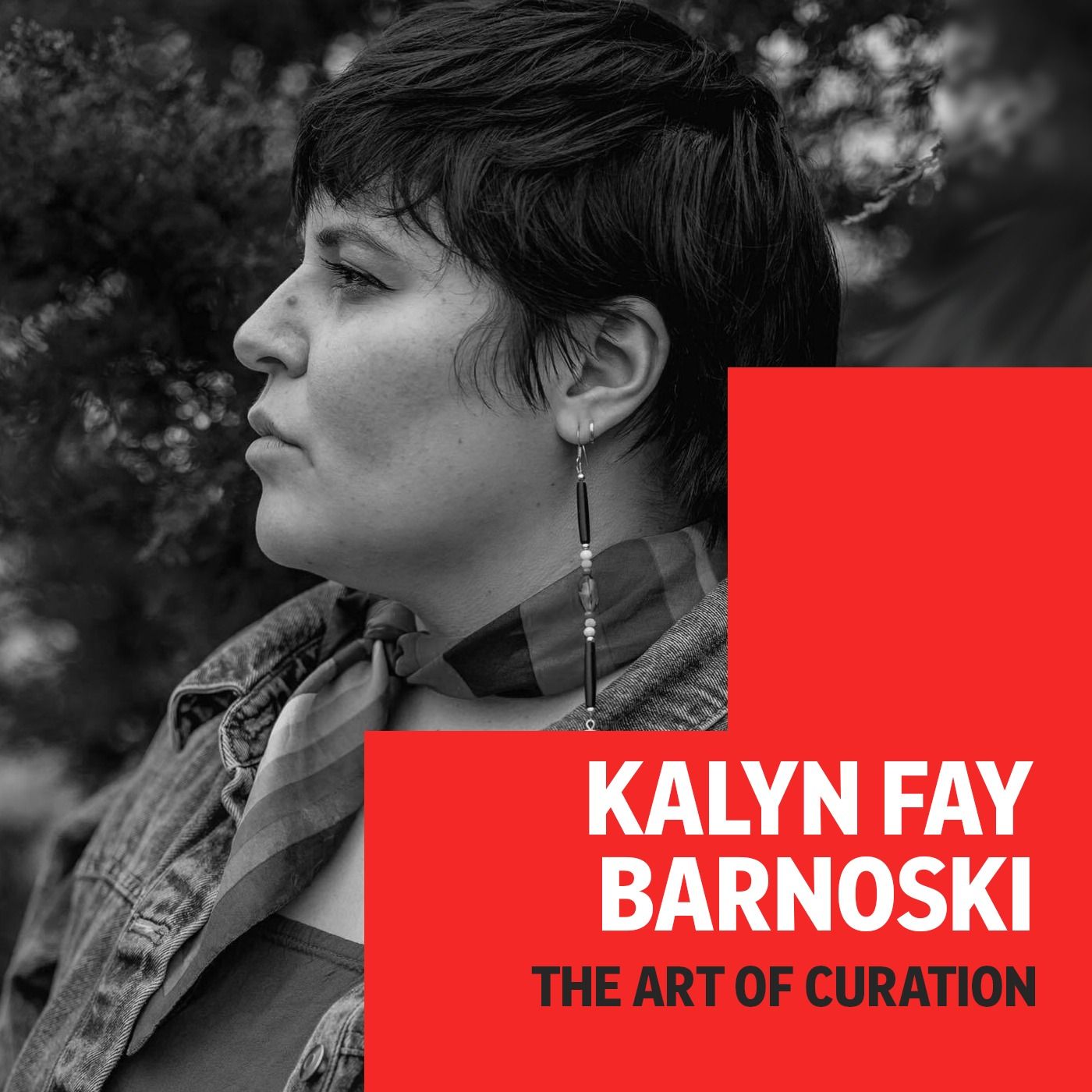
Holding space for native art and community 🪶 Kalyn Fay Barnoski, Philbrook Museum of Art
38m 6s
The transcription discusses the increasing visibility of Indigenous creative practices and the evolving approach of museums towards inclusivity. It delves into the pressure and responsibilities of curators in deciding what art to showcase and how to retell history. The importance of the land a museum sits on in curation is highlighted, emphasizing the need to engage with community perspectives. The conversation between Mia Qualirello and Kaelin Faye Barnoski, an Indigenous interdisciplinary artist and curator, sheds light on the significance of representing contemporary native art authentically. Kaelin's philosophy of honoring diverse perspectives and engaging with the community to care for and present native art is emphasized. The responsibility of curators to present a nuanced understanding of native art and culture, moving beyond stereotypes, is also discussed. Kaelin's approach to curation, influenced by their identity as an artist, stresses the importance of representing artists well and engaging with community narratives.
Transcription
5508 Words, 30252 Characters
We live in a time of increasing visibility and expansion of Indigenous creative practice.
Museums and institutions are rethinking their histories, collections, and inclusivity.
Art by Native artists is exploding, and Indigenous curators finally have a seat at the table
in deciding who gets to be seen, where, and how. Things are opening up in the art world,
and yet all I can think about is the pressure. The pressure curators must feel as the gatekeepers
to a world that's still unfolding for mainstream audiences. What does this responsibility feel
like? How does one begin to curate from such a vast universe of art and artists? What happens
when the job also means retelling history? And what's the importance that the land a museum
sits on when thinking about curation? That's today's episode. Welcome to the Art of Curation,
the show from Flipboard that explores the role of human taste in a tech-driven world.
Each episode, we talk to someone who's an expert in finding signal in the noise,
people who do this for a living in media, tech, fashion, music, and more. I'm your host, Mia
Qualirello. Like you, I get overwhelmed by the sheer amount of content out there. I crave authentic
people to guide me in making smart choices that make my life better, people with taste, the real
kind. My guest today is Kaelin Faye Barnoski, an Indigenous interdisciplinary artist, musician,
curator, and educator from Oklahoma. Kaelin is a Cherokee nation in Roli and of Muskogee Creek
descent. They are also the assistant curator of Native Art at the Philbrook Museum of Art
in Tulsa, Oklahoma. I'm so excited for you to hear Kaelin's perspective.
So Kaelin, since this is the first time we're talking, I stalked you on the internet.
Please just tell me a little bit about yourself. Yeah, so my name is Kaelin Faye Barnoski. I'm
Cherokee Nation enrolled in Muskogee Creek descent. I come from Oklahoma all over in many rural city,
rural towns all over Oklahoma. And I got into curation really by way of visual and studio art.
I perform music. I am a visual artist and I am the curator of Native Art at
Philbrook Museum of Art in Tulsa, Oklahoma. I love your art. It's so cool. Can you tell me
a little bit about your style and your philosophy there? Yeah, absolutely. So while I was in school,
I was making a lot of very serious artwork. And when you're in school, I think a lot of people
coming from a other perspective or seen as sort of a minority, people want you to really make work
that stems from trauma and painful situations. And I kind of fell into that. And then I realized
I really wanted to be making joyful artwork that really reflects my culture and my community more.
And I got to work with an Eastern Band Cherokee basket weaver. Her name was Shem Goshorn and
she passed away a few years ago. She was one of my mentors for my first graduate school program.
She just had some really incredible things to say about the importance of weaving and what
basketry can do. There's an anecdote in which she was talking about her double wall Cherokee
basket. And the way in which she wove is she used paper strips that was cut up like broken
treaties and images from boarding school. And so some really difficult subject matter.
And when someone asked her why she wore limited baskets, she said it's easier to receive a hard
message once you've already leaned into something. And that was sort of this gateway for me and to
recognizing why I wanted to be making the work I wanted to make is I wanted to help people
lean into hard messages and lean into other understandings of the world. So the work that I
make is inspired by Shan and this flat woven basketry. And I do 2D work, so I don't do 3D work,
but it's all in the shape of different dancers at powwows and thinking about regalia and the
importance of the regalia and how each bead or each object or material that's on regalia is
embedded with a prayer or embedded with a good thought for the person wearing it. And so as I'm
doing these weavings I'm thinking about praying for people or thinking about people or hoping for
you know the good in humanity as I do each like each weave of the paper. And that's sort of what's
embedded with for me. And how does your life as an artist impact your perspective as a curator?
My perspective as a curator is deeply deeply influenced by being an artist myself because I
want to make sure artists are represented well in the space that their perspective is platformed in
this space as opposed to you know doing this sort of like singular assessing of a work and putting
what I think is out there but really talking to artists especially contemporary artists talking
to community being part of that community. I think artists are incredible researchers and
incredible purveyors of knowledge and if we just talk to them then we have the opportunity to present
that sort of research and knowledge they've dedicated their lives to. And yeah I'm just really
like artists centered in my practice. I think one of my most burning questions is about the
responsibility that I imagine you must feel for surfacing and putting into context a long
marginalized culture that's that's so diverse. And this is such a big and courageous task to
take this on so I'm not even sure where to begin but maybe we can begin with that sense of responsibility.
Do you do feel that? Absolutely. I was just a part of a panel at the Santa Fe Indian art market
through First Americans magazine and there were about four FEM and queer curators from Indigenous
backgrounds and we all had this conversation about what makes us different sort of from
other curators and it is this responsibility to community and to culture is that whatever
we're doing we're doing on the shoulders of our ancestors and we're doing for generations to come
thinking a lot about the idea of seven generations so whatever we do presently
has to honor seven generations before us whatever we do presently has to honor seven
generations in front of us. If you are close to community you are so accountable to that community
you're so accountable to your family your friends there's just constantly that responsibility aspect
of making sure we're maintaining good relationship and reciprocal relationships with not only our
own Native communities but the Native communities that we serve and the positions that we hold.
So when you think about the actual artifacts that you're curating like what kinds of things do you
keep in your head and in your heart as you bring Native art and culture to mainstream audiences?
Yeah so I curate both contemporary Native objects and then Philbrook Museum of Art has
a collection of historical Native artworks too. So as I am working with these objects I think very
I think a lot about the object as a living being and I think that is you know vastly
different than it has been in most museums historically speaking as these are objects
that are to be placed on the wall they aren't they're just objects you know for us to be entertained
by in some way and coming from a Native perspective these objects are living they need to be caretaken
they need to be touched they need to have songs and ceremonies around them and so I think when it
comes to curating the specific objects I'm thinking of them as kin as living beings that deserve the
same respect as another human being does as any other living object does and so what I can do
to support that and for a lot of that you know this questioning around it that means that I
need to be bringing community in to be working with those objects to be touching and loving on
those objects again and really have a large role in what we present and how we present it.
What does that look like really tactically both in the museum and in your relationships with the
community? Yeah I think you know as a museum does it occasionally falls into this trap of
we need to invite people in but they don't always think about the reciprocity aspect of it and that
means going out into the community spending time with them investing in them in different ways
and not just assuming what the needs are of the community but really asking and engaging in a
way that you're able to give people with what they need and what they want. As far as what that
looks like logistically here so something that we were able to do recently was we hold at the museum
some of the big house ceremony objects so some of the posts from the Delaware Lenape tribe
it's from their last house in Copan, Oklahoma and we just care to take the objects for them we don't
own the objects you know they're theirs whenever they want to take them back but in the meantime
we're taking care of them until they can find a place to put them but we were able to you know
they contact us when people are around or when they're pow wow or dances are coming up and you
know people want to visit these objects with Missingua on it and they came in this was just a
few months ago but they were able to come in at a little delegation of Delaware people
and pray around the objects do ceremony and songs with some of the prayer sticks that we have of
theirs and really like engage with these objects in a way that they don't always get engaged with
we also learn so much when we do this kind of stuff because we're able to document exactly
what the needs are from various perspectives for these objects you know so that means
you know this post needs to be turned north and it was turned south you know because that's
respectful to the object you know something else that happened during this time was we pulled out
some of the moccasins that have a very specific type of ribbon work on them and you know this one
of the Delaware members is a maker and he had never seen these this type of ribbon work or
hadn't able to document how it was done so he was able to really get a hands-on understanding of
you know what his ancestors had made so he could continue that practice forward
what's something you think people don't get right about native art and culture that you hope
to address in your work I think something that doesn't always get done right specifically around
native art is that people just want to think of us as like a past when we are very much a present
and a future and so even in the didactics within museums you know they speak of us you know as
this sort of stereotypical native from like the 1800s you know at the at the age of discovery
the man during manifest destiny and it's that's just not how we are and also that we're like a
sad we're a sad group of people because all of this bad stuff has happened you know and it's
the fault of the government it's the fault of you know the people who came settlers who came in
and really we aren't sad and we aren't just you know constantly swimming and trauma you know we're
really joyful people where we laugh we like to joke and I think making sure that the way we present
the work is reflective of these really expansive and nuanced understandings that we can hold pain
but we can also hold a lot of love and joy and happiness and I don't always think that museums
do a great job of reflecting that in the way we're presenting the work it's always like very stoic or
cold and I just hope that in the future that changes the ways in which we present our artwork
and when you talk about the past I imagine that your work is also about retelling history
what is what does that responsibility feel like
that one is a really heavy responsibility to be retelling history especially at this point of time
you know there's so much dissension amongst the country there's dissension amongst the world
and so to be retelling these histories is like a delicate thing to be doing especially in Oklahoma
where there is a lot of legislation and a lot of leadership that is against you know indigenous
sovereignty in this state I believe it's a heavy responsibility because not only you know these
difficult situations surrounding it but because there's so many different perspectives to be told
and there's only so much tech space there's only so much time and bandwidth a singular person
can do it with you know that there's only so much time I can personally
invest in retelling these stories so it's really about getting investment from the rest of your
the rest of the institution so really having buy-in from you know top to bottom leadership
down everyone recognizes that this is a story that needs to be retold um it's also about
meeting with the community finding those stories um because again like if you look back even at
let's see so the battle of little bighorn we have a muslin of that in our uh collection of a drawing
by steven standing bear and even that story you know people understand it as general custard came
in he was defeated by the Lakota Cheyenne Rappahoe people um because they banded together to defeat
him over the black hills um but even within that story there's so many other stories and so many
perspectives that are so built from different cultural understandings so it's really about
working hard to be as expansive as possible talking to as many people as possible and just
recognizing that history is not um set in stone history is this thing that um can change and can
be adapted and is adaptable to like various perspectives so it's about what perspective
you need to be presenting in that space what perspective means be platformed at this point
in 2023 do you think most museums recognize this importance
you know um I think we are definitely like as a field we are on our way and we are on that
path working towards that um but museums or bureaucratic spaces they're held together by
many different opinions um and funded in a bunch of different ways and
everybody is uh all these spaces have to not only deal with these sorts of issues but
funding and uh legislation issues too so it moves a lot slower because it's bureaucratic
but I do see it moving in the way in which it needs to move what do you think other museums
can learn from the philbrook I mean there's a bunch of different ways in which another institution
or the field could learn from philbrook I believe that you know our native collection was one of
the first collections that we actually held at the museum um we also had the Indian annual that
spanned from 1947 until I think 1978 um in which we had contemporary native artists of the time
be a part of a juried show and we would collect work from that show so we actually hold
an incredible amount of modern native artwork um and just making sure I think as we move into the
future and what people can learn from situations like that that philbrook has already done is that
we just hold space we hold space for the things the community needs we hold space for these
opportunities to engage with other native artists and building this like hub of native interaction
because that can only build that can only build really beautiful and strong artwork as they move
forward so I think just supporting spaces for native people to be themselves and to be together
and to be with this artwork is what I think people can probably glean from philbrook
and how do you or the museum think about the importance of the land the museum sits on when
you're doing your job as a curator that is a really great question so um philbrook is sits atop
25 around 25 acres of muskogee allotment land and one of our other curators Susan Green who works
at philbrook museum of art has done a lot of research around the allotment process specifically
for this land that we sit on you know how it came to us who's the family that used to own it
and I believe that she's done an incredible job of doing this research being really careful
and while a lot of allotment spaces especially in Oklahoma there is um they they have come into
they come into the hands of people through like very tumultuous ways um
I believe that uh from her research that thankfully philbrook did not come into anyone's
ownership through anything like nefarious which is great um but we are working with a group called
the Lucinda Hickory Research Institute we've been working with them for over a year now
and we've done some presentations about the land that we sit on presentations about allotment land
generally but something that we do here specifically that I really do like is that instead of creating
a land acknowledgement um that's like carved in stone and put on our building you know um again we
recognize that that land acknowledgement isn't just enough for everyone and also it needs to be
constantly ready to be adapted and changed so we do have it up in the museum we have it on our website
but it's in a way that it's welcome to change it's welcome to other opinions other input advice
consultation other perspectives and I think that's something you know that philbrook just does well
is that we keep ourselves open to change and we keep ourselves open to being able to adapt
to new knowledges we may we may gain you know
what do you think other curators can learn from you that's a hard question
um oh wow I think
I don't know even how to answer that um I don't know how much other curators can learn from me
because I feel like I'm still learning so much constantly and maybe that is the thing that people
could learn is that we stay open and we stay honest about what we know and what we don't know
we stay curious um and respectful um I'm not sure even how to answer how people could learn from me
I think one of the most important things I hold for myself is that I make sure that I honor all the
parts of myself that I need to honor um and that means staying uh staying active in my all my
practices and all my research so not ever focusing on a singular but focusing on a plural thinking
about art making music making curatorial work what it means to be a good sister what it means to be a
good um friend or a daughter you know there's so many different aspects and I think it's easy
in a western mindset to sort of compartmentalize and focus on a singular and that's what we're taught
from a really young age but I think specifically in like Cherokee perspective we have we stay curious
we learn a lot of things and we learn how to do a lot of things not because we're trying to be the
best of anything but because it's important to know how to do those things and it's important
to honor the parts of yourselves that are capable and able to do those things um so I think probably
that would be the the thing that you could learn is that um you don't have to be the best you just
have to constantly be learning and trying I'm really curious like who are some indigenous
creatives you think more people should know I mean there are so many um I was just able as far as
indigenous creatives that have been really inspiring to me recently I think about Kelly
Mashburn she's Osage she's um does video and sound work um she's out of Pajasca, Oklahoma
and when I think of Lydia Cheshawalla she's also Osage and a dear friend and she is out of Chicago
currently she's been in a few different spaces she's just making really interesting work um and then
people like Suzanne Kite who is better known as Kite I believe she's up in Hudson Valley now
but she's an incredible sound artist and performance artist and I just feel like
there you know something that happens a lot in any sort of um genre of art making is
people get really focused on like a select few like you know the top five or top ten
and don't always um take the time to invest in investigating what else is out there
and there's so many native artists who are just doing making and creating incredible work and I'm
just so excited about not only the generation now but the generation to come because there's
so many people who are you know 10 years younger than me who I'm just blown away by even I'm thinking
about like Jordan and Craig she just had an opening at Hales Gallery in New York and
her work is so beautiful and is just as valid and just as important and as any work happening
in any gallery right now she's pulling from Cheyenne text styles and this geometric visual
language and I don't know there's so many I could list and I'd love to list oh Hayley Greenfather
she's painting a mural down the street right now incredible painter muralist I don't there's so many
I don't even know if I could list all of them but they're all really exciting yeah when you
think about the future and I'm glad you brought that up what excites you and what work do you
think still needs to be done I think the most exciting thing for me about what's to come with
native artists and what's here's what people are starting to see right now which makes me really
excited is just a complete ownership and autonomy of the story that they want to tell and in the
way in which they want to tell it and a lack of pandering that might have happened in the past
about like what is perceived as native art and what isn't native art but a reclamation of
as a native person whatever artwork you make is technically native art because you are a native
artist and you don't have to make it look a specific way or mean a specific thing you are a
native artist you're making native art as well as contemporary work and I'm just really excited
about people just not pandering to what they think needs to be made to be a popular or sellable
but making things solely because this is what they want to be making and they're excited to make it
I'd love to learn more about your own creative process and you talked about
making time for it as part of the way you live in the world what does your practice look like
and how do you find time for creativity yeah so you know I have my day job and I
carry artwork during the day it's usually like weekends and evenings when I make time to do
anything else but it just means researching reading a lot being with community going out
to land going out to waters are a really important
aspect for me specifically for Cherokee culture going to water is important for a lot of different
tribes but it's always been important for me and my family and just making sure I'm spending
time being like really present and understanding myself and relationship to living beings as opposed
to my relationship to an institution and I think whatever creative practice that like
evolves into is whatever I do you know so some days it's visual art some days I'll be drawing or
weaving and some days it's music some days I just want to play guitar write a new you know write
something new some sort of sound bit um sometimes some days is just writing but I think just doing
something and staying curious is the way in which I'm maintaining my creative practice outside of
work. Can you tell me about a specific exhibit that you're really proud of or a specific artifact
in the collection as a whole that you really love? Probably one of my favorite works of the museum
right now is a work by Emmy Whitehorse and we just acquired it a few I guess it was last year
that we acquired it but Emmy Whitehorse is a contemporary of Jean-Quick Dissie Smith
and she was part of the Gray Canyon painting group and I just love her work
because she's pulling from totally a denay perspective she's from New Mexico
and this idea of hojo which is you know kind of hard to explain but it's this like balance
and equity between things and understanding that there's a balance between all living things
and how to maintain that balance but not only like personally but visually
but the work that we have is really gorgeous and speaks to abstraction and this history of
abstraction and is pulling from a really deep scientific history spanning you know the mesozoic
era up to the present day and you know when you see it you might not always recognize that that's
what she's pulling from but that is what she's pulling from and I just like love the reason I
love that work is because it's not only just beautiful and a striking piece and there's
so much depth to it but she's also doing so much expansive like connecting and interweaving of
indigenous understandings with these like scientific western perspectives and helping people recognize
the interconnected nature of both of them I went to see Jean quick to see exhibit at the Whitney
this summer I loved it so much I actually bought the book I just want more so I love to hear your
recommendations about other artists to check out yeah I mean there's a book that just came out by
Jeffrey Gibson and it's called an indigenous present and it's incredible there's not a lot of
like contextualizing information within the book but it is a collection of contemporary
native artists and as a great it's a great starting point for people who might not know a lot of
native artists that are existing right now to just like jump in and visually
start building relationships with the artworks so I would definitely recommend that as like a
starting point it's really amazing that this has come out because I don't think that there's ever
been anything quite as expansive as this specific book and helping people and representing like
what's happening right now in native art I think if you're wanting to learn more about like
research around native artworks I would definitely look up Nancy Mythlow Nancy Mythlow is the person
you want to read she is incredible incredible author researcher scholar specifically around
native art and its display how you perceive it what it represents you know there's so many different
ways to engage from a curatorial's perspective and she has a great job about expanding upon that
as far as like more artists I mean Chinupa, Hanska Luger is like so good so keen wonderful artists
again another incredible researcher Nicholas Golanan, Suzanne Kite who I've already mentioned
I just think she is also incredibly intelligent just finished her PhD and she's just she's got it going
Mikaela Patton is a younger artist I think who is doing incredible work
and making work that I have actually never seen and that's sort of hard to do
and I think a lot of people are really impressed with her right now
and then people like Warren real writer who just accepted the Tulsa Artist Fellowship
so he'll start that this year Nathan Young another sound artist obviously I really like
sound art and performance art but yeah there's just so many to start looking at but
if you want to think more about how to understand native art I would definitely look to Nancy Mythlow
Caitlin how have you evolved as a curator since beginning this role?
Oh wow that's a good question
you know I fell into curation I think a lot of native artists or native curators probably
say the same thing is that we like sort of fell into this as opposed to
knew that we were going to be doing this and I've changed so much I think I've got a different
type of patience now and an understanding for what it means to be a curator specifically
holding space in a museum I think as far as being a native curator in general
I believe I just have an even deeper understanding of what it means
to be accountable to be accountable to your community to be accountable to people just
generally and um man really taking the time to build long sustainable relationships with people
which is something you know I was taught and already knew but recognizing how important that is not
only for myself personally but within a museum and a museum structure and I think recognizing
the importance of I don't know the right word but probably like social capital or social currency
in a specific space being a good friend being a good colleague in these spaces and learning how
to build long-term relationships across departments and across institutions so that people are able
to work together to you know add to the well of knowledge to build the best exhibitions we can build
to build the best knowledge bases that we can that's something I've definitely learned
over my time so far and I know I have so much more to learn and will continue learning constantly
you've already given so many great recommendations about artists to check out and and books to read
are there any other recommendations you can make for us books movies podcasts games places to go
things to see and do that you think others should check out because you just love them so much
so something I would check out for sure is native futures uh or center for native futures it's in
Chicago um it started by Debra Yavlopapan um and I think that they're going to do some incredible
things in the next few years um I mean they're already making waves and they just opened up
and then um New Red Order I believe that uh they were just featured in an exhibition
by the Forge uh curator director I think that's I'm not sure exactly what her position is I
she's either the chief curator or the director but either way it's Candace Hopkins and she's an
incredible curator and curated um an exhibition about a native theater um that incorporated their
work um as far as that I mean just keep an eye out generally there's so many people doing incredible
things uh artists from so many different generations right now um all working together
working seamlessly together um collaborating um I just I'm just really excited about
native art as a whole especially in this in the year 2023 right now
if you want to connect with Kaylin you can contact them through their website
at Kaylin Barnoski.com that's K-A-L-Y-N-B-A-R-N-O-S-K-I.com they're also on Instagram at Kaylin Barnoski
we've put links to everything Kaylin's recommended in the flipboard storyboard that you'll find in
this show's notes. A big thank you to our audio editor Ann Leigh. If you want to find out more
about flipboard or enthusiasts are curating stories they recommend across thousands of
interests download the app or head over to our website at flipboard.com anyone can be a curator
on flipboard simply create an account and start flipping to share your ideas with the world
Podcast Summary
Key Points:
Indigenous creative practice is gaining visibility and expansion.
Museums and institutions are rethinking their inclusivity and collections.
Pressure and responsibilities faced by curators in showcasing art and retelling history.
Importance of land in curation and exploring diverse perspectives in native art and culture.
Summary:
The transcription discusses the increasing visibility of Indigenous creative practices and the evolving approach of museums towards inclusivity. It delves into the pressure and responsibilities of curators in deciding what art to showcase and how to retell history. The importance of the land a museum sits on in curation is highlighted, emphasizing the need to engage with community perspectives.
The conversation between Mia Qualirello and Kaelin Faye Barnoski, an Indigenous interdisciplinary artist and curator, sheds light on the significance of representing contemporary native art authentically. Kaelin's philosophy of honoring diverse perspectives and engaging with the community to care for and present native art is emphasized. The responsibility of curators to present a nuanced understanding of native art and culture, moving beyond stereotypes, is also discussed.
Kaelin's approach to curation, influenced by their identity as an artist, stresses the importance of representing artists well and engaging with community narratives.
FAQs
Curators feel immense pressure as gatekeepers to a world still unfolding, deciding what and how art is seen. They must navigate vast universes of art and artists while retelling history.
Being an artist shapes a curator's focus on representing artists well, platforming diverse perspectives, and engaging with communities and contemporary art practices.
In Native art curation, objects are seen as living beings requiring care, touch, and ceremonies. Engaging with community and respecting objects as kin are central to the curation process.
Retelling history as a curator involves delicacy, considering multiple perspectives, and ensuring stories are accurately portrayed. It requires significant time, community engagement, and institutional support.
Curators aim to dispel stereotypes by presenting Native art as a contemporary and joyful expression, not just rooted in trauma. They strive to showcase nuanced understandings and diverse perspectives.
Museums are progressing towards acknowledging and presenting diverse perspectives in history, although bureaucratic processes and funding challenges can slow down this progress.
Chat with AI
Loading...
Pro features
Go deeper with this episode
Unlock creator-grade tools that turn any transcript into show notes and subtitle files.
 PodcastTranscript AI