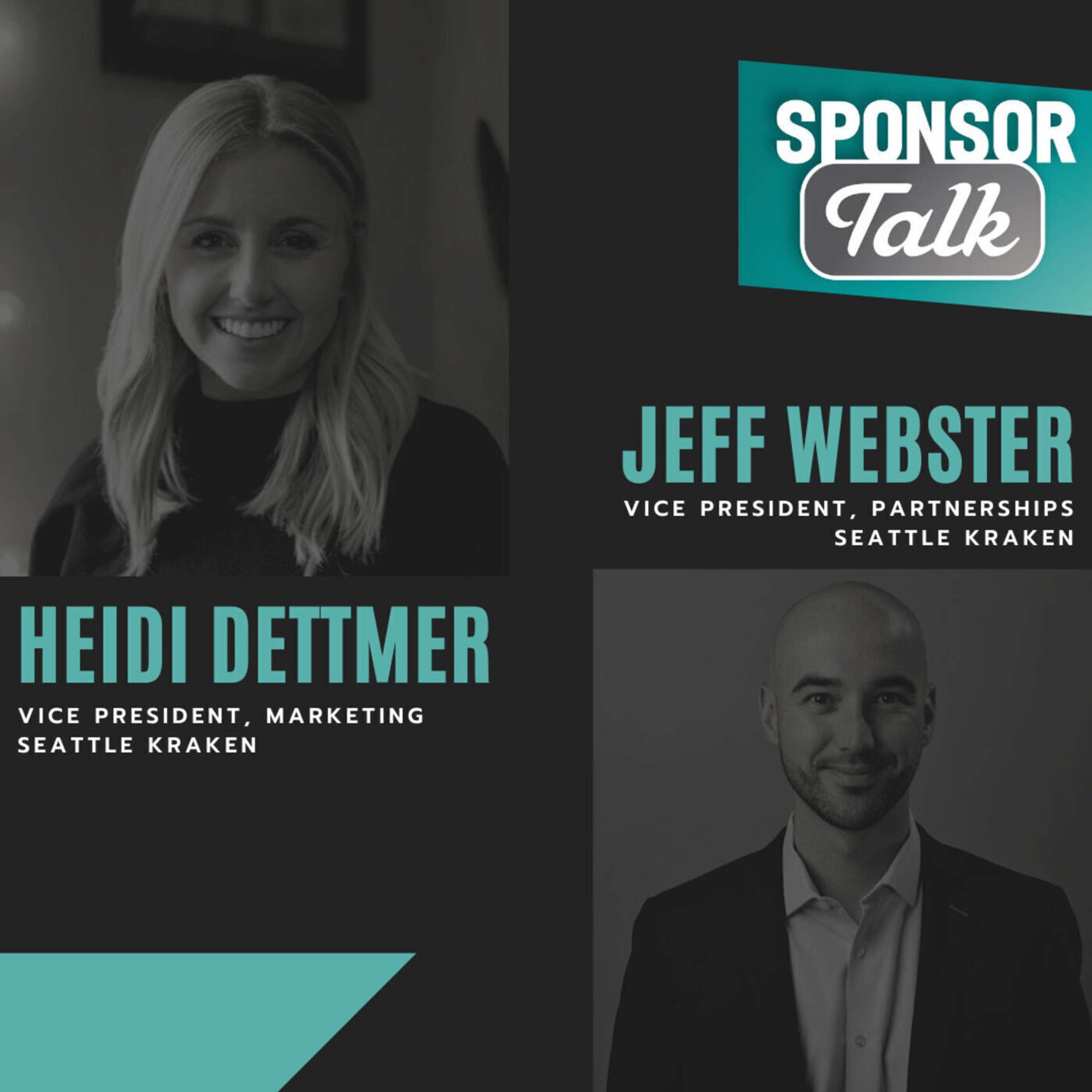
Heidi Dettmer (VP, Marketing) and Jeff Webster (VP, Partnerships) at Seattle Kraken
44m 17s
In this episode, we sit down with some of the minds behind one of the biggest team and brand launches in recent sports history - the Seattle Kraken. Heidi Dettmer (Vice President, Marketing) shares insights into how the marketing plans came to life, the various aspects of the newly developed brand (including the logo, brand storyline and social persona), how fans were involved since inception and the challenge of keeping it all a secret. On the other hand, Jeff Webster (VP, Partnerships) shares details on how his team worked with and sold in partners on a brand t...
Transcription
7499 Words, 39944 Characters
Hey there and welcome to the sponsor talk podcast where we interviewed some of the leading minds in the world of sponsorship marketing and discovered the various ways in how brands interact with properties within sports, arts, film, music, you name it. Today's a really special episode, so one that I'm very excited about. We actually have Heidi Dettmer and Jeff Webster from the Seattle Kraken hockey team here to join us to talk all things Seattle Kraken. So Heidi, Jeff, welcome. Thank you. Thanks for having us. Thanks a bit. No problem. So I think, you know, this is fun. I generally like to start the conversations with how you got into the role. So Heidi, you're a Seattle native in a lot of ways, like you've worked for the Seattle Sounders as the director of marketing, the Seahawks, and then most recently for Lyft covering the Pacific Northwest region. So clearly you're passionate about Seattle. What excited you about this role and how did you end up with the Seattle Kraken? For sure. Yeah, so I'm also born and raised here. So I have a ton of pride for this city, it truly is a very special place and being rooted here, it's deep in my heart. So the opportunity to build a hockey brand from the ground up that will last generations to come was just beyond exciting and quite a rare opportunity. So I felt pretty fortunate to get involved. That's awesome. And Jeff, what about yourself? So you've worked on the sports partnership side for quite a while. You went to Ohio, did the joint MBA, MSA program, you worked at Daytona International Speedway, the Detroit Lions, AEG. How did you end up with the Kraken and what excites you about the opportunity in front of you? Yeah, well, similar to Heidi, I was born and raised in the Seattle area as well. So I took a detour for about a decade, a little more so and hit some of those spots that you just referenced. I always had Seattle in the back of my mind as a place that I'd like to get back to one day, but I wasn't in a huge hurry to do so. In fact, I was really happy where I was in Los Angeles and with AEG, one of the best companies you can work for in this industry. But this was a once in a lifetime opportunity. It's not every day you get the chance to build a new arena and an expansion team at the same time, much less to do it in your hometown and get to work with people like Heidi, much less to him and Todd Laiwiki. So it was just something that was too good to be true and couldn't pass up. Yeah, no, it seems like an amazing team that you're building there. You're on the verge of some incredible things and some incredible things have happened very recently. So I'm excited to dig into it. I think what's really interesting is when you look at the name, the storyline for the team, the process of building something like that can't be easy. And so I'm curious about what kind of things played a key role in the process of building a brand like this. So I know that you were asking thousands of fans if feedback on the name. There was years of social listening going on and Jerry Brookheimer was involved on, you know, he has a role in Seattle Kraken in his movies. You know, what kind of things happened behind the scenes in terms of a process like that in building a name and a storyline for a brand? Yeah, so I'll say it was a very long and very thorough process. So 18 plus months, it started with the fan listening. That came from our leadership and ownership group. We have a fantastic ownership group and from the very beginning, they said it's so important that we listened to fans. So long ago, we started with social listening, the Seattle Times did a fantastic contest where fans can submit names and then vote on names. And so we got to kind of listen a lot to the feedback on that process. We also launched our own fan portal where we asked fans about things like logos and colors and even the experience in the arena. And so fans had played a really, really big role in all of this. Then among our ownership group, we had a subcommittee with a ton of experience to your point, Jerry Brookheimer, who's the master of brands and big movie production was very involved as well as Andy Jazzy and others. And they did a fabulous job kind of leading us through finding a brand that's really authentic and true to this town. Mm-hmm. And I feel like more sports brands, as we think about, you know, where sports is heading, there, a lot of them are utilizing storytelling as a key part. You know, having a name is one thing, but truly bringing it to life like your team did, what is another, right? So when I think about, you know, why I kind of enjoy the team name so much, it's the storyline that's been weaving in, right? There's heritage with the city of Seattle. You know, there's the giant Pacific octopus that lives in the Pugin Sound and the history behind that, the maritime history. There's so many elements that go into it. So, you know, is there anything else that like, you know, happens behind the scenes, a variety from your standpoint on like building a storyline like that and kind of executing it so that consumers can see that product and truly fall in love with it? Oh, definitely. I mean, we looked at over a thousand names, right? And when I first heard the crack in, like, huh, that's new, you know, that's interesting. But then we do this. We have a discovery phase. So you kind of really delve in and it really quickly became clear that this is the only name for this town. Not only was it kind of a rally by the fans and we heard it over and over again, but exactly to your point, the storytelling is there. It really is authentic. We have these really deep, mysterious waters in the Pugin Sound. We do have our marriage, you know, we have the giant Pacific octopus to your point. Some of the largest, the largest octopus ever found was here. And so I'm not to mention our Scandinavian tie and this feast comes from Scandinavian folklore. So there's just a ton of ties here and it made it easy really to tell a really good story. Mm-hmm. And I feel like it's cool because it's such a sense of mystery too, right? The ocean is so deep, the colors that are used and we don't know a lot about the cracking itself because it's a mythological creature. But like, that sense of mystery is so interesting. I'm a big fan. I don't know if you can tell yet. Love it. Jeff, what about you, man? So your standpoint, you know, you have to start weaving partners early in the process, right? And this is a very interesting process because a lot of it is kept from the public and it's a bit under wraps before the launch date, right? And so how much of the marketing and the storyline could you really share with partners when you were working with them and what was that process like? Yeah, it was really unique. I think you look back even way before the brand launch process and early in this entire phase and journey of building a team way before we ever had a name for the arena or for the team itself. When we were just called NHL staff in our little startup office with 10 or 15 of us or so Heidi and I included and we had partners coming on board and seeing our vision all the way back then, which was truly remarkable, but they would understand what this project meant for not only for sports in Seattle, but for the community and for the region, and that they would come on board as early as over a year ago. And so for those partners, the Cometras and the Waffed banks and the last airlines of the world in Virginia, Mason's, I mean, we had a long road in front of us before we would announce the team name and it was every meeting, every call every every time we spoke to them, but only only them asking because they're excited and they couldn't wait for what was to come. So leading into the months and weeks and days prior to launch, we worked super closely with Heidi's team and with others internally to help them prepare to activate and to engage on the brand launch day, but without actually revealing the name or the logo or the colors. This is a really tricky thing to do because we knew we could trust all of them, but we just wanted to be really careful about a week and so what we ended up doing was partners created sort of stories, videos, social media, other aspects with placeholders in them that we would later deliver toolkits and things the morning of the brand launch that they quickly inserted into these videos and other pieces of content, making it look like they had created it with our brand all along. It was pretty amazing to watch. Well, that's so interesting. I would have thought that it'd be must be elements you did share so that you could paint those stories. Otherwise, it's hard to do, right? It's kind of like insert brand here. I would have never guessed that's the process. Yeah, it was pretty remarkable and it speaks to not only our marketing team and their ability to get them, get our partners prepared, but also just to the engagement and commitment our partners had to sticking with us, although we weren't going to share the information prior to, we did everything we possibly could to prepare them and get them ready for the day of without oversharing. So on the topic of sponsors, Amazon's naming rights deal is pretty one of a kind, right? It's not often where you see a stadium that's been named and built with a purpose of committing to things like carbon neutral operations, banning single use plastics and fighting climate change. It actually fits so well with Seattle and, you know, the care that Seattle has for the environment. So it's, you know, what was the naming rights process like and how was it working with a brand like Amazon on that knowing that you couldn't share a lot of details prior to the launch? Yeah, well, it was no surprise. We would go to Amazon to talk about naming rights to our arena. I would probably venture to guess that every team in the world for their stadium or arena has come to Amazon at some point or another to partnership opportunities. They're certainly the biggest company in this town. But the unique approach that we ended up with was not the one we started with. We started with the more traditional exploration of what is Amazon arena or AWS arena look like and to their credit, that really was not just to them. They had much more of a commitment to the community in Seattle and less about their brand. Everyone knows who Amazon is. And so, you know, we kind of went back to the drawing board with them and this was never a sure thing by any means. But we started to think differently and how do we make this arena stand for something bigger and come up with a purpose and is it local or is it global? And one thing that we uncovered was our organizations were both super passionate about sustainability. And you mentioned it that fits really well and nicely into the framework of the community in Seattle as a whole and even consumers and fans here who are passionate about sustainability. But through that different exploration of a cause, the climate pledge was something that rose to the surface and, you know, it took a lot of courage from both sides to end up making that the name for the arena because if you stamp something like climate pledge on your roof, you better be able to back it up when the fans come inside and have a really authentic experience. So to be able to step up to the plate with Amazon's help and really through their guidance and leadership, figure out how to create the first net zero carbon arena in the world was quite an endeavor. Yeah. And me on a brand lens, like I always think about, you know, when you invest in a long-term strategic partnership like that, sometimes you're always looking for the ROI and you're looking for things to tie back to, but their purpose was so much more than that. It's not just how much return am I going to get. It's how can we make a difference in an impact? And I think that's really powerful. Yeah. Amazon's trying to change the world and in some ways they already are changing the world just by how they do business, but they've recognized a major need to change some of their operations and they've seen just like Tim and Todd Laiwiki and our ownership group and others. On our end, the climate change is one of, if not, the greatest challenge facing our generation. And so not to get too much on a soapbox about it, but, you know, we have a platform with our arena and our team and the other events that will take place at our venue. And you've seen it with other musicians, even with Coldplay and with Pearl Jam and others that have taken a stand on the carbon footprint of their tours and we wanted to create a place that everybody could be proud of, that when a fan comes to an event there, they know that we're doing the right thing and they can feel good about it at the end of the day. Yeah. And Heidi, let's move the conversation over to a brand level because I think, you know, that's kind of when brands have a lot of power, right, is when they really stand for something, they focus on what the impact they can have and the voice they have, you know, this all started with the name, things like the logo, but the storyline started to build and build and build. So can we talk about the logo for a minute, like the S represents Seattle, pays homage to the Seattle metropolitan, you know, but elements of it is so cool. So I'd love to hear from your side, you know, what was the process of creating the logo? And did you guys know you had a winner as soon as you found it or was it like the name or where you took some getting used to? Good question. I mean, so the name of Kraken is pretty bold and forward and progressive, right? But it was really important to us that the mark itself, the logo, was something that players would be really proud to pull over their chest. It would be iconic and would stand the test of time, right? And so Ron was actually Ron Francis, our general manager, was really involved in that and making sure that it was a really iconic mark and that it paid respect to the game and used the word nobility a lot in the design process. And so, you know, while the name is really kind of forward and progressive, we kind of liked this classic clean look on the mark. And so I think it was Adidas who we partnered with and I think they did a really great job capturing that. And then to your point, the mystery of the beast, like that's the thing about the Kraken. It's so big. You don't see it. It's, you know, abominable to mankind. And so leaving that as the subtle tentacle, you know, nodding to that and the eye of the beast and then the beveling time to our maritime culture, they did a fantastic job. And we looked at a couple, you know, definitely had rounds of reviews of creative, but I think we did know right away, hey, this is the direction we wanted to go. And so that's so interesting that there were so many parties involved with this, right? So Adidas was involved, you know, a lot of people on the marketing side were involved. But how did that come about and did your team, like from Jeff, your standpoint and Heidi, your standpoint, like, did you both have to work together to manage that partner integration onto the logo design or was it one of your teams managing it? How did that work? You're right. And there were a lot of parties involved. I think our ownership subcommittee and Todd were the real leaders in this and Adidas was brought in on the design jersey front. The league played a really big role into Jeff's point earlier. We did everything we could to keep this being quiet. So while there were a lot of parties involved, it was very few people on each of those teams. And so to, you know, as Jeff mentioned earlier, a lot of our partners took a leap of faith not knowing what the brand was going to be up until the final hour. And because of that, we were able to tell our story our way and not have the risk of leaking and having kind of all different narratives come out. And then Jeff, what about from your standpoint? So like, how much of this could you share with potential partners? Like was there logo colors? Was there certain elements of the story? Like, what could you share? Yeah, well, we shared as much as we could. We certainly gave partners a heads up in terms of timing. We had been working with them in the weeks and months leading into that on just general strategy, things that regardless of what the team name or the logo or the colors were, we could begin to plan out activations at their locations or downtown, you know, various ways on digital and social that they were going to take advantage of it. Certainly even apparel, like things that we were going to create that they could distribute to their employees the day of the launch that, you know, we had their logo, they didn't have ours, but that allowed us to take the lead on creating the apparel for them. So, you know, maybe between the, between the lines here or there, we gave some hints, not necessarily to the name, but, you know, to a color that they might want to feature more than another in the days leading up to it, but really they respected the fact that we wanted to control the messaging and the narrative and they did their best to prepare for whatever it ended up being. It's so different than other processes, and I love it. It seems like a great opportunity from a marketing lens, Heidi, and then from a partnership lens, Jeff, like being a part of that seems awesome. You know, I'm actually curious, Heidi, like one of my favorite parts of the Kraken persona is the social side, right? And so it's already clearer and like when we saw the first week of the launch, the brand is fun, engaging. It has a comedic undertone, you know, the captions are pretty hilarious, but there was even this cool video where the whole NHL kind of got involved with that group chat that was on social. So it's like, how did that personality come to life? And so did you always think that it was going to be funny like that or is that something that was part of the brand building process? It was a part of the brand building process. We did definitely did some thinking around our voice and tone. We wanted to be authentic, a little bit different, almost quirky, I would say, around the different part, respectful and modern. Those were kind of key words that we use when describing our tone in a little bit tongue and cheek. Like let's not take ourself too seriously, but also let's be respectful, you know, and so it's a balance, right? And I think that we have a really incredible social and digital team and I think they struck that balance really well. Yeah, I love it and I think that, you know, it's so different than traditional hockey teams from when you, when you see it as a fan, so I can only speak it from it from my side, but like as a consumer myself, you know, it's, it's very fresh and it's very different than a lot of things you see in the market. And I think when you add all those elements together, it paints a really nice storyline. You know, for the both of you, when the team was building up hype the week of the launch, there was obviously some crazy stuff happening, I'm sure you were running all over the place. But you released a few cinematic videos telling the history without giving away the launch name and the brand name. You plan some open forum conversations for the day of the event with executives and then the social team had their fun, but like, what was the launch like for you guys? So Jeff, let's start with you. What did that launch week look like? Yeah, it was, it actually, for most of us, if not all of us, it kind of really started four weeks even before that, which was when we announced climate pledgerina. So it was kind of a month of just butterflies and fun and a lot of preparation and fire drills, but excitement. And like we always talk about those were the days and the weeks and the reasons why we all came here for these jobs. And we were building the franchise, you know, literally one name at a time during that four weeks span or so. The moment, the morning of the arena announcement, we were all on pins and needles waiting for Jeff base us to post his Instagram message because that was going to be the official announcement of the climate pledgerina, and we wanted him to be first because it was his message to tell. So we were all waiting for that and then all of our messaging began immediately after. And then the day of the actual team brand launch, it was wild. I mean, we all woke up sort of knowing that we had an amazing day in front of us. We had launched the video the night before which Heidi and Sherwell reference that started creating excitement. It got all of us excited to knowing that it kind of told the public that the next day was the day. And for me, one of the one of the coolest moments was being inside of our arena, our construction site with our 44 million pound historic roof hanging over our heads and Heidi being on stage live in front of the world with a what was a Heidi of 50 foot banner raising behind her, telling the whole world for the first time that we were going to release the cracking. I mean, that was, I still get the chills thinking about that moment and what better person than her to be on stage to tell everybody the big news. But that was something I don't think any of us will ever forget. And then, you know, in the war room afterwards, what we refer to as anyway, just phones and social media blowing up. It was quite a day. And Heidi, what about from your standpoint, like obviously, when that first domino fell and the team was announced, like you had everything in a lot of ways figured out as soon as that happened, here's what else is going to happen. And so what was the process like from a planning side, and then also from the day of the event? Well, you know, just to really take you under the hood here, we had a pretty big roll out plan. And then COVID happened raised and we pivoted pretty significantly. And then there were, you know, the after the murder of George Floyd, there were a lot of civil conversations that we didn't want to distract from, right? Like we wanted to leave some space for protesters and things happening in our community. So our plans shifted quite a bit leading up to this moment. And then additionally, there was this other track where we were working on trademark, final trademarking on the team names, right? And so there was a lot of kind of a lot of interesting barriers and things happening. And we didn't decide on that Thursday launch date until really we firm that up Saturday before. So we had four days to execute on this plan. So it was a really wild and exciting time, you know, obviously we had teed off a lot of these lovers and we're getting, you know, we're ready to move and we had things in place. We had rehearsed some things but it was a quick turn and it was a lot of fun. It was very exciting. And I think Jeff said it to you when that first teaser video went out, it was like, oh, it's real. It's really happening. You got to get better flies and you're something. It's so exciting to see it take on a life and see how fans are engaging with it. And then I totally agree with Jeff. Once that five story banner started rolling up, I think was the, the kind of aha moment where the hair stands up on your own type of thing. And I feel like with any event with any brand launch, like once something happens, there's always that one thing that happens. And then you're just like, like a sigh of relief in a lot of ways because you've been working for so long to have that happen. And then you're like, you know what, it's kind of, it's going to happen now either way. So I might as well just enjoy a few of the things. That's at least my process. I don't know what you guys. So totally, I think that banner rising was like a really like, wow, people are really seeing this for the first time, wow, it didn't leak was a huge thing. We were pleasantly surprised by that. It was such a special moment and then we did have a, you know, in-person war room going on in the building beside our arena. So after that moment, I popped in there and then to hear the positive response from fans and media and things like that was really overwhelming in a really positive way. Mm-hmm. Yeah. No, totally. And I think that's part of the process, right? It's like you work on this project for so long, you put all these elements in and to see your work getting received positively is always a great moment. So I can, one, congratulations to both of you on a successful launch and two, it must have been a great thing to be a part of. Thank you so much. Thank you. So Jeff, let's talk about some fun stuff, sponsorships. Why don't we talk about, you know, some of the partners that your team has brought on recently, right? So if I think about pitch book, you know, obviously the Amazon announcement quite a while ago, crack in rum, these are partners that when you think about the sport sponsorship landscape, they're not the first names that come up, right? And so, you know, how much of it was your team looking for the right traditional fit with your team and, you know, what you guys are trying to stand for as an organization versus, you know, going for standard sponsors that you might see elsewhere in other sports properties? Yeah. I mean, it's great that that's been, that that's been noticed as far as just, you know, maybe a different approach. I would say even going back to when Heidi and I are others first, God here early in this whole building process of the team and arena, you could look around at our organization, literally just look around and you would feel that things are much different than maybe if you've worked for other sports teams before and what you might traditionally or typically see, just even things, you know, as glaring as diversity or gender equity. I mean, like there's, and frankly, for us people who have never worked in sports before, which is a really unusual thing to have as many of those people and leadership positions as we have. And I think, you know, you start there because for me, it was clear early on that we were going to think differently about everything. Partnerships is no exception to that. I think even just that story that we've created with who we've hired and the opportunities that we've created in this community, I've really stood out to some of these brands that have never engaged in sports marketing before and to see from day one that this wasn't just going to be sort of what they've seen before in the past and they get into conversation with us where potentially maybe who knows with another sports team, they may not find as many commonalities, but where we just strike up a conversation and, you know, sort of the priorities, the vision, things that are important to us are important to them. And it's led to some really unique different opportunities that I don't think we probably saw coming either with the pitch books of the world and others who have dipped their toe in this sports marketing for the first time. So we're super appreciative of them trusting us, you know, and also taken much more of a less is more of any means, but we get to start from scratch. We started with zero partners and, you know, how often do you get an opportunity to do that? And so we tried to be really thoughtful from the beginning about how to not clutter it up and how to create the most value we possibly could for partners across our different pillars and how to not water it down for them. I think you've seen that a lot of these brands have understood that they've appreciated it, they've bought into it and really committed long-term with us as a result. Mm-hmm. And Jeff, you brought up a good point about the distinctness of the team and the vision that's been established like from the early on, right? And it comes from the top down in terms of things like gender equity and diversity and to see some of the reporters or people that have been brought on by the Seattle Kraken hockey team. I've seen some news recently and it's amazing to see. But also Heidi from your standpoint, the Kraken, even though it's a team that's been around for less than a few months, it's already involved in the community, right? And so when I saw the release, the Kraken merchandise that was going out, a lot of the proceeds were going towards community initiatives. So from your standpoint, how important is the Seattle community to the team and what is it that there's some initiatives that you could talk about in terms of what you're doing in the community itself? Yeah, definitely. I mean, to your point, it's top down, right? Todd's always been a guy at the community when you loved the Seahawks here and I've seen it in other market teams that and the community really is the backbone of our organization. So when you know, retail is a really big deal and brand launches like this and we wanted to give 100% net proceeds back to the community. So that went towards youth faced with homelessness and young people in this area and also creating positive passageways for young people of color. So I think that, you know, you will always see threaded in everything we do as a brand of community aspect. It's just really important to who we are. One thing we're working on now is our official kind of team foundation. I should say team and arena foundation and you'll probably see that in the, you know, upcoming quarters, the kind of rollout of that and we'll continue to be present in youth, youth homelessness and growing the game with youth hockey. Pretty much. Yeah. Go ahead. Sorry. I'm not to jump in. I was just going to add to that Heidi to say too that I've worked in a number of different markets and in various professional sports leagues and incredible cities with amazing fans and people that I always love but I've never in doing what I do in working with external brands and partners. I've never heard in conversation the word community come up more with corporations than it does here in Seattle. I think it just speaks to the companies that are based here and how much they care about our community and the people here. And so it's been really refreshing to see and hear to Heidi's point. It's the sort of guiding principle behind everything we do as an organization is trying to make the community better for us haven't been become a part of it. But to the credit of our partners, this is a huge part of the mix when we look at activations and just their entire partnership assets is really a lot of it's driven by community impact. Yeah. That's awesome to hear, guys. I think, you know, more brands continue to do this. I think you guys have used your platform in a way that is really supportive of the community of Seattle and especially with people of color and young kids of color. So I think that's awesome. You know, now that everything's kind of out there, right? So what's next for the team on a business front from our marketing lens? You know, Heidi, why don't we start with you? What's next for you guys on the marketing side? Yeah. So I didn't have a ton of breathing room after brand launch. We got right into things so last week we actually launched our seat selection. So we've already sat all of our club seats. We went into kind of general seats and so, you know, we had 32,000 folks on our deposit list, another 50,000 now on the wait list, so making sure all those people are taking care of it when we're getting folks in the building and getting them all set up. And so that's quite a campaign in itself. Today we actually launched our brick and mortar retail store. So that was exciting fun morning for us, you know, with a ton of COVID safety measures. Fans can now come in in person and we have the largest selection of merchandise there. And then from a business standpoint, there's so much on the horizon, we will continue to engage our fans and community. And there's just a ton of work from the arena construction project, our training facility project. We were just on a long call about that and what that's going to look like. Our hockey operations are scouting right now and their plans to build the team. The Jersey development is another example. We just hired our game presentation staff so they're going to be heads down on what opening weekend looks like. So there's just a ton of things and a ton of milestones that will continue to happen and we will cover those and engage fans in those things as well. Yeah, I'm excited. Jeff, what about you? What's next on the business front or the business development side? Yeah, Heidi knocked out a number of them and to her point right before this we were on pretty exciting call going over the overview of our training facility of which will be really cool. I think a lot of professional sports training facilities oftentimes end up being very closed off, very private as they should be for certain reasons. But ours will be open to the public. So we're going to have three sheets of ice in there and even our practices for the cracking team will be open for viewership to the public. So there's so much that goes into that facility and how partners will be brought to life in there. We're also going to have a naming rights partner of that venue in addition to the arena. So that's another big initiative for us that we've got a great head start on. We also are working really closely with our friends at the city on some new opportunities at on the Seattle Center campus. So as part of the billion dollar new arena, we're building climate pudgerina directly adjacent to that as a 74 acre campus that houses some of the greatest arts and culture organizations in Seattle, the opera, the children's theater, the ballet, the repertoire theater, space needle, et cetera, and we're going to kind of revamp some of the offering as far as partnership and experiential activation and whatnot around that campus. So that's a really cool thing we've been working on. And then to Heidi's point, there's some big milestones. One of my favorites that I'm most excited about is the expansion draft next year. This whole thing has become a lot more real now that we have some names for our arena and our team, but the next step is to get some players and have some actual faces that are behind this thing. And I know our fans are super excited about that as our partners. So that'll be a fun one next year. Yeah. One of my favorite parts of that social persona we talked about Heidi and Jeff was, you know, on the day of the launch, I think it was it was said like the biography or the Twitter bio was like strategizing how to pick your best players, your best NHL players. I love that. That's the fun that came out of the social team at the time. I'm so glad you noticed I'll have to tell our social media manager because she was really excited about that one as well. She's very happy. No, it was fun. I loved it. So I know you guys don't get a lot of breathing room, it feels like at least. But if you look back at the experience of the last few months, you know, you're starting to build a professional sports team, right? Like this is something you've probably never really done in your career. And I think it's a huge milestone for the both of you. So what's some of the biggest lessons that you've learned throughout this process? Heidi, maybe we can start with you. Yeah. I mean, listening to the fans is huge. I think that was such a key part of this process and if I were to go and advise on another brand being launched, I would say involve your fans. They know what's going on in the market, they know, you know, they have preferences, they have opinions, they're super valuable and we learned a lot from fans. And I think that's kind of the number one thing. Also, it's important to be authentic to your city. So telling those stories is really important to your point earlier, Abish. And then one thing I was thinking a lot about is just, I mean, we had lots of sleepless nights thinking about one of this leaks, you know, and we took a lot of measures to make sure that it didn't leak. I mean, brand leak all the time, New Jersey's leak all the time, evolved logos leak all the time. And you have to weigh, like, do you produce a bunch of merchandise ahead of time or do you wait until you launch it and then go into production? So there's a lot of things that go into that. And I think for us in this name, particularly, it was a huge win that it didn't leak. Jeff, what about yourself? Yeah, I think Heidi nailed it and the word, I heard her say it a number of times during this conversation, but you'll hear all of us say it if we spend time around us and it's the word listen. And I think it's probably the most key reason for the brand launch having gone over well is we didn't make it our idea, you know, we listened to things. And we all know, you know, there's a day that our company acknowledges as a company holiday, which is the day that we got 10,000 paid depositors in the first 12 minutes that we went on sale with our season to get campaign. And we acknowledge that as a company holiday because all of us understand that without the fans, we wouldn't be doing this at all. And so it's really just, you know, using that as sort of a guiding principal, Todd Laiwiki will tell anyone who will listen that a lot of the success from his career has been from listening to the fans. And you know, as simple as that might not everybody does that. And you know, I give a lot of credit to our owners too because you a lot of times we'll see owners in sports and for right or wrong, you know, who want to name something themselves or want to make a decision because it's how they feel and are just chose to let the fans speak and make this all about them and not just the brand launch, but the entire way we built this organization from from top to bottom, sort of every time we get to a checkpoint where we've got to make a big decision, whether it be pricing on tickets or just how we go to market with our new retail store that just opened or how we're going to program our training facility. It's always about the community and about the fans and we put them first and that has served us well as far. Yeah. And I think, you know, whether or not you work in sports, you know, there's a lot of lessons to be taken away from some of your experiences. I think, you know, if you want to build irrational brand loyalty with fans, with consumers, no matter what your brand is, I think it starts with involving them in the process, really listening to them, using your platform for change. There's a whole bunch of things that your team has kind of prioritized since inception, but way above, way beyond that, like, you know, since the few years that social listening was happening and the consumer tests were happening in the focus groups, all of that stuff played a role into the storytelling that came through throughout the launch. So I think thank you one for both of you guys coming to our show and sharing with listeners on the value of that, because I think that, you know, not everyone does that and it's a very valuable lesson to say if you want sustainable loyalty with fans and consumers, involve them in the process, because I think that's a great takeaway. Absolutely. Yeah. All right, Jeff Heidi, thank you again and looking forward to all the great things that are coming our way from the Seattle Kraken. Awesome. Marker County is next fall. Next fall. Got it. We're not in trouble. All right. Take care guys. Thank you so much. Thank you. Thank you. I see you. Thanks for listening to today's episode. Make sure to follow us at sponsor talk on Twitter and at the sponsorship space on LinkedIn and join our community if you're interested in learning more. Thanks and have a great day.
Podcast Summary
Key Points:
Summary:
Chat with AI
Loading...
Pro features
Go deeper with this episode
Unlock creator-grade tools that turn any transcript into show notes and subtitle files.
 PodcastTranscript AI