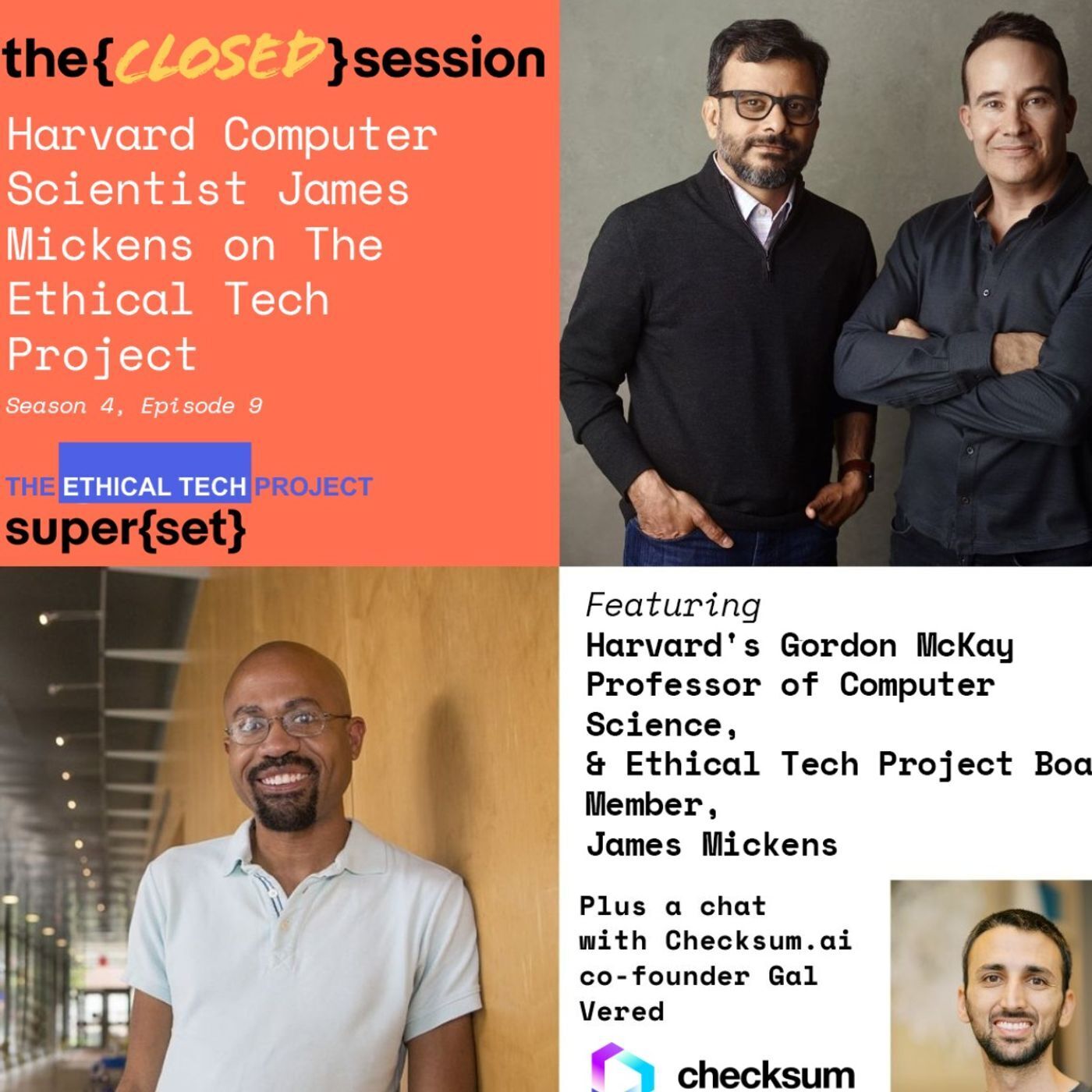
Harvard Computer Scientist James Mickens on The Ethical Tech Project
59m 18s
The podcast episode features James Mickens, a computer scientist from Harvard, discussing various topics. Mickens shares insights into his background, career journey from industry to academia, involvement in the Ethical Tech Project, and leading the Institute for Rebooting Social Media. He emphasizes the importance of collaboration between technologists and policymakers in implementing ethical data practices. Mickens critiques the challenges of unfettered use of machine learning and AI, pointing out issues like biases and the lack of understanding of how these technologies work. The discussion sheds light on efforts to address social media issues and promote responsible technology practices, emphasizing the need for a multidisciplinary approach to creating a better future for technology and society.
Transcription
10775 Words, 59679 Characters
(upbeat music)
- Welcome to the closed session.
How to get paid in Silicon Valley
with your host, Tom Chavez and Vivek Vidya.
- Welcome back to season four of the closed session podcast.
My name is Tom Chavez.
- And I'm Vivek Vidya.
- This is an exciting episode for us
'cause we have a very important notable guest with us.
We're gonna reveal him in a minute,
but to set it up a little bit,
we're gonna look at a whole range of topics now,
machine learning, artificial intelligence,
security, society, governance, all kinds of good stuff.
We're gonna give ourselves room
to just swing a cat's stretch out.
Our guest is James Mickens,
distinguished computer scientist
and professor of computer science at Harvard.
As we're getting ready to get going here,
I just James reminded me that he's been
on sabbatical this last year and,
which I'm sure is giving him even more time
to roam widely and explore new things,
but his central focus has been on distributed systems,
our scale services, ways to make them more secure.
He is also on the board of the Ethical Tech Project,
where Vivek and I do some things.
And he has the Institute for Rebooting Social Media.
James, welcome.
- Thanks for having me.
Good to see you both here.
- Good to see you as well.
- Well, let's jump in here, James,
'cause you have a very interesting journey,
and I was wondering if you could just back it up
a little bit for us.
You don't have to go all the way back to the dinosaurs,
but you know, how'd you get here?
Where are you up?
How did that all happen?
- So difficult, they answer such an important question
concisely. - Right.
- The shortest version is that I was born in Atlanta, Georgia,
and then I lived there for the first part of my life.
I got my computer science undergrad degree at Georgia Tech.
Then I went out to the University of Michigan
to get my PhD.
So at that point, I had experienced Southern heat
and Midwestern snow.
Then I decided to experience Pacific Northwestern rain.
So I went to Seattle,
and then I worked at Microsoft Research for about seven years.
I was in the Distributed Systems Group,
and so there I did research on large-scale online services.
So basically the pieces of software
that run in data centers and that act as the backbone
for all the apps and the web pages that we all know
and partially love, partially hate.
And then I decided in 2015 to come back to academia.
So I joined the faculty of the Harvard Computer Science
Department in 2015, and I've been there ever since.
- So that had to be an interesting twist, right?
Because I'm not aware of that many people who are happily
ensconced at Microsoft's research or one of those large groups
and then decides to go through all of the pain
and tumult of tenure.
And I'll, how'd you make that decision?
That's not a usual everyday thing.
- Well, yeah, it's true.
I mean, I had a great time at Microsoft,
and it was great when I was in a particular mindset,
where I really wanted to be very close to the product groups.
And so increasingly, in a machine learning in particular,
as I'm sure we'll talk about later,
access to data sets, access to the real user data at scale,
that's important for doing certain types of research.
And so that was super exciting to be able to be adjacent
to those groups adjacent to that real data,
at real infrastructure.
But I did miss teaching, you know, I did miss working
with students closely and the mentoring aspect of things.
So yeah, so I decided to come back to academia.
And yeah, I did have to hustle for tenure
and that was existentially terrifying.
It's very fun.
Whenever you talk to a professor who already has tenure
and you say, "Hey, what's it like?"
Was it, and they say, "Oh, don't worry about young person."
You'll be fine, you know, back when I got tenure
on a wailing, you know, schooner, it was,
it was a little bit scary, but it is absolutely terrifying.
You get judged by your peers.
But as one of my good mentors told me,
"Look, you know, just try to do good work."
You know, and like, "Yes, sometimes you'll feel scared,
"you won't know what's gonna happen to you,
"but just try to do good work."
And that's what I tried to do.
And luckily, you know, Zeus smiled upon me
and I got tenure.
- Then I worked out, "Hey, well listen,
"I mentioned ETP, the Ethical Tech Project,
"at the beginning."
And I was wondering, we just talk a little bit about that.
So for listeners who don't know what ETP is,
Ethical Tech Project is, as we like to call it,
a think and do tank focused on enhancing web safety
for consumers and guiding companies
to be responsible data stewards, by the way,
on a quick but relevant sidebar many years ago,
I worked in a think tank.
This is a long time ago.
And I had a friend who was just endlessly fascinated
like, "Okay, so Tom, what do you do all day?"
And I tell him, "I think."
And you think great thoughts and then you publish some reports.
So we're thinking great thoughts over here,
but we're doing stuff as well.
We're getting shit done at ETP.
And so I was wondering, if you could talk a little bit
about what draws you to the Ethical Tech Project,
'cause I wasn't gonna take it for granted
when we asked you to join up.
You got a lot of important projects competing for your time.
What draws you to the work we're doing
at the Ethical Tech Project?
- I think it's the doing part.
I mean, of course, the thinking part's also important.
I mean, let's not get trapped in the epistemology
and how they get to, but it's like the doing part,
I think is the most important,
because I think that if you look at the landscape
of sort of people who want to do good
at the intersection of policy and tech,
roughly speaking, this is a very big set of ideas
and people, so I'm not trying to disparage them
and just say, if you look at a high level,
the people who understand that technology can have harms
and want to make those harms go away
or mitigate them in some way, there's a lot of good intentions.
There's a lot of people who have various policy proposals
to make cybersecurity better, to make ML better
or so on and so forth, but from my perspective,
as a technologist, as someone who writes code
as someone who used to work with
and currently sort of still collaborates
with big tech companies, there's always this challenge
of implementation, like how are you actually going
to affect the change that you want to see?
And one of the big challenges I see
in the ethical tech space, very, very large,
is that there aren't as many technologists
having deep conversations with policy peoples, we might hope.
And also, when we talk about these, you know,
sort of attractive but nebulous concepts like privacy,
you know, how do we actually make those concepts real?
From an engineering perspective, at least.
So, you know, from my perspective as someone
who's done a lot of software engineering,
the way you make it real is you create protocols,
you create software frameworks that allow you
to actually put into practice the policies
or the ideals that you have.
And so, that's why I got, you know, interested in NETP
because this is what, you know, in my opinion,
it's trying to do, it's trying to create these artifacts,
these reference architectures, these stacks
that, you know, real engineers and real people
and companies can look at and say, ah, okay,
this is a concrete example of a way forward.
- Yeah, look, I mean, there's a lot of paneling out there
and we're psyched to be doing the work
and making it real and actionable and implementable
for different organizations.
So, thanks for everything.
You're chipping in there.
- Yeah, and what you said was interesting, James,
which is there's a lot of good thinking
that's been done by policy people.
And the challenge comes in,
how do you turn all that work into protocols
and frameworks and whatnot?
Are there any other roadblocks or blockers
that companies face
when they try to implement
these kinds of ethical data practices,
whether it's data stewardship or privacy engineering even,
that prevent them from employing
or deploying these kinds of best practices
for lack of a better phrase.
- Yeah, I think there are a couple of blockers.
The first is we just discussed was the lack of infrastructure
for, you know, to sort of make these ideas real.
Another challenge is that I think that a lot of times
engineers think that we are the anointed people
and that we don't really need any of these insights
from these other sort of soft fields for, you know,
the dilatants and that's super unfortunate.
Like as it turns out, as the sort of wheel of time
is in spinning, humanity has been making progress
not just on engineering, but on things like sociology,
on things like psychology.
And so I think that having an engineering first
all the time approach to these types of problems is bad
because you should actually listen to, for example,
psychologist and economist and a sociologist.
If you care about things like getting rid of bias
in machine learning algorithms,
you can't just define that sort of statistically
and just be done because I read my Bayesian textbook
or things like that.
I'll say one last thing, another challenge I find sometimes
is that people and people inside companies believe
that doing the right thing either won't be rewarded
by the market or it's like not as profitable
as doing the quote unquote wrong thing.
And that's just I think oftentimes an unexamined assumption
that people should look at.
I mean, you may be aware of some of the work
that some economists are doing around targeted ads,
which show that targeted ads may not actually be
as beneficial for anyone in the ecosystem except for the people
who are running the ad targeting infrastructure.
And so I think we really need to sort of step back
and re-examine some of these assumptions
we make about how we can make companies that make money,
which is important just to be clear, I'm not a Marxist.
Some people should be able to make money,
but also we should be able to deal with these other sort
of public good issues.
And I think we can do that in a way that's not
mutually exclusive towards achieving those two goals simultaneously.
- Listen, I mean, I love, I mean, we subscribe.
James is you well know.
It is interesting right to see a younger generation
of engineers coming up who's the only frame of reference
it strikes me are sort of overreaching monopolists
who have taken liberties and claim and concentrate
as much market power as possible because it's worked, right?
And so the question is, well, do good guys ever win?
Or do you have, does doing the right thing
actually pay off, right?
And so it's exciting to be trying
to provide those counter examples like no,
you can actually do the right thing
and participate in the large market
and create a lot of wealth as well.
I don't want it to rail us, but why that preciousness,
that hubris that you talked about,
'cause I worry a lot about that where engineers just,
you know, well, I did all of this math
and I write all of this code.
I know the answers and all of those weenies
and the humanities over there, you know,
adorable but irrelevant.
How, any psychosocial theories, 'cause James,
I know you have a lot of ideas.
What's your like take on kind of that happen?
Like why the preciousness, why the hubris?
- I think it arises because at least superficially
the things that engineers have been able to build,
particularly over the past, let's say, you know, 40, 50 years
are just amazing.
I mean, even just in my own lifetime,
the fact that I can translate, you know,
one human language to another automatically
through something that I can hold in my pocket.
I mean, that's magical, that literally used to be sci-fi
that I would see in your movies or cartoons or things like that.
So at least at first glance,
if you look at some of these technologies we built,
they are quite literally amazing.
But then as soon as we think that, you know,
one of our instincts hopefully should be amazing for who?
Is it amazing for everyone?
Are there downside risks of those things?
And so to answer your specific question,
I think it's sometimes easy for engineers to get caught up
in the amazingness that they see directly
for the target populations they're thinking about directly.
But they don't think, you know, at what cost?
Or, you know, who isn't getting access to these technologies?
Or did I not consider someone
when designing this, you know,
ostensibly amazing new feature?
- Right, and now all of the reverberations of these technologies,
right, in maybe ways like you can solve it in a silo
and from an engineering perspective,
it is unbelievably great.
But then it reverberates, right?
Which brings us to this question about,
I was wondering if you could just talk about the institute
for rebooting social media,
a group that you had at Harvard.
It dovetails with what we're talking about here.
What are the goals and structure?
What's that all about?
What should our listeners know?
- Sure, so the Institute for Rebooting Social Media
is a group that I help lead alongside Jonathan Zittrain,
Rebecca Rankovich and a bunch of other great folks.
And the basic idea is that,
well, let's first start with the motivation.
What's for the origin story?
The motivation is that much like with ETP,
we feel that we're kind of in this interesting
and important perilous but hopeful moment with privacy,
because of a lot of well-known privacy breaches
or sort of bad happenings.
We think that in social media,
there's a similar type of sort of inflection point
that we're possibly on,
because of things like the Francis Hagen
and the whistleblowers inside these various companies,
because of the research coming out that shows that,
yeah, social media can be very good in some cases,
but it can have these really devastating impacts
on hate speech misinformation, you know, so on and so forth.
So what we wanna do is we basically want to sort of look
at social media and say, you know, what's working?
Let's try to keep that.
But then, you know, what isn't working?
How can we get rid of those things without destroying
some of these sort of economic facts on the ground
that I don't think we're gonna be able to get rid of
and maybe we shouldn't.
So as a concrete example of that, you know,
a lot of people will push on this idea of,
oh, everything should be super decentralized.
That's the only way to give users control over their data.
But just for various reasons involving economies of scale
and so on and so forth,
data centers are here to say, breaking news.
Congratulations, listeners of the podcast,
you've heard your first breaking news of the day,
data centers are here to stay,
because they just make a lot of things efficient,
and they will end up costing less
for various definitions of cost
than fully decentralized ideas.
So that's one of the things we want to look at.
How can we sort of give users more control over their data?
How can we give them in some sense more of a sense
of dignity online while not trying to say,
we're gonna go fully decentralized
or we're gonna get rid of all kinds of ads.
Another reason breaking news, ads are not going away.
I can just guarantee you that
because there's like this weird tension inside everybody's soul,
which is that we both don't like ads.
We also want stuff to be free,
at least as we directly perceive it to be so.
So ads are not going anywhere.
So how do we wrestle with those tensions?
And much like ETP, we try to be generative,
so we don't just want to be issuing white papers.
You want to be bringing a diverse set of people,
scholars, civic activists, so on and so forth.
People from tech companies too,
they're an important part of the solution.
Unlike a lot of attempts to do quote unquote ethical tech,
where we sort of say,
well, engineers are purely the enemy in some sense,
and we just have to put them in a cage.
We want to engage with them because they're going to help us,
we think, to make a better future for social media.
- Yeah, just switching gears now, James.
AI, machine learning, generative AI now is been,
of course, it's become a household word.
My barber is asking me about generative AI, you know?
And she's good, huh?
To give him a little tutorial.
- Yeah, I did, I did.
I tried to make it as accessible as possible.
- We got to go to your barber shop.
- Yeah.
- This was actually in Boston.
- It's different from my barber shop.
- This was actually in Boston.
- This was actually in Boston.
The marvelous barbelange in Boston.
But you know, you've been, and rightly so,
these technologies are being perceived as,
as experts in some cases, to solve the world's problems.
But you've been a critic, a somewhat vocal critic
of some of these, the challenges come out
with machine learning.
So can we go deeper?
We talked about a little bit in the beginning of the podcast,
but can we go a little bit deeper?
And hone in on what you believe are the challenges
that arise from widespread use, unfettered use
of machine learning AI, et cetera.
- I'd love to, I'd love to.
This is great.
This is like, you know, asking a coffee addict.
Well, tell me why you love coffee so much.
As a video game addict, tell me more
about the world building in Zelda, yes.
So for those of you who can't see me,
my eyes are rolling in the back of my head,
and now I'm gonna enter sort of like a translate guru state.
So, I mean, at a high level,
as we kind of hinted at it before,
there's some things that machine learning can do
that practically speaking.
If we ignore sort of downstream effects,
or just focus narrowly on,
does this app do something awesome?
The answer is yes.
You know, so I'm not against machine learning
in the sense that I don't appreciate
some of the goods that has given us.
But there's sort of, a lot of intrinsic problems
that arise from machine learning
that in part flow from the fact
we don't really understand how a lot of it works.
And this is different, by the way,
than the critique of like, well, you know,
why do you fly in airplanes
if you don't fully understand how the engines work,
or why do you know, it's different.
Because like, at least in theory,
there's a set of people at Boeing
who understand how airplanes work, you know.
But like when you look at some of these models,
they're just these sort of deep, profound mysteries.
And like, I know some people in ML groaning,
"Oh, no, no, look at this explainer,
"look at this medium article."
Yes, I understand that there are some sort of theoretical
sort of underpinnings for why we think
these things work like they work.
And yet, if you look at what happens
with things like chat GPT, you know,
or Bing's version of chat bots or things like this,
people put all this effort into making these guardrails,
well-intentioned effort, by the way.
So I'm not trying to disparage the work of those people
in any way.
It's very hard to make those guardrails
because we don't know how these things work
in some sort of deep sense.
And so you see like all this effort
go into sort of putting these guardrails in.
And then yet still, there are these pretty easy hacks
that you can do to turn off the safe features
or to make it, you know, sort of misbehaving certain ways.
So I think that's a huge problem.
And what that sort of exacerbates is a problem
that then because these models oftentimes
encode biases in the training data,
now it's kind of like a double whammy.
Because we've got these biases in the training data.
We can't fully understand how the models
ingest that data represent those internal biases.
And then people want to look at these models as magic.
You know, like it gives me the PBGBs
when like I go on LinkedIn.
I mean, that's my first mistake, don't go on LinkedIn.
But like when I go on LinkedIn,
and you see someone saying like,
hey, you know, don't get left behind by AI or machine learning,
bring it into your business.
Look at all these great things it can do.
Good Lord, would you just walk on a beach?
If just some just bedraggled person showed up on the beach
and you were walking there and they said,
hey, guess what?
I can evaluate resumes for you.
And I can do it at a tenth of a cost.
Would you say yes?
No, you would call a priest or the Ghost Busters
or the National Guard or whatever.
And that's like essentially what we're asking people
to do with some of this machine learning stuff.
And so it just, it's, I feel like, you know,
it's a weird position to be in as a technologist.
'Cause on the one hand, I do appreciate the amazing thing
that it can do.
But I do think that in many cases,
we're not being reflective enough
about how it's being used, how we put those safeguards in,
how we test the stuff, so on and so forth.
Yeah, listen, I mean, I've been at this awhile.
You look back at these hype cycles in the hysteria
that ensues going back to like object oriented programming,
object oriented programming,
it's gonna save the entire planet
between object oriented programming
and web free slash blockchain.
I know you're a big fan, James.
Yeah.
Chum in the water.
That's right.
This one is uniquely hysterical.
Everything that's going on right now with AIML.
I really appreciate your comment also about
how scary it is that we really have no effing idea.
How it really works.
An honest researcher in that field.
And 'cause I, you know, you pick up some of these papers,
I stay curious and I look at some of the,
some of the summaries and other cutting edge research
and you open it and it's just a lot of notation hacking, right?
And people kind of trying to gussy it up
with the patina of a lot of math and symbology,
but honest researchers who do it will tell you,
listen, dude, we have no understanding
as to how I'm multilayer neural network.
It actually does what it does.
Zero, you know?
So it's, and in that context, here we are,
just all of us, all the Flutter everywhere,
AI for your business, AI for your bathroom,
AI for your car, AI for your kitchen.
It's kind of crazy.
God help us.
It's completely crazy.
And I'll just say by the way,
like this is one reason why I think that like,
people who dismiss the existential risk thing,
they're going to be the first to go because like,
it is both true that there are immediate harms
for people whose lives are currently impacted
by machine learning systems, just to be clear.
There are immediate harms that are being done
in terms of like, you know, deciding who gets parole
and deciding whose mortgages get, you know,
hand out stuff like that.
But like when you talk about existential risk, right?
The fact that we already have so many,
quote, I mean, I don't call them mundane to dismiss them,
but we have so many sort of immediate negative impacts
of AI that we see already.
Why wouldn't we think that if we're not careful?
Oh, you know, someone's going to hook up, you know,
machine learning to, you know, the Pentagon's a system
for doing, you know, early warning or things like this.
So I think that we should be concerned
both about these sort of immediate near-term harms
as well as the existential risk stuff.
I'll be wearing a sandwich board out by the,
the Harvard T-stop later on if anybody wants to hear more
about this exciting positive field philosophy.
So make sure to wear your tinfoil hat on top
of the sandwich board.
Pat singular plural might have multiple layers
to attenuate different frequencies.
But just to play devil's advocate, right?
The train's already left the station, right?
So you can't, or you can't put the toothpaste back
in the tube, you can't put the genie back in the bottle.
Pick your favorite analogy, right?
Isn't our only recourse to figure out
how we are going to build in the things
we were talking about earlier, frameworks,
policies, protocol, et cetera, so that all
of this amazing technology is used to the extent possible
in the right way in scare quotes, right?
Mm-hmm.
Well, I mean, you're exactly right that, you know,
absent a time machine, you know, we can't go back in time
and whisper to Jeff Hinton and say, hey,
maybe you should become an artist, you know.
By the way, Jeff's a great guy.
And I mean, that's just, you know, got it thrown
at a time travel joke there.
So yeah, I don't think we should like outlaw the technology,
but like what's going to happen practically?
Well, I think like what history shows us
is that there's going to be a disaster,
like a very big disaster if we don't sort of get ahead of it.
And then we'll try to do more regulation.
And then we'll sort of engage in sort of like this,
this sort of halting, we'll deregulate.
There's a problem, we regulate more.
We see this in the financial markets to some extent, you know?
Like where people say, oh, times are good.
Let's roll back some of these regulations we've had before.
And look how well that's worked out.
So I think that like, I'm not advocating
for sort of like a maximalist position
of like let's abolish this technology,
because I do think you're right that in some sense,
like information wants to be free.
Like we're never going to be able to just sort of completely
make people forget about neural nets.
But I think that the core challenge, I think,
for people like us, the technologists who are interested
in responsible technology is trying to figure out
what that balance is of wanting to foster progress
while encouraging regulation.
That sort of makes sure that some of the excesses,
some of the obvious harms don't come to light.
And it's a difficult needle to thread, but we have to try it.
No, 100%.
I think regulation is the way to go.
The challenge, there's a separate conversation
to be had about what the challenges are
with getting regulation like this,
passed in any way, shape or form.
But yeah, I agree with you that it has to be a combination
of tech, policy, law, all of it coming together.
By the way, the irony in all of this
is that AI, machine learning, data science,
all of that, butters are bred.
So we're up to this, right?
But in some sense, because we're in the boiler room
and we see so much, right?
I hope that we have a sharper understanding,
not just of the wildly exciting opportunities,
but also these perils and hazards
that we're talking about.
When you look at regulation, I just want, you know,
when Eric Schmidt talks about, okay,
gotta keep the government away from this.
It's too, they don't understand it.
You don't want the governments or senators
or members of the House of Representatives
even thinking about this stuff.
It reminds me of that preciousness
and hubris we talked about earlier.
But as I was saying to you, Vivek earlier today,
we're walking back from lunch
and we're talking about something related to this.
Look, I had a chicken in my salad.
I don't know how salmonella works,
but I have high confidence that the government
and the USDA has ensured that the chicken
I'm about to eat for lunch doesn't have salmonella in it.
And a senator and a member of the House of Representatives
maybe doesn't know how to build a bridge.
Maybe they are, I don't know.
But the point is that governance,
whether they're governance mechanisms
or governments, if we trust them,
there's a long productive history
of them doing helpful things,
a harness and channel new technologies
in a way that's responsible and good for everybody,
not just Robert Barons.
Anyway, hey, so let's switch gears, James.
We have this thing on our podcast
where we like to boost something that we dig.
Totally unpaid for promotion.
It's very exciting.
This will be the first time I think where we seed the floor,
right? - Mm-hmm.
- Okay.
James, we're giving you the floor.
Totally unpaid for promotion in the closed session
what do you got?
- Awesome.
Yeah, I want to boost insure.
In particular, insure plus, it's a nutrition drink.
The commercials, oftentimes say it's not just for old people,
I'm not an old person, I can vouch for that.
You'll find yourself sometimes in life
in a difficult place, okay?
You've been there before, you know,
you've been working all day, you skipped the meal,
your body's kind of feeling like, you know,
like it's not in its tip-top shape,
get an insure plus man.
It's got a perfect blend of just vitamins,
minerals, flavor crystals.
I don't know, it's just really good stuff.
So I hope you all go out drinking it sure, not too many.
You know, eat from the earth and all that kind of stuff.
- How many per day do you have?
- I try to put a cap on one per day
because although insure is delicious,
it is completely synthetic.
I believe it's created in particle accelerators.
So like your body knows that.
So after a certain point, if you drink too much of it,
like you don't die, it's like a fate worse than death,
like you're just fully nutrition,
but just the psychological strength is not there.
But yeah, one a day, that's the key to my success trademark.
- James, I'm a big fan.
I also have regular shipments of insure coming from Amazon.
What's your favorite flavor?
- Well, you know, it really just depends on the mood
and where I'm trying to take myself, you know,
it's kind of like being a DJ for your own inner Spotify
channel.
I usually go for the vanilla.
People say that vanilla, oh, it's vanilla,
but I'm like, no, water doesn't have a taste.
Vanilla has a taste and that taste is delicious.
I usually go for the vanilla plus.
- I, big fan.
Vanilla is the only flavor insure plus that I will drink.
I don't like the chocolate, actually.
- Okay, too.
I'm feeling totally left out.
- You should have some, you should have some insure.
- I got FOMO, you know, I'm do right after this podcast.
I'm gonna go get buy some insure, right?
I feel totally left behind.
I'm gonna go check it out.
- Go to Safeway and you're gonna stay back.
- Yeah.
- Do it.
- This is an example.
This is what a class like how it is called
positive peer pressure.
We've just changed a person's life during this podcast.
Tom's gonna go out there.
You'll be flipping cars over tomorrow after that first insure.
- Hallelujah, I need all the help I can get.
All right, ensure this episode's totally on pay for promotion.
You're welcome, insure.
- Great.
So with that done,
let's pick up on the question of regulation
and we were talking about, right?
You recently had an article come out in nature
where you proposed to create an IPCC like body
to harness benefits and combat harms of digital tech, right?
What does such an interdisciplinary meeting of the mind add?
Even if they lack the power
as a regulatory or industry actors themselves?
What, how would be structured in your mind?
How do we get governments and firms
as strong as talking about to listen to people like you
and others who are talking about these things?
- I think a big sort of advantage or an attractive feature
of such a body is that it can get a bunch of experts
in one place in one time, you know, abstractly speaking,
and allow them to sort of function as this singular advisory body.
And you're right that they may not have the power
to actually pass laws themselves,
but as it turns out, like it can be very helpful
if you have a group of scientists
and other concerned policymakers who can say things
like we've done a meta analysis of a bunch of different studies
and here's what they've all shown.
Here's like a menu of possible regulations you could pass
along with the pros and cons.
And I think that we were inspired by we,
I mean, the authors of that article,
and part we were inspired by, you know, bodies
that have been made for things like climate science.
- Yeah.
- You know, to be clear, like climate science
is not a solved problem,
but it's been great to have some international bodies
that have been able to say, well, at a high level,
here's what the research seems to say.
And you know, governments that are responsible,
they can look at that research
and then try to craft policies that, you know,
they think will work for their particular countries.
But we think that would be a really helpful thing
to help level set sort of the way that, you know,
national level governments, even state government,
small governments can try to understand this complex topic
'cause it is complex, you know,
in the same way that climate change is very complex,
it is not simply like the world is getting hotter.
Like, yes, it's like at the most highest level, that's true.
Some places are gonna get wetter,
some places are gonna get drier.
You know, so it's this really subtle interplay
between, you know, individual actions, corporate actions,
government actions, those statements are true
for both climate change and for what happens with technology.
So we thought it was a really nice analogy.
- Actually, I was just thinking as you were saying that,
it could be something back to ETP for a second.
This could be a project that ETP sponsors.
Like it could be, to your point about just doing the research
on learning from all the other regulations
and building a framework,
it could be a great research project
for a master's thesis or even a PhD
that is done in partnership with ETP
and then we could make a recommendation
could serve as guidelines or whatever
to state governments, federal governments, et cetera.
- I think so.
I mean, I would say that like the scale of it,
I mean, unless the master's student is very good.
But you know, I think the scale of this is, you know,
gonna surpass like any individuals capacity to do it.
But like on the other hand, you know,
this intergovernmental body we were thinking of,
it's composed of individuals, it's composed of people.
And I think that's a really sort of important aspect
in all of these conversations we have
about, you know, ethical technology and governance.
And this is only I tell my students a lot too.
The technology world's pretty small.
It's all people driven.
As much as we might like to tell ourselves
that it's all about equations and, you know,
code and stuff like that, it's all about people.
It's all about the decisions that people are making
to do or not do certain things.
And so that's sort of daunting from one perspective
but also empowering from another perspective
because it means that, you know, we,
if we wanna see a change in the tech industry
then we as individuals in that industry,
we have to act and do things to, you know,
bring about the world we wanna see.
Absolutely.
James, I love the way you think about all of these topics.
I am now going to invite you to do a little bit
of a victory lap or maybe give yourself a high five.
I wanna, that earlier topic we touched on decentralization
and I mentioned blockchain.
I was chiming the water, but let's come back to this
because two years ago, I think we were at an event
and you were speaking quite virulently
about the perilsal blockchain
and the problems that everybody was overlooking.
And I love this because you never hold back
and you always have vivid ways of expressing yourself.
Holy shit, you're really right.
Like a hundred percent, right?
Yeah.
Now, what do you make of this whole journey, right?
'Cause since that time, the, you know,
Samuel Blankman free, then the collapse,
generally of that space, you know,
and you're not, you're too gracious to be smug.
But like, give us, give us a recap.
What the hell happened?
Yeah.
By the way, I'm not too gracious to be smug.
(laughing)
Well, then go for it.
Yeah, thank you for thinking that.
But oh, no, it was my many character strengths.
The ability to hold in restraint.
This is not, it's not up there.
But I mean, like at a high level, yeah.
People say, like sometimes your parents might say to you,
like, you know, I hate to say I told you so.
Not me, I love it.
I tell these crypto people all the time.
I told you so.
I told you exactly how you would be destroyed.
I said, you would be the instrument of your own destruction.
I'm nearly a Chronicle.
I'm like, Herodotus or what?
I'm just looking at this stuff.
But so, like at a high level, you know,
what happened there?
I mean, a lot of it was foreseeable.
So, you know, when we look at, you know,
like Sam Bankman for you, for example,
that's just some old-fashioned fraud.
Right.
You know, good old-time country store fraud, you know,
and people sort of want to think that somehow
there is something magical about crypto currencies
because crypto currencies rely more on code.
Well, there's a couple of problems of thinking like that.
First of all, like, how do you think the federal reserve works?
Or like, how do you think the modern banking system works?
It's not like we're just trading, you know,
Babylonian tablets with, you know, esoteric writing.
Like the banking system is very computerized already.
Now, a core difference, though,
between, you know, what the Fed is doing,
and what Swiss is doing.
And let's say what people want to do with Bitcoin or things
like this is that they are trying to essentially create
mechanisms that either implicitly or explicitly
lie outside our traditional regulatory schemes.
And everything that we know about human history
and our desire for, you know, just greed
and hope and optimism in some case.
Like some people who got duped by these crypto people
are good people.
They're good people who saw a fad.
They didn't want to get left behind.
But it's like, this has happened with tulips.
This has happened with beanie babies.
So to me, like, the reason why I think it was an easy call
to make that this is all going to sort of end up
in a ridiculous way is that we've seen this before.
Like, one of the few advantages of getting older
is being able to see patterns and things.
And so like, if you look at the history of economics,
the history of boom bus cycles and the history
of what happens when you have, like,
these highly speculative, unregulated markets,
everything we know about the human condition
told us this wasn't going to work well.
Now, note that I haven't even talked about, you know,
sort of fundamentally the decentralized aspect of things.
I've really just talked about how, you know,
we're creating this sort of financial system
that's existing outside of the bounds of normal regulation.
When we look at it from a technical perspective,
in terms of like why hasn't someone
made like a killer app on Bitcoin or things like that,
these fully, you know, these fully decentralized approaches,
they just don't scale that well.
People oftentimes observe, oh, well, you know,
there's like a bunch of people,
you know, there's a bunch of miners, for example,
they're doing stuff.
Well, first of all, there's not actually
a huge number of mom and pop miners.
Like, if you listen to this sort of, like,
pick yourself up by your bootstrap, like, and ran type,
you know, all you people need to go find
some different books to read, by the way.
I don't understand how it is that you talk to these people.
It's like, what's your favorite book?
I've found it.
But when you last read, I'm reading it right now.
I'm wearing some augmenting realities.
I'm reading it right now.
Just find another book, literally almost any other book,
would just change your life for the better so much.
But if you talk to them, they make it sound like,
in theory, like, you know, and in practice,
oh, you look at Bitcoin.
It's just people like you and me,
just, you know, normal everyday folks from Americana
who are running these Bitcoin miners.
Absolutely false, absolutely false.
If you join the Bitcoin network,
if you're like commodity laptop that you got
from Best Buy or whatever,
you're not going to make a Bitcoin and expectation.
You're going to make an electricity bill.
But you're not going to make a bill.
Why is that?
Economies of scale.
This is so interesting about these
ostensibly decentralized mechanisms.
When you go fully decentralized
and you don't have authorities that are preventing
consolidation of fiat power in the cryptocurrency world,
what do you end up seeing?
You end up seeing people who are wealthy in the fiat world
using that wealth to consolidate and get power
in the crypto world.
So for example, when you look at, you know,
who's mining in practice?
Who's getting most of these rewards?
It's these huge crypto rigs.
Who are they funded by?
They're funded by big companies, rich individuals
who have the yen, the euros, the dollars,
all the fiat currency to go build the data center
and to fill that data center full of Bitcoin toasters
whose only reason it is to exist
is just to solve the Bitcoin mining puzzle.
So this, once again, is just something that should be
just intuitively obviously the casual observer
that if you don't, like they now always use,
like look at what happened with Burning Man.
Another sort of like libertarian fantasy
gone obviously awry.
How great would it be?
Just have a bunch of people hang out in the desert,
love no rules, certainly it will stay that way.
And now like these rich people come in
and basically bring in like Atlantis
on zeppelins that are like air conditioned
and have like private strike forces and stuff like that.
You're like, who would have thunk it?
Anyone who's literally read anything about economics
or regularly, the same thing ends up happening
in these crypto things.
It's just silly.
And like I try not to make fun of students,
but if they tell me things about crypto,
I just tell, I'll make fun of you directly
'cause it's just not a good way.
It's the same thing as someone came up to me.
I have a dream.
I have to go into my eye, I have a dream.
What's your dream?
I wanna become a crack head.
I'm gonna make funny, that's a bad dream, okay?
So like if your dream is to somehow like make cryptocurrency,
you should just change what you want.
Okay, end of rant.
- James, James, James, your smack is so fresh.
It's so, it's so on point, we salute you.
- Are you like this when you're teaching us about James?
- Yeah, I'm not saying my most love, I love you.
- I would love to audit your class, actually.
- Listen, and for our listeners, as we close out here,
go to YouTube 'cause some of this banter, you can find it.
I've listened James Big Van, I follow you on YouTube.
This is not just James, you know, on a lot of Adderall
here in the moment.
This is James, just on a Monday.
- And short plus though, and in short plus, obviously.
And I need to go, I'm gonna go buy some in short plus as well.
- That's the secret.
- Done.
James, thank you so much for joining today.
This is a lot of fun.
- Thanks James.
- Yeah, thanks for having me.
Yeah, we had a blast.
Yeah, thanks so much.
- Thanks for our listeners.
We'll see you next time.
- See you next time.
- Welcome back to the closed session.
This is Tom Chavez.
- And I'm Vivek Reddyah.
- Okay, we are gonna chop it up and do something
a little different today.
I'm very excited here to have a chance to talk
with a couple of our amazing co-founders from SuperSat.
We haven't done this before, have we?
- We did one context, right?
- No, we did quite a few times actually.
We got punker gin, we had Matt, we had Dane.
We've done it a few times.
But this is a different format though.
That's a different, that's where I got discombobulated,
but yes.
- This is format, it's called the Spotlight series.
- We're doing a spotlight.
- Yeah.
- And so it's exciting, let's just hurdle right into it.
We have Gaul with us.
Gaul is one of our co-founders,
is our principal co-founder and head of product
with checksum.
Hi, Gaul.
- Hi, how are you?
- Good, I'm glad you're here.
- Yeah, great to have you here, Gaul.
- Well.
- I'm happy to be hosted.
- Gaul, back us up a little bit.
- Give us the personal journey.
How did you, yeah, to go all, well, yeah, go back.
Where did, you know, where you from?
How did you get into this game?
- Sure, so I'm, as some of you may be able to tell
by my accent, I'm originally from Israel.
I served seven years in the Israeli Navy.
And then I decided I came to the US,
did my master's degree, walked at Google,
and then founded a company at YC,
and joined SuperSet as a co-founder.
- All right.
And now, and so can you tell us more about the Navy experience,
'cause that's, you know, for us Americans,
Israelis who train in the military,
it's fascinating to us.
What did you learn?
What did you do?
- Yeah, so I think what you learn in the Navy
is that you operate with a high risk, right?
'Cause if something goes wrong, you're in a trouble.
But on the other side, you operate very fast.
Like you don't have time, everything needs to happen now.
So you kind of learn how to process this stuff,
so you can operate in high speed,
but lower the tolerance to mistakes.
So it's about debriefing, trusting people,
and kind of getting them ready for the day.
So that's what I learned.
- So that sounds exactly like a real stage copy.
- Yeah, exactly.
- Well, it explains why there's so many kick asses, really,
much per nurse.
- So speaking of early stage,
what does our company do, Gal?
- Yeah, so we help companies QAIDer product
and test every corner of their web applications using AI.
And if we take it to one level more technically,
we generate N2 and test in SWIT,
SWITs that can run on command and test everything,
again, using a state of doubt, generative AI models.
So as with all things at SuperSet,
we do, we explore and build companies
when they're personal,
and we think we know something about the space,
the premise, the opportunity,
but we also want to have
up close and personal experience of the problem.
So I always like to talk about in the context of checksum,
there's another SuperSet company
where I'm the guinea pig, early product user,
and I'm getting so frustrated
that we're pumping into these knowable, avoidable bugs,
and I'm getting angry.
And then I think, well, how did this happen?
And then I remember, oh, no, no, no.
That didn't just happen to me.
I am the problem.
Gal, back us up and talk a little bit
about the context around this, right?
The problems that,
'cause I'm the person in that context,
telling the head of engineering
and asking the head of engineering
in the subject context, hey, ship it, go.
Keep it going, don't break your pick
and get all caught up in your knickers
on some of those bugs we'll fix them later.
Talk a little bit about the problem
and why we care so deeply about it.
- Yeah, I think, first of all,
one of the cool things about checksum
is that it was never about AI, right?
It always started with the problem.
Like we all suffered from the same problem again and again.
And AI is just a way to solve the problem.
And I think that's why we're kind of seeing,
seeing the traction we're seeing.
And so if we start from the beginning
and this is the, I'll tell you the journey
from a startup perspective,
but it's true for big companies, small companies
as we kind of learned across the months is that.
You start with a small team
and at the beginning it's all about chip ship.
You have so much risk that it doesn't make sense
to think about quality because you may not solve
the right problem.
Everything you do right now may go into the trash bin
and you're gonna start from scratch.
But the mindset is always about chip ship,
but it's a small team.
So the city is able to handle it.
You know, everyone know you're recruiting
very talented senior engineers so you can manage it.
With time, the team goes,
you get more engineers into the mix.
The city knows the most experienced person
most of the times can't micromanage and review every PR
and test everything manually.
The CEO, the head of product, the product manager,
can't keep doing like back and forth
with every engineer because the team is now big.
And also the powerful hiring, hopefully you keep it up.
But in reality, every once in a while you're gonna have,
you know what, even forget about hiring
even junior engineers are gonna join the team
'cause that's the natural succession of the company.
That's a good thing.
But the problem is that with that quality goes down
and you'll start seeing bugs hit production
and you'll start seeing tasks that should take two or three days,
take three weeks just because there is so much back and forth.
The task itself takes three days
and then it's three weeks of fixing the bugs
and dealing with all of the unintended consequences.
And at that point in time, you kind of feel like the house is on fire.
And this is the time where our customers
kind of like crying out loud and we come in
and we help them test their app and to end.
So you walk on a feature three days
and instead of a three weeks process to figure it out,
you run it, you find all of the bugs immediately,
you fix them within the day and within four days,
you ship it back.
- Yeah, and so for listeners who don't work
in the middle of a software engineering process,
what Gaul was describing that those heron fire issues,
we call that Tuesday, right, in a software group.
It's very, yeah, it's a big problem
and it's a remain unsolved for decades.
- Yeah, and so let's talk about that, right?
It's been, it's a remain unsolved for decades.
You mentioned AI and the fact that AI is,
you didn't say it like this but AI is a means to announce for us.
We focus on the problem, we always start with the problem
and always have the problem in the back of our minds
when we're doing this.
But there is an element of AI which is informed our approach
and we couldn't have done what we're doing right now
two years ago, right?
So can you talk a little bit more about that
and what makes checks some unique based on what's happening today?
- Yeah, how technical should I go?
Is it keep it high level or?
- Well, give us a high level and go deep.
- Yeah, so if we think about all of the great things
we see in AI today, the most well-known ones
are obviously Churchy PT and all of the image generations.
They all became available because of a new technology,
diffusers and transformers that was introduced in 2019
and kind of took three years to take it to market.
And I think what we're seeing today is that
those technologies allow us to understand the delicate
interconnections and dependencies that language
or systems in general have between different steps.
So with Churchy PT is how it can understand
what the word that it needs to generate now
correlates with the sentence that it wrote
like one sentence ago and one paragraph ago
and take all of the context into consideration.
For checksum is the ability to understand that the user,
the action that the test is growing right now,
how it correlates to what it's done five steps ago,
10 steps ago, the entire system, the user context,
everything that makes software so complex
but also so wonderful.
All of the logic that's picked up into the software,
the new innovations in AI now allow us
to create a model that can take everything into consideration,
understand what's important that the attention
networks if we want to go kind of technical here
and speed out a prediction that for us might perceive
as intelligent and I think it's up to debate
whether it is intelligent or not,
but perceive that as at least intelligent like
what you see results from ShareGPT
and what we see in checksum when we generate tests.
- Yeah.
So role playing here,
Gaul, a listener who is a software engineer
say was listening to this and say,
"Well, sounds like QI automation."
Is it, you're doing QI automation then, right?
- We, so we think about the problem as continuous quality
in a world.
Around 10 years ago, I think companies started to shift
into SaaS models and into CI/CD models,
meaning that instead of fighting software for six months
in a row and then package it up in a CD,
ship it to stores and they started doing CI/CD.
Every time you deploy multiple diamonds a day,
every time you ship code it goes to production.
What's missing from this piece is continuous quality.
'Cause yes, you ship more code,
but you ship more buggy code and you create more issues
and we've all been there, like we've all used companies
from the products from the best and the greatest Amazon,
Google, Apple, and there's just so many bugs out there.
So we think about this as continuous quality.
We think, and what we do is check some is
because we understand systems very well
and because we understand how your code works very well,
we're able to make sure at every step of the process
on the developer writing code to the integration,
all the way to deployment and production,
make sure that your code works as if you had an army of people
that review every PR, review every code, test every release
and make sure it just works.
And if it doesn't work, you get feedback now.
Not two weeks from now, not two months from now
and the users file the bug report as you write the code,
you get feedback and you're able to fix it.
So, and it's important to say,
it's much about the velocity that is about quality.
Because our customers, they mostly talk about spill,
like when we talk to them about the value we provide,
and quality, because it goes hands-on.
- Yes, if you talk to a CTO or any head of engineering
who's worked in software at any kind of scale
and ask them rhetorically,
hey, what would you be willing to pay
for just one percentage point improvement in throughput
from your engineering team, like working code per unit time?
It's immeasurably huge, right?
So, I really appreciate how you always bring us back
to the two, it's about quality,
but it's also about the velocity
of your software engineering process.
- Yeah, and just to kind of make it personal, right?
I've used so many QA automation platforms in the past, right?
They, and there are quite a few out there,
people use testing frameworks and various CI/CD systems
to implement these automation pipelines.
And that's not the hard part.
Those systems exist, where I think Chexam
solves a unique problem is you all,
the long pull in the tent is you need to have tests
that you run through those frameworks,
that you run as part of your QA automation pipelines.
And that's where Chexam is unique,
and that we actually generate tests for our software,
and for the software engineering teams who are our customers
that help them achieve the velocity
by not compromising on quality.
I don't want to get too punchy about it,
but for me, Chexam is the conventional QA automation
when apples are to hovercraft, right?
I mean, yeah, I mean, they're both entities or objects,
but this is, to your point, the fact,
automating the test after it already exists,
that's not the hard part.
- Correct, correct.
- Generating a new test that smokes out a bug
that I actually care about.
Okay, that's, that's Nirvana, right?
And it couldn't, to your point, golly,
it couldn't have happened two years ago, right?
We had to wait for this magical cusp, right?
Where this gen AI, this multi-layer neural network explosion
of possibility fuels the kinds of things
that we're doing at Chexam.
I don't think we could have built this company five years ago.
- No, exactly.
- Absolutely not.
- So, a note or two, call if you would about Super Set,
what has been like, you know, joining up
and whacking away at it,
at it over here with me and Rebecca Super Set?
- Yeah, it's just what it's great.
And-- - You don't have to just say that.
- Yeah, I kind of do, but I mean it.
In this time I mean it, but I don't know
by any means. - Okay, there are a lot of those lines.
- A lot of those lines.
The VAC or me, who do you like more?
- Oh, and--
- There's only one right answer, here we go.
- And it starts with the V.
(laughs)
- Let me, I'll take the, I plead the fifth, I believe.
- Oh, gracefully dodged.
- No, I think, look,
walking at Super Set was simply put in my example.
First of all, I'm doing what I love.
I don't think, I was always happy in my, in my jobs.
I, so, yeah, I've had the luck to always walk
on interesting problems in worlds,
but this is really kind of like the essence
of what I've dreamt about to be walking in tech,
walking in new technologies, innovation,
solving people problems, and you know,
every day whiteboarding, a lot of breakthroughs,
a lot of disappointments and stuff that doesn't work,
stuff that don't work.
And, and it's simply been amazing.
And I think with Super Set, the unique part is that
it provides you all of the kind of excitement of a startup,
but it just gives you some percent more guidance,
like you're still in the field,
you're getting your hands dirty, you're taking the risks,
but to everyone's in a while and, and quite often,
but like I have, I have the Super Set, it's you too,
but it's also the entire Super Set group,
and it's the Super Set companies and it's the other co-founders,
you kind of share your thoughts, share ideas,
and that I often, I sometimes give the analogy
'cause people ask me about Super Set, it's like I cook,
and I don't cook well in my wife cooks well.
So everyone's in a while, I like, I make the dish
and I spend an hour on it, and it, it just doesn't taste well.
And my wife comes and she adds a bit of salt, paprika,
I don't know, some condiments, and we did like two seconds,
she'd take an okay dish to something amazing,
but I couldn't do it myself.
And I think that's, that's the Super Set experience, it's like,
the Super Set group, and especially you too,
you add like the salt, the paprika, the pepper,
and suddenly what we had with was okay, turns into amazing,
'cause it's like two small directions in life and,
and I think I'm very lucky to have this kind of mentorship
and, and support system in my first kind of like,
truth to nail starter.
I don't call not to get all goopy on you,
we're the lucky ones here, actually, right?
I mean, building, 'cause we've said in prior podcasts,
like we just need the joy of building shoulder to shoulder
and getting that dirt under our fingernails
and getting kicked in the head, as we do every day,
but doing it shoulder to shoulder with with world class
product leadership, that's as good as it gets.
- Yeah, and I think for us, it's also that energy
that you have, the hustle that you bring is infectious.
We, we get inspired by seeing you
and other other Super Set co-founders do their work.
Really, we do.
- No, we need that.
We need that. - Yeah.
- Really great.
- God, thanks for joining.
- Thank you.
- This is fun.
- For our listeners, if you wanna check out,
what check some does, you can go check some.ai.
For all the software engineering leaders out there,
if you wanna give it a shot, reach out to us,
we're looking for design partners always.
(upbeat music)
Podcast Summary
Key Points:
Introduction to a podcast episode featuring James Mickens, a computer scientist.
James Mickens discusses his background, career journey, and transition from industry to academia.
Mickens talks about his involvement in the Ethical Tech Project and the Institute for Rebooting Social Media.
Mickens highlights challenges in implementing ethical data practices and the importance of collaboration between technologists and policymakers.
Mickens shares insights on the Institute for Rebooting Social Media and the goals of addressing social media issues.
Mickens critiques the unfettered use of machine learning and AI, pointing out challenges like biases and lack of understanding of how these technologies work.
Summary:
The podcast episode features James Mickens, a computer scientist from Harvard, discussing various topics. Mickens shares insights into his background, career journey from industry to academia, involvement in the Ethical Tech Project, and leading the Institute for Rebooting Social Media. He emphasizes the importance of collaboration between technologists and policymakers in implementing ethical data practices.
Mickens critiques the challenges of unfettered use of machine learning and AI, pointing out issues like biases and the lack of understanding of how these technologies work. The discussion sheds light on efforts to address social media issues and promote responsible technology practices, emphasizing the need for a multidisciplinary approach to creating a better future for technology and society.
FAQs
The Ethical Tech Project focuses on enhancing web safety for consumers and guiding companies to be responsible data stewards.
The Institute for Rebooting Social Media aims to address privacy concerns and negative impacts of social media by examining what works, what doesn't, and finding ways to give users more control without disrupting economic factors.
Challenges with machine learning and AI include a lack of deep understanding of how models work, leading to difficulties in setting effective guardrails and addressing biases in training data.
Companies may face roadblocks due to a lack of infrastructure to make ethical ideas real, engineers' reluctance to consider insights from other disciplines, and assumptions about profitability versus doing the right thing.
The goal is to analyze social media, preserve what works, eliminate what doesn't, and find ways to empower users while considering the practicality of fully decentralized solutions and the persistence of ads.
Chat with AI
Loading...
Pro features
Go deeper with this episode
Unlock creator-grade tools that turn any transcript into show notes and subtitle files.
 PodcastTranscript AI