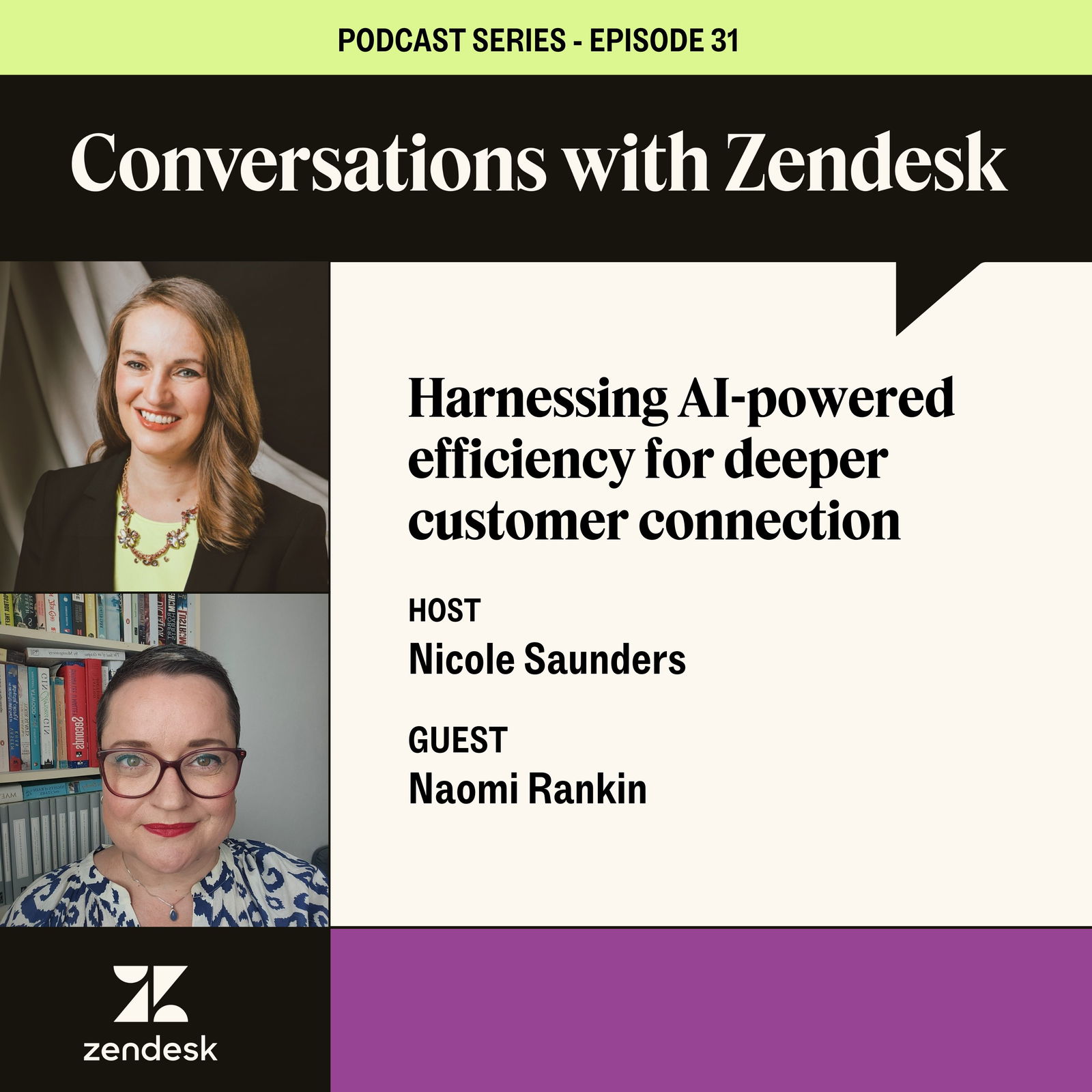
Harnessing AI-powered efficiency for deeper customer connection with Lush’s Naomi Rankin
26m 6s
In this podcast, Naomi Rankin, global customer care manager for Lush, discusses how the cosmetics company integrates AI into its customer service while staying true to its ethical values. Lush's AI tool, named Marvin, handles about 55% of incoming requests—primarily routine tasks like order tracking and sale queries—freeing human agents to focus on personalized, high-touch interactions such as skincare consultations. This approach aligns with Lush's philosophy of "leaving the world lusher than we found it," which emphasizes sustainability, ethical sourcing, and putting people first. Naomi highlights that transparency is key: the company openly communicates with both employees and customers about AI use, ensures customers can easily reach a human, and involves staff in refining AI workflows. Data ethics are also paramount, with Lush storing minimal customer data and using AI that learns only from its own secure database, not external sources. The result is a balanced model where AI enhances efficiency without compromising the human connection that defines Lush's brand. Naomi advises other companies to research AI providers that align with their values, involve teams in implementation, and avoid seeking a one-size-fits-all solution, noting that even small AI features like ticket summaries can significantly improve agent productivity and job satisfaction.
It's just been such a benefit. I think ambient Lee, he's understanding and either responding to all processing correctly, about 55% of all incoming stuff, which is amazing. And then if the customer needs to, they can reply to it and come to a human, but a lot of the things which would have just been a macro, they're done. Hello and welcome to Conversations with Vendesk. I'm your host Nicole Saunders. Today we're speaking with a cosmetics company that has a strong ethical compass, one that takes a firm position on everything from animal testing to ethical tech. As you may have guessed, I'm talking about Lush, a global brand known as much for its friendly, personalized customer service as it is its wonderful back products. Now, they may seem like unlikely AI enthusiasts, but Lush has a thoughtful approach that has upleveled their entire customer experience, helping them to deliver the same universally loved in-store service on a global scale. Joining me today is Naomi Rankin, global customer care manager for Lush. She's been working for nearly 10 years on this vision. She currently oversees a team of highly trained specialists from 21 countries who speak 16 languages, and she's found that AI sweet spot that allows their human agents to focus where they're needed most. The result, a higher level of customer service that meets their standards, but is modern, scalable, and cost efficient. Before we dive into that conversation, just a quick reminder for our listeners, applications are now open to attend the inaugural Vendesk AI Summit happening in New York City on October 9th. More information is available at zendesk.com/aiSummit. We'll also include that link in our show notes. All right, without further ado, Naomi, welcome to Conversations with Zendesk. How are you today? I'm great, thank you. I'm so glad to have you here. I love your products. I love your stores. I've already had great customer service when it got in. Let's dive in. Lush is known for its philosophy and ethics. Can you describe that philosophy a little bit more and explain it to customers who might not be familiar with the brand? So the key tagline for us is to leave the world lusher than we found it. I think people of my generation, our parents were born just after the war, and there was that mentality of you can get anything you want and work hard. But it became a bit of a strumble way generation. Then with, oh, you can just get a new one or get a plastic one. And that old fashioned spirit of like reuse and repair kind of went out of fashion, I think, in a lot of places. But Lush really believe in making sure that our children's generation and their childrens actually still have an us to live on and live well. Not just survive, you know, so everything we do, every supplier we go to, every new company we work with or every tool we use. There's a whole ethical background check and we make sure that companies we work with are happy with the ethics we want to stand by. A lot of us who work for Lush work for Lush because we share those values. So when I was 12, I made my dad go to the garage to convert his car to unledded in the 80s or early 90s. And no one else really cared. And I was like getting the more recycling and so I loved Lush way before I came to work for it. But working for it really just it empowers you and it's so lovely to work in a community of people who care just as much and want to do good. Let's talk a little bit about how you bring that ethical position into how you view technology and more specifically AI as you modernize your customer service operations. It's a position that's come right from the top of our company is still owned by the six friends that founded it and one of the owner's sons is head of digital and he's passionate about using tech for good and divestings from big tech and China uses much open source technology and ethical technology as possible. And how that's affected us in customer care with looking for AI is making sure that just as we've always put the human first the customer first the environment first in everything else we do. We don't want to lose that suddenly and automate everything. So we've been basically looking at it as a tool for good rather than trying to replace a bunch of humans who we actually really value quite highly. I think a lot of businesses share those concerns right they want to make sure that they're using the technology in a smart way. But that they're not just eliminating good jobs for good people and that the technology is enhancing and expanding what a business can do not just replacing things. As you've started to think about how you're implementing the technology what are some of the ways you've been able to do that what are some of the ways the AI is enhancing experiences for people. One of the earliest things we looked at doing within customer care team was automating sort of the easiest tech items. So for instance, last has been known for a long time to only have a sale one time a year. But it means that more traditional sale times like stay back Friday our customer care teams are having to plow through hundreds sometimes thousands of tickets or customers all asking when you're black Friday sale when you're black Friday sale. So one of the first things we demoed the ticket button was to filter out those and give a simple macro response which is what our human agents would have been doing anyway. But taking that burden off them so that then they could still have the time to talk to the people who actually really needed more dedicated help and not just a simple answer. So that definitely was a very tentative to step in because traditionally the companies just been human human fast all the time and the teams were justifiably and understandably quite worried. So really we're to present it in such a way that this is a tool to help your job be easier and for you to do the nice things in your day not the monotonous boring things in your day that get in the way of doing the things you enjoy. All of them are shot floor trained and have the same product and ethics and values training and brand training as our retail staff do. So rather than having to deal with just copy and pasting a macro or doing operational button pressing this means they have the time to talk to people you want to ask about our products and maybe can't get into a store. So in any cases where your employee base has come up with ideas for how the technology might be used and have you had this a bubble up from internal experiment. Definitely so the ticket box is our oldest is a value team member now we've named him Marvin. He reads every single incoming ticket across all of those 16 languages so some of our teams maybe in a smaller market who only have maybe two or three agents and not equipped if there's a sudden media interest or search and very quickly we've been able to set up an intent so that the ticket can help them and support them. And then also one of our most frequently asked things from a customer's coming into us is order tracking because at the moment they get an email when it's been sent to the courier but they don't know where it is up until that point. And as you can imagine at busy times of years sometimes an order isn't in and out within minutes of placing the order it might take a couple of days so that's been something they've been begging for for years and we're finally getting there we switched on the order look up so people messaging now and and imminently those emailing in as well will be able to just self serve like the status of their order if it's waiting or if it's been dispatched and where about the in which is or just save us a ton of time. So it sounds like the new AI power technology is really helping you serve needs that have been around for a while or finally be able to solve problems that maybe were too complex too big and now this is something that can come in and do that in a really efficient way and it does sound like it's accelerating things for your customers and creating a lot of efficiencies for you in the business. As you figured out sort of what is the right balance are their processes you're using to like test or temperature check like hey we're going to implement this thing and we need to make sure that it's not going to mess up the way that we regularly interact with our customers. What are some of the processes or methods that you're going through as you're doing some of that experimentation to check on it and make sure that it's the right way to implement things. For sure we're doing now I have a trusty assistant Dean who used to be one of the training managers of the UK management customer care team but now works with me on all of our tech and we like to call him our robot overlord we like to that but basically he's in charge of all the AI and whenever we have a new idea or suggestion comes in from then that about new ways we can use the tools we have will always have a look at it in our sandbox first. sandbox first, which is really important.
but then also go to our global team and say, we wanna try and do this and we'll get their opinions on whether actually this is just my bright idea, but I haven't spoken directly to a customer for ages and they're like, "Namu, this is a terrible idea." Or whether they even can enhance on it and say, "Actually, this is perfect and here's the thing that happened me today that could really help that." So we always try and get their buy-in by helping us to develop the idea and the workflow because when Dean and I, because we're doing stuff in the back end all the time, we're never gonna know exactly what it's like to be that agent with a ticket with someone maybe upset on the phone or somebody chatting and you're trying to find information. So they're the ones we need to glean that knowledge from and those questions and like, what really would help your day? Not what do I think looks fancy, you know? Totally. So what does the employee response ban? Are you finding that they are enthusiastic about these things? Is there a steep learning curve? What's that looked like for you? They're always willing to try because we've been really clear from the start that none of these things are here to replace you, they're tools to help you out. And they're really honest with us. So they're pretty quick to notice when Marvin or the messaging flow bots have made a mistake, not quite understood, then they help us tweak it and basically it's like a daily calibration for us. And I think that will probably happen to a lot of people is where you had a lot of agents and management moving your agents around now, you're gonna have staff who are looking after your AI. Like that's gonna be the full-time job because you certainly can't just turn it on and leave it. You have to constantly check what it's saying. - Well, and I think that that speaks to one of the things we've talked about a lot over the last year is not only is this gonna help enhance and expand the roles that your day-to-day agents have, it's also gonna create some new jobs, right? For people to be those AI operations experts and really specialize in that technology. So what have been some of the biggest challenges in bringing AI technology? And we talked a little bit about having to make sure you're balancing humans and technology and you're not disrupting your current service offering and you maintain those relationships. What other kinds of things have come up as you've worked with implementing it? - The pushback definitely from our local team at first was that fear that we were sneaking something in to gradually replace them with. And we dealt with that by being really transparent about, well, this might be able to take this, but it helps you have more time for this. But then also you get it from the customers who are, so passionate about our products and often they're drawn to us because of our ethics and values. So they're very vocal if they think we're doing something wrong or we've made a mistake and they will come to us. And when we first introduced Marvin, we had quite a few people emailing me directly and saying, does this mean you're laying off your staff and like what's going on? This isn't very much of you. And so it's great because they're all looking out for the staff and that was something we had to lay and talk about. And even now, even sometimes when the team are on a chat, maybe they've sent a link or something and the customer will be saying, are you a bot? They almost have to do proof of life because our customers are so anti-any automation. Like they love it if they can come in check where their stuff isn't go, but then definitely a large subset of customers who want to bypass that box straight away and get straight to a human. And that's something we've built into those tools is that at any point they can say talk to a human and they can't. We haven't built any eternal loops of doom either in the email bot or the messaging. It's quite clear in both. And we're honest, if you need the human you can, but they might be awake or I could try and help you here now. And the customers who really want a human are usually willing to wait a bit because they might even, you know, sometimes they have a name to person. They're really good friends with. Like we have some customers who call up every week and have a long chat and they recognize them but the team by their voice here is then, yeah. So it is a constant daily challenge to find that balance, but it is possible. Well, first of all, I have to say it really speaks to the quality of your customer relationships and your customer support that people have like a favorite agent or someone that they want to talk to you and relate to, especially when you're picking out products that are so personal, right? It makes sense that you might start to develop a relationship with somebody that's going to help you out with whatever those issues are or figuring out what you need. I love that you have created a way where your customers can choose. Do you want something that's just like, you need a quick piece of information you don't mind that it's automated or do you want to talk to a human and it sounds like you really put the power in their hands to decide what they're doing. You also mentioned transparency and you were talking about it in terms of feedback and how you communicate about it, but it also sounds like you're really transparent in the way that you implement it where people know when they're talking to you human and when they're talking to you about or they can get that clarification really quickly. And I think that's so critical. You cannot build customer trust if they don't know whether they're talking to a person or not. And that seems really key. So it does seem like you've been really thoughtful about this. I know one of the challenges that comes up for a people with AI is data and data collection. How are you thinking about that side of this technology and what are you doing in that space to protect your customers? - One of the things I'm really passionate about and I've been fortunate enough to expand on that in this role is that we wanna treat our customer data and information as ethically as we do. The animals we're not testing on and the environment we're trying to save, you know. So one thing's possibly people don't realize in customer care is you're kind of like the hub of this wheel out of necessity. You have access to every part of that customer journey because you need to be able to help with customer. So it means that we can see a lot of data. And I think one of the hesitations or not blockers, but concerns when looking at generative AI will be where's it generating it from. So I think if we do move further into that, which we are looking at now, we're having a trial with the conversation at AI in ZenDeath, making sure that AI is only learning from our database. And it's not gonna be bringing answers from Reddit or from Facebook. And also that that data stays in our instance and it's not gonna be stored externally anywhere as a company, certainly in the UK and Europe. We don't record phone calls or store them. We don't store any bank data. We store as little as we possibly can. So you get the job done for the customer, but without keeping hold of things that are unnecessary and could ultimately cause an issue. And yeah, the AI has to fit in with that. Like we're not gonna compromise. And like we think we're so very careful about how we saw some ingredients and the buying stories. Like we're supporting growers on the ground and supporting schools and communities. And we wanna make sure that every part of that journey is so valuable and so important to the final product that when we get to the point where we're talking to a customer about that final product, we want to impress upon them how beautiful these products are. Like every ingredient is in there for a reason. Every ingredient has to have an effect. So going back to the AI, it would be a huge ask to ask AI to suddenly start doing skincare consultations and care care consultations with people. Soon, you know, people's hair is their pride. And you just can't risk AI accidentally telling you to use the wrong thing. So we're always gonna make sure that those conversations and those interactions with customers are human led. But then obviously using the AI helps give us time to do that. - Absolutely. It sounds like Lush is such a great example of how to really thoughtfully bring an AI that complements the human experience, but only to expand it and make things better and more efficient and not to replace that human experience. As you've gone through this whole process, and of course, I'm sure you will continue to for many years, it's gonna be an evolving technology. What learnings do you have that might be helpful to other companies that are maybe for us to adopt AI or nervous about how it might impact their customer engagements? What would you tell them? And how should they be thinking about this technology? - I'd say absolutely, look at it. Do your research maybe find providers or suppliers that share your own values as a company and be transparent with your team where you want to use it and why and involve them in the process as well. And also with the customers, just being the very fact we've named them up in and kind of adopted them as one of the team has meant that the customers know he's there and that if he gets it wrong, they can just reply and say, "Oh, I'm loving, got it wrong." So they're not fighting against the bot to try and find a human, but they can carry on talking about it.
in to our team, which helps us. That's all great to be back as well. I think, yeah, don't go looking for a magic one that's going to do everything for you because I don't think they exist. But certainly the capabilities it has right now can so greatly enhance your day to day. Even the trial we're doing at the moment with the agent workspace and the suggested replies, and even the summary of the tickets, our agents have said after using it for less than a week, that that's been amazing for them because they're not having to scroll back and read whole on conversations. So just little things like that. And if you just think each of those takes a little a few seconds, a minute, a couple of minutes out of their day, out of their load, then of the time you're saving at the end, but you have to involve them because unless you're a one-man band and you're physically answering the phone yourself, you're not going to know how it's going to impact your team because you're not doing their job. Yeah. So sounds like you've really seen some benefits even as a company that has sort of, as you put it, slowly dips your toe in the water of AI. I've been really thoughtful and methodical about how you're ruling it out. We talked about some operational efficiencies. We talked about how it's helping connect people and create some more meaningful engagement, how it's giving customers the option of the different ways that they can interact and hate you want efficiency, do you want a human touch? What has been some of the business impacts? Are you seeing any kind of specific return on investment yet? Yeah. So for instance, once we started using Marvin for that first Black Friday experiment, which then continued, he'd managed to answer and fill us through 57% of all incoming conversations in the first week. And everyone was just like, "That's fantastic." It's amazing. He's working across, I think, 10 languages at the moment. So that's quite a lot of a big chunk of our incoming contacts. And then if the customer needs to, they can reply to it and come to a human, but a lot of the things which would have just been a macro, they'd done. That's amazing. So great experiences for your internal teams, great experience for your customers, house savings for the business, driving efficiencies, and doing it all with a deeply human touch that stays in line with your company's ethics and values. What a fantastic example for other companies to look to and review and learn from. Before I let you go, one of our favorite things to do is ask each of our guests for an example of a time that you had a great customer service experience. You can shout out another company or brand, but what was the time that you were in the customer seat and had an issue and somebody served you really well? So I'm a single mom. I have three children who are still at home and I work from home remotely. My oldest son works three days a week remotely as well. And my youngest son is well in both gamers. So you can imagine the fight for broadband in our house is quite intense. And our next door neighbor was having some work done. And I already had to show the windows because there were like chasels, there were gardeners there. But then all of a sudden and all three of us were online, everything just went black and we were like, what's happened? And I went out and my neighbor's garden had broken through our cable. They'd like snapped it in half. So I just went out and at first I was like, well, we're going to do. And hilariously, I'm working customer service by, hey, how are you to ask anyone for help? So I went on the Virgin website, who do our broadband. And it was a little bit tricky to start with to find the right department. But once I did, and I was really nervous that either they were going to ask me to pay for it because it wasn't there for, or I was going to have to ask my neighbor to pay for it. All awkward things. But they just sent an engineer out literally by the next day. So we weren't even without internet for a full day. And they were like, it's a genuine accident and we told you understand, and it's okay. And I was so relieved because that could have been either a huge slog to get to that point and have to wait for days or weeks. And it was just seamless and it was such a relief. Yeah. So that was a big shout out to my lovely engineer. I can't even remember what his name was. It was terrible. I should have probably. Well, that sounds fantastic. Thank you so much for sharing that. Thanks everyone for listening. And I hope that you enjoyed my conversation with Naomi. Don't forget to check out the show notes for the links to the Zendesk AI Summit and some of the other things that we mentioned in the podcast. Please be sure to subscribe so you don't miss future episodes and keep up with Zendesk on LinkedIn at zendesk.com/li. As always, if you like what you hear, please consider giving us a five-star rating, sharing us with a friend or colleague or leaving us a review. We really appreciate your support. And on a final note, this will be my last episode of Conversations with Zendesk. I've greatly enjoyed hosting this show and I want to say a huge thank you to all of the wonderful guests that have stopped through and shared their insights. I also want to thank the production team, especially the indomitable Maggie Midzetti. It takes a lot of work to put together a show like this and a lot more people than just me working behind the scenes to put together a great podcast. Thanks everybody. And most of all, thank you listeners for tuning in, for subscribing, for sharing on social, for writing those reviews, and being a part of our community. The podcast will continue. We'll take a brief pause while we bring on a new host. And I hope that you will stay tuned and enjoy. So, and last time, I'm Nicole Sondersk, the intelligent heart of customer experience.
Podcast Summary
Key Points:
Lush uses AI (named "Marvin") to handle about 55% of incoming customer queries, focusing on simple tasks like order tracking and sale inquiries, while allowing customers to easily escalate to human agents.
The company's ethical philosophy—"leave the world lusher than we found it"—extends to technology, prioritizing transparent, open-source AI that doesn't replace humans but enhances their work.
Employee and customer buy-in is achieved through transparency, involving staff in AI development, and ensuring customers can always choose human interaction.
Data ethics are critical
AI has improved efficiency, allowing human agents to focus on complex issues like product consultations, and new features like ticket summaries have been well-received by staff.
Summary:
In this podcast, Naomi Rankin, global customer care manager for Lush, discusses how the cosmetics company integrates AI into its customer service while staying true to its ethical values. Lush's AI tool, named Marvin, handles about 55% of incoming requests—primarily routine tasks like order tracking and sale queries—freeing human agents to focus on personalized, high-touch interactions such as skincare consultations. This approach aligns with Lush's philosophy of "leaving the world lusher than we found it," which emphasizes sustainability, ethical sourcing, and putting people first.
Naomi highlights that transparency is key: the company openly communicates with both employees and customers about AI use, ensures customers can easily reach a human, and involves staff in refining AI workflows. Data ethics are also paramount, with Lush storing minimal customer data and using AI that learns only from its own secure database, not external sources. The result is a balanced model where AI enhances efficiency without compromising the human connection that defines Lush's brand.
Naomi advises other companies to research AI providers that align with their values, involve teams in implementation, and avoid seeking a one-size-fits-all solution, noting that even small AI features like ticket summaries can significantly improve agent productivity and job satisfaction.
FAQs
Lush's key tagline is 'to leave the world lusher than we found it,' focusing on reuse, repair, and ethical practices to ensure a sustainable future for generations.
Lush uses AI as a tool for good, automating simple tasks like answering sale queries to free up human agents for more complex, personalized interactions, while maintaining transparency and ethical standards.
Marvin is the name Lush gave to their AI bot that reads incoming tickets across 16 languages. It handles repetitive queries like order tracking and sale questions, allowing agents to focus on higher-value customer interactions.
Lush builds transparency into its tools, allowing customers to easily request a human agent at any point. They also name their bot Marvin, so customers are aware when they're interacting with AI.
Initial challenges included pushback from both staff and customers who feared AI would replace humans. Lush addressed this through transparency, involving teams in development, and ensuring customers can always opt for human support.
Lush ensures AI only learns from their internal database, not external sources like Reddit, and that data stays within their instance. They minimize data storage, avoiding recording calls or storing bank details.
Chat with AI
Loading...
Pro features
Go deeper with this episode
Unlock creator-grade tools that turn any transcript into show notes and subtitle files.
 PodcastTranscript AI