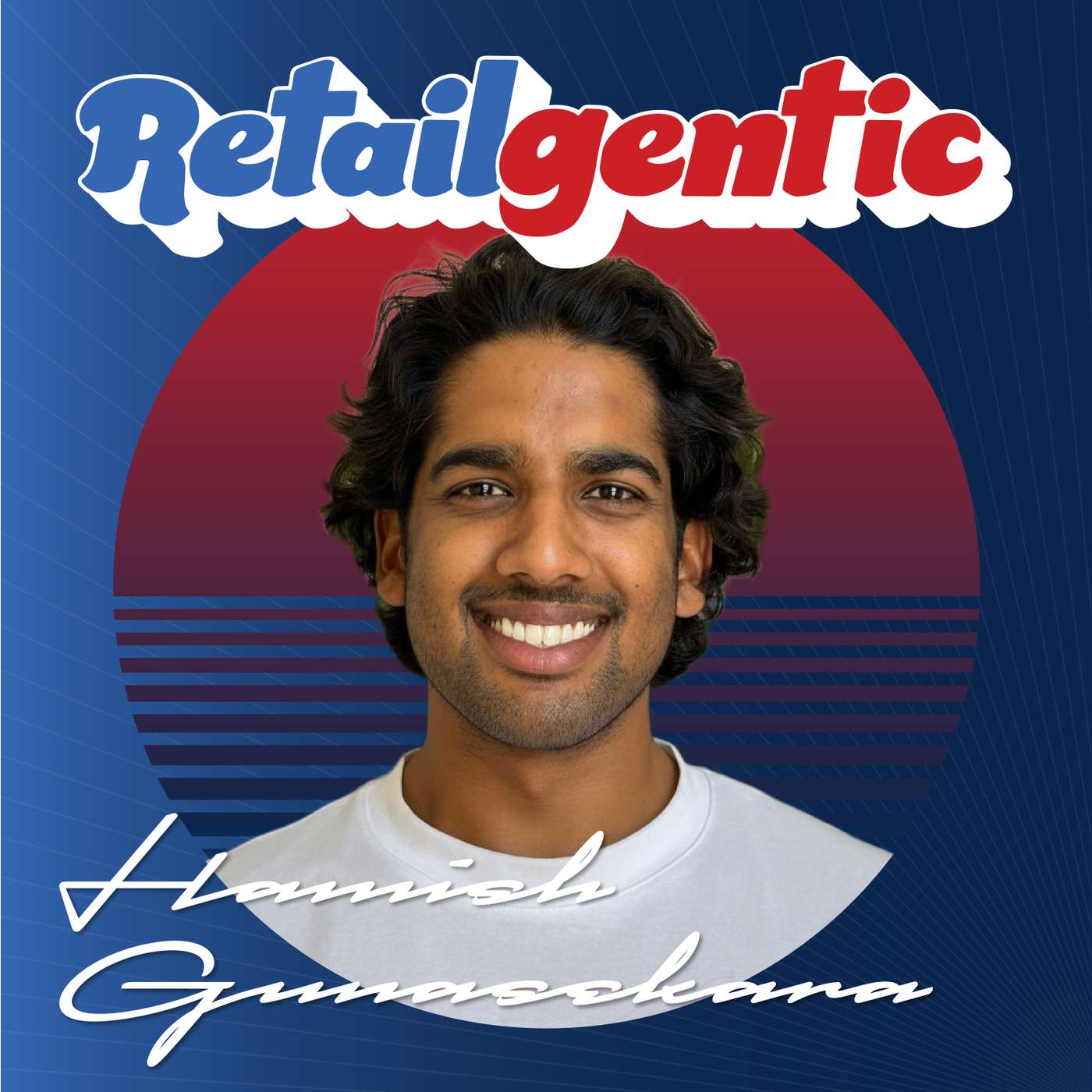
One thing I will say, having spent time at our pay, which is the consumer app, cash app, consumer app, is that it does take time for consumer ahead yet to change, and that would be the one in which is why we haven't seen an even greater explosion just yet, is that people do get used to the ways they do things because it relates to shopping. They are now quite used to seeing that they're the shop if I check out at all. But in the fullness of time, that was typically changed. People were uncomfortable about e-commerce right way back in the day. They were like, "Why would I buy something online?" But I can buy something in store, but over time, in the fullness of time, that is quite dramatically. Welcome to the retail-gender podcast, where we explore the intersection of retail e-commerce and AI agents, which we call retail gen-end. Our mission is simple. We are shining a bright light on the new agentic AI shopping mega-trend, which will disrupt the trillion-dollar digital retail market. The stakes are high. Google. Open AI. Microsoft. Herplexity. Amazon. Apple. Meta and Anthropic are all fighting to be the consumer AI shopping agent winner. There are going to be some tough decisions for online brands and retailers to make. What happens to check out? How should payments work? Could you continue to invest in retail media networks? What does the world look like whenever half of your traffic is not from humans, but from AI agents? These existential questions are the tip of the iceberg on this podcast we're talking to industry experts, analysts, and influencers to get answers to these questions, identify trends, and best practices. This is RetailGentic, your podcast partner in navigating our AI shopping agent future, and now here's your host, Scott Wingo. Welcome to this episode of RetailGentic. Before we jump into today's episode, if you're enjoying the content here at RetailGentic, and you love agentic commerce as much as we do, we would really appreciate it if you had a second to subscribe, follow, share, or leave a review. If you're watching on YouTube, hit the subscribe button and the little bell up there to be notified about new episodes. Thanks for doing that. We really appreciate it. My guest today is Hamish Gunasakra. He is the co-founder and CEO of catalog, which is available, which you can learn more about at get catalog dot AI. Hamish worked at be by now pay later company after pay, which was acquired by Square. So he has deep e-commerce experience. He and his co-founders started catalog earlier in 2025, and catalog helps agent builders discover reason and transact in agentic commerce. What's all that mean? Well, let's ask Hamish and find out, enjoy the conversation. Hamish, welcome to the RetailGentic podcast. Excited to have you on. Thank you, Scott, for having me. Yeah, I go out there and talk to lots of people in our ecosystem, and everyone be it one of the folks that supports agent builders or folks building agents themselves. And when I'm saying agents, I'm talking about these vertical shopping experience or specialized shopping experiences. Everyone is like, hey, have you talked to Hamish at catalog? And I'm like, no, but I would love to. And finally, we got introduced. And it's great to you and I chatted previously, but it's great to meet you. And I think the audience is going to enjoy hearing what you guys are up to. Yeah. Likewise, I've heard from so many founders that at some point got us to what's called so really excited we're doing this. Awesome. Let's start at the beginning. So you know, where are you from and how did you get into our fun world of e-commerce? Yeah, for sure. So I grew up in New Zealand, studied in Australia at the University of Melbourne. My first job out of university was being a data scientist that after they had built many of the core AI and machine learning systems there right throughout the company. A couple of years ago, we sold to Square, at which point I was on the founding team of cash app commerce. After a little bit after the acquisition, I then started focusing on this world of sort of agentic commerce. Initially was actually creating an intensive experience. It was called naya. It would help people get the most out of their spend. And go to, you know, 10,000, 15,000 people signed up, have realized that it's actually a bigger opportunity to be the infrastructure for all of the ways people, sort of, all of the ways AI changed people's shop. My co-founder, Dylan Ferrell, he had studied pure maths at Harvard. He was also a captain of the sailing team there. In his junior year, he was actually living in Kirkland House row 33. That is the room where markets start on Facebook. And I was where Dylan had realized that AI is where the world is going. It can only be good as good as the data infrastructure beneath that. Anyways, he went on to be a staff machine learning engineer at authentic Kirkland House. And we had become friends last year, actually, playing poker. It means how plants go. And with the all-in gas, this is high stakes. This was not high stakes. This was playing at a mutual friend's house one weekend. And yeah, at that point, we were sort of both exploring these different ideas. I was building naya at that point. And towards the start of this year, we started collaborating together on many of the learnings we had had over the past couple of years. So it turned into a catalog, which is what we're building today. Let's go back to University of Melbourne. So it's unusual to go straight out of university into a data science machine learning role that after-pay. What would you study at Melbourne? Was that like a focus area for you? I had studied computer science while also taking a few subjects and finance as well. I think so after pay was really the perfect company for me to join. And I was very lucky, actually, that a director had taken a chance on me. I was one of the youngest data scientists there. And there's very hands-on building these core systems that would look for one thing that I had started with was in sort of the world of AML and like know your customer and built the transaction management system all around that. Always, yeah, just really best-rated about the way people spend and say, yeah, it's always been a interest of mine. We had an office in Chambers or in Melbourne, so I spent some time there and I'd get to go twice. So the light for flight. It's a great city. The flight was not enjoyable. Yeah, a long way from the US. Yeah, it must be painful to go home. But then that's what I learned about the big controversy between Australia and New Zealand. Vegemite or Marmite, where do you land on that one? Hi, I'm a Marmite person. Marmite out the way. Yeah, yeah. If you don't know what we're talking about, you're going to have to Google it. Cool. And then say a little more about, so when you're at Square, was that in the Jack Dorsey era or was he gone by then? Yeah, so Jack Dorsey is still very much involved with the company. During the time that I was there, it was, there were these business units of Square, Cash App. One of the main reasons behind the opt-play acquisition was to move from a business unit sort of structure to one, which is more centralized. An opt-play is being at the two-sided network, having a strong go mark with retailers and strong relationships with especially enterprise brands. And then also a very strong customer affinity similar to Cash App. The idea was to bring these business units together. And so yeah, during my time, like my specific team, we would actually jump around between Cash App and all those. Sometimes on the Square side, and then back to Cash App. So kind of like an agency, like we've got data science problem over here, help us kind of thing. So you kind of like support both sides. In some cases, it was like that. Yeah. Cool. Do you have any good Jack Dorsey stories? I always picture him like, he went through that weird yoga sitting on a mountain with a yogi kind of face. I always imagine him kind of showing up and saying three words. And it's just like some magical and lightning situation or something. Everything he said was very powerful and very enlightening, definitely. The very first call we had with him, like post-act acquisition, I think he was in a room that was full of just, it was all without bread because he's a sort of big bleep and sort of even for bread that being breakfast and I just remember this guy is not concerned about how he is perceived, he will do what he thinks. I love that. Do you think he's Satoshi? Do you have a point of view on that? Is it really some compelling evidence to suggest that he is Satoshi? I don't have any sort of inside information, but I did actually see a video just the other day, which points to some of his first tweets and account. He's also a very big believer of the coin. That's something he really pushed during the time. He's one of my top three candidates. Yeah, yeah. Controversially, I put Elon in there too. I know that. Interesting. The way I come at it is like, who would be sitting on what is it like $30 billion? I don't ever get what is some ridiculous amount of money and not caring about it. That number of individuals is pretty much Jack Dorsey and Elon Musk. Yeah. I don't know. Tell us a little bit more about Nia. I know that was like, did you go through I see with that? Was it just kind of in the exploratory kind of proof of concept phase and you didn't really be forward? Yeah, that was very much in sort of the exploratory phase, I would say. It was built on some core like fundamentals or thesis that I'd sort of formed during my time at Cash App and After Pay, which is that the people want to get the most out of every dollar right and the way that Nia would work is when you have figured out that, okay, I want to buy this pair of AirPods. What I would do is go to different retailers, compare prices. It would look at your inbox to see if you have any any promotions at those retailers. It would look at your credit card points, you'll find out payway and options, you'll just do all of that work for you so that you could have a sort of conviction that you were just getting the most out of you spent. I think that is an important product which doesn't exist today. One could say it's sort of like a honey 2.0, Nia with a practice extension and yeah, I had a great time building it and ultimately realized that actually there is just a much greater opportunity with the upload. Yeah, no, is that with your your Harvard buddy? Yeah, I know, this was solar. Okay, good job. And then this kind of gets into the founding story of catalog, which which I love to hear as a founder, I love to hear these founding stories, because it's always a big, people don't realize if you're not in this game, like starting a company, it's kind of like a, it's like having a kid, it's like a 20-year commitment, it can be a 20-year commitment. So most people don't enter into it lightly. So let's talk about that. So tell us about that transition from Nia to catalog and some of the things that went on there to kind of get you to where you're? Yeah, it's very much at a 20-year relationship, especially with the co-founder. That's in many ways. So it's like a marriage there. I'm very grateful that Dylan and I had like an existing friendship before, I think that really helped us and the work relationship has been really enjoyable. That means because you met Plankpoker, neither of you like really destroyed the other one. There was like some kind of a equivalence there. So you're relatively even, I would guess, otherwise the relationship would be kind of squirrely. Very hot to be day on hot, advanced grad. Yeah, what's that? It's in my tea people, but same by where they all go to, you know, there's that movie where they go and they learn how to card count in the early days when you could. Yeah, yeah. That professor goes to the professor realizes he can monetize the students in his class. Yeah. And then, yeah, so the sort of evolution of the product, why would it like, you know, when we think about, hey, I, and it's the impact on the boil until it's late? It's fundamentally changing the way that people discover and find new information on the internet. You know, the idea of like, for any sort of knowledge gathering or research, the idea of knowing to all these worksites and and doing discovery through that way is seeming to become more and more of a artifact of the past era. And I look at my personal way, and I interact with the internet. And it's almost always now starting a conversation on on chat chat or or another platform. And it's so it's clear this day how that applies to to shopping and comments. We're already seeing that's profound change where, you know, if I want to find the best keyboard for me, the most definitely go to to chat GBT. I'm doing a fashion search, then I'm on user coming like one off or doji. I'd use their if I want to sort of find it and you couch, then I most definitely will use a platform like on top. It's just like a fundamentally better experience and you have all of these products from across the internet and it's a personalized experience because you're coming back to that same spot and it's building up an understanding of who you were. And so having felt that or having tried to build like an energetic commas experience myself and then also being surrounded by friends who were the same, I realized that his really was no sort of infrastructure that was equally amortized across all of these different experiences. And especially sort of at the day level, which is where Camelot focuses on mostly today. And so we set out with a few design partners. And here we are. Did you realize that back in the square and the square after paid days you may have, but you being paymenters so far of the till into the process, you may not see the upstream crazy that goes on in the world of catalogs. Even during the after paid days, one thing that had made us stand out relative to the other buying out paiders is we heard what was called after paid shop directory. And I was like a shopping destination that people would start their shopping search at. And you know, when you look at that experience, it's one where you have like a rough sort of understanding of like one merchant that's sort of available in the after paid ecosystem. It would have been amazing to have like product level information, but it was simply just like too hard to do that at scale. And like relying on affiliate networks is really tough, unreliable. So quite early on, I saw just how challenging the early product catalog spaces and like how that really hasn't been solved in an ideal way yet. So when did you decide to start catalog with how long have you been at this? As those around the start of this year, where I had made the news from Mayer and also started to work with Dylan. And he was like, I think you know, you mentioned a startup is similar to a marriage. I think it relates to the idea of what you're actually built. I think that's sort of constantly in evolution. Best startups are always iterating to bigger out. What is the product? Really traits a lot of value for the world. It's sort of constant evolution, but really focused on catalogs of product. Yeah, the last eight to 12 months. Yeah. Have you guys decided to raise capital at this point? Or it's fine if you don't answer this, but I tried looking in crunch based and there's, you probably know this, there's a lot of catalogs. I didn't see y'all in there specifically. So a more formal announcement. This is coming very soon, but very pleased to share with you. It's a scoop. We've got a scoop. Everyone, we've got a scoop. We have just raised raised from some really exciting phones that are pick the leases of this world of itch and the commerce. And yeah, what to come on that in due time? Congratulations. We'll watch for that eagerly. Did you guys do, I don't think I remember this, but did you guys do one of the YCs or an accelerator or anything? You're pretty, you're pretty senior foundry. Yeah, even though it's like your second company, having the time at half, you kind of know they'll lay land, but sometimes people prefer to go through that for the networking. Yeah. Yeah. So we did not go through an accelerator. I have plenty of friends who have gone through YC when I had first moved to San Francisco. The house was like a bend diagram. It called Australian founders like YC founders. It was a lot of fun. I think just like the sort of nature of how things just moved along so quickly were us like from getting landed on the idea to work with like design partners that were like super very willing and open to to pay for this product to getting a set of early-end angel investors like the founder of poshmark. Evan, that very quickly landed on to a pretty secret island. We just like did a, I guess didn't need to do an accelerator, but yeah, he had really great things about YC and that. Yeah, you can't through a rock and Silicon Valley without hitting someone that's promoting YC to get a good brand. So let's kind of, you know, you've been at this about a year. How do you define your customer? Is it, you know, I've kind of assumed it's agent builders, but let's hear it from your words. So catalog is really the central node for agentic commerce. So on one side, we are the data backbone for the swarm tail of the agentic commerce apps. So that's companies like Assetting, one-on-one. These are all sort of emerging platforms that have a very captive audience and we help them get real-time product information from any item on the internet. And it's, yeah, our, our sort of Valley Rob Tevis would discover a recent transact. We mostly focus on those first two, which is all related to data. Discovery is getting all of this information in one place and the second is reasoning, which is sort of how do you use AI to like do a very smart search across all of these different products in our catalog. The third piece, which is transact, we work with other partners on that one. And then a central node, and there's the other side of the platform, which is working with retailers and brands. And for them, our alley prop is, let's help you show up in all of these new AI services, wherever your customers are starting to shop. So that not only is that the long tail platforms where we out the day of act one, two, and we have sort of unique, unique access to two work with these platforms, but also the large ones such as Chatchee BT, helping these retailers get ready for ACP, making sure that their sites are very friendly to agents. So as your name would imply, a lot of what you do involves the catalog. Do you guys, there's been a lot of companies that have tried to go create like the global mega catalog of all, you know, the catalog of all catalogs. Is that part of what you do? This like very stated, you know, stateful catalog where you're just constantly accumulating catalog data, and then making it available to an API, or is it more on demand? Like an agent says, I would like you to give me, I'm a fashion agent, and I need these 30 retailers and brands go pull that for me yearly. How does all that work? Yeah, yeah. So sort of the concept of doing it a truly global catalog has been something that has been spoken about for maybe 20 days. And so when you dive into the technical feasibility of creating something like that with real times of updating, it's a year and a half old task, right? The door out there, I would say, actually many buyers of that sort of product. And they seem like there are many people who would get value out of that, but in practice, there's always some level of curation, which is guaranteed. And so you pretty much band on where an agent builder or an agent themselves could specify, okay, what products or what sort of cluster products are they interested in? And then we can go out and pull that. It's much more sort of, the scope is much narrower than that for God, and that allows us to have a more focused and targeted set of data for only the brand-assled products that the agent actually cares about. So if you have three agents that have a similar set of data they want, is it all bespoke or there must be some sharing that goes on in there of some kind? Yeah, and in the backend, as our user that scales up, we are already seeing like overlap in the brands that have these agents care about and that allows us to really dramatically improve the response time, for example, they're awesome, so network enough that says as we scale up. Yeah, and this is another just curiosity question, feel free not to answer, but pricing, and I don't want specifics, but just generally there's this interesting thing going on where you have, we used to have SaaS pricing, whereas like, you know, $1,000 a month or whatever it is. And then we now we have like hybrid usage models, and then now there's like these outcome models, which is like some of the agents are trying to put like the call center ones are like, you know, customer tickets resolved, you know, and we'll pay 50 bucks a ticket result. Have you guys kind of figured out where your pricing going to be in that or? Yeah, our pricing, and by no means, there's a perfect day, it's blend, yeah, like the SaaS and the usage base to where, right now, the way it looks for most platforms is, they've done some sort of work to create a product index themselves, and we are supplementing or subcases out the full index for them, and based on how much company products they want to have in their system, and how frequently they want to update those products is we will find the price based on one of those variables, and then for the retailer side, it's mostly based on the size of their catalog, the output that's required to like get all that information into our system, and then disperse them onto these different platforms. I saw that you guys were recently awarded by the information as a top 50 startup to watch, congrats on that. Thank you, thank you. Was that a was that a surprise? Did they call you? Let you know, or you were just like reading it one day, like, hey, we got this. Yeah, so we were sort of very, very grateful to about calling that award. I think that when we look at ourselves relative to the other startups in that list, we have had a long way to go in terms of us growing to like the evaluation of some of these other companies and things like that, but yeah, very some humble that we got that. The reporter who pleads calmness at the information she had reached out a couple weeks before saying that they would love to love to have us and as part of the top 50, and had gone to know her a little bit of the last couple months, as she's been sort of learning our project to call us. Yeah, it was really stoked about that. Yeah, cool. Yeah, they've had some good content about what's going on. I've enjoyed it. So you mentioned you kind of like these three areas you're thinking about, discover, reason, and transact. As you know, I've had a lot of the payment folks on the pod. So let's see, I've had POS, Nikuda, I guess their instant checkout now, and then simple or simple checkout, and then various other agents that will go complete the checkout for you. And you know, so transact, what are you thinking about, agentic payments? You're obviously from the payments world. Do you, you know, also throw in, there's a whole set of people, there's kind of the crypto bros that think all this goes stablecoin or something like that. I tend to stay away from that, but even though I think about who Satoshi is, I don't really do too much in the crypto world. I just like the mystery of it all. And the, what are your thoughts on the transact piece and where catalog is with that? I think the transact pieces are a very important part of the ecosystem. The way I sort of think about it is there are three layers to sort of be a chain to call a stack. The first is where we really play in, and that is really the discovery and data piece. Below that is checkout to that's folks like Rye, Henry Labs, and then the third piece is of what sort of payment to, yeah, as you mentioned, that's like Nikuda, that's Pay Your West, that's cart AI. All of these, these folks have gone to show quite well over the last couple of months. You know, it is a small ecosystem today, but software providers for agenda columns. And it's really quite exciting actually that like, there is, there is sort of this community around like building together. We need to do a beat up of some kind. You guys may be doing that out there, but aside from the East Coast, we need to come out there and hang out with you guys sometimes. Yeah, definitely. I think you go to Chicago or somewhere. That's why I think so. We outside your comfort zone. Yeah, a couple of months ago, a recent hour was hosted at dinner in the Bay Area. We had the founder of Pay Your West, not Henry Labs, not a new generation, the Plexi, goes that head of color, Plexi, and yeah, everyone in one room was good fun. And it was like a brown table fallout, it was like one speaker at a time, and there were like 30 people, and it was like also just speaking about the color, so it's great. Yeah. But to your question, you know, we are as excited and open to work with any of these sort of payment providers at different parts of the stack. It's really sort of up to what our customers want to do, and yeah, as I sort of think about a gender commerce, like right now, like we work with these early stage startups where they're just getting off the ground and sort of the first run to get started is just like data, right? And then I think the next step after this is then native transactions, we're definitely training towards that way, but I think we may be still in a few months through that becoming sort of a commonplace. Now, cool. Anything else you want to say about Kellogg before we start thinking about the broader agente commerce world? Yeah, like if you are an agent builder or really sort of any customer that is looking to get high quality product data that's real time, and to like a very great degree of depth that we can definitely help with what's been interesting is like there will be many use cases, even companies that have direct relationships with merchants, still they have found tremendous value from the infrastructure which were created, because it's just a very hot thing at scale to like consistently get product information, in like a standardized schema. And so yeah, we're starting to work with some V2V providers that need data to power their experience. We can help there. And yeah, on the retail side, if you're listening to this concaster, you're in good hands with Scott helping you get your your Kellogg ready for PCP and that, if you're also interested in getting access to the longer tail of AI experiences, then also very good to chat. So I keep getting in these fun, mostly LinkedIn battles, which isn't really well known for this. I try to stay away from the YouTube comments and stuff, but over there's this growing set of people, and they usually start with like a very controversial statement like agentic commerce is a mirage or a hallucination, and then as I dig into their argument, I like to hear the counter claims to these things, because I'm like you, I'm like all in on this thing, but it's kind of good to hear the other side of it. And as I get into it, it always comes down to the definition of agentic commerce. And what's your definition? How much definition is that, you know, there is six trillion dollars of e-commerce spend today, that's happening in these sort of like stateless storefronts or e-commerce storefronts. And that is like it equates to I think 28% of sort of global retail. And what agentic commerce is, is really just like the next generation of experiences that are progressing from what e-commerce is today. And it's not necessarily automating the shopping experience, it's creating like new shopping experiences, which are just more enjoyable. That's doing things like virtual triumph at his personalization element and being able to use a system like ours to get products from all over the internet and recommend that to you in a really effective way. You know, for the interior design example, you imagine taking a video of your house and it can stitch together what your floor plan is. It can look at the items that you have already to get a sense for what your budget is, and then using a diffusion model, it could show you a new product that you can you couch. That is really suits your space. That is just an amazing experience that I don't think a way they are or a furniture company by themselves could do. And that is what we see as the agentic commerce. Does it have to be fully autonomous? I really don't think so. Because that's the argument. They kind of define it as the agent has to do everything. Like you say, I want sneakers and it knows what you want, it finds them and it goes and buys them. And they're like, if that's not happening, it's not agentic. Therefore, agentic commerce is not a thing. That's the logic training. It all hangs off that definition. Yeah, yeah, yeah. And it is funny, you know, like sometimes they're having protocols which are launched which are truly deterministic. Like, is that really sort of AI or a genetic, but it's sort of fun to think of it as a genetic. I would say like, it's just, it's not really how people shop, but they look fully automated way. People like to know what exactly they're purchasing. I think like an example was many years ago, and this all had launched this like button, which would like allow you to make a purchase of like some toilet paper, or I think even now you can use Alexa to like purchase some toilet paper. And they discontinued or it doesn't get used to often, because people at least just want to visually see like, what is the toilet paper getting? Make the case for us. So there's, there's another set of people that kind of say, chat to BTS 800 million users, Google's getting in the game. So you've got these horizontal players. Make the case for the vertical guys. Like, so their argument is these folks are so big in their own distribution. There's no way you can punch through that if you're daydream or one of the big kind of more vertical type of companies. What's your, you seem to be pretty bought into that, there's some really cool stuff going on there help, help people understand how those companies are going to win and get some usage. And maybe, maybe you have stats of how many people are using, I don't, this is an area that I, I follow tangentially, but there's, there's got to be some good data in there that haven't seen yet about them getting traction and stuff. You know, we go back to that top level number of six trillion dollars of e-commerce spend. If we imagine that all of that is going to, um, can, uh, tour that really practice like more than that. I actually can, Twitch call us and we can get into that in a second. But, you know, let's say there's six trillion. I think, you know, maybe on trillion to trillion, we'll, um, we'll go to a chat to BTS. It does have, the distribution that has 700 million of the active users and it's still growing very quickly. But the question is, like, what about the, the other four or five trillion? Um, we think about commerce for all of human history. It's, it's always been long-tailed. It's, it's never not being long-tailed. Um, the current paradigm, you know, Amazon is a, is a very large company, very successful company, but still there is tremendous value in being a Shopify or being a, um, being a striped, um, and we sort of, I thought we saw the, the agenda call as well. I'll sort of play out very similarly where it's in the nature of how people shop with a one these sort of, the spoke experiences. For example, that interior decor, um, example, has very hard to imagine that being, like, natively, a really brilliant experience. It's the chat GVT, um, especially when compared to, like, a company like Holmton, whose full focus is to, um, to be the AI for, for interior decor. It's just simply going to be a, a great experience. Yeah, it's sure, right, right. The chativity gets one to two trillion. How much do you think the verticals can carve off? Do you have a prediction or like, uh, is it? All it has to be is 500 million and that's enough. It's such a big, I guess, part of your point is it's such a big, big pond that you don't have to get a ton of it to actually do pretty well. Yeah. And I'd also say we are still so early in the piece. This is going to be, um, the transformation, which plays out over a decade plus. And we are really just getting started. Uh-huh. Okay. So one of my favorite predictions, there's a couple of these now. Um, so the PayPal CEO said by 2030, uh, I think it was 20% or 25% of e-commerce will be agentic. Um, now this whole, like, what does it mean by agentic chisened of the definition? So the purist would say that means the agent doing stuff and other people would say influenced or kind of like auto, you know, copilot is kind of a thing. Um, what, uh, and then what gets me more excited than that is there's been two Wall Street firms. Morgan Stanley just came out with a really good report. If you haven't seen it, I'll send it to you. And then, uh, uh, another one was Bernstein. And they basically say that this is going to like accelerate e-commerce. You've been in the industry for a while. We used to, retails always grown five to seven percent or kind of like GDP-ish plus one, you know, plus one or two. And then we were growing 20, 30% back in your heady days of square and after a pie and after a pay. And now we're down to kind of like, maybe, you know, retails five and we're seven, which is kind of boring. Um, I'm excited. I think this is going to re-accelerate e-commerce. But, um, and I think we're starting to see that this holiday. What, what are you seeing? What's your tea leaves tell you for, for pick a timeframe? 20, 30 is pretty good. Kind of like now four years away. What do you think? So, yeah, I couldn't agree more. I think like this, like, new paradigm of sort of experiences is going to mean that like online commerce becomes an even greater percentage of total commerce. Um, you sort of flash into the future of like, okay, what is it going to be like, we all have A.R. glasses. And, um, when you could sort of look at mirror or see a hologram of yourself, in this quoting that or some thank you posting. Um, one thing I will say having spent time sort of out of pay, which is the consumer app, cash app, consumer, consumer app, um, said it does take time for consumer behavior to change. Um, and that would be the one thing which is why we haven't seen an even greater explosion just yet, is that, you know, people do get quite used to the ways they do things. So, as it relates to shopping, they are quite used to seeing that like, um, there's the Shopify checkout funnel, um, but in the fullness of time, that was definitely changed. People were uncomfortable about e-commerce, right, way back in the day, you're like, why would I buy something online? Um, when I can buy something in store, but over time, in the fullness of time, that is quite dramatically. Yeah, what's better than the Shopify one page checkout is the no-page checkout. I think we'll get there pretty quickly. It's a very safe bet to, um, uh, think about consumers wanting things more conveniently, wanting them all personalized, uh, reaching free. That's cool. Uh, and then another topic I was interested in. I saw in LinkedIn, you've done some posting around trust and governance. It's not one of your, your discover reason transact. Like, it's implied in transact, but, um, you seem to have some opinions about it. Say, say more, what, what, what has you thinking about trust and governance? And was that a response to some bad bots you sell are going on? Are you kind of predicting that we're going to need more structure there? What, what do you think? Yeah. So that sort of relates to trust and governance. I think part of what we allow the consumer to change their behavior is having confidence of these systems. Um, that is maybe what I was being to in that piece there where it's like, changing the behavior is hard and parcel of trust. And if I can have confidence that these new AI experiences are finding the best price, finding me the most relevant item that that will, um, maybe return time and time again. And if that trust is broken, then that can be like sort of really detrimental because, let's say, um, the app has promised the best price, but then they've done their own search and pelted even cheaper. And as we think about based in new purchase, they will sort of have less conviction that they can rely on this up. Well, we're up against time a little bit in the last thoughts. If folks want to learn more about what you're up to, where do they go? You can go to getcatalog.ai. You can reach out to me at
[email protected]. Um, and yeah, I was supposed to a little bit, I'll link and so it's a bit of compend there as well. Cool. Are you big on, uh, should we follow you on Insta or TikTok or other socials or is LinkedIn your your primary channel? I would say LinkedIn is the primary channel. Um, maybe joint that the day a day is the consumer app is definitely marmitelevers.com. You can fly out from some TikToks or something like that. I'll, uh, you know, uh, but not so much these days. Well, really appreciate the time. I know you're super busy building a great company and, uh, good luck and happy agenda, conversing. We appreciate you coming on and sharing what you're building. Skull thanks for having me. It was a pleasure. Follow rate and share to stay up to date with Retail Genic. Your guide to the future of AI Shopping Agents.
 PodcastTranscript AI