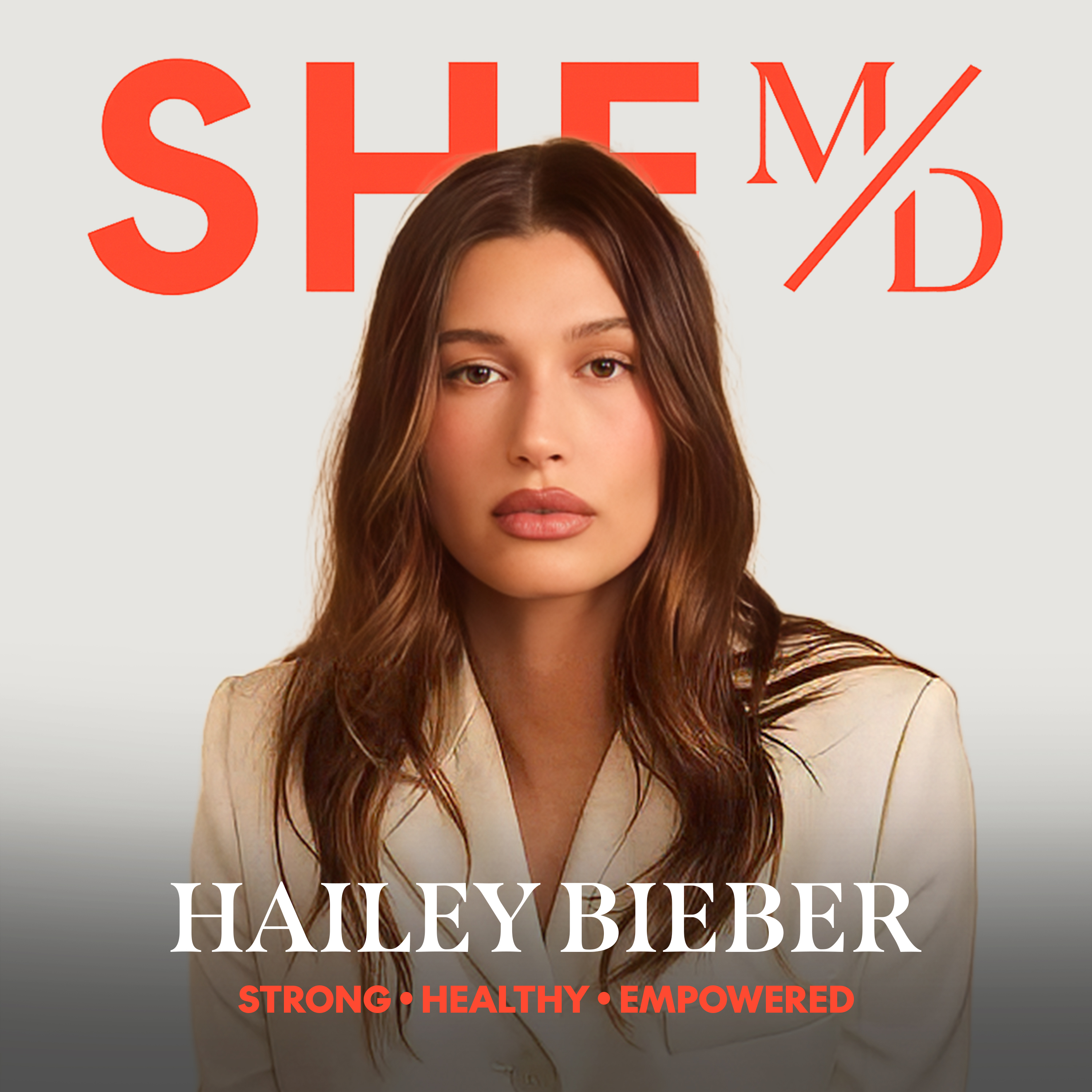
Today we have the incomparable Hailey Bieber. Hi guys! Women don't know that, you know, heart disease is one of the leading killers of women. So when I was 25, like just turned 25, I had a TIA, so I had like a mini-strel. The whole right side of my arm went numb, I couldn't speak. The right side of my face was drooping. It was definitely the most like near death experience feeling that I ever had. They say your genetics load the gun, your lifestyle pulls the trigger. And then I magically got pregnant. So I pushed the baby out 44 minutes and then I couldn't stop bleeding. I started to sense the panic in the room like a little bit. I kept saying to Dray, "Am I okay?" So you have this beautiful baby and you get all this under control. You started this incredible company. The moment that your career starts to take off for a woman is around the same time that you start having kids, being a business woman and being a mom. How do you navigate that? So. Hi guys, it's Mary Alice Haney and Dr. Chinese Aliyah Badi and we have some amazing news to share with you. You've been asking and we've been listening because nothing matters more to us than your feedback. We know we had to make this happen. OV now comes in a brand new flavor. Tropical! It's the same science-backed hormonal and metabolic support that you know and love. Now with a refreshing tropical taste, then you'll actually look forward to taking every single day. We're so excited for you to try it and we can't wait to hear what you think. So let us know, go to ovi.com or on Instagram at @ovihealth. Today we have the incomparable Haley Bieber and we're going to talk about so many things. Pregnancy, your heart issues, your beauty line, your badass bossness, but you are more excited than I am because she considers you one of her babies and she actually delivered your baby. So she's been talking about you since we first started the podcast and I just can't thank you enough for being here and really just being so open about all of this because I think when someone with your platform comes on these sort of things and talks about this, it really helps so many women and this healthcare industry for women is so broken. So I just, I really can't thank you enough for being here. Thanks for being here, cutie. Hi guys. Thanks for having me. Tell me how you all met. I started seeing Dr. A when I was 19, I think, so 10 years, I'm 29 now. And I didn't even live in LA when I started seeing her. I was just coming back and forth for work and visiting. I met her through one of my friends who's another client of hers and I was just like, this is how your OB/GYN is supposed to be and it's supposed to feel like this. And she obviously is just amazing and makes you feel so taken care of and like family. It's so nice. You guys met as your OB/GYN, not as you're a gynecologist. Yeah. You're a gynecologist and then you got pregnant. Were you trying to get pregnant? No. It was a. But before you got pregnant, you had that little issue with your heart. Yeah. That gave me a heart attack when you texted me. I know. So talk to us about that because women don't know that heart disease is one of the leading killers of women. So I think you talking about this important time in your life that was so scary is incredible. So tell us about that. Yeah. So when I was. How old am I now? 29. So when I was 25, like just turned 25, I had a TIA. So I had like a mini stroke. And how. Like what were you feeling when that happened? Stroke symptoms. Stroke symptoms. Like the whole right side of my arm went numb. I couldn't speak. Like my words were coming out all jumbled. It was like a classic stroke symptoms, but obviously it's a transient stroke. That's why they call it a mini stroke. So the symptoms went away quickly. Like within. I would say within like 30 minutes to an hour. It was like by the time you kind of like not come to, but you're a little bit disoriented for sure. You feel like things go back to normal. With TIAs, you don't usually suffer like permanent deficit to my knowledge. When it happened, did you know, like did you think it's a stroke? What were you thinking? You know what's crazy is so scary. I didn't know what was happening and did you go to the hospital right away? Yeah, I went to the hospital right away. And then what did they do? Nothing because it was a transient stroke. Like I didn't need a clot buster medication or anything. They just, they did. Because by the time I got to the hospital, I was talking normal and I was okay. But they did scans right away and they were able to see like the dot of where the stroke was on my brain was so tiny. But it was just in the part of my brain that controls your speech center. Yeah, which is why I couldn't talk at age. At 25, yeah, it's crazy. Is that. No, I mean, does that? What she has is a PFO, a patent for a man of alley. It actually affects 25% of us. You could have it right now. Well, not you because you've had an echo. But usually 25% of people have it. Majority of people go through life and they never have any issues. But can I say what's really crazy is that when I was in the hospital and they did a bubble echo, a bubble study, they didn't see it on the bubble echo the first time that I did it in the emergency room. So when I went to the stroke center where I was, then they found it. The first thing they looked for was the PFO because they're like, "That's the biggest explanation for somebody your age to have that." And they did the bubble study. They're like, "No, I don't see it on the echo." And you know what ended up happening is that my heart is slightly tilted. So they couldn't see it. In my body, I don't know why, so they couldn't see it on the echo. So I ended up going to UCLA to see a specialist and they did special kind of testing, which was a transcranial Doppler testing. And they listened for the sound of the shunting in the heart and that was how they ended up finding it. And then they did a TE and they were able to see it on the TE, but they told me when they were doing the TE, your heart is slanted. So it would be really hard to see it from a certain angle on an echo. And yours was pretty large. It was large, yeah. They ended up when I went in to do the closure surgery, which is when they go through your groin, they put a closure device, which is kind of a newer method. They've only been doing it for the last 10 years. Usually you would have had to get open heart surgery. They'd have to go through your chest and do the whole thing, which is super scary. I'm glad that I got to do the newer method, but they went in to do the closure device, which is like a little, I believe it's copper and Teflon. It's like a little button that they put between the two spaces. Yeah. And your scarches, you grow over it and that's how they close the hole. Wow. Yeah, it's super interesting, but they ended up using like a two times bigger size than they thought that they were going to need to just based on the testing. Because when they got in there, they were like, it was even bigger than we thought, which is just crazy because you're 25 and I lived my whole life having this thing and I just never knew other than having really bad migraines, which is one of the biggest signs of having a PFO in women. That's crazy. So what causes it? It's genetic. You just born with it. We're all born with it. Okay. And then typically when you cry for the first time, it's the first signal for it. It's the first signal that you get to close and then as you grow it as a baby, it's post-affolate close. And then in however many percentage of people, 25% of people have it. So what happens, there's a connection between the two atrium, the upper chambers of the heart, right? You shouldn't have any connection between the two. When blood comes from the venous system back into the heart, from your right atrium, it goes to the lungs, it gets oxygenated, it goes back into the left atrium and that's the process. When you have an opening that shunts from the right to the left, if in rare cases, like in her case, if you have a small blood clot, it can come from your deep veins in your legs, it can come from your deep veins in your pelvis, that little clot separates, comes into that right atrium, generally speaking, it should go through the lungs and get the blood absorbed in it. Yeah, because it's so tiny. But in her case, it went through that opening into the left atrium and out the aorta, to the brain, to the brain. It went on the wrong route. It went the wrong way. Yeah, it took a deep tour. That's crazy. Crazy. Yeah. I mean, were you scared? Super. Yeah. Yeah. It was definitely the most like near death experience feeling that I ever had because obviously it's really serious. But I was grateful that it led to finding what was wrong because obviously they told me you had not found this before you got pregnant in your life. They've had women who were pregnant and it happened when they were pregnant. It's just, I'm glad I found it when I did and I took care of it because now I have a lot more peace of mind for the rest of my life. I actually have really interesting genetic predispositions that I found out about. We talked about this the lipoprotein literally. Little A. That affects 20% of women. That's different. I have that too, by the way. It's what the APOE was telling you. So we have four particles in our blood that can cause plaque formation and coronary artery disease. And APOE is a bucket of those four particles. One of them being lipoprotein little A. The other one is LDL, ideal and VLDL. What about the APOE4? So that's a different one. APOE4, I have that too. One copy. I have two copies. I have two copies. Which I was told was really. Oh, risk of dementia is high. I have one. By the time your genetics is not your, it's really about lifestyle. It doesn't mean you're going to get dementia or I'm going to get dementia. It means we're at a higher risk. But the doctor was like, oh, you have copies from both sides of your body. Yeah. I was like, yay. Thank you, mom and dad. APOE4, actually, I mean, I'm not a cardiologist or a stroke specialist, but APOE4 also increases our risk of inflammation in the blood, brain and stroke. Stroke, heart attack, heart disease, all that. But I actually, here and you talk about this, thank God you found all of us out at 25. Totally. Because you can totally change lifestyle. You can do things. Totally. There's so much we know now. I mean, I had an amazing brain specialist on the podcast and she said, your genetics isn't your, your life. You can, it, there's so much you can do with lifestyle. You know, they say your genetics load the gun, your lifestyle pulls the trigger. Totally. So as long as you're sleeping, you're exercising, you're controlling your lipoprotein little A, checking your apolation, all of that. Yeah, keeping your inflammation at a minimum, I think is such a big thing just for your body and general. For anything in general. So let's move on to the pregnancy. So you get a gig. Baby Jack. You get married. You get married. Um, were you guys trying? Was it a surprise? Was it a surprise? Was it a surprise? Yeah. She told me this was going to happen. And I told her, don't get pregnant. Do you want to share about your? Yeah. So I had like a, a septum in my uterus and Dr. Aikip saying, well, we need to look at this and keep an eye on it before you get pregnant because it could potentially be an issue on, I really know we got to see, I might have to give you like a small surgery for it. Not sure. I'm not thinking about getting pregnant right now. So we'll just, we'll cross that bridge when we get there. And then she calls her, she's like, I'm pregnant. I'm like, no. Yeah. So what, so what is a septum? So uterine septum is genetic. Again, we're born with it. So basically imagine you have a normal shape uterus, but inside the cavity of the uterus, imagine this little wall that comes in, this thin wall that comes in. You can have a mild moderate or a severe septum. When it basically we measure it on ultrasound, if it's less than one centimeters, we call it mild, if it's one to two centimeters, it's moderate and if it's more than that. And my nose moderate. Yours was moderate. Yeah. It affects one to three percent of women. And with moderate, you have a higher risk of miscarriage with the pregnancy. And so the risk for her was about maybe 25 to 40 percent risk of miscarriage. That's scary though. That's a scary thing to hear with your first baby. And a 10 to 20 percent risk of preterm delivery. Which I think was like our bigger scare. Scar because we realized like as the baby was growing, like the septum, it was, you know, expanding. Everything was opening and doing what it needed to do, luckily. Luckily everything worked out. Yeah, everything worked out. I never forget, as I was telling her, like, well, these are the risks. And she looked at me, she's like, you know what? I believe that everything's going to work out fine. And I remember this. And I looked at her, like, I think so too. I mean, a septum moderate, septum is not an indication for termination of pregnancy, but it's important to know that you're at risk for preterm. Yeah, but there's a higher risk for certain things. And I think our conversation, we spoke with someone else too, that said, unless you've had a miscarriage prior, you wouldn't even. You've been really ever operated unless that was already the experience because you kept having miscarriages because of the septum. Right. And I had never been pregnant before. So, you know, this was, and you know, a lot of patients who, I'm sure you have friends with recurrent miscarriages. Yeah. And the doctor says, I don't know why you're miscarrying. Your labs are normal, your hormones are normal, your autoimmune, 15% of them have a septum. Yeah, I was going to say, is this something you see gets missed a lot all the time. Yes, if you do a quick ultrasound and you don't know what to look for, you're going to miss it. But I do a 3D image on every single cavity. So I have a 3D image of that cavity so I can see that while dipping. So it's commonly missed on regular ultrasound. So if you're listening to this podcast, if you have recurrent unexplained infertility, besides obviously PCOS and endometriosis, you want to make sure your doctor has a 3D image of your uterine cavity because it's so important not to miss it. And it was just important for me to know that because obviously you just want to know about your anatomy and when you're thinking about having children. It's like I wasn't far off from thinking about having kids because that's why we're having the conversation in the first place. But it happened and it all worked out and clearly my septum did what I needed to do. Yes, and I think it's going to keep doing what it needs to do. So the other thing I want to add while we're at septums, patients with septums also you can't really put an IUDN. And with a specially moderate and severe septums when you put an IUDN, the IUDN arms can't open up in the uterine cavity. That's why sometimes they're misplaced, sometimes they get pushed out. So that's another thing. But one thing that's interesting and most people probably don't know about this, but we have a test now that's available to public. It's by Sarah Prognostics. It's called preterm. Remember that test with it on you. So it's a preterm test. Thank you for the percentage, right? How likely you were to go to preterm labor. Oh, my God. Exactly. Dr. Haley. I feel so smart. You know, there'd be Dr. Vanny on the show today. So explain that. So what it is, it's this test you take between 18 weeks and 20 weeks and six days. So right before 21 weeks, it's a blood test, maternal blood test. And basically they check for two proteins from the placenta. One is an insulin growth factor and the other one is a sex hormone binding globulin. Also then they basically check for the amount of nutrients that go to the placenta and they also check for inflammation. The two causes of, you know, one of the main causes of preterm labor and preterm delivery is delivery before 37 weeks. So the due date that your doctor gives you is 40 weeks, three weeks prior to that is 37 weeks. Any time you deliver before 37 weeks, it's preterm delivery. So what this test does, it gives you the, it's a relative risk. Again, it doesn't mean, oh, you're going to have a preterm delivery and you're not. But it's a good test. I run it on all of my low risk patients. Low risk. Low risk. You can't do it in someone who's had a history of preterm delivery and you can't do it on someone with twins. But she would be a perfect example. Young healthy low risk and you never know what's happening. You just give you another data. Also my mom had to preterm labor with my sister. She was six weeks early and with me she was three weeks early. So it tells you the relative risk. It tells you whether you're low risk or high risk. And if you're high risk, then we want to address these two causes. In order to lower the inflammation, we give patients vaginal progesterone, 200 milligrams per vagina. And oh, I said per vagina last night to my daughter. My daughter's like, how many vaginas do we have? It's one, I'm like, no, no, no, it's a medical term per vagina. It's a human. It's that's how we write prescription. So inside the vagina, you put 200 milligrams and you do that from the time your test turns positive until 36 weeks. So we want to take you all the way to 36 weeks for patients who are testing positive. Besides the vaginal progesterone, we also start them on a low dose aspirin, 81 milligrams to increase the flow, increase the nutrients. Which I was on my whole pregnancy anyway. Because of your heart stuff. Which I only stopped however many weeks before. 36 weeks again. We start the two things we do and also we measure the cervix. We watch them a little bit closer. But again, if your test with preterm is positive, doesn't mean you're going to have a preterm delivery, it means we're going to watch you a little bit closer and we're going to reduce that risk. So it's important for people to know, because people don't know this test exists. Right. Why didn't lately my schedule has been controlled chaos. I'm juggling kids, work, plans and personal goals. And it's really easy for my own health to take a back seat when everything gets busy. That's where premiere protein comes in. It's my go to for that exact moment when I need something quick that still feels like a good smart choice. Because it's easy, it's convenient and it actually tastes really good. And honestly, having something I look forward to makes it easier to stay consistent. With 30 grams of protein in tons of delicious flavors, it isn't just for those who get after fitness, it's for those who get after life. And that's exactly how I think about it. It's not just for the intense gym sessions, it's fuel for the day to day stuff. I actually want energy for like squeezing in a walk or a workout, keeping up with my to do list, showing up for my friends or family or even just having the stamina to try a new recipe for dinner. Plus, there are so many flavors that it never gets boring from cafe latte to cake butter. And if you have a favorite chocolate caramel vanilla, strawberry and cream peanut butter chocolate, this is where it becomes fun. You can actually pick what you're craving. Find your favorite flavor at premierprotein.com. That's premierprotein.com. P-R-E-M-I-E-R-P-R-O-T-E-I-N dot com or at Amazon Walmart and other major retailers. She MD has been growing. I've been looking for ways to level up the business. Things grow, the behind the scenes stuff grows too. Back and forth. The best thing about this is that you can get a lot of money from your friends. You can get a lot of money from your friends or family or family. Plus, you get direct access to certified HR experts if something tricky comes up. Which if you run a business, you know it eventually will. It's quick and simple to switch to gusto. If you're still doing payroll the hard way, this is your sign to stop. Try gusto today at gusto.com/schmd and get 3 months free when you run your first payroll. That's 3 months of free payroll at gusto.com/schmd. You have all these things and you have this badass woman over here that's walking through it and making it not scary. Other than that, how was your pregnancy? It was great. It was a good pregnancy. I mean, the first up until 13 weeks, I had really bad nausea and morning sickness. They shouldn't call it morning sickness. It's all day sickness. All day. Crazy. And then once I was right at 14 weeks, I was like magical. Wow, I feel amazing. I have all this energy. So the first 3 months was tough, but I was super personally militant with my pregnancy. I was like, I'm going to exercise the whole time. I want to put my body in the best possible shape for delivery. I was approaching it. I was about to run a marathon. I was like, wait, training and doing all this stuff. I was working out the day before I went in for my delivery. What did you work out look like during pregnancy? Is it different than it is now? It's not. Honestly, I stayed with Pilates. I stayed with weight training, strength training. The only thing that I picked up was prenatal yoga and stretching. I did a lot of stretching, a lot of prenatal yoga. I was like, I'm going to just stretch everything. Keep everything open, open hips. She pushed like a champion. Okay, so let's talk about the vision. So what week did you go into labor? Did you go into early labor? No, I didn't go into labor. I was sad. I really wanted to go into natural labor. I had a birth plan. I had no, not really. I had an induction scheduled. As it was getting closer, I told Dr. A, I was like, I think I want to go into natural labor and she was like, okay, whatever you want. You can wait, but we're not waiting past 40 weeks. We're just not going to do that. I was like, okay, if I go 40 in a day, we can still do the induction, but I really want to do it. I just wanted to know what it felt like to just be somewhere and be like, oh my god, my water broke. I wanted the natural to go into labor naturally, but I was losing my fluid. You were leaking some fluid and there was a question of rupture, I think. Yeah. So she came in and we induced, by the way, inducing, I'm a fan of induction, even though it's more work for me. I love inducing patients between 39 and 40 because opposite of what people think, your risk of C-section is lower with a correct induction. I'm not talking about these induction doctors do for three days. That's what I was going to ask because I see so many women have such bad stories about their induction. There's so much fear around your induction turning into a C-section. And I always feel so bad when I see, I have plenty of friends who did inductions. I don't know someone who had an induction that led to a C-section, but I see so many women on TikTok, especially talking about I went in for my induction. I'm so sad. I ended up with an emergency C-section. It was traumatizing, like the whole thing. Why do you think that happens? It depends on how you induce the patient, right? What medications you use depends who your doctor is, who your nurse is, how you're doing the induction, what medications, what techniques you're using, how fast you're going up on that patosin. And you can do everything right and still, 25% of women will end up with a C-section. That's like labor in general too. Exactly. But I love inducing at 39 weeks because it actually reduces your risk of C-section. It reduces the risk of NICU admission, maconium aspiration, waiting for preeclampsia, high blood pressure, bad tracing. For me, even though it's a lot of work, I like inducing women between 39 and 40, but you guys, there's a new test. And I don't know if you know about this. It's called Arrival. I think I was one of the first people to have it. I just received it last month. You do the test between 24 to 28 weeks and it predicts the week you're going to deliver. How? I'll tell you later. Okay. No, that's what I mean. But then having babies now, you have so much at your, I mean, we didn't have the preterm test when I was there. You had no idea. I was so convinced I was going to go into labor early because of my mom's history because of the septum. I was like, I think I'm going to go into natural labor at like 38 weeks. And I was doing everything. I was like, everything that everybody says to try to do to induce labor. I was like, I was doing all the drinking the teas and eating the dates and doing the things. Every single thing that you can think of and I realized as I got closer to my induction date, I was like, he would stay in here till 42. He's not even budging. I went to her for cervical sweep and she was like, you're like, hi. Shut up. He's not even down. Like I was like, look how low my belly is. I bet you he's like really low and she was like, he is so high up. I like, he's like, yeah, as he could probably be like finger. He does not want to come down and I was like, yeah, I think I probably would have gone over. But I think she had a 16, 18 hour induction. It was 18, like 18 door to door. Yeah, amazing. So that's that. I mean, for a first pregnancy, that's an honor. That's an honor. That maybe not to want to come out like this fast. Super fast. And now what's crazy is I got in there. I do like the planning aspect of an induction. I got in there. We started with the Foley balloon, which I'm not going to lie to anyone listening to this. That shit sucks. The Foley balloon is not fun. They stick a balloon up there and go, yeah, that's not painful. It is painful. It was very painful. Did you have an epidural? I did have an epidural. But one thing I do want to say about that is I would like to try one time without one. Yes. I say that now. Now you can. You never know. When they gave me the epidural, I was four centimeters, I think. And I was chilling. I was like, I don't really need it. But the reason they told me to do it then was because I was pregnant. So that I could rest. Yeah. They're like, oh, you're going to want to be able to sleep. You're going to want to be able to rest. If you let it go too long and then you're screaming for it, it's a lot harder. You don't want to be squirming and the whole thing. But I was laboring and I was standing up and moving around and my contractions were happening. And I was like, okay, I'm okay. I could have kept going. I totally could have kept going and I wanted to, but I wanted to listen to everybody because I was like, I do want to sleep. I don't want to be exhausted when I'm pushing. So I did the epidural at four centimeters. And then what happened, I turned it off because I was like, I hate the way it feels. I feel so numb. I feel like a dead fish. I can't feel my legs. And by the time I was pushing, I could move my legs. Yeah. I had to get patients in a sweet spot where they feel pressure but not pain. Yeah. If you're completely numb, you can't push. And if you're in a lot of pain, you can't push. So it's a sweet spot we can get patients to. Like I said, she had a nurse was amazing. Amazing. She was really making me around. Even though I was numb, she was putting me in different positions and they were putting the peanut ball between my legs. And I do remember I turned it off. Like I turned it off completely because I wanted to let it fade. I hated the feeling. The feeling too. And then all of a sudden, I remember this one specific moment where it wore off. It was right back on. It was the craziest. Like the pressure was so crazy. You just don't know what you're supposed to feel when it's the first time you're having a baby. And I was like, hold on a second. Turn that back on. I cannot feel that. And then we turned it back off before I went to the doctor. And you know what? I have to say, as part of this quick induction and to delivery that I have, I feel like, and I recommend it because I've done thousands of these induction and it works is when you do the fully balloon, it's painful, but it shapes hours out of your induction. And mechanically, it opens up the cervix. I give some patocin. Usually within few hours, I can have the balloon come out. By the time the balloon comes out, the cervix is already four centimeters. At that point, I usually like to give an epidural. And I pop the bag of water if the head is applied. And by doing that, I don't need to keep going high, high, high up on the patocin that the body kind of takes over. By pushing them out like a champion. I really did. Do you understand 18-hour induction? That's crazy. That's a long question. But that's what happens when you have a young patient. Yeah. So when you're a geriatric pregnancy, which is not fair because people say that after even 35, it's crazy. No, it's crazy. I know. I was 30. No, but I have 40-year-olds who deliver 18. It's how active you are managing the patient in labor, really switching the patient from side to side using that peanut ball. And it helps push that head through. I will say nobody left me alone for 18 hours. Like they were up my ass like turning me, waking me. This thing, that thing. I was like, by the time he was there, I was like, please take me home. I can't deal with the thing. Did you know you were having a boy? Yeah, I did. I knew right away. Did you announce it that you were having a boy? No. I, we announced that he was a boy when he was born and like we announced it ourselves right after. But I knew right away that I was having a boy and I kept telling doctor, I was like, I think it's a boy, I think it's a boy. I'm having a boy, I just know it, I know it, I know it. And then we did the sneak peak and she was like, you're right, you're having a boy. But every time I come into see doctor, I am like, I have a system, I write over, I have this thing. Every time I come in, she's like, how do you always know? I probably have three or four patients in my entire practice like her. She comes in and says, I'm here, I'm here, I'm here, you're here, you were just here, I don't know six months ago. She's like, I have a system on my right. I'm like, okay, at the beginning I'm like, what? And now when she says it, I'm like, okay, she probably has a problem with it. She's always right. Yeah. I do just earn tune with your body. Super in tune with my body. Like I, I feel like also when you've had interesting things happen, it makes you like more, maybe not in the best way. Sometimes we're like overhyper aware of your body. But it's due to be aware. Yeah. It's very good to be aware. You're so educated about all this. So you have this beautiful baby boy. I have this beautiful baby. I was breastfeeding easy. So I'm going to walk it back a little bit. I was going to say you skipped over. Okay. Okay. I skipped over my bleeding, which was a little crazy. A little worse part, honestly. Yeah. So I pushed the baby out 44 minutes. I was like, all right, I did it. I got him out. And then I couldn't stop bleeding. And I was so in it. It's always immediate. But I wouldn't have expected that. If like obviously you go into it being nervous, you know, you hear people hemorrhage and you don't ever think it's going to happen to you until like you're in there and then you just don't know. I mean, anything can go sideways when you're having a baby. It's extremely, it's an extremely crazy experience. But I was bleeding and I trust Dr. A with my life literally. I ask her about every medical thing I could, aside from OBGYN related things, I'm like, hey, I hear this a lot. I found a bump on my leg and like, what do you think this is? She's like, send me a pic. Like that kind of thing. So I knew that she would never let anything get bad for me. But I could tell, I mean, I was a little bit out of it just because, you know, you're a little bit, I don't know, is it like 18 hours of flipping you left and right? Yeah. Like at the door, the whole thing like I was really like my eyes were glassy and I was just so out of it. So I don't even really think I knew what was going on at first. And then I saw her face and then the nurses and they were like giving me every medication to clot and nothing was working and they stabbed me in the leg with the thing and then they stabbed me in the leg with another thing and like, I started to sense the panic in the room like a little bit. I kept saying to Dr. A, I'm like, am I okay? Yeah. You're going to be fine. Am I okay? You're going to just, you're going to be just fine. And I was like, and I was, I'm going to be. I'm going to be, I'm going to be. So many things, patients which she didn't have any of it, but 2 to 4% of women with vaginal birth have postpartum bleed, postpartum hemorrhage, I should say. And when we go to see sections, maybe 6 to 10% of them can have postpartum hemorrhage. And the most common reason is the, basically, uterine muscles, the uterine wall doesn't contract. After the baby comes and after you pull the placenta, that's what we give pitocin because you want the uterus to clamp down. In her case, her lower uterine segment would not clamp down. You know, you can see it with infections, you can see it with long labor, long pitocin, twin deliveries. There, there's so many risk factors for it. She didn't have any of it, but it can still happen without any of those. And usually when it first happens, the first thing you want to do, you do a bimanural exam, we call it, basically, you put one hand in the vagina, you grab the cervix and with the other hand, you start massaging it. Yeah, show you had her whole fist. I did. I did. It wasn't saying. I went inside her uterus to make sure that there's nothing left. And I did or I didn't. No, you didn't. She didn't have any placenta. That's the first thing you have to check. Two, you have to empty the bladder. Three, you have to make sure your pitocin is actually running because sometimes they get excited and they're holding the baby and the arm is not extended. So the pitocin is actually not running. So you check for some of the basics, but I kept doing that and she kept bleeding and bleeding. I never, you know, postpartum hemorrhage is if you lose a leader, she never got to that point, but because I was like at the edge. And yes, I was standing right there. And let me tell you with postpartum hemorrhage, literally, you blink, patient loses a leader. You blink again. They pull another leader. You have seconds. The reason she senses it because as a physician, you have to say, give me side attack. Give me method. Go give me it. Try this, try this, try this. One thing I can do is, but with bimmanuel exam, I can always control it. Do you know what I'm saying? But you can't put your hand in there and massage your uterus. I did it once for like 45 minutes. This patient had everything failed. Back then, we didn't have the Jada device that I used on you. But basically, it's this device when all the medications fail and nothing is working and you still have to do the bimmanuel exam. There's this new device we have that you push into the cervix and you apply it to suction. And what it does, it basically contracts the walls of the uterus. It's like a vacuum suction of it. And then can I say one thing about that? Because I did the Jada, I didn't really have any postpartum bleeding. Which is interesting. You try this. Stucktion, all over the world. You hear women are like, I bled for 14 days after I made my baby. So we acted super fast with her. I mean, I've done thousands of deliveries. I would have never let anything bad happen to her. But I also don't like being in that situation. Nobody likes to be in that situation. You're not in control. The human body is its own thing. Yes. And it's unpredictable. I thought it was so interesting watching the way that you weigh the blood with the regs. Yes. I don't think anyone would know that unless they're in that situation. You're weighing the regs for how much blood is getting soaked into them. Yes. I used to basically predict, like the nurse would look at me and say, what was the blood loss? Sometimes you would say 500 CC. And the next day the patient's hemoglobin is eight. Right. And it's like, are you sure the patient didn't lose two liters of blood? So for that reason, now we have a better way. It's more accurate. I still tend to over call it because I rather be safe. But usually when you do a hemoglobin and you check it the next day and yours was fine, it was mildly anemic. So that's the best indicator of how much your patient went. I remember they wouldn't let me leave until they were ready. You have to stay for a certain amount of time after a postpartum lead. But like my hemoglobin after my C-section was six. That means I lost half of my blood volume during that C-section. That is crazy. Isn't that crazy? I remember you telling me that is it at 500 CCs you do a transfusion? No. No, no, no. When your hemoglobin goes below seven. Got it. Yeah, we don't do blood transfusions. So she wasn't close to that. No. She was a transfusion and I was six. If you have a young healthy patient, I mean, I think yours was like 10.2, if I remember. But let's say you were 6.5 but your blood pressure is good, your pulse is good, you're not really dizzy. I would never transfuse you. But you have to act fast because like I said, you can blink and then your leader comes out. So you don't want to fall behind if the medic and I've done this for so many years. I can I smell it when it's you can predict it. I can predict it. I can absolutely predict it. So I rather be safe. You saw it going that direction. You were like, no. Yeah. Why not put a, you know, device in to. I know. I'm sent from home. You did postpartum too with a healthy baby. Why risk it? Yeah. It's not worth it. Taking care of family can be incredibly meaningful but it can also be really stressful. A lot of people wonder if they're even capable of giving their parents or aging family members the support they truly need and still taking care of everything else life throws at them. So if that got sick and needed care, we were all so overwhelmed. We didn't even know where to start. If you're in need of senior care or starting to think about what comes next, whether that's a little help at home or exploring new living options, care.com is here for you. You can find background checked in home caregivers and compare senior living communities. You can even get a senior care advisor plan to talk to a master level social worker to build a personalized care plan. If you're looking for care at home care.com gives you access to safety and hiring tools plus the ability to filter by expertise availability and cost or you can browse senior living communities, read real reviews and even request a tour to find the right fit for your needs care.com really is an easier way to find help. So if you want to stay independent with your own kind of personalized support, visit care.com. For a limited time, go to care.com and use code GMD for 20% off your initial care.com subscription or a senior care advisor plan. That's GMD all one word with care.com start your senior care journey with confidence. When it's not you, it's care.com. This is sponsored by care.com lately. I've been way more intentional about a nightly wind down routine. I take a hot bath and then I incorporate you see his dream night serum and dream night cream. It has genuinely elevated my nighttime ritual for me. But actually winding down at night can be really hard. I'm someone who's brain doesn't always want to shut off, especially after a long day. For instance, ever since I started pairing minipause, I flip and flop and flip and flop and sometimes I'm laying there for an hour and a half. What's helped me is being more intentional about my nighttime routine and turning it into something calming instead of rushed. That's one of the reasons I've been loving OSEA's dream collection. It has completely changed how my nights feel and how my skin looks in the morning. Their dream night serum and dream night cream are clinically tested formulas powered by bio retinal and they're designed to reduce the visible effects of stress on your skin while you sleep. It feels like giving my skin a break, saying goodnight to dryness dullness wrinkles and lack of firmness. The formulas feel nourishing and comforting and my skin feels truly cared for by the time I go to bed. It's also a reminder that skincare is self care. OSEA has just launched their newest product in the dream collection. The dream bio retinal body serum. This is a full body restorative overnight treatment that visibly destresses the skin using a holistic blend of bio retinal, red seaweed, magnesium and lavender. Give your skin a rest with clean, clinically tested skincare from OSEA. And right now we have a special discount just for listeners. Get 10% off your first order site wide with code
[email protected]. This show is sponsored by MittyHealth. For so many women in midlife, pariamenapause, menopause, all of it, the hardest part isn't just the symptoms. It's not being believed. It's not being heard. It's being dismissed, minimized or just told to just deal with it. For decades, women's midlife health concerns have been ignored by a system that was not built for us and it leaves so many of us feeling unheard, underserved and exhausted from advocating for ourselves. But here's the truth. Nothing is wrong with you. 75% of women who seek care for menopause or pariamenopause are left completely untreated. That means most women aren't getting the help they need. But things are changing and that change is Mitty. Mitty's only virtual care clinic dedicated to women navigating the midlife hormonal transition. It was created by women. For women with a deep understanding of what this stage of life truly requires. Mitty is committed to changing the way menopause is treated. They support women with safe, effective FDA approved medications offering both hormonal and non-hormonal options. Treatment is personalized to each woman's specific needs, ensuring care that is tailored rather than one size fits all. Mitty health is the only women's telehealth clinic covered by major insurance companies. That means you get expert midlife care without paying sky high prices. Care clinicians are true women's health specialists. They meet with you one-on-one virtually and they actually listen. No rushing, no dismissing. Just real attention to what you're experiencing. Everything is tailored to your symptoms and your goals because midlife isn't a one-size-fits-all. Ready to feel your best and write your second act script? Visit joinmitty.com today to book your personalized insurance covered virtual visit. Join mitty.com. Mitty, the care women deserve. So you have this beautiful baby and you get all this under control with the master. I never answer. How was your postpartum? Did you have postpartum? Was breastfeeding easy for you? How was getting your body back? How was that for you? I honestly was, I had a really pretty good experience, I think overall. Honestly, I think having a new baby is just completely jarring for anybody. You don't know what you're doing, you're learning, you're sleep deprived, you're just so cute. You're so good. It was good. I didn't have postpartum depression, which I'm super grateful for. I had a bit of anxiety but I think it was like normal anxiety of just anxious about keeping a baby alive. Yeah, definitely. But I hear every mom say this. I was staring at the baby to see if they were breathing and pulling their hand over that guy. All of that stuff, I was like the first month. I was like, are you good? Are you this? How much did you eat? I think my one thing that gave me anxiety with the breastfeeding was knowing how much they were eating. So I really liked pumping because literally says no one ever. I was like pumping because I liked seeing how much and I had so much milk. Like thousands of ounces. I still have some in my freezer that I have to throw out because I was an overproducer to the craziness. That's amazing. That's such a good start. What is it? It was such a gift. It was so crazy. I did a combo, breastfeeding and pumping and then in the end I ended up pumping more than anything. So I have a question about that. So she had no postpartum but have you ever had PMS or PMDD? So I did end up having PMDD after but this was like a month later. After. Never before. Okay. I got diagnosed with PMDD probably six or seven months postpartum because I was like, this just feels way more intense than before. The lead up to getting your period. I was like, I've always had PMS like everybody does but this felt it was like a lot more mental involved of just like that whole week before you're like, why does it feel like my whole entire life is going to end? I don't understand. You just have all these swirling thoughts and feelings and just everything feels like the biggest deal in the world and like every little thing feels like the biggest deal and then you get your period and you're like, oh, I guess everything is going to be fine. Like I feel totally normal now. So yeah, I was diagnosed with PMDD a couple months postpartum and then it ended up getting better. So it was, it gradually kept getting better and I remember you said and my therapist said at the time she's like, it probably will lessen and get better. It probably has a lot to do with your postpartum. Postpartum. I was going to say it's probably, you know, with PMDD if you had PMDD you would have had it before your pregnancy. Right. You know what I'm saying? This is, this is postpartum PMDD. Yeah. It gets triggered. It's like, yeah. Postpartum. It's like all the hormone shifts, your body changes, you have this new child. It's tough. I think, I think women underestimate how difficult it is to go through that postpartum period and you know postpartum is not six weeks. People, because the wound in our body feels like a year and your C section feels like six weeks and you can go and walk and exercise and have sex in six weeks, people use six weeks as post the postpartum period. But really, it's a full year. It takes a year for your body to recover, for your hormones to go back to normal, for your hair to recover, for vaginal dryness to get better, for your weight to go back down, for your skin to go back to normal. I mean, it's a full year. So anything that happens in that postpartum era, I would talk, I would say it's mostly postpartum and not necessarily PMDD unless you had it growing up. I never had it before. I will say that, not to that extent. PMS for sure. All the normal symptoms. I want chocolate and potato chips, now I'm crying and then I'm like laughing, blowing up your life a wee before. Yeah, but not like everything feels like the world is ending for literally five days and then all of a sudden you're like, I don't know, like why even was upset about like that one tiny thing. It was, it was a lot different and way more intensive feelings. It didn't end up getting better. Month to month, sometimes it's still, it's like different, you know, like sometimes it's like way more mild and feels totally fine. I would say that's the overarching thing now. I did end up getting on different supplements for it, taking different vitamins. I found that taking it into histamine was really helpful and my personal theory, obviously I'm not a doctor, but I do think it's really linked to histamine intolerance, PMDD and histamine intolerance and like overproduction of histamine in the body. What is inflammation? Any form of inflammation? Yeah. I'd say PMDD affects three to eight percent of women and what it is is it's an extreme form of PMS. As she talked about PMS, PMDD is an extreme form. It does affect your life. PMS doesn't affect your life and what it is is it's not an abnormal hormone levels in your brain. It's how your brain reacts to the normal hormonal changes after ovulation, mostly with the progesterone. The progesterone turns into a aloepregnant alone which binds these specific receptors, these GABA receptors in our brain, but what happens in PMDD patients? Your brain reads the signal in a wrong way. It turns it into anxiety and depression and irritability and brain fog and just not feeling well and not being motivated. Usually it happens after ovulation, so we see it 10 days before the period and just like you described it, two to three days within the start of your period, all the symptoms go away. Yeah. And I always say that and you're like, yeah, okay, a little embarrassed for feeling so crazy. And I always say disrupts your work, disrupts your relationship, your social life with your friends. And I always say you destroy your relationships for 10 days and then you spend the rest of the month fixing it and here we go again. Yeah. With PMDD it's cyclic. It sucks so bad. It's crazy. I don't know about it. Do you know that it increases your risk? But I hear a lot of women talk about it and I hear, I started hearing about it actually weirdly before I got pregnant and I was like, that's so interesting. I wonder what causes that and then having experienced it after I'm like, wow, this is, this is real. It's becoming like a pandemic for women of, yeah, of this. Well, it's just, I think it's also just starting to be talked about like everything in women's health. And inflammation for women is such a big thing and that linkage and keeping your inflammation down. And the supplements that I started for it, I think, did help me a lot and a lot of it was for inflammation. Yes. Do you remember what supplements you did? I got on Corsitan, which is for inflammation. I got on something called DIM, which is for your estrogen health and estrogen levels. You can do calcium, you can do magnesium, you want to stop alcohol, you want to exercise. But if you do all of that, you know, I had a very good friend of mine text me. She said, my daughter is saying she has PMDD, is that a real diagnosis? Right. I still, this was three days ago and I was like, what? Yes, it is. It's very, very real. Take it very seriously. And you have to take it seriously because of risk of suicide, you know, they attempt suicide. It's really dangerous and you really have to intervene. And it's, they really think they're going crazy. It's like an out-of-body experience for them. The other thing I would say is for patients who try all the supplements, the exercise, the diet, this and that and it does. The diet is helpful, yeah. Huge. But if you do all of that and it doesn't work, believe it or not, the brain actually responds really, really well and differently during those 10 days to medications like SSRIs. If you use pro-Zachs, if you use Zoloft, if you use Lexiprof, your brain is so receptive to these medications during that time period. So you pulse it. So you give it for 10 days and then you stop it. So date, let's say 20 to 30 of every cycle, you give it to the patient. But you also want to make sure that this is cyclic and it's happening. It's not like a one-time thing and you start treating it. And Haley, I think I would be remiss if we didn't talk about, you know, I think, you're the most gorgeous thing that I've ever seen in my life here. It's an empty beautiful. I mean, just, you know what it's inside and out. It's coming inside and out. Yeah, yeah. And we're going to talk about your, like things we got so many questions about your beauty line and all of it. But can I say something before we leave postpartum? But I visited her at home once, remember? She's so hands on with Jack. She was such a good mother and I think I told you this. I was shocked, honestly, because she's so young. And when you go to her house, she was doing everything. And I love that about her. She was literally holding this baby in her arm and like, you know, talking to me. She's so involved and you're such an amazing moment. I'm not just saying this because I have a mic in front of me. You know me. I wouldn't have said that. No, I know you have said this to me, probably. But it's really, really nice to see that. And I love that about you. I always wanted to be a mom. Since I was like this, hi, I was like grabbing people's babies, burping them on my, my mom loves this story. She should be like, when you were little, you take anyone's baby, put it on your hip, burping it, feeding it. You'd be like nine years old, walking around with a baby. I just like always, always felt like a little mom and always wanted to be a mom. So, of course, I used to most about being a mom. And he's about one and a half right now. He's one and a half, yeah. And he's at that age where it's a tornado. I had two boys. He is. I mean, he's into everything and what shocked you the most about being a mom? I mean, so many things shock you, right? It's like, you really don't know what to expect. So many things. I think the thing that was surprising to me about myself when becoming a mom was actually how much more relaxed I was about it than I thought I would be. I think I had this expectation that I might be a little bit more like helicoptery and, you know, nervous and like controlling. Yeah, but just more so like, oh my god, he tripped and fell like, right. You know, is he okay or like, you know, watch the corner of the thing and like just constantly being on edge about what you could drive you and say about him. And I don't, when he got here, I just felt so peaceful about him and about him being here. And I just was so much more chill as a mom than I thought that I would be. Did you have pressure to get your baby body back? I mean, the baby that you had before. She had her baby body back at two weeks. That is not true. That is absolutely true. That is not true. I will say like, I- It helps when you're 25. I gained 40 pounds. Like I walked into the hospital, 40 pounds over my regular weight. When I came home from the hospital, I had lost 25 just from literally giving birth in the hospital. And then it went in like stages. I would say I got down to like being 10 pounds over and then the 10 stuck the whole time that I breastfed and pumped. It did not, not a pound came off. And I was so annoyed at the way that people were like, oh my gosh, breastfeeding, you're just going to burn, burn, burn. It's going to fall off of you. So skinny, da-da-da-da. And I was like, okay, cool, great. Like, I'm going to breastfeed and the weight's going to fall off. That's a myth. I don't know why people say that because it happens for some people and for other people, it doesn't. For me, my body needed the extra weight, I think, to continue to producing. Yeah, the milk. And then also you're breastfeeding, you're starving. You're thirsty like you've been in the desert for 40 days. It's crazy. Chugging water, eating food. Need this. Like, it's a whole thing. So I would say I held onto the last 10 probably until, between the last like seven to 10 until I was six months postpartum. Yeah. Yeah, it is. I ate whole red velvet cake a day. I was like, why can't I lose it anyway? Yeah. Because you're eating a whole red cake a day. Six, seven months, I was like back to my pre-pregnancy weight and I was like, okay, but then there's still like, I've worked on like toning back my body. You know, you lose tone. The relaxant's still in your body for a long time. Your ribs get quite wide. So I did a lot of like rib rehab and, you know, rib flare work and bringing that back together. There's so much postpartum rehab stuff and I call it rehab because it is rehabbing your body. It's not just working out and getting in shape. It's like, you actually have to put yourself physically back together and I think rehab work for postpartum is so important. I did pelvic floor therapy my whole pregnancy. I did pelvic floor therapy pre-during pregnancy and after it's the one thing that I say to people all the time, I'm like, please, if there's anything, just do four sessions after you have a baby. We did a whole podcast on it. So you can, I mean, it's really true. Yeah, I did not know that. I feel it was like, it helps a lot. I think it's amazing. It helps you bring back that connection, that pelvic floor connection to your body. So I was really grateful that I did that and I would say that to any woman listening, any friend of mine, I'm like, you have to do pelvic floor therapy. Trust me. And you were also, and I feel this so, so in my bones about being a business woman and being a mom and navigating both of those. How do you navigate that because you started this incredible company, which I'm obsessed with and I-- Was it your idea? The company? Yeah. My idea. I mean, again, cheers. I mean, I'm a mental name. So tell us about that because this is your other baby. So we'll talk about birth in this baby. Yeah. So you had the idea. Uh-huh. So what happened? How did you find your partners? Like, how did that all happen? And how did you navigate being a mom without all of that? I came, I had this idea that I really started to bring to life in 2020 during the pandemic. I went to a friend of mine who he was starting and launching his own production company. So nothing to do with beauty. And him and his girlfriend at the time, she had a background in branding and marketing. And I went to them and I was like, hey, I have this idea. Here's what I want to do. I know that, like, this isn't your background. But it is building a business and starting a business. And I know that, you know, you're doing that for yourself in a separate space. What do you think? Do you want to help me? I just in my gut was-- I gravitate because they were all-- so such good friends of mine. And I was like, I think you guys are really brilliant, really smart. This is what I want to do. I had made my own cute little decks and had all these thoughts and ideas. I knew what the name was going to be, all of it. And I linked with them. Their names are Michael and Lauren Ratner. They're now married. They were dating at the time. He's about us. Yeah. He's amazing. And we just decided to kind of take this leap of faith just three of us. And then, you know, we found our team and partner and all of it. And you just decided to be-- And you decided to be-- Is this correct? A billion dollars? We did. Yeah, we still have to be-- She's a new hero. I know. I know. Do you know how many-- do you know how few female unicorn founders there are? I mean, it's amazing. And you did this all at the time where you were getting married, where you were having your baby. And I always say that, that the moment that your career starts to take off for a woman is around the same time that you start having kids. And it's so fucking hard. It's so true. And it only continues to get better. I will say that like so many people would say to me, just keeps getting better. Get better with time, better with age, all of that. And I think when you're really young, you're like scared of getting older. But getting older is awesome. I love it. I love getting older. I can't wait to turn 30. All of it has been so good. Yeah, we launched in 2022. I got pregnant in 2024. I worked through my whole pregnancy. Did the whole thing. I took time off in the beginning when I first had the baby, obviously, because that was important to me to, you know, you only get that time once. And you know, continue to just, when I felt good and felt ready and felt like I had the capacity, I just kept pushing and kept going and being supported is very important. And being able to have, however you can, moments to yourself, even if it's a little thing, a good, everything shower, like an hour to yourself, just like do something that makes you feel good and is simply just for you separated from, you know, your home life. So we always love to have our listeners or viewers ask us questions for you. I think it's one of my favorite things, like because what I want to know is maybe not what everybody else wants to know, although I have obsessed with the creation of road. So I'm so thank you for answering this question for me. What is the Haley Bieber skincare routine right now? The Haley Bieber skincare routine right now is, I mean, I always keep it really simple, you know, like at night, I love to double cleanse, oil cleanser, regular cleanser. I use our mist. I love that step, our glazing milk. And what's the one road product you can't live without? The glazing milk. I used it this morning. It's really like, what is it? It's insane. It's like an essence, like a serum, kind of. It's a milky essence. I'm trying to describe it to you. It's like something. I'm like, it's kind of like a serum, but it's a toner essence. Under your makeup. Or just as a skincare step. It really is a skincare product. It's not made for makeup. Oh, I see. It's okay. Oh, this is my question. I don't care. I know. Y'all didn't ask this. I'm asking this. You went from blonde to this color. Your look is color is the best color. How did that change you? Well, I let my natural hair grow out, which I hadn't done since I was like a child. And when the pandemic happened and none of us were going to hair salons for a long time, I just decided to let it go back to its natural color. I was like, I don't even know what my natural color looks like. So I let it grow out and then I started seeing that. - Of course. - That you go to, you love. - Colorist who, Dr. A also goes to, and we just come up with our little hair formulas, and sometimes I'm like I wanna go a little darker, a little lighter and just like make little tweaks, but I think I'm very married to this more natural color for, it's gorgeous. - It's so good to see. - So you're coming inside, like inside and out is amazing. Okay, are we taking so much of your time? But I have like about 5,000 more questions I want to ask you, but you have a baby at home that you need to go back to. - Yes, yes, yes. - You have a flight. - You have a flight. - We can talk to you all day. - Yeah. - I just wanna thank you so much because I have a conference show. - Thank you. - I'm so lovely. - I mean, you told me that we met once before and you were loving light and so was Justin, but you, I mean this is gonna help so many women, what's just a closing statement to any woman who's having a pregnancy, who's going through it, or just becoming a new mom, what's the best advice you'll give them? - I think trusting your intuition is the most important thing. I think it becomes heightened when you're pregnant. I think it becomes heightened when you become a mom. Just think, trust that gut. - Whatever it's telling you, follow it. - I love you, guys. - You're the best. - Thank you so much for doing this. - I love you for doing this. - Thank you. - Anything for Dr. A, truly. (upbeat music) - Thanks so much for joining us today on GMD. If you want to own your own health, a good place to start is by following us on social media at GMD Podcasts and by subscribing to our show on YouTube or wherever you get your podcasts. For takeaways from today's episode, visit our website, she-m-d-podcast.com. We'll see you next time on GMD. This podcast is for educational and entertainment purposes only. It is not intended as a substitute for a physician's medical advice. You should regularly consult your medical provider and matters relating to your own health. Even though we share our honest beliefs on GMD, some of the products and services we discuss may involve sponsorships or paid advertising. (upbeat music)
 PodcastTranscript AI