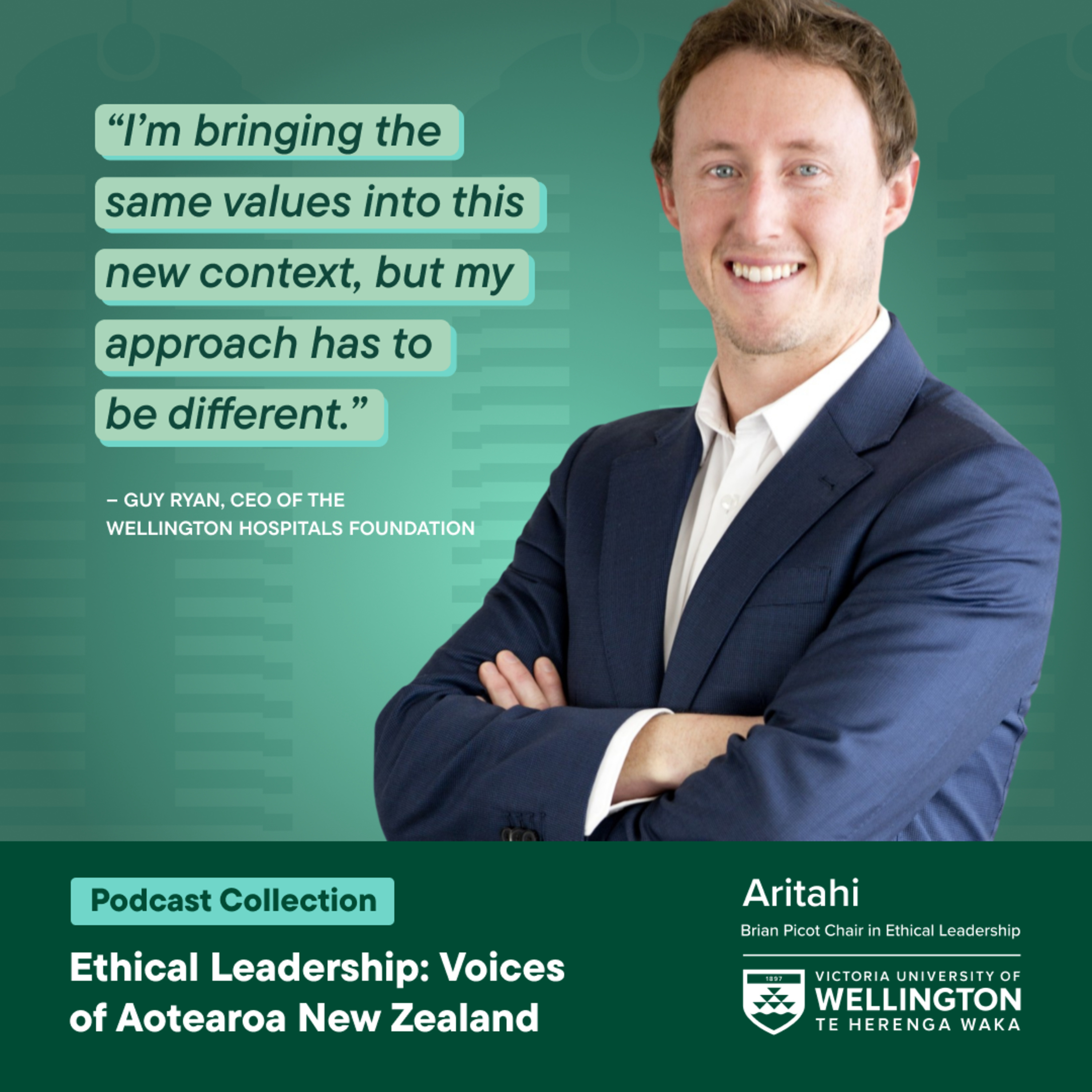
Guy Ryan shares his journey from founding Inspiring Stories in 2011 to becoming CEO of the Wellington Hospital Foundation, highlighting how ethical leadership evolves with context. Though rooted in consistent values like youth empowerment and environmental stewardship, his leadership style has adapted significantly—from founder-led autonomy to navigating complex, stakeholder-rich institutional environments. He reflects on the challenges of transition, including imposter syndrome, past failures, and the need for strategic clarity amid systemic pressures. A core insight is that ethical leadership isn’t just about principles; it requires sustainability, agility, and organizational resilience. He emphasizes that true impact depends on financial viability, long-term planning, and alignment across stakeholders—especially volunteers and hospital staff. Through a current brand refresh, he is working to strengthen organizational coherence and shared values. His experience underscores that ethical leadership thrives not in rigidity, but in continuous learning, humility, and adaptability, especially when shifting from startup innovation to institutional transformation.
Hello and welcome to Ethical Leadership. Voices from Ottawa New Zealand, a podcast series
commissioned by the brand Pico chair in Ethical Leadership, Aritahi, at Victoria University
of Wellington, and produced by advisory firm PocketKnife.
This podcast series aims to demystify ethics and make ethical leadership a concept we all
become more fluent in and a skill we all become more nimble with.
My name is Ellen Melanda, Director of PocketKnife and it is my pleasure to be your host for
this episode of our podcast series.
Today I'm excited to be joined by Guy Ryan.
Guy is a purpose-driven leader, a mentor and a born member.
Guy is best known as the founder of Inspiring Stories, a charity that he established in 2011,
with the vision of enabling young New Zealanders to realize their potential to change the world.
The organization supported up a 15,000 young people through initiatives such as the Festival
for the Future, the Future Leaders Program and the Impact Awards.
In 2015, Guy was honored as the young New Zealander of the year for his contributions to
youth development and social enterprise.
He is also an Edmund Hillary Fellow, a distinction awarded to individuals demonstrating leadership
and a commitment to creating positive change.
Just over a year ago, Guy took up a new challenge as the CEO of the Wellington Hospital's
Foundation.
It's my pleasure to welcome Guy on the podcast today, Guy, a warm welcome to you.
Thank you, Elaine.
Great to be here.
Thank you.
Thanks for joining me.
So good to have you here.
So today we're going to try and demystify ethical leadership guys and I'd love to discuss
what ethical leadership means, of course, to you.
If you don't mind, let's go back to 2011, I believe.
And you found it inspiring stories.
I think at the age of 25, would that be right, Guy?
Yes.
24.
So as suspect, you did not think of yourself as an ethical leader back then based on your age,
but I may be wrong, but you had it in you, right?
So can you tell us a bit about what, from what you can remember, what motivated you to
start a charity to support young people to realise their potential back then?
Yes, sure. So I guess just prior to founding inspiring stories, I had always been really
interested in the idea of entrepreneurship and I dabbled in a few things.
You know, I guess I grew up in a beautiful place on the west coast of the South Island.
It always had this really close affinity with nature and the sense of community.
And I guess it's kind of carried what's through it, lots of things that I've done.
Prior to inspiring stories, I had co-founded a film production company, focused on
producing documentary content, especially in promotional content.
It was really about education and environment election and a film that I produced as part
of my Masters told the stories of full young people taking action on climate change.
And I seen how powerful the stories of these young people could be to inspire others.
The film went on until when the Colorado International Film Festival was one of three finalists
in the world for the BBC's Best New Government Award and really seeing how powerful that
could be. I thought, wow, well, you know, I imagine how many other young people there
are out there doing great things for our communities and country.
What would it take to supercharge that?
And so I pitched this idea to a corporate at the time, Vodafone, and it was lucky enough
to win one of their world of different scholarships, which would support you for one year if you
were successful to head a youth focus project of your choice.
So that was really the genesis of inspiring stories, drawing on my interest in entrepreneurship,
on production, storytelling, marketing, and I just had this idea, I just thought of
magic.
If every young user under unleashed their potential to change the world, what would it take
to make that happen?
And that was a big drive that got me out of bed for a very long time, pouring my heart
and soul into an organisation and a fascinating learning adventure, I guess as well.
That is wonderful and I'm loving what you're saying about, you know, that part of the
community you lived in and you grew up in and not only the people, but also the importance
of the environment and the beauty of the environment and wanting to protect this and wanting
to cherish it.
Would you say your values, like you've talked about, like them in your young years as a young
adult?
Do you feel like they've evolved as you matured as a person and as a, can you see whether
there's an evolution there or do you think they've been cemented or how would you describe
that kind of journey you've been on and whether the values have changed so time?
Yeah, it's a correct question.
I think the values or my values would have been pretty consistent, you know, they would
have evolved a little bit over time, I guess one tangent, for example, when I started doing
a lot of that work at my age is, I don't have kids, you know, now I've got a five-year-old
and a neighbor-old and so that's an immediate shift and not so much values, but a little
bit, you know, but it definitely influences your priorities as well.
I think my values would have been pretty consistent throughout that journey even though the context
has changed a lot and I think that's one of the really interesting things about leadership
or ethical leadership is, you know, great leadership in one context or what's needed for
great leadership can actually be really different at a different context, you know, and I think
where I got to with my journey building inspiring stories and a national development organisation
that became, like I knew the context really well, I became increasingly confident in the
decisions that I was making, while I was making those things, whereas now I've taken
on a new role and I'm kind of like a tiny version of big ocean and actually I can't just
do exactly what I did, you know, back then I have to really deeply understand the context
and it's a different set of challenges, still trying to bring those values into this
new context but the way in which I approach it just has to be different as well.
That is so interesting, so are you, so you're finding yourself being a slightly different
leader, so just after 14 years of building an organisation from scratch and like you
say, like leading, not a small team, but a tight team that was really looking to you for
direction and vision because you were the founder, to finding yourself now in a role, tell
me a bit more about it because I don't want to put a words in your mouth, but at the Wellington
Husband Association where the context is very different in so many ways and so you're
finding yourself being the leader that's during upon the same value set but you can see
how you are applying, implementing these values, these beliefs in a different way, would
that be right?
Yeah.
So I guess in terms of just painting a contrast of those two different contexts, there are
a lot of the things that I have done previously, you know, I've come up with the idea, I've
shaped it, I've built a team around me, I kind of, you know, lead the version of the implementation
of what it was a strategy was and so you have this huge amount of autonomy in that context,
right?
And I've stepped into, more recently, is taking on a role, a new role as the chief executive
at the Wellington Hospital's foundation so we're the official charity for Health NZ
for the Wellington region so we're an independent legal entity, a charity that we exist very
much to serve and support Health NZ that are hospitals across the Wellington region and
I didn't set that up and in fact quite different, I'm stepping in from somebody who built it
from scratch and who led that role for 20 years, you know, and that my, my predecessor,
that person built the team, built the culture, built the strategy, built the systems, built
everything, you know, and achieved amazing things but for me stepping in, that's a completely
different context, you know, I'm the second youngest employer, I don't have a background
in the health sector, you know, and we're set up to support three public hospitals across
the region even just finding your way around this hospital, you know, commitment and mission.
So radically different context and loads of sensitivities to kind of navigate to figure out who
are we as an organisation, who are we as a team, what is our north star, where are we trying
to go and how do I bring those values into that context and try and lead in a way that
feels really authentic to who I am, you know, but really respectful of the many different
sensitivities and competing priorities in the same context.
Are you also getting external advice, may that be from, you know, reading, researching
transitions such as these, you know, in other organisations in what works, and/or getting
some advice mentoring and coaching potentially from the outside world as well, is that part
of the next?
Yeah, so just comparing and contrasting some of those different contexts again, so what
I've built previously with the development of these leadership space, we built from scratch
on a smell of an oily rag and honestly, I'm trying to make stuff financially viable and
that you've developed with leadership context is extremely hard, but one of the amazing
things about that is that it forces you to be innovative, creative, resourceful, you
know, lean, and what I've stepped into is a charity, but it's in a much stronger place
financially, I mean, part of it just blows my mind, and so one of those differences has
been starting from a place of financial strip, yeah, and so actually, even though I've,
I guess, cut my teeth or learnt, you know, through such a lean environment having to figure
out how to make magic work on smell of an oily rag, something we've got a bit of resource
around and there has afforded us the opportunity to work with some, you know, scan the market
and find some great partners but to work with a range of organisations across those different
colours of transformation that we empty.
expertise. You know, you have to pay them, right? And they give us a charitable discount. But,
you know, that affords us the opportunity to work with sector specialists, whether that's in a
technology space or the brand space or, you know, retail space or HR, an organisation of change
processes. So that's been amazing. But yeah, I guess like similar approach, but just starting from
a slightly different level of resourcing around that. And this is an organisation, you know, with
20 years of credibility and track record. Yeah, like I said, a different set of challenges. But
wanting to point those values, you know, back through as much as possible. So really thinking
about what's the social impact of the work that we're doing or the change processes that we're
leading. This means for the team, the board, the founders, sort of about key stakeholders. We also
manage, you know, over 500 volunteers who help out across the different hospitals. Actually, you know,
we're always having to think, what does this mean from a financial sustainability perspective?
I guess there's two key parts for us as an organisation, one fundraising organisation. So really,
we want to be making money and raising funds to support the various needs of our hospitals across
the region. Yes. As a balance there, where we actually have to support the organisation of the
engine that underpins and enables it, that, you know, it was intentionally because we do need to
make some strategic investments, including the things that I mentioned, technology,
being capability, systems, etc. And that stuff costs money. And if we spend that money, that means
for a period, best money that we're giving out to our hospitals. But that's done with a long-term
view that actually if we get this infrastructure right, we do this transformation, ultimately, that
means that we will be in a position to significantly improve the sustainable fundraising revenue
that we can unlock longer to support our hospitals. Galaxy, those kind of short-term and long-term
priorities. Yes. Yes. Yes. There's always moving paths and nothing's ever simple.
And balancing the short-term and long-term, but also the personal and the common good,
right? Because back to your point, like the people are in it, because they share a vision and
hopefully they share values. To what extent do you feel like, you know, like people are, because you
were talking about the volunteers, and that's what triggered my question, I suppose, because
really aware that volunteers, it's such a large force of volunteers, it's such an important asset
for an organization in particular, one like yours, where they usually extremely invested,
extremely values aligned, like they are an extremely big part of the image of the organization.
And the voice of the organization on the ground, do you feel like it's a coherent organization
in terms of values, I mean we've talked about your personal values, but the values of the organization,
do you feel like there's coherence there or is there a great opportunity for you moving forward,
thinking about that aspect of being an ethical leader and bringing coherence to an organization
on that level? What's the situation and what's ahead of you? Yeah, great question. I certainly think
that there is an opportunity for recalibration and alignment there. I've multiple factors that's
the consider, so my predecessor, who's now the chair, you know, built the organization from scratch
over 20 years, and there's four years difference in age between us, you know, and within that,
similar values, but very different leadership styles, you know, and my predecessor, like I mentioned,
has built the team, built the organization, built everything around their leadership style,
their preferences, their lives, their dislikes. I think everybody has been drawn to the organization
in alignment with the permits that the organization stands for, right? So make the difference for
our hospitals and healthcare across the region. So I think everyone's attracted to the organization
for the right reasons. Within, we did a little bit of work as early on as part of the
brand refresh process to try and understand the section that some of our stakeholders had of us
as a foundation in our work. And super interesting, you know, I'm coming at this from quite a
neutral perspective, but what that highlighted was actually how we might have thought about
ourselves internally. Actually, there was some differing perceptions, you know, across our
different stakeholder groups. And, you know, even for example, for some of our volunteers,
which there's more than 500, they don't necessarily talk about working with the foundation. They might
just talk about volunteering for our hospitals, you know, if we want to build a brand and some really
clear brand values that underpinned how we want to be perceived externally, for me, it's really
important that all of our key stakeholders are aligned and singing from the same song sheet
around that. And so we're still, again, in the alignment process, but I think having a really
shared version of where some values set for who we are, how we want to work together, you know,
the impact that we make is a really important piece of development that we still need to do.
Yeah, so we're like I said, we're going to a brand refresh process at the moment, but it's not like,
oh, you just launched a new logo on that. So, you know, it's so much more complex than that.
There's so many things even within that example transformation project that we need to click in
place to, you know, ensure that ideally all of our key stakeholders really, ensure that we know
who we are, why we exist, how they can get involved and how to talk about some, how to champion us
to their peers and their colleagues, you know. And you're a fantastic storyteller. Like you said,
you studied as a field maker and so this is also an amazing experience and skills that you bring
to the table through this angle and this lens and the importance of storytelling and share
storytelling internally before it can manifest with, you know, credibility and externally as well.
So having your people singing from the Samsung sheet, as you say, is really important.
And talking about this, the storytelling part is something that's really, you know,
close to your heart and something that you've practiced through the years. I was thinking about
going back to 14 years at inspiring stories. Are they like two, three major lessons that you
learned that you're bringing through in this new role or lessons learned in terms of ethical dilemma
or some mistakes that you may have made because don't we all, you know, that you learn from,
that are always top of mind because there's really stuck with you because probably it was quite a
hard time. And or you just saw a wear of the fact that that was such a treasure learning that you
build upon in this new role. Are there other particular experiences, particular illus and mistakes
that you made with the years that are a big part of you as a leader? Yeah, I think there's
probably a few, and I guess so stepping into the Wellington Hospital's foundation, I've never heard
of the organisation before, before the role, you know, despite having two little kids both that were
born at Wellington Hospital, it's been lots of time there, new about the hospital but had never heard
about the foundation before and and taking on the role. You know, I had a fair bit of imposter syndrome,
you know, like this amazing organisation when I kind of dig, you know, beneath the service,
why have I been given this, given this opportunity and what can I bring, you know,
that's actually shift the needle or make a difference here. And so as a leader, you kind of sit
with that discomfort probably for a longer period of time and the more I kind of get into it,
you know, the more I'm like, oh yeah, actually, I think that's a good idea.
Coming back to the question and are there things in that kind of earlier journey, any of those
lessons that might apply to the context? I think there is, I think one of the interesting things
about working with such a public-facing organisation within the hospital's foundation,
like literally our offices are in the main hospital in Newtown and we've got staff at
Kennethbury Hospital and Hollywood Hospital in the heart. So, so there's all these things that
happen all the time in a hospital environment where there's just, there's no shortage of
data. I think everybody is aware that our health system is under a huge pressure at the moment
and government funding only stretches so far. And because you're in that context with literally
thousands of health museum staff, tens of thousands of patients coming through the door all
the time, it's really easy to get distracted, you know, it's just come up. And I think one of the
most important things for us in an organisation has actually been to get really clear on strategy.
Where are we going? What is success look like? Let's distill that down into five key priorities
and really focus on nailing those. And I mean, you can't ignore everything else that's going on,
but just really trying to be really clear, strategic, focused. And with them is the ambition,
you know, which I talked about earlier on, like the easier approach would have not been to have
an ambitious new strategy. The easier approach would have been, oh, let's just do what we've
always done trying to get better at it. And I think for me coming up, there was a real,
I guess, sense of uniqueness and beauty of being able to see stuff with fresh eyes. And you don't,
that doesn't last for ever, right? You only have that kind of perception of fresh eyes for a limited
period of time. So to kind of acknowledge that and put value on that, I guess, and actually go,
well, okay, here's my rare. Here's some things that actually I think are going to work for us,
you know, this will be the future. Here's a bunch of things that we're going to have to do quite
differently, to support that transformation. Let's be really bold and ambitious a bit about that.
Let's be really focused on strategy and let's prioritise what needs to happen to enable that.
And that is also meant having to say no to some things. We're doing releases and things,
you know, that can be challenging as well when you've got, for example, the long-standing
founder of 20 years, who's now my boss and is the chair, and similarly, this people in the team
that might have been there for nearly 20 years as well, there's a lot of emotional infestering,
you know, it's a lot of. ways of things have always been done and that could be a really interesting thing to navigate.
And for me it has been so important to try and approach that in a way that feels really genuinely
authentic or specific. Because actually those relationships are too important to break and
sometimes if you have a relationship so it can't be minute. So really we get one shot at this
and sometimes that means that actually even though I'm coming in with a newer gender
and pushing for a cushion and transformation, if there's too much tension you know in some of
those things and actually if that is brings the risk of damaging some really important relationships
to the foundation, I'm just going to have to step back and respect that and be a bit more patient
and take a longer time for your own friends. Loving the clarity you have on all of this 12-1 scene guy,
that's that's amazing. Thank you. There was something else I wanted to ask you about you and that
was again looking back when you were honored as young New Zealander of the year 15. That came with a
kind of a new level of public exposure and kind of meant you become even more of a role model for
aspiring change makers. And again I could see this being one of the people evolving in the sense
there's as you like nine hindsight like I'm curious like did you did this change you getting that
sort of level of public exposure? Did it give you a chance to maybe reflect on your leadership style
or did it crystallize crystallize who you were already like what what was the change there if any?
Yeah probably lots of changes I think so so when the young New Zealander of the year announcement
happens one of the things that come with that is this public expectation and one element of that
is that you get a lot of requests to speak at different things hundreds of things whether that's
university graduation ceremonies or coming into speak at businesses or to schools or all sorts
of stuff so really interestingly in my much younger years I used to hate public speaking you know
it terrified me and I would avoid it every opportunity and then slowly but surely and internally
into that discomfort and you know even though I might not have enjoyed it initially you figure out
how to get good at stuff you know one of those things that can hopefully help to move hearts and
minds of the audience feeling like it takes some time you're able to share it you know and I guess
with that I probably another level up in terms of needing to be able to engage with such a diverse
range of stakeholders you know confidently and so kind of be relatable to such different audiences
you know whether that's prime ministers or ministers or mayors or chief executives right through
to young people or community organisations in spending time you know from literally some of our
most most socially economic challenged rural communities in New Zealand I drew to you know
engaging with senior leaders in some of the top two organisations being able to I guess one of
the things I learned out of those opportunities was the the confidence level to engage and
in what very different spheres there and I also off the back of winning that I was probably
even more confident and even more ambitious and that's not necessarily a good thing one of those
things that I tried to offer back of winning the young people during the year award was launcher
campaign to try and raise a million dollars that we would use to back young people to bring their
bold ideas for change to life and that campaign failed you know failed miserably and I guess
my confidence took a big hit you know I had thought okay well young news editor of the year
now's the time to do something more delicious here for the right reasons but no and I think
for me you know as a as an emerging young leader I don't come from any money I don't come from
wealth you know and that's perhaps one of the interesting challenges with trying to get you know
some of this kind of purpose driven or impact driven ideas of the ground you can have a best idea
but actually if you can't secure the resources or the funding around you it doesn't necessarily
mean anything you know if it's not viable you can't sustain it so coming back to the kind of
I guess that framework or definition around ethical leadership you know we're trying to consider
social impact outcomes our mental impact and outcomes economic and financial economic and outcomes
all of those different parts are all kind of moving in different ways of retirement one thing
that might have worked perfectly in one context suddenly things can change and no longer stacks up
and you've got to adapt to develop a new approach to that step so I guess this is lots of moving parts
and I guess that's one of the beautiful things about leadership it's never boring you've always
got new two fours you've always got new challenges new problems to solve and so forces to kind of
always be learned and always be trying to stay in tune with the context and the stakeholders
around you as to how you move thoughts. I love these two thoughts guy like you've touched on two
very important things around sustainability be financial emotional or everything the ability to adapt
and be flexible and learn and iterate it's all good to say I'm going to lead with integrity
and fairness and accountability and respect but you know you need to have the conditions to be
able to do this and I think sustainability and ability to be agile and adapt and learn are
important conditions in order to be able to be the leader so thank you that was incredible hearing
about all of your experience and like I said like incredibly amazed by the clarity that you have
12 months into a role like this one around you know what is happening what is the situation around you
and how you go with so much intention and humility and care about you know being the best leader you
can be for this organization so you mentioned how you obviously built an organization from scratch
at inspiring stories and you were that core kind of node in the middle and you know you created a
team around you that's brought into your vision straight away and look up to you for everything
so I'm kind of hearing that was a bit of a hero printer type of situation there which is not
unusual you know you know self-funded startup style and company what have you learned around the
risk of such a setup and such a leadership style and how different is it now in the context of
the Wellington Hospital foundations um great question I guess and at the time probably without
any awareness of it you know building an organization uh with me at the center and when you're
building it literally from scratch from startup there's so many acts you have to wear in your
figuring out um finance fundraising you know what a sustainable revenue model bookline you're
doing with your stakeholder relations you're doing the design stuff the wind development the
promotion the marketing the recruitment the training the onboarding the everything you know um
so just because of the I guess the stage and the nature of that stage of development you wear so
many hats it can be a really challenging thing especially the resource constrained environment how
you go from that to then having a bit more scale and perhaps a few more layers of an organization
particularly if you're in a resource constrained environment and account necessarily higher
or come to long-term employment for a leadership team or additional permanent roles and
things like that so it's a root conundrum and then it also opens up lots of challenges around
succession if you've built something that's so depending on a single founder and that founder
having so many different skill sets where so many different hats that can be really hard to replace
I want a single human and I think I've seen that in stepping into this new organization but I didn't
found that I didn't set out but another person did you know and there are many things that have
been very dependent on that one human you know and that person similarly having to wear all of
those different hats and setting it up and so for me one of the things I'm really mindful coming
out of this succession how do I involve this organization in a way that is actually not just
dependent on a single human so how do you actually build resilience into the organization from the
outset so there's a number of ways that I'm approaching that and you know one of those ways is
through that organizational structure that would just be through the organization up until I
started it has been very flat most people reported into the chief executive the chief executive
you know was kind of I guess a power to make decisions on heaps of things I want to change that
and so establishing unleadership to you know with a head of fundraiser a head of marketing
communications a head of volunteering for example and actually wanting to ensure that leadership
team feel really empowered and have the autonomy to make important decisions within their respective
functional areas across the organization and I guess trying to design this in a way that look
if something happens to me as chief executive if I get hit by a bus the organization's not going
to fall over and hopefully when I step back from the organization and it's time to return a new
chief executive you're not needing a new chief executive that has to have deep knowledge and skills
across 20 different areas because actually you've got that level of capability those skillsets
shredded throughout the organization so yeah that's I guess that's one of the things that I'm
really mindful of as part of this six phase development so but interesting and different challenges
trying to take an organization from zero to one that is to take an organization from one to two
And I'm really liking this new space.
Yeah, what fantastic learning.
Yeah, the what fantastic.
learning that you're bringing from 14 years of reigning an organization you
started to do this new context. It's amazing. It's been fantastic a guide to
hear all of the differences, but also similarities in these two roles of
yours. And like I said, amazing to get your level of clarity around what these
are and how you're going about managing these and the best way you can. I think
I'm going to leave us with three key words. You talked to us about the
importance of the conditions in order to be that ethical leader. And why
needs sustainability? Why is agility and learning? And the other one you just
touched on is the resilience of the organization and the people around you.
And so all of these are super important right to be that moral leader and that
moral person. Thank you so much for your time. It's been just wonderful talking
to you today. And thank you for joining us on the podcast.
Thank you for having me. It's been fun.
Thank you for listening. This was an episode of Ethical Leadership, Voices of
Auterra and New Zealand, a podcast collection commissioned by the brand
Pickard Chair in Ethical Leadership, Aritahi at Victoria University of Wellington.
I hope you enjoy the episodes as much as I'm enjoying the fabulous conversations
with our guest speakers. Stay tuned for more.
Podcast Summary
Key Points:
Guy Ryan founded Inspiring Stories in 2011 at age 24, driven by a passion for storytelling, youth empowerment, and environmental values, which he saw as powerful tools for social change.
His core values have remained consistent over time, though context and personal life changes—like becoming a parent—have shifted his priorities and leadership approach.
Transitioning from founding a startup to becoming CEO of the Wellington Hospital Foundation presented a radically different leadership context, requiring new adaptability, humility, and respect for existing structures and stakeholders.
A key lesson learned is the importance of strategic clarity and bold focus—rejecting incrementalism in favor of a deliberate, values-driven strategy to lead with integrity in complex, high-pressure environments.
He emphasizes that ethical leadership requires more than values; it demands sustainability, agility, and organizational resilience, especially in balancing short-term needs with long-term impact.
The organization’s values and coherence are currently being refined through a brand refresh process to ensure alignment across stakeholders, including volunteers and hospital staff.
Imposter syndrome and past failures, such as a failed $1M campaign, have deepened his humility and understanding of resource constraints in purpose-driven leadership.
To build resilience, he is restructuring leadership with empowered functional heads, ensuring no single person is critical to the organization’s survival and enabling smoother succession.
Summary:
Guy Ryan shares his journey from founding Inspiring Stories in 2011 to becoming CEO of the Wellington Hospital Foundation, highlighting how ethical leadership evolves with context. Though rooted in consistent values like youth empowerment and environmental stewardship, his leadership style has adapted significantly—from founder-led autonomy to navigating complex, stakeholder-rich institutional environments. He reflects on the challenges of transition, including imposter syndrome, past failures, and the need for strategic clarity amid systemic pressures.
A core insight is that ethical leadership isn’t just about principles; it requires sustainability, agility, and organizational resilience. He emphasizes that true impact depends on financial viability, long-term planning, and alignment across stakeholders—especially volunteers and hospital staff. Through a current brand refresh, he is working to strengthen organizational coherence and shared values.
His experience underscores that ethical leadership thrives not in rigidity, but in continuous learning, humility, and adaptability, especially when shifting from startup innovation to institutional transformation.
FAQs
Guy was motivated by his interest in entrepreneurship and storytelling, especially after producing a film about young people taking action on climate change. The film's success at an international festival inspired him to create a platform that would empower young New Zealanders to realize their potential.
Guy believes his core values have remained consistent, though they have been shaped by life experiences. For example, becoming a parent has shifted his priorities, but his commitment to purpose, community, and social impact has stayed strong.
In Inspiring Stories, Guy built an organization from scratch with full autonomy. In the hospital foundation role, he leads a mature, established organization with complex stakeholder dynamics, requiring a more collaborative and context-sensitive leadership approach.
He balances immediate needs with long-term sustainability by investing strategically in infrastructure and systems, even if it means temporarily reducing direct funding to hospitals. This ensures future financial resilience and operational capacity.
Yes, he acknowledges that while the foundation's mission is clear, there is room for improvement in how stakeholders—especially volunteers—perceive and internalize the organization’s values. A brand refresh process is underway to strengthen this alignment.
He emphasizes the importance of strategic clarity, bold ambition, and the ability to say 'no' to maintain focus. His experience in a resource-constrained startup environment has taught him the value of agility, adaptability, and strategic prioritization.
Chat with AI
Loading...
Pro features
Go deeper with this episode
Unlock creator-grade tools that turn any transcript into show notes and subtitle files.
 PodcastTranscript AI