The Pacific Theater of World War II unfolded with stunning speed and ferocity, as Japan launched sweeping offensives across Asia and the Pacific, capturing key territories like the Philippines and Singapore within weeks of the attack on Pearl Harbor. Japanese forces employed aggressive, mobile tactics inspired by German Blitzkrieg, using night attacks, stealth, and psychological warfare to overwhelm Allied defenses. The U.S. and Filipino resistance on the Batan Peninsula became a symbol of endurance, despite being isolated, starving, and under constant attack. Japanese military culture, rooted in honor and self-sacrifice, made surrender unthinkable, leading to the horrific "Patan Death March" where thousands of prisoners died from starvation, heat, and abuse. Meanwhile, the U.S. responded with strategic innovation, launching the first major ground offensive at Guadalcanal in 1942. Though initially met with disaster and heavy losses, the American Marine Corps persisted through brutal combat, bolstered by naval intervention under Admiral Halsey. The eventual U.S. victory at Guadalcanal marked a turning point, demonstrating the resilience and determination of American forces and the immense cost of the Pacific war. The campaign revealed the long, bloody nature of the conflict, not just in territory but in human suffering, ultimately shifting the balance of power in favor of the Allies and setting the stage for a longer, more costly war in the Pacific.
the History Channel, original podcast.
It's hard to comprehend the scale of the Pacific Asian Theatre War.
It stretches from Hawaii to Burma, from the Aleutian Islands to Indochina.
In 1942, the United States sends fighting men to far up places most Americans have never heard of.
They are soldiers, sailors, airmen and Marines from every town in America.
They will confront an enemy whose moral code does not permit surrender.
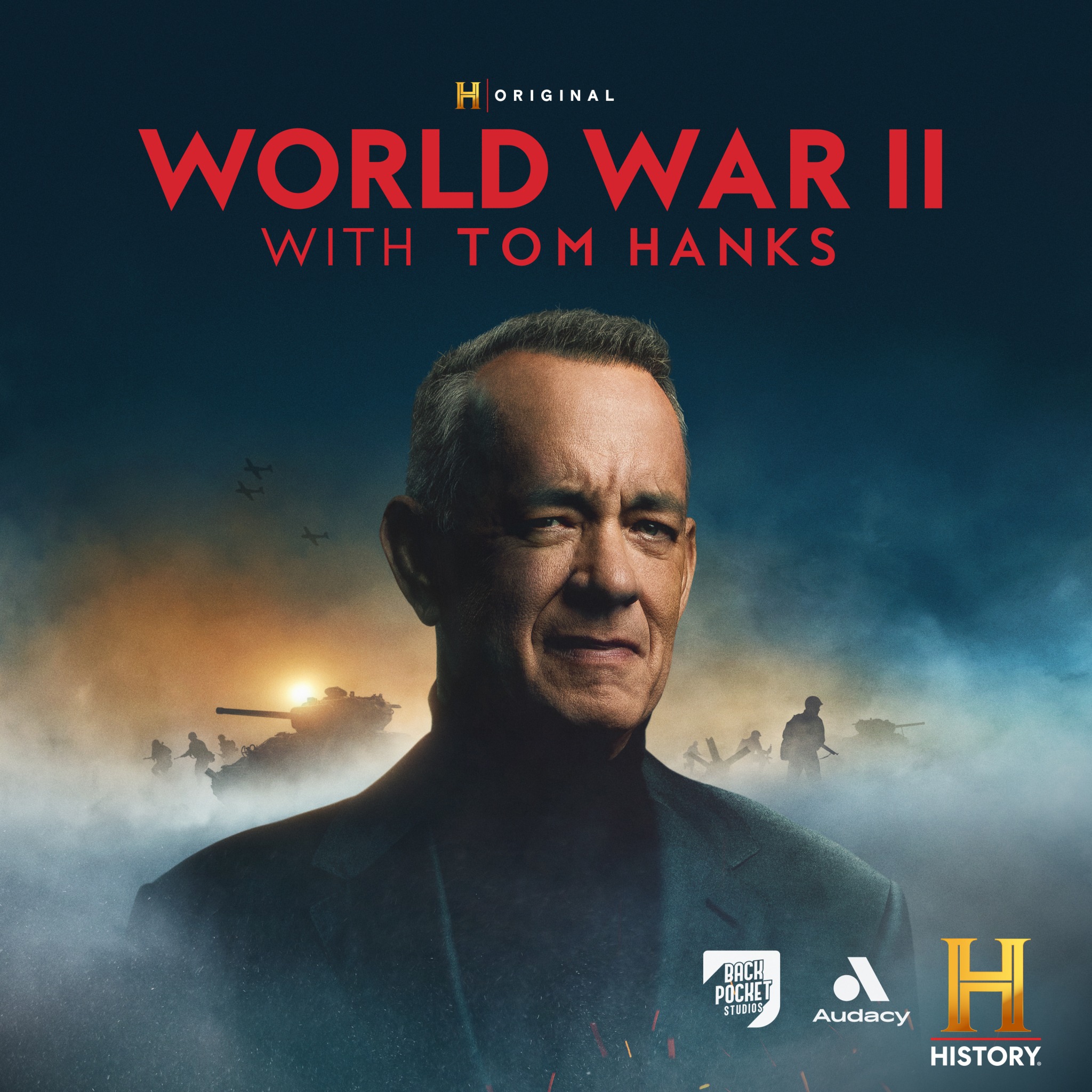
This is World War II with Tom Hanks, Episode 6, Quadal Canal.
Hours after the attack on Pearl Harbor, Japan invades the Philippines.
They begin with a devastating strike against the U.S. Air Base at Clark Field.
Then, land 35,000 troops at advance on the Capitol, Manila.
American and Filipino forces are overwhelmed.
Within weeks, Manila is captured.
There was a Philippine war plan that in the event of a Japanese major invasion,
the forces would withdraw to Baton.
Batan is strategically located next to Manila Bay.
It's this rocky peninsula.
It's got two dormant volcanoes that are sitting in the middle of it,
and so it's really good defensive terrain.
On December 23rd, 1941, U.S. and Filipino troops begin their retreat to the peninsula of Batan.
You have this chaotic retreat.
About 100,000 U.S. and Filipino troops, and we should add the 25,000 civilians.
Filipino but also Americans now desperate to escape the attacking Japanese.
As the troops retreat, the Japanese continue following a well-planned well-coordinated offensive,
aimed at British and Dutch colonies.
They have already invaded Burma, Borneo and Malaya.
They take Hong Kong on Christmas Day.
Then, move further into Malaya.
Malaya is considered difficult jungle terrain.
But the Japanese, using bicycle infantry and some tanks,
managed to push south to the island of Singapore, known as the Gibraltar of the East.
Singapore was our military base with its massive naval facilities,
guns facing into the sea so that it could protect that position,
and really a military HQ for the Empire in the Far East.
They begin their assault on February 8th.
The Great Wall of the West.
Winston Churchill, back in London, is looking on an ore.
He is an empire man. He said many times. He didn't come to power to oversee the liquidation of his majesty's empire.
But it's crumbling before his eyes.
Churchill cannot abandon the defence of Britain and the battle-edalante.
He cannot risk losing the whole of the Mediterranean, North Africa and the Middle East to access forces.
So what's gotta go? Unfortunately for Churchill,
he's got to scrimp and save when it comes to defence in the Far East.
It's just too much for Britain to handle.
The Japanese take advantage of British military mistakes and capture the island in only seven days.
Tens of thousands of Commonwealth troops are trapped and imprisoned.
Singapore was the granite foundation of the British Empire in Asia.
And boom, in the space of days, it falls.
The idea that Japanese forces could go into this historic place.
A real symbol of British power and prestige in Asia and take it within such a short time.
It's absolutely tremendous as far as Japanese are concerned.
This is Britain's fall of Rome moment in its Asian empire.
Japan has plunged into the war and is ravaging the beautiful fertile prosperous and densely populated land of the Far East.
The British empire now for centuries had been the most powerful empire the world had ever seen.
The Japanese had cracked it like an egg.
By the time the Shakapurl Harbour, you know, wears off,
the Japanese have taken their empire and expanded it seemingly overnight.
Japan's Asian offensive has two primary war aims.
First, the seizure of raw materials like oil and rubber.
Second, to replace the Western colonial powers who have long dominated the region and establish an empire of their own.
This is one of the most audacious offensives in military history.
In late 1941, early 1942, it's good news every week, almost every day, coming in.
They are liberating Asia. They are pushing back white Western colonial power.
The speed and scope of the Japanese offensive stuns the world.
A year earlier, General Tomayuki Namashita, the commander of the Assault on the Philippines, consults with Japan's access ally, Nazi Germany.
Japan is eager to adapt the Wehrmacht's Blitzkrieg tactics to a very different theater of war.
He was really admiring the German Blitzkrieg, the German Lightning War, and he took the German Blitzkrieg as the role model for a future Japanese war in Germany.
It's the Southeast Asia, so we must surprise the enemy. We must be fast.
It's always movement, movement, movement. For the enemy, for their enemy, for the allies, it looks like the Japanese aren't even thinking about what they're doing because they're moving so fast and they're moving constantly.
But this has a kind of shock effect on the troops there that are trying to defend the peninsula.
The Japanese have learned to move quickly, move stealthily, they fight well at night, which is what most armies are not good at.
They are pretty good at operational art, don't attack strong points, envelop the enemy, put them in untenable positions either in time or space.
And hence, it defines a lot of their victories early in the war.
They should underestimate the Japanese. I think part of that was racism. I think they were astonished that a non-European race could defeat Europeans in battle.
They didn't consider Asian people capable of what the Japanese are doing.
After the Japanese land in Malaya, Singapore's governor, Sir Shenton Thomas, allegedly says, "Well, I suppose you'll have to shove the little men off."
But British hubris is no match for Japanese military prowess.
There had always been this faction in the Imperial Japanese Army called the Kodoha, the Imperial Way faction, whose belief was because of Japan's extraordinary fighting spirit in the blood of their soldiers.
We can overcome the odds. That really is drummed into the soldiers.
So there is this asprey to core within the Japanese Army. It's guided by this belief in Bouchido, the way of the warrior.
Japanese military discipline is instilled by physically harsh measures. Officers abuse non-commissioned officers who in turn abuse the men.
You can see in diaries and in letters home, people saying, "I got beaten up today. I got slapped. I got punched. I had a rifle butt get me in the stomach."
There is a fair amount of ritualistic abuse that takes place as they go through what they would refer to as lessons.
It's all about self-sacrifice. They are all about suppressing individual needs and desires for the sense of whatever the nation needs, for whatever the emperor might need.
In just two months of fighting, Japan has achieved most of its objectives and appears to be winning the war.
Except in the Philippines, where US and Filipino troops are fighting back.
After more than a month of fighting, U.S. and Filipino forces continue to fight.
to resist the Japanese on the Batan Peninsula, but supplies, food, and ammunition are running
perilously short.
Supplies, provisions, ammunition, they're strewn about the Philippine islands and they're
not where the defenders need them.
The American forces are now completely isolated and surrounded.
They don't have what they need to survive.
The men spend a lot of their time just foraging for food.
Every snake, monkey, anything within the Batan Peninsula is fair game.
The commanding officer of both American and Filipino troops in the Philippines is the
charismatic and controversial General Douglas MacArthur.
MacArthur is the son of a civil war hero.
He's confident, courageous, a proven battlefield leader.
MacArthur's begging for more troops, for more supplies, for more ships, but none of those
things are coming.
The U.S. doesn't have them.
The Japanese, of course, they're coming after MacArthur's force.
They know they can't leave an army like this with MacArthur and consider the Philippines
have been occupied.
In Washington, President Roosevelt faces a very difficult situation.
The American people expect the troops to be supported, but he knows resupplying and
reinforcing Batan is impossible.
Also for both political and symbolic reasons, he must retrieve General MacArthur from the Philippines.
You couldn't afford to let MacArthur be captured.
You couldn't do it because it was bad for the American spirit.
You can't let a man like this go down, he's a figure of history.
MacArthur does everything he can to inspire his troops in Batan, and he's prepared to
go down with a ship.
But FDR orders MacArthur to leave the Philippines.
A few weeks later, he sends a rescue operation, and MacArthur with his wife and young son
leaves the Philippines on a small torpedo boat.
He promises I will return, and this is his commitment to the American people, but more importantly
to himself.
Knowing that America must make a stand, General MacArthur issues a final order to his
men.
MacArthur orders the garrison to fight to the last, which is completely unrealistic.
Soldiers are dying in medical tents merely because there's not enough medicine to save
them, so everybody's in a weak condition, but the defense is quite heroic.
The soldiers on Batan realize that they are being sacrificed.
So the battling bastard of Batan is written by a journalist named Qit.
The battling bastard of Batan.
No mama's, no papa's, no uncle's, Sam.
No aunts, no uncles, no cousins, no nieces, no pills, no planes, no artillery pieces,
and no one gives a damn.
For all the people left in Batan, I'm sure that's exactly what they thought.
After four months of the Teague, hunger and disease, the Batan garrison surrenders.
But their ordeal is just beginning.
The Japanese didn't expect that so many allied defenders of the Philippines would actually
surrender and become prisoners of war.
One of the things you're taught in the Japanese military is you don't surrender.
You're disgracing your family, you're disgracing your home, your village, your country, the emperor.
Surrender is dishonorable, not only to yourself, but to your family, anybody who surrenders
is inherently dishonorable.
The idea that you would surrender and that you would expect to be treated with respect,
being done so really is disgusting to a lot of the Japanese soldiers.
The Japanese marched the 75,000 American and Filipino troops to a POW camp 65 miles
north of Batan.
These men are exhausted, they're malnourished, and the Japanese they line them up and they
march them out.
And 110 degree heat with no food, no water, and Japanese guards just beating you and kicking
you and stabbing you the whole way.
And so if you're a recruit out there and you've received umpteen beatings from your own
senior officers on the way to where you are now, then it's a very short hop to having
a westerner in front of you, asking for food, asking for water and slapping them, punching
them, perhaps even shooting them.
The Japanese will drink their cantines and then dump the contents out on the roadside.
Needed troops will fall to the ground, they will be instantly banded in a shot.
They have been taught to regard western soldiers, and I think white western civilians generally,
with really no respect at all.
These people are lesser, almost to the point of being a slightly lesser species.
Thousands die on what will become known as the Patan Death March.
The loss of the Philippines will cripple America's military capability in the Pacific for months.
It's also a serious blow to morale at home.
In a matter of just a few months, the Japanese have conquered an empire of 500 million people.
The Japanese have the upper hand in the Pacific.
It's not clear what or who can stop them.
G'day, I'm Justin Wolffers, host of the Platypus Economics Podcast.
If there's one thing I've learned from a career teaching economics, it's that your life
is shaped by economic currents you'll never see.
A single price tag can explain things a thousand experts can't.
People who understand economics, they make better decisions.
In their careers, their finances, their relationships and their communities, and I want that for you.
Listen to and follow Platypus Economics, available now wherever you get your podcasts.
Spring in Tokyo.
Japan controls vast areas of the Pacific and Southeast Asia.
To protect this growing empire, Japan will consolidate its new territory and push into various
island chains to create an even stronger barrier against the United States.
The Japanese say we got to consolidate our position quickly.
We have to create a defensive bastion between the United States and Japan.
So all these island chains, the reddit like pearls, they have got to be strengthened.
They've got to be four to five into some kind of defensive perimeter.
Japan deploys thousands of troops to outposts stretching far into the South Pacific.
The Japanese are making absolutely sure that what they've got they will hold.
In the U.S., war production accelerates. FDR calls for 60,000 planes and 125,000 tanks
to be produced in 1942.
And in June, the U.S. Navy defeats the Japanese at the Battle of Midway.
It's Japan's first decisive defeat.
The victory at Midway has taken place in June 1942, but this is a naval victory.
It's only directed against Japanese warships.
Eventually, the Americans know they're going to have to re-take real estate there and actually
have to capture islands.
The Japanese plan in the South Pacific is to build a lot of airstrips which are going
to allow them to use air power to defend these stronghold positions.
To counter, America sends in the old breed, the first marine division.
Marine Corps is always soldiers from the sea.
Back in the revolution when we invade NASA, we are meant to come from the sea.
That's the mission.
In support of the Navy, that's their purpose.
After World War I, what they really start to do is turn their attention to what does
the next war look like.
And what they start to realize is, Japan is becoming a power in the Pacific.
If we're going to fight in the Pacific, then we need to figure out how to conduct amphibious
landings.
And amphibious landings on this scale are unprecedented.
Well, there's no sneaking up on an island.
They can see ships coming.
So everything across the beach is a frontal assault, machine gun, rapid fire artillery.
It's suicide, terrible idea.
And Marine Corps goes, "Got it, we'll take that one."
And that's how they get into amphibious operations because that would be what was necessary
to operate in the Pacific.
The training for the US Marines Corps is probably the best.
the toughest in the U.S. Armed Forces at this point. They are designed for amphibious warfare,
but to travel relatively lightly because of course if you attack a coast from the sea,
you can't take much heavy equipment with you. Their job is as an elite assault force,
but don't leave them in a campaign for too long because they don't have all the heavy weapons
to be able to do the job over a considerable period of time.
The Navy has ships and the Army has tanks and artillery. What does the Marine Corps have?
It has culture. So if you join the Marine Corps it's because maybe you can be one of those elite.
You know you get to go fight the Japanese. The majority are new recruits. They are relatively
inexperienced. They've had some pretty hurry training and now all of a sudden in 1942 they're
going to go into action against what they know and fear is a very formidable opponent.
They've read a lot of the stories about how the Japanese are almost Superman.
Until we actually face them in close combat we'll never know if we're good enough to take on these guys.
In the summer of 1942 an American B-17 on routine patrol reports that the Japanese are
building an air strip on the largest of the Solomon Islands, Guadalcanal. If the Japanese
are successful they will build an air base on Guadalcanal and potentially sever the lines of
communication with Australia which is meant to be a jumping off point for any campaign that's
going to come from the southern Pacific. We cannot let that happen.
Americans know that Australia is crucial to their holds over the Pacific.
What's at stake certainly for the United States Marine Corps is they've hitched their horse to
this idea of amphibious operations. Now they actually have to go executed.
If the Americans are going to roll back Japanese power in the Pacific
it's going to have to be boots on the ground and boots on the ground it will be in Guadalcanal.
Early on August 7th 1942 the first marine division approaches Guadalcanal.
They are the first US troops to take the offensive in World War II.
What's interesting about all amphibious lineings is if they're opposed and you don't really
understand the terrain you're getting into there's always the possibility of disaster and that was
absolutely the case of Guadalcanal. After the naval bombardment the Marines will land and
attempt to capture the airfield and secure the island. The intelligence for the land is a Guadalcanal
is so thin that they don't know what the interior looks like and they certainly don't know how many
defending troops are there. 10,000 Marines reach the shore.
To their relief the landing is unopposed. There are no Japanese defending the beach head.
The Japanese have only 2,500 men on the island most of them conscripted labor to build the airfield.
The Marines are astonished at how easy it is they move in land and they're very quickly capture the airfield.
The Marines build a defensive perimeter around the air strip which they name Henderson Field
after a marine dive bomber killed at the Battle of Midway.
Supplies for the Marines on Guadalcanal are being held just offshore by a US Navy task force
anchored in Savo Sound. But two days after the landing the calm of Savo Sound is shattered.
It's the middle of the night. These American cruisers are asleep. They don't come to battle stations
quickly. In the space of 25 to 30 minutes the Japanese have sunk four allied cruisers killed more than
a thousand allied sailors. So it's a disastrous defeat to the Americans. The West naval defeat
since Pearl Harbor you've got bodies washing up on the shore it's grizzly.
So many American ships are sunk that Savo Sound is christened iron bottom sound.
Vulnerable to air attack the task force pulls out before they've unloaded all the Marines food
and ammunition. General Vandegrift is the commander of the first marine division. His
understanding be upset that the Navy have skidadled. But he's absolutely vital also that he gives
a sense of confidence to his men. We're going to get through this we are US Marines after all.
The first wave of Japanese troops land east of the Marines defensive perimeter on August 18.
They're objective Henderson airfield.
The airfield is in a key position to maintain the shipping lanes from America to Australia.
That supply line is like the allied sciatic nerve so this is a very serious development.
It must be very spooky for the Marines. They are abandoned on the island. They can hear
the Japanese ships coming in. They know they must be trouble ahead.
What options do ground forces have? You can attack, you can defend and you can retreat.
Well guess what the Marines can no longer retreat. So no matter what we're going to have to fight it out.
The untested Marines are about to face Japanese soldiers for the first time.
On Guadalcanal, the first marine division is dug in around Henderson airfield,
bracing for a Japanese assault.
Commanding the Japanese troops is the veteran colonel Kiyonao Ichiki.
The Marines know that all the Japanese have done up to this point is win.
They start to almost have these superpowers. They're quiet at night. They're all snipers.
They don't require any arrest. They're fanatical.
All of these things start to build almost a super samurai adversary.
On August 21st, the Ichiki's troops attack the Marine lines.
The Marines respond with rifle, mortar and machine gun fire.
The Japanese have gone about 200 guys trying to get across this sand spit and then moan down.
Ichiki just slushed that off. He'll launch two more attacks.
The Marines will beat them back.
The fighting is brutal.
Often hand to hand.
Some Japanese soldiers even use ancestral samurai swords.
The battle doesn't end until 5 o'clock that evening.
44 Marines are dead.
But nearly 900 Japanese soldiers are killed.
The Marines are stunned. How could a battalion commander throw 900 men away?
Who would do that?
After the battle, Colonel Ichiki commits suicide.
Just a single Japanese soldier surrenders.
They may look dead, but if they've got a weapon they're going to shoot you when you go past
and think about a grenade. They may blow them shoulder up with a grenade to cure you.
This is a different kind of enemy.
The US Marines on Guadalcanal realized that to combat that and to protect themselves,
they are going to have to be equally ruthless.
And this produced incredibly brutal form of warfare that I think was unequal in the Second World War.
The Marines now understand what will be required to defend Guadalcanal.
The island has become a proving ground for a generation of young Americans.
The Japanese conduct regular air strikes on Henderson Field
and continue to move men and supplies into attacking positions.
Every night, the Japanese are using fast transports and depositing troops and supplies on
wildle canal via what's going to be known as the Tokyo Express.
They are absolutely determined to retake this island. Their whole strategy for moving forward
in the sudden Pacific is based on recapturing wildle canal, and they're going to pretty much
send as many troops as they can to make sure that they do the job.
Fandagrifton's staff start taking preventative action in case they're overwhelmed, so they start
burning vital intelligence papers. By October the Japanese force has more than doubled its size.
But the US Navy is able to resupply the Marines from newly constructed supply bases.
Guadalcanal is now a battle of attrition. Who will give in first?
The Japanese are very good at night attacks, and so nights are horrific.
Imagine being a 19 or 20-year-old American kid, and you're in a foxhole, maybe with one
other person, right? One guy sleeps the other is on watch, and you can hear the other foxholes
with your compatriots, but they're not visible in the dark. Remember, these islands are really
black as night, and you hear screaming from another foxhole.
This is life or death. You go to sleep, you may not wake up. This man was with you 24 hours ago,
now his throat's cut in the foxhole next to you. This is a war of man against man. This is personal.
And as darkness comes down every night, the fear grows deeper and deeper.
Even though they're deprived of sleep, lack sufficient food, and battle tropical diseases,
the Marines maintain their morale. But their casualty rate is climbing,
and they begin to suspect they're being abandoned.
A lot of people are catching malaria, dysentery, they don't have enough food,
they're just becoming increasingly incapable of functioning.
General Vanda Griff estimates that less than half his force is fit enough to fight.
The Japanese are still coming. Guadalcanal is going to be where the Japanese teach the Americans
the cost of punching a hole in that defense perimeter. They'll say, look at the effort it took.
Look at the number of men you lost on Guadalcanal. How long do you think it'll take you to
batter your way across the Pacific?
One night, two months into the battle, the Japanese deliver a bombardment designed to crush
the Marine spirits. But the Marines just dig their foxholes deeper.
A thousand shells are sent over in 80 minutes. We're talking about 14-inch shells
described by some of the guys like the weight of small cars.
Most of the Marines planes at Henderson Field are destroyed in the bombardment.
The U.S. reinforces the Marines. But the Japanese reinforce their troops as well.
Control of the island and the entire U.S. campaign in the Pacific is at stake.
All eyes are on Guadalcanal.
In America, Guadalcanal is front-page news. It's on everyone's minds.
It was observed. Guadalcanal is not a name, but an emotion.
You young Americans today are conducting yourselves in a manner that is worthy of the highest
proudest traditions of our nation.
All the attention of the American public is focused on this island.
Roosevelt knows this is the first big American ground offensive of the war is going horribly wrong.
They have to hold on to Guadalcanal.
Roosevelt sends a note to the joint chiefs and says, "I want to be sure of something
that every available man, ship, and plane is being devoted to the struggle on Guadalcanal."
"We here at home are supremely conscious of our obligations to you. We will not let you down."
The campaign gets a new commander. Admiral William Bull Halsey.
Halsey's coming into this campaign is like a defibrillator on the heart.
Halsey looks the part. Halsey is this but leathery old commander who's been successful.
He's a can-do combative guy. He can't wait to get to the Japanese.
His line was, "You hit him hard. You hit him fast. You hit him often."
This is entirely in keeping with the mentality of your average marine.
Admiral Halsey promises the Marines all the support they need on Guadalcanal.
In just a few weeks, he gets the chance to demonstrate it.
A large Japanese fleet carrying 14,000 troops is approaching Guadalcanal.
The body of water is the size of a bathtub. So risking your battleships to send them up to
Iron Bottom Sun. I mean, it honestly makes the hair stand up on the back of my neck even now.
But Halsey is determined that he is going to fight with everything that he's got and so he pushes
all his chips into the middle of the table. Halsey instructs the US Navy task force to attack
the Japanese fleet in the sound. For two days, American and Japanese warships battle in Savo Sound.
The fighting is fierce.
It's ship-to-ship combat at its most intense.
Nearly 2,000 Americans are killed. But the Japanese are only able to land a quarter of their force.
Bull Halsey and the US Navy have turned the tide.
And the Japanese begin to withdraw from Guadalcanal.
Most of the Marines on Guadalcanal are relieved by the US Army.
A generation of Americans have proven to the world that they're capable of fighting this war.
But Guadalcanal has also revealed how long and difficult this conflict is going to be
and how steep the price of victory.
It was the first clash of arms between the Japanese Army and American Marines and soldiers.
And in that victory, the Americans came out ahead. Halsey put it best when he said,
cry out to the battle, the Japanese advance at their will.
Off to the battle, they retreated at Oz.
It's a long road to Tokyo, but Guadalcanal is the first step.
The Marines who hold the line for months on Guadalcanal are sure their country has forgotten them.
But when the first Marine Division is relieved by Army units and sent to Australia to recuperate,
they learn that they're actually heroes.
That year, in 1942, Hitler escalates his campaign against the Jews of Europe
to an unimaginable level.
World War II with Tom Hanks is produced by Neutopia Limited, A&E Factual Studios,
Play Tone Productions, and Backpocket Studios in association with Motion Entertainment
for the History Channel. This episode was narrated by Tom Hanks and mixed by John Lloyd,
additional voicing provided by me, Jeremy Reagan. From the History Channel, our executive
producers are Eli Lara and Liv Fiddler. For Play Tone, executive producers are Tom Hanks and Gary
Getsman. For Backpocket Studios, our executive producer is Ben Dixting.
Podcast Summary
Key Points:
The Pacific Theater of World War II saw rapid Japanese advances from Hawaii to Indochina, including the swift capture of the Philippines and Singapore, shocking the Allies with their speed and military efficiency.
Japanese forces employed Blitzkrieg tactics, emphasizing speed, stealth, and night attacks, exploiting weaknesses in Allied defenses and undermining morale through psychological warfare.
The defense of the Batan Peninsula by U.S. and Filipino troops was marked by extreme hardship, shortages, and a lack of supplies, leading to widespread starvation, disease, and eventual surrender.
Japanese military culture emphasized absolute loyalty, self-sacrifice, and honor, making surrender a moral failure that led to brutal treatment of prisoners during the "Patan Death March."
The U.S. Marine Corps, trained for amphibious warfare, launched the first major ground offensive at Guadalcanal in 1942, marking a turning point in the Pacific war despite initial setbacks and intense fighting.
The Battle of Guadalcanal became a grueling battle of attrition, characterized by brutal hand-to-hand combat, relentless Japanese night attacks, and high casualties on both sides.
American victory at Guadalcanal, secured through naval strength and strategic leadership under Admiral Halsey, shifted the balance of power in the Pacific and demonstrated U.S. resilience.
The war in the Pacific revealed the immense human cost and logistical challenges of prolonged conflict, while also proving the U.S. military’s capacity for sustained, effective resistance.
Summary:
The Pacific Theater of World War II unfolded with stunning speed and ferocity, as Japan launched sweeping offensives across Asia and the Pacific, capturing key territories like the Philippines and Singapore within weeks of the attack on Pearl Harbor. Japanese forces employed aggressive, mobile tactics inspired by German Blitzkrieg, using night attacks, stealth, and psychological warfare to overwhelm Allied defenses. S.
and Filipino resistance on the Batan Peninsula became a symbol of endurance, despite being isolated, starving, and under constant attack. Japanese military culture, rooted in honor and self-sacrifice, made surrender unthinkable, leading to the horrific "Patan Death March" where thousands of prisoners died from starvation, heat, and abuse. S.
responded with strategic innovation, launching the first major ground offensive at Guadalcanal in 1942. Though initially met with disaster and heavy losses, the American Marine Corps persisted through brutal combat, bolstered by naval intervention under Admiral Halsey. S.
victory at Guadalcanal marked a turning point, demonstrating the resilience and determination of American forces and the immense cost of the Pacific war. The campaign revealed the long, bloody nature of the conflict, not just in territory but in human suffering, ultimately shifting the balance of power in favor of the Allies and setting the stage for a longer, more costly war in the Pacific.
FAQs
It was the first major American ground offensive in the war and marked the beginning of the U.S. push to regain the Pacific. The battle established American naval and ground dominance, forcing Japan to shift from offensive to defensive operations.
The Japanese used rapid, stealthy attacks, often at night, and emphasized envelopment and surprise. Their forces were trained in discipline and sacrifice, following the ideology of 'bushido' or the way of the warrior.
To prevent Japan from building an airfield on Guadalcanal, which would have threatened Australia and cut off vital supply lines to the Allied forces in the Pacific.
The Navy provided naval gunfire, supply convoys, and air support, and later engaged in decisive battles like the one at Savo Sound to protect the Marines and resupply their forces.
Marines faced extreme hardships including constant night attacks, disease, starvation, and lack of sleep. The conditions led to high casualties and tested their endurance and morale.
Japanese forces launched repeated attacks, often using night raids and the 'Tokyo Express' to deliver troops and supplies. Their persistence led to heavy losses, and the campaign showed their inability to sustain prolonged combat.
Chat with AI
Loading...
Pro features
Go deeper with this episode
Unlock creator-grade tools that turn any transcript into show notes and subtitle files.
 PodcastTranscript AI