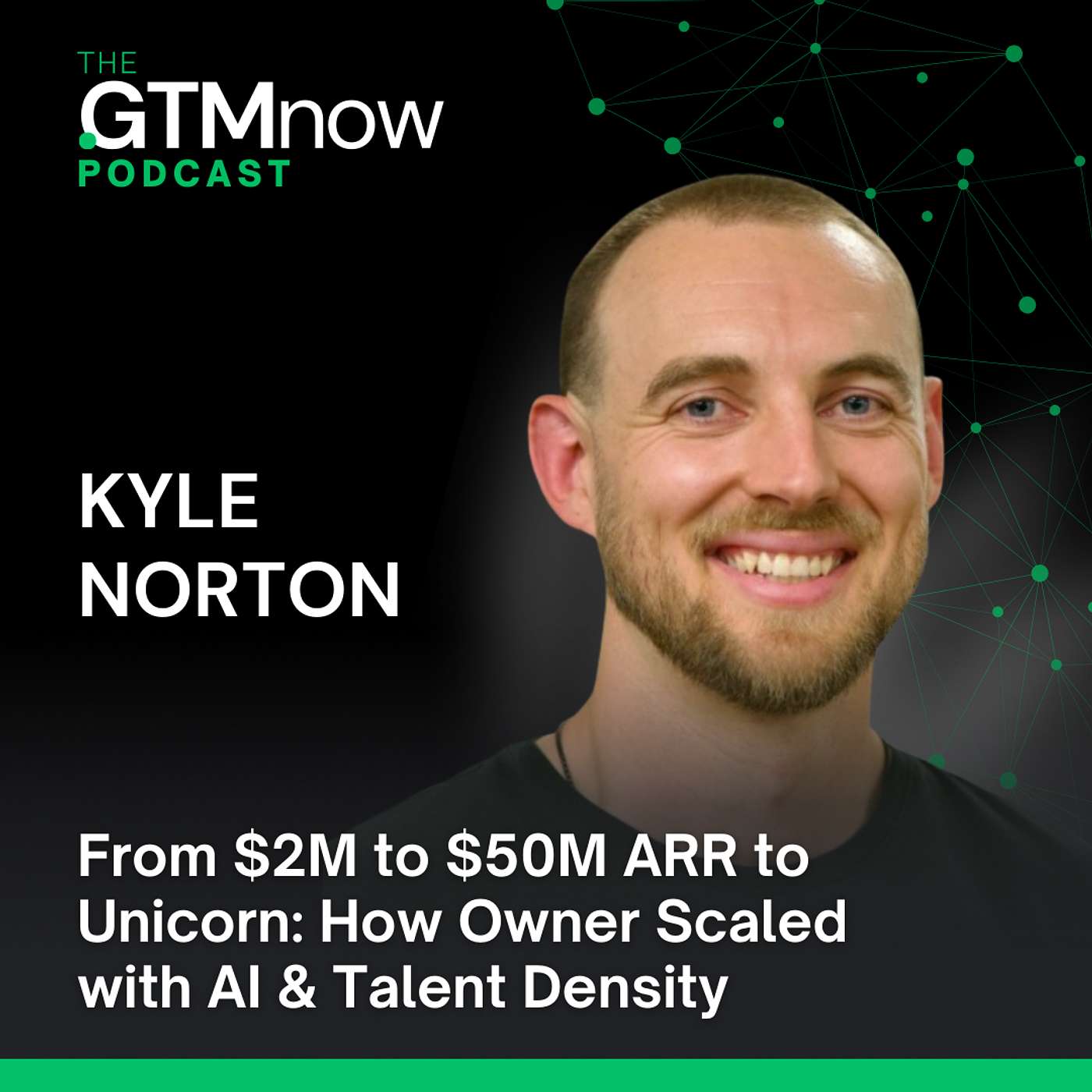
GTM 163: From $2M to $50M ARR to Unicorn: How Owner Scaled with AI & Talent Density | CRO Kyle Norton
from The GTMnow Podcast
68m 32s
Building a generational company requires bold, early decisions and a relentless focus on foundational systems. The founder of Owner made a decisive move by restructuring the sales team within 45 days, setting a high bar for talent and emphasizing only the most driven, culturally aligned hires. This was coupled with early investments in RevOps, data infrastructure, and enablement, enabling scalable, efficient growth. Data—both third-party and first-party—was prioritized as the foundation for AI-driven decisions, ensuring accuracy and relevance. Hiring is not based on traditional metrics but on cultural fit, shared values, and personal drive, with transparent "don’t hire us" videos to manage expectations. Leadership is rooted in servant leadership, where managers serve frontline teams, and a strong emphasis is placed on growth, coaching, and personal development to create fulfilling careers. AI is used strategically to augment performance, not automate it, with clear constraints and human oversight to avoid "lossy" decision chains. The company’s success stems from a disciplined, data-first approach, deep cultural alignment, and a commitment to creating long-term value for both the business and its people. This model emphasizes strategic congruence across fundraising, go-to-market, and operations—especially in venture-backed environments where big outcomes are expected. Ultimately, the company’s growth is driven by intentional leadership, rigorous hiring, and a culture where every employee feels supported, empowered, and professionally invested.
Anytime you're trying to build a company that you want to take somewhere big,
you have to make difficult decisions up front and lay the right foundations.
It was always my intention to try to build a generational company, to build something huge.
We're all playing this powerlog game where a modest outcome doesn't do anything.
You have to be honest with yourself and decide what game you're playing.
[Music]
Owner is one of the fastest-scaling SMB SaaS companies right now.
Going from 2 million to over 50 million in annual recurring revenue,
over 10,000 customers, restaurants specifically, and now over a billion dollar valuation.
Congratulations.
Thank you.
But that wasn't always the case.
When you joined,
churners rampant, sales wasn't really moving the way it should, the engine wasn't spinning.
So what we're going to do right now is really break down the systems, the frameworks,
some of the minds that you use to really take a company from 2 million to a unicorn status.
Kyle, welcome to the podcast.
Thanks for having me.
Absolutely. Thanks for being here.
Great to get together in chat and person.
I always find episodes are extremely special when you're talking to somebody
that also hosts the podcast in your very different perspective.
Yeah, it's fun. I've loved doing mine.
So it's always fun to be on the other side of it.
Yeah, definitely, definitely.
Now, we want to start at a very interesting decision that you made.
45 days into the role.
You like of half of the sales team.
Pretty bold decision.
And it essentially dictated the rest of the outcome for owner,
which is clearly a very, very positive growth trajectory.
Why did you make that bold decision?
Anytime you're trying to build a company that you want to take somewhere big,
you have to make difficult decisions upfront and lay the right foundations.
And the first 10 people in your sales team that becomes a lot of the fingerprint
of what you build on in terms of their dedication, their drive,
their intensity, the craft, the acumen.
If your first 10 sales hires aren't at that, like,
upper tier and bringing a level of intensity and drive,
then it's really hard to build an organization that has that into the future.
And so it was pretty apparent that there was some good sales talent on the team.
The three, the manager and the two reps that remained after that are still at the business today
and thriving and doing awesome.
But we needed to raise the talent bar and I got to work on bringing in folks
who I thought were the right foundation to build something special.
It was always my intention.
I would have never left shop if I had I not believe this.
But it was always my intention to try to build a generational company,
to build something huge. That's what I saw in Adam and Dean at the time.
GTM Fund invested, which is how I got introduced.
And so from the very beginning, whether it was investing in systems,
building out leadership teams maybe earlier than you otherwise would have
or making calls like that, it's always been about playing for a really big outcome
and trying to make early, early decisions that gave us the best chance to do it.
And that was one of them that was certainly played an impact for a role.
Definitely. And what were the other core decisions that you felt like
were those pivotal ones outside that one?
So having a really high talent bar, everybody that we hired in those first few quarters,
and this is still the case today, but much more difficult back then.
They were all president's club performers, the number one or number two rep in the company
that they came from. They were all one degree of separation away from me.
They were people that I could like very easily back channel and personally validate.
And we didn't accept anything but the best.
And so we've had an extremely high hit rate with sales hiring,
especially on the account executive side.
Very, very few people have not worked out.
Now like less than 10% in the sort of three-year history of hiring account executives,
our hit rate's been really good.
So high bar for talent and bringing in people that I could really easily validate.
Before we jump in, let's talk about something wild.
The future of sales isn't human, it's AI.
It's Piper, the AI-SDR agent. Piper is the number one ranked AI-SDR and G2.
She works 24/7, follows up with every lead,
books meetings and actually knows when somebody's ready to buy using signals,
autonomously and at scale. Piper's not just replacing repetitive tasks.
She's helping sales teams reap focused on high impact work,
like closing deals and building relationships.
Hundreds of fast growing gold market teams, including leaders in the GTM fund community,
are already using Piper.
Learn more about AI-SDRs, like Piper, at Qualify.com.
That's QualifyQ-U-A-L-I-F-I-E-D.com.
So our first BDR was the cousin of a BDR that worked for me like three companies before that.
Okay.
And then there was like multiple people that came from the same company because
they were all referred in and I obviously had a strong back channel.
Or it was leaders that worked for CRO friends of mine in the past.
So talent density, really high bar and people that could really go validate,
were excellent and lived our values was number one.
In early investment in systems and infrastructure,
we spent a lot of money on tech and infrastructure much earlier than you would at like a
$5 million ARR stage or a $10 million ARR stage.
Again, because we were playing for this really big outcome.
And I was trying to avoid the situation that many companies get themselves into where it's like,
man, our Salesforce is a mess and we want to do this.
But we have to like completely change how we use the tooling or re-ampliment Salesforce,
you see people go through.
So we invested in tech very early and I invested in people that were non-quota-carrying individuals
to support quarter-carrying individuals also very early. So I brought in my former RevOps leader
on a contract basis in my like fourth month or something. We were like three or four million
in ARR at the time and I was like, hey, can you start doing some consulting for us?
We want to build the right things and I hired Steve full-time, I don't know, maybe I was like six
months into the company and he's like a senior like world-class RevOps practitioner and
that would have been way earlier than you would otherwise think prudent.
You're like, oh, that's expensive and that's a really senior person. Same thing with enablement,
same thing with building the enablement team and the RevOps team.
The data team was another big area of investment and in most companies you'd look at that and go,
like there's so much there's so much cack going into non-quota-carrying people but that's what
gave us the ability to scale at the pace that we scale that and why it's why a big reason why we're
so efficient as a good market org. So I'd say those are the three things.
One of the big lessons that we here consistently, I wish I had done this earlier is RevOps,
an investing RevOps earlier and earlier. We're starting to see startups do that earlier and
earlier which is great. It's advice I give to CROs and founders all the time. If you have legit
product market traction, product market fit and traction and you think that you have sort of
figured out GTM bringing RevOps. The way the world is going and the power of the tooling out there
today, it makes so much sense to bring those hires in early but people are really, I don't know,
gun try about doing it. It's a big cost. We had like six reps and like a VP caliber RevOps
leader in many traditional views that is way too early. But man, it's paid off crazy dividends
for us. But you have to be confident and you have to be pretty honest with yourself that's like,
okay, our PMF is really good. We're really figuring out GTM. I think there's a path to a lot of
repeatability and I can scale. If you're growing 60% year over year and you've got like four or
five reps, it's not the same decision making. But if you think you've got the opportunity to
go for it, then bring those people in earlier because we are all playing the power log game.
Like as venture investors, as founders or early executives of these companies, we're all playing
this power log game where like a modest PE outcome doesn't do anything for me as a CRO really.
Because you're going to get squashed under a pref stack and the liquidity is going to go to
everybody, but the employees, that's just the nature of the game. And so you should be like trying
to go for the big win. What's so interesting about what you just said too is
[BLANK_AUDIO]
mindset you always had about trying to build a multigenerational company, because essentially
every startup wants to build an enduring company.
So every startup should really implement the principles that you just shared to build
an enduring company and approach it with that lens, which is really, really interesting.
Not every company has the market size or the traction or the team to try to play for that
type of outcome.
And they really shouldn't be venture backed. I think there's a lot of the markets starting
to come to terms with that. You're seeing now people go this like seed scaling or seed
strapping route where they raise a seed round and then don't raise again and you keep
a bunch of liquidity, you keep a lot of optionality as founders.
But yeah, venture capital is investing for those types of outcomes.
And so if you have it and you have the seeds there of being able to do it, then you have
to place really aggressively in my mind.
The downside is if you spend aggressively and you didn't have the PMF, you don't have
the market size, then you sort of spend yourself into the wall and you end up laying a whole
bunch of people off. It is really painful. So you have to be honest with yourself and
know what game you're playing and decide what game you're playing and have a congruent strategy
from your fundraising strategy to your product strategy to your go-to-market strategy.
I think like Ciro's oftentimes don't understand those dynamics well enough and they're not
conversant enough in understanding the pressures of venture capital and how it works.
And so you see like early stage revenue leaders complaining on LinkedIn, they're like oh,
the complaints like oh, I was forced to do this thing and it wasn't the right approach
and the founders are dumb and the VCs are meanies.
Yeah, yeah.
I think they're just pointing.
It's like that's the game we're playing. If you don't want to play that game, go do
something else. Venture capital is investing in these businesses so that a very small percentage
of them become extraordinarily valuable and you need to understand that that's what you're
signing up for or just like go do something else, like work for a bootstrap founder or play
a different game. But I think like strategic congruence is something that is sometimes
missing.
Hmm, super, super interesting. And so you talked about sales and the reps you hired and how
you hired them based on proximity. Turn was another area that you tackled earlier.
How did that play out in terms of your go-to-market strategy?
So Adam and I started spending a bunch of time together after GTM fund invested owner
to Shopify for restaurants basically. I was at Shopify. I had some early stage experience
and so as part of being an LP, like I was going to spend time with Adam to help figure
things out. And very quickly, he understood it. I understood the challenge is that a bunch
of inefficiency in go-to-market was because they were closing like questionably fit customers
and the handoff wasn't good. So the early turn was much higher than the company wanted.
And it didn't make sense to pour a bunch of money into GTM into a bit of a leaky bucket.
And so one of the first things that I tried to tackle was getting early turn into a
better spot. And that meant narrowing the aperture of the customers that we chose to work
with and which actually meant month over month. We sold fewer deals in my first month, fewer
deals in my second month and my first month. But the metrics would show you that the quality
was much higher. If you looked at high quality revenue that we were closing was actually
growing month over month but we were getting rid of a bunch of fluff. And luckily I had
Adam's support. I have the sort of background and stature to like to do that and maintain
confidence. Because that would probably be harder if you were first time VP sales that
doesn't have the background. But like those were the right steps to take. And we got way
more clear about expectation setting which means some deals chose not to work with us.
And we said no to a lot of customers. Like 30% of the customers that we could have closed
previously we were saying no to now. And it just cleaned everything up. And now we could
go out and add marketing dollars and add sales headcount and add onboarding capacity into
a system that had a lot less sand in the gears. Because many sales eaters don't like to
admit it. But a lot of churns are fault. At Shopify owned onboarding in CS at the end of
my time there I picked up the onboarding function in my first year at owner. And so I've
had to manage that side of the business which I think is a very productive thing for revenue
leaders to do. It's a good empathy building exercise and I think it's good from a decision-making
standpoint. And we were able to get to a place where the sales driven churn dropped
dramatically and then we could go tackle everything else.
Incredible. Incredible. Now that makes sense. And I mean that's fantastic that you and Adam
had that alignment and that trust built up. You're actually a perfect example of one of
the points that you made around. It's the people. It really matters who you're hiring.
You're using the context of sales right. But it applies to everyone. It applies to you.
It applies to all of your leadership hires. How do you think about hiring? Because I've
heard you say that you don't really buy into the traditional method. And I saw you
commenting the shopifies to data officers post that you do a don't hire us video and things
like that. So really curious about your methods of hiring because every startup is trying
to hire the best talent. And you were able to do that really before owner. You obviously
grew to be the company and brand it is now. Yeah. Brand matters a lot. Like if being able
to hire the right people means that you need a really compelling story. And I've had
the advantage of building an audience on LinkedIn over a bunch of years, which certainly helps
and I had a track record. So I encourage people to do that and like really be sharp about
the narrative they're telling and how to get people excited. But the thing I think that's
a little bit less consensus in our approach is two major things. Like one, and this is
a big credit to Farhan Thawar from Shopify. So he was the engineering leader that I worked
with in the point of sale team, who's now the head of engineering at Shopify. And he shared
a bunch of data and like really interesting insight about how little hiring process
actually allows you to predict in role performance. Like behavioral interviews and case studies
and all of this stuff. A little bit of is like theater. It makes us feel a lot better
about the hiring decisions we're making. But when you actually look at the data, it doesn't
actually, doesn't actually improve outcomes all that much. But you have to be really data
oriented with with hiring or else you never learn that lesson. One is appreciating like
what does interviewing actually tell you and what doesn't it tell you. And the other big
principle that that I lean into a lot is hiring is about fit. There's no like best rep.
There's no rep that will be successful in every single scenario. You need to find reps
who want to work the way that you want to work and reps that want to do the type of work
you do. Like we sell the restaurant owners. They are like gritty blue collar folks who want
a shoot straight and can be like pretty gruff at times and won't just like hop on to
a Google meet. Like you have to call them and help them get on to it. And and some people
get really frustrated by that experience. They're like, why can't people just like show
up for the Google meet? If you've sold the white collar your whole life, then that might
just be like a frustration for you. But the reps who are successful and something that
I really enjoy is like selling to salt to the earth people and just being able to shoot
straight and not like dress up our language in a bunch of tech jargon. And so for us it's
about finding people who can fit that environment and fit my style of leadership because we are
quite opinionated about how we want to go to market and the style of sales that we teach
is very specific and and the style of organization we run is like not for everybody. But some people
it's like the best thing that will ever happen to them in their careers because they're
going to learn awesome skills that they can be successful with later. But but it is not
for everybody. And so the video that you're referring to is something that I do for especially
leadership hires. There's like an explainer video where I talk about the situation of
the company and what the role is meant to do and the state of the team. And then there's
like probably five minutes at the end of the video where I'm like, okay, an owner is an
exciting place. And on the outside, everybody, most people are would be thrilled to work
at a company that's winning in the market and has all these accolades. But I was like,
that owner is not for everybody and here's why. And I explain it's really intense. We're
performance based. It's not not a great work life balance culture. Like that's not what
we're optimizing for. And I explain the reason somebody might will not be a good fit. And
I do that before their first meeting with me because the video is helpful to because
now in an interview, I don't have to waste a bunch of time like explaining the basics.
They come in knowing that and they can just get into a much more interesting questions.
But in the video, I explain why owners like not to fit for people. And I have folks drop
out of the interview process semi-regular basis. And I've actually had examples of people
responding to that, responding to the video saying, hey, like, I really appreciate
that you were so honest and transparent, it doesn't feel like the environment that's right for me,
but like it's great that we could just figure that out now and save everybody time.
Everybody time, it's a good candidate experience and it is what you don't want is to hire somebody
who doesn't know any of the bad thing, the trade-offs, because it's not necessarily bad,
but somebody who comes in not understanding any of the trade-offs and then they're at the company
for three or four months, they're not working at their best because they're like,
"Man, like everybody works here so late and like, I don't, that's not really what I want to do,"
and they're stressed because they feel like they have to answer slacks after five o'clock,
which is like not their stick, and then they end up resigning like four or six months in,
and you just wasted a colossal amount of time and energy, and you haven't progressed
the, you know, those strategic priorities that person would have owned and you're just back at square
one hiring that role again, and it happens all the time. We try to do that at the very top of the funnel,
and then also like if we hire somebody and we can tell that they're struggling or it's like not a fit,
we'll often have a conversation, like an open transparent conversation with them pretty early on,
and be like, "Look like Sophie, if this, like get the sense that this is, you're not having a great time."
And if that's the case, that's totally fine, and we should just be on, like let's have an
honest conversation and solve it or figure out if this is just like not a right match.
And so when we have lost sales reps, most of the time it's very early. It's at the,
we had one that was like less than 30 days, somebody had 75 days, because they've just realized
it's not what they want to do, and that's a way better scenario than it dragging on and on and on.
Definitely. Definitely better to find out earlier.
Yeah. The other thing we can talk about is going back to the first point about interviews being a
poor predictor is. That's unpacking. Yeah, the exercise we just ran where we did a big hiring
retro. This is another area that is oftentimes missed in hiring, is we hire and we hire and we hire,
and we never go back to that hiring process and analyze whether or not it's good or bad and like
what we could possibly do better. And in product management, you do retros in sales, you do
MBRs or QBRs, but the most important thing in your business is being great at hiring and we never
go back with a critical eye to like understand it. And so what we did a couple months ago
was go back to every single person we've hired in 2024 and 2025, and we pulled in all of their
interview scores by the hiring manager. And so we looked at a few different and compared it to
enroll performance. And so there's a few things that we learn. So we use a one-to-four scoring
framework, and there's four people that score that candidate across the interview process,
so they get a score at 16. And what we noticed is there was not a lot of correlation between
enroll performance and whether or not they were a 13/14 or 16. Not a lot of, there were a couple
13s. And so there wasn't a lot of correlation, we're like okay, so like something, it means like
we're not scoring very well. And then you could go manager by manager and unpack, it's like well,
I was a four and the director was a four, but this person was a two and this person ended up
being awesome. Like what happened there? And so you have to go give feedback to that hiring manager
because clearly they're seeing something different and to coach them up. But the most interesting
insight going back to this like concept that hiring can be a little bit of like performative
theater is the case study scores had like no correlation, actually we're inversely correlated with
success and role. So the people who crushed their case studies didn't really do any better
in the role versus the people who we hired that didn't do well in the case studies.
And if you think about it, then we're like if somebody did poorly in the case study,
but we hired them anyways, there must be a bunch of other stuff we really liked to get over it,
which in our case was their like raw DNA. And we're looking for super competitive driven people.
You have to be really organized to do what we do because there's a lot of you're managing a lot of
deals. The velocity is very high. And so if you're disorganized, it's hard to be successful at owner,
which is like not a common thing to screen for in sales hiring. And so we started to like tweak
how we thought about the case study and we've like really now waited DNA and mindset more highly.
Even in like our SDR cohorts, especially in our SDR cohorts, because you know none of them
are going to come in with that much skill or craft. It's really just all about DNA. So we haven't
done it yet. We haven't been brave enough. But there's part of me that makes me want to like scrap
the case study altogether because it's so unpredictable. But unless you're doing the work to
analyze your results and to take a critical eye and do that retro, it's hard to calibrate on hiring.
I can imagine, especially at the velocity that yours are hiring.
Yeah. Yeah. Yeah. It's helpful that we hire like, we'll hire a hundred people and go to market
this year, fish. And so we have we have a cohort to analyze, but you could probably still do it
with less. Yeah. Yeah. Definitely. And what about leadership? Does it differ? Or are you still
thinking about it from a very DNA perspective? Slightly different. But DNA still matters a lot.
I think the biggest lesson that we've learned on the leadership hiring front is the importance
of like philosophical alignment and congruence. And so there are so many different ways to lead people.
You know, like we have a very servant leadership oriented approach. We are very systems engineering
centric. We're trying to build like high repeatability. And if somebody comes into the business that
has like a slightly different perspective on your core tenets, then it can be very, very
difficult for the organization, especially if you're bringing in somebody senior. And so what we've
seen with the most successful leadership hires is that they're people that have a very like similar
mentality and set of principles. And also people that are very adaptive. I think this is the
other thing that I like underweighted historically in leadership hiring is and this might be because
like again, I am very opinionated about many things go to market. And so, but which means I require
people who want to learn my system. And so the leaders on my team are so productive because they
use the same language. They refer to the same books. They talk with this common vernacular.
So when I'm talking to the reps about something, you know, recorded training or a town hall,
it's the same language they're hearing from their director, from their frontline manager,
from their peers. And it seems like semantic and a little bit silly, but just getting to common
language is so critical. And so you need leaders that are willing to adapt and to operate within
your system, I find. Maybe that's like a little unique to me because I'm so particular or so
opinionated about it. But like that's something I need to understand about myself and the system,
the organization we're building, and no, I need to go higher for that.
It makes me think organization, organism, you think about different blood types, so you're hiring all
type A blood. Yeah. Or type B blood. So we're going to have you, right? Somebody that's got that
congruency baked in. Yeah. And it's a careful balance because you don't want to just try to replicate
yourself. You need some diversity of thought and background. And you don't want too much of a
monoculture. And we try to operate by the principle of opinionated, but open. So I want people to be
opinionated and like think critically from first principles and not to just accept things because
that's the way we've always done them. I want people to disagree with me, but I want people that
are also open-minded. And I try to be open-minded about new ways of doing it. And so you have to
find the balance here between that congruence and a good example with my VP of Revops. And I,
he's the guy that will disagree with me the most directly and be the most brave about it. We've
worked together for almost a decade now across three companies. And it works so well because we can
just like have the argument. We can try to like look at the data together, disagree. And sometimes
we like can't get to the same answer. Like we just have slightly different opinions. And ultimately,
I'll be like, you know what? This is your call. It's in your wheelhouse. I trust you. Like, let's go
forward. He'll do the same with me. There's a lot of nuance there. And you have to find the balance
between like avoiding an echo chamber, but also having like having congruence on the really
important things. Like, servant leadership is a non, it's a non-negotiable. Like, you have to
operate with the mentality that you work for the people that work for you. The managers work for
the reps. I work for the reps and I work for my leaders and the reps work for
The customer, that's a non-negotiable for me.
But there's other things we can be more funchable about.
>> So you're hiring 100 go-to-market reps this year alone.
So you're growing a ton and you've been really successful with your AI transformation.
Love to hear a little bit more about your playbook for implementing
that transformation and what you're doing.
>> Yeah, and so we were really early to try to steer into this in a big way.
So some of it was just getting lucky and following our intuition.
Because there wasn't a lot of places to go learn from.
Luckily, I have this podcast.
I talk a lot about GTMI and I get to talk to a bunch of smart people who are doing things.
So having a network and using your network is definitely important.
But we've meandered our way into or
intuitive our way into a bunch of good decisions.
And now that I've had some distance from it,
I've started to put some principles behind it that I think are fairly reasonable.
But again, this is so new that I reserve the right to change my opinion over time.
But one of the things that I think the most important thing that we did right,
and a principle that now I push people on, is we spent most of our GTMI energy on data.
So the very first thing that we did, and this was led by our head of business,
he gets all the credit, was figure out prospect data.
And so we used AI to scrape and crawl websites and pull information into
Snowflake and transform it and score it and figure out who the very best people are,
that we should be approaching.
So getting really great third-party data was step one.
And so now when I give this advice to other founders and revenue leaders,
I'm really pushing them before anything else.
Get really great third-party data.
And this could be like clay plus a claygency to help you like answer a bunch of
these questions or an internal data science resource.
But like, some spend the money, get a good data on the market.
You're accounts, people, and then enrich with like information that can help you
with the right play for that account or prospect.
And so like now we use datalene for a whole bunch of this stuff,
because it's restaurant specific and they've built better things that we built internally,
but the big, the first investment we made here was getting good third-party data.
And I, in that we were not, I didn't at the time go like,
I want to be on this transformation journey with AI,
but like I think like the third-party data is the first thing.
We sort of intuitive our way there, but now I feel about like that as a principle.
The other thing is great first-party data.
And so this is where momentum comes in.
This was like our second really big AI application,
where you know there's all of this information in call transcripts and in emails
and like all across the customer journey that yeah, you can go access,
you can pull open gong and like read a transcript or search transcript,
but like it's not all that helpful programmatically unless that data is structured.
And so for momentum it used to be on top of gong and then we replaced gong
and now we use momentum as the call recorder, which is being great.
That will take all of this information and put it into a structured format
so that we can actually now power a bunch of analysis off of it.
So it can answer specific questions.
Did the reps say this or that, like yes or no box,
is the customer using this list of 10 competitors or something else?
Or open text fields?
What were the challenges the customer is like most interested in solving like ranked one to three?
So you start to bring structure to all this unstructured information.
And now that I've good first party and third party data,
I really have a very different understanding of the business
and you can make such, you can make much, much better decisions.
And how we do it in SMB is a little bit different than how you might do it in enterprise.
Ours is like a data science led motion because the TAM is massive
and there's so many data inputs in an enterprise environment.
I'm using AI more to deeply enrich accounts with specific information
but you're writing those prompts thoughtfully.
And so I would say the biggest thing that we've done is start with the data foundations.
And now when we layer on a use case, it's so much more effective
because AI is just a pattern recognition machine.
But if you have good patterns for it to learn from, now we've got,
we use one mind as this AISDR education avatar.
So you can talk to an AI version of our founder
about anything related to restaurant marketing
and it can explain what you should be doing better based on your specific website
because we've got this AI website greater.
But that all works because we've got this corpus of information work run.
So I would say that's probably the single most important thing that we've done.
Start with the data foundations.
Before we dive in, a quick word on hiring.
It's a weird market out there right now.
The finding top go-to-market talent is still one of the biggest levers for growth.
At GTM Fund, we've made over 2,000 candidate intros on placed hundreds of eight players.
One of our go-to recruiting partners is Pursuit.
They specialize in sales and marketing talent and they do it without a retainer.
We work with them closely across many roles.
If you're hiring, go to PursuitSalesSolutions.com/GTM.
That'll be in the show notes.
Or ping someone from the GTM Fund team. We'll get you connected.
It kind of sounds like how you built the go-to-market engine.
You started with RevOps, you started with the data foundation,
and then you built on top of it too.
Yeah.
Same thing coming back to the data first.
Yeah.
And even if you go one level of abstraction out,
we just start with the boring stuff.
And I think that's one of the places that people go wrong with AI.
They want to chase the shiny things first.
And this is a Jordan Crawford thing.
He's like, people need to eat their damn vegetables.
You have to do the hard work on the data foundations.
You do have to do the hard work to really thoughtfully decide who is your ICP?
What are the key segments?
What is the digital footprint of those specific high-fit segments?
What is our positioning?
What are the specific things we want to say so that you can feed that
into these models so that when you are producing
either like cold outbound messaging that it is sharpened on point and not like AI slop?
Or when you see so many startups trying to do this,
like, oh, we're like a sales co-pilot.
We'll tell you what play you should run.
We'll give you all this account information.
But so many of these tools go wrong because it's just like
generative layer over generative layer of, you know, probabilistic reasoning.
And you've never inserted deterministic constraints onto this model.
And so you're just stacking like, in AI, it's called lossiness.
So you're just stacking layer and layer of lossiness on top of each other.
And so your tool is like, oh, entering your company website URL or company URL.
And we'll give you sales messaging.
You're like, wonder why the sales messaging sucks because the model had to
view your website and take a guess at what your positioning is and take a guess at what your
ICP is and then take a guess about the challenges and who you want to talk to.
And this and this and this.
And every one of those guesses is probably going to be like pretty good.
But if you stack on these 10 guesses, it's like broken telephone.
As a kid, you just end up with something that's like, uh, like it's yeah, like it sort of is
what we do, but like it's not it's not good enough to send to a customer really.
People still send it to customers, but uh, that's one of the problems.
It's like people aren't aren't, aren't inserting enough constraints on.
It's like, no, like I will tell you what our positioning is.
I will tell you what the ICP is and and the digital footprint of that ICP.
And then the AI can use all of the wonderful generative capabilities to go find all of the people
and all of the evidence that supports the, the specific criteria of your ICP.
Like filling in a smaller set of blanks, we've found to be very, very helpful rather than just like
letting AI answer every question and make every determination in a system.
It sounds like the lesson for founders and operators would be, don't replace your actual
foundational work around the company or positioning messaging with AI at all.
Do the work and then use AI to scale.
Yeah, or use AI to help you get to that answer, but there needs to be a deterministic layer.
Because, um, you know, like even for me writing, like I use AI a lot as a writing co-pilot,
but I'm always editing and changing and tweaking and I'm like, no, that's like obvious or silly.
And so there's always a process of me being human in the loop and like making thoughtful decisions
rather than like we really avoid AI making like many sets of decisions on top of each other.
And this is a reason I like momentum as well because we can write the prompts that fill out the
specific fields.
And so we get the power of AI, but within this constraint.
So it's like tell me what the next step was that was discussed.
And then maybe suggest based on other interactions what next steps could be.
But then a rep has to go in and like adjust that before it just goes off and starts executing workflows.
>> Got it. So it's not autonomous essentially.
It's doing the hard work and then prompting the rep to give it some instruction.
>> Yeah, that could be the architecture.
The important principle I think for people is being thoughtful about combining
deterministic decision making and workflows with the generative side of things.
That's where we've seen the most success, even like our AI website grader.
We are thoughtful about the things that we're telling the grader to go think about and analyze.
It's not just like an AI free, free form like.
Tell me whatever you want about these websites.
And you make the decision about what drives good conversion rates versus bad.
There is a lot of AI driven decision making in it, but there's also a constraint,
which is where, which is why that output is so powerful.
I just see this pattern all the time.
You just need the deterministic constraint somewhere.
It could be a human in the loop. It could be you setting the rules within the
the agent workflow. You just can't let AI layer seven AI steps on top of itself,
or else you start to meander and get to slop territory.
>> That's great advice because I think that's what a lot of people are trying to do,
is trying to automate as much as possible and create more of a waterfall effect from it.
But it sounds like you're saying, you know, be really intentional with how you're actually putting
the inputs in along the journey. >> If it feels way too easy, it's probably
if it feels too good to be true, it probably is.
Like even, you know, being really mindful about the prompt engineering and spending the time
to build the evals and run, change the prompt, run the eval, run the eval, run the eval.
Like going and doing the work to really like test and iterate and tweak the context engineering.
That is involved in these workflows. Like you can't the out of the magic box
answers of like, oh, just entering your website. And we'll tell you everything.
I'm yet to see those tools work all that well versus something that like, you know,
why I chose momentum over a bunch of the other tools is because I could go write the prompt.
And I could go set it up with that specific field. And then we could run it. We would run it.
I would look at the end of the day and look at the fields that have filled out.
I'm like, okay, well, it's actually, it's like giving away too much. And it's like one of the things
that I'm like, we use a call recording tool that's for interviews that I won't name because I'm
about to trash them. But like the, the, the, the, the transcript like summary is like the interviewer
asked the candidate about whatever the candidate responded. Yada, yada, yada. I'm like,
this is a completely unhelpful transcript because it's so long. And it like tells me about
the like stuff that is obvious. It's like, no, just like give me the answers to their questions
based on the, the lever RATS, the lever feedback form. But because it's just, there's no constraints.
We haven't like, we're not able to do the prompt engineering in that tool versus like we can do
the prompt engineering in momentum. So the results are way better. And so it's funny to see these
two things side by side. One that my RevOps team spends a bunch of time tweaking and testing.
One, which is just like hiring AI black box that gives me like unusable junk basically.
Super interesting. And I mean, we're seeing a lot more founders leaders use AI to write content
and publish it online. And I've heard you say how monumental or impactful it was to actually build
a brand. If you're recruiting earlier, you talked about that. What are your thoughts on actual
content creation for founders and early stage operators? Should everyone be building their own
personal brand? Not everyone because it not everybody has like a ton to say that's all that
interesting. And it probably won't, you'll put a bunch of effort into it and you won't get the result
you necessarily want. Like I think people who are successful creating content have something
unique to say. And they're able to bring new ideas to the table. And you have to like it.
Like you have to enjoy writing and enjoy like putting your ideas together and spending time
looking at a page. I'm like, oh, like the taxonomy of like how these things fit together. It's not
right. I want to do this. I want to do that. And so because a huge commitment like it's it's I
generally like writing and I write I wrote a lot internally. And so I just started open sourcing
stuff that I was writing for my teams or training docs in little like bite size components. And so
it was enjoyable for me. And so it wasn't like a taxing job. Some people don't want to do it. And
it's going to be a chore. And you'll never be that successful at it. I don't think if if it is a chore.
But I think today like, you know, it is the market's very competitive, especially competing for
the top talent is very, very difficult. And having a brand is meaningful. There's other ways to
like solve that problem on talent attraction. You could just be like a hardcore outbound
sorcerer. So like earlier in my career, I thought that's the game I had to play. And I you know,
like sharpened my messaging and I did a bunch of outreach. And so I think for the right person,
it makes a ton of sense. And you know, it was because of Naval and Seth Godin that I really started to
be like, I kind of build an audience. I have to build a brand because it's a compounding asset.
It's something that I'll take with me for the rest of my life. And I'm like so bad at monetizing it.
Like I basically don't bother. It's really just about hiring and I friends who like make a bunch
of money doing content stuff and influencer stuff. And I'm like, it's just not. It's like, yeah,
I should. But at some point I will be able to. Right. You're busy. You're busy. How are I supposed to be
people? Owners the only thing that matters. Yeah. And all the other stuff like podcasts and content
and speaking stuff. Like that's all to build. My brand is a as a hiring leader. And owners brand
as a as a destination. Like the number of the number of eyeballs that owner gets just because I'm
out there doing a bunch of stuff is awesome. And it's going to help us in a bunch of different ways.
But you can build this compounding asset that you can monetize in a whole bunch of different ways.
So if you like it and you want to spend the time, I think it's worth it. But just know like you're
signing up for like years of nothing basically. Right. And maybe I could have been more thoughtful
about it earlier and grown faster. But like there's just a cold start problem where it takes a
while to get it going. And you have to be so consistent because if you miss a week, then LinkedIn
crushes you for it. And so you're signing up for like a long haul thing. But it is a compounding
asset. So over time, like now, I just gain followers by doing nothing. And it grows very quickly.
But I mean, I'd for like six or whatever six or seven years, I don't know. Yeah. Yeah. Yeah.
Now you're on the hockey stick momentum and trajectory. Okay. So you said you bring that with you
everywhere. So do connections. Connectivity between people. You bring a lot of your relationships
with you over time. And I know you implemented BDRs being in office five days a week, which is
a common point of contention. And I have a lot of opinions due because we're actually in the office
five days a week. Yeah. But you had a lot of growth and success on the revenue side. So does that
settle the debate on in office first remote? No, the debate will never be settled. And it's very
nuanced. And I had the serial of oyster on the podcast Geraldine. And they're obviously they're
they're like a EOR company. They're very pro remote. A bunch of the content their founder puts out
is like super remote's the only thing. And it's it lacks nuance. But the conversation we had was
was like very nuanced and and productive because remote makes sense for some companies in person
makes sense for some companies in some roles. But again, going back to this theme of like congruence.
Like what is the thing that you're building and what serves you best in terms of a strategy? Because
if you are remote, but you're like not created documentation and you are like not taking advantage
of hiring internationally. Like then you're sort of just sacrificing the connection, the speed,
the engagement that by not having people in person without getting all of the outcomes.
Yeah. And so for example, you know like our most of our sales teams still remote are outbound sale
or AE team is almost entirely remote other than the brand new AE's we've hired very recently.
But the SGR team is five days a week in office. That's the requirement. And yeah,
Absolutely, the performance between remote hired
SGRs and BDRs versus in-person has been drastic.
We pulled the numbers and it was like grain assault
'cause it was a small sample size,
but it was like the ramping performance.
So in that first 90-day window,
it was like 3X for in-person, then it was for a moment.
And the system's more mature now.
We revamped onboarding, so you can't chalk at all.
It's on-boarding, but those roles do benefit so much
from being around their peers and being around their manager.
And I'm in the office.
The managers are always sitting like hip-to-hip with one rep.
Going through workflows, really inspecting things.
My VP of Revops was in the office two or four weeks ago.
Sitting there beside the SGRs, watching them dial.
And we realized a bunch of stuff were like, oh my God,
we thought what they were doing this and the system
is designed this, but we didn't enable them properly.
And so there was this big hole that we found.
And you can, just like, there's some big advantages.
But the strategy moving forward, and we haven't nailed all
the pieces, but generally we're going to have like BDRs
and SDRs in the office five days a week.
Because you just, it's so input-driven,
and it's so hard to do that job if you're sitting at home
in your tiny little apartment with all those distractions.
So there'll be five days a week.
We'll graduate people into Associate Account Executive.
Their first three to six months is probably also five days
a week in person.
Once they start hitting quota, then we'll graduate people
to four days.
And then once they move to an outbound AE,
now they've been in AE with us for 18 months, maybe 24.
We'll make it three days a week.
And then once people move to our high segments,
we'll say, look, come in as much as you want.
We would love to have you more as better,
because then other people get to learn from them.
But we'll basically tell them that they
can be fully flexed, come in when they want,
don't come in when they want it.
Because I'm not worried about them anymore.
I'm not worried about a multi-local or an organized segment,
but our top segment reps, lacking motivation,
or not understanding the process, or needing
the deep coaching that an earlier stage rep would.
And they can operate great, fully remote,
and it's easier to-- it is still way easier
to hire people remote.
Reps want remote.
There's no doubt.
Sometimes they want it.
It's actually not the right thing for them,
but it is an expectation in the market.
And so we're trying to find the middle ground.
But engineering's still all fully remote.
I'm in person with the whole exact team here in San Francisco
now, same with a bunch of product leadership.
So that makes a lot of sense.
But there's still tons of people that
are remote at the company.
So we're not hybrid.
I don't know what you would call owner now.
Hybrid implies to me that everybody is in the office sometimes.
We have a bunch of people that are never in the office
really other than for off sites.
We have some people that are fully five days a week in person.
And so some roles, yes, some roles, no.
It matters by the role type, the seniority,
and just trying to find the right balance there.
Even if it's just as you get older,
you have so many more life demands.
I've got two young kids.
I go in the office a lot because it's productive and I like it.
But yeah, some days I just have to be home
because something is going to go on.
And so try telling a 35-year-old enterprise rep
that it's five days a week.
You're not going to hire anybody good.
So you just have to meet the market where it is
and try to find the right things.
But you have to really think critically
and think from first principles about the decisions
by role and not just be like, in person is bad.
It's like people make it the silly moralistic decision.
And there's a bunch of people on LinkedIn
that are like, oh, it's like, it's unkind
or it's unconscionable that you have forced somebody
to go in and you're like, grow up, man.
And you just, if you believe that,
then build a remote company.
But like, that company--
It's like what you said about venture.
There's other places, find those places
that you agree with.
So that resonates with you.
Find the place and be honest with people about it
and it's all good.
It doesn't need to be this like in-group versus out-group
argument and it might evolve.
Like you might be in person as a startup
when you need all five people shoulder to shoulder.
And then when you need to hire 50 engineers in a year,
good luck doing that if you founded your company in Dallas.
Like, no, no, no, you're a remote now.
Yeah, yeah, exactly.
So so much context, OK.
And you've got, I mean, a ton of leadership
principles through this even remote structure.
But all the things that you've shared around the good markets
strategy, the hiring, like, what's a core leadership
principle that you just, you take everywhere?
So I have a bunch.
Yeah, sure.
Servant leadership is at the heart of it,
which we've already talked about.
This idea that like, it's all of our jobs
to figure out how to enable the people
doing the hard work, the people on the front lines
with customers to do their best, to do their best work,
so that they can be in service of the customer.
Like it's always about the customer.
So serving leadership is number one.
And I just actually recorded my podcast with my VP of Revops
because a bunch of people asked me to do it.
Oh, I can't wait to listen to that.
And one of one of the design principles
we talked about that's been so important for us
is building Revops infrastructure and business
process in a way that helps do the right thing
as the easy choice.
And so like removing friction from the stuff
we want them to do and just like being extremely rep-centric
and how we make decisions in prioritized projects
and really, he calls them a quality of life improvements.
We ship a lot of quality of life improvements
for our high-sea team.
So servant leadership is probably number one.
The other one that's the most important for me
is growth is the thing that we should be optimizing for,
personal growth, professional growth, company growth too.
Because if you are growing as an individual investing
in yourself, trying to learn and get a little bit better
every single day, this is Darren Hardy compound effect.
Like you can compound those little improvements
over time to be exponential.
And so the biggest investments we've made
as leadership team, as a GTM organization,
is in our enablement function, onboarding
and training and development.
Our managers are psycho coaches.
This is an open challenge for anybody listening
to bring me a frontline management team
that spends more time coaching than my team does.
We are so hardcore about it.
Every single day, multiple hours a day,
we do this thing called chop wood carry water,
which is like you're not allowed to have meetings
in the first three hours of the day, the managers.
All they're allowed to do is be hip-to-hip with their reps
and be doing ride-alongs or practice
or something to move the rep forward.
The growth thing is the most important thing.
It's what I'm really passionate about too.
Like when I was growing up in high school,
I taught preschool art.
And then I taught martial arts for years and years.
And when I got into sales, like I wanted to teach people
right away, and I became a manager very early.
And it's the thing that I get so much fulfillment out of.
And so I think a lot about, and I study,
and I read a lot about how to develop skill and train people.
And I really want people to come out of their time
with me feeling like they exploded in their career.
And they learned all of this stuff.
And the mantra that I have for myself
is I want to give people the best years of their career.
That's the expectation that I set for myself
and for my leaders is that the 1, 2, 5, 10 years
that any of these folks spend with us.
Those should be the best years of their career
because they learned a lot.
They felt like they made an impact on the world.
They won.
They felt supported.
They could trust the organization.
They made money.
They got promoted.
That's really what we're trying to do
because I think if you can do that,
and people really feel it and believe it,
then you'll hold onto your top talent.
You'll attract great people.
You'll get the best out of them.
And we want to help people find their internal drive
and purpose and motivation as opposed
to being this environment that's just shoving people forward.
Because then they can take that internal locus of control
that intrinsic motivation and drive
to whatever they do next.
That's one of the most important things we try to kindle.
That is beautiful.
And what about books?
Any favorite books that have been really impactful
for you in your career?
A ton.
So the book that I think everybody should read
is "Thinking Fast and Slow" by Daniel Cahneman.
He's the-- him and Amos Tversky are the creators
of the field of behavioral economics.
It's much more in our zeitgeist today
than it was when I read it when it came out over a decade ago.
But it's like how humans operate and why do we act--
why do we act in these very irrational ways sometimes?
Predictably irrational is another great book
in that category nudge by Richard Thaler.
I think there's a bunch of interesting things
in the behavioral economics world
that once you start to understand, you're like, oh, yeah.
Yeah, that's why my reps do this, that's why these people operate this way.
So those are all great books, the book servant leadership is a really good one.
Messaging I love made to stick, that's one that I recommend a lot and then atomic habits
is another one that I recommend to every rep that works with us, every one of my leaders.
It's like something we steer into, the other one that's on my leadership mandatory list
is the obstacles the way by Ryan Holiday.
Those are some of the like starter, that's like the starter, the Kyle Norton leadership
starter pack, to get people going and I got to update my reading, I published my like
longer reading list a bunch of years ago, I have to do a big update and put it on LinkedIn.
But I'll make that commitment, I'll do that in the next couple of weeks when this comes
out.
There we go, there we go, we've got to commitment out of it.
And Adam, co-founded and is the CEO of owner, he's a T.O. fellow, I'm curious, what is
it like to work for someone that is a T.O. fellow?
So I don't know if it's because he's a T.O. fellow per se, but Adam has really set the standard
for like what I think the bar is to be a founder and build a generational company.
And I've worked, I've gotten the opportunity to work with really great founders.
The founder at League was like a third time founder, two super successful experts, obviously
Toby's, like the goat, I have like, I still, any podcast he does, anything you write,
it's like I read and I've insane respect for him.
But I'd never got to work with somebody in the early stages of their journey.
Adam was like 23 when I started, when I started to owner.
And so I got to see like what the raw building blocks were of somebody that I think has the
opportunity to build like a truly great company, which has been really informative.
And so like one, he was just a force of nature, like just this insane drive and presence
and willpower and work ethic.
Like nobody, it's funny, like nobody had ever made me self conscious about the amount
I worked until Adam, because I was always like the hard working guy.
Yeah.
I was always out working everybody.
And so it was like a weird, it was a weird thing to be like, whoa, like I'm not the hard
working guy anymore, like this guy's sort of running circles around me because he's just
like an absolute machine.
And so like he's a he's a force of nature and very charismatic, he's a great recruiter
that I put into this since meeting Adam, this is like my new founder evaluation framework.
Are they a force of nature?
Are they a super computer?
Do they just have like not just are they really smart, but are they like freakishly smart
and do they learn at an obscene rate?
And so the story I always tell about Adam is like I mentioned this book offhand, it made
to stick that book about messaging.
We were on a call and talking about messaging, I'm like, oh, there's a book made to stick
that I really like.
And then he texted me 18 hours later and was like, hey, I read that book and then had
all of these questions.
So it was impressive he read a book in like literally less than a day.
But then he was drilling me with these questions and I was like, man, these are questions that
I should be getting from somebody who's like a deep product marketing expert who's got
like years and years of building sales messaging.
It like really caught like cut to the center of the first principles of that book and was
asking me really hard questions that I had never gone about the book.
And so that was like, okay, like super computer.
Then founder market fit was the other thing like is there some reason this founder should
win in this market?
Yeah.
Adam built owner for his mom like he's so deeply passionate about about helping small businesses
and he's still so close to the customer and has such a crazy customer intuition because
he does care.
And I think it's really hard to break through the 2030 million AR mark unless you have
that true founder market fit in that founder secret.
And the last thing is enough humility not to blow it all up because I've seen a bunch
of founders that have a lot of the other stuff in the vent diagram of like force of nature,
super computer, a founder market fit and also humility like that that's liver the vent
diagram of humility overlapping is is a very rare one.
But they need to have enough intellectual curiosity and humility to when you hire like
senior leaders to actually like give them the rope to go the amount of CROs that I talk
to that complain that their CEO is like way deep in the weeds and making sort of weird
decisions on stuff that they like don't have a ton of context on is like crazy because
they don't trust and they don't have the humility to be like okay like I wanted this
person to like make these decisions and Adam has done like I'm very grateful for the
rope he's given me to build this thing.
And I've and so you see it the like I don't know if it's an employee count number it's
like an error number but like the 10 million error number like 100 employees whatever
the number is things just start to like fray and fall apart for those founders who can't
touch anything every more touch everything all the time now.
And so like that humility piece I think is really important and Adam's done an admirable
job listening to feedback from the people in his network and and being open minded about
this decisions we make internally and he asks thoughtful questions and he will go founder
mode on stuff he feels good about and when he does the founder mode thing I'm like all
right like because he doesn't do it all the time and when he does it he's like being
right almost all the time right and so you just got to like trust me like okay like he's
got some insight some intuition I don't have the customer intuition of this specific
thing like he does that's why I chose to work for him.
But there's enough of the humility there that that it all works and it's something around
I'm curious on people's opinion on this so so shoot me a note but like it's like 100
employees or something around there when you can't touch anything anymore but the founder
still is trying to hold on to everything like with an iron fist and it just all starts
to fall apart you can't keep great people you can't attract good people now you're like
being pulled in too many directions but like I that's a pattern that I've only picked
up on in the last like three to five years but I but I now I see it all the time.
Interesting interesting yeah that's incredible and where can people find you if they want
to fall on LinkedIn is the best place or fall the podcast if you really want to go deep
on revenue leadership stuff it's me going usually super deep on one topic that that
person is an expert in it's a lot of fun for me I would probably do it if nobody listened
just because I learned so much every week and it's the revenue leadership podcast.com
it's the newsletter of the podcast are all there so it'll be in the show notes for
anyone who has not read or listened to it highly highly recommended is incredible.
Thank you very much appreciate that and LinkedIn and LinkedIn and LinkedIn yeah I have now
moved to San Francisco and dealt with a whole bunch of stuff over the summer so I will
be back on the content generation horse soon I have so it's funny I like have a widget
on my phone like a to-doist button so I can like jot down ideas as they come so I'll
be like I was like running today and I did like I was training so I'm like trying to
scrape my phone out of my pocket to like put this idea in so I got a backlog of things
that I want to talk about that all sorts of start to jot down so that's amazing we'll
look out for them we'll know the cure the purist kind of ideas yeah if you can hear
me panting through the newsletter that was one of these yeah on a runner on a bike
I love it well thank you for joining us it's fantastic it was a pleasure.
Podcast Summary
Key Points:
Early, bold decisions such as restructuring the sales team were critical in setting a foundation for rapid growth.
A high talent bar was applied, hiring only top performers who aligned with company values and culture.
Significant early investment in systems, infrastructure, and RevOps enabled scalability and operational efficiency.
The company prioritized data foundations—third-party and first-party data—before deploying AI to ensure accuracy and relevance.
Hiring is guided by cultural fit, philosophical alignment, and DNA over traditional interview metrics.
Leadership decisions are rooted in servant leadership, transparency, and a focus on enabling frontline teams.
AI is used strategically to augment, not replace, human judgment, with clear deterministic constraints and human-in-the-loop oversight.
Growth is optimized through continuous development, coaching, and creating "best years of careers" for employees.
Summary:
Building a generational company requires bold, early decisions and a relentless focus on foundational systems. The founder of Owner made a decisive move by restructuring the sales team within 45 days, setting a high bar for talent and emphasizing only the most driven, culturally aligned hires. This was coupled with early investments in RevOps, data infrastructure, and enablement, enabling scalable, efficient growth.
Data—both third-party and first-party—was prioritized as the foundation for AI-driven decisions, ensuring accuracy and relevance. Hiring is not based on traditional metrics but on cultural fit, shared values, and personal drive, with transparent "don’t hire us" videos to manage expectations. Leadership is rooted in servant leadership, where managers serve frontline teams, and a strong emphasis is placed on growth, coaching, and personal development to create fulfilling careers.
AI is used strategically to augment performance, not automate it, with clear constraints and human oversight to avoid "lossy" decision chains. The company’s success stems from a disciplined, data-first approach, deep cultural alignment, and a commitment to creating long-term value for both the business and its people. This model emphasizes strategic congruence across fundraising, go-to-market, and operations—especially in venture-backed environments where big outcomes are expected.
Ultimately, the company’s growth is driven by intentional leadership, rigorous hiring, and a culture where every employee feels supported, empowered, and professionally invested.
FAQs
Kyle eliminated half of the sales team to raise the talent bar, focusing on hiring only the top-tier, high-intensity performers who aligned with his vision for a generational company.
Owner prioritizes fit over traditional metrics, focusing on cultural alignment, work style, and drive to succeed in a high-performance, results-driven environment.
To avoid common pitfalls like a messy sales stack or poor process efficiency, Owner invested early in systems and infrastructure to enable scalable, repeatable operations.
AI is used to enrich prospect data, analyze call transcripts, and power targeted outreach—though it operates within strict, deterministic constraints to ensure accuracy and relevance.
Owner requires in-office work for SDRs and SGRs, with gradual reductions as reps gain experience and expertise, balancing proximity with flexibility based on role and seniority.
Servant leadership—prioritizing the success of frontline teams and customers by removing friction and enabling them to perform at their best.
Chat with AI
Loading...
Pro features
Go deeper with this episode
Unlock creator-grade tools that turn any transcript into show notes and subtitle files.
 PodcastTranscript AI