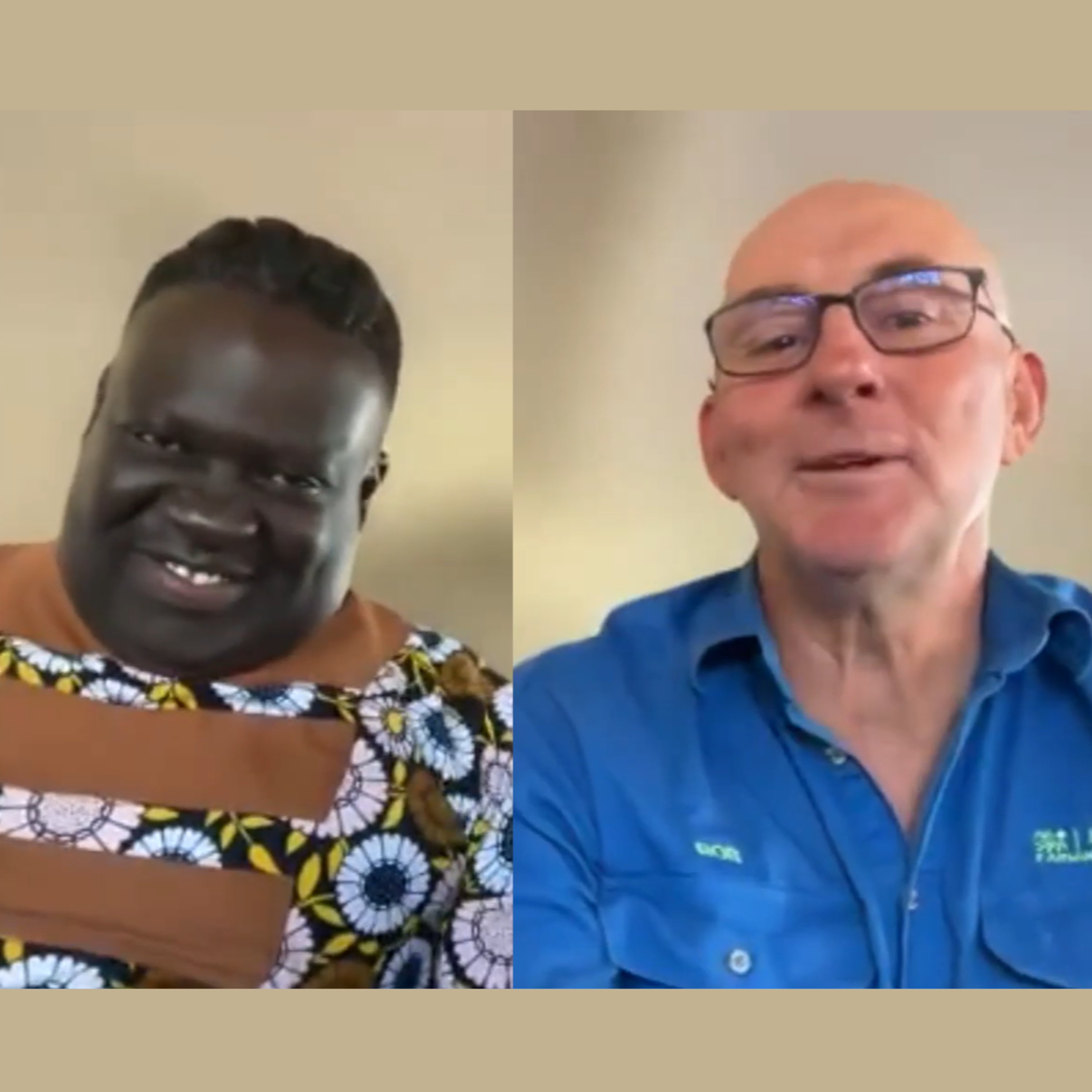
A small group of friends in Australia—Rob Houghton, a third-generation farmer, and Ken Dachi, a development advisor from Kenya—started an ambitious humanitarian effort to ship 100 tons of Australian wheat to Sudan to combat the global hunger crisis. Inspired by a conversation over a meal, they envisioned a direct, transparent, and people-driven model of aid, bypassing traditional systems that often fail due to inefficiency or political instability. Rob brought agricultural expertise and scale, while Ken contributed international experience and a deep understanding of global development challenges. The project began with a modest vision: each of their farming partners donated 25 tons of wheat, forming the foundation of a tangible, measurable response. Despite logistical hurdles—including war zones, shipping complexities, and the need for local partnerships—the team has secured key contacts, including a receiving partner in Djibouti with capacity for fortification and distribution. A central goal is to maintain end-to-end visibility of the grain’s journey, ensuring accountability and a strong human connection between producer and recipient. The story underscores how one conversation between two friends can ignite a large-scale, hopeful intervention. It also reflects on the power of storytelling in amplifying progress, with Amy from Fix the News noting that such narratives humanize global challenges and inspire action. The project serves as a model for Rotarians and others: that meaningful change begins not with grand declarations, but with simple, courageous decisions rooted in empathy and shared purpose. As Rob and Ken conclude, they call on others—especially in Africa—to step forward, share their networks, and help make this journey a reality. The story is not finished; it is in motion, and its success depends on collective participation and belief in human potential.
Hey everybody, this is the Rotary E-Club of Silicon Valley, and every week we bring you
the stories of people around the world who are working to improve the lives of others
near and far. They do their service locally, globally, and digitally. We are part of Rotary
International, 1.2 million people in 36,000 clubs around the world, all of whom subscribe
to the idea that one way to live your life is with the focus on service above self. There
is a joy and meaning that comes from helping others, and we tap into that in our clubs
all over the place by doing things in our communities and getting together, sharing
our time, talents, and treasure to make good things happen. Now, if you're looking to learn
more about Rotary, the easy way to do that is to go to Rotary.org. If you're curious about
a hyper-flexible online and asynchronous Rotary Club, that would be Rotary.cool, and that's
where you'll find us. You will also find that we have tons and tons of recordings of fantastic
speakers, and those stories or stories we love to share, and this one that we're going
to do today is going to be another gem for us. We are excited about that. We are talking
today with Rob and Ken in Australia. They have a story to tell that goes under the title
"Grain of Hope." I first learned about this story from Amy, who is also with us today.
She's part of the very cool "Fix the News" crowd. You may longtime fans of our club may
remember Angus Harvey, a guest Harvey, doing a program for us some years ago that is one
of my favorites. We are excited to have all of you here. Amy, let me hand it over to you
to just set the stage, and then we'll start in on the story. Thanks, Rustin. I'm just going
to start sharing my screen. I am Amy. I am from "Fix the News," and our job as a media
organization is basically to tell you what's going right in the world. Believe it or not,
despite all the other headlines, there is a lot that is going right in the world right
now. Usually we report on the outcomes of progress. It's the impact that's been made
after usually decades of tireless, invisible work by individuals, by governments, by NGOs.
Generally, we tend to come into these stories toward the midpoint or even toward the end.
Last December, it was around the time of the Bondai shootings here. I got a text message
from my best friend's husband saying that he had just spoken to a group of people in
Leighton, which I'll put it here, is a small rural town in Australia. It's about five hours
west of Sydney. These guys had decided they wanted to ship a hundred tons of Australian
grain to Sudan in response to the global hunger crisis. They were calling themselves grain
of hope. From the first time I met these guys, I was completely hooked. Not just personally,
because this was just a story that made my heart feel good. It's also because this was
an opportunity for us as a media organization to pick up a story from the beginning. Like
all of us, last year, these guys followed all the headlines. As the withdrawal of global
funding in different countries around the world started to unravel the money that so many
people in different parts of the world really depend on. Instead of retreating into their
tiny pocket of the world, these guys, this group of six people did something pretty extraordinary.
They decided to roll up their sleeves and do something about it. As governments around
the world and funding bodies for starting to step down, this small group of friends started
stepping up. They decided to take on the audacious task of creating a new model of aid that's
direct, that's tangible, but most importantly, is fueled by people power. It is my great
pleasure to introduce the two vision barriers of this project, Rob Houghton, a third-generation
farmer, and his mate Ken Dachi. Leetan's multicultural advisor who has also spent much
of his career in international development. Okay, I'm going to stop sharing so we can see
them fully. Ken and Rob, how do two friends have lunch on a Friday and decide that they're
going to ship 100 times of Aussie wheat to Sedan?
Purely out of the story you've shared so far, Amy is very, very correct and pointed
to our discussion on that day that we were having a nice meal that I kindly provided
for Ken. We come up with the idea, well, Ken was explaining to me the Sydney issue and
it was just so sad to hear that tale. As I said to Ken that day, I said it's a shame
we can't do anything about it. I would love to be a part of the solution and Ken said,
"Well, we can." I thought he was joking because he jokes a lot, but that's not. He wasn't
joking. He was deadly serious about contributing some of our production. Ken has said to some
exposure to what we do here on our farm. It's a fully automated irrigation, highly intensive,
productive, irrigation farm that produces cotton, corn, rice, among other things and wheat.
A good quality output right across the board. He thought, "Well, why don't we portion the bit
off for a Ram Sedan?" That's where it started. Really, the heroes of this story are certainly not
Ken and I to start with the people in Sedan who are not prepared to give up on life. They're
the true heroes of this story and the other heroes, the unsung heroes in our committee, the other
members of our committee who do a lot of the background work and a very well skilled to keep
Ken and I in line. Basically, we come up with the idea and they're doing a lot of the hard work
in the background. From that conversation, I was so delighted that a light bulb went on in my head
that we actually can do something about this massive problem. We're not going to solve the
world's issues in any way but we can have an impact and we can start today. On that day,
we decided that we would follow this through. I'll hand over to Ken because I think that initial
meeting is a very important program but this whole thing, how it started off, so how do you
can? You know, the task before us was really intimidating and enormous and just like with the
way we tackle issues in our everyday lives, I think the sheer scale of the problem was quite
daunting and the question was, even though obviously at the table or the view that something could
be done, where do you begin? With his folks doing life, we do a fair share a bit but look, we're trying
to tackle something that is global at scale and that meant obviously there's no luxury of time,
you're dealing with hunger issues and the compounding nature of malnutrition so you're not afforded
the luxury of time. So then the question was, how do we get started? It's one thing seating and
charting all day and obviously wrestling with the problem but it starts starting point that I
think was definitive because we looked at it traditionally and said, look, must be huge agencies
out there doing phenomenal work. The list goes on from all the not-for-profits we do know
all the way up to you and level and we think it to ourselves through these two blocs and maybe
a few friends. How do we proceed from here? And I've
thing for me that's the most moving one primary lesson and a very moving one is that
there is always an opportunity to do good and the time is a lot to be right. So it was more
a question of let's speak the next step and see what we get to and we both retreated into
our little corners and figure out what influences you have. Rob was like okay I'm getting on with
the farmers and the producers you get on with your network particularly joined from the international
aid experience and asked precisely what we did and what is absolutely mind-boggling even up to
this hour is the sort of response we did get producers were like we're in. The friends I spoke to
are like this is long overdue we're in and to find ourselves here right on the brink is such such a
huge blessing. I'll jump in right there because when talking about this story and the heroes
involved in this story I mean there are a lot right there are a lot of people who have chosen to
step forward to say we want we want to make something happen here. There are people on the ground
there who I think Rob quite rightly identified as the people who you know we really need to
respect for their tireless work. There are also heroes that will be made out of this story so we
understand that one of the things that we are doing is telling the story in order to get some of
the final pieces in place and to do that what I'd like to do is to start with a bit of a background
for both of you gentlemen that allows us to really understand the power of what I believe you're
saying which is that almost anyone can choose to make a difference and that power is just a decision
and the decisions lead to actions the actions lead to possibilities for for really making that
difference. So so Rob and Ken if you would take a minute to to just your backgrounds specifically
Rob you know the kinds of things that that you experienced growing up right there and
leading they assume or nearby and Ken how you got to Australia from Kenya share those stories with us if you would.
Yeah certainly I'm a third generation irrigation farmer from this this area I haven't moved too far
I went away to study and did a bit of travel early on but my passion since the age of two I didn't
really know what I was going to do when I was one but when I turned two I knew that I wanted to be
a farmer and I loved primary production I loved that the idea of producing food for others and
and I've loved it all my life just had such a blessed life doing what I love and being exposed to
to issues that have to be overcome to improve our our record in terms of using our inputs efficiently
and getting better quality output and more volume so it's just been a blessed life for me I met the
lover my life and married her and we've had children and now we've got nine grandchildren everything
for me has fallen into place relatively easily in fact I would call myself very privileged
to be where I am and through no good word of my own it's just fortunate that I landed here in this
postcode and I've had a great run this this discussion about Sudan and other other things that are
going on around the world it really makes you realise that we have an obligation
to at least attempt to to to share that that wonderful experience of our life
to to others who are less fortunate and there are many who are less fortunate and have not
got the same opportunities as I've had and that's not lost on me in this situation I just see it's
an obligation and a privilege to be in a position to maybe make a difference to someone else's
life and in terms of survival like it's just and I just I love thinking about this project I love
talking to Ken about and anyone who cares to listen about this project because it's certainly not
about us it's not about our endeavors it's about human beings looking out for each other
and promoting hope and and that's what we're about and it is an absolute privilege
and Ken how about you a little bit about your background how you got to where you are
and and we'll pick up the story from from that but I think that's good background for us
all right I was born in Nairobi Kenya and from a very early age I was always fascinated
with the world my curiosity obviously the parents get to tell you this
that one of the things I really loved as a little boy was the idea of flight and flying
and I was just be sorted by aircraft and apparently as a cross over the skies our dollars run out
shouting aircraft aircraft and you know you fast forward to my working life particularly
when I was doing lots of international work and what an enormous privilege it's been to travel
across the world and I think for me both the light bulb moments and I say that is one of travel
it brought about an awareness that as human beings we go through so much and perhaps
part of the answer not the full answer part of the answer is how individuals can act responsibly
their place of calling their place of vocation just as you know Rob has pointed out you
happen to occupy a space in the time I think the question is how responsibly are you acting
within that space and so even as I travel across the world I began peeking and identifying and observing
that just the ebbs and flows of everyday living and the issues people grappling with both good and bad
what sort of role can an individual play just looking back at this point entirely to myself
these were critical building blocks and when I used to find myself somewhere in West Africa
and thinking oh wow this is stuff I gotta do this but not actually getting a big picture so it's
I would say this has been a series of building blocks so I ended up leaving in the United Kingdom
for a few years that's where I met my wife and we had an opportunity to travel to Australia
to attend a conference and when we got here I kid you not like three days in my wife says
this is a place we're moving so I don't know about you but I'm moving you follow me if you care
and that was way back this 10 years ago and we flew back to England and we just could not
stop thinking about Australia and what just began so constantly as a conference that you got
immediately attend became the beginning of this long story that finds this place so eventually we
moved two years later in 2019 we went through that COVID lockdown period but one of the most
pressures of blessing someone was asking me this question is just a day ago you know I didn't come
across our story and making contact and they're saying oh look how can I make this rob guy do you
know him before moving to Australia I mean I got so straight over the same curiosity that I'm
just described and I remember I was attending a session with a group called the University of the
Third Age and I'd been asked to speak about my life's work which is always a fantastic opportunity
to do and one of the attendees there asked me okay you've told us all these things were you being
and so what is it that you want to achieve in Australia I say well that's an impossible question
to answer but I will respond with another question do you know any producer in our area here in
England whose innovative as an embrace technology is doing things at scale that was my question
and I was immediately told oh well the guy you need to call this called Rob
his number. So that's wrong and it takes back and forth and then we speak on the phone
and then I show up. And he's like, I the kid. I'm just expecting someone else. But anyway,
we just need to talk from, you know, 2019 and to think that the basic tenets of any friendship
just sharing meals together, spending time across the farm and going to the gym when I'm able to.
Those were the main ingredients that are getting us to this point because I guess in shared
living, shared experiences in friendship in particular, you have an opportunity to unload, to
offload and to reflect and to ponder and to connect and to just go back and forth. I am shopping
as I am. So it was one of those situations. I believe it's not been on anything, but it just happened
to be on an issue that sucked well with both of us. And so we're here. Let's start it.
I love it. Well, so there are a number of pieces to this, right? There is the friendship that
allowed for the kind of discussion that would get you to a space of talking about shipping the grain.
There is following your heart, which I believe is the kind of thing that Rob
did to meet his beloved and stay right there in that area. Can you or smart enough to follow
the lady of your life to a totally new space? Good man. And now we're in a sense using these same
ideas to try to make this go from where it started, to where you are, to where it needs to be.
So as I understand it, as a team, you and the others that got together on this,
we're able to get to get the grain to ship. Is that right? You have that grain now,
it's ready to be shipped. That's where we are at the moment, is that right?
That's right. The grain is in the silos and each of the females from the
each of our contributors have set aside 25 ton of wheat each.
Just a little bit of background on that too. We were way more ambitious to our initial
estimations of how many people we would feed and how much wheat we would export because we thought
initially it would take a few weeks to get an association set up, an NGR status,
and we would have a delivery system in place and a way we'd go prior to harvest. We would start
advertising. Unfortunately, I don't know whether it's unfortunate, it's just part of the journey.
We realised that it was going to take a lot longer and the fact that we were just
donating the grain without everything else would just fall into place, what's such a generous offer.
Well, it's 10% of the cost of getting that food to the beneficiary. So we quickly realised that
this is going to be a journey and even from that time onwards and the obstacles that were faced
and the people that were engaged but not enough to jump on board and that's fine. That's how things
work. We realised that this is going to be the long haul, not only in terms of the journey that
the wheat's going to take now that we have for conflict in the Middle East, it's going to go for
longer journey across the ocean and even over land. So all those things have been challenges that
we've had to overcome and through those obstacles we've met some wonderful people and that's
I think that's the journey. These people have backed us in saying let's do this in their area of
expectation. I'll say we'll make this happen, just get someone at the port or get someone at the
next stage whether it be milling or distributing, we'll make this work and it's just being
outstanding. The buying we've had from other ordinary people just like us in, if you're not
aware by now, Ken and I are just ordinary people. We're certainly not gifted in any other
other than we both like a bit of food and a chat. That's our passion.
So clearly as two guys who love sharing an idea, a little bit of food and a chat, you've encountered
the challenges of getting this grain together and prepared and seeing that path to getting it
actually to where you want it to go. You probably have a pretty clear idea at this sense,
here is what needs to happen next, right? This is what the next step will be. Could you describe that
for us? Yeah, so I will, so a couple of key components. One is the mobilization of grain,
that's domestic. One is the setting up of an operational base, the admin stuff, registering the
entity, doing the DDR status. There's that big too, which includes a platform for
financial resource mobilization and fundraising. So those two are domestic, if you want.
Now, the externalities begin with shipping. So shipping, lots of conversations, and the good
news is that at least as we close last week, we've identified a potential good lead for shipping,
and this will be a bestial test case, and if it goes well, we'll be able to clearly map what
the future would want for us going forward. Then there is the receiving part. Now, for us thinking
about Sudan, we had to carefully think where does the grain arrive, and what partners can we have
on the ground, to complete the rest of the equation, which is obviously either we 45 the food,
mill it, and eventually get it to the beneficiary. So two halves, the domestic half that is
Australian, and then everything else from shipping up to the recipients. Now, as you would tell,
if you map that in a piece of paper, there's an enormous amount of conversations with different
people you have to speak with. So what it is eventually translated into is that we now have
key parties across that entire process. So then the question would be, once the shipper option that
we've had discussions with confirms that it's a goal, we then have to see how we get the grain to
the nearest spot of interest in Australia. We've already identified a key partner on the receiving
end. So someone will receive grain on our behalf at one of the ports. We've identified Djibouti,
that would be the closest ports to get us to Sudan. We'll receive the grain there,
translate to the neighboring country or Ethiopia for fortification, and then it gets into the
distribution network that we'll get us into Sudan. I think one of the elements that is really good
news is that this new partner that is coming on board, particularly on the receiving and the
fortification distribution, has both the capacity, the insight, the contextual understanding,
and then backed by technology and the context as well. One of the key areas of interest for us,
right from the beginning, was an ability to, if you want, control this process end to end. We wanted
to have the opportunity to have clear sight of everything that's happening with the commodities
as they leave Australia into the receiving country. The good news is that we now have the opportunity
to do so, which is really important for the purposes of our vision, which is we wanted to amplify
that connection between producer and receiver of the food. That is what we want to maintain.
That is a critical relationship. We do want to be lost somewhere around the process.
Thanks, Ken. A lot of look this out. I was a little bit uncomfortable with what Ken was saying,
but I just had a crank. I went on a bike ride this morning. I cranked up just then. Some of us
is not a bad kid. Nothing's a bad kid. I love that you feel the pain of those you're wanting
Now, very, very impressive.
[INAUDIBLE]
Ken was spot on with the detail there.
And some of these contacts, particularly
at the receding end, are exploring
ways for the first time with our brain
that they can extend their services
to made it trucking and distribution.
So we're actually-- because of the size of our parcel,
being 100 tonne, it is a perfect size of a parcel of grain
for them to do their research and see, well,
how is this going to work for us?
And we will be able to extend this service into the future.
So having these contacts right from the start
is so important.
And we might be able to start our own charitable events
that aren't all that traditional.
And that's not a bad thing either.
No, no, no, not at all.
In that what we're doing is we're
telling a story that is in process, exactly
what Amy described earlier about not telling the story
once it's done, but as it kicks into gear, as a Rotarian,
it is my hope that there are any number of Rotarians
in eastern Africa, in Djibouti, in Sudan,
in Ethiopia, who are going to see this recording.
We're here, this podcast, and know
that the call is going out to you to help with this,
to be there to take the pictures,
to see what needs might be there for you,
how you might help the contacts that you have in these places.
And we are very much looking at this story in that way.
We do believe that two friends can get together over a meal
and set something in motion that could result
in a hundred tons of grain for people in need somewhere.
So all of my rotary buddies out there,
I want you to be thinking in terms of who you'll be sharing
this with.
We are reaching about a half hour into this.
And so what I'd like to do is I'd like to give Amy the opportunity
to talk a little bit about how she sees this story.
I'll do a wind down, and then I'll
hand it back to Ken and Rob for final words.
But Amy, it was your mailing that got me focused on this,
and through which I reached out to you to say,
we would love to share this story.
So tell me a little bit more about how this is affected you
and fix the news and what you're seeing as a result.
Oh my goodness.
This I was only talking to Robin Ken on Friday.
And this story in particular has been a complete game
changer for us.
Just in terms of being able to--
it's one thing to report on progress.
It's one thing to see this incredible impact week after week.
It's another thing to really understand
what it takes to make it happen.
I mean, we started doing this with our podcast
when we started interviewing all different people
that are driving progress.
But generally, when we're speaking to these people,
they are like 10, 20 years into the work.
And they've forgotten what it's like to be at this point
where Ken and Rob and their former mates are at,
which is basically looking at a mountain.
I mean, just to go through the logistics of what's involved,
we're talking about 1,200 kilometers.
I'm not sure what that equates to in miles.
But of ocean, you are talking about a war zone.
You are also talking about a very under-reported crisis
in the world.
This has also brought attention.
There are so many hotspots in the world right now.
And for some reason, some are in the headlines
and on the radar more than others.
So what this group are doing as well
is they are bringing attention.
They're shining a spotlight on something
that we all need to be caring much more about.
And I think as people who document progress,
as people who are passionate about progress,
this story is really allowing us
to get under the microscope
and to see what it takes to change the world
in a very human, like tiny level, like all the details.
And we've just had the most wonderful response.
So I could not, I'm so proud to call these two men my friends now.
And we will definitely be there every step of the way.
Friendship continues to be the orienting piece
of this, which I really love.
I'd like to say to everybody who has been watching this video
or listening to this podcast, thank you for taking time
to see what we're sharing, the weekly stories
from people all over the world, giving them that chance
to have a platform for messages of hope.
We believe that stories like the one that can and robbed
and their mates have put together on all of this
is the kind of thing that inspires people
to see what's possible.
And so we hope that you will share this with others.
The person you shared with might be the person
that puts the final piece in place to make this happen.
And we think that that is something wonderful.
As we always like to do,
we hand it back to our speakers for the final word.
So Rob and Ken, what would you like people
who are finishing up listening to this podcast
or watching this video have in mind as they turn around
to say, hey, I've got to tell you about this story
that I just heard.
- I'd like to start off by saying,
if it's not glaringly obvious that Ken and I do need help.
So if anyone is out there who has an idea
that would assist us in getting this going
for the beneficiaries, we would welcome you with open arms.
Amy has really helped introduce us to some really key people
for you to explain one of them.
And it's made such a difference to us.
We can't do this on our own,
but that's the beauty of these podcasts
and getting the story out there.
There are so many talented and wonderful people out there.
We need your help in many ways.
And we can't wait to see who comes on board, to be honest,
because there are so many wonderful people
around this place and around the world.
I'll end up with this one quote,
which really sums up what this is all about for me.
We're sending a truckload from each of the farms,
which is about 25 tonne of wheat.
And within every grain in that truck,
there is a ton of hype.
- That is beautiful.
Ken, what would you like to finish with?
- I don't know if I'm much of that.
I'll try.
(laughing)
And are there good human beings out there?
Yes, they are.
There is certainly a remnant.
And for us, we just want to trigger and spark
a movement of responsible actors.
So you're out there, you are a responsible actor.
Put your hand out and do your fair bit.
- Absolutely, everyone.
Thank you.
Make this happen.
We will see you next week.
Podcast Summary
Key Points:
Rob and Ken, a third-generation Australian farmer and a multicultural development advisor from Kenya, initiated a grassroots effort to ship 100 tons of Australian wheat to Sudan in response to the global hunger crisis.
The project began during a casual meal where Ken, moved by stories of suffering, proposed a direct, people-powered aid model, which Rob supported due to his experience in high-efficiency, sustainable farming.
The initiative highlights that even ordinary individuals can create meaningful global impact through collaboration, shared values, and a commitment to hope and human connection, emphasizing the importance of visibility, transparency, and ongoing community involvement.
Summary:
A small group of friends in Australia—Rob Houghton, a third-generation farmer, and Ken Dachi, a development advisor from Kenya—started an ambitious humanitarian effort to ship 100 tons of Australian wheat to Sudan to combat the global hunger crisis. Inspired by a conversation over a meal, they envisioned a direct, transparent, and people-driven model of aid, bypassing traditional systems that often fail due to inefficiency or political instability. Rob brought agricultural expertise and scale, while Ken contributed international experience and a deep understanding of global development challenges.
The project began with a modest vision: each of their farming partners donated 25 tons of wheat, forming the foundation of a tangible, measurable response. Despite logistical hurdles—including war zones, shipping complexities, and the need for local partnerships—the team has secured key contacts, including a receiving partner in Djibouti with capacity for fortification and distribution. A central goal is to maintain end-to-end visibility of the grain’s journey, ensuring accountability and a strong human connection between producer and recipient.
The story underscores how one conversation between two friends can ignite a large-scale, hopeful intervention. It also reflects on the power of storytelling in amplifying progress, with Amy from Fix the News noting that such narratives humanize global challenges and inspire action. The project serves as a model for Rotarians and others: that meaningful change begins not with grand declarations, but with simple, courageous decisions rooted in empathy and shared purpose.
As Rob and Ken conclude, they call on others—especially in Africa—to step forward, share their networks, and help make this journey a reality. The story is not finished; it is in motion, and its success depends on collective participation and belief in human potential.
FAQs
The 'Grain of Hope' initiative is a project where six Australian farmers and a multicultural advisor, Rob and Ken, decided to ship 100 tons of Australian wheat to Sudan to address the global hunger crisis.
The idea began during a casual meal between Rob and Ken, sparked by Ken’s emotional response to the humanitarian crisis in Sudan. They decided to take action by donating wheat, inspired by the belief that people can make a difference through simple, direct actions.
Rob is a third-generation Australian farmer with a lifelong passion for agriculture and food production. Ken is from Kenya, with a background in international development and travel, which shaped his awareness of global challenges and his commitment to helping others.
A total of 100 tons of wheat is being shipped, with each of the six contributing farmers setting aside 25 tons of high-quality wheat from their farms.
The wheat will be shipped via sea to Djibouti, then transported to Ethiopia for fortification, and finally distributed to Sudan. Challenges include war zones, logistics, and securing partnerships at every stage, but key local partners have now been identified to help navigate these obstacles.
The project aims to maintain end-to-end visibility of the grain’s journey, from harvest to delivery, by using technology and strong partnerships to track every step, ensuring that the connection between producers and beneficiaries remains clear and accountable.
Chat with AI
Loading...
Pro features
Go deeper with this episode
Unlock creator-grade tools that turn any transcript into show notes and subtitle files.
 PodcastTranscript AI