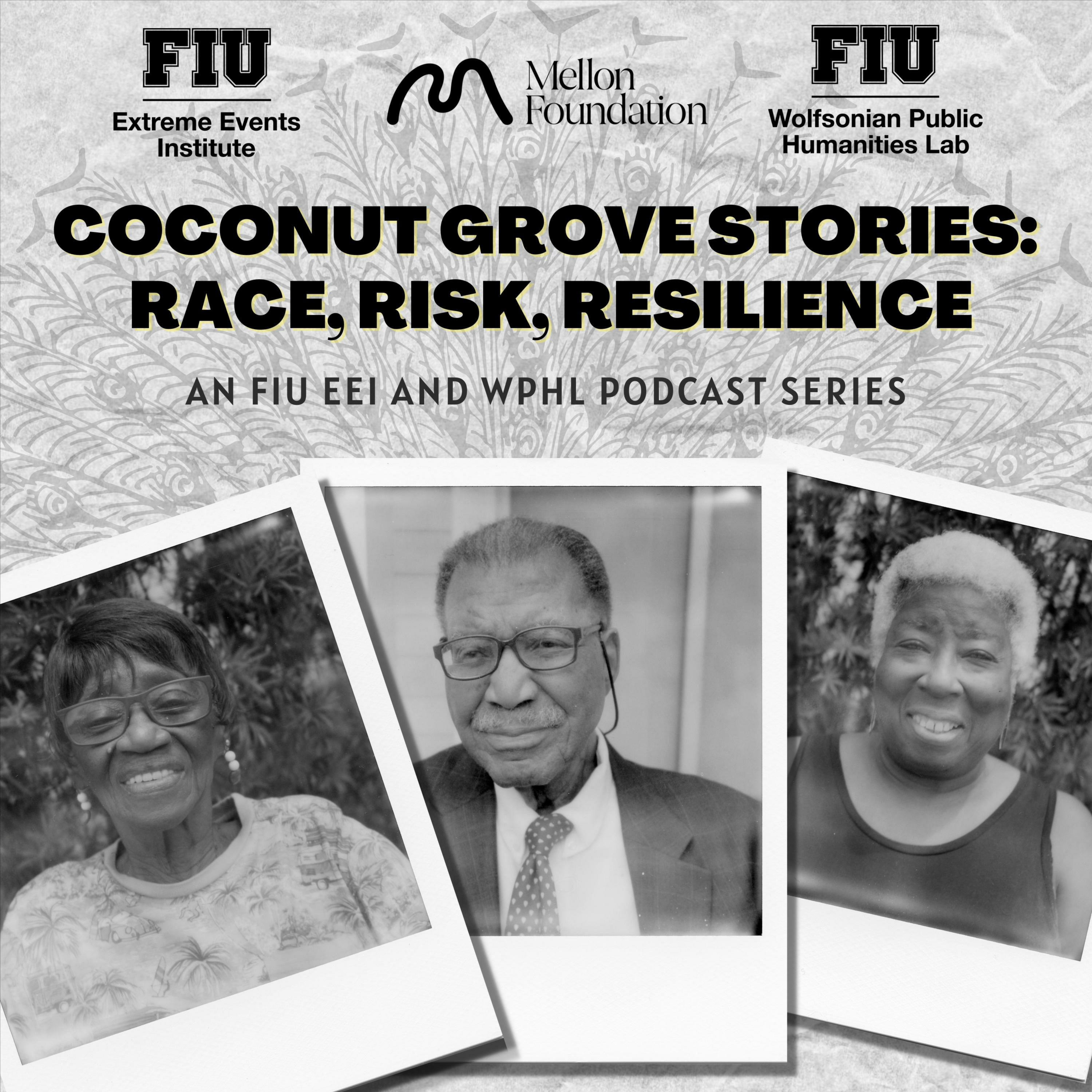
The transcription features interviews with four long-time residents of Coconut Grove, Miami, discussing major crises and community responses. Key disasters include economic blight, loss of black-owned businesses post-1960s, and the negative impact of integration, which dispersed the population and weakened local institutions. The 2008 recession and predatory loans further eroded black wealth. Affordable housing is a critical issue, with young people forced to leave due to rising property values. Health challenges are linked to social, political, and environmental factors, as Dr. Simpson’s story of a child with pneumonia from a leaky roof illustrates. The community responds by meeting with elected officials and advocating for jobs, housing, and mental health services. Strengths include persistent civic engagement through churches and organizations, and youth activism, such as high school students sparking Black Lives Matter and changing Florida gun laws. However, challenges remain: youth disinterest, lack of intergenerational wealth planning, and loss of neighborly cohesion. Speakers emphasize the need to involve all residents, especially the disenfranchised, and to leverage social media to engage younger generations in preserving community assets and building collective power.
(upbeat music) Good morning, everyone. Thank you so much for joining us. This interview is being conducted for the FIU CFJ Project. The interviewer is Yimani Warren. The interview is being taken place at LBW Home Quest Foundation, and is in Miami, Florida, 6/11/22. So that's June 11th, 2022. So thank you all so much for joining us today, so we're gonna get right to it. You all can please introduce yourself. Please tell me your name and where you're from. - Oh, well, my name is George Simpson. MD, I'm a general surgeon. I practice in Miami, and they county were last since 1958, and I've tried to be a good citizen and do whatever I can to advance the culture, the wellbeing and general health of the community in which I live. - Thank you, sir. - My name is Gregory Simpson. I've been a real estate developer and real estate exchanger. And I've spent about 30 years of my life creating affordable housing for individuals and also for elderly people. - Thank you. I'm Federica Simmons Brown. I was born and read in Cognac Girl, Florida. I am a retired school teacher, having taught school for 48 years, from home set to what we now call Liberty City, and I haven't lived all my life in Cognac Girl, went on various vacations to other cities, but I came back to my old hometown. - Yes, ma'am, thank you. - Good morning, my name is Clarice Cooper. I'm a lifelong resident of Cognac Girl. If I love Cognac Girl to the bottom of my heart. I am a retiree from the advertising division and a major newspaper here locally, and I have been enjoying retirement. The pandemic has set my goals back a little, but I'm very hopeful that everything will be returned to normal and I can proceed with everything else that I wanted to accomplish, but I am still active civically, thank you. - Thank you all so much for that. So the first question, and you all can just go around and respond the way you did prior. What are some of the major disasters or crisis events that your community has experienced? - Economic blight. For I was just speaking where the commercial portion of Grand Avenue was in black hands, and that was like a three or four block space. It's now a one block space. From the 60s, from the end of the 60s on, getting financing and getting monies to keep up with the other developments in the city of Miami and Dave County was almost always lacking. And so that was a struggle for individuals who wanted to actually be in coconut growth and create businesses because they did have the same opportunities as across the street, and I would use the example of the difference between what the growth as folks related to, you just call it, and we're now looking to maybe call it little Bahamas, but little Bahamas compared to the village of Merrick that I can see from this interview where there are skyscrapers and million and two and three million dollar condos and all the economic development in the world. - Right. So I can literally walk across the street to go to a trade or chose, but coconut growth is literally what's called a healthy food desert. There are only two or three, no, there are only two now, small grocery stores that you can come into to buy and that's always been the case. We're not always been the case. It was not the case earlier when it was a viable economic community. It's still never saying money's as, because before the '60s and before I was born, it was still segregated in society legally, but it was still a very functioning and economic society. We created business for within the community for the community. That has been a bigger blight that hurricane Andrew or the recession in 2008 or even the AIDS epidemic. - Wow. Okay, I'd like to add that. - Jump in. - So you can go. - You can go wherever you see fit. - Yes ma'am. I think the question was, what can you repeat it? - Yes ma'am, what do you think would help to, oh wait a minute, I'm sorry. - The disaster. - I asked the wrong question. Oh wait. - What kind of disasters has your community face? - Okay. - Thank you. - I have seen coconut grow in the worst stages of existence. I live here all my life and that is affordable housing for our younger generation. They are going other places to live because they cannot afford or not even a one bedroom apartment here in Cote, New Grove. So I, being a community resident for so many years, I hate to see this change coming. I hate to see that our young people have to go other places in the community or even out of the community in other states and cities to live because they cannot afford the prices for houses they're causing in this area. I never realized, I never dreamed that my little house that I live in on Franklin Avenue would be a million dollars today. However I told my children, I will not sell and I hope they don't sell. So affordable housing is one of the big crisis issues in the growth today. - Yes ma'am. - This might sound controversial, but I think integration also had a big negative effect on our community because a lot of people were free to go to use other public facilities locally and otherwise and also housing was available in other parts of the county. So we lost a large part of our population here and that affected the schools as well as the churches, most of our churches in this community and we have about four to over 100 years old. A lot of their members, most of their members of congregations consistent people do not live in this community. We have sort of lost our village effect that we had everything was more close than anything that happened in the schools or the churches or any community civic organization events was attended by most of the people in the community regardless of whether or not they were affiliated first and or not. - Yes ma'am. And I think we have one more response. So would you like to respond to that, Dr.? - When I was a resident, we used to be the physician for the clinics for the neighboring, for the people in the neighborhood. One day, a lady came to the clinic with her child who had a cold developing pneumonia and retreated to the child, finally she had pneumonia and prescribed at that time penicillin for her to take paper prescriptions a let her go. And the child came back about a week and a half, two weeks later, just as sick as she was when she came the first time. And it brought us to the realization why was she having this pneumonia? Well, in her house there was a hole in the roof and you can give all the penicillin in the world to that child but she's not going to get better until you fix the hole in the roof to stop the rain from coming in and causing her to have pneumonia. So if you, as we were concerned with good health in the community, you realize
that there are more factors than just physical or chemical or biological disease, that there are factors impinging on the health of the community and of the family, which are political and financial and social, psychological, political. All of these factors impinge on the health of the community. In order to have good health of the community, you must address each and every one of these factors, which impinge on the health of the community. This is a family was what my experience as a physician since 1958, and I came from New York, and this was my first real experience living in the South. Things came to you that had to be done, and although you were not specifically working in that area, you had to help and help lead in many instances. I myself found this to be true when I added up all of the affordable housing projects that I had been involved in either as a noner or a builder, a developer, or a board member, and it came to 295. I was amazed, but these are the numbers of houses which I personally had been involved in, but this was not all. You had to be involved in the political aspect. You had to back political candidates. You had to petition and fight for stewards conditions. You had to fight for environmental changes. You had to fight for the very existence of taxes, for instance, lower taxes. And too many of the people in Coconut Grove, which was a nice little village. I think in terms of Hillary Clinton saying it takes a village to raise a child. I said very nice, very nice, except that this was a freeze taken from an African adage. The whole thing was this. It takes a whole village to raise properly a child. A child is going to get raised whether things are good, things are bad, but in order to raise that child properly, you have to involve the resources and help of the whole community, meaning the rich in the poor and the politically affluent. So these are the things which, in my life as a physician, you come on to, but you don't necessarily aim at doing that as your profession, but you have to consider working in these areas in order to improve the general health of the community. Thank you. That was a profound statement. Thank you so much. This is Arthie Mata-Krohl. I'm a graduate student in the Department of Global Social Cultural Studies. So my question is considering the challenges the community is facing now. How is the community responding to it? How we responded to the challenges that you just described. Oh, well, we have stayed in touch a lot of us through local organizations and churches with our elected officials at the city, state, and the federal level as well as county. And we have situations where we address our needs of the immediate and long term and we invite them to meetings and to have discussions with them community meetings. We've done that quite a bit. And we seem to have gotten a pretty good response. Usually it takes consideration of financial considerations as far as getting money's appropriated for whatever we're asking for, whether it's improvement to the parks, affordable housing, which is very high on our list as the top priority in this community, as well as securing jobs for a lot of jobless people. And we also have a mental health crisis that I think we need more of an address to at all levels. And that also affects people's ability to work or to be productive. Well, I think we depend a lot on our elected officials to help this community a lot. As Kyrie said, we do see the need for improvement. And we join the community organizations to try to present our feelings on particular systems. And we have a particular situation that we develop. So we go to the community meetings, we go to the meetings that they have at the Niki. And we express our feelings. We want them to know how we feel as top of all residents, how we can keep and improve our local health. We depend on them to help us do this. I was thinking about the last financial loss. And I think that was a lot more devastating than what was going on now. The last recession in 2008, because at the very end of that, in 2006 to 2008, you had the predatory loans. And more folks lost their properties in those predatory loans, taking equity out of their houses. And then the rates changing right as the depression comes about. That's one. And number. So I thought that was actually a greater loss to property and wealth, black wealth in this community. Currently now we're a buyer's market. So if you still were able to hold on to your home, you have that opportunity to sell or to take equity out of it. But too often as a group, we black, this community and black communities in general don't operate in unison, especially economically in use. I was speaking just a little while ago about when 12th, the grow families collected to try to turn the blight of the commercial part of grand avenue. And what we got control of the property, and that was possible, but it was still 30 or 40 years before any development happened there. And that was out of our control. And by the way, that ends up becoming a generational fight. And unfortunately, in terms of with money and wealth, we don't operate. Too often black people do not operate in generation ways. And so I always tried to educate folks as you were expressing about your million dollar property and what you hope for your children to have. If you have a trust, or if you have a living will, or if you can structure your properties in a corporation and then divide it among your family members at that time in these giving them the opportunity. These are my wishes, but you have the control. These are the percentages and it's illegal in. Then you actually hold on prop. And you actually build up your community. But that doesn't happen enough, but it should. You kind of kind of touch bases on the next aspect of the question, which was, what do you think would help to protect your community from these threats? And you really kind of segue into that. So if you all don't mind elaborating more on what would kind of protect the community. Well, one challenge that I think we have now is getting our young people involved because they seem to be less interested or less motivated. And I think that's not just for the families to be concerned about, but other organizations in the churches and also the schools to let these people, for young people know that everything is being passed on and left to them. And they should be in a position to uphold the flame burning and be enlightened as far as economically, financially and politically, how they can keep things going. And that seems to be a really big challenge and I find even among some of my close associates and family members. Because these kids, I have a lot of distractions. And what's going to happen in the future really doesn't concern a lot of them. If they think that'll just be taken care of and as it goes along. So it's our big responsibility as a bigger challenge than before. Because I compare a lot of these kids to what I was young and the concerns that we had and they don't seem to have to.
the same kind of interest, a motivation. And I agree with her because I'm now talking to my children, my grandchildren, my great grandchildren, the value of our property and it keeps going up and up. And I'll say one day, you'll appreciate what we have. But like Charis said, the young people don't think to understand anything about value and what would be beneficial to them in later life. So I, on that question, I'm a little know what we can do to encourage them to hold on to what they have because it is a value. One of the things that is necessary in community building is to involve all of the people, but more importantly, to involve people who previously did not feel that they had any effect or any real weight in determining what was going to happen in the community. I think in terms of one of my heroes, of course, many others, Martin Luther King, who often said, the arc of the moral universe is long, but it bends toward justice. Now again, Hathuit Hilary, that was part of it, but the whole thing was this. This was the phrase which was put forth by a pastor in the 17th century of Protestant pastor. And what he said was the arc of the moral universe is long, but I believe it bends towards justice. There was no such thing as saying that it would bend towards justice on its own. It has to be helped to be bent that way. And that involves the participation of all of the people who previously might not have believed that they had any real weight. So to involve people who previously did not take part in building that community and holding on to what they have is a great function of people who would improve the community. So this is one of the features which community groups, such as those which many of us represent, has to do. People will fight harder to hold on to what they have than other people will fight to get what they need. And we have to fight as hard as those who have so that we can also be one of those who have. So my question is considering all the changes that have happened in the community intergenerationaly over time with the financial crisis. What do you see as some of the continuing strengths of the community now? What do you see as those points of solidarity that are still there that can be built upon? Not all I want. Well, I look at a group of us like ourselves who are continually involved in civic and our churches and fraternal organizations that are preaching the same thing about community building and community cohesion. And that's what I think is very important as far as us improving what we have and what could be lost because we have that concern within us that we refuse to let go. And as I say, the still and part that on our young people and neighbors and other family members and friends, that that's very important. As I look around, I see a big change in development of our community. It really isn't what we might call a community. It is just a place to live now. Because a community consists of a group of people living and coming together as one. I don't see that anymore. As I was telling the young lady during an earlier interview, I don't even know my neighbors. And when I was growing up, we knew everybody in the front behind on the side, down the street, all around us. They were all neighbors concerned about each other. And as Dr. Simpson said, it takes a village to rare a town. This community, this community is not a village anymore. We used to call it the village because everybody was concerned about children growing up. Their concern was about us. But how can you be concerned about people who you don't even know as your neighbor? So the neighborhood atmosphere has gone away. We don't have no community. We're just living together in a place. That's what I would call it. Two things. First, I'll speak about-- I've been a youth sponsor for a lot of years. And I think of these two examples that I pass on whenever I speak to kids. One, when the kids in North Miami walked out when Trevon Martin walked out of their classroom, at the risk of being expelled or locked out, but they had such a visceral feeling that the entire school locked out. Black radio got that in locally. And then it got to Black radio statewide. And then, if I recollections, maybe about five or six weeks later, Rachel Maddell skipped. And also, the Congresswoman helped with that as well. But the actual initiating spark was those children. If Trevon Martin had been a child from Stuart Floreward, where it happened, from that community, and his fellow students didn't even admit they acted up, but the children in Miami said, this is wrong. And an even better example. And even though the outcome wasn't what we wanted, in least, it sparked Black Lives Matter. I mean, his death and its motivation. And that was done by high school kids in Miami guards in that here. And at Stonewind ducts, high school kids who now are in their 20s or young 20s, changed the laws for guns in Florida. And that was high school kids. These are the people I believe in. But a lot of times, the economics, if they-- and you were saying about distractions, children, what-- it's not attractive. They have a minute attention span, because that's the way the culture is now. But if you can focus all of their internet savvy and their social media to moral social media, you're going to accomplish anything. But those are two examples of children of young people, teenagers, high school students in Florida. That have changed their world. Black Lives Matter is because of those kids walked out of that high school. They were so upset. And our gun laws got changed and got signed by a Republican governor, because high school kids said no more. And they got their parents to say no more. So if we can get children to be as concerned about what's going on with the cardacians or as or our other-- for the moment, social effects, that's changed. That would be changed. And it'd be quick, because they would keep a generation, at least the ones who are committed to it. What anyone else likes to respond to that question before we move to the next one? You would. Can you repeat the question? Well, my question was that considering all of the challenges the community is facing now, I still see there's so much strength. And so I wanted you all to speak to the strength that you see in the community. Let me repeat. You're saying in the curtain, where to the strength for future progress for our community, economic level, where does that kind of come from? Or where do you see that coming from? Well, you have to, I guess, instill in people who would change a belief that change is possible. As many examples have shown that change is possible. But I think of slavery. Slavery has been a part of human existence since Adam and Eve, almost. It's always been a part that those who have power will seek to use that power to say,
subjugate and use people of less of power. Throughout the years slavery has always been used to advance the health and welfare of the power group. And they used the intellect and the attitude, the skills of the slaves to improve their condition. All through the years, they have never been an attempt to obliterate the history, to complete history, culture and language of slaves, except in this country. This was the first country, and this is always knowing at my innards. This is the first country that deliberately sought to obliterate the history, the culture, the language, the skills and the self-esteem of a group of people to further subjugate them. - Yes, sir. - That is one of the things that we have to recognize. This, and it comes down to white supremacy, is deep, deep in the soul of America, and we are still working hard to obliterate this scourge, this smear on our character. We would be great people, we would be people of value of freedom, but until we face the reality that there is this deep, cultural star which must be erased, we cannot and will not be able to change the situation and we go further, degrade, and make worse, the conditions for the majority of people who live in an autocracy or a dictatorship type of government. This country is closer to that than we'd like to think, and we need to think in terms right now of changing the political structure so that we can get as simple as, why would an 18 year old be able to carry an A45 mass or massacre gone around? - Yes, sir. - And we can't even do that in the last 50 years. - Right. - This country's in trouble and we have to realize that unless we have this change in our attitudes or our history that we will want to change it, we will not be able to change it. - Yes, well that was, woo. Especially speaking on today's topics, when you give a 16 year old a firearm when most children are getting cake and shoes and video games, it does kind of negate differences. You all have led profound lives. So this question is basically talking about, tell me about your earlier lives. And Doc, can we start with you? - You want to start with me? (laughing) - Well I'm 96 years old now. - Wow. - And that gives me a panoramic view, if you will, of what has happened in my lifetime. And I have seen, like Martin Luther, I have seen the changes with the web. We have made profound changes, but we cannot be satisfied with what has been done because unless we continue to obliterate the causes of the degradation of our society, we will lose it all and be even more degraded, especially in the lives of those who are on the bottom, the minorities, the less educated, the less advantage. I grew up, I was born in New York City, which at that time, was not as deeply segregated as many parts of the South, but still had many of the conditions which would lead to segregation. Fortunately at that time, I was able, because of laws in the city and the custom to get an education free of charge. And I was able to get a good education, but still and all, I had to live in a partially segregated discriminatory society. I had never lived in the South before. My first experience in the South was, when I went to medical school in Nashville, Tennessee, which was not part of the deep deep South, but which still had its great element of segregation and discrimination. My first real experience with the deep South was in Fort Lauderdale, when I was a ex-turn, as a senior medical student, with Dr. James Sysrung, who was a general practitioner in Fort Lauderdale. And to me, the quintessential model of a general practitioner working in the community on the adverse circumstances. And I watched what he was doing and what he was trying to do, and it impressed me. And then I happened to have married a young lady from Miami, from Corbinna Grove, if you will. Her name was Danielle Simpson. And that's fairly impressed me with what is possible out of the South. - Yes, sir. - We were determined to go to California where there was, at that time, less discrimination. When we finished medical school, she was my college medical school classmate. But having lived with Dr. Sysrung and having visited Miami at that time, and having met her grandfather, EWF Sturck, who was a real pioneer in this area. I began to see, maybe there is some promise with hard work to work some changes in the society. But until she, we had, when we started, when she started her practice, we built the house here. And once you set roots down, that kind of changes your mind. I think that probably swung me to the realization that there is promise, there is possibility. And there is room for change with hard work, even in a place which was not, you know, Miami was not the deep, deep segregated South. There were a lot of people from other areas who mediated, if you will, the deep segregation attitudes. So I saw possibilities here, and we decided that we continue to live here and build a community. So that was my experience. Had I not externed with Dr. Sysrung, I probably never would have come to the South. And yet I had not married a resident who grew up in Covenant Grove. I know Don, well, I will be here sitting today. Yes, sir. Thank you so much for that. I grew up in the '60s, you know, in Covenant Grove was this type of community. First, my grandmother and her sisters at 32, 42 trials sit on the porch on Sundays after church. Church was still not only their church, Christ's Episcopal, but the other four traditional long-term churches were the center of the community. And that's how you got to really know everybody. Even more so than being in school, it's that you had so many connections in your church. And there was a sense of raising, I'll give you the best example of raising a village. All right, if I were to get in trouble, on a church-- - I can't say a whole village. On whole village. All right, this is how a whole village operates. This isn't the '60s, but it didn't happen in the '70s and then going on. If I were to get in trouble now, I'm gonna have a disclaimer that I was a good kid for a smart boy who would go to South Miami to get in trouble. But if I were to get in trouble, I could be stopped, chastised, and if it's a close friend of my mother's or my grandmother's, whooped then, and then the great vine, for the time I got home, another whooped from my mother and then the extreme intimidation of wait till your father gets home. That's a little of a story, which I don't even give it. But the community was involved in my rear end. But as I said, how's the spark kid's eye? That didn't happen to me as much. My older brother, my cousin Malcolm, a lot more. I mean, my younger brother. (audience laughing) I used to get a bike ride someplace else. Not going to grow, mostly. That is part of who I am today. Right under the influence of my parents and my family. And I would praise them in the Catholic Church, but Christ Episcopal was a big part of my life. And church was a big part of it. And it still is now. I think if young people hadn't moved from the community and still had those same roots with their source of their religious nourishment, I like to use that term. We're spiritually malnourished. And that's why we don't have that term.
the strength to fight when you have an economic giant literally across the street that I'm looking at very little Bahamas doesn't have the same economic power but it could if it had the spiritual nourishment. How about that? Thank you. Well as I said before it seems that we are so separated it does seem like we're back to integration to me and I was telling the young lady that we don't have the family feeling from one another as we did before. We are not concerned and as great in his day he experiences the same thing I did in my day. If someone saw us doing something out of the way and they had no telephone, no connection, no cell phones but do you know when you got home our parents knew what we did wrong because someone had notified them that we did something wrong out of the ordinary. It was like a family. I just can't say the word bonding together that helped us grew up as young women and young men in our community because we had the concern of everyone in the community and everyone knew each other like I said before. People concerned about each other but who cares nowadays and that's why these young people are getting over because no one is concerned about them, no one cares about them, they just join things their way. Thank you ma'am. Yes I can echo what the other three panelists have said. We have lost that sense of community here. He said as far as your neighbors, friends, family, your churches, your organizations, fraternal groups and we have lost that. I saw that happen after the integration kicked in primarily. The other thing that distresses me most is that the young people have no respect for older people. That's the less before if the person was the town's strong or the town's peeping time or whatever you still had respect for those people that they were older than you because that's what the age thing did to you. But now these kids don't have that and get that reenstealed and instilled into them as it's kind of like a lost art I would think because that has to come from the family and other groups and schools and whatever. And now the kids don't get paddled in school not that I was ever in favor of that but I think the fear of being paddled can't help kids go on the right path. So there's a lot of things that they have working for them but it's also working against them. So this will be our last question and it's what advice do you have for the next generation for these young people who you want to take the helm and confront this change? What do you have to say to them in terms of what they need to do to support the community? The thing I mentioned earlier, spiritual nourishment, spiritual enrichment in my life and experience has come from a spiritual community and also something that my father was speaking about about this country and the racism that was formed in this country. In this country, racism was based on a complete overarching dehumanizing of people because of color. But once you start going down, that is the actual epitome of a slippery slope because once you can dehumanize people because of color, you can dehumanize women and their value because of their sex. You can dehumanize, so you can be the person in power, then you have all the privileges and everybody else is a lower tier. There are class struggles, there are caste struggles, but the one based on racism and sexism, those are ceilings that you have to find a jackhammer and knock a ceiling upside down above your head to get through. But that has been done. But the other thing that people need to always be reminded of, unfortunately, a student of history and we fought the Civil War. And for about five years, there was, in the east and the south, the beginning of political equity. And then for the next 90 years, that ended. And it was struggling again in the 60s. During time when my father here was locally head of the NAACP and was one of the people who even once the laws are put on the books, somebody had to be the first to set it the lunch counters before and after to send their kids to school, to integrate it and the risk that that entails. And that takes commitment and courage and belief in your community and a social core. Our young people have that, but they also have phones in their hands all the time. And so they can find a way to connect as a social community that we're not only a social community, but we're a spiritually connected community. And I won't dehumanize anybody because that dehumanizes me. You see, if we have that, you could change not just this community, but this state, this country, you could change this world. You have that, then you don't have one large country invading a small country. You don't have women losing their rights that they thought they had to their integrity of their own bodies. And also you don't have a community which stays under an economic blight for generations. You have the belief that I'm the change agent and I'm not alone. Thank you. Is there anyone else who wants to respond to that last question? Oh, well, as far as to tell young people, I think a lot of them don't realize how important education is and that's why a series such as this one with FIU and other local institutions of higher learning is important that we stress upon the kids how important education is in knowledge. And to pursue education doesn't necessarily mean it has to be an academia. It can also be a trade. It's just that you should also just build up something that you can prosper in and then also couple that with your spiritual nourishment and your community spirit. You can get a whole lot accomplished within your community. Okay. Doc, would you like to add anything so we could kind of. Something that young people should take in to move forward for the next generation? Yes. What do you think young people should do? They should take in, to strengthen them for the challenges in the future. What can the next generation do to share itself up? Well one thing that they should do is to, that they must do, is to internalize the changes which have been made to believe in the possibility of permanent change. They have to realize the importance and significance of the history of their own past generation, their parents and their grandparents and believe that they can grow further on that line of approach. You have to instill in them the belief. You have to let them instill in themselves the belief that change is possible but that it is not possible without their individual and personal participation. So to get them involved, to get them knowledgeable of the power, for instance, of their single vote. A lot of them believe that they can't do anything with it. The power of the vote is essential in building a foundation for political and social advance of the group. So you have to, in your own belief, transmit to them. In our own belief, transmit to our children, this coming generation, the possibility, the probability and the inevitability of change if their participation is strong enough. Okay. Thank you all so much.
I wish we had some more time, but maybe we can make some more time in the future. Because of course what you're saying is imperative. But wait a minute, do we forget you? Oh, we can't forget you, Miss Brown. - Oh, no, you can forget me. - Okay. My only last comment is that we all created by God. And if we can think that we are all brothers and sisters, created by God and have a feeling of love for each other, regardless of color, I think this role will be a better place to live. - All right, any last comments that you all had before we wrap up? Any last comments? All right, well. - Yes. - No, I was gonna say, I said, amen sister. (audience laughing) You know, it was Brown. I said it to her, but that's my last comment. Well thank you all so much because this is like, it's really important for our young people to see how we can engage our communities together. So we thank you so much for your time, and we hope that we can kind of speak more in depth about what we need to do and how we can bridge that gap between our young people. And just hearing your story, so I thank you very much. Thank you so much. Thank you. Thank you. Thank you. [BLANK_AUDIO]
Podcast Summary
Key Points:
The community has faced economic blight, loss of black-owned businesses, and a shift from a vibrant segregated economy to a "healthy food desert."
Integration led to population loss, weakening local schools, churches, and the "village effect" of close-knit community ties.
Affordable housing is a major crisis, driving young people out; predatory loans during the 2008 recession caused significant loss of black wealth.
Health is impacted by social, political, and financial factors beyond medicine, as illustrated by a child's pneumonia linked to a leaky roof.
Community responses include engaging elected officials, attending meetings, and focusing on affordable housing, jobs, and mental health.
Strengths include ongoing civic involvement, church and fraternal organization efforts, and examples of youth activism (e.g., Trayvon Martin protests, gun law changes).
Challenges include youth disengagement, lack of intergenerational wealth planning, and loss of neighborly connections.
Summary:
The transcription features interviews with four long-time residents of Coconut Grove, Miami, discussing major crises and community responses. Key disasters include economic blight, loss of black-owned businesses post-1960s, and the negative impact of integration, which dispersed the population and weakened local institutions. The 2008 recession and predatory loans further eroded black wealth.
Affordable housing is a critical issue, with young people forced to leave due to rising property values. Health challenges are linked to social, political, and environmental factors, as Dr. Simpson’s story of a child with pneumonia from a leaky roof illustrates.
The community responds by meeting with elected officials and advocating for jobs, housing, and mental health services. Strengths include persistent civic engagement through churches and organizations, and youth activism, such as high school students sparking Black Lives Matter and changing Florida gun laws. However, challenges remain: youth disinterest, lack of intergenerational wealth planning, and loss of neighborly cohesion.
Speakers emphasize the need to involve all residents, especially the disenfranchised, and to leverage social media to engage younger generations in preserving community assets and building collective power.
FAQs
The community has faced economic blight, loss of Black-owned businesses, affordable housing crises, predatory loans during the 2008 recession, and a shift away from the close-knit 'village' atmosphere after integration.
Residents stay in touch through local organizations and churches, engage with elected officials at all levels, and hold community meetings to address needs like affordable housing, jobs, and mental health.
Involving young people more actively, educating them on financial and political matters, and encouraging generational wealth-building through trusts or corporations to hold onto properties.
Ongoing civic involvement from residents, churches, and fraternal organizations that promote community building, as well as the potential of young people to drive change, as seen in the Trayvon Martin protests and gun law reforms.
Younger generations cannot afford even one-bedroom apartments, forcing them to move elsewhere, while property values have skyrocketed, making it hard to maintain a stable community.
Integration allowed people to use facilities and find housing elsewhere, leading to population loss, weakened schools and churches, and a decline in the close-knit village effect.
Chat with AI
Loading...
Pro features
Go deeper with this episode
Unlock creator-grade tools that turn any transcript into show notes and subtitle files.
 PodcastTranscript AI