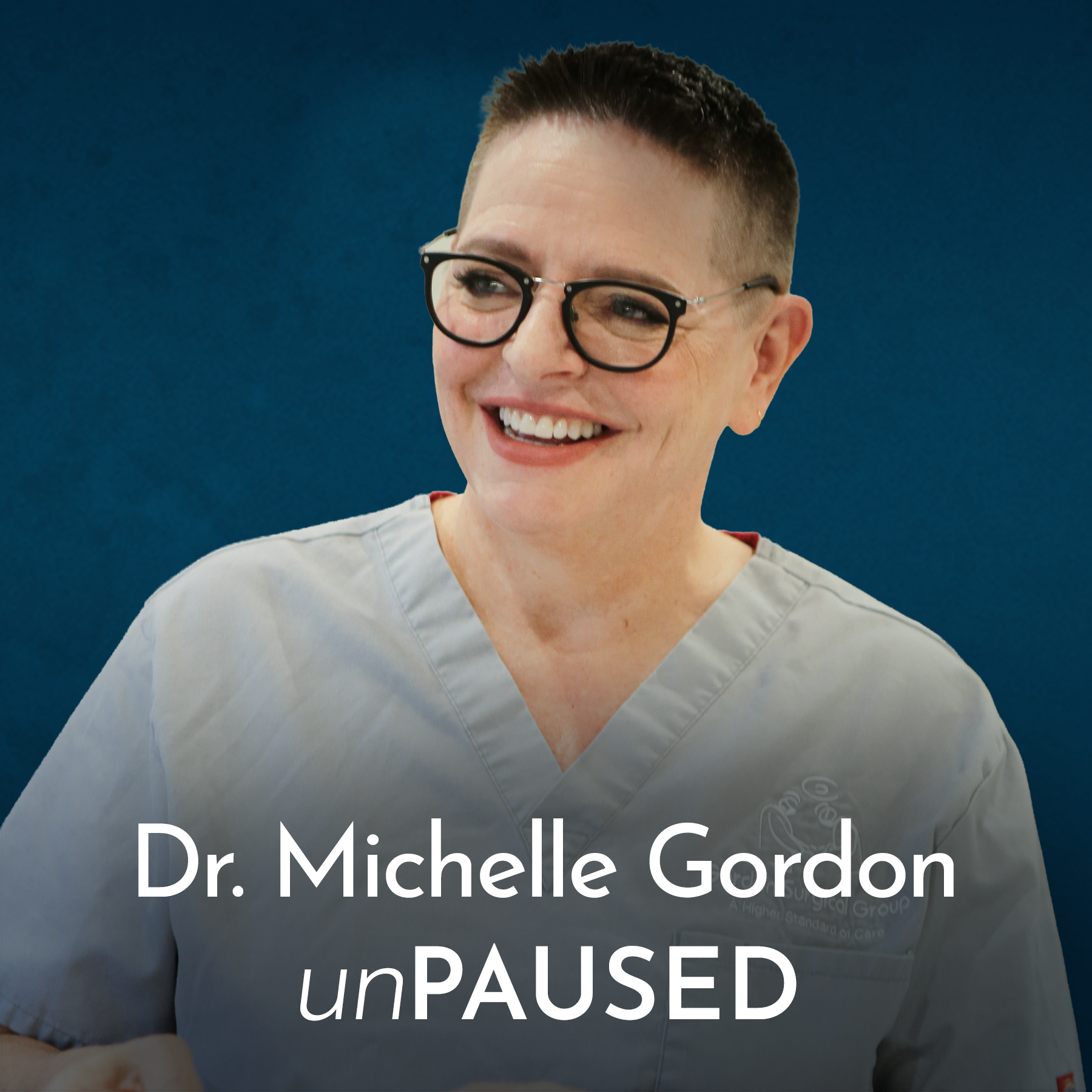
GLP-1s, Hormones, and Why You Can't Calorie-Count Your Way Out of Menopause with Dr. Michelle Gordon
from unPAUSED with Dr. Mary Claire Haver
71m 7s
This podcast episode features Dr. Michelle Gordon, a former general surgeon who now specializes in obesity and lifestyle medicine for midlife women. She explains that weight gain during perimenopause and menopause is not a failure of willpower but a predictable physiological process driven by hormonal changes. As estrogen declines, fat oxidation decreases by 32%, visceral fat accumulates, and inflammation rises, leading to insulin and leptin resistance. This makes the “calories in, calories out” model ineffective because biology determines the metabolic burn rate. Dr. Gordon emphasizes that women are not small men, yet medical training has historically treated them as such, often dismissing symptoms as psychological or stress-related. She advocates for hormone therapy (estrogen, testosterone) to restore brain function, reduce pain, and improve metabolism. Other key interventions include resistance training, fiber, sleep, and GLP-1 medications when needed. Dr. Gordon left her surgical practice after repeatedly seeing women arrive too late for help, having been ignored by the healthcare system. She now runs a virtual clinic to reach more patients and stresses that women should not accept dismissal from doctors—they should seek clinicians who treat obesity as a chronic disease with evidence-based, judgment-free care. The conversation also touches on bariatric surgery’s limitations and the need for more research on women’s health.
Weight gain in midlife women is physiological and predictable. We know this now. The burn rate goes down and you can't out calorie count yourself out of it. It's going to happen. It's predictable. We can work on it resistance training. I mean, that's that's the number one longevity hack and sleep. Yeah. And fiber. You don't have to white knuckle through it. If if you start gaining weight and you rapidly, rapidly the weight comes on and all you're doing is thinking about food and you're craving food, we have medication, medication that can help now. And the other thing I want to say to the women is that if your doctor dismisses you go get another doctor or there's a million doctors in this country. You don't have to go to a doctor that makes you feel like crap. Yeah. The views and opinions expressed on on pause are those of the talent and guests alone and are provided for informational and entertainment purposes only. No part of this podcast or any related materials are intended to be a substitute for professional medical advice, diagnosis or treatment. Today's guest is someone I found the way I find many of the best medical communicators. I was scrolling on social media and came across a video where she was explaining why calories and calories out does not work for many midlife women. Not in the vague wellnessy way. In a physiological mechanistic, this is what's actually happening in your body way. And I thought this is someone who gets it. I was watching her dismantle a medical myth in plain, precise clinical language. And I thought she has got to be a guest on on pause. Dr. Michelle Gordon is board certified in three disciplines. General surgery, obesity medicine and lifestyle medicine. She spent 15 years building and running a multi-million dollar surgical practice and she was good at it. Then she walked away from it because she kept seeing the same thing over and over. Women arriving for surgical intervention after years of being dismissed, minimized and told their symptoms were stress or aging or their own fault. By the time the system paid attention, the damage was already done. She left this thriving surgical practice because she was tired of seeing women arrive already broken. She wanted to intervene earlier. Her practice focuses on weight, hormones, metabolism, sleep and brain health in midlife women. She works with hive performing women who cannot afford to lose their edge and need clinical clarity without judgment. Today we're doing a deep dive into why midlife weight gain happens, why eat less, move more, stops working, and what GLP1 therapy actually looks like when it's done right for a parrymineposal or menopausal woman. The connection between metabolism and brain health and what the future of obesity medicine and menopause should look like. I'm Dr. Mary Claire Haver, a board certified obstetrician and gynecologist and a certified menopause practitioner. I'm also a junk professor of obstetrics and gynecology at the University of Texas Medical Branch. Welcome to Unpost, the podcast where we cut through the silence and talk about what it really takes for women to thrive in the second half of life. What does it mean to be a doctor? A doctor's degree is a doctor's degree. Now it's 20% more than the average. You're right. I'm a doctor. about weight management, GLP ones, and how that can all incorporate successfully into a clinical practice is one of the top requests that we get. So our audience is super excited to have you here. But you didn't start out doing this? No. I didn't. You were General Surgeon. General Surgeon. I like to say it was a General Surgeon for 20 years because it was five years of residency. Yeah. But yeah, no, I did I did acute care General Surgery. That's what I found I liked. And then in the pandemic, things got really weird. Yeah. And I didn't like it anymore. And I just stopped all of it and started looking at other things. So I took this time off. I was I was really unsure where I wanted to be thinking I was going to leave medicine all together. Yeah. I'm a surgeon. Yeah. Okay. We forget medicine. So I had to learn a lot. And that was probably one of the harder board exams that were taken. But I passed it in 2023. And then I started practicing and learning about obesity as a chronic disease was eye opening for me. Yeah. When I was learning about obesity as a chronic disease, that was such a kind of a mind blowing, you know, concept to me because what I had been taught in all of my training was this was a willpower issue. This was a personality disorder. This was a thermodynamics problem. My first video I saw you that really got maybe I've seen something before. But like the one was you debunking the thermodynamics equation to the Jim bros on your page. You had a quote from somebody up there. And I was like, and you did it in such a great way and you use science. The problem I think with the thermodynamics argument is yes, you are not going to lose weight if you're not in the calorie deficit. I have never ever ever said that that wasn't right. The issue is that all thermodynamics experiments for the most part are based on static engines. And biology determines the burn rate. And that's the difference. And in a pariamid appausal woman, which of course the research hasn't really been given to women's health. So we don't really know a whole lot. But what we do know is that women are not small men. Exactly. Very, very different biology. You talked about women showing up in your office when you were surgeon and they were already broken. They'd missed all these windows of opportunity for intervention. What did already broken look like? Well, I was in acute care, care general surgeon. So people come to the ER. They're already broken for the most part. But the best example of that was a woman in her 60s who came to the ER with with belly pain and septic shock. She lost her granddaughter about a week before. And it was obvious that something was very broken inside of her. And when I got her to the operating room, there was a clean hole in the sigmoid colon and the belly was full of stool. And she just sat there and endured it. She was obese. And she endured it because women put themselves last. We're taught that from the beginning. And she might have survived if she had come earlier. But by the time we got her to the OR, it was too late. That's what already broken looks like. You have a phrase that I love. I mentioned in the opening, you help women who cannot afford to lose their edge. I have the same sub-settipation say, think coming to see me. A lot of them are very high functioning in their jobs and their day-to-day lives. Not all of them are employed, but they are literally managing multiple things. And all of a sudden they've lost that ability. Are you seeing the same thing in your clinic? I do. What's happening is the women who come to me are high-powered leaders, CEOs or entrepreneurs. A lot of entrepreneurs come to me. And they're women who have always met their goals. And all of a sudden, either they're not able to think the way they used to, or they're really upset because they've always met their goals and they can't lose weight. Or they lead a team. And they can't get to the edge of their brains. And their team is noticing and they wonder if there's something wrong with them. And we'll get into some of the specifics, but what happens with the majority of those patients in your practice? Well, usually we treat them with estrogen. Estrogen is amazing. That will help. I have one patient in my practice now who had a TBI. And then for our listeners, the TBI, traumatic brain injury that she's recovering from. And it's been a while. But I put our estrogen within a week. I said to her, just I think yesterday I saw her. And I said, are you able to get closer to the edge of your brain now? Because that's a big problem. People who've had traumatic brain injuries just feel like everything's just right there, but they just can't get there. And she's like, you know, my thinking has cleared up a little bit. Amazing. I have another one that I saw yesterday as well, who I had just started her on testosterone. And 0.5 milligrams really small dose like most does. Should this the first time in years, I didn't take any adveille for a week. Wow. No pain. I was I said, this is miraculous. Yeah. Because when you take hormones, when you feel crappy and you just take hormones, it does feel like a miracle. It's a, you know, estrogen in its natural state, pumped out of the ovaries, has this amazing anti-inflammatory property. And then when you outlive the life of your ovary, that goes away. And it just unmasks so much, musculoskeletal pain, inflammation, et cetera. So being able to ameliorate that in in part with hormone therapy is one of my favorite parts of my job. It's so nice to see women come back to themselves. And yeah, I don't know if you know this, but I, I
I've got survey data from over 16,000 women. And one of the things that they've said over and over is I feel like an alien is being down taking control of my body, mind, emotion and mood. Why do I just not feel like myself? - Yeah, did you see that paper last year? It was presented at Metapos Society meeting which I did virtually. And it was a woman who wrote a paper called, I just don't feel like myself in Perry Metapos and really quantified it. Like now we can use that as a medical term. And now I like use that all the time on social media 'cause it's now considered a medical term that a woman has just, she doesn't feel like herself and that often is the first sign. - Right. - Let's talk about calories and calories out. Is that the biggest thing you had to kind of rethink through when you left surgical practice and got into lifestyle and obesity medicine? - I wouldn't say it's the biggest thing I had to work through. I think what really brought that on for me was posting on social media and seeing the pushback from Jim Brose more than anything else. - I've been through this exact arc. - You know, talking about lipotoxicity and how obesity is a disease of inflammation. And when I was on TikTok and posting, I would post like a text post and I had to turn off comments. They were so awful. Just put down the fork, bra, thermodynamics, bra. And so it makes for a real easy way to attack the standard that men think about. And then when I start to get into the conversations with the people who actually watch my videos, you know, this is for the women. Women are not small men. And we've been treated like small men our whole lives. Or like we are a servant to men or they're for men's pleasure only. And what we think and what we are doesn't matter. - Right. - We also had to learn how to really believe women and get out of the bias. And that was kind of built into the system of women tend to just be emotional. I mean, and I was taught that women tend to somatocize psychological problems. It's not clear if it's not on the checklist that we gave you, then well, she's just a little bit crazy. - Yeah, what did you say on Mel? I was a whiny woman. - Whiny woman. I mean, that was my intern year. The WW, well, she was Caucasian. So it was a WWW, one-year-white woman. And so they coded in it, 'cause we still had handwritten charts. That's how old I am. It was like a little WW. And that was like a little signal that she's midlife. She has multiple vague complaints. Can't put your finger on it. Labs look okay. She's still having a few periods. Like she's not menopausal. We did not have a framework in how to treat this woman. - Right. And it didn't matter. It didn't matter because it was a woman. - Yeah, exactly. - And I think the biggest problem is that women dismiss other women as well. - They do. They do. I see, you know, in the comments and social media a lot, there's a lot of blaming of male clinicians. We got some great male clinicians out there. - There's some great ones out there. - And this is not a gender issue. You know, sadly, I was one of those females who did tend to dismiss. And when I couldn't figure it out, well, it must be something psychological I'm missing. Until my patients and I all got to that age. And I'm like, all these women I hang out with outside of the office are not crazy. Like I know them. I shop with them. We run together. We have mommy groups. You know, they pick up my kids when I'm running away at the hospital. Like she's not crazy. Like this is real. And she's not gaining weight 'cause she's constantly going through the drive-through. - Right. And I think women are not believed. Like it's a, it, women and girls are not believed. I mean, it's more of a systemic problem than just in medicine. - Oh, totally. You're in there fighting the good fight in the clinics across from the patients day to day, seeing the success, seeing the new tools available to patients, you know, and really helping change your patients lives. - Right. - But, you know, you don't have to fight this battle on social media. - No, but I'm trying to reach the woman who has been dieting since she was eight. - What do you wanna tell her? If she can't drive to Northern New York and come find you. - Well, I have a virtual clinic. (laughing) And I have 39 licenses. So I can treat a lot of people. But so here's the thing. The metabolic chaos that goes on in women is just very different. And obesity has its own sort of inflammatory markers, inflammation. And the woman who has been to the doctor and the doctor just says eat less, move more. - Yeah. - Why does this fail her? - Because she's already got so much inflammation that fat oxidation isn't happening the way that we would expect. I mean, even in paramedicopause, you must know this 'cause you just wrote the book. But in paramedicopause, fat oxidation goes down by 32%. Right? So a woman who does the same things, exercises the same or even starts doing more, will gain weight because hormones. - Mm-hmm. - Right. And that's where put down the fork bra, doesn't work. We have to work on the resistance. We have to work on insulin resistance and leptoresistence and the brain. The brain will pathologically cause someone to feel more hungry through paramedicopause. - Yeah. - So what is insulin resistance? For our listeners who may not understand, it's a term being tossed about quite a bit now. - Yeah, so it's a really interesting problem. It's not something that you're born with, although there are some genetic predispositions. But in midlife women, estrogen is responsible for how the body responds to insulin, right? And I can't imagine 'cause you just wrote that book. And you must have read so many papers on how insulin and estrogen interact. - Less than you would think because when you look at the volume of research around paramedicopause, I have to kind of look at the postmenopausal data and make inferences backwards. - Wow. That's frustrating, but maybe we'll get some more than 11% of the NIH budget. - We will. - So we'll see. - Maybe. - So what happens when estrogen declines is there's more visceral fat accumulation. So fat moves from around the hips to visceral, right? And that becomes-- - And for listeners visceral interrupt abdominal cavity. So inside our tummy or what we call belly fat. - Right, well, we also have, remember, we have the omentum, right? And the omentum's job is to clean up in the abdomen. And I can't tell you how many times I took out an appendix and had to do a partial omentectomy just because the omentum was doing its job. And that gets bigger. The omentum gets bigger than mesentery, which is the fat between our bals. - Right, well, it's where the blood vessels are living. That gets bigger. And then, of course, anything around the organs. But when we talk about visceral fat, I think we're mostly talking about increased volume of omentum and mesentery. But that's an active, active, indichrint organ, right? And so it starts releasing some inflammatory cytokines. And then with that, the fatty acids go up. Fatty acids go through the portal vein in the liver, which is where most of our blood comes back, right? And there's a reaction there that causes us to have less sensitivity to insulin because of the increase in the fatty acids. It's not all sugar. You think it would be all sugar, but it's not. And that's where the biology is just so complex. As the pancreas tries to adapt, as the sugar goes up, it puts up more and more, but the body doesn't react as well. And that's insulin resistance. And then you mentioned leptin. So what is leptin is a hormone? Yeah, leptin is what it's leptin do. It is responsible for satiety. And satiety is feeling full. Feeling full. Yeah, it's the thing that makes you full. And we know from bariatric surgery studies, right? That leptin resistance goes down with bariatric surgery and growing-- Another hormone is-- - Is the hormone. - Is the hormone. And that sensitivity goes up in bariatric surgery. We've lost a data on bariatric surgery. But we don't have enough on weight loss. In people who lose weight, they, the hormonal changes don't last. We don't have the data. We think that maybe five years staying at a lower weight, maybe, but the body always tries to go back. That is survival. And so we're fighting against survival and the way that we evolved in bariatric surgery. Yeah. And not just bariatric surgery. And any time you want to lose weight, right? Bariatric surgery is really interesting. I almost became a bariatric surgeon. I studied bariatric surgery and decided I didn't want to do it because I thought the relapse rate was too high. And now I understand why. I never understood why until I started studying obesity medicine. Bariatric surgery, about 25 to 35% of patients will regain. Yeah. Most won't because there is a permanent hormonal change that happens when you permanently change the anatomy. But bariatric surgery comes with its own problems. Yeah. I've had a lot of post bariatric surgery pregnancy patients and they were complicated. We managed them, but it was, you know, it creates a different body. And that creates its own set of complications to deal with, especially when you're dealing with another human growing inside of a body that's been changed. Right. of what I do because I'm not brave enough.
Pierale mala korkeasaareissa, tuet eläinlajen ja vililuono suojello. Tutustu päivän Oghjelmaan, korkeasaaripistefi. Päralein, kun on tullut kertaa, niin se on tullut kertaa. Se on tullut kertaa, että se on tullut kertaa, että se on tullut kertaa. 60 per centivuus ja pesetelminen ileenוהdu טäkkäy tehtyä tahdimmalla, 14 9 filling planned on ystävystä. TerË 3 minä mukana integera併 effieäYden eläyhököitä. Serim - 20 nervismellainen, niin. Our patients and period 문제an ja metipause, - wants to know, what kind of Parsley (ch Jewish dialect ) - ja ei ole bruskanserin, ja ei ole kertaa kertaa ja kertaa kertaa kertaa kertaa, koska se ei ole kertaa kertaa, mutta mitä haluaisin kertaa, että se ei ole kertaa, että se ei ole kertaa, että se ei ole kertaa, että se ei ole kertaa, että se ei ole kertaa, että se ei ole kertaa, että se ei ole kertaa, mutta se ei ole kertaa, että se ei ole kertaa, mutta se ei ole kertaa, että se ei ole kertaa, mutta se ei ole kertaa, että se ei ole kertaa, että se ei ole kertaa, että se ei ole kertaa, että se ei ole kertaa, että se ei ole. gennä pierwsälä. ¤ ¤ ¤ shredded. – On vaatkea Fan, meikkimme saja, vaan jatekään käh Avi. – Gospelas bundleingot. – aplicato ver – rysojasineet otteni yhteystem Heather liitt acostuminen hallitus. – Kalarissa on valmiin. – Kälärissä on valmiin. – I have a daughter in medical school. So I'm seeing what the new kids are being taught. They're definitely treating obesity as a chronic disease. – Great. – They are not stigmatizing patients with high fat levels, nearly as much as I was taught to do. But I think we have a whole generation of physicians still practicing who are struggling to get that message. Were you seeing this in your clinical practice? By the time my patients get to us, they're primarily coming for menopause, but many of them are struggling with weight. And so once we kind of tend to their menopause, then we'll start introducing GOP1s into practice. – So women who come to me are women who have either been mismanaged or have gone to an online place and gotten medicine and weren't really just kind of left-to-the-consition. – Nobody comes to them. – Yeah. And so when they come to me, most of them are usually on a GOP1 and have been dieting since they were eight. So it's a much more difficult metabolic picture when I'm dealing with. Let's talk specifically about GOP1 therapy. And I get this question all the time on social media. Is it okay? Like they're asking for permission. For me to use a GOP1 for my menopause waking. – Depends. – So who's a good candidate who's not? – So the guidelines are as follows. BMI, I know BMI is trash, but that's what we have. Of 27, with a comorbidity, comorbidity including high cholesterol, sleep apnea, high blood pressure, prediabetes, diabetes for the most part. So that's BMI, or BMI of 30 or higher. Okay. Those are all candidates for GOP1. – 27 plus 1, right, or 30 plus. – There are some guidelines to say 25 plus 1. For me, it really depends on the patient. Let me tell you who GOP1s are not for. – Please. – Okay. – They're not for someone who wants to lose 10 or 15 pounds for a wedding. They're not a temporary fix. Obesity is a chronic relapsing disease. There's no world where we would tell someone, "Hey, you know, you can take this asmenhaler for two times and then you've got to get off it. We've got to get you off it." And so the biggest issue is changing the narrative around what obesity really is. And even if it was behavior that caused it, it's still there. It's still active, indecrime organ that is causing inflammation throughout your body. And so what I love about GOP1 is it makes it so that you're not hungry when you're trying to starve. I mean, you don't have to fight against your biology to get to a normal weight. I'm a GOP1 patient. – Yeah, yeah. – My patients talk about when they go on a GOP1, something unlocks in their brain. Did you feel that? – I don't know, because I had been on a weight loss journey. I mean, at my highest, I was over 220, okay, on 5 foot 6. I gained weight with pregnancy was never able to lose it. Right? So I gave birth in 1993. My son's going to be 33 next month. And I was never able to lose it. I would exercise my butt off and get down to maybe 15 pounds every then where I'm now. But then I just couldn't maintain it because it was restrictive and so much exercise. And then I went into surgical residency freaking. – Right. So for me, I was on a journey working with a coach, losing weight, doing great, tracking my food. And then I got bored in obesity medicine and started treating patients. Six months into treating patients, I went to obesity week. And one of the presenters said this about tersepoti specifically. It prevents diabetes. It prevents 10 types of obesity-related cancers. It prevents, we think, Alzheimer's. It has longevity benefits. And for me, that was the click. It's like, oh, I don't have to really fight with my body. I'm going to try this. I'm going to try it as an experiment and see. And so I started in December of 2024. I mean, I didn't lose that much. I also didn't go to the max dose. So I stayed at five milligrams for a long time and went up to maybe eight and a half nine. But I got down, and this is the Maglittider. No, it turns up a tide. Thirty-ish pounds. Okay. I'm pre-prepredeensely weight. I haven't seen this weight since 1992. So for me, the biggest thing is I don't have to worry about what I eat. Other than the protein. Like, I got to make sure I get an protein. You clear the brain space. I mean, I still track. I still make sure I eat enough or don't eat too much. So you have a patient coming in. Decide she's a good candidate. Yeah. You know, for her, GLP1, walk us through what the options are. What's available commercially right now for you to prescribe to a patient? What are the differences in them? How are they given? Okay. What is currently available? We have lyragletide. I don't prescribe it. It's a daily injection. It's sexinda. Same thing, right? It's GLP1, but it's daily. Decent weight loss, 12 to 15 percent. Not bad, but it's a daily injection. And that will cause needle fatigue fast. Okay. We have somagletide. Good drug. High side effect profile. For example, what are the symptoms? Nausea, gastrointestinal. That's the biggest one. That's what we see in our clinical practice. You do very, very high side effect profile. I do find though that men tolerate somagletide better than women. You don't treat men, right? No. In the men, men I will always start on somagletide first. And then if they don't tolerate it, I'll switch them. But women don't tolerate it as well. Because we're different. We're not small men. Time's out. Right? We just threw trial and error had now pretty much exclusively due to her's appetite. Yeah. Just to avoid the side effects, our patients tolerate it better in general. There's a few that come in on it, want better management. They're happy with it. We keep them on it. If we're in doing a new start, we're pretty much doing turns up a time. Yeah. I really like turns up a tide. I started with turns up a tide. I never had any major side effects. I get a little bit of nausea. I'm very careful about constipation as a surgeon, especially. So my cocktail for constipation is magnesium oxide. Some people do better with magnesium, such rape. But for the most part, if I have a patient who says that they're constipated, it's magnesium oxide. And it works. It's great. It might cost them diarrhea in the morning, but it's a lot better than being constipated in my opinion. So some agni.
the tide will come in 0.25 and now up to 7.2 milligrams. I haven't prescribed 7.2 yet, but it's like a huge jump. It's from 2.4 to 7.2, which I don't know how I would never want to do that. I would want to step somebody up. Yeah, sure. But I don't know. I haven't talked to Narbo, so I don't know how to step somebody up to that, but I'm pretty sure you can go from 2.4 to 7.2, which seems scary to me. Wow. What about Terzepetite? How do you do step? Terzepetite is 2.5 to 15 milligrams. Another big jump. Yeah, yeah, but you dose it small and slow. I love using vials. So do we. Okay. I like having that ability to control the dose. Yeah. So there might be somebody who can't take a 2.5. They just, they just get too sick from it and we'll start them on a much lower dose. The Zetbound vials come in 50 units per vial. And so we might start them on 20 units or 30 units instead and work that way. I have very few patients who are on max dose of Terzepetite. It is never my goal to take somebody to the max dose. I want to get somebody to the dose that works where they're feeling good, able to live their life and losing weight, of course, but we don't want to lose weight too fast. Right. Because the data tells us that if you lose weight too fast, you're at risk for especially for women, more osteoporosis and muscle mass loss. I mean, we know that from bariatric studies that there's a lot more muscle mass loss in rapid weight loss. So we don't want that. And also with rapid weight loss, there's the gallbladder risk. Yeah. Costones. Acute colleagues to stitis. So how do you count? So you get these patients and we decide she's a good candidate. You pick the medication. You start her on the dose. What other counseling are you giving her? Oh, well, about the medicine specifically. Well, about lifestyle lifestyle. I'm your patient. Yeah. Right. So we're going to talk my shots. I'm ready. Yeah. Yeah. No, you know, I have your shots yet. We're going to find out what your history is first. What is your relationship to food? What is your lifestyle like? Why is that important? Well, because if you're somebody who has always been afraid to eat a carb, we're going to talk about eating carbs. That's really important. I'm really big on understanding what somebody's relationship is to food. You know, some patients of my practice who want to step on a scale, they just want to base it on how they're close fit. That's fine. I think it's very important to meet patients where they are. We're going to talk about how you sleep is. What's your sex drive like? What's your mood and motivation? How willing are you to partner with me in helping you reach your goals? Right? And then what are your goals? What do you want? And how fast do you want it? Because is it realistic to think that you're going to lose 20 pounds in a month? Those are really important things. So I need to get to know you and we're going to talk about protein. The only thing you have to track is protein. That's all I care about to start. Okay. How much protein? The data say one gram per pound of ideal body weight. Almost nobody can get that. So yeah, like that's a lot. For example, if you're a hundred and twenty pounds ideal body weight, 140 pounds, that's 140 grams of protein. Every single moment. And most women are in reality eating 50 to 60. Yeah. Maybe. Yeah. And that is so like more than doubling. That is a lot of protein. So how do you teach them to scale or do you teach them? Well, we again, you have to start people where they are and we start finding high protein foods. Right? The only thing I care about is getting 30 grams of protein in the morning. I don't care about timing, but I want you to get 30 grams of protein in the morning. Why? Because that's going to keep you full and it's going to feel your brain and it's going to help you get through the day. That's the number one thing. And it's funny because when I have patients who start doing that, like, oh, I feel so much better during the day. Yeah. Right. And I've seen videos that you did where you're like getting 50, 60 grams of protein. So yeah, I like efficiency and I'm a very busy girl. And so I've concocted the shake that I make that hits so many of my nutritional goals at once. So we tell patients to track their protein and their fiber. Okay. For satiety and all the health benefits. So the shake has this scoop of protein powder, of course. And has Greek yogurt. I have no dairy issues. And that gives me another 20 grams there. I have a like hemp chia flax, you know, mix that I throw in there for omega three's. The Greek yogurt also has probiotics. You know, I put extra scoop of fiber. And I do put a little collagen that's a specific for skin and bone, which we create. And so, you know, I put frozen berries for anthocyan and, you know, butter and minerals nutrients and fiber and shake that whole thing up and add a little water because the berries are frozen. And it's delicious. It's probably 700 calories. And it is 700 calories. And but it has 50 grams of protein ish and probably 20 grams of fiber. And it takes me three, four hours to get through it. So I take it down to the gym. I get my work out in. And then I work on the treadmill and my walking desk and take all my Zoom calls for business there. And, you know, that's my morning. That gets me till noon, one o'clock. And that is how I start my day. Usually we're not at home. That's great. I usually tell patients that, you know, they have to start tracking their protein. I do tell them 25 to 45 grams of fiber. But that's that's hard. It's hard to get. It's hard if you've not done it. So I, but you have to really ramp up the fiber slowly. No, yeah. If you've got the fiber too fast, you're going to have, you're going to have the scoots. So we don't, we don't want that. But what what I do is is if they really have a hard time eating food and getting protein in from real food, then I say, let's let's find a powder that you like. There's some clear protein powders you can put in water. There's there's just there's a lot of options out there's more coming. Yeah. I like Greek yogurt. I like to I like the Oiko's protein shots. The 10 grams of protein and 60 calories. I usually have a couple of those in the morning. And that and I'm also a big sourdough bread fan. So I make my own sourdough. So I'll have that every morning. Every morning I'll have a slice of sourdough bread and some and some like kefir kind of thing. And that that'll get me to 25 or 30 grams of protein. Awesome. Okay. So what about do you prescribe hormone therapy? Yeah. I do. Yeah. The combination seems to be magical for my patients. G-O-P-1 and HRT and the data backs it up. They're good studies now showing both for some agglutide andter zapatide that the patients on HRT plus one or the other will lose more weight than on the medication alone. Well, yes. And a G-O-P-1 on women lose more weight on a G-O-P-1 when they pull the met a couple of metal analysis and the data show us that women lose more weight than men on G-O-P-1s. Probably we're thinking because of estrogen. But yeah, I do I do prescribe them together. But not always. Some women come to me and just want to see if they feel better and see if they can lose weight on hormones. I think it's very important to meet patients where they are, like I said. And we have to know what their goals are. Right. So part of evidence-based care is based on the patients wishes. And if the patient isn't ready to start, that's fine. Yeah, we don't start them together. We almost always start hormones because we're menopause clinic. And then see how they do. And there are few patients who that's all they need it. And that with lifestyle, they're doing great. Why add something else? That leads me to the next question. This is all controversy, but I see it constantly on social media. Microdosing, giving G-O-P-1s to patients who don't have a way problem for the anti-inflammatory benefits. Where do you stand on that? Well, it's not something I practice. I think that it's an area of study. I think that there's a lot of benefit for people with say rheumatoid arthritis, for example, who would take a small dose, maybe a 1 milligram of terzoepipad, and find that it really helps. It's like any other drug. Let's say you're going to take Sermorlin, for example. We have no data. And so I can't go conscience. And for our listeners, Sermorlin is the G-O-P-1. It's a hormone ant- Yeah, it's a growth hormone analog. You can get it at functional medicine clinics, and that's the way. There's a lot of untested peptides that are kind of getting hocked by people on social media, BP-157, and the CHU. We don't do any of that. No, no, no, I don't either. I have worked for some big telehealth clinics that do sell that stuff, and I won't prescribe it, because I have not seen the data for it. There's just no data. So why would I want to be a party to an experiment that isn't being controlled? There's no human data. None. It's very, very far. But to be clear, G-O-P-1s are a peptide. Insulin is a peptide. Yeah, like we use peptides that are studied in humans and show benefits. Absolutely. I'm not against peptides. I'm against unstudied peptides that haven't been FDA approved. What are the benefits of this experiment? Autovacutus fennia. Now the maximum of 20% of the month. The scientific research is in the fennia study. The research is in the fennia study. We have been working for the Korkia Sare. The Lens are the first to join the event. In the Korkia Sare, the Lens are on the line and the Ville is on the line. The study is on the line. The Korkia Sare is on the line. [Music] When your patients come to you, what labs are you learning? Do you have a general panel? Do you wait till they get there? Yeah, I do, but I don't delay treatment for labs. I usually will meet with the patient. I'll see what their needs are. Again, remember, most of them are already on the G-O-P-1. Some of them may not be on the line.
hormones, but they're on a GLP one. So I get baseline labs. So a good, a good portion of my patients have had bariatric surgery. Okay. And I've had regain. And the problem with bariatric surgery is many patients forget that they had it and get lost to follow up. And anyone who's had bariatric surgery, it does not matter which kind, right? You had a VSG or you had a Rui or a Doudinal Switch. You are at risk for iron, firemen, all the bees. And you know, if you get tingling limbs, you probably have a B vitamin deficiency. And so it's really common for somebody who's had a regain to come to me and say, you know, I want a GLP one. And I'm like, but are you taking your bariatric multivitamin? And they're like, no. So that's important. So I test for micronutrients. I only do that once. I'll do cholesterol, you know, basic stuff. And then usually CBC. So blood count, basic metabolic yeah, fasting insulin. The other thing I do is inflammatory markers, which one CRP, homo, IR, that kind of thing. And then we work on it. Yeah. And of course, DexA, but I don't require, usually the labs and the DexA, our listeners DexA is a bone density scan, the DexA scan. Yeah. Do you do any body composition measurements in the office? I don't, I don't, I don't do a lot of virtual. Yeah. Yeah. So do you do West, no, use DexA, use DexA. Okay. DexA. DexA is, I think it's the gold standard standard. Yeah. So I use DexA. And that I do within three months. So some patients that come to me have already had it. And then we just follow. And then I'll do one every three to six months, depending on the patient. We try to standardize it. So they all come in fasting, do their bladder before, you know, we try to get them in eight hour fast. They have a similar baseline status between scans. Sure. And we don't like hang a solid number on it. We're just looking for trends. What does informed consent look like? Well, I have a big contract. I tend to the patients that I paid a lawyer to make, right? Yeah. Yeah. I mean, we have to, right? But informed consent for for GLP1 specifically. So we talk about a few things. The number one thing I tell patients is that we're treating a chronic disease. And that this chronic disease is something that we have to treat for life. So I look at GLP1 as a forever medication. Not something that we're going to talk about coming off of not that I won't talk to you about it. But if you do decide you want to come off it, we're going to monitor very, very closely. It's not going to be like, you know, I'm going to let you come off and send you off into the into the void by yourself. But we talk about common side effects, nausea, vomiting, diarrhea, constipation, abdominal pain. Usually happens when you try to try too fast, or if somebody's like a super responder and doesn't tolerate the starting dose, which can happen. Yeah. Then there's some other things that we have to be careful about and explain. If somebody's had a history of pancreatitis, not gallstone pancreatitis, because usually gallstone pancreatitis is resolved after surgery. Yeah. Right. Get rid of that gallstone. But for somebody who's had a idiopathic pancreatitis, then we have to be cautious. Somebody who's had gastroparesis, cautious. Right. And then I do warn patients that if they get blurry vision to discontinue use and go see an ophthalmologist right away, because there is a type of neuritis that's been linked. I'm not sure. But enough enough enough to have a couple of patients with blurry vision that I sent to ophthalmology. They were fine, but just to be careful. Right. So those are those are the things I really talk about. Ball obstruction is something else that can happen. And I haven't had a patient with any of the major side effects. But the the rodent studies showed that bowel obstruction can happen. And then we have some some absolute contraindications. Okay. Pregnancy, breastfeeding, absolute contraindications. We don't know what this does to a fetus. Yeah. Right. So I mean, I've had plenty of patients who got pregnant while they were on it, but it's not a fertility tool that I would recommend. We just don't have data. So we want to never do it. And if you're breastfeeding, no, it's a big no now. If somebody wants to get pregnant, I tell them, stop two months before it's got to be out of your system. Because the half wipe is five days, that means it's still in your system 30 days later. Yeah. Right. So we want to make sure that it's that it's discontinued. And then when you're done breastfeeding, if you want to get back on it, then come on back. Most of my patients are done having children. I mean, let's face that's right. So we're mine. Yeah. But then absolute other absolute contraindications include family history of multiple indecrindial pleasure type two. With that comes something called medullary thyroid carcinoma. Other thyroid carcinomas, not a contraindication. Okay. It's the medullary thyroid carcinoma. And that only showed in rat studies or roadcap studies. We have not seen it in humans, but it's enough to make it. And M&2 is really rare. Yeah. I've never seen a patient with it, but I've read about it. I know how to answer the question on the test. That's why longitudinal care and having a relationship with a physician makes a huge difference. So somebody who's willing to look at the big picture and make sure that you're eating enough protein and that you're going to the gym. Or, you know, it doesn't necessarily have some people hate lifting weights. And I've had some patients say every time I go to the gym, I get angry. Right. So we have to find something that you will like to do because the best exercises when you'll do, if you hate it, you're not going to keep doing it. You're just going to be fighting yourself. Do you counsel someone differently if they have low bone density versus normal bone density? You know, it's not something I've had to treat yet. So I will say that, you know, somebody with low bone density, I mean, I usually send them off to a specialist. That's that's not my very special. It's rare. You know, sarcopenic obesity. I don't see a lot in my clinic because we do the body scans, but it's the thinner patients that are struggling because the heavier body that they had, that was actually protective because their bones and muscles were working harder for the heavier weight that they were carrying around. So we don't see so much of that in the obese patient. There's a few things you have to work on from a lifestyle perspective. Okay. Right. You've got to work on the diet. You've got to work on the movement. You've got to work on the self-concept. Self-concept is huge when it comes to obesity. Remember, a lot of women will gain weight because they don't want to be noticed. And then what happens is they realize that it's not healthy anymore for them to do that and they want to lose weight, but then they start to get noticed again. And if they've had any sort of trauma in their life, that can be triggering. So getting the self-concept, and usually I'll tell a woman who is at the beginning of her journey to get used to how you look in the mirror and start really loving who you are now. There's a lot to that working with not hating the person in the mirror. It's a lot easier to get yourself to do something when you not hating yourself. Yeah. The number one patient stop is gastrointestinal side effects. So we talked a little bit about constipation and magnesium oxide, you know, to help manage that. What are you backing off on dose? Like how are you managing some of these other symptoms? Well, I used to just have a tight first of all. But yeah, usually find that if somebody has a lot of nausea, that's usually a cue to back off on the dose a little bit. Most of the time, if it's really bad, we can give them zofran. Just remember, the zofran is going to make any constipation worse. You have to be careful. But also ginger. Ginger works. It's the nausea, anti-nauset, natural. Nausea. And so I usually say start with ginger. Let's see how you do and kind of move from there. And when I was working for the big telehealth clinic, I probably had 15,000 some odd interactions. And I wrote maybe 20 zofran prescriptions. How often are you following up on your patients? Like how often are you monitoring? What does that look like? So that you get them started off they go. Yeah. When do you see them that? It's a medical partnership. Right. So in the beginning, I see them a lot about weekly. And then as things start to stabilize, it'll be every other week, but nevertheless, then once a month. So once they reach their goal way, what do you do? Do you take them off? No. It's a chronic disease. Do you back up on the dose? It depends. What my philosophy about about these medications is they're a liver. Right. If you're a woman who wants to gain muscle, then we got to back your dose off so you can eat. Because if you don't eat, you're not going to build muscle. It's really hard to build muscle when you're in a calorie deficit. That's almost impossible. It's really hard. And so I tell women, look, here's what we're going to do now. I'm going to drop you down to a lower dose. You're going to be hungry or maybe and you're going to lift heavy. And then once we've done that build phase, maybe three months, let's let's do a cut and we'll raise your dose and watch. This is exactly what bodybuilders do without it. Yeah. That's how they get ready for competition. Yeah. For patients who are not losing weight on a GEOP one, does that ever happen? It can. About about 20% of patients lose less than 5%. Wow. That's what the data show. The thing is, is that that doesn't mean that it's not working, that it's not doing things behind the scenes to regulate blood sugar or even even give you cardiovascular benefits. I mean, that was the biggest takeaway from the select trial. But it's just what came to my mind is that regardless of weight loss, there's cardiovascular protective benefits. You mentioned the select trial. Tell us, tell our listeners in late-term space a little bit about it. Why it was important. Yeah. So they looked at cardiovascular benefits with somagletine in particular. And I think the biggest takeaway is that cardiovascular benefits are there regardless of weight loss. Wow. That was my biggest takeaway from it. Cardioprotective, regardless of weight loss, patients in the trial, with less than 5% weight loss still benefit.
- Wow. - That's huge. - What are those benefits? Like what would that look like? Were they measuring cholesterol? - Oh, cholesterol. - No 20% lower major adverse cardiovascular levels. - Oh, they were just looking for heart attacks. - Yeah, but they enrolled only enrolled people who already had cardiovascular disease. - Okay. - So we don't know what it's gonna be like for someone without. - Someone who had had a heart attack or had died. - Yeah, somebody, anybody that already had it and it was a 20% reduction in major adverse cardiovascular events. And so because of this trial, this is when the American College of Cardiology said we have to treat obesity first. That is what brought them around. - That's amazing. - That's what brought them around to saying that obesity is a chronic disease. Because before that, it was all, you know, pro science. But I think also it's really important to going back to select is that we don't know what all of the anti-inflammatory benefits are of this medication, right? - I can be that. - And so what we can't say is that obesity is inflammatory disease, hypertension is inflammatory disease, diabetes. So if we can mitigate that inflammation, we may see a decrease in chronic disease across the board. - I agree. - Okay, let's talk about weight regain data. - So people stop GP1s, they gain the weight back. - They do. In the first year, it's two thirds of the weight they lost. So that's why we don't stop. Just like any other medicine. What happens when you stop taking insulin, when you're diabetic and you're insulin dependent the reason why I love this data is because it is the biggest evidence we have for obesity is a chronic disease, a chronic relapsing disease that when you stop the stimulus, the weight comes back. And some people are able to stop and maintain. - Yeah. - I have, but not many. - No, I don't know what the data are, but I can say that for the most part, the brain will take you back. Because GP1 works not just on, you know, not just on the stomach, but it works on the brain. - Let's talk about that. Because I think our listeners are really curious. How does this medicine work? - Why? - Why, where in the brain is it working? - It works on dopamine signaling. Okay. So there's this thing that can happen with it that's not truly a side effect because it hasn't been described enough called anti-donia. Have you seen that? - Couple of times. - Yeah. - So I call it the, I don't give a shit. - Loss of joy and daily things. - Yeah. - So like a patient's complain, you know, I've lost my libido. I don't want to go shopping. I'm not depressed. But things aren't making me happy anymore. - Right. - This is where I think that there's a good amount of research potential in addiction for these medications, especially at higher doses, because of dopamine signaling. But if somebody gets all of their dopamine from food and I was like that, so when I first started, I was like, why do I feel so crappy? Why do I just like, (laughs) I don't know if I'm lost. It was just very blah. And I realized that it was because I wasn't able to get that hit from food. I just had to change the story about it. And then I was okay. That was fine for me, but that's not gonna work for everyone. I'm somebody who spends a lot of time constructing stories to make my life mean something. And so when I changed the meaning, 'cause I knew the medicine was working, I had to work for me, so I had to change that story. But there is that problem that some people just really feel crappy on it. And that to me is a signal that we just got a dial it down. - Mm-hmm. And when it comes to weight loss, you didn't gain weight in three months. Why expect that you're gonna lose all the weight you gained in three months? I think it's very important to remember that we are treating a chronic disease and we have to be patient. It all takes time. - Let's move on to sleep. - Okay. - So my patients complain so much. And for me, I have to protect my sleep with my life. - Sleep is important. - With my life, otherwise I can't take it for granted. I can't expect to be able to have alcohol and sleep the same. And my little mean ring tells me, you know, like there are things like when I have caffeine, when I work out, like all of this will affect not just the hours I'm sleeping, but you know, we had a couple of sleep medicine specialists on recently who really talk about the architecture of sleep. So what are you seeing in your clinical practice for sleep and your patients? - Well, often times I'll see patients who have not, you know, the permanent opus, and they're not sleeping. And, you know, those patients are usually pretty easy to treat because we give them progesterone and they can sleep to the night, right? Again, it's increase in follicle stimulating hormone and then the sex hormones decrease and the sleep architecture just gets all messed up. But, you know, again, one to 12 times per night, the sleep deprivation then leads to the brain fog where difficulty finding words and then cravings and then weight gain. And then it's all back to that whole cycle again. - Yeah. - Are you finding that GLP ones are helping with sleep at all? - Some patients find that they help with sleep, but some paradoxically find that they don't sleep well if they take it before bed. It's so individualized. - Right. - So if you have a patient coming in and her main complaint is brain fog, what are you thinking? Like what's. - Is she obese? - Sure. - Okay. So we're gonna treat the obesity. - Most are. - Yeah. - So yeah. - Yeah, we're gonna treat the obesity with a GLP one. And I'm gonna find out what other symptoms are going on. - Okay. - You know, she's 43, right? She's waking up at 3 a.m. Progesterone. All right. Progesterone, and maybe even low dose estrogen, depending on her mood. - True. - The data out of Australia is clear. You know, neon. - Neon set mental health with anxiety, your transdermal estrogens are gonna be. - It's like a miracle. - You're best bet. - But also we've gotta look at the thyroid. - True. - I mean, somebody with brain fog. - And they're gonna be a standard on my panel. Like they get that before they even come through the door. - I had one patient who had had a progesterone IUD placed and she was really tired, really tired, really tired. And I said, well, maybe it's that IUD. And then I looked at her TSA, which was 50. I was like, oh, we need to treat your thyroid. Let's do that first. - So we talked about somaglutide, the main GLP one that's being used. Tresepatide is different because it's the GLP one plus. - Yeah, it's got insulin and tropic polypeptide. - Yeah. And then there's something new on the horizon. Are you excited about it? - I am so excited. - Retoucher tried. - Retoucher tied, okay. - GLP one, GIP and glucogone. - Okay, so it's like, it's like Tresepatide plus glucogone. - Plus glucogone. - Basically, and glucogone. - Why would that? - Glucogone ups your fatty acid oxidation. - Okay. - So fatty acid oxidation with more muscle preservation. - Okay. - And the phase two trials, like amazing. They're still enrolling for phase three. And what's really interesting for me because I'm on Reddit, there's a subreddit called Reddit. And the results that people are getting, and it's amazing. - So when you say results, is this just weight loss? What are we talking about? - Weight loss body composition. - You know, muscle preservation. - But it's mostly men. And remember, if you're taking, if you're taking Reddit, you tied now, Retoucher tied now, you're using something that is not FDA approved, that is gray market, that is-- - People are taking it? - Oh yeah. - I had no idea. - Oh yeah. - And it's-- - I'm just waiting for it to drop. - No, it's-- - No, it's-- - It's now research grade is available. You could take it now, just like all the other peptides. I really wanna make use caution there, because you don't know what's in it. - No. - You don't know what's in it. As opposed to my friends in the compounding world, who will compound, turns up a tide and will compound some agglotide. And if you're using a reputable compounding pharmacy, then I don't necessarily have a problem with that. As long as the pharmacy is good. And usually it's because of cost. But I haven't seen appreciable differences in outcomes between the compound and the name brand. - Right, I haven't. - Okay. - So I can't say anything bad about it. - Injection barrier. What if a woman loan injectors themselves? Do you have patients? I don't. They will not get an IV. They will have a baby at home. They will, but they will inject themselves with a G. That is how strong the poll to lose weight is. - So there's a greater conversation to be had about the standards of beauty for women. Like what are they really based on? 14 year old, 12 year old, 10 year old. Not even post adolescent. I mean, P.P. Besan. But I think it's important. So we've got strong social poll to be thin. But at what cost? And that's the problem. And seeing some of the celebrities that are really emaciated now, going back to that 90s heroin sheet is scary. So the question was needle fatigue, right? Or being willing to give yourself a shot. I've had a couple patients who are really afraid. They'll find auto injectors. So they'll get their compound or they'll get their vials from Eli Lilly. And they'll use an auto injector 'cause they're just afraid to put a needle in themselves. I'm a surgeon and I'm afraid of needles. - Really? - I, man, when I needed to get a shot, I would run the other way. So I took depabravera for a little while. And my nurse was gonna give it to me and I just ran to the other side. I'm just, I am afraid of needles. But I inject myself every week. It's slow. - Now, what about the new oral therapies that are coming down the pipe right now? - I haven't had to prescribe those yet. - Many there. - So we have wogovi now that's at 25 milligrams, 15% body mass reduction. Okay, wrapped in snack. Okay, don't ask me what that means, but it's wrapped in a special molecule so it won't get destroyed by the river. - In the gut, yeah. - That's proprietary. And I think it's very important that anyone who is offering a compounded version of oral wogovi, the coating is patented. You're not gonna get that. And so what we're gonna do is,
We found is that oral forms don't work, but this one does. Okay. Because it's coded to make it through. Spell it out there by the gastric juice. But then we have a couple interesting ones coming down the pike, right? Or for glipron and the R1, what is that? Or for glipron is really exciting because it has almost equal weight loss to somagletide, without having to worry about eating around it. So that's going to be an interesting one when it gets approved. We might see that a lot more frequently. And then the other one, what's that other one? Danu glipron. Oh, more side effects, colorability challenges. These agents are really interesting because anything oral, remember everything goes to the liver, right? And everything gets destroyed by the liver and the stomach. These agents actually can permeate the barrier and go into the blizzard in that way. So they're really interesting agents. Wow. So they're kind of skipping that first pass effect to the liver. They're not peptides. They're these small molecules that resist enzymatic degradation. Okay. Super cool. Well, we'll see. You know, my patients are super happy on their injections and do not want to stop. I haven't had anybody like ask for an oral. I mean, they're like, it's working. I'm tolerating this. Like, why would I stop this? Exactly. You know, I'm very happy with my results and I don't want to switch to anything else, giving myself an injection is not a problem. Now, if the cost came down significantly, that may tempt some patients. Well, cost is coming down or some agglotide is off. Oh, since we've been prescribing it, it's down like 80%. Right. But also the patents are expired in Asia. Oh, wow. Let's say you go to India. They're, you can get it for 30 bucks now. Amazing. Maybe 15. Okay. So, I mean, I'm not going to make a trip to India like every month, but I'm just saying it's going to get cheaper. So the studies were not powered to look at menopause, but we're doing it. You're doing it. All my, you know, the whole menopause, most of them are prescribing it to some degree HRT plus. And it's a game changer. I think it is. Yeah. A total game changer on multiple novels, not just on what she weighs, but her inflammation, her sleep, her joint pain, her, you know, the combination really seems to be unlocking something. I'm really giving her her life back. I agree. But it's, to me, I mean, my personal feeling when I started taking this, I was right into my coach every week and say, this joke is a frickin' miracle. Yeah. Because it really has helped me. And it helps my patients. And one time I did a 10 day fast because I was a surgeon. I had to fast people all the time. I was like, let me see what it feels like to fast. And I like to have experience so that I can relate back to patients. And you know what happens after about five days without food? I start to feel really sad. And the reason I bring this up is that my experience with this medication, I understand. I struggle with obesity for 30 years plus. And understanding that it was something, it wasn't something broken in me that I didn't have willpower. It was my metabolism that had changed. Was a game changer. Yeah. Giving you, you back. Yeah. Exactly. Do you see a future? I mean, I'm doing it now. We're GLP1 and menopause hormone therapy kind of go hand in hand for a menopausal patient. I do. But not yet. Probably, you know, we need more research money. We need more data. We need to find out what's actually happening. We need to understand why the overs fail. People are looking at that. But only from a fertility standpoint, you know, are extending the life that overlays simply so she can stay pregnant or get pregnant later. I just want enough estrogen to keep my bones strong and lower my risk of heart disease, you know, and do keep my cognition humming the way it should be, you know, keep my general urinary system on point. And let me go live my life. Exactly. I would love to understand why it is. I mean, it's, it can't just be because of fertility. There's got to be an evolutionary reason. But I intentionally didn't have a period all throughout my residency. But then when I stopped the pill, I had, I got a fibrillator to hear and had to have a uterine artery ablation. So it was, it was crazy. As I thought, I thought, well, I want to lose weight and access premenopausal. I didn't know I was premenopausal. And so I stopped the pill and then I was suddenly, I was like, what is this mess? It's like, oh, my God, I'm cancer. Okay. So, so the question was more along the lines of, is it going to be standard care? Probably. Mm-hmm. But we need data. And for that. And for that. And make guidelines, they, they, we're going to need the studies. Yeah, we need to do that. And I think that the studies need to be, they need to be, you know, free of commercial bias. True. And, you know, the problem is, is that there's no money in that. So how, you know, how do you get it done? Yeah, that's hard. So let's talk about the system and the fix and social media. There is a very loud contingent out there on social telling women that GOP ones are a crutch, the easy way out, that they're cheating and you just need to try harder. Let's say that about Viagra. What do you say to that? No, really. I mean, would, would you say that about Viagra? Because Viagra was intentionally, was, the first intention was to treat Antina. Mm-hmm. Right? GOP ones were first intended for diabetes. We found another use for them to treat a chronic disease that wasn't a moral failing. The problem is, is that the residency system, I'll buy itself is broken. We destroy our doctors through residency. And it's almost like this same feeling when it comes to weight loss. Let's, you know, I had to suffer to lose weight. So because of that so much to you, is it cheating? Not if you look at it as a chronic disease and you understand that it's a chronic disease. It's not for five pounds. It's not for ten pounds. It's not to fit into a smaller clothes. You have to understand. We're looking at somebody who's had weight loss and weight regain and weight loss and weight regain over and over and over. By the time somebody's come to me, they've tried and failed, tried and failed, tried and failed. 20, 30, 40 times. This time it's going to be different. And then inevitably it all comes back. If there's a clinician out there listening, you have this really unique background of, you know, 15 years as a practicing general surgeon. And then, you know, several years now, lifestyle, obesity, medicine, totally just, you know, bringing women back their game medically, psychologically, you know, your part time there is probably as well. But if there's a clinician out there who is traditionally trained, the way we were trained, right, and hasn't is hearing all this noise right now about how women are different than men. What actually medicals is doing? What message do you want them to hear? Well, I think it's important that you understand that women navigate hormonal chaos from puberty to pregnancy. And then through the paramedic posse and apostransitions, our hormones are never stable. Men have stable hormones for the most part. You know, they'll lose a little testosterone and give it back to them, right? It's, our hormones fluctuate because we 3D print humans. It's very important to remember that. We have this magical ability to create life. It's really cool. Doctors don't understand that women are not small men. And I think that's an important fact. Any woman who is presented through the doctor for weight loss has tried calories and calories out, eat less, no more. They've really exhausted that. And a woman who continues to come back to the doctor in a system where she's been dismissed is persistent because she wants help. And I think that's important. And that woman who's sitting across from you as person who hasn't, you know, maybe hasn't studied menopause or starting to understand, you know, she's starved herself. She's counted her calories. She's exercised into oblivion. And she's probably been explained something by a man that she already knows more times than she's tried those things. So it's important that you meet her where she is and meet her with compassion and curiosity. Is there anything else you want to let to the women listening out there who just feel like there's, they've just been gaslit, dismissed and they're giving up, you know, this is what it is. What do you want to say to her? You're not broken. Middle-life changes, everything. Everything changes. It's your biology. No one told you it was coming either. Yeah. I mean, how many women have you spoken to that said, what the hell is happening to me? Thousands, right? All of a sudden I'm embarrassed, but I'm not embarrassed. It's hot-flashed, right? But weight gain in midlife women is physiological and predictable. We know this now. It's predictable. We can work on it. Resistance training. I mean, that's the number one longevity hack and sleep. Yeah. You don't have to wait and knuckle through it. If you start gaining weight and you rapidly, the weight comes on and all you're doing is thinking about food and you're craving food, we have medication that can help now. And the other thing I want to say to the women is that if your doctor dismisses, you go get another doctor or there's a million doctors in this country. Yeah. It's okay to fire them and find someone else. Absolutely. So if someone's starting a new start for a GLP one and say she gets it from someone who hasn't given her a lot of information, what are your top three tips for her?
So first one is don't go up too fast. - Okay. - It's not something that you want to raise to the top. It's never a raise to the top. It's a raise to effectiveness, first of all. So when your appetite and your cravings are managed, then stay at that dose as long as you can. Let's milk as much out of it as we possibly can. And then we'll step it up. - Okay. - Absolutely. - Good advice. - Eat protein. Eat more protein than you think you can tolerate. - It's the magic sauce for men and men's lives. It's very important. One of the most important to me findings from the women's health initiative, 'cause you know, they followed these women off they were off more months for decades, right? And we're still collecting data. Was when they looked at frailty scores, amount of protein in their diet was the most predictive measure of her chance of being frail. Was how much protein? So the women in the highest quartile of protein intake had the lowest frailty scores. - Well then regardless of their weight. Even more reason to eat more protein. Gram of protein propounded by ideal body weight. And that's the start. That's really the start. And there's a lot you can learn from bodybuilders. Not the guys who are like doing tea, but they do understand weight loss. They do. The problem is is that most of them don't understand female biology. So we have to take the good with the bad. But the third tip I would say is, it's gotta be a slow process. You didn't get hair overnight. You're not gonna get there overnight. Enjoy every second of this journey and love yourself through it because no one shamed themselves into weight loss and felt good about it. - Awesome. - Well Dr. Michelle Gordon, thank you for coming on on pause. - Thanks for having me. (upbeat music) - You can find Dr. Gordon through her website at drmeshellgordon.com or an Instagram at Dr.meshellgordon. I'd love to hear from you about this topic and anything else that's on your mind. You can find me on Instagram at Dr. Mary Claire and get honest and accurate information on health, fitness and navigating midlife at thepawslife.com. My new book, The New Perry Menopause, is available now everywhere and anywhere you buy books and through our website. If you're loving this podcast, be sure to click follow on your favorite podcast app so you never miss an episode. While you're there, leave us a review and be sure to share the show with the women you love. We would be so grateful. You can also find full episodes on YouTube at Dr. Mary Claire. Unpause is presented by Odyssey in conjunction with pod people. I'm your host, Dr. Mary Claire Haver. The views and opinions expressed on unpause are those of the talent and guests alone and are provided for informational and entertainment purposes only. No part of this podcast or any related materials are intended to be a substitute for professional medical advice, diagnosis or treatment.
Podcast Summary
Key Points:
Midlife weight gain in women is physiological and predictable due to declining estrogen, reduced metabolism, and increased inflammation.
"Eat less, move more" fails because fat oxidation drops by 32% in perimenopause, and hormonal changes cause insulin and leptin resistance.
Effective interventions include resistance training, fiber, sleep, hormone therapy (estrogen, testosterone), and GLP-1 medications.
Women are often dismissed by doctors; they should seek clinicians who believe them and treat obesity as a chronic disease, not a willpower issue.
Dr. Michelle Gordon transitioned from general surgery to obesity and lifestyle medicine after seeing women arrive for surgery too late, having been ignored for years.
Hormone therapy can restore cognitive function, reduce pain, and improve quality of life in midlife women.
The medical system historically treats women as “small men,” ignoring sex-specific biology and dismissing symptoms as psychological.
Bariatric surgery has a 25-35% regain rate, but hormonal changes from it are more durable than from dieting alone.
Summary:
This podcast episode features Dr. Michelle Gordon, a former general surgeon who now specializes in obesity and lifestyle medicine for midlife women. She explains that weight gain during perimenopause and menopause is not a failure of willpower but a predictable physiological process driven by hormonal changes.
As estrogen declines, fat oxidation decreases by 32%, visceral fat accumulates, and inflammation rises, leading to insulin and leptin resistance. This makes the “calories in, calories out” model ineffective because biology determines the metabolic burn rate. Dr.
Gordon emphasizes that women are not small men, yet medical training has historically treated them as such, often dismissing symptoms as psychological or stress-related. She advocates for hormone therapy (estrogen, testosterone) to restore brain function, reduce pain, and improve metabolism. Other key interventions include resistance training, fiber, sleep, and GLP-1 medications when needed.
Dr. Gordon left her surgical practice after repeatedly seeing women arrive too late for help, having been ignored by the healthcare system. She now runs a virtual clinic to reach more patients and stresses that women should not accept dismissal from doctors—they should seek clinicians who treat obesity as a chronic disease with evidence-based, judgment-free care.
The conversation also touches on bariatric surgery’s limitations and the need for more research on women’s health.
FAQs
Weight gain is physiological and predictable due to a decrease in metabolic burn rate and hormonal changes, making it impossible to outrun through calorie counting alone.
Resistance training is the top longevity hack, along with prioritizing sleep and increasing fiber intake.
Medications are available to help manage rapid weight gain and food cravings, offering support without needing to white-knuckle through the process.
If your doctor dismisses you, seek another doctor; there are many physicians who will listen and provide proper care without making you feel dismissed.
In midlife, fat oxidation drops by 32%, and inflammation, insulin resistance, and leptin resistance make simple calorie restriction ineffective due to hormonal and metabolic changes.
Insulin resistance occurs when the body's cells become less responsive to insulin, often triggered by visceral fat accumulation and inflammation, leading to higher blood sugar and weight gain.
Chat with AI
Loading...
Pro features
Go deeper with this episode
Unlock creator-grade tools that turn any transcript into show notes and subtitle files.
 PodcastTranscript AI