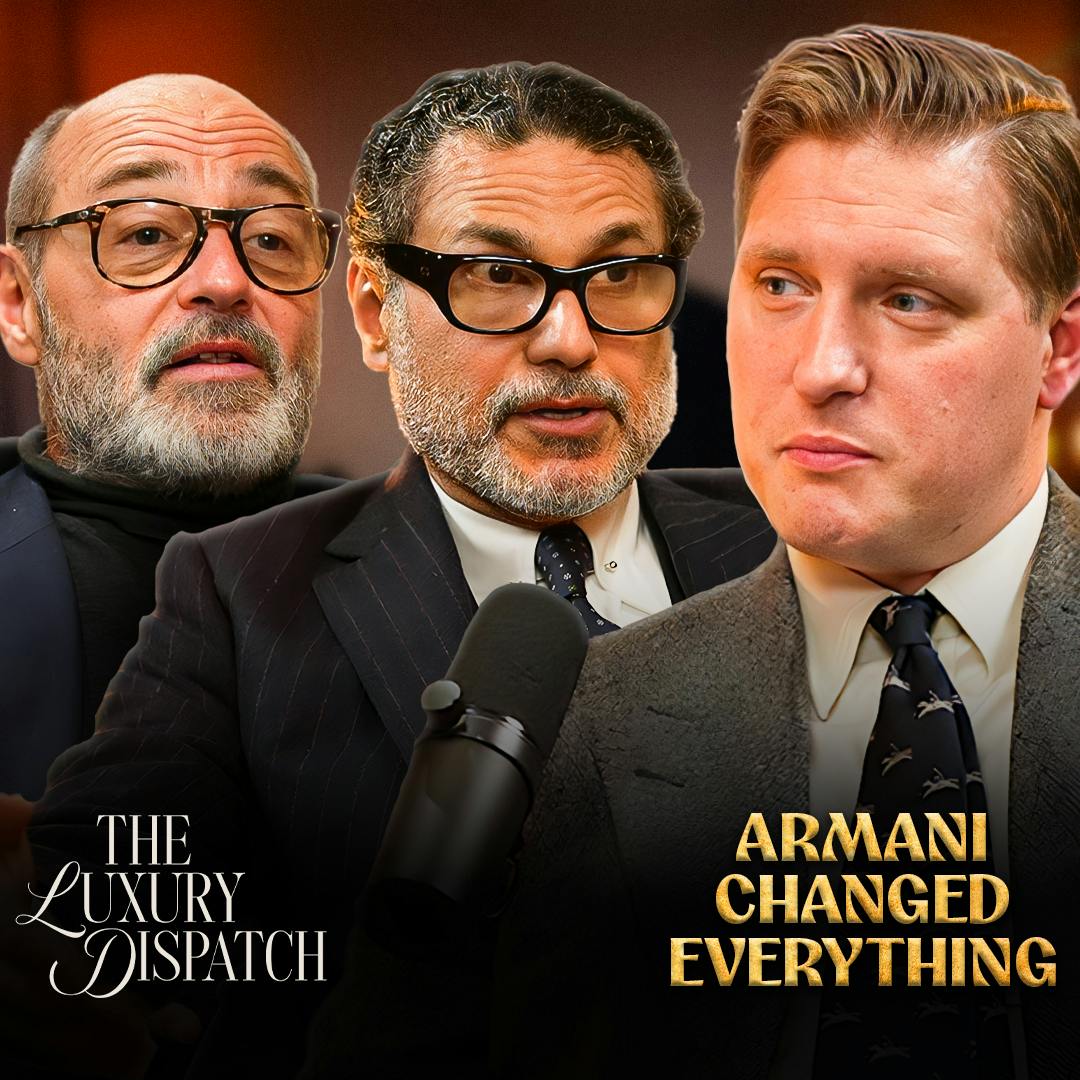
Giorgio Armani: Fashion, Film & the Revolution of Tailoring
50m 8s
Giorgio Armani fundamentally transformed the global menswear landscape through his revolutionary approach to tailoring. Growing up in wartime Italy, his childhood was marked by poverty, danger, and a life-threatening accident that left him with a burn scar, experiences that fueled his relentless work ethic and obsession with looking impeccable. His mother instilled in him the idea that personal appearance reflects inner dignity, a principle that guided his career. After studying medicine briefly and working as a window dresser, Armani learned the craft of tailoring at Nino Cerruti's studio in Biella, where he began exploring deconstructed jackets—removing padding and interlining to create lighter, more comfortable garments. When he launched his own label in the mid-1970s, his first collection was menswear, a rarity for a designer. His women's wear line emerged organically when women started wearing his men's designs. Armani's breakthrough came with the 1980 film *American Gigolo*, starring Richard Gere, which showcased his effortless, modern style and made him Hollywood's first fashion designer. This film, along with over 400 others, cemented his influence on cinematic style. Armani's deconstructed jacket, which he refined season after season, made tailoring feel like wearing a cardigan—easy, elegant, and accessible. He changed not only Italian tailoring but the entire perception of luxury clothing globally, blending Hollywood glamour with Italian dignity to create a timeless, global aesthetic.
I'm only didn't just change the way that the Italians regarded tailoring. I would say that he changed the entire menswear landscape globally. Took him a long time. I think he was 14 when he started. It wasn't his 40s. Yeah. It was absolutely revolutionary what he did with Mac and Jeklo. Wolf of Wall Street, the dark night, shaft. I mean, 400 films or something. I mean, it's. Right, no, that's not true. Rodinry. His first collection was menswear. And then he did women's wear because his sister and her friends kept on wearing menswear. And our money would say there are times when I'm in fashion. Yeah. And there are times when I'm out of fashion. But I'm always our money. Hello and welcome to the luxury dispatch. The podcast that reveals the refined and the rare. The people, items and stories that make up the luxury industry. I'm Tom Chamberlain. And today we turn our attention to one of the most influential figures in fashion history. Georgiou Armani. From his revolutionary approach to tailoring to his enduring impact on how the world perceives luxury clothing, Armani has defined elegance, restraint and power in style. From the catwalk to the silver screen, from classic tailoring to modern interpretation, we'll uncover the story of Armani like never before. We shall also be exploring how he became Hollywood's first fashion designer. Joining me to navigate his life and legacy are two exceptional guests, Peter Howarth, a leading expert on Armani who will guide us through the evolution of his designs and his remarkable influence on luxury menswear and women's wearer like. And Hannibal Z. Film producer, philanthropist who will also explore Armani's indelible mark on film and television where the brand has become synonymous with on-screen sophistication and cinematic style. Hello, Peter and hello, Hannibal. Hello. Big topic, small time to some extent. So I apologize because I know that this is a topic that is close to your heart. And you knew Georgiel Manny. I did. I did. I knew him very well for about 30 something years. I was the editor of a Reen magazine and a Squire magazine in the late, the late last century, early this century. And through that, it's been a lot of time traveling with him and then subsequently on various kind of journalistic gigs as it were. So I knew him very well. And he wasn't an easy man to get to know. But I found him always just a fascinating study really. And his story is incredible. I mean, it goes right back to the Second World War when he grew up initially. Yeah. So this is the thing that's really important about Armani is, we fashion designers are now a thing. We know their names, their interviewed, their magazines. But you've got to think back to a time when fashion designers were not. You bit quit us in popular culture. And so you obviously have people like Coco Chanel, you know, there are a few. But it wasn't really part of popular culture. So he was born in a town near Milan, a Corpiachenza in 1934. He had an elder brother, a younger sister. His father was a civil servant. And his mother was a housewife. But it's 1934. Yeah, interesting time for Italy. There are things happening. And this is the thing. It's like the designers now that come out of St. Martin's and they're very concerned with their social media profiles and this. And Armani's origin story is completely different. I remember talking to him once about his childhood. And he was explaining that his father ended up in prison because he was part of the fascist movement. As everybody was in Italy at that time. And so his mother was looking after them. And she used to go out to relatives in the countryside, friends and relatives to kind of forage and get food and supplies during the war. And she would smuggle them back, pass the German patrols by pretending she was pregnant and stuffing them up her dress. Really? And he told this extraordinary story about how he and his friends. And I think he was, you know, six, seven, eight. We're playing one day with an unexploded shell bomb. Wow. And the thing went off and it killed his friend that was next to him. And it burnt him from head to toe. He was blind for six weeks in hospital being sued in the vat of alcohol. And just, you know, that sort of experience is extraordinary. I mean, when he was telling me that story, he rolled up his trouser leg and he said, "You see this?" And there was a little burn mark. He said, "You know, it's skin memory." It was where his buckle from his sandal was burned into his leg. And, you know, people always say about our money that he was a worker, Hollick. You know, and I know from being on trips with him, you know, first in in the morning, last out at night, you know, totally focused, totally dedicated. And at a certain point, you kind of ask yourself, "Where does that come from?" And, you know, if you want an answer, you can look back at that kind of experience that, you know, don't want to be pseudo-psychological about it. But, you know, there is a sense in which, you know, you know poverty, you know privation, you know danger, you know life-threatening things. And one way of dealing with that is to work your way out of it. And I think that's what he did, his entire life. Yeah, amazing. And the context of the Italy he grew up and was really important. And of course, Italy had ill-boom and it sort of unexpected financial revival. So Italy at the time of ill-boom, you know, was dressed, something that was something that Armani would have grown up with, understanding and getting a sort of sense of Italy, or do you think Italy was still trying to find its way? I think it took a few years. I think the war ended. The economic mercury referring to took a few years for it to take place. And he grew up at a time that there was long lines for bread and for food. Italy was destroyed as well. But his mother, Mara, understand really instilled in him the idea of always looking your best, always being neat. And she evoked him the sense that it reflects an inner dignity, basically. But what influenced him was a cinema. He was in love with films. So the cinemas in Picasso were showing films from the 1930s, 40s, and well, like 30s and 40s at that time. So he was influenced by looking at the sort of elegance of categorized suits, of the gowns, of. He actually liked American Westerns, first of all. Really? Yeah. And then kind of moved into the Hollywood Silver Screen, and then into the near-realists. Exactly. But they were gods, you know, they were gods of the Silver Screen. And very different to the. To what he was growing up with. And it's interesting because you have that sort of Hollywood glamour, right? Computer Feynman, and at the same time it was beginning to produce the Italian Neurodism, in which normal people, it was. There was no studios, it was filmed on the streets though, you know, we thought it the sickest sort of films were. But it also showed dignity in what they were doing. So he was influenced by both of them. There's an interview in which he said his biggest influence on what he later created was Hitchcock's Notorious, which is. Oh, it's really that right. It's a very, very. See, I was going to ask whether do you think he was more aligned with, you know, to seek a Pascellini and all the kind of the Italian film makes the camera out of the film. Or do you think, as you say, he's in, she loved his Westerns. And obviously, Hollywood is still very much in charge, for instance, of the cultural output of that tone. So what do you think he aligned himself with? All perhaps both, both. No, both, definitely both. I mean, that's. I mean, you know, the hadn't actually thought about it until this very moment. But one of the things that is so interesting about Amani is that although, you know, for many people, it's a kind of byword for Italian style. It's actually a global style. Because, in a sense, it's an amalgamation of a fantasy of elegance that's forged. I mean, you know, interestingly talking about Italian culture. And of course, you know, Italy is the land of Bella Figuora. Okay. So, you know, and the passage at this idea that, you know, on a Sunday, you go and you walk down the main street in your finest clothes to say hello to your, you know, friends and. Shurred church. And you show that you're doing okay. You know, you show it as an outward manifestation. And I think it's Norman Lewis's Naples 44 book where he talks about, you know, Naples being completely devastated. But the, you know, impacunious aristocrats in their, you know, delapidated palazzo still dressing up in their finest tailoring to go out. And you have to remember that, you know, a brand like Brioini, you know, elegant, extraordinary tailoring. I think started in 44 or 45. I mean, right at the end of the war, I mean, it wasn't. Had a time when people couldn't. I think I read Jay McInerney or somebody on Brioini at some point saying, you know, people couldn't afford food, but they still go and buy cloth for their suit. So I think deeply, I mean, you mentioned quite rightly his mother who, you know, he, you know, absolutely kind of forged this idea. She had this saying that was, you know, it was something like, you know, to create true beauty, you know, only do so much, but no more. It was this sort of lesses, more, lesses better. Well, that's just considering, Armali, that's a really interesting. Exactly. Yeah. I mean, the other thing I was going to suggest, do you think perhaps the disfigurement as a child gave him an obsession of looking amazing? Wow. Who knows? I mean, I know that he was fascinated by anatomy. He was always, you know, as a kid, he used to make little dolls, and stuff, and he went to medical school. Right. Oh, is that right? Yeah. Yeah. He went to the University of Milan. He. Yeah, he dropped DC dropped house. He did drop it. Yes. The interesting thing, the thing that inspired him to become a doctor was AJ Cronin's The Citadel, which if I'm right, is saying Wales. It's a rural doctor in Wales. OK. And he read this as a young boy and thought, that's what I want to do. You know, I want to go into the community and be this kind of heroic, you know, kind of life-saving figure. But he dropped out. He was, his studies were, I think, were interrupted by a national service, which he did. But then after a national service, I don't think he went back to university. And he says he had a problem with studying. You know, he just couldn't apply. He just didn't apply himself. It wasn't him. And so he was trying to work out what to do. And again, you know, at a time when fashion designer was not a job, he went to the department store, big departments, were still there in Milan, the premier department store, which is called Lairi Nascente, I think. And he had this notion that he might be a photographer. And he'd taken some pictures of his sister, who actually subsequently went on to become an actress. And he turned up to see the woman who was head of marketing or something, and said, "Here are my pictures," whatever. And she kind of looked at them and said, "Well, they're very good." But you know, you're kind of clearly interesting, you know, how about coming and working here? And that's how he became a window dresser. And finally enough, you know, he did say to me once that, you know, he basically has always had a great deal of success with women, you know, that he was very, you know, I suspect he probably flirted with her. He said, "You know, we spent a lot of time going out and having coffee." So he was charming. He was charming. Absolutely charming. But that was his entree was to become a window dresser at a department store, whereas the kind of young gun on the, you know, the block, as it were. He then started to work with the buyers, trying to get them to buy interesting clothes to sell to men in Milan. And that's how he then came to the notice of Nino Shiruti, who was a fashion designer, who kind of hilariously had a label called Hitman. OK. And Armani went to work for him and sort of learnt his trade in the studio of Nino Shiruti. So he had a sort of securitus route, like a lot of teenagers, I suspect, and really now what he was going to do, once the doctor dreamed vanished and found his way into this kind of world. And when he started, Armani, did he have a sort of an objective in mind? Well, it took him a long time. It wasn't as 40 as you know. Oh, he gots, OK. So there's a big, there's a big kind of gap. He worked. He worked. So he did, he did the, OK, so right. Mokunjud Laws in the United States. Yeah. He started, I mean, George Ormani, 75. He joined, he went to Beella to join Siruti in the early 60s, and really worked. And the fact is the fabrics, the construction, really learned the craft basically. Yeah. And actually Shiruti-- Because Beella obviously is the capital, for those of you know, it's basically the capital of fabrics in Italy. The water is a very particular type. That's perfect. And every single great fabric maker in Italy is in Beella. It's like tweed. Sure. Yeah, yeah, yeah. It's like what we say about tweed. But the Shiruti, he acknowledged that Nino Shiruti really kind of set him on his aesthetic path, because it was while he was working for Shiruti, that Shiruti said to him, look, I want you to explore this idea of deconstructing tailoring. Because if you think about it at that point, 60s, early 70s, tailoring had essentially been made in the same way for generations. You know, your suit was what your father had worn. Made in the same way as-- Yeah, bodyguards and sentailers. Yeah. So interlining shoulder pads, type of cloth, weight of cloth, whatever. And at that point, there were new fabrics coming along that were lighter weight and strong. Yeah. And there were new manufacturing techniques. And Armani took this to heart. And while he was at Shiruti, started to explore with this idea of taking the pads and the padding and the interlining and taking it out, could you still create something that had some structure but felt very comfortable? Very nice example here on Wacken, obviously. And when he started his own label, that became his holy grail. And he talked throughout his entire career of the deconstructed jacket as being the thing that he returned to every season, playing with, trying to make it lighter, trying to make it comfortable. He said, you know, I want a jacket to feel like you're wearing a cardigan. Odd enough, it feels like every subsequent talent design, it feels like they've also wanted to try and take on that challenge too, as if to kind of, you know, do their own version of that, maybe. I mean, difficult to name names because they might-- Right. --were a bit late to an eye. This is the case. But it feels like, especially in Italy, I mean, we talk about on Sundays, people going out. Because I've always said that it's halons wear ties in the way that they don't wear ties. It's exactly the same. There's no difference. Whereas in Britain, if you put on a tie, there's like an intent behind it. There's a messaging behind that, so-- That's the Torah. Yeah, sure. It's the look as though you don't care. You're not trying hard to do that. No, but I mean, you're completely right. But it's not just Italians. I mean, there are different traditions initially. The neopolitan tradition is slightly more stronger. But-- It's a geography thing, isn't it? Because you go up, because there is Roman tailoring, there's Florentine tailoring, there's Millenine's tailing, and they're probably like-- it's all different and quite territorial. But I would argue that it-- I'm only didn't just change the way that the Italians regarded tailoring. I think-- yes, because you were saying, honey, he started it in the mid '70s. I mean, it didn't take him long to make a huge impact clearly, because along came American Jiglo, in 1980. I mean, do you remember when you first saw American Jiglo? Yeah, I saw him when it came out. I was an only child. So when I came to London or Paris, I just saw everything I was allowed to see. And Paris was different to London. I was allowed to-- they had different restrictions. So whereas in the UK, this was x-rated in the old rating system. There it was. If you were above 13 years old, you could watch it. So of course I did. And I was captivated by it completely. I mean, from Blondie singing called me to the scene of which he's put in the clothes on. And that just was explosion in my mind. Do you remember? So people always talk about that scene. Because essentially what he's doing is he's acting like a stylist. He's pulling out-- Precisely. --the shirt and the ties and putting them on the bed and matching them up. Rather like he would have seen-- I mean, so he Richard Geer would have seen Armani do put some stuff together. Well, there's two things I have to say about American Geer that many people don't know. One is that John Travolta was originally cut in the role at just off the back of Greece and Sassley Night Fever. Probably. It would have been Greece for up in 178. So he was casting that and he turned it down. He and but he came. He turned it down. He turned it down. He had shed your lit. But I think he came to Milan for a fitting. I think Armani did 40 suits or something with Travolta in mind or whatever. He did the Urban Cowboy instead. But the art-- That's interesting. That's really interesting is if you watch that scene again, I think it's Smokey Robinson that's playing in the soundtrack while he's doing his styling. But he's snorting cocaine throughout the whole thing. Oh, Richard Geer. Richard Geer. All right. He's snorting cocaine on screen while he's putting his outfits together. I didn't get that one off 13 years ago. People forget that. And I just think it's fascinating. It's interesting. 1980. So the context of films-- Film styling because I know that you are a great fan of the Thin Man. And films that sort of go back to the very early years of cinema full stop. The styling back then was incredibly tailored. Like it was super sartorial. If you look at Cari Grant, if you look at Bogart, or if you look at-- William Powell. They were impeccable. William Powell was amazing. The contrast between what was then going on in the '80s and the Armani managing to get a foot into Hollywood. Let's talk a little bit about that. I said that a bit, because you had an expression of style that was incredibly old fashioned, elegant, sophisticated, but at the same time quite alienating. And then suddenly, in the '80s, you had the style that people thought I could do that. You're absolutely right. It was, first of all, the previous style, you'll have to go to Savile Row. And you have to know what you're doing to be able to achieve the result, right? Esanna's silly, easy to get. But what Armani did was easy, effortless. It was close that people wanted to wear. It was not formal, but it was exceptionally elegant. And it caught on very quickly. It was absolutely revolutionary, what he did with American Jiglo. Yeah. And I think it's very important also to say that in 1975, when he kind of launched-- I think his first show was in '76-- was a men's show. It's very unusual for a fashion designer who is known for-- I mean, Armani is one of the few designers who's equally known for his-- Absolutely. It's very unusual for a fashion designer too. The other thing, who do we think Ralph Lauren-- Yeah, Ralph Lauren. Dolce and Obama. Yeah. At some point, I would say Versace as well during his lifetime. But most of them, Valentino, would really be known just as a woman. I mean, he's gonna run.
and your many women's Chanel, of course. - Absolutely. - Pan and Sialga. - Yeah, but Siala Ron and Dior do do men's, but what they're known for. And most, I guess most global fashion houses are probably known for their women's wear first, but his first collection was men's wear. And then he did women's wear because his sister and her friends kept on wearing men's wear. And he thought, "Oh, I can do a different sort of women's look." But still using the deconstructed tailoring things, softer jackets and trousers suits. And so it was that kind of bourgeois. I mean, that's also very interesting because by the time you get to the '70s and '80s, it's in a bit of a mess, I think economically and politically. And I remember talking to him about the imagery that he created around that time, which is still very famous. Those black and white pictures by Elder Falae, which had guys reading Lastambe in the square by the Dwomo. But he said that he and this photographer Elder Falae very consciously wanted to project an image of a successful and he used the word bourgeois, Italy. It was a branding statement. He wanted to show the world that they weren't a political and economic basket case. And I think that's fascinating in a way because there's a sort of class element to that. Which goes back to Bella Figuera and walking down the Pazza Giata and showing your best, you know, how do you show the world your best foot forward as Italy? You show a kind of, it's a kind of industrial, northern Italian, very different from Versace, which is all Roman, you know. But when you're talking about, you know, 1980, he only, he'd started in '75, he only went to America, closed only launched in '79. So how did he get his foot in the door? Well, he was asked to do the film by Paul Schrader. So I have no idea how Paul Schrader found him, but he was asked to do the film and he thought, I love cinema. This will be fun. He had absolutely no idea that it would be the kind of step change from a marketing point of view. 1982 is in the cover of Time magazine. Okay. The first designer since, I think since Christian Jewel to be on the cover of the magazine, I mean, extraordinary. In that short, not even 10 years old as a brand. And so he did American Jigalot and he was completely gobsmacked by the impact that it had. And that's really where fashion's infatuation with the cinema and by extension, the red carpet and all the rest of that we've come to know started. So when I've kind of said, he's Hollywood's first fashion designer. That's not hyperbole. That's probably right. No, there were some people like Ivan Schien, people like that who did Audrey Hepburn. Yeah. Jivonshu will be the one, but then again, these are culture pieces. These are, you know, not, not necessarily that easy to do. Not of all, he couldn't find them in a store was, this was a collection. This was something you can actually buy. And think about that scene where he's laying the things out on the bed. He's doing it himself. The AI is great. So, so there is a subliminal message, which is you can go and buy this stuff and you can do it yourself. And in the 80s, very colorful and, you know, bombastic decade, technology was everything. You know, people were going, you know, to, you could see, certainly with synthetic materials and stuff, they were, they were produced as a pretty wacky outfits and stuff. People were extraordinary hair. And, you know, the music scene was, you know, a flight of four people. You lost your sea, you lost your sea, girls, and you're a man to say, yeah, at least second, the new man to say, very, very different, statistical, to reach what our money was doing, so did he come to late, did he come at the right time, what was the. Okay, so yes and no, you're speaking as an Englishman. You know, early 80s Englishman, you're thinking about the Blitzclub and the Neuromantics and Edamant and all that kind of stuff, human League. Human League. Yeah. Part of that as well was an infatuation with old school, Hollywood glamour. You know, if you think about the Ultravox video for Vienna, you know, people are dressed up in tuxedos and this, so Armani could sort of fit into that, but the parallel fashion story of the 80s is Wall Street. It's suits. It's, yeah, it's greed is good. It's, you know, it's the suit, shirt and tie. It's the apotheosis of the double-breasted suit, you know, and that's what Armani was taken up by professional men and women. The women, it was a revolution in women's wear because women for the first time had a wardrobe that could compete sartorialy in the workplace. Yeah, with the men they worked with, they didn't have to be feminine and dress as women. They could be powerful and, you know, they'd be. And Armani provided that wardrobe very, very significantly. So in a way, he's just as much part of that. I mean, if you talk to somebody, what's the typical 80s outfit these days, you know, most people aren't going to talk about the neuromantics. They will talk about Michael Douglas. Yeah, I'm Eric Clapton coming to the record, looking like the way he did. Exactly. You know, people, people were adopting that a lot. It's a ten, it's a ten-year period. So the part you referred into was the absolute early 80s. Wall Street was 88, I think, before the Untouchables was 87. Yeah. Yeah. So very different. Very different. In America, Jigland, and I saw from a styling point of view, from a silhouette point of view, very different. Well, different. I mean, of course it was, it was in the needs of the twenties. It was nice. But also, he was also involved in Miami Vice. Yes. So people just think of Versacee, but also Armani provided a lot of the suits. Whereas Versacee was doing the pastel colors. Armani stuck to his usual palette and the suits were, they were being used there at all. And Miami Vice was in the houses of everyone across the globe. So everybody saw American Jiglo, for instance. But everyone watched Miami Vice. That's true. And that would have started in early 80s. I think 83 or 84 was the first season. So that would be way before the Untouchables. So he cemented this position between the release of American Jiglo and the Untouchables with Miami Vice. Because it kind of feels like therefore the Armani soon enough became almost a shorthand for men's style. It's casual. It's elegant. It's sophisticated. It is, it is something you can work to go out on a Sunday. Very relaxed. It's expensive. For the time, yes, but not eye-wateringly expensive. And you can still find the T-shirts and the basic things were not selling to expensive. And he also launched jeans later on. He launched the Emporia Armani Collection, which was adopted by the, you know, the Paninari in Milan, the kids on the scooters with their Timbalands and Levi's and Emporia Armani with the Eagle was one of their kind of a bit like the hip-hop crowd he took on Ralph Lauren in New York. Exactly. But yes, a shorthand for men's style, I think, is absolutely right. And there weren't so many designers. Yeah, there's very true. If you walk down a, if you walk through an airport now, think about the ads, think about the names, they become household names, all of these. Yeah. They were fewer. And not every design even had their own stores back then. I mean, that's why department stores were huge playing a massive role. The fact that you can, everybody had their own specified store across the globe was a new thing. That didn't start a much, much later on. Yeah, of course, because everything was going in sacks. And yeah, you'd go to sacks, you'd go to herds here, other places. And it was in the mid-80s that they started having their own stores. And you know, your point about a sort of shorthand for men's style is, you know, it's really crucial really because aesthetically as well, you know, we talked about how Armani was easy to kind of style and put together. But one of the appeals, eternal appeals of Armani is that people just look good in it. You know, they, it's in a sense, he's a safe pair of hands. And he would talk about when the red carpet thing, which became the, you know, the consequential, you know, the next step from being on the screen was to be the red carpet thing. And he would talk about it, particularly in the 70s about how the young women, you know, on the red carpet were tired of being, he was told them kind of like wedding tape dresses. They were tired of being trust out. So, you know, he, he, I'm, is it Julia Roberts? Julia Roberts wouldn't her Oscar wedding suits. War, war man suit. Right. Yes. And taking Jodie Foster from being on the worst dressed list to the best dressed list in, you know, for in a year by putting her into a copper coloured tuxedo and whatever. But he would talk about the red carpet and he said, think about red carpet is, you know, somebody can put Armani on and they're going to, they're never going to regret it. They're never going to look at that picture in five years time and go, what was I thinking? You know, because basically he, you know, his concern, he used to talk about how he never wanted to overwhelm or disguise the wearer. He won't. Okay. So that's interesting because I would say he was a little bit risky by creating these oversized silhouettes that he did. So for example, Frazier. Well, he was never, he was never, you know, Armani would talk about himself not as somebody who was not particularly interested in fashion, interestingly enough, that what he was interested in was eternal style, style, rather than fashion. And the difference being that, you know, fashion follows trends and fads. And if you get caught up in trends and you start following trends, you can get very lost because you flip flop and you go around it. So he was like, well, I'm always Armani. Now having said that, you know, he's not
immune to the culture. So those oversized, miles crane suits were 1980s suits. 1990s, I think. If you look at, you know, they were not weird for the time. Exactly. Everyone was there. Okay. Should have had the same thing, but it's such a. That was unfortunate to look. So, okay, so he was so much lean the way it's just being a part of the culture. It's probably not the culture. Okay, so I would say that it's a wise thing for him to say that there's not interested in fashion because my feelings that men in general aren't either in terms of what fashion is. I think, you know, if you look at the Gillette ads in the 1990s, right? You know, it was all about, you know, professional men who shaved with their floppy head just with good getting a shirt on and where it was our money suits. I mean, I mean, all our money looking suits. It was that kind of. But it was very much about, you know, business and success and achievement. Yeah. That was the messaging using men, all of whom. It wasn't as interested in fashion, but it was just a professional topic, which I think makes up a vast constituency of men. Most of us aren't actually that interested in fashion. We are more interested in just looking nice when we put a jacket on or a jumper or a pair of trousers on. And so there is a fairly well-set code that can help achieve that. And it's just interesting that a fashion designer. Because he was referred to. He's referred to fashion as a fashion label. We'll prefer it back to those codes. We'll probably. The most famous fashion designer by name in the world, I would suggest. But he would have. He talked about elegance and style rather than fashion. Yeah. He saw fashion as something that was ever changing, but he was about elegance. And that, in a sense, can go back to. You know, when we were talking earlier about. When he started and he wanted to present this idea of a kind of successful and bourgeois Italian look, goes back to Carrie Grant. It goes back to, you know, those kind of screen idols. It's eternal elegance. And laterally, it was interesting because, of course, you know, the narrative favored him in the sense because later. He was very vocal during COVID about, you know, when we come out of this, we have to bear in mind that we've been making too much stuff. And, you know, we need to. We need to make less and make better. We need to buy less and buy better. And you can only do that if. Number one, the thing is good quality in terms of what is made from and how it's made. But number two, if your aesthetic is designed to last. Because if your aesthetic is designed to date, which is actually fast fashion, is, you know, built in obsolescence. It's a default setting for fast fashion. I need something new. I haven't worn it out, but I just need something new. I mean, it's hard to be perennial. Yes. It's hard to just make something that will last forever and be. And it's also relevant forever. I think culturally, as well, it's particularly hard because there has been such in the last sort of 20 years, this building demand on, you know, the creators to do for newness. It's all about the new. Yeah, that's very true. And so to actually have the presence of mind to say, "I'm not going to buckle to that. I'm not going to follow that just because you're all telling me." So, you know, there are. You know, our money would say there are times when I'm in fashion. Yeah. And there are times when I'm out of fashion, but I'm always our money. Yeah. And I'm not going to be a member of the company. I'm not going to be a member of the company.
a kind of Armani universe, you know, like applying this aesthetic, elegant aesthetic, to the way he saw the world. It was a philosophy. It wasn't just about making clothes, it was a philosophy. And I would say that probably more than any other fashion designer, with the possible exception of Ralph Lauren, but Ralph Lauren, I see much more like a movie director, stylist kind of creating, you know, a kind of. - A tablo. - I think so, yeah. - Whereas Armani, I think, was intimately involved in the. - In order to be. -. thing itself. But I think he created that universe, successfully created that universe. And Armani Hotel, and Armani Restaurant, and Armani Cafe, and Armani Sofa, and Armani Red carpet outfit, and Armani Piece of Ready To Wear. It is all of a piece. And when you want to talk about brand, successful branding, that's extraordinary. You know, that is absolutely extraordinary. And it entirely authentic, entirely from him. And he told one fantastic. He was in China very early, very, very early. And I can't remember the year, but it was, I mean, really early, 80s maybe, even. And he tells this story about how he went to China. He's like, "I'm gonna have a red door, 'cause it's China. I'm gonna have a green door." And the Chinese didn't want Armani from Milan to have a red door. And he said, "Oh, no, they want me to be Armani." So, yeah, when he kind of did nodded to it, it's like, "Oh, no, no, no, no, no, no, no." Interesting. So, that's fascinating. I mean, my fascination, in some respects, stems from the fact that this guy from. You know, a fairly, well, modest background in Piazzanza ended up being, you know, just. Just striding the world. That's quite extraordinary. I can be agree. He succeeded and he created a clear DNA of what his style is. It's unmistakable. And he followed throughout his entire career. He succeeded in becoming a designer that does amazing and beautiful clothes for both men and women, using a specific style, very unisex. Same tones, and you can trace his style as being a continuation of the same aesthetic, basically, throughout over the last 50-odd years. And to me, the fact that he succeeded in a very difficult business, which is hospitality as well. And in manufacturing furniture as well, is just incredible. There's nothing quite like that. And as much as I love and respect Raflorn and what he does, Georgia created something that was his aesthetic, his look, his feel. And yeah, it's incredible. So, honey, you saw Amari once in your journey. Right, Chaconis in 2000. For those who could say, for those who don't know, Chaconis is a very, very, very in-demand restaurant in Bang in the middle of Mayfair, which if you can get a table there at any point, then the world done you. It's heyday was certainly when you opened and owned it. And so anyway, sorry to interrupt. I just think it's a good giving context. So, I was there every day. And we had people from Clinton coming to Madonna everybody. And usually, by then I was already a few years in the business. And I was completely comfortable and happy and relaxed about anybody coming. The only time I was thirst struck was when Armani arrived. And I was, I don't know, it was the guy had presence. And I still remember 25 years on when he actually ordered the other chicken pie out and had mint tea afterwards. And I was just, I was from far away observing and making sure that nobody dropped anything. Who's going to be sitting in the table next to him, just orchestrating the whole thing. And I had to get all my, I'm like, okay, if you don't go and say hi to him at the end, then he may have never got this chance again. And show at least I did go briefly and I didn't ask. So how was he dinner? I just welcomed him and thanked him for coming and I left and thank God I did because I never saw him again. But he was exceptionally charming, very polite. Didn't seem much in English at all. And he left a nice tip for the guys. So it was lovely. Very good. That was very funny. I mean, the, yeah, the, the, the order, amazing that you remember it. But he used to eat very well. The food was always, you know, was always healthy and fresh ingredients. I actually had lunch with him once. I think it was in Los Angeles with a group of people at the end of it. He said, my, I'll get this wrong literally because my Italian is non-existent. He said something like, be there. Manji Trabbo, which means you eat too much. It's so, it was kind of funny. I mean, the first of all, he was right. But what was funny was he's a stop. He's one old chef. Thank you, Tom. We're not worried about it. But, but it was funny because, you know, he wasn't being rude. It was a statement of fact of, it's very interesting. You know, you say he's very polite, very, very reserved, very, you know, very much, you know, didn't speak English, although I always suspected he spoke much more than he pretended. Because if you were interviewing him in English, he'd sometimes answer before the translator, you know, a bit of a giveaway. But he could say something like that because he was Georgia Amani. He's loud. Yeah. He said what he thought. And he had this reputation, particularly, I think, with the, you know, the Italian press every now and again, and he was just saying stuff because he, and as, as he got older as well, just because he didn't care, just would say what he thought. Say, say how he saw it. So, yeah. Manji Tropu. Super. Well, look, the objective, I think, for this podcast, is that anyone who puts their headphones on and is on the way to work or is doing tours or errands of any kind, finishes up, learning a lot more than they started with. And I cannot imagine anyone would have listened to this without being enlightened one way or another about this extraordinary man. We've all heard the name, but the backstory and the kind of the inside tales that we've been discussing, I think, has been fascinating. And I couldn't be more grateful for both of you for coming down. You must come back and we'll do more, lots more. But in the meantime, I appreciate your time, efforts and knowledge and thank you very much for coming along. Pleasure. I remain Tom Chamberlain and this has been the luxury dispatch. The podcast that tells the stories you didn't realise you wanted to hear and answers the questions you haven't yet thought to ask. If you've enjoyed our journey through the lifetimes and enduring influence of George R. Amani, please do like, subscribe and leave a comment. We love hearing your thoughts, agree, disagree or suggest other figures, designers or facets of the luxury world you'd like us to explore. No review will go unread. Thank you for listening and happy dressing.
Podcast Summary
Key Points:
Giorgio Armani revolutionized tailoring by deconstructing the traditional jacket, making it lighter and more comfortable, aiming for a "cardigan-like" feel.
His early life, including wartime poverty, a near-fatal accident, and his mother's emphasis on neatness, instilled a deep work ethic and focus on elegance.
Armani's first collection was menswear in the mid-1970s, and his women's wear emerged from women wearing his men's designs.
His breakthrough in Hollywood came with the 1980 film *American Gigolo*, which showcased his effortless, modern style and transformed on-screen menswear.
Armani's influence extended globally, changing how men's tailoring was perceived in Italy and worldwide, making him a key figure in both fashion and film.
Summary:
Giorgio Armani fundamentally transformed the global menswear landscape through his revolutionary approach to tailoring. Growing up in wartime Italy, his childhood was marked by poverty, danger, and a life-threatening accident that left him with a burn scar, experiences that fueled his relentless work ethic and obsession with looking impeccable. His mother instilled in him the idea that personal appearance reflects inner dignity, a principle that guided his career.
After studying medicine briefly and working as a window dresser, Armani learned the craft of tailoring at Nino Cerruti's studio in Biella, where he began exploring deconstructed jackets—removing padding and interlining to create lighter, more comfortable garments. When he launched his own label in the mid-1970s, his first collection was menswear, a rarity for a designer. His women's wear line emerged organically when women started wearing his men's designs.
Armani's breakthrough came with the 1980 film *American Gigolo*, starring Richard Gere, which showcased his effortless, modern style and made him Hollywood's first fashion designer. This film, along with over 400 others, cemented his influence on cinematic style. Armani's deconstructed jacket, which he refined season after season, made tailoring feel like wearing a cardigan—easy, elegant, and accessible.
He changed not only Italian tailoring but the entire perception of luxury clothing globally, blending Hollywood glamour with Italian dignity to create a timeless, global aesthetic.
FAQs
Armani was born in 1934 near Milan, Italy, during the Second World War. He experienced poverty and a traumatic incident where an unexploded bomb killed his friend and left him burned and temporarily blind.
He began as a window dresser at a department store in Milan after aspiring to be a photographer. He then worked for designer Nino Cerruti, where he learned about fabrics and tailoring.
The deconstructed jacket removes padding and interlining for a lighter, more comfortable feel, like wearing a cardigan. Armani made this his signature by exploring new fabrics and techniques.
The 1980 film, starring Richard Gere wearing Armani suits, showcased his effortless, elegant style to a global audience. It revolutionized menswear and made Armani a Hollywood icon.
His sister and her friends frequently wore his menswear, inspiring him to create a women's line. This made him one of the few designers equally renowned for both men's and women's fashion.
He was influenced by Hollywood glamour and Italian neorealism, as well as his mother's motto of 'less is more.' His childhood experiences also drove his intense work ethic.
Chat with AI
Loading...
Pro features
Go deeper with this episode
Unlock creator-grade tools that turn any transcript into show notes and subtitle files.
 PodcastTranscript AI