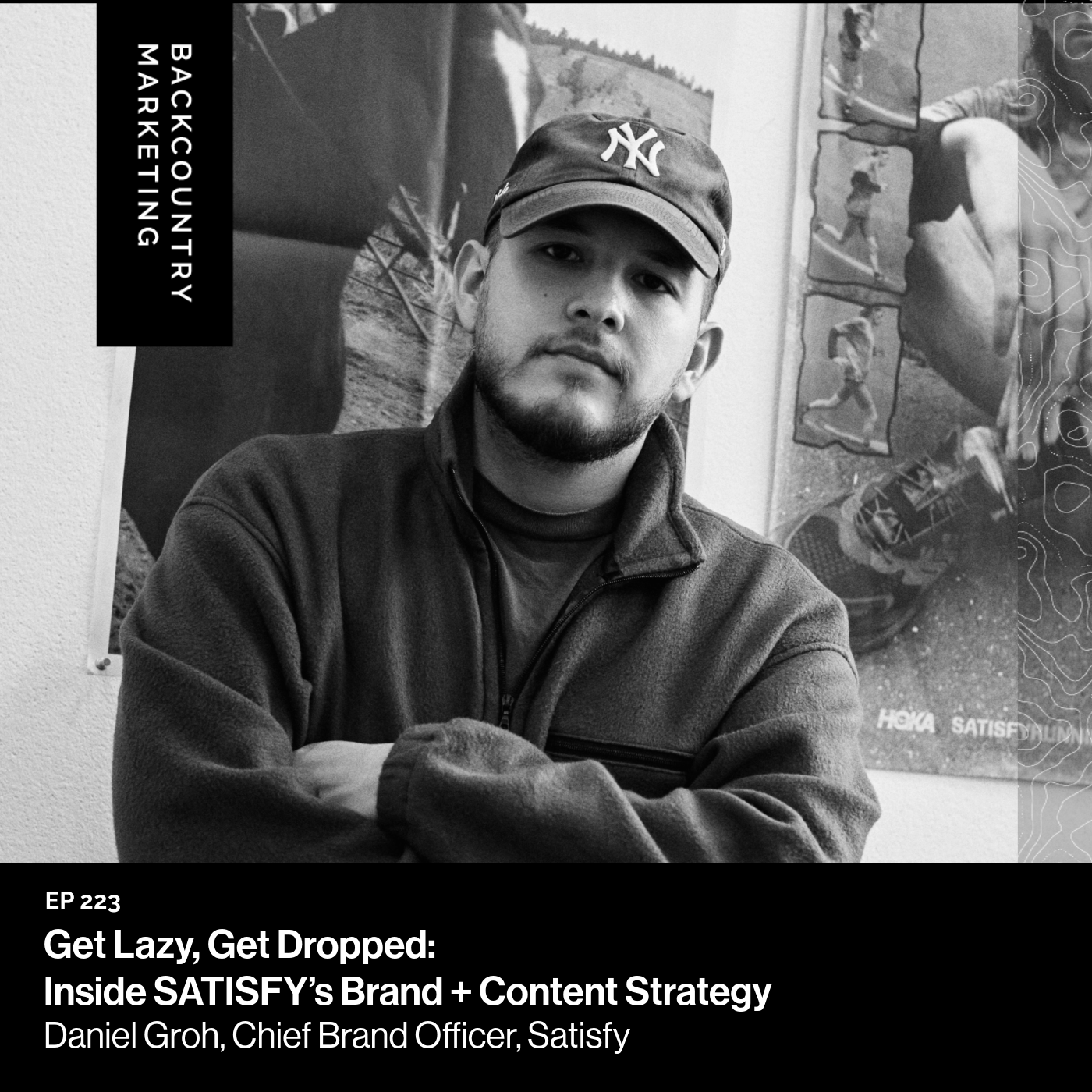
Get Lazy, Get Dropped: Inside SATISFY's Brand + Content Strategy
59m 39s
In the discussion, Daniel Groh emphasizes the importance of continuously nurturing brand loyalty rather than taking it for granted. He highlights the podcast "Backcountry Marketing," which delves into creating effective creative work. Satisfie prioritizes referring to customers as guests to enhance the sense of hospitality and care in their interactions. The company's approach involves creating engaging content that sparks emotions and resonates with the audience, leading to increased shares and interactions. The brand's strategy includes focusing on longer-form content like films and documentaries, demonstrating that the effectiveness of content is more about storytelling and emotional impact rather than the debate between short or long-form content.
Transcription
12033 Words, 65283 Characters
The moment you get lazy, you'll get dropped. I think for us loyalty is never acquired,
it's never gained, it's something that needs to be built and continuously nourished.
This idea of full brand loyalty doesn't exist anymore. So for example,
someone chooses us for our shorts. We continue to make sure that we're providing
the best shorts for that guest. It's really about understanding the nuances of where we're loyal
and where guests are loyal to us. Everyone else is evolving, so if we stay stagnant,
we're going to lose into someone else. On this podcast, we go behind the scenes with industry
experts as they break down what it takes to produce creative work that works. If you're seeking
insights from some of the sharpest minds of the industry, this is your guidebook to producing
creative work that actually delivers. Welcome to the Backcountry Marketing podcast. Today,
I'm sitting down with Daniel Groh. He's the Chief Brand Officer at Satisfie. Daniel,
welcome to the show. Hey, cool. Thanks for having me. Yeah, thanks for taking the time. Thanks for
joining. How are you doing? Good, good. Happy to end the week with you and it's going to be a fun one.
I know we've covered a lot and so we're excited to go through all of that. Yeah, so let's just jump
straight to it. We got a lot to dig into. When you and I connected on our intro call, you kind of
set the stage with this idea of your thesis as it was kind of like simplifying marketing. Tell me
more about this idea and can you kind of give us a thesis statement to set us up for the conversation
to come? I think we landed on that just because of my background in agency where everything was
processed driven. I think both the time we got to a great idea, the idea kind of got knurled down
into something that really wasn't an idea anymore. And so that's really what kind of sparked this
anti-process, um, out of methodology, uh, what we try and apply here at Satisfie where we protect
ideas as much as possible. So for us, it's about, you know, putting away through process,
helping in a room and really being able to find that spark and then protecting that spark as much
as possible. And I think for us, it's really important to note that that spark can come from anyone
in the room, right? It could come from someone that's passing by as we're brainstorming. And then it's
that acceptance and that accessibility to where that spark comes from is really how we keep the
authenticity of the brand alive. Okay, so in this episode, we're going to dive into how you look
and view your audience, your customers. Um, we're going to talk about content and strategy behind
content. We're going to talk about creativity. We're going to talk about how to distribute all of that
content, um, but kind of with this premise of keeping it simple, um, which is such a, I,
as someone who's spent 200 episodes trying to unpack all of the elements and insights behind
great brand and and and strategy. This is almost kind of a good reminder for me of like,
maybe it needs to be simpler than we imagine it can be. So let's start with your customers. We'll
start with your audience because that's where it all starts. How do you think about them?
I think that's a really good question. And I think the biggest shift or two ways. And so first and
foremost, we don't call. And you know, I correct my team all the time. We don't call our customers,
customers or consumers and all that stuff. We call them guests. And I think that's a really
big shift for us, um, just because we want to have everything that we do come through a hospital
deal and we want people to feel welcome, want to feel people to, we want people to feel taken care of.
And calling them a guest to really make sure that we're learning that idea. I used to come from a
hospitality background. And so having that sense of welcoming and really all that stuff you learn
when you take care of a guest in a restaurant setting or in a hotel setting really allows you to
fully understand how you're supposed to make someone feel welcome. And I think that's really what
we're trying to do here at Satisfying. So that's the first big kind of shift. And so whenever
people come, uh, when they say consumer, it's always up. No, not consumer. It's, it's guest. And I
really helps people project into really how we want to speak to to the people that we, we, you know,
call our community today. The second big shift is exactly what I just said a second ago where we
speak to people. We don't necessarily speak to runners. We speak to people that run. And I think
it's that nuance that really helps us really expand what the Satisfying universe can be. I think
a lot of brands speak to runners and that really pitches the pigeon holes them into talking about
performance, talking about PBs, talking about races that everyone expects them to be at. I think having
that lens of saying, okay, as a brand, we're speaking to people that have run for years, people that
are just starting to run or people that don't run and that might run really opens us up to a lot of
stories. Um, and a lot of different almost ecosystems for us to really explore. And so I think
those two nuances of how we're looking at who we serve is really important for us to really
keep satisfied what it is and also help us grow in the years to come. Yeah, let's come back to this
idea of referring to your customers as guests. That seems like such a simple shift, but maybe a
simple shift that has such a really profound impact on well, everything that you do. Um, can you
share some examples of how that is influenced? How you interact with them? 100%. I'll give you an
example of two examples. Um, you know, experience is a big part for us at Satisfying. Experience
meaning how we show up in the real world, obviously being a D to C brand. A lot of our transactions,
a lot of our relationships are built online. Um, but so for us, it was really important to really
establish what that meant, um, on the ground, right, with with people face to face. And so we have
a grassroots, uh, format called LSD, which is a monthly run that we do in about 12 cities now,
scaling that down to almost 15, 16 mud at the end of the year. Um, and it's a format that's free,
right, guests can come in, sign up, obviously it's capped. Um, but once they come in, it's an experience
that's almost designed. And, you know, what other brands have designed for influencers, right? But
really it's how we bring that care into that experience allows people to feel welcome in a space
that they've never felt welcome before. And I'm not talking about just like, okay, here's a banana
and go on your way. It's really the best catering from all the cities that we do. It's really well
thought out. So for example, if you join us in Bali, you'll have fresh cold coconuts right after
your run. You know, if you join us in Paris, you have this amazing kind of friend's pastry that we
do with our friends at our cafe called Dreaming Man. So each experience is really localized to really
bring out the best of the city, even the routes that we're doing. So it's, it's really about bringing
this idea of care and that's something that we've started to bring across with the team where
satisfy everything that we need to be done with care and care as a service gesture. How does that
impact your content and the strategy behind your contents? Really, really good question. I think
it starts from, you know, what are we trying to land as an emotion, right? And I think what are we
trying to achieve? And so when we build our content structure, you know, a big part of our Instagram
is dedicated to a piece of content that we call Dream, right? And it's really about making people
imagine what running can be, right? Through either amazing locations, amazing storytelling. And all we're
trying to do is really land a different point of view. And as we're sitting as a room, we're trying to
think about, okay, what are the stories that people haven't heard? And what are the authentic points of
views that other brands are perhaps a little bit afraid to share, right? And so a really good example
was a couple of years ago when one of our first athletes, Mike, he was running. I feel like Coca-Dona
or he's trying to do the FKT on the Colorado Trail. And unfortunately, like many runners, he
de-enoughed, right? And for us, we were sat in a room where we're thinking about, do we share this
perspective where other brands, this is something that you put in a closet, a hush, and then wait for
his attempt next year. But we felt as a brand, together with Mike, that was important to show the
full side of running, right? To show that it's a journey, to show that you can come back from a DNF
and win the next year. And so for us, it's really about also thinking about what are the
perspectives that we want to lead in, right? And from an emotional perspective and say, okay,
maybe you haven't heard of this perspective before, but let's introduce it to you as a brand.
And ever since then, we've always shared whether an athlete finishes a race, DNF's a race,
no matter what placement they do, we try our best as as brand partners, right? And that's how we
share athletes. We're partners to them. We're at their service just as we're at the service of our
guests to help share their story. Obviously, whenever they're comfortable to. And so really we're
thinking it from that perspective of new ways of really shining light to the sport and really
being able to express emotion. And I'll say emotion a lot through here because that's really what we're
trying to land. And I said this before in another interview, we just so happen to be a really good
company that is great at building emotions that operates and running, right? I think that's our
forte and how we spark emotion. And I think you might have heard or people might say, we're polarizing
brand. And that's what happens when you spark emotion. I think if we are brand for everyone,
I don't think people will be as excited of what we do because that means everything that we do is
vanilla. So, okay. So emotion is something we talk a lot about on this podcast. And it's something that
I talk and try to champion and encourage brands to lean into the emotions. But there's inevitably
a barrier to bringing emotion into marketing and into storytelling because it always comes back to
the quantifiable ROI, all those basic business class 101 questions. How do you work through that?
Is that something that you're concerned about? Is that something like what's your philosophy
around emotion and business and how they should or shouldn't intersect? I think that's a really good
question. And I'm here to myth bust, at least from the side of my perspective, that through all of our
social media tracking data in terms of engagement, shares, likes, saves. Our athlete content is by
farther content that performs the most. And it's the content within the athlete sphere that's
sharing a story. And most likely is either anchored in triumph or despair. So two very strong emotions
that humans latch onto. And so it's either our community celebrating with one of our athletes as
they achieve something amazing or empathizing and understanding that sometimes you can't show up
at 100% and that's okay. And we'll be there for you the next time. And so my kind of myth like my
speaker phone to everyone is that emotion from what we're seeing as satisfies definitely something
that does convert, right? Because it's building that fandom around the stories that you're trying to
build. You know, whenever we're showing more, I would like to say a mode of content. So we have a
piece coming out for a winner drop in the next couple of weeks that will probably be the most romantic
running film you've ever seen, right? It's very much attached to kind of the solitude almost of what
running is like in a winner setting where, you know, it's really funny and summer. Everyone's really
chipper runs out there. But once it starts to snow, no one's really excited to go out for a run.
But how you can turn that solitude into almost something that's very beautiful and reflective.
And I think being able to communicate that emotion allows people to attach to it. And then
through that kind of chemistry, right, then the product leads. And I think what we're really trying
to do is build the world and everything that we do, the athletes that we choose to work with,
the product that we build all falls into that world. And it's a choice for our guests to decide
whether or not they want to partake or partake in the certain worlds, right? And so right now we're
in this crazy Western story arc just because what many people don't know is that, you know, people
think that we do a lot of Western stuff because we think it's cool and fun. But it's actually very
much anchored into Brisa's history. So Brisa's parents used to own a Americana store in the South of
France. So it's very much anchored to me as a person. So everything that we do is really related to who
we are as a brand being, satisfy being an extension of who Brisa is. And so right now we just so
happen to be in this Western arc. And so we're building that world, right? Who knows that we're going to
be in nine months time as we build another world. And so really all we're trying to do is build these
worlds, create these emotions that people can experience in these worlds and hopefully people
lean in and decide to partake. If not, that's great. And perhaps they'll join us in another world
that we decide to build in the future. So for the series, I think I saw you on my run. What what goal
do you have for your guests as they're consuming that piece of content? Like what are you hoping they
take away from it? Talk to me about the intentionality behind a series like that. Yeah. So that series
is really designed to just kind of share what we are as a brand and satisfy. The only goal really is
is one for people to be like, wow, that was sick. And two, now I want to get out my run. And I think
it's the perfect combination of beautiful scenery, really nice cinematography and a really great
soundtrack and something that we're really good at here at Satisfy is we've built this very strong
musical DNA. And when you get it right and you built all those three things together, it works and
it's just a magical recipe that can't be replicated. And I think, you know, for the marketers that are
listening on this call today, that was the first time that we debuted a new silhouette in the
Satisfy range, which was the piece of RiverShirt. And we debuted that new technology, that product
innovation, if you would like to call it that in that film. And once we released that shirt, it sold
out almost immediately. And so it's also a demonstration to the fact where when you're building content
that's engaging, regardless of whether or not it's designed to push that product, which it wasn't,
right? We worked with Matt who was our athlete. And he said, I want to wear the shirt. I think it's sick
and it was a very organic way of placing the product. It wasn't on a deck and that we said, we need
to launch this, right? It was really just a genuine conversation and Matt saying, hey, I love the shirt,
it's new is what I've been running in. Place that onto the set and then boom, the rest is history. And so
there really is that very good strong link of, you know, once again, repeating it, creating a motion,
being able to transport someone somewhere. And then if all those things come together and really
hits the viewer, then you're able to really create that strong product link, assuming that one,
it's available and all those good things. So use the word engaging. What are the ingredients
that make up engaging content? How do you define that? I think for us, you know, I don't want to,
like, you know, reinvent the way here, but I think today and a day and age of so much content,
it's about stopping power. I really think it's more about one being able to stop your, stop your
scroll to keep your attention and decide whether or not you're going to be able to share or
share your attention with me as someone that's projecting this content to you. And I think the one
that we're trying to win the most right now is how we're encouraging our fans to share the content,
right, to get more people to see what we're doing here at Satisfy. And I think that's what a lot of
brands are looking at right now that share metric. How many times a post is getting shared is something
that we're really starting to look at more and more here at Satisfy because for us, that's a good
sign of content. And I think it's, there's no really easy answer to how to unpack shares, right? I
think for us, what we're seeing from the early signs of data is that, you know, like product releases,
garner shares because it's a more transactional form of, hey, cold, do you see this? This is coming out
soon. But where we're seeing the most shares is really once again, going back to the longer form
pieces of content that are one either on inspiring spark and an emotion. Or, you know, I wouldn't even say
not necessarily linked to product. We're really linked to something that's, you know, really,
really impactful. We launched a climbing collection almost, I would say like two years ago now,
it was called stoner. And we have this really beautiful, impactful shot of two climbers that climb
up to a crag and share like a really nice rest and kiss. And that post still gets featured and shared
up until this day. And so it goes back to the point of like so many people in the world, right?
So many people haven't seen that, but people are still connecting to that weather and not they know
satisfy. That collection isn't really even really available. But they're still sharing that because
it sparks that emotion, it sparks that wow. And that's really what we're looking at when it turns
of how we're defining engagement. Because if you're looking at likes, a lot of those things today,
it's really hard, right? You know, especially how much the algorithm is pushing you just because,
you know, you could have the best piece of content. But if it's not posted at the right time or shared
immediately, that can kind of close. But I think it's really about, you know, when it gets the right
exposure, how we're getting that share and that love as well. So okay, people, people still are
kind of amazed that they debate short form versus long form. And I feel like, I don't know,
that that topic doesn't feel like something we even need to discuss anymore. I think there's the
short answer is like, both are useful. Both have their own place. Long form certainly is not dead
and short form has, you know, can be useful at times. If you just had to like put that argument
to rest and put it on it or put it on a shelf and be done with it, like, how would you respond to
that argument? I would encourage, and in the most humblest of ways, for people to go on our
Instagram profile, look at, I think I saw my run today, look at the number of views and notice that
it's a long form film that we encourage our guests to flip their iPhone to a lot of effort required
to really consume the film in its full entirety. But that's really like the end all to all of that.
We also just relaunched a documentary called The Ranch, which was a recap of the training
camp that we did up in Wyoming, 15 minutes, really short, I mean, short and, you know, very long in our
new day and age. It's on YouTube. And a lot of the comments are saying, I wish this was longer,
I wish this was longer. And so it really demonstrates that if you're hitting the right message,
drafting the right story arc, there isn't such a debate about whether it should be short or long.
And I think it's about, you know, if people think it's too long, that means the content wasn't good.
If people think it's too short, that means the content was good and you should have made it longer.
And so I think it's really just about understanding how you're demonstrating and building what
you're trying to put out. So there's like, there's this element of effort that I feel like marketers
are trying to maybe dumb down for the audience. They're like, or guests, sorry. It's like, let's make
this as simple and as effortless as possible for the audience to engage with. But I'm not entirely
convinced that that's the right way to go to your point. Like for people to enjoy some of your
content on your Instagram, they literally have to flip their phone 90 degrees. In the world of like
digital, that's considered a lot of effort. That takes an exception to do it. Are we confusing
effort with something else because we're missing something else? And we're just looking at
effort as a way to try and make up for the lack of whatever that factor is.
I think people are looking for a quick win. And I think what we do when we look for the long
form engagement that we try and do with films like I think I saw in my run one or two,
the ranch documentary is we're asking for permission to be consumed. We're saying, hey,
we built this beautiful piece of content. We know you're busy, consume it when you want. And I think
that's something that we try and something we talked about earlier is this idea of consistently
pushing concepts, right? And I think to your point, I think people or marketers today are obsessed
with impact very soon and novelty. And I think those two things are detriment to brand. Because if you
shares impact too soon, you're only really looking for the people that are engaging with their posts
in the first 24 hours. And you're dumping down the fact that that content could live for years,
right? If I talk about it, I think I saw you in my run today, for example, or the post on the
climate collection that we did. And also in terms of like consistency, I think a lot of great brands
out there lose really good concepts because they're like, no, we did that last year. Or even
within the same calendar year, within the same kind of brand between different races, right?
You might launch a really great concept at, you know, Berlin or not Berlin because that's too late
in the season in Paris, for example, and, you know, London's two weeks after, but you'll want to
change the concept because it's London and you don't want to do what you did in Paris, right? And I
think that's detrimental because your Paris guest isn't necessarily the guest in London, but who's
to say they wouldn't have like the same experience. And I think it's that almost once again, going
back to what you said about like simplifying it for the guest or simplifying for the audience
and saying, no, they wouldn't want that. They want something different. It's like, no, I think we're
in a world where, you know, we're so connected, but also so disconnected, where I think people
want to be able to experience something that's a little bit more long-term, especially now,
like when you look at what, you know, sales velocity looks like for our products, you know, our drops
it's a, you know, unfairly quickly just because of, you know, the supply and demand structures,
right? We're trying to get better at that because we know it's not great to be able to
miss out on a drop, you know, people are busy at 5 p.m. C.E.T. whenever we send our newsletters,
right? People are picking up their kids in a meeting or, I don't know, having lunch on a run.
And so who we are as a brand to tell people to stop and say, hey, drop what you're doing, the newsletters
going out. And so that's also something where we're trying to get better at and saying, we respect
your time, we respect that you have stuff to do as a person. So let me be able to cadence out how
I'm building my brand. So even if you miss out once, there's an opportunity for to participate
later on. And that's the biggest thing that we're trying to do at Satisfy is almost rewire. Like,
I think we've built our brand through this almost impossible to get mentality. And obviously that
takes you to a certain step. But how are we reworking this idea of access to what Satisfy is as a brand
and saying, access can not just have to be about being there at a drop time. But let's say, you know,
being able to experience something exclusively at an LSD, for example, where I think it's a little
bit more forgiving to say, oh, okay, I have to be in Bali to get the coconuts versus I have to,
you know, be a coconut and to get the coconut experience, right? And I think, you know, building
access and consistency and the exclusivity through that way is a lot better than just frustrating
your guests by being sold out. So yeah, you started all that by saying short term gains and novelty
can be the death of a brand. Tell me more about the novelty factor there. I think, and, you know,
this is coming from my background in advertising where everyone's trying to chase awards and chase
LinkedIn likes. And I think people forget that you're doing it not for your peers in the marketing
industry, but you're doing it for the end desk, right? And if they're not reacting to what you're
building and, you know, reacting to the sake of you being creative for the sake of being creative,
there's no point in doing it on. So I think it's that lack of connection to who you're really doing
it for, LinkedIn, how we started the conversation of working for the end guest that really creates that
sake of novelty. And it's, I would say, very, you know, it takes a lot of insistence to make someone
feel bored of what your concept is because that means you've assumed that everyone's seen it, right?
And so for us, right, if you take something as simple as Mofftech, which is one of our, you know,
signature technologies that we've introduced, you know, 10 years ago, it's still new for people.
Imagine if we said, no, we're going to kill Mofftech in year five because everyone's seen it.
That would have been the worst mistake for satisfy, right? And so it's that understanding and that
humbliness of saying, okay, no, this message can still be, you know, tweaked. It can still live on.
And being able to say that, no, I believe in the creativity that's in this. I believe in what we're
trying to push and being able to say that you can have it live on versus being like, no, we've done
that. Let's try something new. So most brands struggle to capture attention. You know, when you look at
all the things that are competing for their time, the audience's time, Netflix, Reddit, Facebook,
and like all the things. And I'm just listening to the digital things, not the actual things that
matter more. I think most brands really struggle to earn a piece of that attention.
And something that I've talked a lot about on this podcast is this idea that like you can't
assume that your audience wants to hear from you because if you make that assumption, then
you've already lost the game to your point about like thinking about your customers and your
audience as guests. What is satisfied done differently that has earned the attention and when you come out
with a piece of content, your guests are already like they're eager for it. They're looking forward
to it when most brands would probably kill to have that level of attention. What have you guys
done differently? I think it's a, I don't want to call it a simple formula, but we always work in a
way where the first thing that we do, something at a cultural moment, whether it's Coca-Dona,
whether it's at UT&B, we do shock and awe. We really show up unannounced with something that blows
everyone out of the park. And that really sets the stage of, or even something as not even end-guess
facing like TRE when we showed up last year, we really showed up with a bang. And that's what we love
to do best because it kind of sets the stake in the ground and say, okay, satisfied here. And I think
we've established the fact that we don't do one in Dunes and we're coming back. And so we've
established that as a cultural moment for satisfy. And so every single year you'll have guests saying,
are you coming back to Coca-Dona? Are you coming back to UT&B? Are you coming back to TRE for example?
Are you going to do anything at Black Canyon later this year? And we used to do a lot more on the
marathon circuit. And you know, we moved away from that this year as we really wanted to focus on
the trail circuit. We'll hopefully be back on the marathon circuit next year. But that even comes
from marathon circuit. So I think for us, it's about finding the cultural moments. And I think that's
best because, you know, like what you said, we're competing with the tension for across so many things,
you know, you just mentioned social networks, but there's people's lives, jobs, etc, etc. And so
rather than trying to create our own moments, right, which are a lot more difficult and a lot,
you know, it's almost impossible to create our own moment. I think we've done it with saddles,
but that's a separate case. What we like to do is say, okay, where are people's,
whereas if people's attention going to be, right, like let's have the moment to 80% of the job,
what we need to do right now is make sure that when we're at that moment, people are looking at us
and not at everyone else. And I think that we've done a really good job in doing that, you know,
it's, and you know, those events, right, like, you know, when people come to Coca-Cola,
don't know, they're like, it's sad as if I'm going to be at faint aid. And that's something that
is a given at this point. And if we're not hope, and then hope will be there every single year,
moving forward, the day or not. And hopefully that doesn't come. People are, I would say definitely
going to be disappointed, right? And, and I think, you know, it's the fact that, you know, we're consistent,
we're building that almost amazing experience that feels so different from the rest that people
want to be able to come that. And so I think it's that combination of understanding and knowing where
that your, your desk is going to be. And just making sure you show up in a way that feels satisfy
is how we win almost that every single experience, how we do.
And so you're saying that shock and awe has created an expectation from your guests that anything
that satisfy might do is worthy of paying attention to. Exactly, right? Like if I take an example of,
you know, Coca-Dona, everyone's expecting a nice little table with some crackers, maybe some tacos,
you know, you come to the satisfy aid station, you have togos, you have massage therapists,
you have pancakes, you have vegan options, you have mortgages, you have flota, that's shock and awe,
right? And then it's really about, you know, juxtaposing what the industry does at that moment,
or what the cultural sphere does at that moment, we'll do the opposite. And so, you know,
Coca-Dona, a very low-key race will come in with a very high-key concept, right?
TRE, the biggest running trade show in the world, ironically, a lot of brands do a very low-key setup,
so we come in with almost what looks like a store built out. And so we're almost doing the opposite
almost of what everyone else is doing, because that really helps us stand out in a way that's very
credible. UTMB, everyone's in the village building out their crazy build-outs. Hoka has this insane
space multi-story. We have a garage, 15 minutes outside of the city, you know what I mean? And
it's about just always flipping the script and being like, okay, they have to be crazy enough to do
that. And if they're crazy enough to do that, there must be something interesting. And so,
UTMB's always a really amazing one for us, where, you know, our guests are walking 15 minutes out of
their way outside of the city center to come spend a time, a moment with us. And so, we'll
way we're thinking about that is, okay, fine, we'll have a retail aspect, but how are we building an
ecosystem for them to really spend as much time with us as possible for them to be like, okay,
that walk was worth it. And so, you know, this year, we installed a fuel station upstairs where,
you know, if you're coming post run, pre run, you can refill with Morton, you can refill with Florida,
you can just come out and hang the view, speak to our athletes. If you want to spend some money,
there's a retail space downstairs. We did runs every day. And so, for us, it's really about how do we
make this worth it for you? Because we're conscious. And that's something that we're always thinking
about. If you're spending time, money, effort with us, we have to make it worth it for you. And
if we don't, then we've let you down. Yeah, oh, that's so good. You mentioned it's really hard to
create moments. So, we have to take a moment where our guests will already be and then kind of carve
out a piece of that for us. How does that apply to, again, content strategy and understanding where
your guests are consuming content, how they're consuming it, and then maybe trying to like slip a
piece of content into that little sliver of attention that you know exists. Yeah, I think for us,
it's about understanding what's credible to us in our tone of voice and really being able to
make sure that we're not, we're not the brand that's trying to be funny. And I think we're quite conscious
of the fact that we want to be able to, you know, build a world where, you know, we can show up
in a way that's useful. And so sometimes we'll slip in a couple of different kind of surprising
moments, but really where we try and shine is really through different facets, right? And so,
you know, the satisfying Instagram will be very curated, very, you know, aesthetically pleasing,
and then we'll have different facets of the brand like Possessed Magazine that allow us to go left,
right? And I think it's about understanding where and how to show up. And I think for us, digital
equals Instagram for the moment, I think that's really where we found our voice.
You know, YouTube is, I would say like a secondary hub for a little bit more of our long form format,
but I know we've just scratched the surface of that. We're still a very small team. And so,
if we go do something, we do it, right? But then I think where we've done a really good job in creating
unexpected grand moment is Possessed Magazine, for example, which is a, I would say four to five
issue a year publication that we do in house. That's a magazine about running that sometimes talks
about running, but doesn't really, right? It's a really great avenue for us to explore the culture
that surrounds running. We've done issues on other brands, pro athletes because, you know, we wanted
to celebrate running culture as a whole. We've done issues on, you know, running mechas like, you
know, we did an issue in Arizona because we're always there and we wanted to kind of tell the world
why this French brand is spending so much time in Arizona. We just did a last issue on the ranch,
which was all about our pro team. And within that issue, we actually have a little bit of an Easter
egg, which is kind of this play on, you know, running cult member, right? It's a slogan that's
attached to the Satisfie brand. It's been there for the longest time. We have another slogan called
Possessed. And when we're on the ranch trip, you know, the team thought it would be really funny to
air quotes. Initiate our newest recruit yo and through this like funny cult thing. And so it's
something that the athlete team did without even telling us and they just said, Hey, can you guys
record this? It's going to be really funny. And it makes a cameo at the end of our documentary.
So if you haven't watched the documentary until the end would recommend to make it to the end credits.
And there's a full kind of feature that breaks down what Ian Satisfie is, which is the kind of
cult to satisfy in possess. And so we're using different channels to allow us to flex a little bit
of how fun we can be as a brand and create those unexpected moments. Bumper stickers, you know,
we we started doing bumper stickers almost a year and a half ago now. And that's something that
a lot of a lot of brands, you know, did in the running space. You know, they would do the little
logo cutouts, but we really thought running a bumping stickers are really fun way to kind of express
a more fun quirky side. And so that's also another avenue for us to express, but I think we're very
much conscious on what's credible for us to do as a brand. Because if we start mixing different
emotions into one channel, I think we're going to lose people. And also what we're really conscious
about is that we have guests that consume us in different ways. And so when to be we want to be
respectful for those guests and understanding that, you know, the fun quirky, almost weird running
stuff is isolated to possessed and people can choose to consume possessed versus if it was on the
Instagram that we're just force feeding content to people that perhaps don't want to see that.
If you had the generalized and and and look at your average outdoor active brand, what do they get
wrong when it comes to their content and the strategy behind it all? I think instead of
trying to do their own thing, they're really trying to build something that follows other brands. And
I think that's a little bit unfortunate. I think, you know, if we look at some of the heritage brands,
have so much DNA and so much great content in their in their back pocket that they need to be doubling
down on what they know that they can do best. You know, I'll give you a really good example. There
was a time and place where people really loved blurry running photos, right? We like the like that
effect. I think some brands still do that today. So no offense to those brands that still do that.
Oh, it's still a really popular one. And you know, and I mean, or like the famous, let me jump
between two rocks. I think those are all not accurate reflections of how people are running today.
And I think that's the biggest thing where I think people need to or people are brands need to
understand that it's okay to show reality. I think obviously, you know, you know, it's okay to show
people sweating. I think it's okay to show people like in pain or suffering because it's a reflection
and demonstrates the end guess that you're not making a not I don't say making fun of them, but you're
not, you know, taking them as idiots in essence, right? And it's kind of dumbing it down, right? Like,
you don't need to show people smiling. People don't expect that, right? People expect effort. People
expect, you know, really hard work from from a brand and people want to see that from their content.
So I think it's a it's a misunderstanding of what their guests really expect is is kind of that
that short form answer to what they're getting wrong. I almost feel like though a lot of brands
even struggled to answer that initial question like what what what what what are we what do we produce
for our guests that's actually interesting and engaging. Yeah, I think no, you know, there's a really
good example right now, right? I think you know, Nike's doing an amazing comeback story or I don't
even want to call it comeback because and this is what I argue with people all the time we go like,
oh, Nike's going down. It's like, no, there's still the biggest sports brand in the world. So they're fine.
But I think the recent wave of communication that they've done across all other different sports
has done a really good job and it demonstrates that they do know what their guest looks for. People
look to Nike for innovation for inspiration for being able to flip the curve. And I think that's
really, really what, you know, they're tapping into right now and it's demonstrating that they're how
people are engaging with what they're doing, right? You know, whether that's through ACG or some of the
work that they're doing the running space, I think that's really a really great space to be right.
You know, if I look at another brand like if we look at on, I think they've tapped really,
really well into their kind of almost futuristic, innovative space, you know, the great the work
that they've done around light spray is really interesting and really tapping into that. And so I think
you know, it's there. It's coming and I think it's just that willingness to say like this is our
heritage. This is really who we are as a brand and not having to be like, Oh, okay, look like
satisfies done this or X brand has done this. We should be doing this because of the engagement.
It's understanding. And this is really what we've done a big exercise on is we believe that our
guest isn't necessarily a Nike guest or an on guest or a abandoned guest, right? Or a
Tracksmith guest, we've defined and understood that we speak to specific set of people. And obviously,
I'm talking about brands with different business sizes and business kind of ambitions,
but it's a true understanding of who they are as a person. How are they consuming and the key
message that they want to receive that really helps us really dial in how we're doing content
versus how other brands are doing content. What are some myths out there? We spoke to one long
form versus short form that you feel like your average marketer gets wrong about content. Yeah,
a big one that I learned myself is, you know, how people react to failure. I spoke about that a
little bit earlier, but showing failure is okay. I think, you know, there's always this assumption
that we need to show up being perfect, but I think, you know, being able to show emotion and show
vulnerability is really important to show that brands can be human as well. And that's what I always
tell my teams, right? As we both satisfy into the future, remember that it will evolve and that's okay.
And we need to treat satisfy as someone that's growing up and that you'll see that in our design,
you'll see that in how we communicate. And being able to have that ability to evolve and not be
static as a brand is really, really important. So I think that's another myth. I think we're
much conditioned to playbooks and DNA and brand books. And I think those are great as you onboard
new people, but you need to make sure that that brand book isn't, you know, done and dusted and it
was evolving with the times. And I think what we found to is really understanding where you can't play.
There are so many moments in the calendar year where we're like, should we be there? And we sit
collectively as a team and say, no, that's not really credible for who we are in our strategy for
this year. And I think learning to say no is also a really big kind of myth where, you know,
I think there's this expectation to be everywhere. Whereas what we've learned is that no there isn't,
there's an expectation to be at the events that you've built your brand against. And so I think
that's also another key learning that I've taken away from from this year too.
Point of view is an element of all this that we haven't really talked a lot about. You mentioned
it earlier. Like in order for content to like one of the ingredients of great content is the
brand has to have a point of view and that has to be felt and seen through the content. I again,
I think this is something that brand struggle with is developing a point of view. Maybe they have it
to develop, but then figuring out how to articulate it and actually get it out into the world.
Any advice or ideas around developing and then distributing that point of view.
So really good question. That's a tough question. I think, you know, that's something that we're
we continuously ask ourselves even here at Satisfy where, you know, our point of view is simple, right?
It's how do we bridge the juxtaposition between the urban world and outdoor culture, right? I think
we're very conscious of the fact that the majority of our guest space lives in urban centers.
And we believe that their dream is to one day either move to the outdoors, move to nature,
or spend their time there. And so for us, it's about how we bridge that gap. We call it concrete
to mud and how us as a brand, we're able to help, you know, provide the content, the product,
the experiences that help make that journey a lot more seamless. We're not going to solve it,
but, you know, we'll do our best and able to provide you with the tools and the playbox and the
ecosystem to really help play in that way. And so, you know, that's why, you know, the rocker was
designed in a way that, you know, was, you know, using a lot of that kind of cushioning and
super foam feel that people are used to in a road shoe and helping them slowly navigate their way
to the trail. LSD is a similar format where, you know, run club is very much 5K track workout. How do
we introduce a format that introduces our guest space to a longer time outside? We do a take-down
version called trail SD, which is really interesting enough. And something I'm really proud of is that
we accompany a lot of our guests on their first trail run or their first long run. And that's
something that, you know, creates emotion and creates a lot of brand loyalty where thank you for helping
me do this big moment in my running journey, which a lot of brands also forget about, which goes back
to my services care point. And so, I think, you know, it starts from, you know, what are we trying to do
as a brand? And then it needs to be felt in everything that you're doing. So not just from a content
perspective, but really from every single touch point that you're producing as a brand. And so,
I think it's a question that evolves. It's a question that we're constantly answering ourselves.
But I think it's about understanding really what's the mission for the year, right? And it doesn't
have to be your brand mission. But what's the line of sight that we're trying to do as a brand and
really hammer that down and consistently hammer that down across the year? And that will come through,
right? And I think the one thing that I want to share too is that it will take time, right? Like,
I honestly believe that any single brand can, I don't say be credible in something, but can transition
to something. But it takes time and you need to incubate that thought, right? If one day X brand
decides to do a shoot with crop tops and fringe crop tops, people are going to be like, that's a
satisfied copycat, right? There's a, there's a, maybe one day they can pull that off, but there's a
way to incubate that. And I think that's what a lot of the brands do wrong where guests will kind of
pick up on that. They'll be like, oh, they're just trying to be like a second satisfied. But it's just
like, you know, your brand can evolve and kind of take cues from what you think is working from other
categories and what other brands are doing. But you need to install that in a way that, you know,
is, is slowly accepted by your guest base, right? And hopefully brings in it. And it's like, if,
if one day you show up cold and you shaved your whole beard off and be like, whoa,
happened, right? And so I think obviously if you shave a little bit off and come with a massage
and take it off, and that change a little bit more well accepted. And so it's also about being,
being conscious of the fact that change takes time and that, you know, building that POV will take
time as well. Yeah. Can you share your 80/20 rule when it comes to creativity and the culture around
satisfy? What is it? And what's the principle behind it? Yeah. So the 80/20 rule also known as the
happy accident internally is a framework that we like to do as we plan out our, you know, six to 12
year plans where we'll build everything out to 80%. So 80% of the drops will be locked in, you know,
a year in advance, all of the experiences that we want to do will be locked in a year in advance.
But we always leave, you know, 20% of flexibility for our teams to react to cultural moments that we
think would be credible to satisfy, you know, new athlete signups, you know, new opportunities in
the calendar, new ideas that are shared in the hallway. And some of our best work comes out from that.
So for example, I think I saw in my run the first edition, an hour and a half before the drop,
we decided to do a quick merch shirt. And that's the beauty of 80/20 where everyone's aligned to the
mission. No one's saying no. And we're able to execute that. And, and so, you know, things like that
allow us to be nimble and quick on our feet. Obviously, as we grow bigger as a company, we still
need to take that into consideration and, and perhaps instead of 80/20, it's 90/10. But it's really
about keeping that creative mindset in and allowing us to be flexible and, and be able to latch on to
ideas when we think they're right. Because really that's someone where our best ideas come to life.
And how do you think through you use the word content ventilation, how you distribute and the
cadence of that? Share more about how that works. Yeah. And so, you know, we, we think about,
you know, once again, from the, from the guest perspective, how much can they really take from us,
right? Like how much attention do they really want to give? And so the way we're telling our stories
really is in a way where we feel they think give us their undivided attention, right? And so
if I'm going from, you know, let's say, an athlete win, then into a major campaign, and then into,
you know, a big selling campaign, that that's a lot for a guest base to understand. And so what we try
and do is really map out the whole ecosystem for satisfying understand, okay, where we trying to make
the impacts. And so something that we've started to do from a kind of commercial perspective that
now impacts content is this idea of drips and drops, right? And so drops are big major moments for us,
you know, whether that's a commercial moment, an experience moment, a cultural moment. And drips
are the little moments in between that allow us to stay top of mine and say, hey, we're satisfied,
we're still here. So those will be moments where we're guiding our guests through, you know,
technologies that we've released, updating them and say, hey, Cole, you love or a light, here's a new
colorway. But we're very conscious of the fact that the big moments, the news that we want to share
for the season, they're very much condensed into drops that people can kind of consume in a way
that's quite healthy. We don't want to just keep banging content around. And so we work with,
you know, our experience teams, our cultural marketing teams or athletes teams to really understand
what's the story you want to tell over the nine months and then make sure that we're building that
a way that feels organic and true and also respective of, you know, people's time and attention.
And also the other moments that are happening around, right? And we look to what our peers in the
space are doing, you know, like, okay, we know that there's going to be this big attempts here.
There's UTMB here. You know, this is the moment that we slide in. Or sometimes you don't really
care and say, okay, we know everyone's going to do this. We're going to zag and do something that's
completely off. And so it's, it's really just taking a step back, mapping everything out. And I think
that becomes a lot more difficult and bigger brands or everything's more siloed. The beauty about
satisfies that the brand function sits transversally and we're sat into every single department's meetings.
So we're able to chime in and say, hey, production, hey, design, we have an opportunity for a 20%
project right here. This is how we can tap into that. And that gets cascaded down into my team and
say, how do we make this happen from a brand perspective? And so it's about looking at the picture,
understanding how all these moments work together from an attention. But also, you know, at the end of
the day, we're a business. So from a, you know, purchasing power perspective and making sure that
everything feels like there's enough breathing room in between each drop and in between the drips as
well. Gotcha. What's the value of building an audience as a brand? I think, you know, this is
something that we talk a lot about, especially with, you know, as we shift to a brand that, you know,
sells out within 24 hours and a brand that needs to be always in stock and bringing new guests.
I think we're trying to build is, you know, we have an audience, but then what we're really good at
is also building fans. And so I think right now, everyone that follows satisfy, I would like to say
as a fan, now we need to build an audience. If that makes sense. And so I think we're building it from
other brands, how they have audiences and they have less fans. I think we have a huge fan base,
and now we need to build our audience out. How do we start bringing more audience members
and turning those audience guests, if you would like to say, into fans? So I think we're almost doing
at the opposite way where we've come from this cult, like, following, right? You know, it's like,
it's more of like, oh, do you know what satisfy is to now getting to a stage where people are familiar
with us as a brand and be like, oh, yeah, that's not running brand with the holy shirts or that's
that running brand that says running called member to turning those audience members because
technically they are a part of our audience because they know who we are and to fans of the brand
and people that one, you know, and this is what we talked about previously in the intro call,
to fans of the brand doesn't mean you have to consume. And I want to make that like super clear
to everyone listening where you can be a fan of a brand and not be able to consume that brand
because of whatever, maybe, you know, monetary kind of capabilities or whatever, or geographic
graphical availability, whatever. But how do we turn them into fans? And then once they're fans,
then how do we help them convert into buying product as well? But so it's that journey that we're looking
at to say, okay, awareness is acquired, right? You're an audience member now. How do we turn to
something that's going to champion what we're trying to do here at satisfy? And we need to talk about
this every time we do a drop, really, you know what I mean? Like, I would love our fans to be like,
hey, Cole, did you see that satisfy drop? That was really cool. And, you know, you could also say
I was really cool or I preferred blah, blah, blah, you know, I'm not here to dictate what emotions
need to be felt, but it's really about building the opposite way now I feel and saying, okay, like,
we have these fans. Now, we need to build an audience and then how do we turn those audience members
into fans again? Yeah, so what's the difference between an audience and a fan? For me, an audience member
is just someone that's just there and that's aware of your brand. A fan of someone that will,
you know, champion your brand, be able to explain what the brand ethos is, really be able to tell a
deeper story about the brand storytelling, basically an extension of who we are as an HQ team,
right? I don't want to use the word ambassadors because that has some weird like connotation today
of like, oh, like you're like paid for by the brand. I think it's, it's, you know, there's a really good
music parallel where it's just like fans and music are those that are going to go to the concert,
like, audience members are those that just are listening and streaming, right? There's a big
difference. And so I think we have a great, we could pack out an arena, but now I just need to get those
people to and aid more people to stream our song, basically. And so it's just like, and then how do we
get those people into the arena again? And so I think building awareness of the brand and then
building that loyalty and deepening that is something that we definitely want to work on for next
year. So you brought up brand loyalty and I've heard mixed reviews on loyalty, especially
when it comes to Gen Z, like our Gen Z people, like are they, are they loyal? Will they be loyal to a brand?
What's your, what are your thoughts? What have you seen around concept of loyalty based on
different generations? I think you're very much correct on the idea of loyalty is not achieved
forever. I think you need to consistently be on your toes. I think gas will be loyal as long
as you continue to produce great product, great content, great experiences. The moment you get lazy,
you'll get dropped. And so that's really our perception on loyalty, where we're always thinking about
what's the next thing, right? And it's that balance of consistency and novelty, right? We've talked
a lot about consistency, but we're always thinking about what's that one thing that people are going to
talk about in our product range this year, right? We'll solve moth tech, we'll solve our lives,
we'll solve all the basics. But what's that one thing that we know our guest space will talk about?
And that the fans will be excited about. And so I think for us loyalty is never acquired. It's never
gained. It's something that needs to be built and continuously nourished. And so I agree to you,
when you say, you know, I think loyalty in the purest sense is dead, right? I think like we're seeing
so much brand switching that, you know, it's it's it's something that you need to continuously
nourish. And I think it's also understanding that this idea of full brand loyalty doesn't exist
anymore. Like as much as we'd love to see everyone in head to toe satisfy or someone, you know,
wearing another brand head to toe, we've come to the fact that a certain guest space will do that,
but not everyone will. And so how are you making sure that whatever they choose? So for example,
someone chooses us for our shorts. We continue to make sure that we're providing the best shorts for
that guest because we don't want to switch them out to something. We don't want them to switch out
to something else. If someone loves us for our socks and just our socks, amazing. I need to make
sure that my socks stay as great as they are for you. And so it's really about understanding the
nuances of where we're loyal and where guests are loyal to us and making sure that we're delivering
continuously and then also surprising and delighting every year because everyone else is evolving.
So if we stay stagnant, we're going to lose into someone else. So is the moral to this episode
get lazy or you'll get dropped? Is that exactly the big takeaway? That is the big get away. Get
lazy, get dropped. And I think that's really like, it's very difficult, you know what I mean? Like
we're always on to the next thing and it's, you know, it's a little bit of the, what's that phrase?
The double-edged sword almost where we can't, we don't celebrate our wins enough because we're always
thinking about what's next because we know that we can't get lazy or get dropped, right? And I think
that's really what it is, whether that's on product, whether that's on content, whether that's on
the experiences we're providing. And, you know, even when we go back to okay, like we're showing up
to TRE this year, which is our next big event, we're like, okay, we'll have the same build up. But what
are the little surprises and delight moments for even if you comments, you see it's the same build out,
you'd be like, oh, that's new. And it's just that 10% more that keeps cold and gays and say, okay,
the same satisfying known love, it's still super beautiful. They added this year, this this year,
and that's amazing. At UTMB, we had the same setup. We just added the, the customized 4x4 Fiat Panda,
which was that one 10% on top. And so we're always looking at, okay, how can we add, what are the little
things that we can add? Because, you know, we need to make sure, and you know, early I use the word
shock and awe, I think the most, you know, appropriate thing of how we evaluate whether or not we've
done a good job is that have we achieved a before and after, right? In terms of culture, in terms of
revenue impact, in terms of engagement on social, and everything that we're doing, everything that
we're investing in, the mandate is that needs to be a very clear before and after, right? And
that doesn't mean everything's linked to sales, right? You know, we're a brand that, you know,
pushes brand first. There just needs to be a clear identification and needle shift on everything
that we do. And then we know that it's worth it. And that keeps us going because as soon as we lose
the before and after, we can just be like, Oh, let's just do what we did last year and it'll be fine.
And that's when you get dropped. Because forgiveness is very hard. Forgiveness is very hard. And so
you might as well just keep going and make sure you don't have to say sorry.
Interesting. If you had to start to try to, I mean, there's a lot more we could talk about. But I,
we could probably do four or five episodes. But for the sake of time, if you had to start to kind of
wind things down for us and kind of summarize some of the takeaways that you've shared so far,
what would you, because I mean, frankly, it's kind of been a fire hose of an episode. Folks who are
listening are probably going to go back and listen through twice. But if you had to reiterate any kind
of big ideas that you'd want to leave folks with, what would you want to leave them with?
Very good question. I'd like to leave with probably three things. Make content and make experiences
and make product that you generally enjoy as a person. I think we forget that at the end of the day,
we need to make stuff that we're proud of and that we believe that we will enjoy and that your peers
will enjoy. Number two, don't be creative because you need to be creative. I think we often overlook
the fact that simplest ideas are often the best executed and the most engaging.
I think there's this fear of, oh, this isn't creative enough, we're not going to do it. We believe
that satisfy, right? I think we're not the only company to apply this. Virgil Oblok calls this
the 3% rule. We call it the twist where, you know, by changing something slightly, right? So an idea
that people are familiar with and experience that people are familiar with, changing it slightly
is enough for them to create a new reaction and a new way of experiencing that. And so, don't
overthink it. Don't do two twists because two twists you lose somebody, one twist you get them engaged.
That's the second thing that I'd like to leave. And the third thing that I'd like to leave
ever and with is it's okay to be emotional. It's okay to be able to show emotion. It's okay to be
able to show anger, fear, excitement, pain. I think there are different ways of doing that for
different sizes of brands, but demonstrating emotion demonstrates impact and demonstrates care.
And I think in a world where everything feels like it's very well produced and, you know, very
much calibrated, I think being emotional is a welcome kind of vulnerability from your guest space
that they'll expect and really want to enjoy. So those are the three things. And then if I do a bonus
simplicity, right? Just keep it simple. But yeah, it's been really fun chatting through all of you.
I agree we could have done a couple more episodes, but those are the three plus one takeaways from
today's chat. Incredible. Daniel, thank you so much. If you're open to it, working folks find you,
if they want to follow along, if they want to try and pick up, you know, more wisdom and insights
from you. Yeah. I don't have social. The only social that I have is my LinkedIn. So you can find me
on LinkedIn. It's Daniel Grove. I don't have a photo. So as I was telling Cole earlier on,
the first time that I'm on video. So you'll find me with my little blue indigo circle. That's me.
I usually share the projects that I'm working on, a couple little insights. But yeah, you can find
me there. And hopefully I'll do a couple more of these as well to share a little bit more.
Awesome. Thank you so much, Daniel. I really appreciate that I've got a lot to learn here.
Awesome. Thanks, Cole.
Have a great rest of your day.
Thanks you too. Bye-bye.
Bye. Thank you for listening to this episode. If you enjoyed it, please consider sharing it with
a friend or leaving us a review on Apple. And remember, as you're working on that next piece of
creative, the difference between creative that works and doesn't work often comes down to the
hard questions that you ask while you're shaping it.
Podcast Summary
Key Points:
Brand loyalty needs continuous nourishment and cannot be taken for granted.
The podcast "Backcountry Marketing" discusses producing creative work effectively.
Satisfie focuses on referring to customers as guests to enhance hospitality and care.
Summary:
In the discussion, Daniel Groh emphasizes the importance of continuously nurturing brand loyalty rather than taking it for granted. He highlights the podcast "Backcountry Marketing," which delves into creating effective creative work. Satisfie prioritizes referring to customers as guests to enhance the sense of hospitality and care in their interactions.
The company's approach involves creating engaging content that sparks emotions and resonates with the audience, leading to increased shares and interactions. The brand's strategy includes focusing on longer-form content like films and documentaries, demonstrating that the effectiveness of content is more about storytelling and emotional impact rather than the debate between short or long-form content.
FAQs
Satisfie believes brand loyalty needs to be continuously built and nourished, as full brand loyalty doesn't exist anymore.
Satisfie refers to its customers as 'guests' to create a sense of hospitality and welcome, aiming to make them feel taken care of.
Satisfie's content strategy aims to spark emotion and tell impactful stories, focusing on authentic storytelling that resonates with the audience.
Satisfie focuses on content that stops the scroll, captures attention, and encourages sharing, aiming to spark emotion and transport viewers.
Satisfie believes that both short form and long form content have their place, and the key is to craft engaging stories that resonate with the audience.
Chat with AI
Loading...
Pro features
Go deeper with this episode
Unlock creator-grade tools that turn any transcript into show notes and subtitle files.
 PodcastTranscript AI