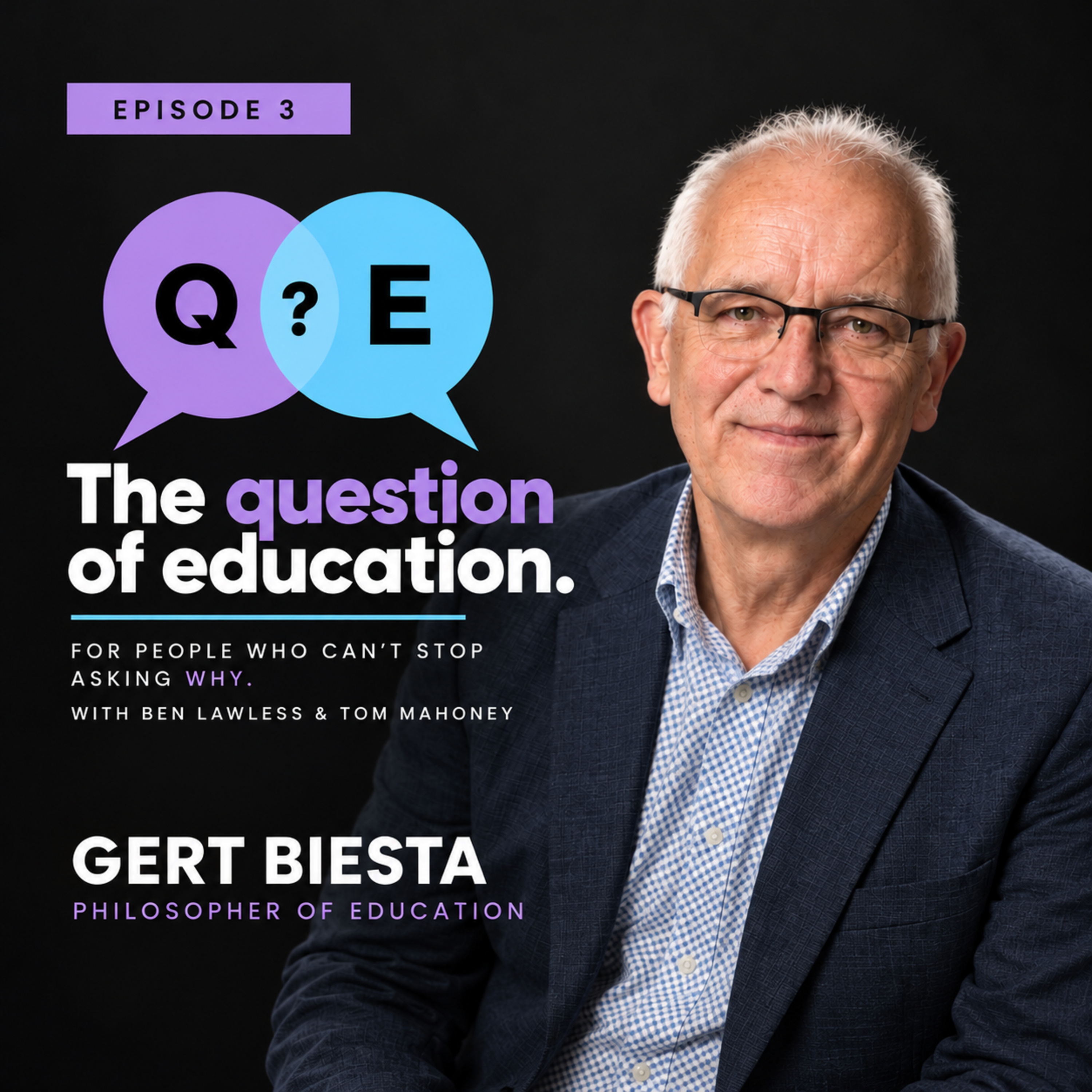
Gert Biesta: Teachers Should Be on the Side of Democracy
from The Question of Education
1h 8m 3s
The conversation centers on pressing questions in Australian education, sparked by concerns over the lack of transparency in the ERO’s independent evaluation report. Despite its role in shaping policy, the report remains unreleased, fueling skepticism about accountability and evidence-based decision-making. The discussion is enriched by insights from philosopher Gert Biesta, who reframes education beyond cognitive learning, emphasizing democratic agency, student autonomy, and critical reflection. He critiques the dominance of policy-driven models and measurement, warning that they reduce education to a one-trick system focused on outcomes rather than human development. Biesta introduces "orientational knowledge" as a vital tool for educators to navigate complex classroom dynamics without prescriptive formulas. The episode reveals a recurring cycle in education policy—where control, simplification, and ideological shifts repeat without meaningful change—across countries, including Australia, which has strong ties to the UK. This pattern highlights a systemic failure to balance structure and flexibility, leading to dehumanized classrooms and misplaced trust in metrics. Ultimately, the conversation challenges listeners to reconsider what education truly means—emphasizing openness, ethical responsibility, and the role of teachers as facilitators of thought rather than mere transmitters of content. It underscores that progress lies not in control or standardized outcomes, but in fostering critical inquiry, democratic values, and genuine student agency.
This is the Question of Education. One hour once a month. The question's education keeps
asking, avoiding and arguing about, with guests who thought deeply about the answers.
Welcome to episode three of the Question of Education with me and my mate Tom Marnie here
again this week Tom. Good man, how are you? Yeah, I am great. I have spent three of the
last four weeks in Korea and I've been loving that. And most highly educated society in
the world, 70% of the population have got a university degree. There you go. Wow, that's
incredible. I've had really interesting things about Korea in terms of the competitive nature
of it. Did you see any school stuff when you were there? We met a family and they had an
eight-year-old daughter and she was like amazing and she was smarter than both my kids, could
speak better English than both my kids and we're both older than her. And then I asked
the parents, "What time does she go to bed?" She goes to bed at night. She's been seeing
tired, so I don't know. They're doing something right over there. Yeah, it's pretty
what I hear though that if they don't make it basically it's poverty. So it's either
university or otherwise it's nothing. That's what I'm very proud of. I don't know enough
to comment on that. Amazing country. I loved everything about it. How a country who's
half as wealthy as us can do that much with the public transport when we can't get a train
to leave the station. I don't know, but I don't want to be cynical. To me, the big news
over the last month or so Tom has been the wild success of the petition that you started
to release the ERO report. Do you want to tell us about that? Yeah, so for those you don't
know the Australian education research organisation, which we call ERO, has been really influential
in developing and directing a lot of the educational policy across Australia over the past five
years or so. And they've been responsible for a lot of the explicit teaching reforms and
that focus on explicit teaching over the last little bit. And last year, an independent
evaluation of ERO was done by the KPMG. Regardless of how you sit on the whole KPMG side
of things, it doesn't really matter. Basically, they did a report reviewing the effectiveness
of ERO and ministers received the report in May this year, I found out. And it's yet
to be released to the public on the quite dubious grounds that it might impact on the public
perception of the organisation itself, which is just a lot of questions. I need to do
a review of why the review didn't come out. Can I ask you two questions? The first one
is, why were they going to do a review in the first place? That's a good question. Actually,
I think it's just routine procedure for any government that's spending millions of dollars
on an initiative, right? It makes sense, you know, you want to check if it's doing what
you want it to do and you got to check the effectiveness. So it was done by the ministers
and then now the ministers aren't releasing the report. So my second question is, would
you do you think maybe that public support is wavering due to the fact that the report,
so the report, not being leased as potentially causing as much damage as what, when you
don't know what's in the report, you start, you start inventing stuff that might worsen
what's in the report, right? That's exactly right. So it started to raise a lot more questions,
especially about an organisation such as ERO that promotes itself as being evidence
body and being, you know, all about accountability and transparency. And so it raises more questions
and probably the report itself would raise. So yeah, the open letter that I wrote some
time ago now, last month, yeah, it's received over 600 signatures, which is really positive,
almost 700 I think now. And from teachers and school leaders and general public as well,
as principals as well. And yeah, we're calling for its release. It's still not happening,
so there's even been a few people asking questions at budget estimates and things like that
and still no budging. You sent me a really spicy YouTube link last night. I had a look at that.
I didn't watch the whole thing. So if you could summarise it for us all that will be great.
I'll put a link to this petition in the show notes. I saw Poro Jenny being grilled by a
green senator and Penny Almond. I'm interested to know, will she have read the report?
Yeah, yeah, she would have read the report. She knows what's in it and ERO was consulted
when the freedom of information request was denied for the reports released to the public.
So they're well aware of what's in the report and that grilling, it's a bit rough.
Like, she gets a bit slammed, but at the same time, it's something that is quite reasonable
to be asking, but she does make a mention that within the report, there actually haven't
been any really big changes that ERO has then done as a result of the report, which then
raises questions. What did we spend for $400,000 on this report that apparently didn't show
anything? And there you can show us. So yeah, it's all very, very, very interesting.
We would like to point out in the interest of fairness that we're not anti-ERO, we're
just interested in finding out more about them. And I think the point that you make the
atom, it's fairly ironic, an organisation that talks about evidence-based. But I think
Jenny Donovan made a really good point. She said, we aren't the ones who aren't releasing
it. It's the minister. So, yeah. I expect an update next
month, I want to see you, you know, throwing paints of red, throwing paint, throwing buckets
of red paint on politicians as they carry out in Canberra. I want to see that on you.
But we'll see, we'll see this, this time. We've got one of your philosophical heroes that
we're going to interview in a few minutes. Yeah. How exciting is that? So, Gert B. Esther,
one of the leading educational thinkers, I would say, you know, once again, I'm a bit biased.
But one of the leading educational philosophers and thinkers in education, he's recently
been given a position at Melbourne University as a visiting professor, I believe. And so,
he's now coming in and out of the country, which is great. But he's had a few roles here
and there. And I don't think I'll read through his whole portfolio, because it's quite large.
But he's been really influential in thinking about education differently and thinking about
teacher agency is another thing that he is very passionate about as well. So, let's get
into this interview. Let's bring him in. Very lucky to have what I am told would call
an international superstar of the philosophy and ideology of education, Gert B. Esther. Thank
you, Gert. And welcome to the question of education. Thank you. I know that Tom has been
frothing at the mouth about the prospect of talking to you for 40 minutes. I'm a big
fan. Yeah. And to be honest, I didn't know a lot about your work beforehand. And then
I've listened to quite a lot of what you've said in various presentations. And I'm just
like, yeah, this is amazing. I'm really excited. You've come to Melbourne from I assume somewhere
in Europe before this. It's a very interesting time to come into Victoria in particular.
There's a lot of changes happening. I think a lot of the culture of certainly K to 12
education is in flux at the moment. As a fellow Melbourne University staff member, I'm
interested in knowing what brought you to Melbourne. And what are you currently doing in
the Faculty of Education at the university? Right. So what brought me to Melbourne was a
very nice question I had from the new dean after I gave a talk about three years ago.
And he said, can we talk? Because he was keen to explore whether I could contribute
something in Melbourne. And then we had slow conversations and eventually that ended
up in a part-time professorial position with the request to focus on theory, which I like
very much, and to work a lot with graduate students. And I also like that a lot because
that is, yeah, where a lot of interesting things are happening. It's another big adventure
in my life. So the appointment started in May and we agreed I will come to Melbourne
several times a year for a longer period and do work there. So I'm slowly getting into
this. We're doing a lot online already to see what I will encounter there. But I'm getting
closer to education policy in Australia and in Victoria. And let's say that looks interesting.
Yeah. So this is the new day.
I don't know if I'm pronouncing it but he says he's a Kiwi and I take that he is because
he used to work at University of Auckland but where is like based on his accent I'm guessing
that he's somewhere as his origins are somewhere closer to you, are they?
I think he has European roots but we've never entirely explored one of the people in Europe
and worked in the UK and then ended up in New Zealand, yeah. So are you doing any teaching
or is it grad student supervision or kind of? I will be doing teaching for graduate students
so I'm going to start with a couple of workshops on academic publishing, on the role of theory
and one thing I proposed is to do a summer school or winter school program for a whole week
and we'll do a first run of that in June next year and we've also set up a whole program for
new graduate students with an introduction week and then we'll meet monthly online and again
with input from from a range of colleagues but they are well also, yeah share my thoughts on
educational theory and policy and the differences between sort of the English-speaking world and
continental theory. So it plays to my strengths I think but I think it's also really important for
beginning graduate students to get the time to get into what is this field and
why does it exist and can I make a contribution? These are the existential questions for
beginning PhD students I think. Yeah and I know it's been a short time but what are you currently
seeing so far in your experience of Melbourne and Australian education? I know that you've been
and gone you've been and you've done a bit of work in South Australia as far as I understand as well.
Yes so what's kind of your perception of the Australian education environment?
So what I'm seeing so far from the policy side I see a lot of pressure
someone introduced me to the idea of scripted teaching for example what was this
I don't know how it's pronounced arrow institute. Yeah right. It seems to be generating
evidence about what works and what I'm seeing is that there are a lot of questions about that
institute apparently there was a review done that is not being made public so that already
raises a question. How have the people in our faculty have like put on a freedom of
information required? We saw that yes yeah which have been denied. Yes so that is strange and
but the developments are similar to what I've seen in countries here in Europe this
assumption that if we have evidence about what works and if we collate that and then
well you can say make it available to the teaching profession or tell them they should
just do it like this that then education will improve and I'm surprised that I think
people politicians keep falling for this idea that education can in some way be fixed.
So it's remarkable that it keeps coming back and that it seems to be quite big now in Australia.
But if you've been around for a while and have been around in education for several decades this
isn't another way of the same promise and then these promises disappear and they transform
so it's quite remarkable how that's possible and I'm curious to to understand what the dynamics
there are. I also see that Victoria is what is it a teaching 2.0 framework. Yeah something
yes Victoria in teaching and learning model 2.0. We've now had a second idea about teaching.
The first one was like quite a big model and then the second one is just like this tiny little
diagram on one one one page of one a4 that's like that's it that's all that education is
yeah so it's again remarkable that the policy simplifications so I'm curious about that to get
closer to that and to see yeah how much to take that seriously or what to do in response to that
but the dynamics are very familiar and it's an ongoing repetition I'll give you talk in a couple of
weeks in which I refer back to the the national literary sea and numeracy strategy in Britain
which happened about 25 or 30 years ago and it was exactly the same investing a lot of money
and infrastructure to say if schools do all this then everything will be fine and of course
it never works like that so these initiatives then disappear and are being taken over
so this is currently I think part of what I see and then I'm curious about Australia as a country
because I know it has ties with the United Kingdom to put it in my way yes oh hello we are still
the farm you know yeah yeah and I was surprised that the king's birthday is actually a day off
it was when I was in the UK everyone ignores it so we do anything for a day off here you'll
that history the colonial history then of course the much older history of Australia and that
that makes it interesting as well and then what what education does in that frame can do yeah we've
got our head of state is like 12,000 kilometers away that's so fascinating to hear that you are
seeing this as a repeating cycle what part of me is excited because that means that it's going
to be over at some point what and you also stated this you see these kind of cycles not just in one
country but in quite a few different countries so I'm wondering when you see like is the cycle
between like conservative and more progressive views of education or is it like control to autonomy
like what what kind of phases do you see these cycles go through there are probably a couple of cycles
so one is definitely the control and openness there is one sort of student centered or
curriculum centered you see these waves and they're really old and there is a policy cycle
that goes from control to supporting the profession
and yeah I had to laugh because you can be optimistic and say what's how it means this this will
disappear at some point but you can also say it's tremendous waste of resource and energy
and or negative vibes it also creates because many of these cycles also go from one
one-sided option to the other one-sided option and for some reason policy never manages to
stay somewhere in the middle and say yeah this matters that matters but it's all in proportion
and it all needs to to work together that's quite strange when you look at it at the policy dynamic
so what do you think there is that inability to find that middle ground why can't we
why can't we accept that it sits somewhere in the middle I don't entirely know so as I said I'm
always surprised how this happens but there is also scholarship that goes with the same moves
and that moves from one yeah one side to the other side so I think what I try to do my own
work is to always look for the middle to say cannot be that and not be that because they both
are half of the story and how can we bring them together but even that is often perceived to be
on one side of the spectrum so I've been critical about measurement for example and then a lot of
people think oh I'm a fan of completely open education without assessment which I'm not
or I've tried to reclaim the importance of teaching and then people say I'm a conservative
and want to restore the power of the teacher which again is not what I want to do so it's also
a bit difficult for scholarship maybe to try to be subtle and nuanced it's also a massive
field there are so many people in education yeah
So I always try to be a bit modest and think yeah it's a big world, I'll do my best but I think it
would also be very strange if everyone in the world would agree with me that would be also a
nightmare scenario I think. You wouldn't get as many hostile podcast requests as for sure. So I'm
wondering do you think that your work in general has been sort of pointing in a direction and you've
found that there's a problem in education or the way that people think about education and in
all of your scholarship you have tried to respond to that.
Yes I think that's what I've been trying to do and one thing I noticed getting into all these
discussions is that quite often you see in education people taking a particular position and
they have good reasons for it but it is in a sense limited and then you see that the the arguments
or sometimes the fights are between that position and the opposite position. So child center versus
curriculum center for example and what I find interesting first of all just as intellectual work
is to to identify that often these these positions take a different position on the same set of
assumptions and I think real progress is to ask what actually are these assumptions and
are these assumptions do they make sense or or can we do something else there. That's probably
when I look at my work I always try to look for the third option. With my book the rediscovery
of teaching I once said it's a progressive argument for the conservative idea in order to say
a lot of people think teachings off the past and I want to say no you can actually make a progressive
argument for it and that is sort of to to find a different way in in these conversations.
Yeah interesting what what I found interesting about some of the changes coming in in Australia
is that it hasn't been tied to your typical left or right political ideology it's not the left
labour governments you know have more progressive education policies and like center-right
governments have more conservative like you know arguably in Australia at the moment pretty much
every single jurisdiction has got or most of them have got left leaning left leaning government
and yet we're seeing what I think is it's quite hard to come up with the terms because
progressive and conservative probably mean different things in education as they do in politics and
it's you know me the simple turn would have thought oh yeah the lefties will be like all about
student-centered and what I found quite interesting we just said there is you talk about child-centered
versus curriculum-centered whereas the the terminology that we use here I think is child-centered
and teacher-centered so what's it so sorry I know there was a lot in there I'm interested in
why you call it curriculum-centered instead of teacher-centered and are they the same thing
is this your amazing third position there or so I see a lot of current developments that
go back to the curriculum or to knowledge or to powerful knowledge and they can say that that
moves from saying we should follow the child or the student in their development and what they
want to learn and bother to say now we should decide what they should learn and what should be
yeah on their diet and what we test them on so for me that's that's quite an opposition or a
pendulum I see teacher-centered I think is part of that but probably comes out of an idea what is
the role of the teacher is the role of the teacher to facilitate or to instruct with both
again don't really understand that that I would say the point of the teacher is to emancipate
to to work in the interest of the freedom of the student but to do something educational thing
that view I love that view but that would be offensive to quite a few thinkers that I can think
of who like a lot of education thinkers here in Australia the idea that the teacher emancipates
I think that the view of the role of the teacher has is starting to become one as like a
pretty narrow function of like content delivery there's a lot of movement and especially in
Victoria away from them having much input in the development of material at all yeah yeah and as
well on that point I feel like there's a few people that would say that the knowledge-centered
curriculum is like is a form of emancipation for students someone that some actually would
believe that that is a form of emancipation so what are your thoughts on on that side of the
argument yeah I would say it depends because knowledge is a very slippery word it can mean a lot
and actually I think it's not a very helpful word because what I think we should aim for an
education is to to work on our students understanding for example and that's quite different from from
knowledge in in some of what I've written I go back to a distinction that comes out of the the
laborer emancipation movement in 19th century Britain and there someone made a distinction between
useful knowledge and really useful knowledge and I find that beautiful also because there's a lot
of talk nowadays about young people should get useful knowledge in schools and not all this
just training for for exams or tests and he says when you work in a factory or a mine
you will get a lot of knowledge you will learn a lot so there is knowledge and that knowledge is
very useful for doing your job but that kind of use is very much confined to the particular
situation and he says there is also a lot of knowledge that you will never get when you
just do your job the political knowledge about who is in power who is powerless why that is so
a historical knowledge and he calls that really useful knowledge because that is knowledge that
emancipates whereas useful knowledge actually ties you to the the situation in which that knowledge
is of use so therefore it's very difficult to to simply say yeah focus on knowledge is emancipatory
because it it depends tremendously on what kind of knowledge is on the table and also how that
knowledge is on the table if it's seen as true or as contested or situated or coming out of a
particular history so yeah you have to go the step further than simply say if we focus on knowledge
then we we are emancipated so we have I to stay angry I read a lot of comments in right-wing
newspapers online and you often hear this phrase that teaches indoctrinating students with their
woke ideas and I wonder whether these straw man fallacies the idea that like teachers are teaching
like every time I see that that we woke indoctrination as a teacher I'm going like what are we indoctrinating
them into like we've got a curriculum to deliver but anyway so on the one hand you got people saying
woke indoctrination on the other hand the progresses are like this knowledge rich curriculum is just
forcing students to memorize disconnected facts either of those positions real and
is there a third one that gets the best of both isn't yeah so I encounter this also in this part
of the world and again I think they are very limited views that don't really speak to to
classroom realities or they speak to some classroom realities I have a particular response to this
whole discourse about brokenness or teachers yeah indoctrinating because then there is strong
argument for for saying should teachers share their own views or should teachers be neutral
yeah and often the the option of being neutral with seniors this solution for all this
but I would argue that in a democratic society teachers should be on the side of democracy
and that is not neutral so the teacher simply says I have now opinion or a bunch
share an opinion or assess to students you can all have your opinions and let's
behave well when we exchange our opinions. That's not a teacher who is on the
side of democracy. So I mean in total Italian countries it works differently,
their teachers are tasked with being indoctrinary in particular ways. But I think
the response can never be in a democratic authority to say teachers should be
neutral, not share any views they maybe even away from difficult topics. They
should be on the side of democracy and that's that's hard work. I love that
because actually if you look at Australian especially Australian young people's
views on democracy our views on democracy have dropped dramatically like to
really really scary levels and we have compulsory compulsory voting in Australia
and yet despite having a civics curriculum it's not really provided much time
in the high school curriculum and so I feel like we have all these people coming
out who it's compulsory for them to vote but it's not compulsory for them to
really have a clue as to what they're voting about or. Yeah I don't I feel like
there's a bit of a lack of an understanding of what democracy actually means
culturally you know at least in Australia I think yeah I wonder if there
needs to be a bit of a you know reinvigoration of what what democracy
actually means and re-engaging with it as teachers. Yeah I think so I think
it's it's really important to think about what a civics education what is
democratic education and the problem there is that in this whole discussion
like I also mentioned then democracy is being repositioned as as just the
preference of a liberal elite there's one preference amongst other
preferences and I think that that is very dangerous also in classrooms but
also in societies if you say this is just a preference I tend to think and I've
argued that that carefully that democracy is precisely what makes it
possible for people to have preferences so it's a kind of
infrastructure I often compare it with playing football if you want to play
football the first thing is that you need at least one other team
so you start with a plurality of teams you also understand that not everyone
can win but everyone who wants to play football
needs also to take a responsibility for the playing field for the conditions
that make it possible to play football and for me that's where where democracy
is located it's in a sense the societal playing field that for
everyone who wants a degree of freedom and have their own preferences it comes
with a duty to care for the playing field that's a very different way to
position democracy than to say it's a liberal preference that's
such an I think uninformed and a historical idea of
why democracy even emerged and what it has tried to do
so do you see the classroom as a site of democracy as well I think to
some of the uh what I guess feel like more like top-down approaches to
teaching is that it's I mean again this is a caricature where you lift the kids
head open and just pour the knowledge in and then close it in some bomb
year year 12 um you know uh if one democratic ideal is like agency
for the people who are you know in the system do you see that
needing to be in the classroom so that's like what level of
agency do you think that students should have if democracy should be in the
classroom um so for me the democratic experience is
never just about trying to to get as much of what you can get as an individual
be it in material sense or be it in terms of ideas or ideologies
um but democracy is comes with an understanding that not everything that
you want is possible because you live together with other people who also want
things and if you want to phrase for that I would say democracy is about the
the authority of of the other in your life
um and therefore sometimes people say democratic
scurling is wherever one can say what they want to say
or democratic classroom is wherever one can can share their opinion
but I think the democratic experience actually
goes in the opposite direction and is always about
how the let's say the the social situation you are in how that also puts
limits on what is possible for for individuals
and to to practice that in schools and in classrooms and in the curriculum
is I think really important to um yeah to do experience like not
everything that you want is possible um I I talk a lot about uh
working with clay because working with clay for me is the the basic democratic
experience um because you have a piece of clay and you think I'd like to
make this out of it and then you begin to work with the clay
and you find out that the clay doesn't allow you to do it
and then you need to adjust your your own ones your own desires your own
imaginations and that is is the basic I think democratic experience
uh and if you can yeah first encounter that with clay and then maybe with
gardens and then with other people but again through
through these kinds of forms that I think singing together is a very
interesting democratic experience or playing sports together or dancing
together before everyone begins to talk and say I think this and I believe
that and I disagree that if you don't prepare that carefully then
then democracy can yeah it immediately
explodes into just a cacophony of opinions uh
yeah such a powerful analogy the the idea of clay and I remember reading
I believe in one of your books you do talk about gardening as as being
that um that experience where you want to do something but then
there's resistance potential resistance um you know you have actions and you
want to achieve something in the world but then there is a certain
element that you don't control how that response comes your way and I think
that's definitely something as a teacher I've tried to seek out I think
too often I think we can get really comfortable in our experiences and
not experience a lot of resistance um so I think one of the things I've been
trying to do through my teaching going to different schools and
different contexts is seeking out those experiences that are a little bit
uncomfortable that kind of shape me up a little bit and
caused me to to rethink things a little bit more than my small little world I guess
I've been living in um yeah no sorry sorry you get
that's uh two two I'd like to get this in there are a lot of concerns about truth
and post truth but I think the the biggest crisis we are in is not
post truth but post real um if I look at Trump but but Putin is doing the same
they have no sense of reality Trump really has no sense of what is real he just
does his own thing put in as a sense of what is real and he doesn't like
what we see and then with a lot of violence he tries to
to change what is real so I think the the real challenge in our time
is to help young people to to encounter what is real
because what is real always resists and puts limits and and therefore
yeah also knocks on your door and the problem with with truth is that
you can talk until the cows come home about what is true
but to experience what is real is is a different one I think yeah
educational to begin with yeah I think that neither of those leaders do their own
groceries for sure um something something that you talk about that I
it's it's so funny the more I've learned about your views the more I'm like
I can see where Tom's coming from um is you have talked in the past about um
not what the dangers or like the the idea of education
being reduced just to learning quote unquote and then one could argue in
Australia at the moment learning is now also being reduced to just like
this one cognitive load theory yeah there I said it um
so can you tell us why you think there's a danger like
you know to the person on the street that go at learning
education? Hang on, aren't I the same?
So they are not the same. Learning is not a very interesting word to begin with because
if you really try to say what is learning, we use the word to refer to change. So when
we say someone has learned something then they have changed, not because of inner maturation
but because of interaction with an environment. Now that can be very interesting, people can
change their understanding, their abilities. But learning can go in all kind of directions.
And I tend to say if you want to learn, you don't need to come to school. If you want
to learn, you can get a job, you will learn a lot, you will join the scouts or a criminal
gang. Learning is free if you want to say it and you will change. There was also the other
thing that learning is not one thing. So our people say we need to study learning processes
and then we have important base for education. But to learn how to write a bike or to learn
that two and two equals four or to learn that you are not good at something. We all use
the word learning in those instances, but these are very different processes. So I think
learning is quite an empty word, it actually means change. There is not a single learning
process but there are many different ways in which these changes happen. But then the
point of education is not simply to let students learn, but we have ambitions with education.
And I would actually say we should be very precious because education is expensive and difficult.
So education should only be there for the things that cannot happen outside of education.
And to come back to the distinction I made, if you have a job, you get a lot of useful
knowledge. But it's very unlikely that when you work at McDonald's that you will get
time out to do a political analysis of the history of Australia. But to have that time
out is precisely something special, that education does. Where you say, I hear other questions
that are not immediately asked and we take time for that. For me, that has something to
do with education. And for me, education, but this also has to do with different languages,
always means educate team. So for me, education is never this process in which we change.
But it's always about an educator and a student meeting each other. And again, for a lot
of things students don't need teachers. But one of the beautiful things teachers can do
is to open up parts of the world where students didn't even know that they existed, that those
questions can be asked, or that it is something that they are allowed to engage in. So teaching
is very much precisely to do what you cannot do by yourself. Thus, for me, are reasons
to say the language of learning cannot really capture what happens in education.
So where have you seen jurisdictions that have incorporated these more holistic ideas?
Where is this happening in the world that we can lack of a better word? Lone from?
One way to answer that is to say, this is most likely to happen in many places.
Because it's really difficult to run a stupid school. Then you need to control everything.
And there are stupid schools. There is a famous school in London that says we can get any
student in and will make sure that they achieve very high on the exam. But the price for that
is that we tell them how to behave and what to do. And if there is only the second of independent
thinking, we immediately will push that down. So they have to spend an awful lot of time
to create a school that's pretty stupid, because it only looks like one.
That school is held up is like this great thing to be celebrated if we're thinking of the
same place. Yes, I think we are. But I would say that's a stupid school, because it is
not helping to make students wise to allow them to judge. It just produces high exam schools.
But those schools, I think, are still open. And I think that much more interesting things
are happening there. That is, of course, a whole spectrum. In England, the government
has really tried to tightly control what happens in schools, what happens in teacher
education, which doesn't look happy. But still, in a classroom, students will ask questions.
And then you can say, you're not allowed to ask that question. Or a good teacher would
say, OK, let's take on that question. And also even in England, because I find it one
of the more worrying sort of educational countries, there are a lot of schools who say, look,
this is what the government wants from us. But we know we need to do something better
to serve the young people in our communities, in our cities. So there I'm optimistic and
I wouldn't immediately point to countries or systems. But I would have helped in what
can happen in classrooms with good teachers. And for me, the funny inside is, it's really
hard work to run a school where you want to control everything. And of course, it also
becomes, yeah, I call it surrogate education. It looks like a school, but it is no longer
a school. It's becoming a training facility, you could say. That is quite worrying. Again,
that people think that that is a brilliant model for education.
So there's a lot of discussion over here about teacher autonomy. So like I like that you
talk about the curriculum sense, the idea of the curriculum-centred education, because
I think people can think the job of the teacher is to take what's published in the curriculum
documents on the government websites and then put those, put the facts that were listed
on that website into the students' brains, the end. But what I've found, and even before
this sort of recent trend, is that most teachers, to some degree, are quite subversive in the
sense that they're told, well, the government wants me to do this, the school wants me
to do this, my head of faculty wants me to do this, but with my humanity, with the students
in front of me, I'm going to do this. Do you think that that subversive attitude is quite
common in teaching and should it be? I'm not sure how common it is, but I remain optimistic
that aid are many good educators working in systems that are not always great. Although
I do worry, of course, about the frame of reference that teachers have to even understand
what they should be doing there. Teacher autonomy is a bit of a difficult concept. I've written
with colleagues about teacher agency, and I like this idea a bit more because teacher
autonomy can sound like it's up to teachers to decide what they should be doing. And with
teacher agency, you can say, as an agent, you have agency, you have scope for action and
judgment, but it is within a context. It is within an understanding of what education
is for. Now, sometimes these understandings of what education is for are heavily policed
or heavily constrained. That makes it difficult. And in the research we did, it was really
interesting to also get a sense of the ways in which teachers speak about their own work.
And there you can see generational shifts that teachers who were educated in Britain
in the 80s, they have a different discourse to talk about their work. But I would say
education needs thoughtful teachers and needs to maintain its level of thoughtfulness.
And if you eradicate that by means of policy or by means of sort of self-control, you're
You begin to create education systems that ultimately to use the word again become stupid
because they can only run on one trick.
And if the trick works, if you have the luck of having the right students in the room or
if you manage to control your students and your teachers so much, then maybe the trick
will work.
But if you understand, you have real human beings in your classrooms, then a one trick
education system will ultimately fail at them.
Yeah, so this one trick I'm really interested in this.
I work in assessment, probably like the least sexy area of education.
And I often come into schools and I'm like, you gathering all of this data, but you're
not doing anything with it.
Like it's weird for the assessment person to come in and say, "Why are you assessing
so much?"
And from some of the things that you've said, I wonder, like, has measurement taken over
schooling?
Sometimes I get worried that, like, what's the whole point of a K-12 education in Australia
is to get a number when you're 17 that's like as close to 100 as possible.
Do you think, like, has measurement gone too far?
Does that capture everything that's valuable?
So I have a lot of worries about that.
I'm not against assessment.
I think it's really good from time to time to have a kind of reality check with your students
and say, "Look, we've been working hard.
Where are you in relation to this?
How good is your ability?
How good can you do things?
How good is your understanding, your judgment?"
That's fine.
And for that, we need good assessment.
You could even say there's nothing wrong with teaching to the test if the test is brilliant.
But most tests are not brilliant.
They are for our reductions.
They take a proxy for the whole.
And there is a risk that they begin to drive what's done in schools.
And I think those are problematic dynamics.
And tests and assessments often look like that they are very robust and a lot is invested
in making assessment very robust.
But there is a point where the robustness begins to undermine the significance of what you're
doing.
So you need a good degree of current sense and see that assessment is one of the means
that you use in education, but not an ant in itself.
The same with curriculum.
Curriculum is a means, not an ant, but it can very quickly shift and become an ant in
itself.
It loses its educational significance.
And the problem with all the data and all the monitoring of students is also, again, I
think that it creates a pseudo reality, we say, as long as we can monitor students and
monitor the progress, then we know what we're doing.
But you're turning a student into a data unit, actually.
And that begins to distort what we actually should be doing.
And it's very seductive, a friend of mine said he was called to the school for a conversation
with a teacher of his son.
And then the teacher said, "I can show you on that Tuesday something went wrong and he
has dropped there and has been behind ever since."
But they were looking at the spreadsheet and they were not looking at the job.
And that is all so strange.
And it sounds seductive.
There is something good about it, because if you make all judgment just the remit of individuals
and say, "Let's leave it to teachers.
You will generate a lot of inequality."
But the solution for that is not to create one-dimensional system of measurement.
It's still to go back to the educational common sense, I think.
But it's so remarkable that education keeps falling for these kind of systems that maybe
come out of good intentions, but very quickly become counterproductive.
Yeah, they're so seductive.
As a secretary-school teacher, I am like a wash with all of this information, this data.
And even my understanding of the flaws of the data that we collect and all the issues
with it and the way that doesn't actually reflect everything, there is just so much weight
that it carries within our systems often.
That it becomes this really powerful identity marker in so many ways.
And not just for teachers, but the way that we see our students and we start seeing our
students in terms of their numbers and rather than who they are and what makes them an
individual.
Yeah, such an important thing to be thinking about.
We've probably got a couple of questions left and I did want to ask good, what is something
that you would say you are wrong about, or you have been wrong about maybe?
So for the people listening, you sent me a couple of questions beforehand and you said,
are there any particular ones I liked and I picked this one?
Yeah, I was quite interested that you picked this one, you know, it's a good challenging
question.
Yes.
And then I was thinking because I wanted to say that there's nothing I have been wrong
about.
Now that sounds terribly arrogant, but it has something to do with another important distinction
which I have found very helpful about educational knowledge and research knowledge and what we
know in education because there were two kinds of knowledge, that's the insight.
There is instrumental knowledge that gives us a lot about how to do things and it's tremendously
important because at the end of the day teaching is a practice and how to do things and how
to do better can be informed by all kinds of ways of scholarship.
But there is a different kind of knowledge and the phrase I discovered about a year ago
is to call it orientational knowledge.
And this is not knowledge that tells you how to do things and how to do things better,
but it's knowledge that gives you as a teacher, as an educational professional, a language
for articulating what you're doing, what's happening in the classroom, what matters, what
is important, what is on the horizon.
And I tend to think that most of my work is in the domain of orientational knowledge.
I try to articulate what's the point of education, how can we talk meaningfully about purposes
of education, what is the dynamics of teaching, not how should you teach, but how actually
does this interaction between what teachers do and what happens with students, how does
that work and how doesn't it work.
And then I would say orientational knowledge never tells teachers this is how you should
think.
What it does is it generates possibilities.
It says, yeah, you can look at your classroom through the lens of behavioral management
or through the lens of young people not really knowing how they can bring their insight
to the outside and ending up with very unhelpful behavior.
And when you have these two possibilities, it opens the space for you as a professional
to think, okay, how shall I look at my students today and what then may be helpful.
So it begins to inform your instrumental action where you can say all these disruptive teenagers
are not there because they want to make my life difficult, but they have difficulties
in their own life.
They have difficulties expressing themselves, articulating themselves, being in a social
situation.
If I respond to that as a teacher, you may be open up an opportunity for your students
rather than that you say, we need more rules and more exclusions from classrooms if students
misbehave.
So orientational knowledge provides possibilities.
And then I would say these possibilities are never right or wrong, but they may be helpful
and meaningful or not.
So if I had been in the job of generating instrumental knowledge, then you can say,
there are some things I'm just wrong.
They don't work or they get you in a different direction.
But I think I've. the other work in educational scholarship,
the orientational knowledge is not black and white,
but you can say, hey, maybe we can look at it in this way
or can name it in this way.
May that be helpful.
So that would be my funny response to the question actually.
- That's excellent.
That's like in a job interview when they say,
what's your weakness in your game?
My weakness is that I don't have any weaknesses.
(laughing)
- I think that me and Tom could probably sit here
for 10 hours with you.
And I think that I would love to like catch up in person.
I'm sure Tom would too, as well.
And if you still have with the Christmas party
at the faculty, I'll see you then.
I actually had a bit of a flashback to philosophy lectures
that I had when I was like 18, 19,
because in a lot of those lectures,
I knew less about some things at the end than I did at the start
because there were things that I thought I knew
that I realized were actually much more contested.
And so I'm sitting here now with like my head
just swimming full of the questions
that have been raised based on things that you've said to us,
which feels to me like a really valid,
like valuable type of education.
So thank you so much for being with us.
I can't wait to share this with lots of other people.
- Yeah, well thanks for the opportunity.
If I can be, well, I never want to sound arrogant,
but what you just described for me
is what emancipatory teaching should look like.
Never tell students this is how you need to think
and narrowing it down, but actually opening it up.
And yeah, if you leave your students
with more questions, I think that gets them moving.
And it says, yeah, it's at the end of the day up to you
to do something with these questions.
So I take it as a compliment,
but also as a nice reflection on what teaching can be.
Thanks for that.
- All right, and that was Gert Biesta leading educational
thinker and philosopher of education.
What did you get out of that bin?
- You know, that taught me back to some of the most exciting
times in my first degree, a philosophy degree,
when we gave ourselves the space to ask big questions.
What I particularly liked was that he situated us
within a cycle of fads.
And the fact where he was like, oh, yeah,
this really, you know, locked down version of teaching
is something that happened that I've seen
around the world over various times.
I remember when I first started teaching
and the curriculum changed.
I was like, oh my god, the curriculum changed.
And all the teachers who were there for 15, 20 years,
they were like, just chill out mate.
This happens every two years.
Like, just get used to the fads.
So it was really good to hear that.
It's kind of like, you know, there's something
that sits above whatever is happening
in the word of learning.
I also particularly loved the fact that he talked about
education being so much bigger than just what we call
learning, quote unquote.
I, there was some controversial statements in there.
And, you know, it was interesting to have someone
to platform to say, again, like, I don't want to get in
trouble, so I'm just going to fence it and say, well,
I'm just going to note what he said.
It's interesting.
I think that the stuff that he raises
shows that schools really are a battle ground
for a lot of things going on in broader society.
Like, what's the role of freedom?
What's the role of inequality?
What's the role of choice?
- Yeah, and just, and the way that understanding
education is control, I think it's become really dominant.
We just need to control everything and control the outcomes
and control the students and control the teachers
and control the curriculum and then everything will be okay.
But I think we've found that the increasing control
that's been happening over the past 20 years or so
has not resulted in any positive outcomes.
Not that I can say, at least.
- I mean, like, if anyone's the poster child
for this podcast, it's good for sure,
because the question of education, it really is,
you know, as you say, we're controlling and trying
to lock down an all point into going towards one purpose,
but it's kind of like, have we actually agreed
on what the purpose is in the first place?
People who are sending us all in one direction
are kind of like, oh, no, no, I don't have any ideology.
This is just, we're just doing what is required by learning,
but it's good. - It's going to teach.
- Yeah, right, like, the people who tell you
that they've got no ideology, the ones who are hiding it,
the best. - Yeah.
- Which, you know, it was like when I was in the classroom,
I was incapable of being completely unbiased.
So instead, I would just tell my students my bias.
Like, yeah, I'm a long-haired, a greeny blah, blah, blah.
I can argue any position you like,
but if you notice a bias in me, it's this.
And if I didn't say other, if I pretended
that I was neutral, you know, I can't be.
- And there's definitely been a move away
from thinking about the purpose of education.
I think that's what, what Gert is trying to bring back
into the conversation is like, okay,
it talks about that one trick, like a one trick school,
you know, the school can only do sort of one thing.
Whereas, if we think about education,
not just schooling, education is like a broad concept,
we're not just after one thing or after multiple things.
And then those things really depend on where you are
and who the students are and what your community's really value.
So I think this interview really raised a lot of questions
for me, which I think is one of the things
you want to happen after an interview, right?
Yeah, I remember, yeah, it reminds me of first year philosophy
where you'd leave the lecture being like,
I know less than I did when I went in there
because I realized that half the stuff I thought was nonsense.
Yeah.
Like, I think it's great that he's raised all these questions.
He himself has clearly obviously got a progressive angle
as well, I would say, you know, which is completely fine
and he'd be open to saying that.
I think I'm happy that the stuff is out there
and proud to be currently working
at the same institution as him, so there you go.
Come on, amongst great men and women and academics.
Yes, going without 50% men, 50% women,
really excited about the person
that we're going to get on next month, Stephanie Westcott.
Yes, that's going to be very, very exciting.
She's, she's, yeah, she's a very important voice
at the moment and especially, in this time of our lives
and this world at this point in time.
So yeah, I'm really looking forward to that conversation.
I think there's going to be a lot of really important takeaways
to be taking on and bringing to our contexts and schools
and what we're trying to do in education.
Awesome, lovely to chat with you for another month
and please continue to poke the beer in all legal ways
and I'll see you in a month, Stephanie.
Excellent, thank you always for the encouragement mate.
All right, take care.
You've been listening to the question of education
with Ben Laws and Tom Marnie.
If today's conversation made you think
share with someone who'd enjoy it.
New episodes monthly, until next time,
keep asking questions of every Jewish people.
Podcast Summary
Key Points:
The Australian Education Research Organisation (ERO) conducted an independent evaluation by KPMG, yet the report remains unreleased, raising concerns about transparency and accountability.
Critics argue that the lack of public access to the ERO report undermines its credibility, especially given ERO’s self-proclaimed commitment to evidence-based policy and transparency.
Gert Biesta, a leading educational philosopher, emphasizes that education is not just about learning or measurement, but about fostering democratic agency, critical thinking, and meaningful student-teacher interaction.
A recurring cycle in education policy—moving from control to over-simplification (like Victoria’s one-page "Teaching 2.0" model)—shows a pattern of failed reforms that repeat without sustained progress.
The idea of teacher autonomy is challenged by policy-driven control, where teachers are pressured to follow rigid curricula, reducing their role to mere implementers rather than critical agents.
Gert highlights that assessment and curriculum can become antithetical to education when they dominate teaching, leading to a false sense of control and dehumanizing student identities.
He introduces "orientational knowledge" as a vital, non-prescriptive framework that helps teachers understand the purpose and dynamics of education, opening space for reflective, ethical decision-making.
The interview underscores that education is a site of broader societal struggles over freedom, inequality, and democracy, and that true progress requires questioning dominant ideologies and embracing complexity.
Summary:
The conversation centers on pressing questions in Australian education, sparked by concerns over the lack of transparency in the ERO’s independent evaluation report. Despite its role in shaping policy, the report remains unreleased, fueling skepticism about accountability and evidence-based decision-making. The discussion is enriched by insights from philosopher Gert Biesta, who reframes education beyond cognitive learning, emphasizing democratic agency, student autonomy, and critical reflection.
He critiques the dominance of policy-driven models and measurement, warning that they reduce education to a one-trick system focused on outcomes rather than human development. Biesta introduces "orientational knowledge" as a vital tool for educators to navigate complex classroom dynamics without prescriptive formulas. The episode reveals a recurring cycle in education policy—where control, simplification, and ideological shifts repeat without meaningful change—across countries, including Australia, which has strong ties to the UK.
This pattern highlights a systemic failure to balance structure and flexibility, leading to dehumanized classrooms and misplaced trust in metrics. Ultimately, the conversation challenges listeners to reconsider what education truly means—emphasizing openness, ethical responsibility, and the role of teachers as facilitators of thought rather than mere transmitters of content. It underscores that progress lies not in control or standardized outcomes, but in fostering critical inquiry, democratic values, and genuine student agency.
FAQs
The report was conducted by KPMG and received by ministers in May, but has not been released publicly. This raises questions about transparency and accountability, especially since ERO promotes itself as evidence-based and transparent.
The petition, now with over 600 signatures, includes teachers, school leaders, and the public, and calls for transparency. It highlights public concern that the report may contain findings that challenge education policies and practices.
He sees the teacher’s role as one of emancipation—helping students develop freedom and critical thinking—rather than simply delivering content. The teacher should support students’ autonomy and help them understand the world beyond immediate needs.
It’s not about how to teach, but about providing a framework for understanding what education is for, what matters in classrooms, and how teaching and learning interact. It opens up possibilities for teachers to interpret student behavior and classroom dynamics.
Yes, there is a recurring cycle where governments introduce new educational models (like scripted teaching or curriculum changes), which often fail or are quickly replaced, raising questions about sustainable reform and the need for deeper reflection.
Education is not just about acquiring knowledge or producing test scores. It’s about relationships, shared experience, and creating space for students to question, reflect, and develop their agency and understanding of the world.
Chat with AI
Loading...
Pro features
Go deeper with this episode
Unlock creator-grade tools that turn any transcript into show notes and subtitle files.
 PodcastTranscript AI