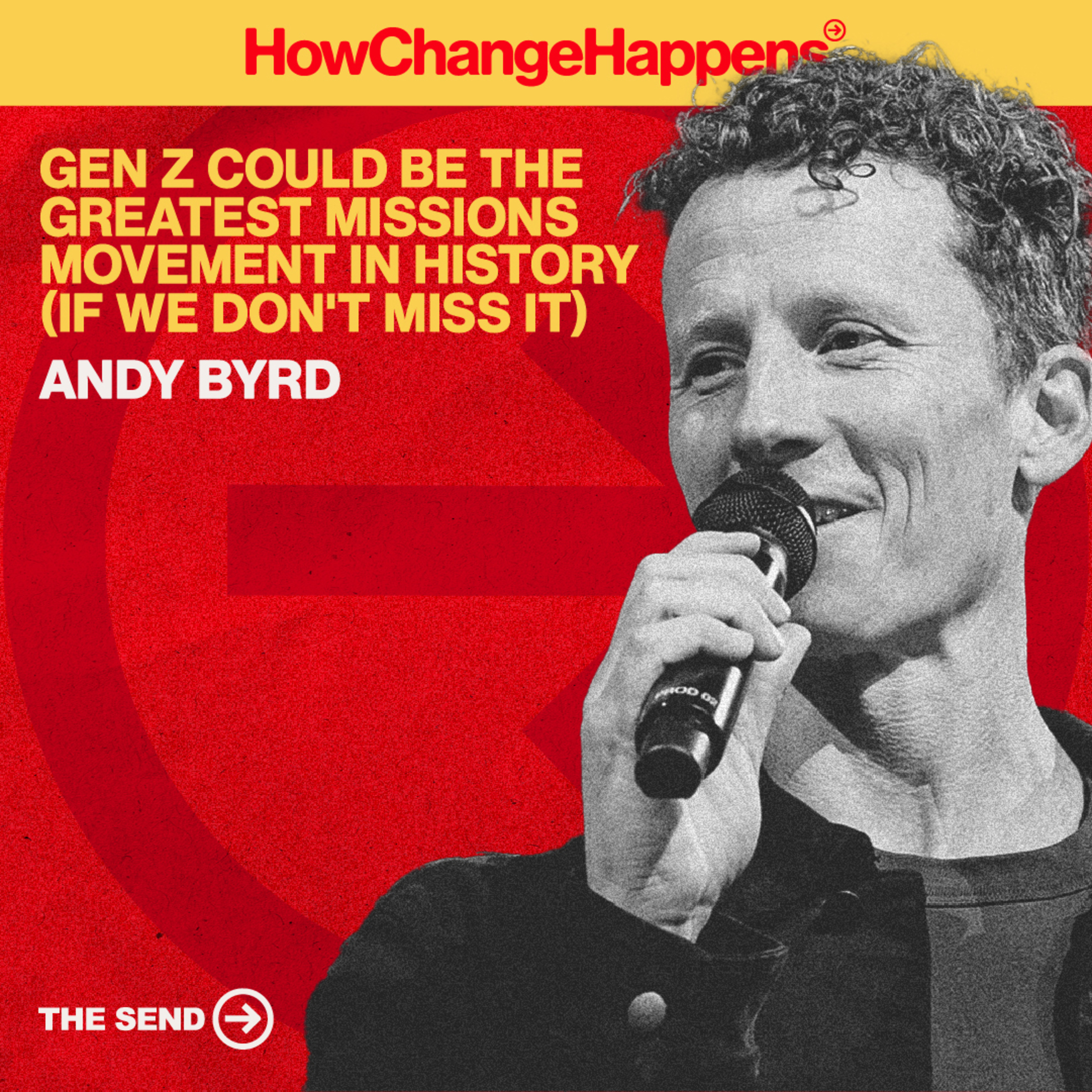
Gen Z Could Be the Greatest Missions Movement in History (If We Don't Miss It) | Andy Byrd | EP 001
57m 51s
Andy Bird shares the foundational story of how God called him to launch the Send, a global movement sending young people to share the gospel in the hardest places. Unlike ambitions driven by success or visibility, the vision grew through obedience to God’s prompting—first in Brazil with overwhelming demand, then in Norway through a young man’s bold faith. This journey illustrates how real multiplication arises from divine hunger, not human strategy. Andy emphasizes that leadership is not about control, but about releasing youth to pioneer with freedom, guided by a mindset of “covering without controlling.” The core of change begins with personal transformation—moving from nominal faith to wholeheartedness—spreading through communities and ultimately leading to spiritual revival and societal reformation. The Send’s mission fields—high schools, universities, neighborhoods, nations, and adoption—emerged organically from existing connections and God’s direction. Crucially, the Great Commission is universal: every believer, regardless of role, participates in God’s missional work, which began in Genesis and continues through daily life. True change requires both compassion to engage brokenness and a theology of suffering to endure hardship, rooted in the belief that God’s love is revealed not in ease, but in the midst of pain. Finally, Andy highlights that leadership is formed through service, not status, and young people are vital catalysts in revival, often the first to respond to spiritual awakening. This process is deeply strengthened by community, shared suffering, and the courage to endure hardship together—proving that real transformation is not accidental, but the result of faith meeting movement.
Hey guys, my name is John Mark. This is the inaugural episode of How Change Happens. A podcast by the send
We're we sit down and talk about the real-life moments of hearing God's voice and then responding to it taking action and
Following the call of God on our lives. Each episode we're gonna sit down with leaders, missionaries and then everyday believers like you and me
That are living out the gospel in bold but still really practical ways. We want to show that change isn't an accident
It's the result of faith meeting movement and in this first episode. I'm gonna sit down with Andy Bird
He's the founder of the send. He's my good friend
I've been working with him for 15 years to help build a ministry called fire and fragrance where we take young people
Send them around the world to share the gospel with people who have never heard about it before
We're gonna talk about how God spoke to him about the send and what do you do when God gives you a dream?
What are those first steps that you take and how do you make it a reality?
So I think you're gonna find it really interesting
Enjoy six hours sold out 70,000 registrations
Something only God can orchestrate God didn't create a church and give it a mission God had a mission
So he created a church. How do you discern if it's like ambition or really the Lord? It was an ambition killer
We'd all just be dead if it wasn't for authentic epic friendship
Andy hey, what's up?
Welcome on the podcast so prompted is it true that you've done a bunch of people that one of your favorites has been Asher bird
That yes, that is true. Wow, you got to be proud of that one out and intimidated like I'm just the the narrative has flipped
And I'm officially known as Asher's dad to
Most people so I just did a UK tour with Francis, you know for the send leading up to the send Scotland
a couple months back now and
Everywhere we went people were like oh
Your Asher's dad Asher was here like four months ago. Gosh. He's a good preacher or like he's amazing
He's so kind and I was like wow
I am literally falling in Asher's footsteps right now, and I'm wishfully known as Asher's dad and everywhere I'm going
We I mean, it's it's probably time for us all to just get out of the way. I know I think it's true
That I mean that kind of is an interest would be an interesting question to discuss like youth movement is often the leading edge of Jesus movements
And so what role as you get older how do you champion that next generation and make room so that you don't
Stifle movement with all like building these strong institutions. You're definitely saying I'm old
There's an element of truth to it. So I just got to own it now. Yeah, I think it's a huge deal. I think
You know this this blend of the wisdom and experience of people that have lived lots of life
with youthful innovation
where often they are most connected to the grassroots
Most aware of what isn't working and is working so innovation is often of course most dynamic
Most impactful. It's the right innovation versus innovation happening in a white white board in a conference room with people that are no longer
Connected to the grassroots, but if you can connect that to the experience and the wisdom of
Those who have lived in a lot of life that it's it's an unbelievable
Combination. I think that's the dream of kind of a multi-generational
Move but of course it is so rare for an older generation to
Be willing to radically empower the next generation. We always tend to think that we're
More relevant than we are we always tend to think that we're more innovative than we are and we always think we're more
Connected to the next generation than we usually are all also tend to think that the young people aren't as ready
Yeah, as they actually are right to take risks and to lead so true. Absolutely true
You feel like you had any experience just working with Lauren where he did it well where he kind of empowered released you
Lauren Darleen the send now you're thinking okay, it's not just one event. How could we impact?
The world with this message of the great commission and that's something Lauren was always pressing so how did I guess
How did you see the benefits of working with the older generation in the things that you've been building and
What I lessons or principles could you offer the younger generation as they're looking for mentors?
Yeah, Lauren and Dar been absolutely you know amazing examples to work with and I
Think the thing that is so remarkable is that though they were increasing in age
They were always constantly working with the kind of the 18 to 20-year-old and other they didn't work with all generations
But they they never left the working with the 18 to 20-year-old
You know, they had a unique ability to spot talent or
graces or anointings and then champion people
To go and do the thing that they saw in their lives and they weren't always
Handholding, you know, they weren't always in the details
They were much more like hey, we've created this giant platform this global network and
This 60 plus-year-old movement and we're giving it to you like you use it for the purposes of the great commission
I think that was what was so astounding when I moved to Kona a number of years ago
Was I had never worked among leaders alongside leadership with such a big vision and such a willingness to like
trust and to take everything they had fought so hard to build
And allow so many people to operate off that platform within their own gifts and callings and that is
That was so unique and typically what holds that back is that as movements increase in size the big question becomes quality control
Because yeah, the reputation is so at stake now. It's big. It's well-known. It's global and so how do you manage reputation?
Well most movements in history have begun to micromanage reputation through centralization
So we're gonna ensure everyone does the same thing the same way, you know to ensure that our reputation stays intact
We can't afford to have all these you know groups out there that are not representing us well
but Lauren and Dar were were much more willing to risk the reputation
So that the pioneers could keep pioneering rather than to consolidate and centralize and maybe the maybe you have less mess
But you'd also have less pioneering so it takes a leader with such thick skin whose personal ego is not attached to the reputation of the ministry
To be able to go like there are some
Wow, it's a major reputational hit. There are some places that are not gonna do it that well
There are some places that are not gonna be
Unbelievably healthy, but if we micromanage this movement there'll be no one who's pioneering new things in new ways
And there'll be no 18-year-olds and 20-year-olds and 22-year-olds who are hearing God and obeying
So because they were so confident in the call of God and their
Personal identity they were willing to risk the hits on the reputation for the sake of the 18 to 20 to 25 year old
Continually being able to pioneer new things and new places. How do you properly release them or what are some principles like?
Okay, I I'm buying what you're saying. I do want to take the risk and empower them to go are there some wisdom principles that they should
Do apply that or is it just like no? Here's the permission slip go for it
Yeah, I mean obviously we really need to aim for organizational and individual health health needs to be a high priority
But sometimes again health can even get so micromanaged that there's no longer room for just normal
maturing processes and therefore young leaders have no room to grow or to lead and it was after probably
I don't know 10 years of working with Warren and Dar and I often would get asked like hey, what's it like working with Warren and Darleen?
You know and
What's what's that like how do they lead and as I was trying to like even get my head around?
How would I conceptualize or how would I define what it's like to be in this type of environment?
This was the simple phrase that really helped me in terms of a personal goal and even what I would encourage other leaders with is that the real goal of leadership is to be covering without controlling
And releasing without abandoning
And it typically we're kind of swinging from one side to the other we're going to be a little bit controlling or we're going to be a little bit abandoning
And I think the sweet spot of leadership is to not control or abandon but to release and to cover it's not an exact science
Not like you just say do these five things and it'll be perfect
But if our overall mindset is I am meant to cover but I'm not meant to control I am meant to release but I'm not meant to abandon
I think particularly for young Gen Z leaders that it is the sweet spot for those who are working with releasing and powering Gen Z
Because of the unique desire and Gen Z's heart to be coached, there's a real increase desire for coaching someone who will walk alongside us not just tell me what to do from a stage but walk alongside
So I think that that this simple phrase that was helped me understand what I was even experiencing is really my goal as we look towards the future as well and how to walk with young leaders
Wow, like that. What would you say to somebody that got marked at the send and they're thinking, okay, I just I want to do something at my local high school at what point
Should they be thinking about a bigger vision in multiplying?
Like when God first spoke to you about raising up burning young people to impact the
hardest and darkest places, were you just like, "Okay, I just want to run one really
good school."
And then how did that evolve into, "No, this has got to be a movement that goes around
the world."
Yeah, first I would say that multiplication really has to do with grace, like a unique grace
from God.
And I certainly don't think that everyone should live under the pressure of multiplication.
But it's really about knowing our grace, and no grace is better or worse on some scale
of something being better than another.
It's more about understanding what God's given us and our unique calling.
And some of the most remarkable heroes you ever meet, they might be nameless and people
know who they are, but they're just unbelievably faithful in that inner city or that remote
village or that, you know, they're just given their lives to this, what could seem like
a relatively, you know, small number of people.
But they're the ones that are kind of the most inspiring, you know.
Those are the movies that move our hearts and it's the teacher that just invested in
that school for 20, 30, 40 years and infected all those kids.
So many young people that come through the sand, I think our ultimate goal is to help them
understand who they are in God and then what is their grace in God?
What are they called to do and not to feel pressure?
It has to be more and of course not to settle for less.
And then some have the grace of multiplication and it's if anything, it's maybe just an extra
burden to know that what they're carrying does need to, they do need to consider a greater
breath to that.
It really is meant to multiply.
And I think that that progression is very like one step at a time and it's more something
at least for me that you look back on than that you look forward on.
So it was more like little bit of obedience, obedience, obedience, and then you look back
and you're like, I can't believe this thing has grown a little bit.
I'm shocked.
I'm shocked.
There's other places that wanted to do this and you're like, I'll crazy.
There's like four or five out there.
You know, it's not that big, but you're all of a sudden go, oh, maybe we're meant to
grow this or multiply this and then, you know, then the part of that progression is then
agreeing with that calling and then at that point, you need to add organizational strength
and team strength and leadership strength and best practices to go, how do we steward what
God's given us?
So when fire fragrance began to grow in the early days, it was fine to just go on just
purely relational pathways and just encourage people to get there and do that.
But at some point, the whole thing will begin to suffer if you don't begin to add organization
strength.
It doesn't have to be rigid or cumbersome, but just something that's serving everyone.
And so in the multiplication progression, at some point, it requires organizational
health and strength to support the momentum.
Like now with the send, you know, we started with just going, we're going to do one city
in Orlando.
Don't know what's next.
And, you know, now we're working actively in 12 nations, you know, right now.
And if we did it, serve that multiplication with some real organizational strength and
health and we would be bad stewards of what God has given us, but it wasn't like we set
out with the send and went, we're going to take this thing global, we're going to do it
in nations all over the world.
There's just one little step of obedience.
And as we obeyed, the grace becomes more obvious.
And then as the grace becomes obvious, we have a responsibility to agree with that grace
and put the things in place that are going to steward what God's given us.
What was that process like from going from Orlando where it was like, okay, we're going
to do one to now many different nations.
Was it the need that kind of drove you like people saying, hey, we need this here.
We need this there.
Was it kind of prayer moments where God expanded your vision?
Just practically.
How do you know like, okay, we're doing a good thing here, but gosh, there is something
pulling us to dream bigger or do expand.
How do you discern if it's like maybe ambition or really, really the Lord?
Totally.
Those are your great questions.
I think, you know, in the foundations of the sand when we first got the word, certainly
the scope of it felt quite large, but so large that you can't make any of that happen.
And it felt like certainly there was something bigger than one gathering in the build up
and the trajectory and the original words in the Lord and all the prayer times, but far
beyond our capacity to make something happen or just be like, okay, we're going to go build
a global ministry.
So it was after Orlando that really I would say it was the hunger of the Brazilians that
catalyzed the first sense of growth.
Oh, yeah, that's right.
It was the, you know, they estimate three to five thousand Brazilians came to Orlando,
but they set the temperature.
And so we walked away from that going like we have to respond to this hunger.
It was astounding.
And I'd been a Brazil a bunch of times already before that and was very aware of kind of
the youth awakening that's been happening over there, happening there over the last, you
know, 20 years.
So the first growth of the sand was really responding to this incredible hunger.
And we didn't know how much the hunger was until we launched that first stadium and then
we're shocked, you know, six hours.
It's sold out 70,000 registrations eight months before the event.
So then at that point, you're just doerding hunger.
You're just trying to hear God is still like, we have to respond to this.
But again, it wasn't some big elaborate plan on like, hey, let's go into Brazil and this
will be our marketing strategy and none of that, just like simple, simple obedience.
And then so I think at that point, we're like, oh, this is meant to go global.
But I would say the third step that really cemented this in our hearts was when I got
an email from Andreas Nordley in Norway.
And for Brazil, it was the hunger of the general population that came to Orlando and that responded
to the first stadium that just catalyzed this thing and exploded it into three stadiums
on the same day across, you know, in two different cities.
But then for Norway, it was Andreas' faith.
It was like he was like showing up like an Abraham and the story going like, I believe
God can move in my nation.
And I was so moved by his faith, Norway had never been on the radar.
I had been Norway one time in my life.
I vaguely knew Andreas had met him a few times, but his email was so compelling, the
faith that he had in his heart, it was different.
We got a lot of invitations after Brazil, as you could imagine, there were, you know, fair
amount of people going like, we want this in our country, but Andreas' was totally different.
It really was this like grabbing a hold of this thing in faith, going, my nation is dying.
And I believe God can resurrect it and can awaken young people.
And his faith, we all read the email, our whole team and we were like, man, this feels
like God.
And then we got an initial call with him and everybody was so undone after the call.
And I think between those Orlando, Brazil and Norway, then it became obvious to us going,
okay, this is bigger than we realized.
And we really need to have the fear of the Lord on how we steward this.
The thing I would say that kept us from ambition was it was just so hard.
Everything about it was hard, brazy, the finance is hard, unifying the church and the region
was hard.
Everything was so unbelievably exhausting and hard, so it was an ambition killer because
it wasn't like, oh, this is so fun, unbelievable, this is a blast, can't believe how easy
this is.
No, every step of it, other than filling those stadiums in Brazil, but every other step
of it was so challenging that it drained every bit of ambition out of like, oh, we have
a cool global thing going on here.
It was like, no, we're just trying to stay alive while we try and move in the fear of
the Lord to sustain something that God seems to be putting life on.
Do you feel like you have some philosophy on this idea of how change happens, like through
seeing the send being built, seeing missionary sent all over, you know, having thought long
and hard about personal discipleship and personal growth and how, you know, if someone's
like burning, they're like, I want to see my city changed.
I want to see this issue addressed in society, some sort of framework in their mind of how
to partner with that.
Yeah, I think, you know, any pattern, of course, is going to be always overly simplistic,
but that's still helpful.
Any pattern is going to be challenged to make room for the nuances that are a part of
every single move of God in history, but I do feel like that has spent, you know, number
of years as a hobby, you know, historian, not a real one, just a hobby one, just a love
for history for the last, you know, 25 years is I do feel like there is a simple pattern
that can be observed in almost every move of God and does not always happen so linear
like this, but these things are typically at work and the simplest way for you to describe
is it usually begins with an individual who moves from some measure of nominal Christianity
to wholeheartedness, and I think that is typically the inception of a move of God.
It's not always some person who was totally lost and not saved and then they all get saved.
It usually begins with nominalism becoming wholeheartedness.
John Wesley is a great example.
There would be so many through history.
They were nominally Christian and then whole-heartedness gripped their hearts.
And when an individual moves from that, whole-heartedness to me has to be defined with a marriage
of justification and sanctification.
So it's the deep revelation of the grace of God through salvation, free gift, by faith.
That is so important to anything that truly becomes a gift of God.
God will be based on the truth of justification.
But it has to be married to sanctification.
So the real hinge between an individual that has a great youth group moment, a great year
in God and someone who becomes a catalyst to change is someone who can move from their
justification into whole-hearted sanctification without confusing the two.
My works didn't earn me this, but my works are essential in this.
And when grace of God can be married to radical sanctification, to me that is the definition
of whole-heartedness.
And it's those individuals that become often the catalyst for change.
And so I would almost say it this way that it's the revival of an individual leading to
the reformation of that individual that becomes a catalyst to a spiritual awakening in the church,
whatever size shape that that might be, could be an individual church, could be the church
of a region.
But that individual living that revived life, entering into the reformation of their
lifestyle, real sanctification, they become the catalyst.
And what happens many times in history is that then the church begins to experience renewal
of spiritual life.
So you begin to see whole-heartedness spreading through a broader community.
And again, that will only lead to some really great meetings or a really great year or
really great couple of years if it doesn't lead to the reformation of the church.
And I don't mean like Martin Luther's reformation or even reformed theology, but I mean just
the dictionary definition of a culture shift, like really the reformation of values and
a vision of what matters, what doesn't matter.
And that church now entering into its own spiritual awakening renewal, but now it's
going into a reformation around the teachings and the life of Christ becomes the catalyst
to, becomes the leaven in the dough, becomes the catalyst to now the lost, the world experiencing
their own renewal, which is salvation for the lost.
And the world then, as a system, actually beginning to experience a measure of reformation.
So you could take it, if we just use one example, you have John Wesley becomes the catalyst
to the Methodist Awakening.
So you have an individual, but he was, he was an Anglican priest before he got saved.
So he was a definition nominal.
He was, the Holy Club had already started.
He was radically disciplined, but he was, he was not actually, he didn't really understand
the doctrine of justification.
So he counters the Moravians.
He has this incredible, he says in his journal, you know, my heart was strangely warmed.
As I heard the message that was preached by this Moravian pastor, and it was on justification
by faith.
He was teaching on the introduction to the Book of Romans that, you know, Martin Luther
had written on Romans.
So, so Wesley has this renewal moment, but he, he unique for most already has this radical
discipline about his life.
So now he's just, he's entering into a reformation of his life that now has the grace of God
in the center of it.
It has salvation by grace, less than he man can boast, red hot core now.
So now his transformed life is Christlike.
It's powerful.
His preaching is anointed.
There's real change, real regeneration.
And because of it, the church starts to shake.
So all of a sudden, now a whole bunch of believers are moving from nominalism in the whole
heartedness.
The structure of the church shifts around the Methodist awakening, Anglican church at
that time, at least, wasn't able to keep up with what was happening with new people
getting saved. So the Methodist movement erupts as a system of mobile discipleship, mobile
evangelism, mobile pastoral.
And so the structure of the church reforms because of the renewal.
There's a reformation of church structure.
And then the next thing you know, tens of thousands of lost people are getting saved.
Wow.
People don't often put together is that all of that's happening while William Wilberforce
is beginning his parliamentary, you know.
Oh, fascinating.
Yeah.
And not adventure is parliamentary work.
Yeah.
You need the slave trade.
But what people don't maybe always put together is that the reason the mind of England
changed in 20 years was because of the Methodist awakening.
And there's even statistics showing how many authentic believers there were in parliament
when Wilberforce started to when he ended.
But it's because of the Methodist awakening.
So now because leaven is in the dough and the church is a vibrant force of both awakening
and reformation, then the lost are getting saved.
The lost are now changing their minds because they're getting saved.
And the effect is that society as a whole changes its mind on the issue of slavery.
And you see the ultimate end being that the kingdom of God is breaking into society and
the world looks more like heaven.
Yeah.
It's more like the kingdom, so revival of an individual, reformation of individual,
revival of the church, reformation of the church, revival of the world, reformation
of the world.
And it is overly simplistic, doesn't make space for all the nuances, but you really can
see that pattern in many ways.
Yeah.
It's a domino effect.
And I mean, it's it's like something only God can orchestrate because there's obviously
so many pieces like how can you strategically plan like Wilberforce to be the right
guy in Congress giving his life at the same time that all these people are finally ready
to respond to his message because they've been awakened.
Yes.
And I think it plays out on smaller levels, regional levels, city-wide levels, you know,
town levels.
It's where we could gain any faith for a real impact on culture and society is through
the simplicity of that pattern.
And that's what gives me great faith that every individual that comes to say a sin gathering
or, I don't know, comes to the church that someone that's watching, you know, leads
or that you meet on a bus and share the gospel with every one of those is a potential catalyst
for massive change as enter into their own measure of wholeheartedness, but then also
sanctification, Christ and likeness because that the power is in both the power is in that
I'm justified and regenerated, but the power is also in that I'm walking in agreement
with the spirit of God and it's releasing both the fruit of the spirit and the power of
the spirit.
And it takes both to become a catalyst for change.
That was powerful.
That was fire.
Okay.
Then, you know, talking about reformation, why did the send pick the five mission fields
that it did?
Yeah.
High school universities, neighborhoods, nations and adoption.
What's the backstory in why those?
Yeah, I think, you know, it's definitely not that profound in a sense, but, you know,
we had in the years leading up to that moment, which I'll explain, obviously we're working
very closely in launching circuit riders, major emphasis on university campuses.
We believe at this point, it started working a bit with Brian Barcelona and high schools
were on the radar.
Many of our own families had engaged in the foster care world and adoption and we were,
our eyes were being open to how significant that was in terms of the overall brokenness
in America.
And then of course, you know, missions, nations was always in our hearts.
So the real moment came, which was just kind of a culmination or a summary of lots of different
things is I was, uh, applying to an event in Cleveland with a handful of our team.
And when we got there, flew all night to get there so exhausted and it's kind of one of
those classic scenarios where that our hotel rooms weren't ready because we got into
early, but we've been flying all night so you're just so tired, just absolutely exhausted.
Yeah.
So we're all falling asleep in the lobby.
It's just, it's just the worst feeling.
And um, finally our rooms opened up and I ran up to get a shower and then we had to basically
run to what we had come for.
And while I was in that process that will run up to the room and back, I felt like the
war just downloaded like, hey, we had not launched the send yet.
In fact, it was still, um, it was still a year or two out until we would launch it, but
we were already talking a lot about it.
I just felt like the Lord said that I'm, these mission fields just popped into my mind.
I went down, we all met after we got cleaned up and it was just a classic moment.
We wrote them on a napkin and we really just wrote out these five things and went, hey,
if the send really does launch, which of course we're believing at that point is going to,
then I think these are the five mission fields and our, you know, Nick was there and Brian
Brent was there and, and we just wrote on a napkin, these five things feeling like these,
these are things God wants to put on the mission's map.
Not everybody's thinking of high schools and universities, the mission field.
Certainly some are not, not, not everyone.
Nations is traditionally known as a mission's field, but nations understanding has been
in such massive decline for the last 20 years or so.
Yeah.
It has not been put on a broad scale and then vulnerable children, we just thought, you
know, we have to go to the very heartstrings of God for the nation and he's with the weakest
and the broken and the most vulnerable people in our nation are those that are in the foster
care system and then ultimately went, you know, but all those that are going to come to
this and be a part of this, they've got to see their neighborhoods or their workplace,
like their circles of influence as a mission field because they're not all
in high school or university are going to go to the nations or adopt children, but everybody's got
neighborhood, everybody goes to work. So it was just these five things written out on a little napkin
that then paved the way for what we would really adopt and go after in the years to come.
Yeah, I think that's interesting that you kind of looked at what God had already been doing in
your life and you looked at, okay, we've got connections in high schools, we're doing something
universities and you said God's going to use this passion and skill set and connections that,
you know, he's writing a story and it wasn't like, hey, here's something totally brand new that's
disconnected. It was already something that was a little bit in your hand. Yeah, yeah, absolutely.
You know, the great commission, you talk a lot about Missio Day, the mission of God,
what would be like, you know, just a crash course, give me a couple minutes on why, why the believer
has to take action, why is the great commission, you know, a pillar of our faith? Yeah, just
give us a little bit of a crash course on it. Totally. Yeah, I think, you know, the great commission
doesn't start at the end of math here at the end of Mark. It really starts in Genesis and, you know,
the moment that God said let there be light, he began his, at least that stage of his mission.
So the first revelation of God that we have, of course, in the scriptures is a God on mission.
And so the very phrase Missio Day means, "Missional God" or the sending God. The very first sentence of
Genesis is the immediate picture of a God on mission. He's creating. He's turning chaos into order.
And so then the original mandate, of course, given to humanity is essentially, you could say,
the first great commission and that they are meant to co-labor, they're meant to participate
in this mission of God. And the important thing there to understand is some people think that like
God birthed the church in the book of Acts and then Jesus' great commission gave the church
a mission. So you could say God birthed the church in the end of the gospels as the disciples
or become the messengers of the good news and they would then become the church. And so Jesus
gives them this great commission so that they know what they're called to do. But this is backwards
is that God, God didn't create a church and give it a mission. God had a mission so he created a
church. And that is really important to understand. This is not the church's mission. This is God's
mission. And we have been invited to participate and that doesn't start at the end of Matthew,
end of Mark, or Acts chapter 1, that starts in Genesis. And so the first thing that is so missing
and obviously the data all shows this is that we have lost the revelation that God in his nature
and character is missional. And so we might talk about he's love, he's forgiveness, he is all those
things. That's true. He's infinite. He's majestic. He's mighty. He's also humble and he's with us
and he's near all these big statements about his nature and character. But what often gets missed
in that is that the very beginning of the revelation of God is that he's missional. And you could say
that everything else he is comes under in some ways, the umbrella that God is on a mission. And so
the missional God sets forth the mission in Genesis and the rest of history is an invitation
to humanity to participate in his mission. Abraham is swept up into his mission, Noah is swept
up into his mission. David is swept up into his mission. And of course there's a culmination moment
as Jesus becomes God incarnates on mission. He becomes the exact picture of the representation
of the Father living the missional life on earth and creates the ecclesia. Obviously salvation
becomes the apex of human history, the redemption of humanity and all that had been lost. And then
the restatement of the original vision through the Great Commission. So so miss day predates the
Great Commission and it's a it's a restatement of what already was. And so the beauty of Missio
Day is that it's it's everyone because it's the mission of God is as big as God is. So that's why
it's so important that people understand that the missional God is not just an overseas cross-cultural
missionary. He's working at places at all times always. And so if we simply understand and find
our piece of mission in that, then we'll recognize that when no matter what we are doing we are
called to partner with the missional God in understanding our own mission. So our mission always
comes in the context of his nature and character as the missional God. And that's where to begin.
Yes, so you're saying, you know, it doesn't matter if you work at a bank, if you're at a school,
if you're a mom that they're the Great Commission is not just for pastors and missionaries.
100%. It's the outworking of God's nature and character. It's let let you know heaven come to earth.
It is it's an assist, you know, take dominion, take Eden basically across the planet. And
and so every believer can find their mission in the context of the missional God and recognize
even now like this is where we get our and it's just language. So it's not a huge it's not the end
of the world. But you think about like I'm I'm going to go to work today and I'm taking the gospel
to work or I'm moving to China and I'm taking the you know I'm going taking the gospel to China.
And of course you could be the one taking the message of the gospel. But where we kind of miss
something here is that God's been at that workplace far before we were ever there. God's been working
in China since the moment China was created. So the missional God is always ahead of the church
and he is long in the church would catch up with the level of what he's doing around the world
and partner with him in it. But we're not taking him anywhere. He's already everywhere. We might be
explanation of the gospel to people that have never heard before. But God's already been working
there. And from the moment that every human was born, God was working on them. He was desiring
and seeking to reach them as the missional God. So it takes the pressure off and away to go. I'm
not the leader of this thing. I'm a participant in it. He's leading. I'm moving to Mongolia. That's
scary. No, it's not God's been working in Mongolia for thousands of years. Yes. I'm just going
to participate with what he's already doing there. Like, oh man, my university, it's so
humanistic and atheistic and so anti God. And I have to figure out how to bring God into my
university. No, you don't. God is working in every single dorm room in your university right now.
Yeah. And we're going then to find what he's doing and participate with him and what he's doing.
And it takes the pressure off. And that's also what makes mission, you know, founded an intimacy
because we are relationally connected to the missional God partnering with him as he is moving
across the earth in unprecedented ways. Yeah. Yeah. It's, you know, Jesus talking about the
harvest is right. Talk a little bit about the power of the individual who who has eyes of faith
that looks at their like college dorm and says, no, I see possibility here. I'm looking through it
with God's eyes. Yeah. What did Hudson Taylor see so different than the rest of his generation
when he looked at China and felt like it was completely impossible to reach? He clearly saw
something different. What did Adam and Adam Judson think is he sailed to Myanmar, Burma?
When everyone else thought it was too hard and too dark and he saw something different. So what's
in the DNA of the Mary Slester's that moved to, you know, the Calvary region of Nigeria where
everyone else is like, you can't go up river. It's too dangerous. She saw something different. And
I think two things I would say to that is number one is it takes a profound level of compassion
and love. So Matthew 937 and 38, Jesus looks at the brokenness of his region. So he's in the synagogues.
He's walking the streets of impoverished oppressed Israel. He is seeing the people who are harassed
and helpless like sheep without a shepherd. So they're leaderless. They're full of anxiety. They're
full of stress. And it's chaos and oppression at every level so much poverty. Yeah. Anybody
would look at that scene and go, this is overwhelming. And Jesus says he's moved with compassion.
And then he declares the harvest is ripe. But the laborers are few. So Jesus had eyes to see that
in the chaos was actually a ripe harvest field. But it wasn't just eyes to see it was compassion.
He was actually moved to action. We often are really frustrated by lostness. Do you know what I mean?
We get frustrated when people act to lost as if they could act like a man they've never met.
So we're like, how can they do that? Can't believe what the world's doing. You know, we're crazy.
And we get frustrated. And instead Jesus has moved to tears. He's moved to compassion. And his
compassion is what leads him then to go like, guys, you can't see it. But all of this manifestation
of anxiety and fear and brokenness is a cry for a savior. And he's like the issue is not
ripeness. The issue is laborers who have eyes to see the ripe harvest field. So compassion.
The second thing that I think is so critical to that would be displayed through the life of disciples
were probably none more than Paul was a robust theology of suffering in the midst of contending for a
break through. Wow. If you don't have it there, you'll never make it. So if we don't have a
compassion that can lead us into the chaos, we'll never even get our hands dirty with the real
work of change. But if we don't have a theology of suffering that keeps us in the chaos until change
comes, we'll never stay the course. So you get some people moved by compassion to do a momentary
heroic acts. But nobody sustains that without a robust theology of suffering that has a space
in our hearts and minds to go, this is going to be hard and it's not God's fault. It's not because
God is mean. It's not because He doesn't love me that this is hard. So you have Paul and second
Corinthians chapter 11, I think it is, you know, gives his resume. It's a horrible resume. Like,
you know, 40 lashes, 5 times, you know, hit with sticks three times, you know, came to basically
stone and left for dead, danger everywhere, danger in the river, shipwreck three times. But the same
man who went through all of that is the same man who wrote Ephesians chapter 3. I pray that you
together with all the saints would have power to grasp the height, the depth, the width, and the
length of the love of Christ. And he wrote Romans chapter 8. Nothing shall separate us from the love
of Christ. Now, we would never put those resume, that resume with those verses. You would never
say the guy who went through that would be one of the most profound articulators of the love of God,
because we articulate suffering with distance. I'm forgotten. It doesn't even care about me.
Why would God do this? Why do the good sufferer? You know, we so easily move into deconstructing
mode because we question God's goodness or his nature and character, or why am I obeying if it's
just leading to more suffering? Paul had he couldn't have thought further from that. His understanding was
that obedience would cost him something. So if we're going to see real change happen, your question
was how does change happen? Yeah. It will require both a an unbelievable compassion that causes us to
thrust our hands into the dirt, into the mess, into pain, into chaos. But it will require a theology
of suffering that does not connect hardship with God somehow not being loving. And if we don't
have that, we'll never keep our hands in the dirt long enough to see real change. Yeah. And so
it really takes both. And we need a generation that isn't afraid of hardship, but a generation
whose heart is easily moved with compassion when we experience the brokenness around us.
Yeah. So break it down just really practically. You know, the red eyes, all the crazy amount of
work to build the sand. I mean, you've done some terrible hikes in the Himalayas delivering
in Bibles. In those moments of suffering, where are you going in your mind and your heart
to find the strength to endure? Well, I think it, you know, I just, I never equated difficulty or
suffering with God somehow making this happen. And then therefore, wrestling with like, why would
you do this to me? As I'm trying to obey you, we live in a fall and finite world with a real
enemy. And to think that we're somehow going to take ground without a cost defies every battle
in human history. Right. Yeah. It's illogical. But some reason we don't bring it into our Christianity.
And we think that because we're Christians, God somehow just gives us a free pass to go like,
because so many people got saved in their initial salvation sentence was like, God loves you and
he has a plan for your life. So we just think like, oh, man, this is the best I'm loved. And he's
just got a great plan for my life. And then you have, you know, really damaging prosperity theology
out there that causes people to equate God's love with prosperity in a physical sense. And then when
it's not there, then we go, well, I guess he doesn't love me. So for me, you know, whether's,
you know, the same draws all kinds of great, you know, amazing testimonies and stories and
incredible church unity. And it also brings out some of the worst like crazy stuff that gets
set about us, you know, and it's yeah, no big deal. But to not to somehow connect that to God's
nature character or even maybe put it to make it more practical, his leadership.
Yes, is to is to miss the whole reality of living in a fall and finite world with a real enemy
and real difficulty and real suffering. And so whether that's taking Bibles in the remote Himalayas,
they're launching something like the send or jumping into foster care and adoption. We just
never should expect that we are going to see real kingdom breakthrough without a decent
amount of suffering on the way. And if we have that mindset, like Paul's suffering can actually
take us deeper into the revelation of the love of God versus causing separation or mistrust.
So good. So a lot. So you're saying a lot of it is you have to have the right mindset going in.
100% kind of expecting I'm going into a battle. Totally. I guess what would be a mindset when you're
when you're in the slugfest. And how do you is it is it community? Is it Bible versus?
Like what are the things that are that are helping you get through those moments of exhaustion,
hard work, disappointment, all that kind of stuff to keep going back to signing up. I'm going to
keep going. I'm going to keep trudging through. Yeah. Yeah. I really would say it's two things.
You pretty much mentioned them, but it's a personal life in the scripture. And often in the hardest
seasons of my life, I've had a primary anchor passage that has been my go to daily sometimes.
You know, on the verge of running out of finances need not just a little bit of money, but a lot of
money, you know, something like the send or more criticism comes in that feels like it's so
unfounded or just misunderstanding or all kinds of stuff, you know, and then even in our journey
with foster care and adoption, you know, lots of unique challenges in there. And for me, it's been a
personal life in the scriptures. You just go back to it again and again, like an anchor and it
becomes your anchor in the storm. But it's more than just like a rigid like, oh, I know the truth,
like this shouldn't hurt, you know, or like, you're my refuge. Like it's got to be way deeper than
that, that the scriptures are drawing us into what a privilege to be near you in the midst of
hardship. Like a real nearness, not just a philosophy, not just a theology, even like it's practical,
it's real, it's felt. And I think that that's where the scriptures can lead us into that place,
where his presence becomes so real that it almost becomes like, I don't know, one way to say it
is this in that category is like, if you really think about eternity, we're going to live forever
and ever and ever. And once, you know, in eternity, eternal life, there will be no tears, no sickness,
no sorrow, no pain, none of that. So in some ways, there's a strange privilege to be on this
subtle eternal life and be able to experience pain and suffering and sickness and sin all around us
and still choose to love God. So there can be this unique like flipping of the tables to go,
like it won't be like this forever. And I don't want to miss this opportunity to love Jesus and be
loved by him in the midst of like real pain or real suffering or real misunderstanding or real
persecution. What a privilege that I'll never have a million years from now. I only get it for
this little blip on the radar. These 70 80 years is the only time I will have the honor to experience
some measure of suffering or hardship or whatever and still experiences grace, his nearness, his love,
his presence and to tell him how much I love him. So first and foremost is that that personal anchor
in the scripture that is more than just like a a bludgeon of truth, like it's an invitation to the
presence of God. And in his community, we'd all just be dead if it wasn't for authentic, epic
friendship, true, bros running together, team, you know, men and women running together,
it is everything. And I don't even know if we to survive as the sand if we weren't working with,
you know, basically going like we're in this because we're all in it. And there's so much deep
friendship and history in it that it's like the joy of getting to do it is like doing it in team
and in friendship. So it's it is everything to have that community. So that's so good.
Give it give a little bit of advice for somebody that wants to see change happen.
You know, they whether they have that call yet or not. But just in the in the season of
preparation and they're in their young leadership, what are the what are the things that they should
be focusing on? You know, there's there can be temptation. Be like, I want a stage of microphone.
I want to get on the album. I want to be the one that, you know, is the founder, the pioneer,
or something like that. But in your years of leadership, looking back, what how important are
those stages of preparation and what what does healthy preparation look like? Yeah, it's everything.
It's everything. I just think it's so funny. We all aspire to leadership until we have leadership.
And then you're like, what the heck was I thinking? And it's a privilege, but it's
It's also tremendously, it's a tremendous burden, you know, and it's hard.
So the issue is that people want an anointing or leadership or grace that is beyond their
current character level and therefore it destroys us.
And God's, in His kindness, doesn't want to destroy us.
So he's reluctant to release vision and favor and open doors, I think, when character
and obviously plenty of people have imploded their character, you know, but was there, how
much ambition was involved in that.
But I think if we really stay sensitive to the spirit and really walking through doors,
he opens and not just trying to bang our own doors open, then God will, he's a perfect
leader.
He will perfectly lead us in the development of our character to sustain the calling on
our lives.
Whatever that may be in the marketplace and the traditional mission setting as an educator
or as anything that we will do for our lives, he wants to build our character to sustain
our calling.
And so those early stages are everything.
And at the end of the day, if it comes down to one word, it's just learning to serve.
There is no better preparation for leadership than learning to serve because at the end of
the day, if it's biblical leadership, then it's servant leadership.
And it is ironic that we have made servant leadership like one chapter in the leadership
book as if like, there's another form of leadership.
It's like one and now we're going to talk about servant leadership.
There isn't another form of leadership, it's not servile leadership.
It's certainly not biblical leadership.
Yeah.
Or what better way to learn true biblical leadership than then to learn to serve.
So it's just so important.
Our 20s are really formational, but we really should be serving like whose vision can I serve
in my 20s.
How can I just give myself to serve as much as is possible so that maybe if I find myself
in a place of leadership in my late 20s or my early 30s, I am leading from a place of
servanthood.
And of course, that's what Jesus models.
He says, you want to be leaders, pick up the towel on the basin.
This from now on, this is leadership.
And not the way that it's been modeled.
And so I think I wish that young leaders, young people would not be in such a hurry to
feel like they have to make something, do something, make something of themselves.
But you want each people on Instagram or whatever you could constantly compare yourself.
Gosh, look at what they're doing and they're my same age or they're two years younger.
Right.
And you know, they're already doing all this other stuff.
And that comparison just destroys the natural process of maturing.
It'd be like a one year old looking at a marathon runner and being like, uh, why couldn't
I do that?
You know, like, what's the difference between being provoked and getting into comparison?
Yeah, I think provoked as long as the provoking leads us into more serving, more selflessness,
more humility, more sacrifice.
When we watch someone like preach and we're just like, that was fire and then provoked
be like, I'm going to be a fire preacher.
I don't know that that's the right motivation.
Or like, look at that crazy, audacious boldness and like, yes, maybe, but you don't want
to be bold because someone else was bold.
You want to be bold because the spirit of God is moving in us and we're also drenched
in love or boldness can be just trying to mimic other people's audacity or boldness.
So yes, to be provoked, but it's, we ought to be provoked into radical Christ likeness,
like provoked each other into the be attitudes, provoke each other and sermon on the mount.
Too much provoking is like shellmanship.
And that's where I think it gets dangerous.
Maybe last question here, what role have you seen young people play throughout history
in the process of revival and reformation?
Yeah.
I think a couple of things is number one is that young people often become the first to
be impacted by spiritual awakening.
So they aren't always the catalyst.
They're typically the first to maybe be respond to the catalyst.
They might be young like John Wesley wasn't certainly wasn't old, but he wasn't like
18 and so typically, at least in my experience, that the eight does say the college age or
the high school 16 to 22 or whatever that that age often are the first to respond to what
God is doing and then essentially becomes a youth movement.
And then certainly there are times where young people are catalysts within that movement.
I was thinking earlier of a story of Donald McFail.
And he was the young, if I remember he was 16, that young accomplice to Duncan Campbell
in Hebrides Revival and he was responsible for some of the significant breakthroughs in
some of the hardest towns as he would just begin to pray or begin to share his heart and
he was super young.
The other would be for Evans in the Welsh Revival who was also quite young.
And Roberts would have been, you know, in his 20s, I can't remember exactly how old,
maybe mid 20s even.
So young people often very involved in the beginning, but maybe the largest thing I feel
like I have read or understood is that they're often the canvas that Revival begins to work
itself out on is that is lots and lots of young people coming to faith.
Yeah.
I mean, that's why we're excited for all those stadiums to get filled up with.
Yes, with young people because they are the potential of the future to bring that Revival
and Reformation to all of society and all the different places it needs to grow.
Andy, this was really good.
Should we talk about something super random at the end?
Like, I mean, just completely you have any random topics?
I don't know.
Um, yeah, we went up to the top of a mountain, just about 14,000 feet to do altitude
murph today with, you know, the vast and straight through.
Make the connection between physically suffering and fitness and the grit that it produces
in your mission of calling.
So so connected, it's overall, it's like a philosophy of doing hard things.
And then secondly, nothing builds community more than doing hard things together.
So we went up today, it was six of us, so little oxygen up there.
Like it, the oxygen is so thin and it was like 38 degrees.
I mean, it was so cold.
And to warm up by the end, or we called the whole time, getting layers for sure.
You're warming up.
You know, as you go through, but, you know, Tigers, you know, born and raised to a Y.
So he was called the entire time.
I feel like I tapped into my inner Alaskan getting layers at some point.
But you come down the mountain and like, not only have you, you overcome something challenging.
So that's healthy.
But then you're also, the friendships get even deeper and more forged, you know.
So we did that, what, that seat of summit last year from 55 miles from the ocean and
white below it to the top of Montecay at 22 and a half hours.
I think 56 miles, 14,000 feet of elevation.
And it was the most painful thing any of us had ever done by far.
So you're, you're definitely pushing past all these mental barriers of, like, wanting
to quit.
There's so many times.
You're just like, I quit.
This is too hard.
So that's healthy.
But then also the camaraderie where you're just like, I feel like we could do anything together
after doing that, you know.
So I don't know.
Let's take some Bibles into places they've never been before.
We can make it.
So it's the community and it's the overcoming hard things.
It's just good.
Just good for the soul.
It's so good.
It's, it's transformed by life.
100%.
good.
Podcast Summary
Key Points:
Andy Bird’s journey with the Send began through a deep, faith-driven response to God’s call, not ambition, as the reality of suffering and obedience made it clear that growth required faith, not ease.
The Send’s expansion from a single event in Orlando to global outreach was catalyzed by real hunger—first in Brazil with 70,000 registrants, then in Norway through faith-driven initiative—showing that multiplication follows divine prompting, not human planning.
True leadership, especially in mentoring youth, means “covering without controlling” and “releasing without abandoning,” trusting God’s call even when outcomes are uncertain or risky.
Change begins with individual wholeheartedness—a transformation from nominal Christianity to deep, lived faith—spreading through communities and ultimately leading to revival, reformation, and societal transformation.
The mission fields (high schools, universities, neighborhoods, nations, adoption) were not invented but emerged from existing connections and God’s direction, grounded in practical context and compassion.
The Great Commission is not just for missionaries but for every believer, as God’s mission is missional from Genesis, and every person participates in His work regardless of role.
Real change requires both compassion (to move into brokenness) and a theology of suffering (to endure hardship without doubting God’s love), rooted in the presence of God in pain and suffering.
Healthy leadership development begins in service, not status, and young leaders are best prepared through humble, sacrificial service that mirrors Christ’s example of servant leadership.
Summary:
Andy Bird shares the foundational story of how God called him to launch the Send, a global movement sending young people to share the gospel in the hardest places. Unlike ambitions driven by success or visibility, the vision grew through obedience to God’s prompting—first in Brazil with overwhelming demand, then in Norway through a young man’s bold faith. This journey illustrates how real multiplication arises from divine hunger, not human strategy.
” The core of change begins with personal transformation—moving from nominal faith to wholeheartedness—spreading through communities and ultimately leading to spiritual revival and societal reformation. The Send’s mission fields—high schools, universities, neighborhoods, nations, and adoption—emerged organically from existing connections and God’s direction. Crucially, the Great Commission is universal: every believer, regardless of role, participates in God’s missional work, which began in Genesis and continues through daily life.
True change requires both compassion to engage brokenness and a theology of suffering to endure hardship, rooted in the belief that God’s love is revealed not in ease, but in the midst of pain. Finally, Andy highlights that leadership is formed through service, not status, and young people are vital catalysts in revival, often the first to respond to spiritual awakening. This process is deeply strengthened by community, shared suffering, and the courage to endure hardship together—proving that real transformation is not accidental, but the result of faith meeting movement.
FAQs
The Send ministry is founded on the belief that God calls believers to actively participate in His mission by sending young people around the world to share the gospel with those who have never heard it.
He discerns by observing whether the vision is sustainable and rooted in faith, not just excitement. The reality of difficulty and exhaustion often drains ambition, revealing a true call from God.
The five mission fields are high schools, universities, neighborhoods, nations, and adoption. They were chosen based on existing connections, spiritual insight, and a recognition of God’s work in vulnerable, broken areas of society.
A move from nominal Christianity to wholehearted faith, marked by both justification and sanctification, can spark a spiritual awakening. This individual transformation often becomes a catalyst for church renewal and wider societal reformation.
Young people are typically the first to respond to spiritual awakenings and serve as catalysts. They are also the canvas on which revival works, and their faith becomes a powerful force for future change.
He stresses 'covering without controlling' and 'releasing without abandoning.' This means trusting young leaders to pioneer while providing support, not micromanaging or holding them back.
Chat with AI
Loading...
Pro features
Go deeper with this episode
Unlock creator-grade tools that turn any transcript into show notes and subtitle files.
 PodcastTranscript AI