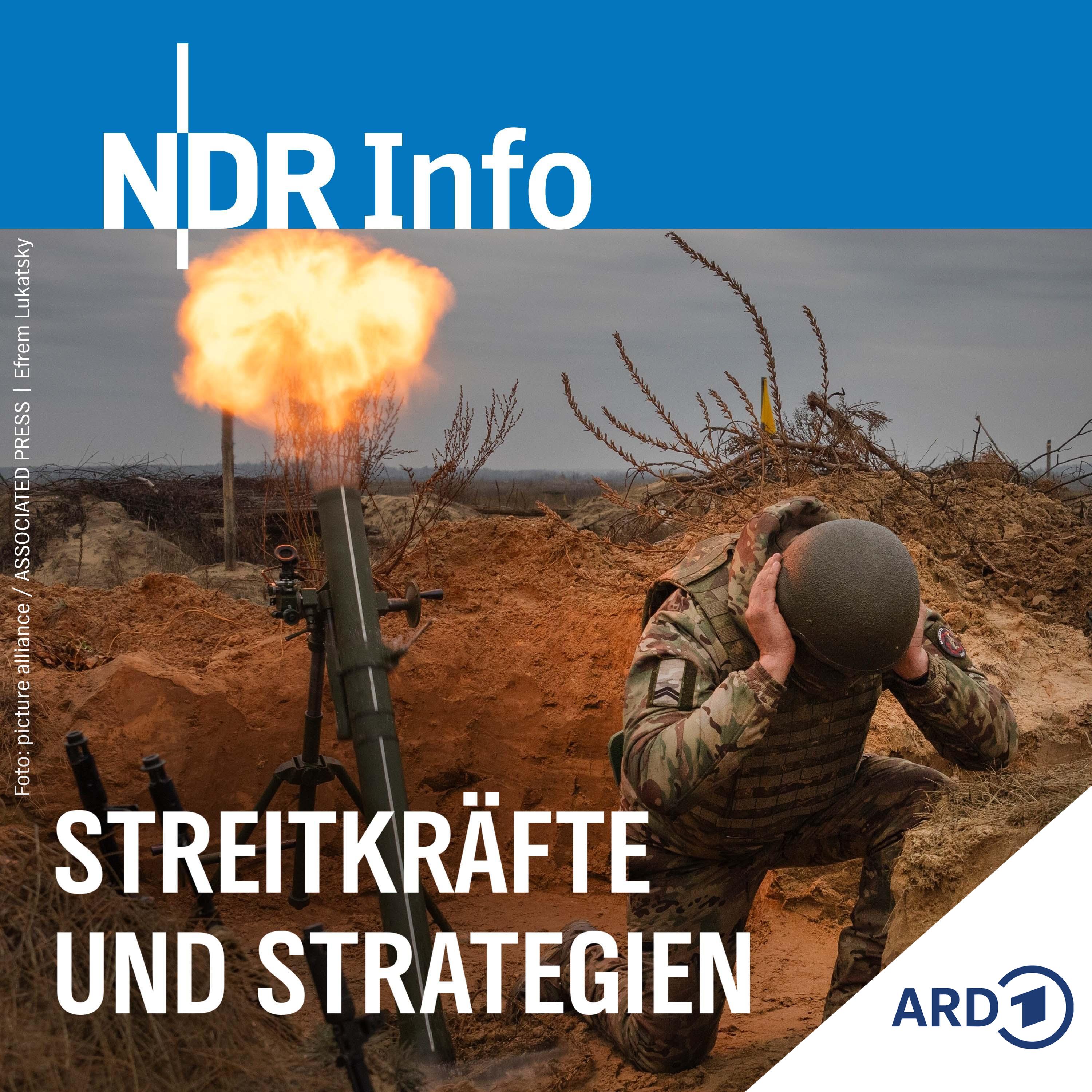
At the moment, it is really so in this phase of the war that the front strip is 30 kilometers wide.
That means, from the first contact line, so to speak, the Ukrainian soldiers, the Russian soldiers,
some meters or some hundred meters across from Schützenkreme, are up to 30 kilometers behind the front.
At the moment, it is artillery, rocket artillery, but also drones for use,
and that can never be very secure in front of the Russian attack drones.
And I would also like to say that perhaps the biggest change compared to other journeys we have gone through in the past three years
is that the danger, especially in the depth of the room, has greatly increased.
This is how the military expert and writer Franz Stefan Gadi describes the situation directly at the Ukrainian-Russian front line in Donetsk.
He can do that, exactly, because he visits Ukraine very regularly and is still under the impression of a new journey
from which he has just returned.
What has changed at the front, at the Russian war leadership, in which the Ukrainian army must fear,
and why there is still a long way to go for it, where we are standing at all, three years and five months after the Russian full invasion.
I have spoken about this with Franz Stefan Gadi.
And with that, welcome to Stride Powers and Strategies, the podcast of NDR Info for the Russian War against Ukraine.
I am Kai Küstner.
And I am Astrid Korall. Today is Friday, July 25. We are recording this podcast at 11.30.
And we are talking in this broadcast, as in almost everyone, now about peace, about peace views, as Marga also likes to be.
And about the fact that the Ukrainian president is very much involved with Putin, the Russian power.
We are talking about Russian attack and Ukrainian defense forces, or how the Ukrainian president is looking to increase this.
There is now the financing for three Patriot missile defense systems.
Zelensky has announced it. Germany is looking for two of them.
He is looking for money for seven more Patriots.
But Astrid, we also have to talk about Bolodimir Zelensky himself.
And with that, we also start your view of the situation today.
Over Zelensky, namely, in the past days, a true storm has collapsed.
At the beginning of the week, a law was decided that the independence of two Ukrainian anti-corruption authorities is limited.
The official grounds are under Russian influence.
Zelensky's announcement followed clear criticism from abroad and in Ukraine itself,
where in several cities, in the middle of the war, people went to the streets in masses.
And here, I would like to note, it shows that Ukraine is a completely different, free country than Russia,
which the Ukrainians and Ukrainians also want to keep.
Astrid has now calmed down a bit for Zelensky, hasn't he?
That's right, Kai. There are still protests, but they have become less and that is because
the president Zelensky has now calmed down. But Kai, maybe the series after, let's look back at the beginning of this protest.
Because the president Zelensky had a law by the parliament.
And then also indicates that the general-state lawyer, which he called Zelensky himself,
has more control over two authorities.
They are called Naboo and Sab and are supposed to go against corruption in the country.
In this respect, what is more important than that is that Ukraine is still one of the most corrupt countries in Europe.
And the fight against corruption is a very important proposition, so that Ukraine can contribute to the EU.
And exactly this European contribution perspective was threatened by the new law by parts of the population.
And that's why they went to the streets.
And also, Astrid, you know the EU well as well as the criticism of Brussels from the European Union.
Yes, but in the past three and a half years since the beginning of the war, I found it difficult to perceive from Brussels critical tones.
And this has changed this week.
The EU commissioner, Chairman Ursula von der Leyen, talked about serious concerns and the EU commissioner for expansion,
Martha Koss, she spoke with a look at this new law from a back-up.
And she explained that she has a clear message for Zelensky and his government.
I'm worried because the fight against corruption is one of the reasons to become a member of the EU.
And it is a proposition that the state has independent anti-corruption authorities.
I expect that we will return to independent negotiations.
Criticism, for example, came from Foreign Minister Johann Wadefuhl,
German EU representatives and politicians in the foreign country always connect with warnings that Ukraine is taking the wrong path on the way to the EU.
And Zelensky has earned high and high points in the network.
And even at the front, Ukrainian soldiers have expressed themselves critically.
As a result of the Kiev independence, this step of Zelensky feels like a blow to them.
And this massive pressure has shown quick effects.
On the day of the Donnerstag, the square wall came. Zelensky presented a new law.
And the anti-corruption authorities wrote about the fact
that all processional powers and the independence of the authorities were re-established.
Zelensky announced in his evening video message
that employees with access to state secrets will be subjected to lie detector tests
in order to close a Russian influence in the state affairs.
In total, of course, one wonders which motives, which goals Zelensky has set out to achieve.
And I also asked Rebekah Bart, the IED correspondent in the studio Kiev,
who is regularly a guest with us at Streitkräfte und Strategien.
That is still unclear to many here in Ukraine.
And personally, I haven't found an answer to this yet.
Because it was a real real process.
Real days, a real approach, what we have experienced here.
And rational, only very, very difficult to explain.
On the one hand, you can see that this administration under Zelensky
likes to have a lot of control, in order to express it diplomatically.
Another possible explanation is that Zelensky and his environment
want to protect their own trust.
Naboo means a whole series of orders in the Ukrainian parliament.
And he also means trust by President Zelensky.
We know that.
We can't rely, at least, on the fact that this was actually a challenge
for this development of the last few days.
But of course there is a temporary connection.
In the past few weeks and months, there has also been pressure
on anti-corruption activists, on critics of the Ukrainian president.
Officially, the explanation is that Naboo, the anti-corruption bureau,
is under attack by Russian spies, by Russian agents.
There was a whole series of rations against several employees,
detectives of this government.
They are investigated, they are promoted as high-ranking, state-ranking,
collaborated with Russia.
We can't check this independently.
Personally, I wouldn't be surprised if that's the case.
Because Russia is not only leading a conventional war against Ukraine,
but also a hybrid.
But you have to say that even if this government
was to be under attack by Russian spies or was to be,
this law is the resolution of the independence of the government.
It is now the case that the parliament
still has to vote for this law.
The events will probably not go smoothly to Zelensky.
And Rebecca, the consequences for the presidents are so much appreciated.
I believe the Ukrainian president has actually
caused great damage, also long-term damage.
I see a great loss of trust within the Ukrainian population,
but also with the European partners,
with the western partners of Ukraine.
He is now trying to protect himself.
We can see that very clearly and that seems to be successful for the first time.
But nevertheless, in general,
everything throws a very bad light on his administration
and also on the Ukrainian parliament.
You definitely notice that the pressure from the inside and from the outside
has affected the Ukrainian presidents.
As far as Rebecca is concerned with her assessment,
and of course, what happened in Ukraine was also followed in Russia.
The Institute for the Study of War has reported about fears
that this political crisis in Kiev could play a role in Russia.
Kremlin-functional propagandists and spokespersons
instrumentalized these protests to spread existing Russian narratives
that the Ukrainian government should represent as corrupt and illegitimate
to prevent such further western support for Ukraine.
And this propaganda was widely taken here and there in Germany
from an interested side.
While it was protested in Kiev,
the third round of talks between representatives
of Ukraine and Russia took place in Istanbul.
I have already talked about this in our exhibition on Tuesday,
that the predictions before this talk
are not so grave.
And also the results were a bit predictable.
There was actually little hope for hope
at the end of the war.
There was really little of this meeting expected
and little has been achieved.
As already in the previous round of negotiations in June,
there was another captured exchange.
This time the number was 1,200 prisoners.
Moreover, Russia is obviously ready to hand over
the death threats of more than 3,000 killed Ukrainian soldiers.
Otherwise, the Ukraine demands,
like the West, a immediate and unconditional weaponry,
which Russia has been leading back for months.
Russia has really short weaponry
with a duration of 24-48 hours on the front line,
so that at this time the soldiers and the soldiers
would be able to get injured and killed.
Russia stays with its maximum demands.
These are also known, among other things,
that all 4 of Russia's promised territories
and the Kremlin completely rejects Russia,
that it is against Western military aid,
just like NATO does.
By the way, we will hear from Stefan Gadi,
who we will hear from later.
He told me that he has no evidence
in Ukraine on a peaceful will of Russia
in any case with his visit to the front.
The Russian attack operations continue to go on,
regardless of what seems to happen at the diplomatic level.
How is it going on at this diplomatic level?
I think that the Ukrainian President Zelensky
is very concerned with a meeting with the Russian power "Putin".
At least I have the impression.
The impression is true, Kai.
According to this conversation,
the subordinate of the Ukrainian side
said that the Ukrainian meeting
between Zelensky and Putin
was scheduled for the end of August.
On Friday Zelensky explained
that subordinates from Russia
would have had conversations
about a possible meeting between the two leaders.
Nevertheless, of course, there is a skepticism.
The Ukrainian side has already addressed
such a direct encounter several times.
For Putin, she is only in a final phase
of possible negotiations.
And the Russian exchange leader,
who was part of the meeting,
also did not make the impression
that there could be a joint term as soon as possible.
What also shows from my point of view
that Moscow is eating these 50 days.
The US President Trump
has not really impressed
the arrival of an air force.
On the contrary,
according to the newspaper "Kiev Independent"
Ukrainian and Western military experts
assume that Russia
could escalate its offensive operations
during this 50-day period.
At the same time,
the US Ministry of Foreign Affairs
makes new weapons deliveries
of the USA and Ukraine.
In height of about 275 million euros.
This includes equipment
for aircraft carriers,
armored vehicles of the type Bradley.
In addition, money for maintenance and repair.
In addition, Trump had already announced
further deliveries.
The Ukraine should, among other things,
get aircraft carrier systems,
which we have already reported several times.
Germany and other NATO countries
should carry the costs.
There is no new state in this matter.
Germany is ready.
You have already mentioned
two Patriot systems.
But wait for the US
to quickly set up a replacement.
Whereas Boris Pistorius,
the defense minister,
has expected about six to eight months.
Because you just mentioned Boris Pistorius,
the Federal Cabinet
has made a new law this week
to be able to quickly
create equipment.
If the creation
takes as long as you need
to pronounce the name of the law,
then we are afraid that we will have
more problems,
in order to overcome this.
The Federal Recreation Act
includes a somewhat complicated name
of this law.
The government
wants to make more time
for equipment.
The process should be accelerated.
The federal equipment
should be faster and easier to buy.
An example for more deliveries
should be given directly
without a subscription.
So far, subscriptions are necessary,
if you have more than 15,000 euros
and this limit is now increasing.
Boris Pistorius also expressed himself.
In the future, we want to
set up a new value limit
for our defense abilities.
The new value limit is at 443,000.
After that, the formal delivery process is needed.
In total,
it is necessary to sort
almost 8,000 orders
that can be made faster.
The law includes, for example,
environmental standards,
for example, the construction of barracks
should be unlocked.
In total, this law
is a quantum leap for Pistorius.
But of course, there was also criticism,
for example, of the left.
About the current military situation in Ukraine,
I will speak with Franz Stefan Gadi.
That is why Astrid
is now a rather short summary of you.
I'm really making it short, Kai.
Donnerstag was attended by
the famous old town of Odessa.
Some historical buildings
that were damaged
due to UNESCO's World Cultural Heritage
were damaged.
You can see on pictures
that the famous brand Privos hit flames.
Ukrainian President Zelensky
has announced a response
to these and other attacks.
As always, this response looks like this.
Ukraine has been trying
to attack drones for a long time.
In the night on Donnerstag
Russian Defense Ministry
destroyed 105 Ukrainian drones
according to the Russian Defense Ministry.
There was a response
for Ukraine during the air defense
on Wednesday.
For the first time,
it lost one of the France-launched
fighter jets of the type Mirage 2000.
Due to a technical defect,
it crashed according to the military.
The pilot was able to save himself.
And with this,
we now have another Kai in your conversation
with Franz-Stefan Gadi.
Thank you for this overview, Astrid.
It's a great contrast.
While in Germany,
the summer holiday is on the rise
or is already on the rise,
the front lines in Ukraine
are being continued to fight
every day.
And also the people in the Ukrainian cities
have to fear their lives
due to drones and rocket terror.
We thought it was time
for an emergency recording.
Five months after the Russian
full invasion in Ukraine,
almost a year after the
Ukrainian surprise attack in Kursk.
How is the military situation?
Where is hope?
Is there hope at all?
Also in terms of diplomacy.
I discuss this with Franz-Stefan Gadi,
military expert and author
of the book "The Return of the War"
that is presented
for the German budget.
And the time for the conversation
is also especially
when Franz-Stefan Gadi
has just returned
from a visit in Ukraine.
A visit
directly to the front lines.
And so I wanted
to know from Mr. Gadi first
where you were
and how it is
to be there as an observer
at the front.
I would like to underline
that I cannot give the details
about security reasons.
We were close
to each other in front
and I would like to briefly explain
what it means.
At the moment it is really
in this phase of the war
that the front lines are 30 kilometers
wide.
That means from the first contact line
from the front edge of the defense
where, so to speak,
Ukrainian soldiers,
Russian soldiers, some 100 meters
across,
up to 30 kilometers
behind the front,
it is now artillery,
missile artillery,
but especially drones
to be used.
And that I can never be sure
of the effect of Russian attack drones,
especially drones with glass fiber cables
that operate in depth.
And I would also like to say
maybe the biggest change compared to other
flights that we have carried out
is that the danger,
especially in the depth of the room,
has taken a huge toll.
You have to look in the sky again,
you always look at what is there
that the danger of drones
of the rotors is huge.
It is always good when it is clouded,
if it rains, then less drones
can operate. But this danger
and also this feeling in your own body
is in comparison to the past
here really increased
during this journey.
Yes, it is relatively uncomfortable,
especially if you think
you could always be a victim
of a drone attack.
The Russians are also very good
in the background, that is, they position
drones in the background
that are positioned on the street
or are lying on the lawn
and should they offer
a worthwhile goal.
They get up and grab this goal
behind their backs,
always support vehicles,
soldiers, the wilfulness
is what causes the biggest stress.
That you can be hit
by a artillery shot
or, above all,
by drones.
And yes, in this regard,
security conditions are of course
increasingly increased, also within our group.
We have to take a very precise distance
where we are going, where we are not going.
A few months ago,
we still had problems going to the most
brigade fighting stations. Now it is
the case that all brigade fighting stations
that lie several kilometers behind the main line
are also lying below the bullet
line or on the road
below the bullet.
And yes, it simply conveys
the feeling of insecurity
and these fighting lines are now
30 kilometers wide.
Full understanding that you
don't want to give your exact locations
a price, but
so that we have a bit more
orientation, they can tell us
roughly where in Ukraine
they have found themselves.
Well, we were
at various places
the front with the heavy point
of course in the south region
of Donetsk. Why of course, because
there the main attack axis
or the main attack axis of the
Russian strike force is located.
Here is clearly the heavy point
of the Russian offensive operations.
I don't really want to
talk about a Russian summer
offensive here.
I think here convey the media
a wrong picture. The Russian
offensive operations, that is, the attacks
on Ukrainian positions
have already taken place in March.
And I don't think that
in the summer it will be the end
I think the Russian attack operations
will win in intensity.
They will probably
also win in size
and they will, but with great
probability in autumn, maybe even
further. So here from a summer
offensive to speak
I hold for wrong.
Well, we were
in the southern area of Donetsk
where at the moment it is very
burning about the city of Prokofsky
and Konstantin Nefka.
Here it is so that the danger
the Ukrainian troops
are involved in the delay.
The big question is, can the
Ukrainian troops on the right from Prokofsky
or also from Konstantin Nefka
pull back, can they also take their material
with them?
What we have seen in the last days
is that the Russians have made a flank
progress. That means they threaten
the connecting streets, especially
in the area of Prokofsky. And here
the question is, will the Ukrainians
defend themselves here?
Will it possibly be a second
Bachmut, the known battle
that took place in winter
in the winter in the city, where the
Ukrainian forces, but also
the Russian forces, fought for months
around the city of Bachmut, also
in Donbass. And both sides
had very high losses
there. Will there be
a replay, so to say,
of Bachmut in Prokofsky?
That remains to be expected.
Will there be a withdrawal order
of the Ukrainian forces?
Yes, that is for me at the moment
perhaps the most urgent question
and here it is very clear that Russia
has set the difficult point. That's why
a lot of time has passed in this region
along this main attack axis
in the last few days.
Now Mr. Gadi
has already talked a lot about
what we can talk about in a moment.
I will now take
the term "summer offensive"
out again, because you say
that it is actually not. It means
that you are already aware
that the Russian attacks will still be
added. So we already had a few
weeks ago in our podcast
that said, yes, this summer offensive
probably started now,
but there was
such a huge shift so far not
on the battlefield. So where do you go
from what is still coming?
First of all, I don't know how
this expression has come into the media
from a summer offensive and who
really found this expression.
I think it will come again every year
that it will be a summer offensive.
And as I said, my attention is
to a completely wrong picture
that actually happened.
In reality, it is so that the main
eye of the Russian attack operations
is not a very territorial
win-win moment, but
really the use of the Ukrainian
strikes. And I think that's why it is
so important that you don't
focus on social media or
contacts from the distance
or on the anecdotal
with single-sided officers.
So it really looks systematically
how the Russian attacks
take place along the whole front.
How do the operations take place?
And then you come to the conclusion relatively quickly.
Okay, a really large
assigned officer would be structured
differently, would start differently,
would be carried out differently.
And what we see,
in fact, is that Russian groups
attack in smaller numbers.
Two or four soldiers
maybe even supports through
motor vehicles, mechanized
forces that attack in smaller frames
and to protect tanks, combat tanks
that attack here.
But continually, 24
hours, seven days a week,
permanently attack in smaller frames
in order not to give the Ukrainians
a sinking break.
That means that this large attack
or this large-scale attack,
which would take place in an offensive
where it is really about going deep
into the enemy space, is not only
not possible due to the permanent
danger of drones or in the fighting field
but much more, it is not
the opinion of the Russian troops
to attack here in large numbers,
but slowly and steadily
simply attack the Ukrainian troops
here. At the same time,
it happens that the Ukrainian troops
have to carry out tactical retreats.
But there is not
this summer offensive,
as it may be shown in the media.
It is much better
to talk about it.
There are Russian attack operations
in March, which will take place
throughout the year.
The limiting factor will be
more natural and human nature.
That means that the personnel
could possibly attack the Russians
or the material. That means
the ammunition or the vehicles,
the artillery, the drones.
But at the moment, it does not look
like it will attack the Russians
until at least the end of the year.
Therefore, the appeal is clear to me.
Please, let's not talk about a summer
offensive, but simply about these attack operations.
That means,
you have also indicated that
personnel and materials
could possibly be a problem
for the Russian side.
However, Putin seems to be
at the moment of the opinion
to be able to sustain this use war
longer in the end
than the Ukrainians and the West
and to be able to win it,
or am I wrong?
The big question in the military lies
to say that Russia
may not be able to sustain
this use war for a long time
as one would think.
First of all, I am not an
economist. I don't know
exactly how the economic situation
is presented in Russia
with the exception of the equipment industry.
Here I can see that the production
can continue to this day,
at least in the year 2026.
I also see that enough ammunition is produced.
I also see that enough armored vehicles,
that this war can continue.
I can also see that the
Russian, North Korean, Iran,
and China, of course,
are supporting Russia in the background.
But I think
we have to choose other criteria
that we might have chosen a year ago
to contribute to the fighting power
of the Russian forces. I will now give you
an example. The role of artillery
has changed a lot, that is,
both sides prefer less artillery grenades.
That means, if we set up a metric
for how many grenades Russia has produced
in the year, and we say that
Russia has produced fewer grenades
now, we would blame the Russians
for not being able to proceed with the war.
And that might be a wrong conclusion
because artillery in comparison
to drones in the last few months
had less importance. The same goes
for armored vehicles. We always
talk a lot about when the Soviet
arsenals would be empty, and
when Russia would only have
newly produced equipment.
Yes, that's true, but the question is
if the attack tactic changes
when armored vehicles are not
used in a larger frame,
is that also the right focus here?
I'll give you just two examples
that you have to give very carefully here.
And you can draw very difficult
conclusions, what actually
happens here, and who
could finally win the overhand here.
What is clear is, of course,
that the military production power
of Russia and the Ukrainian is
almost the same as Russia
has a larger personnel reserve.
But that has rarely
achieved that alone
in order to win the war
or in order to win the war.
Now you have already mentioned
the drones, because
the development is sometimes
so fast that we all have
a few weeks of new status.
You have mentioned the control per glass
phaser.
I have also heard reports that
it is almost as old-fashioned again.
What is happening
in this field from your point of view
and what have your experiences
shown there on the front lines?
Well, I think the most important
experience in this regard is that
we waste too much time
to analyze a single weapon system
in detail, a single technology.
And that we see that the
connection, actually, or the fight
of the combined weapons in the end
is the most important element.
Yes.
There are always these statistics
that 70%, 80%, 90%, 95%,
98%, depending on
the front line, the losses
on both sides are now
to be added to drones.
But this statistic is a little
wrong, because it is actually
the case that without the artillery,
that is, without the explosive
shells that are shot from
tanks, tanks or other drones,
actually only the drones
are able to effectively fight their targets.
What do I mean by that?
Artillery is used on the modern
battle field in Ukraine
to suppress the enemy.
That means to keep it low,
to attack in the rear.
But it is also used at the same time
to destroy various coverings.
That means, in the meantime,
it is so in the battle field
that there are almost no more positions
in the open field, because these positions
and these training systems can be easily fought.
That is why it is so that, if you look
at the front and look there,
all positions are somewhere along
from forest lines
or in cities, in villages, in houses,
somewhere in the built area.
The artillery can
call these areas under fire
and that is perhaps a terrible word
that they can use to block.
That means shooting in there
with bullets, that the coverings
will be shot away, that the trees will be shot away
and only then come the drones
that can destroy
single soldiers or single positions.
Drones play an extremely big role here,
but it is connected.
It is not just the drone command alone,
but it is the combination
with artillery, the combination
with infantry, which of course
also takes attack systems
and which then occupy territory.
That is the important thing.
But specifically on the question of drones
I would like to say that the most important thing
which I take from this journey
is that the Ukrainian forces
slowly
cross the border
in the drone command
along single attack axes,
but especially in the southern area
of Donetsk, where the Russians are coming from.
And that is very dangerous
and can also be
very dangerous.
If I may ask a question,
does it come from hand-to-hand
because Russia's drones
are currently producing
drones?
Exactly, that is one part.
But what is much more important is not only
the quantitative consideration
of Russian drones and also not technically
qualitatively.
Both sides are
approximately on the same level
in one category, although we have to say
that in the area of the airfield
Russia has clearly shown
a lot of consideration here
and the Ukrainians are just trying
to close it.
This is the most systematic approach
of the Russian drone operations
that I have seen,
which I have also personally felt
in the area of 20 to 30 km
behind the front,
which was maybe 5 to 10 km
a few months ago
has now been expanded
to 30 km
in a larger number.
This is the most systematic approach
which has given me to think
on the Russian side.
Russia has really managed to
establish a drone control system
where the front
is divided into individual sectors
and where in these individual sectors
individual units are targeted,
attacks do not lead
very much to the overall width
of the Ukrainian troops, but are targeted
to Ukrainian drone teams,
to the Ukrainian logistics
to support drone operations
and thus
slowly but steadily
launch the Ukrainian airspace
in the lower heights.
This means
between the ground
and 3,000 to 4,500 meters
in these lower heights
the airspace
is slowly fighting.
This is a huge problem
because the entire Ukrainian defense system
is built up
in the drone area
when you look at
the Ukrainian defense system
it is like this, on the ground
there are the infantry, the fortifications
the positions supported by mines
or protected by mines
in the hinterland supported by artillery
but above all
it is about the fact that Ukraine has tried
over the last months
because of its
material and personal
and personal maintenance
because of a drone control system
here the Russians
to resist
in such a long time
to use the Russian airspace
for longer time.
Therefore the center of gravity
was chosen by the Russian side
to collapse this system
or this Ukrainian defense system
by setting
the center of gravity
on the key
how this system could break together.
We are seeing this now.
I am not saying that Russia will have success
winning the airspace
but the situation is quite tense
and in parts
the front has already
happened, at least temporarily
the Russians have overlaid here
and this is a very critical phase
which could
have a greater influence
on the battle of the entire front.
You also said
if we look at the individual front sections
clearly in the focus
of the Russian war leadership
of course the Donbas
and the Pokrovskaya
when I understood them correctly
then I probably
at this critical moment
when the Ukrainian army
asks when is the right time
to give up the defense lines there, right?
I think to move back
to defense lines in the hinterland
that is definitely true
and I think it will be unavoidable
that the Ukrainian forces
will have to move back
to defense lines.
As I said, the focus is
of course on territorial superiority
which is also quite clear.
The Russian view at the moment
is mainly to increase
Ukrainian fighting forces as much as possible.
Of course the same applies
for the Ukrainian fighting forces
and here it is so
that in the past the case was
that the Ukrainian fighting forces
have often been counterattacked
and have often led to counterattacks.
To wait if there will be
a change here
that not every meter of the territory
actually has to be protected
until the last man.
That there is a certain flexibility
in the defense on the Ukrainian side
that then keeps the own losses lower.
The biggest uncertainty for me
is when will the Ukrainian troops
keep a withdrawal order
while they keep a withdrawal order
and if they can move back
in the coming weeks and months
as soon as the situation is established
and is it actually so
that the front can stabilize
in the southern part of Donetsk?
At least that doesn't sound like
the Ukrainian would come
back to the offensive
in the initiative.
If we are talking about individual
front sections,
a section that we
should pay special attention to
from Donbass. There were reports
that a few weeks ago
the Ukrainian troops entered
the oblast in the oblast
of Denier pro Petrovsk.
Is that threatening in your opinion?
Well, first of all
in the comments
the whole situation in the southern part
of Donetsk doesn't exclude
that the Ukrainians don't go
into the offensive.
The situation was on fire
in the last months
and in the last summer
when they could come here
in August?
I wouldn't exclude that
and I have to say
that the situation in Donbass
wasn't stable over the last 12 months
and beyond.
The situation isn't catastrophic
I would also like to stress that
the Ukrainian front won't come
to a collapse.
The front is relatively stable
in the southern part
of Donetsk.
I think what we see
is that a new attack operation
in the Saporizhia area
could take place in the south of Ukraine
so that the Russians
could increase
their attack operations
and increase
their increase
in the coming weeks.
I would also like to point out
that the Ukrainian front
is relatively stable
in the southern part of Donetsk.
I would also like to point out
that Russians could increase
their attack operations
in the coming weeks and months.
It could also be that
the Russians
want to continue their attack operations
in the next few weeks.
The question that I always get
is whether there are enough forces
within the Russian fighting forces
so that they could
close their attack operations
at the same time.
Then there could also be
a new attack operation
in the direction of the Nipro.
At the moment I don't think
that the Russian forces
could have come here.
But that can still be changed.
Sumi, just to explain
the northern part of Ukraine
the Russian is also
constantly trying to
create a "puffer zone"
from my point of view a bit of euphemism
because that means
that you occupy an Ukrainian territory
as if you had to defend yourself
against Ukraine.
But actually it's the other way around.
Has Putin somehow succeeded
or why does he even talk about
the need for "puffer zones"?
One thing is of course
to secure the own population
in the border region
that the Russian fighting forces
protect their own country
and second, especially what Sumi does
is that Sumi is a huge
important logistic area.
I think that the Russian ambitions
are to connect these logistic operations
sooner or later.
That means to attack with tools
to threaten the city
step by step
and then to do it
unaccountably.
The question is what the time will be
and will it succeed?
I don't see that the Russian forces
would have the power
to enter the city themselves
or would like to have
these puffer zones.
I think they will stay
as long as the Ukrainian fighting forces
are not strong enough
to destroy the Russian occupation.
I'll put it together.
They hold the situation
as a catastrophe for Ukraine.
They said that breakthroughs
from the Russian side
are not expected.
I think we should
have already talked to the staff
about the equipment
of Ukraine.
There is a new movement
because the Trump government
has already explained
to deliver new weapons
to Europe and the USA.
They then deliver
to the Europeans and the Germans
what they have given to Ukraine.
What is particularly needed
from their point of view
from the Ukrainian side
and does it also have a psychological effect?
Do you take it to the front
and do something about it?
The general impression
is now much more positive
than a few months ago
when I was the last time in Ukraine.
You can feel
that there is
a certain mood of breakthrough
that affects the American military support.
The so-called
"worst case" scenario
is not accepted
because Ukraine was left
by itself.
The fact that
the Trump government
and the USA
clearly underline
that they
want to deliver
the Ukrainian problem
to the Europeans.
We as Europeans
have to think
strategically
and I think the most important thing
is that we define
what Ukraine means
and what it does not mean.
Only then we can reduce
what we want to do
to maintain the sovereignty of Ukraine
or let them
fall under Russian influence.
I think that is the one important point.
The second point that I want to briefly mention
is that I say that the front is stable
and that the military situation
is not catastrophic at the moment.
Of course, that can change relatively quickly.
It really must be necessary.
I can only look forward
for a few weeks
and that is why I am always there
with my team because the data
is very long-lasting
and these data only have
a production power of few weeks.
The situation can change
relatively quickly.
I always want to underline
that the war situation is a complex
business and you cannot only
break down three or four data points.
What is the air defense?
I think in this area
it is also necessary.
Especially in the area of the long-distance
air defense over ballistic missiles
and Marshal bodies.
And here it is, of course,
that additional air defense
missiles are needed
for the Patriot air defense systems.
Here, of course, Germany is asked.
But I had the impression
that the situation is less critical
in the area of air defense missiles
than maybe in the area of media.
And that Ukraine may still
keep up with the existing missiles.
I believe that the greater danger
is at the moment
how can you get the threats
of these mass attacks
by Russian drones.
Here, too, I have,
and this is an optimistic note,
technological solutions that are very effective
against the newest variants
of the so-called Shahid
or Geraintrona can be active.
So it is possible that even in Russia
in a few weeks
thousands of drones overshadowed Ukraine
and these attacks
lead to the possibility
that there will be countermeasures
on the Ukrainian side.
The question is how quickly they can be produced
and implemented.
At the moment it is so that the Ukraine
has to adapt to the front,
but of course also the own air defense
has to adapt to the growing threat
from Russia.
That would be the so-called Interceptor drones.
What you need
to fight with Patrick
or Iris T.
What is very expensive, as we know.
On the one hand,
you are speaking the right way,
the Interceptor drones,
but there are also other systems
in the field of electronic warfare
that are tested,
additional short-distance aircraft systems,
a combination, as I said,
I always underline this approach
in the combatant-related weapons,
but I think Interceptor drones
can be played in the coming weeks
and months, which are the combatant
of Shahid drones from Russia.
Gadi, I would like to
ask you a question
about diplomacy.
There is now a trade table
in Istanbul.
There were direct talks again,
Russia, Ukraine, but very short
and actually without progress
on a diplomatic path.
What would be necessary
from your point of view
to move Putin
seriously?
First of all,
I would like to mention
that not in the last weeks,
where I was in Ukraine,
for a long time, or what I experienced
or even in the early stages,
I would have shown in some way
that Russia would be willing
to reduce its attack operations
or that there would be
a manifestation
of the Russian peace treaty
that is, the Russian attack operations
continue.
There are also many civilians
in the Russian attack
at the stage of the victims,
i.e. 10, 20, 30 km
behind the front.
And the Russian attack operations
continue to be reduced, no matter
what happens on the diplomatic level.
I think the only real
way or
the theory of success,
so to speak, for Ukraine,
is to increase the total losses
in the counterattack
to very low territorial
accelerations,
so that sooner or later
there will be a change in the Kremlin.
Whether this will work, I can't say anything.
Of course, you have to increase
escalation risks again and again
in this respect.
But that seems to me the only
real way to be
to simply take the costs
for Russia to lead this war
further.
Then it is very easy to say
that if I say this here
as in Austria, in the country
that is in peace or
would also be in Germany.
I mean, this war goes on
every day, enormous losses
that you also get here
and the population is also
now a war myth in Ukraine.
Of course, it still has the will
of an unbroken resistance.
I have spoken with some people
in Kiev himself, a young father
who had a three-month-old child
and I asked him,
"Do you not know how to get away
from Kiev with your child?"
"Do you not know how to live your youth
safely?" Because all these attacks
are taking place in the city center,
in Dusha-Hitron, ballistic missiles,
marshal bodies and so on.
He said, "No, if I leave Kiev
then I have to be carried out
out of this city."
This resistance will is, after all,
unbroken within
the Ukrainian population
and you also see,
I think, that the only way
is to show the Russians
that this will
of the resistance is unbroken
and that they are able
to make the Russian aggression
even more significant losses.
So in this regard, I see this
as the only way.
Of course, it is so that the
political level, the decisive level
is and would Vladimir Putin say in the morning,
"Now is the war to the end."
Of course, it would be a clear signal
that the war could actually
end sooner or later.
And in reality it is only one person
to end this war. We all know that.
And that is Vladimir Putin in the Kremlin
or the system that Vladimir Putin
has established.
And in this regard, it is actually
the decision-making of one person
to influence whether this actually
happens by the Russian
forces' greater losses.
Of course, I cannot say
now, but I think it is the only
tool that we can work with at the moment.
One last question
at the end, because we also talked
about it in our last interview,
for example, how necessary
or meaningful it is
to station US missiles,
Tomahawk and so on
in Germany.
There is an intense debate here
about how strongly
Russia influxes,
how much we should
take care of ourselves
as NATO states in a few years.
How do you see this
discussion at the moment
and is there in some way
new insights,
which are also the strength
and the war machinery,
that is what you have to call them in Russia.
I think it is important
to distinguish between the intention
of Russia, possibly
to attack NATO or the war
after the war in a few years
and then the ability, the capacity
and the willingness, that the
Russian forces will have
in the medium to long-term
future.
The intention is,
in my opinion, to do so.
There are signs, of course,
that Vladimir Putin, the Kremlin,
want to test NATO in the Baltic
or in other parts of Europe.
What makes the willingness
or the capacity,
the size of the Russian forces
and the abilities of the Russian forces
to deal with this?
I think that the high-intensive phase
of the war in Ukraine should
be slowed down in this year
in the next year.
In a few years, a much better educated,
better cared for,
better equipped
Russian army
will possibly stand
on NATO's side.
They will be able to profit
from several years of high-intensive
war in Ukraine
and, of course,
possibly the intention
will be changed
by the Kremlin
partly in smaller units.
There are different scenarios.
It's not about
a thousand-kilometer-long
front across Europe
between the Russian forces
and NATO, to deal with the war.
It's much more about
the confidence of NATO
in a short, intensive war
to discredit,
by overtaking a piece of NATO territory
and, possibly,
using an escalation-to-de-escalation strategy.
That means, the use of nuclear weapons
to signal
NATO should carry out
counterattacks
to spread the Russian territory
and NATO territory in the Baltic,
for example.
And NATO should
risk a nuclear war
in the whole of Europe
and
to return a piece of the Baltic
territory.
I always want to stress
that there is a direct connection
between the political, strategic
and operational level.
And here's the question,
what is the Russian intention
in this regard? I would like to say,
it's true that, of course,
the Russian combat forces haven't made it
in the last few years
to conquer Ukraine. How could they
ever stand against NATO?
I think we have to be careful here,
because one thing is clear,
that the Russian combat forces,
which would lead to NATO war,
would be better trained
with greater security,
better equipment
than the allies who are marching into Ukraine.
That doesn't mean that we have to be afraid
of this Russian steam engine,
in the whole of Europe.
We shouldn't be afraid
of the danger of the Russian
combat forces in the coming years
and decades to come
against Europe.
These are scenarios
that will hopefully never be introduced.
Thank you very much, Mr. Gadi.
Thank you very much for the invitation.
The military expert Franz Stefan Gadi
was that. If you want more
of his expertise,
we will put a link
to his book in the show notes.
And that's it
for this edition of
combat forces and strategies
and one more announcement
on our own. We are now taking a short
summer break. The next episode
will take place on August 15th.
And until then, we are always happy
about summits, praise and criticism.
Please contact us
at strietkrä
[email protected]
Astrid Koray and Kai Küstner
and now we have
a tip for the
Audiotheek.
Hello, I am David Krause,
one of the hosts of 11 km
of the Tagesschau Podcast. In our
latest episode, I spoke
with Julio Segador about the current
situation in the Gaza Strip.
Julio is a correspondent for the
Audi in the Tel Aviv studio.
I wanted to know which strategy
the Israeli army follows in Gaza.
He also told me what has to
happen so that a weapons peace
in Gaza is urgently needed.
The entire episode of 11 km
can be found now, for example,
in the ARD Audiotheek.
 PodcastTranscript AI