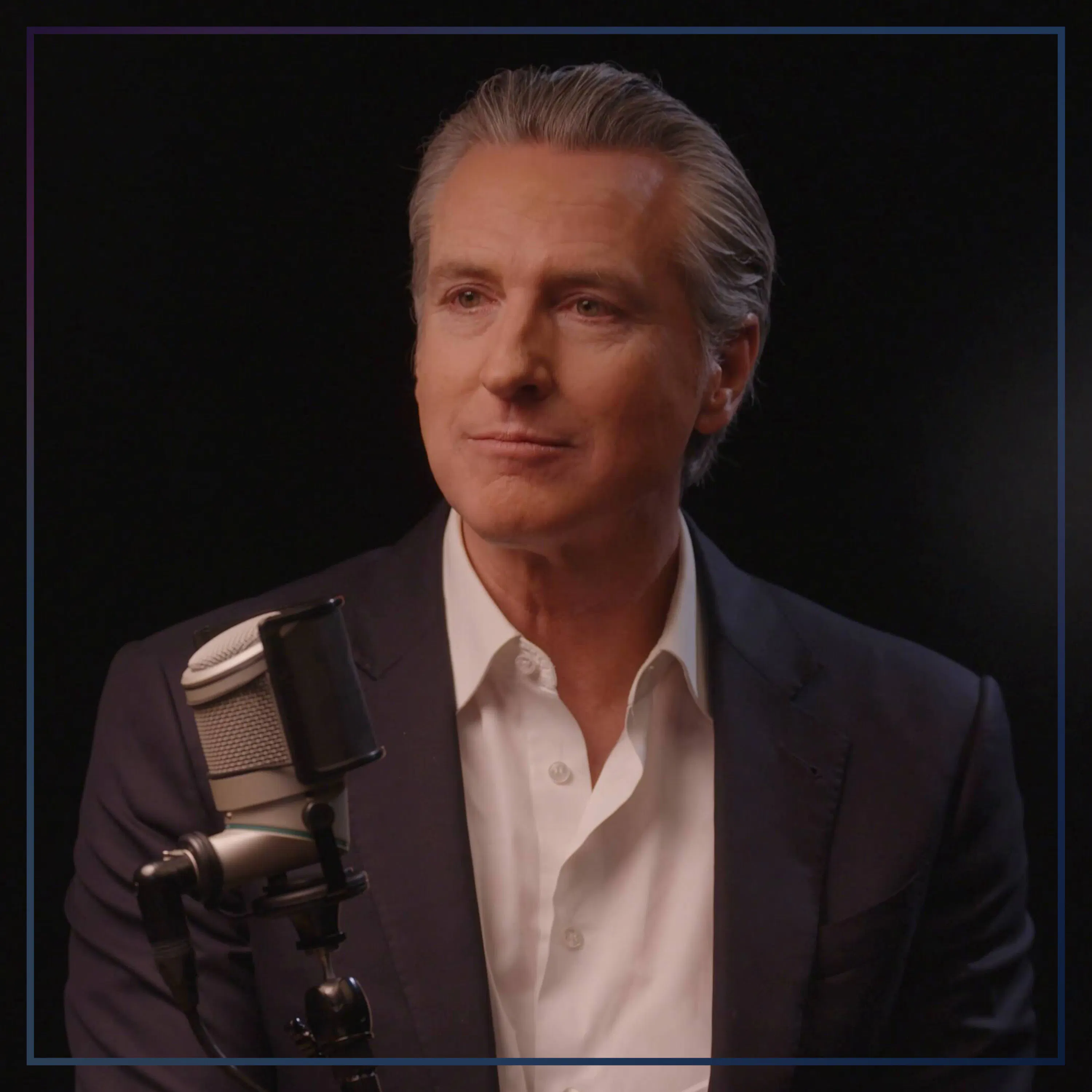
In this conversation, California Governor Gavin Newsom reflects on his complex relationship with his parents, particularly surrounding his mother's death by assisted suicide after a four-year battle with breast cancer. He describes a childhood marked by his parents' unexplained divorce, a financially and emotionally distant father, and a mother who concealed a traumatic past involving an abusive, alcoholic grandfather. Newsom also discusses his struggles with dyslexia and the lasting impact of his mother telling him "it's okay to be average." He admits to being emotionally absent during his mother's illness, prioritizing work until her stark voicemail announcing her planned death forced a reckoning. Being present at her assisted suicide was a harrowing but ultimately transformative experience, allowing him to release long-held resentment. Through writing his memoir, he came to understand his parents' struggles, forgive them and himself, and recognize the event as a gift. He concludes by emphasizing his commitment to breaking the cycle of emotional distance with his own children, consciously choosing to be openly affectionate and vulnerable.
Welcome to all there is wherever you are in the world and in your grief, I'm glad you're here. My guest today is a politician, but we aren't talking politics. Gavin Newsom is the governor of California. In 2002, his mom Tessa left him a voicemail. Gavin, if you want to see me, she said, you should probably do so before Thursday, because that's going to be my last day on Earth. She'd been battling breast cancer for four years and had decided to die by Dr. Assisted Suicide, which was illegal in California. Newsom was by his mom's bedside when she died. He's written a book about his life called Young Man in a Hurry, a memoir of discovery. I spoke to him last week. You had a really interesting childhood and a really strange bifurcated existence, a lot of different rights. My father just took off was sort of broken by two campaigns for local office. He ran for two offices back to back lost, spent the money he had. He said he had basically a nervous breakdown later. But the extent to which your dad and your mom did not talk about stuff with you. And I didn't even know why they got divorced. I never knew that story about my dad until I discovered some audio recordings that were done that my dad did, near the end of his life with other family members. And I listened to them and I'm like, this explains everything. Not only does it explain the thing they never talked about, mom and dad never talked about the reason they divorced. But also explain why my mom was so aggressively insistent that I not get into politics. And she never expressed why. She just constantly pushed me away from politics. And to understand then the origin story of their breakup. And the fact that my mom had to become an adult very quickly with two young kids. She came from no wealth, no money, just hustle to make ends meet. My father was distant in every way financially and otherwise. It explains so much of why I have doubts, anxieties, fear, resentment, anger, and it's allowed me just to let it go and now to understand more deeply. And frankly apologize for many of those emotions and those aspersions that frankly I cast against them when I was growing up. There's a couple of parallels that I found really interesting. I grew up not talking about anything. I also had dyslexia. I'm not sure what my diagnosis was. I used to go see a doctor. It was spotted early, unlike with you. And I was told about it, unlike with you. But I don't think mine was as bad as you. There's a kid in the back of the classroom. Literally soaking hands still. Still happens a lot, sweaty under the armpits, heart pounding, shy beyond words. And felt like I was dumb and actually knew I was dumb. Because it just wasn't smarter than anyone else spelling bees the whole thing. There's a moment when your mom is trying to help you read and struggling with it. Can't really do it. She closes the book and she says to you, it's okay to be average guy. The worst words of, I'll tell you if I look at my life, that may have been the most piercing thing. I've been my representative for years and years for that long. Yeah. You don't want to say that to your kid. And I struggle with that and I'm not, I kid you not. Only through the process of writing this book did I forgive her. Because now as a parent myself with four young kids struggling and just, like I get the exhaustion and it's what she was saying. And I really believe she was saying, it's just, just be yourself. You don't have to be someone else. Okay, let it go. And I didn't. And it was a chip on my shoulder. I'd say, you know, and I don't think it's there like it was before. And, you know, look, I don't want to overste, I don't want to paint it, overly negative picture. But she had her, she had, she had secrets. She had, she had all these struggles. I never, she never revealed them. I just, I lacked the curiosity to really push her on it and want to engage. When she was a kid, her father, my grandfather, was drunk, which was a daily occurrence. And had a gun and put the two girls, my mom and her twin, up against the mantle of the fireplace and said he was going to kill them, put a gun right to their head until my grandmother, Jean came in and calmly put him down and then he passed out. She never told me that. I learned about that. I didn't know about my grandfather's suicide. I didn't know what shaped his drinking. I didn't know what shaped his suicide. He had been a prison of war, the Japanese, his war war two. He ended up shooting himself in his bed. Yeah. And, and how that must have shaped my mom. And we never talked about that. The first few years of her life, she was so traumatized in that house. And with the house of horrors, they described it and later learned. And she didn't even talk for years, quite literally didn't talk. And your mom and hers, Annie, had their own kind of language. And it was sort of this gibberish she would speak to Annie and Annie would be the one that sort of translate her to the real world. See, all those things I wish I knew because then I would have known my mom. And then I would have known myself better. She liked her father, like a lot of members of the family. I mean, she, the sadness for her was she would get home and open that jug of safe way white wine. So she drank too? Yeah. And it was, she wasn't, she drank, but in a different way it was just, it was almost medicinal. It was just a, known out. And she wake up at 4.35 in the morning. Seven days a week was a work. I mean, I, I mean, she, when people talk about three jobs, that three jobs are quite literally the jobs on the weekend. She's worried it's like a waitress one day at a, other jobs. Her mom is a restaurant, part-time bookkeeper. She worked for a do adoption of special kids that have bought family intellectual and physical disabilities. You wrote in the book. She said, I was trying to solve the riddle of my identity. The question put there by my learning disability in the vastly different worlds that she and my father had presented to me. As I grew up trying to grasp which of these worlds have either suited me best. She had worried about the persona I was constructing to cover up. Would she consider a crack at my core? If my remaking was skim plaster, she feared it would crumble. It would not hold me into adulthood. What was the crack at your core? I just, this young man in a hurry, I was just seeking something, validation, external affirmation. I was just hustling. And I didn't take time, I'm trying to pause. I didn't take time to gauge reflect on my mother, advanced breast cancer. I had gone into remission the first time. And it came back and I frankly took it for granted because I'm like, oh, she'll be okay. You said, my way of dealing with your illness was to spend even more hours at work. Yeah. That's what I was doing. I was just priding. Yeah, of course I ran from it. I was just totally fully absorbed by myself. I'm running a few businesses. I'd open a wine store at a college restaurant. I was involved in some other businesses. I was on the county board of supervisors. And you know, I'm so blessed to have an amazing rock star sister. And she absorbed the emotional side of all of it. And so I felt like, okay, that's been taking care of. My sister's got this. And so I'm just going to try to take care of what I can take care of. Just go, just grind. I was very distant from her and she leaves me a voicemail. And she says, hello, it's your mom next week. If you're interested, I will be my last day of life. And if you want, you should stop by. And I remember calling my sister right away and say, what the hell is going on? And she's like, what the hell is wrong with you? Why haven't you been paying attention? Mom's suffering and she's doing this assisted suicide. Your mom literally left you a voicemail saying Thursday will be my last day on her. I have it. I have a small little, you know, went back to Walgreens, little tape recorder with the old tapes. And I kept it. And I don't know why I kept it. I mean, it was such a sad and pathetic thing that she felt she needed to do that. To leave me a voicemail because otherwise I was going to return her call or wasn't around. And sort of the finality of it. And again, talking to you and you talk about psychology and pattern and erupts. That was, you know, that was her just scratching the record player. Get out of your routine man. Paying attention to me. Wake up. Grow up. So it was, that was kind of the plaster. I put a mask on and my face was growing into it. I was becoming someone that I'm, that I'm not someone I didn't necessarily like. Someone that was unworthy of being her son. And I started to spend a little more time with her. And I didn't realize the pain she was in. Just the physical excruciating pain she was in. And, you know, try to boil a hard boiled egg. She couldn't eat. And it was just the kinkersaws in her throat and the cancer treatments. And the body had significantly deteriorated. And, and so it made me deeply understand. And boy, I'll tell you, deeply revere the doctor. It was willing to do this. It was illegal at the time. That last few hours, friends and family came over and her apartment. Everyone, I came a little late. They had all said they're goodbyes. She's in her bedroom preparing for the assisted suicide. And the last two she wanted to be with were my sister and I. When you came in, she had a photo of you and your sister on her chest. And she said my works have worked. Works of art. Yeah. And so you're there. It's emotional. You don't know what you'd, I'd never experienced anything like this. And with two of us were in there looking through old photographs, sort of 1970s old pictures. And she was describing the moment and talking about, you know, her relationship to that moment. And she had a member, there's a bottle of pills and my only job was the doctor said, would you have her take these 20 minutes before whatever time the doctor was coming? And so that was my job. And I just remember, and I remember saying, mom, you need to take these two pills, which was going to prepare for the actual cocktail. And in the process of those 20 or 30 minutes were talking, you could tell she was just sort of getting looser.
and more relaxed, and my sister was getting more anxious more. And she's holding, we're holding both her hands on both sides of the bed. As she's looking through and the two of us trying to show her pictures and the stories, Dr. comes in and my sister just, you know, then that it's real. And he does what he does and she's crying. I'm crying. So the doctor administered the whatever the cocktail is. The cocktail. And he beautifully, what a, like an angel. I mean, he, an angel. He passed away years ago. I never got a chance to thank him as well. I risked everything, talk about, you know, put his license on the line. And just so calmly and, you know, said goodbye. And when he left, my sister really started to break down and she looked at me and I said, you can go, I remember, you can go. And she said, thank you, and just left. And I was there. And just for those last minutes and those breaths, there was nothing, this is not, nothing romantic about this. I mean, it was like violent. The, the breaths, you're like, Jesus, what am I doing here? And holding her hand and then, and then this stillness, but stiffness. And I just put my head on, on, on her stomach, then it distended and just bawling, same to her muttering to her for 20 minutes of things I couldn't, I didn't have the guts to say 20 minutes before feeling like, you know, who, it was like the, talk about the mask, like grow up, man. It was just that moment. And, you know, I had a resentment for years about that too. And resentment that she asked you to be there. Yeah, I just again, through the lens of this, sort of shitty son that was, was about me, but it wasn't about me, right? But I was like, who does this? Who, who would, like invite someone in to see this, the experience? Like, I saw the trauma in my sister. I'm like, she's not, we, this, we've struggled with this. Like, should we've done this together? But I, I, I kid you and I once again, this, this, I mean, this is why everyone's a journal and write. I didn't know I've never done anything like this in the process of writing this. I also back to, it's okay to be average. I like, wait a second. I was holding her hand. She's still, I'm still holding her hand. At breath, that's my breath. It's last breath. And I'm like, Oh, God, what a gift. What a gift. Like, how blessed am I. Thank you. But she's not around for me to say it. And so, you know, what I have to do is, it may have to be a better husband and, and father to my own kids and make up for all that. But you, I was hard. You view it as a gift now that, too. Yeah. Oh, I do. I didn't, I, I really feel the breath. I feel there's this thing. It's just this notion of this letting go. It's a powerful. I didn't, I've never had the feeling of understanding that of, of, a breath. I feel for 57 years. I just all wound up and just accepting, just accepting things I can't control, just accepting them, things I can, taking account and responsibility to be better and more. More of my conversation with California Governor Gavin Newsom in just a moment. Hey, all there is fans. It's Michelle Obama. And I'm here with my big brother Craig to celebrate the one year anniversary of our own podcast, IMO, we're revisiting some of our favorite episodes, including our interview with Anderson. Since all three of us have lost our moms, we wanted to have a conversation that would offer comfort and perspective for anyone navigating loss. We talked about managing the grief process by allowing yourself to feel and how our moms prepared us to live on without them. Once I hear the full conversation, search for IMO with Michelle Obama and Craig Robinson, wherever you get your podcasts. Welcome back to my conversation with Governor Gavin Newsom. Do you feel grief? I feel, because not everyone does or it has different meanings for different people. It's really such a basic question, isn't it? It's interesting. As you pose it, I feel loss. I feel regret. I feel inadequate. I feel grace, humility. I feel, I guess, human. Do you miss her? Oh, kind of. Jesus. I mean, I mean, Anderson in the book, I talk about IMO. The one speech that I have to read periodically will do a teleprompter thing was with my inaugural speech when I got elected governor in my little two-year-old or three, whatever he was at the time, Dutch with his pacifier right out of central casting kid. All of us had those moments with our kids and ran up on stages I'm speaking and I'm terrified to look off the teleprompter because I'm just, there's no way I'll get back on the script. Everyone's staring at the kid running on the stage. My wife tried to grab him and he's running away and he eventually just lands on my leg and I'm in the middle of the speech and I'm just staring there. And I just instinctually lifted him up and he puts his photo, just puts his head right in my, you know, just like any starts falling asleep and I'm reading the speech and I'm like, and I swear to you, like, oh, where's my mom to see this? Because that is someone she would have been proud of. That moment, that's what she wanted me. I'm sorry, man, Jesus. Let's take a look at that moment. Oh gosh, now more than ever. We Californians. Now how much a house matters and children. Matter. No. We got so many of our neighbors have lost theirs. We will support parents. They need support. Trust me. So that they can give their kids the love and care that they need. My biggest fear, my wife's biggest fear was, you know, what kind of data are you going to be? You're going to be your father or you're going to be, she didn't know. Well, that was actually a question of mine. How do you break that cycle? Yeah. I think it just happens. It's like you're struck by lightning. And I didn't, you know, I remember just the birth of my oldest who just turned 16. It's just incredible. And it felt like lightning when she was swaddled and I was like, oh, oh, thank God. Like, I'll tell you the coolest thing for me. Like actually. And if you have a 14-year-old boy, you can appreciate this. Like he leaves, and I'm going to bear some now. But when he leaves, I was like, love you, love you. 14. And I'm like, man, that's called at winning. Like I'm like, that's, and that's the same boy that texted me saying, Dad, did I hear you might run for president? It goes, you can't do that. We're still too young. And we need you around. Life. I now, I have a four-year-old and a almost six-year-old. And I'm trying to do all the things which don't come naturally, which is to talk about myself to them and show, you know, my own sadness or my own joy or whatever it is. I try to say I love you every time I talk to them. And sometimes I fall short. And it's the greatest thing in the world because my dad can never do that. Your dad, even on his deathbed, a home attendant, said to him, tell your son, you love him. And he didn't. It was right after I got elected. It was a night of my election after the after you may have announced, literally Anderson, you may have announced the results of the California governor's race. I'm sitting there with my father. He's in his wheelchair. It's a miracle he lived to see it. He was keeping himself alive to see you elect him. He was hugely proud. Ah, it was everything. And that's and it was everything he wanted to be. Everything he wanted to be. And this was like, come on, California governor. His mayor was extraordinary to have a governor. This is ridiculous. And then she says, you must be so proud, Bill, and everyone's egging him on. And he does this gleecent thing. Oh, you know, the old Irish thing. He's just a joy to me, you know, some thing. A little or a quote, he hates or something. When a doubt, he always quoted the age and it couldn't say it. But I never doubted. He did. Never doubted. He did because he told all his friends and they always told me they said, I was with your father. Last night, he's so proud of you watch this. I'm like, come on, man, tell me. So I never felt that distance and that respect. But I also never felt that direct connection. I listened to a podcast. You did with David Axelrattle long time ago. Oh gosh. Yeah. You were saying that your dad, as you grew more athletic, your dad gravitated more towards you than he had previously. No, now I'm interested. Right. Yeah. I'm sorry to say like that. I was always uninteresting. Yeah. But all of a sudden, I was the captain of my basketball team and all of a sudden we're in the playoffs. All of a sudden, I'm leading score on the team and all of a sudden, I'm in 400 baseball and getting some college recruits and all of a sudden now he's showing up with his friends because their friends, I, Hey, Bill, congrats.
But it was wonderful because I had him bringing friends to see you look up there I'm like, oh my god dad's there and you're just you're performing for man. You're diving now You're not just going the ball. You're diving for the ball and you're dying at the end of the day for the thing that He really were longing for and that is gonna take you to dinner I've dinner with dad. He would have dinner with you, but he would bring for it He was friends never one. I don't think I've ever had one on one dinner with my dad. He couldn't be alone with you Yeah, he never really Opened up to you. He he was charming and could tell a great story But if you were looking for truths of who he was or his past or you weren't gonna get that No, I'm gonna get it and he came from a very strict households old Irish Catholic family and very religious And so the certain things were just not discussed At all and he certainly passed that down But boy was he great storyteller what a wonderful friend and what an extraordinary father he became And he's he's my sense of idealism. He's the spirit. He's the pride I have in public service And you combine that with my mom's grit and hard work and dedication This blend and but yeah, he was he became such an extraordinary example to me But again He didn't raise us. Did you have anybody who you confided in when you were kid? Couldn't really talk to your dad couldn't really talk to your mom No, I mean I developed I developed a very strong internal Conversation in my head and a and a very voice in my head which Maybe a psychopath I'm not sure but is is is an unreliable narrator at best and But yeah, I didn't really have anybody I ever talked to no I was I I did the same thing on the basketball Court in the backyard for hours and hours and hours and hours and hours and hours playing baseball just throwing the ball against the hard wall And then you know throwing the ball in the air and it's a bottom of the ninth and I'm on set or feet I'm just those narratives that would shape and then can't believe trying to be like Remington steel and Pierce, Brosnan and literally furrowed bow that which I wish I would get rid of now that I think I started creating when I was in high school And literally just looking around and trying to see who I could become who could I absorb and Pierce Brosnan that was the Remington still as the model come on see for me was T Lawrence or Colonel Kurtz Sorry, here's this better My's been more dirty. Yeah, I like But I think you may have discovered this with your learning differences you tend to overcompensate in other ways And one of the overcompensations is the gift. It's the superpower and that is the ability absorb and read the room you recognize That pain and other people and you you're you're more sensitive to that And you can absorb that and and I just look I think that's at the end of the day That's a hell of a lot healthier than those that have no shame no empathy or those that assert that empathy is somehow a Destroying Western civilization is one in famous individuals done. It's not about aggression It's about empathy caring and collaboration and that's what strength looks like and you know I found that strength of my parents and I did for all their imperfections from my imperfections Those are the gifts they gave me Kevin Newsom. Thank you so much. It's great to be with you Kevin Newsom's book young man in a hurry a memoir of discovery is out now This week we're bringing you an extra podcast episode this Thursday you can hear my conversation with Robert Erwin His dad Steve Erwin who was a conservationist and TV star best known as the crocodile hunter was killed when Robert was just two years old Steve was shooting a documentary underwater when he was killed by a stingray Robert Erwin has followed in his dad's footsteps as a conservationist. You may also know him from dancing with the stars I'm a very sentimental person and My dad was like he was kind of like Indiana Jones, right when you walked into his office It was like a museum. I mean he's got like Mass eye spears on the wall and he's got like swords from like like he like He's exactly what you would imagine his office to be literally his office was like Indiana Jones And I remember I would often you know just walk in and everything was left Christine exactly the same right nothing was touched and sometimes I would just walk in and I felt like I was in like I don't know like sacred ground don't touch anything don't breathe on anything and I would kind of just look Just just on my own to just sort of get I don't know feel him again and then one day I went you know what? I don't think he's gonna mind so I started taking stuff I went in and there's all of his shirts on a rack that he used to wear all his car key shirts I looked at that and I wonder if that fits me so I popped it in the wash I put it on and I'm like yep that fits And I'm like great. I'm gonna start wearing his shirts He had a watch on the on the table. It was sitting there always told the same time And I went I'm gonna get that thing working again and got it working and started wearing it and now it's like this really Powerful thing. It's like almost like that was that was like this stepping off point to be like he's this Almost like untouchable part of my life that is like held stale in time But then I kind of went no no no no I can I can embrace that I can bring that into my world so that was kind of really That was really how that's really awesome. Yeah, and then I do you know what I'm you know what I mean I know it also gives new life to these these things which become you know draped in memory and maybe sadness and and you know Are frozen in time as you say and it it brings them alive again brings him alive anyway It's a great conversation and it'll be available Thursday March 5th at 9 p.m. Eastern You can watch it on cnn.com/all there is YouTube Spotify Apple or wherever you get your podcasts Then next week on Thursday March 12th join me at 9 p.m. Eastern for my live streaming show all there is live If you haven't seen it you can catch an old episode on cnn.com/all there is right now And if you miss the live stream it'll be posted the following day on that website for a week Thanks so much for listening wherever you are on the world and in your grief. You're not alone
Podcast Summary
Key Points:
Gavin Newsom's mother died by assisted suicide after a long battle with breast cancer, leaving a direct voicemail to prompt his attention.
Newsom's childhood was marked by parental divorce, a distant father, and a mother who hid her traumatic past, including an abusive father and her own twin's suicide.
He struggled with dyslexia and insecurity, compounded by his mother telling him "it's okay to be average," which he carried as a burden for years.
Newsom was emotionally distant from his mother during her illness, focusing on work, and only through her death and writing his memoir did he gain understanding and forgiveness.
His father was emotionally unavailable, never expressing pride directly, which shaped Newsom's drive for external validation.
The experience of being present at his mother's assisted death was initially traumatic but later viewed as a profound gift, teaching him acceptance.
As a father, he consciously breaks the cycle of emotional distance by being open and expressive with his own children.
Summary:
In this conversation, California Governor Gavin Newsom reflects on his complex relationship with his parents, particularly surrounding his mother's death by assisted suicide after a four-year battle with breast cancer. He describes a childhood marked by his parents' unexplained divorce, a financially and emotionally distant father, and a mother who concealed a traumatic past involving an abusive, alcoholic grandfather. " He admits to being emotionally absent during his mother's illness, prioritizing work until her stark voicemail announcing her planned death forced a reckoning.
Being present at her assisted suicide was a harrowing but ultimately transformative experience, allowing him to release long-held resentment. Through writing his memoir, he came to understand his parents' struggles, forgive them and himself, and recognize the event as a gift. He concludes by emphasizing his commitment to breaking the cycle of emotional distance with his own children, consciously choosing to be openly affectionate and vulnerable.
FAQs
He initially took it as a piercing, negative statement that left a chip on his shoulder. Through writing his book, he came to understand it as her way of saying 'just be yourself' and ultimately forgave her.
He discovered the reasons for his parents' divorce and details of his family's traumatic past, including his grandfather's suicide, by listening to old audio recordings his father made late in life. His parents never discussed these things with him.
She left the voicemail because he had been distant and inattentive to her suffering. She felt she needed to directly state that her assisted suicide was imminent to get his attention and ensure he would visit.
He initially resented being asked to be there, but through reflection, he now views it as a profound gift. It allowed him a moment of connection and understanding he had previously avoided.
He consciously tries to do things that didn't come naturally to his father, like expressing love, talking about his feelings, and being emotionally available to his kids, seeing their reciprocal affection as a sign of success.
It made him feel 'dumb' and caused significant anxiety, with physical symptoms like sweaty hands. His learning disability was a core part of the 'riddle' of his identity that he tried to solve.
Chat with AI
Loading...
Pro features
Go deeper with this episode
Unlock creator-grade tools that turn any transcript into show notes and subtitle files.
 PodcastTranscript AI