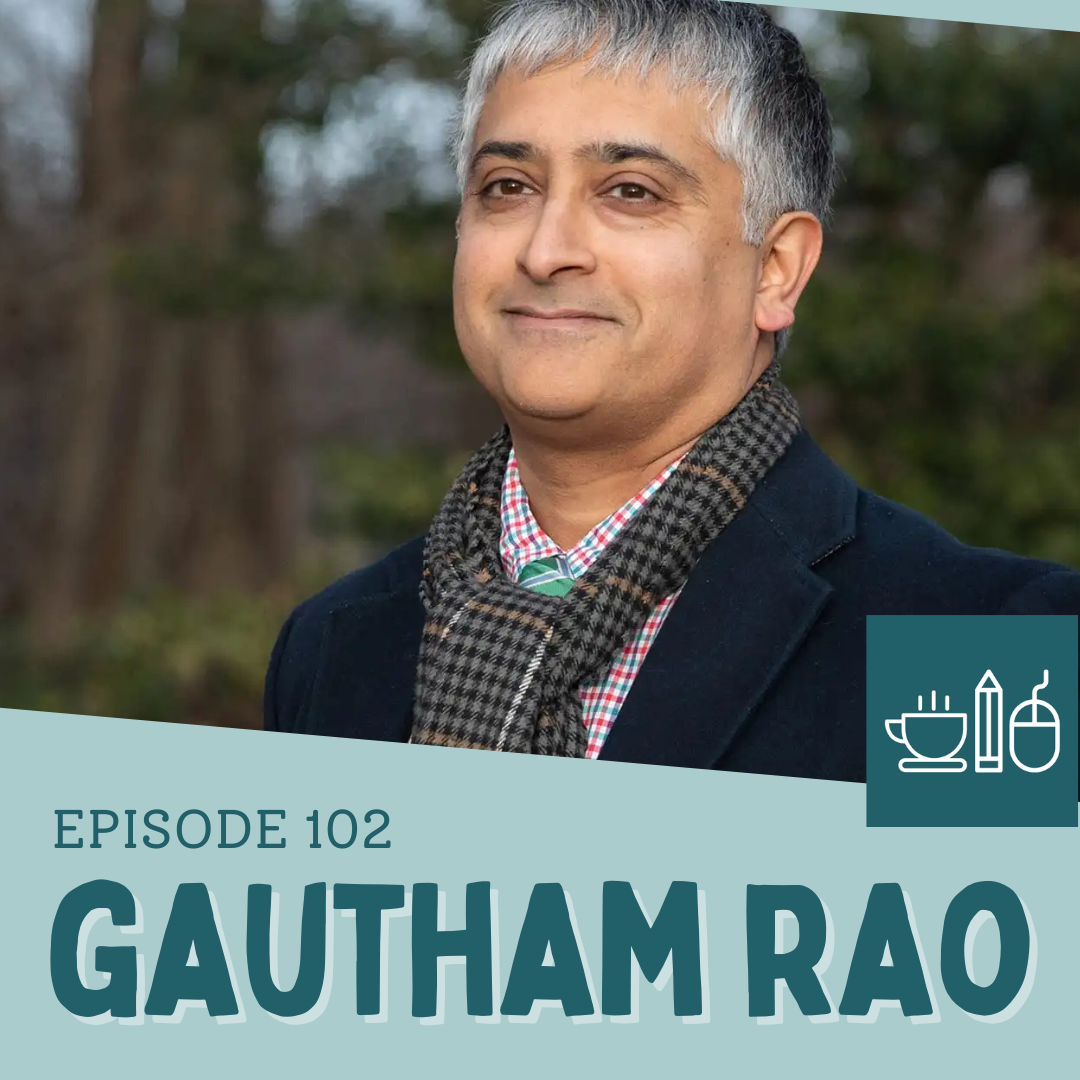
Gautham Rao Completes Each Vacation with an Archive Trip
55m 22s
Dr. Goutham Rao, an associate professor of history at American University, shares his journey as a writer and researcher in this podcast episode. He admits he only recently began viewing himself as a writer, having previously prioritized research over prose in academic training. His new book, "White Power: Policing American Slavery," explores the legal frameworks used to police enslaved people from 1619 to the Civil War and their violent legacies. Rao describes his writing habits as "structured chaos," requiring long, uninterrupted periods—often on Amtrak trains or in his office—to get into a productive flow. He organizes research using a mix of index cards, a Remarkable tablet, research logs, and Word documents, later sorting notes into Excel spreadsheets with coded keywords for easy retrieval. Revision is an intense, ugly process for him, involving full rewrites and a side-by-side method to refine arguments. A turning point occurred a decade ago when a colleague suggested publishing his book for a general audience, prompting Rao to study accessible historians like Kate Maser. This inspired him to strip jargon and technical language from "White Power," making it appealing to non-experts despite the challenges of balancing academic rigor with public readability. His story highlights the importance of adaptability and the evolving craft of historical writing.
Welcome back to "Drafting the Past." I'm Kate Carpenter. In this episode I'm joined by a scholar who can never pass up a good archive. Dr. Goutham Rao. Thank you for having me. Goutham is a historian of American law and politics and is an associate professor of history at American University in Washington, DC. He's the author of two books. The first was National Doodies, custom houses and the making of the American state. And his new book is White Power, policing American slavery. White power is a history of the laws that and flavors used to police enslaved people from 1619 until the Civil War and how the violent legacies of those laws and practices have reverberated throughout American history and life. In addition to his books in journal articles Goutham has written op-eds, contributions to Supreme Court cases and a sub-signus letter called the State of the State. I was especially interested to hear how Goutham grappled with organizing and using the evidence he collected from many locations over more than two decades. And you will perhaps not be surprised to hear him confess that he tends to pick research projects that seem, as his colleagues sometimes say, quote, "not doable." He is nonetheless determined to do them and you'll hear about how he writes and re-writes to make himself clear and how an off-handed remark from a well-known colleague set him on a new publishing path. Here is my conversation with Dr. Goutham Brown. So I have to admit up front that as a fan, fanboy of this podcast, I'm gonna say what many people have said, which is that I didn't really think of myself as a writer until fairly recently. And I think that's partly the effect of being an academic historian to some extent. The craft of the research is elevated over the craft of writing. It was only really in the last couple years where I consciously wanted to write for a broader public that I started to think of myself as a writer. Even now, I think there's a great deal of impostor syndrome for me walking around a bookstore, looking at incredible people I admire and their books thinking, wow, these are great writers, but not thinking myself in the same term so, you know, prayloo decide there. I think the answer to your question is that I have always deeply admired good historical writing and always aspired to want to be able to do it. I think it's it was very tough for me early on to do so because I was coming out of a graduate program at the University of Chicago where the writing was emphasized and it was important to have good historical writing, but really it was about the ideas and it was about the big picture and the sweeping arguments. And so it really wasn't until I was working my first book and I had an editor, Robert Devins at the University of Chicago Press, who pushed me a bit Stephen Mann as well as another one to say, you know, what do you want to rethink the pros here? It's a bit workmen like, you know, give it some of your authorial voice. So that's when I started thinking about it and really it was working on this this book and over a long period of time where I ended up starting to think of myself more as a writer, self-consciously. The other part that plays a key role here is that I started taking on more public facing kind of projects and whether that was, you know, a meekest briefs for Supreme Court cases or blog or substackings or other other venues where certainly the majority of people reading it would not be historians and would not know the conventions of how academic historians write. And so that really pulled me pretty quickly into rethinking my general approach to language and how I wanted to present myself on the page. So I guess here we are, you know, based on that trajectory, but it's been, it's been a pretty dramatic shift, I'd say, over time. Let's talk about how you'd like to do your writing when and where do you write? I am a creature of habit in many ways. I'm very structured about things and I like to have color-coded calendars for pretty much everything and reminders, blah, blah, blah. It's all quite, quite dull. But when it comes to writing, that is what I call structured chaos because I really can't account for what my day is going to look like very often. Even days when I'm not teaching, I couldn't tell you which days are going to be available really for me to be able to sit down for sustained amount of time to write. And I think unfortunately for me, I've never developed the ability to write in little little bits here and there. I've never developed the ability to be part of a 500-word club and say, "I'm going to do a consistent amount every day." That's partly a byproduct of my own family situation with kids and partly a byproduct of my many administrative and other duties by editing a journal. It's just kind of unpredictable. So I like to have good stretches of time, good chunks of time, at least a couple hours. It takes me an hour to just get into it. It takes me an hour to get out of it when I've written what I want to write. My head is in that space and I'll be the kind of zombie friend who tries to talk to me for a little while. So I really like to kind of get a chunk of time, which is probably why it took me 20 years to get this book done. So I may need to find a way to reform myself. But in terms of where, they're a little flexible. So my dissertation was written almost entirely on Amtrak going between Washington, D.C. and New York City. I was a fellow, a Samuel Golyb fellow at NYU Law School and I was having to go up at least twice a week between D.C. and New York. And I could only afford the super cheap Amtrak tickets, which are early in the morning late at night. But it meant that the train was always quiet and the internet was terrible back then. This is about 2007. So you couldn't screw around and look at fun stuff on the internet. I was left with only one thing to do. And it ended up being, I'm not exaggerating when I say it was written on on that Amtrak. So I called it the informal, the unpaid Amtrak fellowship. But otherwise I've cut, I love my office at work. I've spent some time there. It's quite lovely. American University campus is beautiful and, you know, I'm blessed with a lovely quarter office. It's lots of sun, great views. We had to do some renovations in our house a couple years back and I finally got my own space and I have an office in the basement where I work, often tent interrupted by two cats, but it is otherwise quiet. And I do enjoy that a lot. But I do enjoy it. My vision has never been superb. And so I need tend to need a pretty big screen if I'm going to be doing serious writing and editing. That's a more recent development. An unintended side effect of this podcast is that I have come to have great envy of people who have an Amtrak commute on the east coast. What tools and systems do you use to organize your research and writing? So again, compared to many of your guests, I'm going to sound like a dinosaur here. I go from small little notes to myself that are pretty disorganized, oftentimes on index cards that are always nearby. I started using a remarkable tablet a couple years ago and that's been incredible for organizing. I couldn't tell you how many index cards I've lost over the years with the ideas they're on. But the remarkable is a great tool for being able to ensure that stuff is not getting lost. So I started using that more significantly in the last couple of years to keep notes. So I go from there, the next step is a research log, which is kind of updated daily. Even if I do nothing, I'm very dedicated to writing. I did nothing today. But just to know where I am in the process for what I'm thinking about and to be able to remember frankly what I've done, what I haven't done, what I've meant to do. And then we really get into the RCAic approach. So I use Microsoft Word documents to collect notes. I just write notes on them. So that could be cut and paste from PDFs. That can be transcriptions from archival sources. And I'll have a bunch of these based on roughly speaking, I'll save them in a kind of like folder that I'll say chapter one, maybe chapter two, maybe who knows. But I just want everything in one place that might be connected to the idea I'm thinking about. And then the next thing I do is I cut and paste all the text into Microsoft Excel spreadsheets. And here the thing that I've come up with is that for everything I put in there, I have two columns. One is called code one code two. And I use a keyword in those codes so that later on I can just sort based on the code. And I'll have roughly speaking stuff I need for if the code is introduction or chapter five, then the stuff will kind of just appear when I sort it. So that's my approach. I've tried to reform myself over the years using different kinds of things like Sataro and
And there was a brief moment where I was using this sort of all-in-one note-taking word processing. And I just could never rest myself away from what I knew. So my students make fun of me relentlessly when I tell them this and say, "The rest are you wasting so much time?" Which is probably true. But again, I mentioned a creature of habit. So it's tough for me to get away from that method. It comes to research to writing, again, I use word documents and go at it in a pretty orthodox manner, I think, of just trying to get quotes on a page, structuring the quotes based on how I think that my work is an argument, and then writing out around those quotes. I want to go back and get in the weeds on something completely selfishly because I have a remarkable tablet, but I have not figured out how to make it work in my process. How do you use it? So again, this is my weird, the way my brain works is that I tend to be hyper-focused on things, but then occasionally I'll just come up with a thought that I'm like, "Oh my goodness, I really should fall off on that." That could be central to this chapter, this part. And so I found Remarkable is great for that kind of thing, where I'll just have it next to my desk and as I would, I know card or no pad or whatever. And I made it a habit that by the end of the week, usually at least once, I'll review that I call it the scroll page on my Remarkable, you can label each page. So I just call it "shrall" and I'll just go through it and then if there are ideas that I think, "Oh, that was a good one, should it work?" I was shockingly good idea. So then I'll take that one and try to work on it in the other formats that I mentioned. It's great for also library research I found, going when you're in an archive or library. It's easy to take a lot of photos in an archive, right? It's much easier to remember why you took those photos. Often times in the past I'd just have 150 photos and I'd be like, "Why in the world that I take that one, what's going on there?" So I found that I can use the Remarkable for those archives that'll let you bring it in, which isn't all of them, but those that will, that can be a really helpful thing, you know, say photo 7050 on my phone. That was for this idea. That's another use that I find useful, interestingly, and then you can upload PDFs as well onto it and mark those up. So that's been very helpful because then my markup PDFs show up on the desktop app as well. So that's kind of how I use it beyond, you know, department meetings or from a journal, those meetings, that's all my notes go through that. It sounds like you're kind of writing all the way along when you're doing your research. Is that true or is there a point where you're like, "Okay, now I'm writing the project." I do write in weird spurts, I think, when it comes to personalities in particular. I'm trying to compile personality or place right now working on this project about the Confederacy, and I'm really interested in the earliest days that they were seizing federal forts and arsenals and armories. And so I'm trying to set scenes and writing places, if you will. I'm kind of compelling, I'll write it, if I don't find it compelling, I'll wait and then try to piece it together later. But I am always sort of thinking, "Much more so now than I was ever in the past, I am thinking about pros connected to certain things that were searching." But when it comes to writing chapters, just to be clear on this, when it comes to writing chapters or parts of essays or things, that I'm doing more often than not in those big chunks of time that I love to have and rarely get to have. It does revision look like for you. Ugly, ugly, ugly stuff. This is, you know, my wife understands my method, and so when I tell her, "I drafted the chapter," she does not give me the real kind of, "Yeah, you did it. Good job." She's like, "Okay, because she knows what's next," which is the next day I say, "I hate that chapter. It's a terrible thing, I cannot believe, I spent time on this." It needs to be read on it entirely. And then I do this all the time. I will rewrite the entire thing. So for this book, "White Power, Policing American Slavery," there's a story here about revision because I initially written it kind of traditionally for an academic press to be marketed for academics. And it was about 200,000 words when I wrote it, which is not a link that publishers tend to like. And I said, "You know what? It's got to be that long, the ideas are there." And then I rewrote it twice, I'm still 200,000 words. And, you know, it was fine, it was good. But then when I decided I wanted to try to do something different with it, then it became so much rewriting and editing and revising because I had to take very complicated, sometimes jargon-y peros and strip it all out or to make it something that would appeal to non-experts. And so this was a real labor of love when it came to revision. I was doing, you know, nothing other than that for quite a while. Like on a practical level, how do you approach revision? I mean, it first it sounds like you often rewrite to you, print out and scribble all over it. But this is my advisor when I was in graduate school, William Novak told me, "Aligned to have stuck with me since then really." And which is that he said, "You know what's. You know you're done with the dissertation when you can pinpoint what's wrong with it?" And you're going to try to fix that when you write the book version of this. That was definitely true of me at that point. But that's kind of what I think about chapters now is that I'll write the chapter out and by the time I do it, I'm like, "Oh my goodness, it's missing all these things. I didn't do this properly." So that would mean, you know, in the super practical sense, what I have is two documents side by side. I have the draft and I have the thing I'm trying to turn the draft into. And I just go back and forth, left to right, left is the draft right is the version that I want to be better. And although word by word, sentence by sentence paragraph. I paragraph, obviously, the structure will change, but it's a real chore, I would say. It's not my favorite part of the process, but I will say that it is an essential part of my process because it's just the way it really helps me to see something on paper or on screen in order to be able to transform it to what I wanted to be. So white power, you deliberately wanted to write for sort of a broader audience and it is published with a brand new trade imprint of UNC press. What motivated you to want to write this book that way? This was a book that I had been working on for a while as a concept and I'd been collecting evidence over the years, you know, when I write go to an archive, I'd say, "Oh, I have that other thing I'm working on. Let's collect this document that I've been interested in." And I would present it at conferences and people would always ask me, "Oh, you thought about the kind of contemporary relevance of what you're working on?" And the answer would be, no, I hadn't, frankly, thought about the contemporary relevance relevance. I was very much a kind of creature of archives and I love the sources and I love to be doing the research, but I did not spend much time thinking about it beyond that. I still kind of want kind of people might like to read it. It was the most transformative moment to me. It was just a moment in passing when I presented a chapter at my department, we have these kind of works and progress lunches. And my then colleague, Ibar Mkendi, read it and said, "Yeah, it's really good, it's really good." And then he said, "No, I've just thought about publishing this book for general public instead of experts." And I said, "No, and not." And he said, "Well, you know, maybe something to think about." And then, you know, we had lunch. A big bunch of us. And that was that for, I don't think Ibar M's thought of the moment anymore. But for me, it was immediately burned in my head. I was like, "Oh goodness, this could be, you know, he could be right." And so it was that point, this was about 10 years ago where I started to think, "Ah, this could be something else." I started reading a great deal more of these books that were written by academic historians that being marketed to a broader public, they were trying to do pretty complicated things, many of them very successfully. Scholars like Kate Meiser, who, you know, just remarkable ability to translate complicated legal history topics into incredible pros. E. Brahms own were also very influential. And then, you know, political scientists as well who were doing kind of law, centric work, been doing it in public spaces. Think of people like Jessica Pishko, for instance, writing about sheriffs and things of that nature. So, as I was reading more, I started to think of the plausibility of this. You know, it was a turning point. I would say, heading into 2020, I had already made that decision. This is a path I wanted to follow. And then the pandemic happens. And it was brutal for me because I basically stopped. I had to stop any kind of productive.
research or writing for about a year and a half at least. And just getting back to it was tough, felt like a lot of time was lost, the kind of mental toll of being away from it for a while. Of course, with other things thrown in in those years. You know, the decision was one that occurred over time, I'd say, but it was that decisive, really talk with Emoron that if he turned me, turned my head and I haven't not looked back since. - What did you feel like you took away from all that reading you did? - That first of all, it's possible. That's one of the myths that historians tell themselves about just what it is we do and why it looks the way it looks. That it does have to be technical, jargon-y and that historiography has to be dealt with in a certain way. I'm guilty of this as much as anyone else. I think when in terms of when I'm putting my journal editor hat on and I have a manuscript that gets good reviews and the reviewers say, "Yeah, it's missing this." The argument needs to be stated more clearly. The historiographical claim needs to be situated better. You know, these are the kind of central ideas that we think about as historians in terms of communication at words on a page. But what people like Kate, Maser, and others were demonstrating is that it does not need to be that way. There are other ways to do things. It's inevitable that some manner of the kind of traditional approach to writing history will be lost if you do choose a different path, but it doesn't mean that everything is. And so you have to choose, you know, make your choices and sort of be a piece with that. That was above all like the key takeaway for me was that it was in fact possible and that it was not locked into doing things one way as I thought it had been really for quite a long time. And then I'll just add to that that it's been really heartening to know that other people have been on this journey as well, I think, in the last five to 10 years that reading books that have come out published by the most rarefied air of scholarly publishing and thinking of the Omaha 100 Institutes series in early American history. That's just remarkably good. Probably the gold standard for early American history monographs and just seeing works come out of that that I, you know, can't put down. I always have on my side. So Samantha Ceeley's book which came out a couple of years back is just, it's just incredible right, you know, truly stellar stuff. And then just in the past couple of years, Sarah Grinning Sader's work is just beauty on a page really. Emily Conrad Croats's book, you know, "I wish I was a little less year standing pros, you know, sparkling at times pros." Just to know that other people who were, you know, kind of roughly in my stage of career and age and stuff have made the same turn, I think, is kind of quite confidence inspiring as well. - Aiming for a broader audience also meant getting an agent, what was that process like? - So this is a part of the story which like so much is very much dependent on the goodwill of others. So I was joking around that with a great person at the University of North Carolina Press who handles copy editing and production, his name is Matthew Someroff and I told him Matthew, it takes most people a village, it took me at Metropolis to get this book out and he was, you know, mayor of Metropolis in many ways. This was an area where I ended up being totally in debt to my student, former student, Rebecca Brenner Graham, who had, you know, completed a dissertation of the American University a couple years back and, you know, Rebecca is just an incredible scholar and mind and decided that she was gonna be an independent scholar, at the time she was teaching in a private school and she started writing a book about Frances Perkins and she got an agent and she published the book as wildly successful, she's working on another one, another one, I have no doubt it will be equally successful but she's the one who got in touch initially with an agent named Danny Segalmum. Danny now is part of Arc Literary and when I met her she was working at a different agency but I had tried to contact other agents and I quickly realized that, you know, nonfiction is not exactly a market which is an agent's favorite. Number one, number two, a lot of them have client lists already that are pretty deep and people who, whatever they write is gonna be successful to some extent and so they're incentive to pick up a kind of new name who doesn't really have a track record in that space is not ideal but Danny, more, you know, I got, so I got turned down by a bunch of people I approach. Danny and I had a series of conversations and it was clear that I was not yet any kind of short bet for her but what I loved about just the conversations with her was that she was incredibly attentive to detail. She'd done all the reading, she'd looked into me and she had thoughts and it was, she wasn't gonna sugarcoat stuff but she wasn't gonna tell me that I was terrible and it was, I found like immediately very comfortable relationship that I was like, oh, by need advice I can ask Danny and I think a lot of people end up in a less than ideal relationship with the agent but from the start it's been incredible. I call her the agent extraordinaire because she's incredible vision and she kind of matches what I can do to what's possible and just did so much for me who's not learned and matters of publishing and presses and all that stuff, she's incredible. So in a lot of ways it was luck, I owe Rebecca huge amounts of thanks for putting us together but Danny is a truly, truly remarkable agent and person and friend. I wanna talk a little bit about putting this book together White Power, it covers a pretty broad expansive time. It also, you worked on it for a really long time in various ways you've been working on this project for two decades. What was it like to assemble all of the evidence that went into this book? - The story of the evidence of the book is kind of tragedy comedy but I was working on this in graduate school while writing a dissertation about something else. And so that was also a, I tend to choose projects that are really implausible and unwieldy and I really need to find something easier to work on at some point but just as research projects where people will tell me that does not sound doable and they're, they have a point to some extent. So that meant that in this case, I was interested in the legal idea that this all started with the concept of apostee and the idea that in early American law, you could be forced to serve an apostee. You had nothing to do with slavery initially. It was just, I was interested in when the federal government could demand that someone do what it says. And I was working in the kind of shadows of 9/11 at that point and the Patriot Act and other things which in that time seemed like while government overreaches of power, I think today, we would not look upon those fondly but things have moved drastically further in that direction. So I was just interested in the idea of compulsion and the government being able to force people to do things in enforcement actions. That's where it starts. But I started noticing that a lot of the examples of this in American history that I was finding were slavery related. So I was, anytime I was going to an archive, I was seeing if there's stuff there about this and there usually was in a lot of places. So I'd go to Kentucky to give a paper and say, oh, I'll spend a couple hours doing this. Went to Berkeley to give a paper and the bank rob, they had some nice stuff. And so I would end up with these folders of photos built up over 15, 20 years. So that's the good part. The bad part is when I finally decided to write this out again as a more something friendly or to a bigger public audience. I went to check, recheck every source and noted that what's a 60% of the photos I'd taken were irretrievably corrupted. And so this is thousands of photos spread across multiple archives. There was a solid week where I was ready to throw the towel on this project and find something to do or do a drastically scaled-down version. But ultimately, this is where being a member of a university history department, having tenure and having resources prove to be helpful in ways that I never envisioned it was that we have small research budgets at my university and I was able to use every penny of those to hire researchers and let that kept logs of what I'd taken photos of. Recreated as much as I could what I had been working with. rereading evidence that you'd read years ago, you're gonna find new things as well. So in a way, it was better, but also emotionally, it was not better. It was bad, it was very bad. But that's partly why I ended up being able to rethink big chunks of the project was that very unhappy accident. But it's my habit now where I do always try to work in an archives trip when I'm doing something else. And the joke in my family is that [BLANK_AUDIO]
vacations where we'll find ourselves in Virginia and we were in Richmond for a couple days and I said I'm just gonna go off to the Virginia Museum for a few hours and my family has learned to tolerate that little tick of my personality so very much a collector in that regard and then I'll try to piece together. That results in a pretty massive pile of evidence I imagine. How do you sift through that then and come up with something book shaped? So this process is the sifting through of evidence process for me is where I find the joy. This is one of my real things I love is going through the documents and the moment of discovery really is just what I really look forward to and so I have a pretty you know just we'll just to go back to the collection of documents stuff and the collection of photos so I've become quite neurotic about acting up materials and even this is true even before I had this catastrophic loss of sources but you know this is a nuts and bolts thing but I'll mention it is that what I do now is I when I'm in the archive itself I'll create folders in in a Google Drive page and I am sure while I'm in the archive to upload everything into the folders and then when I get home I'll upload everything into my university one drive account and then I'll upload everything into a drop box. So all in all I'm probably spending like $300 a year in paying for these fees but I don't know how else to do it to ensure that the stuff I want to be there will be there and I've become I've become even more neurotic than I was about it but to go back to your original question about about sifting you know I'll just go through document by document very slowly and I transcribe the quotes into that Microsoft Excel document that I mentioned and the key part is the coding because a lot of these without the context you know you have to be very careful not to be quoting stuff totally out of context so I have to be very careful about dates about names because otherwise when you sort that spreadsheet who knows what you come up with but that's basically it I'll have the spreadsheet open and I'll have the PDF open or the JPEG and I'll literally transcribe word-for-word into that spreadsheet and so that can be for me more time consuming than the writing process but sometimes when you're doing it as well you know it's the other things that when you the quotes are so good sometimes you say oh gosh I should write that up quick paragraph I'll think of break and I'll just try to write up a quick paragraph in them is never what will end up in the article book but I find it useful if it's something that I find fun or interesting and I'll I'll remember that you tell this history by sort of highlighting key moments in citizen policing of slavery and race in the US how did you think about the structure of this book I came to the structure pretty early I knew I wanted to be I wanted to be a history of the United States and early America that would follow the same trajectory as a textbook in some ways so chronological that would have the same big turning points and very recognizable moments of transformations of a war the founding era but I wanted the story to be different from what people knew that meant so I was kind of locked into a traditional chronological narrative that would follow the basic structure of what you might see in an AP history course or USHB 101 survey class but recognizable and key slide posts key turning points beginning and like recognizable place ending in one as well and then changing what people are gonna find that's not gonna be the traditional kind of waging narrative of let's say the founding era instead it's all gonna be about enslaver power leading to the future slave clause or you know the Civil War is not gonna be chiefly about battlefields but rather about the panic of a vacuum of enslaver power in the Confederacy so yeah I was sort of being a little playful there or trying to meet with the familiarity of basic things but then shifting around the narratives you are legal historian and I was very impressed that you were able to it is in many ways a history of law and how law changes in the country but you really focus on individual accounts you narrate events so that as a reader you can connect to the narrative it's not just sort of a drive legal account how did you weave those parts together in part I really benefited from a bigger shift in the field of legal history and here you know had this big advantage of being the law and history review editor now in my ninth the final year of doing so but there I've been privy to seeing a big shift that's been underway for a while but really kind of upfront you know front of seats here which is that legal history used to be the the domain of kind of stodgy old dudes riding mad judges and you know partly reverential but but also kind of about the courts being the center of the action and that has changed over time you know we're just a couple examples here scholars like Margo canadae and main eye mentioned the eight maize or before and the cerebronning center these are all examples of scholars who are legal historians and they're doing like cutting edge leave of history work but you know their stories about people chiefly and their stories about power and place and and structure as well but less so about technical legal doctrine or when those things happen through technical legal doctrine again it's translated through lives and events so having seen this and we talked a little about having done a ton of reading period while I was working on this I knew it was really important to be able to tell the story that may be about ritz ultimately legal ritz you know but the story will work much better as a story if I can tell it through the people to the lives of the people who found themselves subject to those ritz or what not that's one thing to say that it's another thing to be able to do it and I think this if there was a real challenge here as a as a writing enterprise for me it was translating the legal stories into the kind of many biographies or episodes that I'm trying to tell without losing the kind of legal significance over time you know this isn't a social history I'm not a social historian and I think there are ways of telling story of lives and events and places without being one thing or the other but for me it was this was the toughest part now there's a kind of corollary to that which is that when you're dealing with enslaved people who are the targets of laws and trying to tell those stories well you know you're dealing with a twofold problem there which is number one enslaved victims of these by-times horrific laws are not going to leave behind lengthy paper trails and number two the paper trails that we do have tend to be written by the people who benefited most from those horrific laws which were the white and slavery and so having to reading a grain a bit of those lawmakers and their laws and the way they're put into practice was another very significant challenge to be able to tell the stories without falling prey to regurgitating out of the official line. Are there any stories you wanted to tell but the archive just didn't didn't make it possible? Yes several many should say especially in the early period where you know the way these slave patrol records work for instance is that they're they're really rudimentary you know they may say something like you know so-and-so patrol or didn't show up and so I would start digging around for that patrol or to try to find out why they didn't show up are there any other court records any sort of properties for you it's maybe I can get some sort of you know death upon death that can find an inventory of property or something like anything that I could tell this person's story and I probably looked for 40 or 50 of these folks and found zero that was going to be helpful as one example there's you know in the in a couple of chapters I talk about enslaved people or kidnapped people who end up being sold into slavery or sold back into slavery and you know I would love to track down the stories there but it turned out to be not possible based on at least what I was trying to do there are parts of the you know relying on the WPA slave narratives where you really just wish you could go back to the interview and ask can you expand on this question but I know you know the list of questions is oftentimes be determined and the interviewers were looking for certain kinds of information so that was another area where I really dug around trying to find more on more information on a couple people
would have been in a re-event. I was hitting brick walls at the to really kind of limit my use of those. So just a couple examples. I mean there's many more, ultimately, you know, reconstruction. I had never studied reconstruction in earnest and I understand why it's so hard now, in terms of layers of authority. The sheer number of things going on in any given place, any given time, what I would have loved to dig into certain areas where clan activity was much more heavy, heavier than what might expect to find out the story of local governance there. It turned out to be very tough. I'm also really interested in, I know that you are a pretty voracious reader of theory and secondary sources. You don't get out of the University of Chicago without Antoine theory. But that doesn't, you don't feel that when you're reading this book. It doesn't feel weighed down by all of that information. How do you think about making sure that your historiography and theory are shaping the story you're telling without interdying on it? That was probably the biggest challenge for me in terms of the conceptual aspect here. Because I do tend to think of things in theoretical ways and this project was no different, I think, going back to grad school when I was heavily, well as an undergraduate, I was really, I did very little else than theory and I've done a bunch of study on the Frankfurt School in particular, but I was interested also in post-structural theory and things of that nature. It's just the way I tend to think about things. In this project, well my first book, I should say, that was heavily influenced by thinking about classical political economists. Mark Smith, Bricardo, people like this. I was trying to think of the United States, founding our government as a creature of the moment, really, of political economy. But I didn't want to write an intellectual history. I was really trying to think through the way Mark was talking about the formation of the nation states and the role of capital, for instance. But I didn't want that to be the central part of the story. It had to be about people and about power and institutions. So I kind of got used to it there, where I was, I'm not censoring myself, but I was trying to think about the ideas as opposed to what, you know, as opposed to the Mark's quote from economic, philosophical manuscripts or whatever. And so that was a good gateway, I think, into how to do this. When it came to this book, the White Power Book, in a way it was much easier because I had already decided, you know, I was going to focus on the stories of the people in the places. And so I could really foreground some of the more theoretical stuff and have it inform, again, the way I was thinking about things but not be, not the ever-present. So in this book, I mentioned, you know, in the beginning of the book, the concept of a permanent emergency that its labors found themselves obsessed with. And that, you know, is a takeaway from the social theorist, George O'Ghamman, and, you know, thinking about the way Walter Benjamin talks about things as well, thesis of philosophy of history. So I was definitely thinking in those terms, I would say, Pierre Bordeaux is a huge influence as well, and I was thinking of this book, but I had to make sure that I wasn't, you know, I don't think a general reader cares much about what Bordeaux would say about the mindset of an enslaved who was sort of caught in a moment of upslaverbelly, but they do care about the slaverybelly, right? And so can I get the Bordeaux in concept without having to sort of overload the text with it? I think that was the key kind of way to do it. And I tried to do that for that book. One of the strange tropes that I noted is that the enslavers that I'm looking at here, and especially the ones who end up in positions of power, lawmakers, and that kind of stuff, the way they talk about dangers, public dangers when it comes to maroons or runaway slaves, abusers, it's just shockingly reminiscent of the way that the Nazi social theorist and theorist of law, carolshmitt writes about enemy ship and thinking of the laws between friend and enemy, and you know, that was, I ended up reading way too much carolshmitt from my liking along the way to writing this book, but I was at no point wanting to confuse the text with reference to the way he is thinking about so-called enemies. So that's the theoretical part, the historical graphical part, if I have any regrets about this book, it is that I really couldn't pay homage to the scholars whose work that has been so transformative for me, just in terms of the way this book was going to end up looking, and you know, again, what I'm thinking about, what a AP history student might take away from it, it's not going to be the fact that incredible scholars have led me to this point. So I had to make this this compromise which still doesn't sit well with me, which is to say I would think as many of them as I could, as profusely as I could in the acknowledgments, but in the prose and the notes to the text I was going to try to keep things as simple and connected to the primary sources as I could. Again, it's not my preferred path here, because my grad students will tell you that I am a footnote obsessive and I always am asking them, "Well, did you read the footnote?" So that was tough for me, that was really tough, but you know, I think about most of all scholars like Sally Haddon, whose book Slade Patrols, which I first read in 2004, and which I've been, you know, wrestling with since then, and whose footnotes in that book were so important for me to find primary sources, and Sally is also been incredibly generous over the years to help me with the project, but that's one example, there are certainly others. So that was a much tougher thing to deal with than the theory element. Where in the process of writing and revising do you start seeking feedback from other people? I'll mention the University of Chicago again here because one of the things that happens there, or at least happen when I was there, was that you get feedback pretty bluntly and pretty quickly, about projects. And I learn there to take the approach to feedback less as a sort of thing to be defended against and more of a thing to really benefit from. And so I tend to be, when I give a conference paper or something, and I'm testing out an idea, I genuinely am desperate for people to tell me if they think it's a good idea or not. I really want to know what works and what doesn't work. And so, that's the same way with writing. If people find that it's not hitting, then I definitely want to know that. So I tend to do workshops and conferences and as much as I can get, because I think it's a real, it's honestly, it's a privilege to be edited and to be to be read. And so I'm part of these networks, and I'm like, you know what, I have this opportunity, I may as well think a badge of it, to try to put my stuff out there. So, you know, their times are as not gone really how I would have wanted it. You know, I remember doing a second writer, a second book writer workshop at the Society of the Historians of the Early American Republic at a great conference and credible people. And this is a tool for people who had done a first book to try to get their way to a second. And I had workshoped this idea about this history of Thomas Jefferson's federal government, you know, thinking about that. Pretty much no one thought it was a good idea. And they thought the proposal I was shopping was not pretty, not all that great. And they were right. They were totally right. But it was, you know, hearing from other people can be very helpful. In terms of this book, God knows, I mean, the acknowledgements I tried to get all the number of workshops and symposia that I presented the chapters in of the years, which were so pivotal in helping me figure out what was working, what wasn't, what was missing. So, I'm a sort of, if I can get feedback, I'd love it. At an early stage, at a late stage, it's, I think, again, a privilege. That's the most influential writing advice you've ever gotten. So the most influential writing advice I've ever gotten, this is going to sound quirky, but I can't remember who told me this, but it was a long time ago. It was to always end on something easy. So, when you're done writing for the day, don't end on the hard part that you haven't figured out, and on an easy part. So it's easier to pick up the next thing. And so I've sort of made that my approach, and I'll only end on something that I'll say, "Oh, only the collusions left. That's my main advice, I'd say." And then I'll just mention one other thing, which is that if everyone tells you it's not working, it's not working. And I think, you know, as authors, we tend to have our chestnuts and we tend to think this is actually gold, but if everyone tells you it's not, chances are you're talking to smart people and they know their stuff. And so, probably listen. Tell me about a book that you've read recently that you've been recommending. Yeah, so I'm right now blessed with being the chairperson of the Little
and Griselaw prize for the AJA. And so, I'm going to tell you I'm doing a lot of reading. I am not exaggerating at all. But let's go with Michael Will Rich's book, "American Anarchy." So this is a book that basic put out in 2024, I believe. So it is written by a legal historian Michael Will Rich at Brandeis. And it's a beautiful book in terms of the way it is written as a sort of series of overlapping biographies, but also just hitting on things that you will know. Again, you know, "Hey Market" and other kind of pivotal moments in the progress of era in early 20th century, but it's telling the story of radicalism, American radicalism through kind of lives. And I think, you know, in a weird way, the radicalism seems a lot less radical when it's connected to biography and to a kind of intimacy that he builds into the prose. And I think that's the beauty of it and why I find it so compelling. But it's yet another example of writing sophisticated histories of legal and political thinkers and moments and pivotal events, but doing it in a way that makes it accessible to a broader reading public. Before I let you know, I do want to know about what you're working on next. So I know you mentioned earlier a project on the Confederacy, but I have also read that you're working on another fun book. What are you up to? Okay, so I will give you, you know, less fun or not fun at all, and I have a great deal of more fun. So the not fun project is the Confederacy. So I'm working on what I'm envisioning to be a legal and constitutional history of the Confederacy of America. And so it is a bit of a purposeful misnomer there because ultimately what I'm trying to think through here is just how force and compulsion was standing in for the rule of law in a lot of ways in the Confederacy. And so the parallel to the Republic of enslavers, I think, is pretty hard to escape. So trying to measure the extent to which the master slave relationship, if you will, ends up being part of the way that the government of the Confederacy is functioning. Early stages. And like I said before, I tend to choose wildly unwieldy projects. And this is certainly that category. So that's the not as fun thing. And then the fun thing is this book project on the TV show The West Wing, which grew out of a class that teach at American University. It's called The West Wing is history. So I started teaching this back in about 2016, 2016. And the entire course and then the book idea is about how the show, perhaps inadvertently, is repackaging American history narratives about the presidency, about the White House, about Washington, PC, about the federal government. So it's how it's packaging a repackaging American history as fiction. So trying to uncover some of those precedents and personalities that the show turns into the story of Jed Bartlett and his senior staff and whatnot. So that's been, you know, it's a enormous joy to teach that class and to see all my colleagues are very skeptical that 18 to 20-year-olds can care about a TV show from 1999. But they are. They're really invested in it for different reasons. And so it's been a real source of inspiration and energy from me. I remember working on this on the side for a little while and working up a book proposal with with my agent and trying to think about it as a book. As we've learned in sort of preliminary approach to this, really tough moment for playful histories of American politics right now where things are pretty dark and gloomy. So maybe the timing isn't quite right for that, but where I'm still working on it. I'm envisioning it to be a kind of shorter book, but one which which both people who know the history of 1990s politics and the game rich Clinton stuff and that kind of history, but also people who are interested in the show itself might find some something fun and useful to read. Terrific. Well, Dr. Gatham Rao. Thanks so much for joining me on Dr. Gatham Rao and talking with me about your book and your writing process. Thank you so much. Thanks again to Dr. Gatham Rao for joining me on this episode of Drifting the Past and thanks to you for listening. You'll find links to his books as well as the other things we mentioned on this episode in the show notes. If you love the show and you want to support it, but you maybe don't have any spare cash to become a patreon supporter. Please leave a review in your favorite podcast app. It really does help other like-minded history writers find the show. Until next time, remember that friends, don't let friends, write boring history.
Podcast Summary
Key Points:
Dr. Goutham Rao, a historian of American law and politics, discusses his new book "White Power: Policing American Slavery," which examines laws policing enslaved people from 1619 to the Civil War and their lasting legacies.
Rao initially didn't see himself as a writer, but shifted toward public-facing writing after encouragement from editors and colleagues, aiming to reach broader audiences beyond academic circles.
His writing process involves structured chaos
Revision is a laborious process for Rao; he often rewrites entire chapters, using a side-by-side method to transform drafts into clearer, more accessible prose.
A pivotal moment came when a colleague suggested publishing "White Power" for a general audience, leading Rao to study writers like Kate Maser and others who successfully translate complex topics for non-experts.
Summary:
Dr. Goutham Rao, an associate professor of history at American University, shares his journey as a writer and researcher in this podcast episode. He admits he only recently began viewing himself as a writer, having previously prioritized research over prose in academic training.
His new book, "White Power: Policing American Slavery," explores the legal frameworks used to police enslaved people from 1619 to the Civil War and their violent legacies. Rao describes his writing habits as "structured chaos," requiring long, uninterrupted periods—often on Amtrak trains or in his office—to get into a productive flow. He organizes research using a mix of index cards, a Remarkable tablet, research logs, and Word documents, later sorting notes into Excel spreadsheets with coded keywords for easy retrieval.
Revision is an intense, ugly process for him, involving full rewrites and a side-by-side method to refine arguments. A turning point occurred a decade ago when a colleague suggested publishing his book for a general audience, prompting Rao to study accessible historians like Kate Maser. This inspired him to strip jargon and technical language from "White Power," making it appealing to non-experts despite the challenges of balancing academic rigor with public readability.
His story highlights the importance of adaptability and the evolving craft of historical writing.
FAQs
Dr. Goutham Rao is an associate professor of history at American University in Washington, DC, specializing in American law and politics. He is the author of two books, including 'White Power, Policing American Slavery.'
The book examines the laws and practices used to police enslaved people from 1619 until the Civil War. It also explores how the violent legacies of those laws have reverberated throughout American history.
He was initially trained in academic writing but shifted after an editor pushed him to add his authorial voice. He also started writing for public-facing projects like Supreme Court briefs and blogs, which helped him simplify his language.
He prefers long, uninterrupted blocks of time, as it takes him about an hour to get into writing and another to get out. He is not part of a daily word-count club and often writes in structured chaos due to his unpredictable schedule.
He uses index cards, a Remarkable tablet for notes, a daily research log, and Microsoft Word documents for collecting notes. He then organizes material into Excel spreadsheets with codes for sorting by chapter or theme.
He often rewrites entire chapters, describing his process as 'ugly.' He works with two documents side by side, transforming the draft sentence by sentence. He also credits his advisor's advice that you know a project is done when you can pinpoint what's wrong with it.
Chat with AI
Loading...
Pro features
Go deeper with this episode
Unlock creator-grade tools that turn any transcript into show notes and subtitle files.
 PodcastTranscript AI