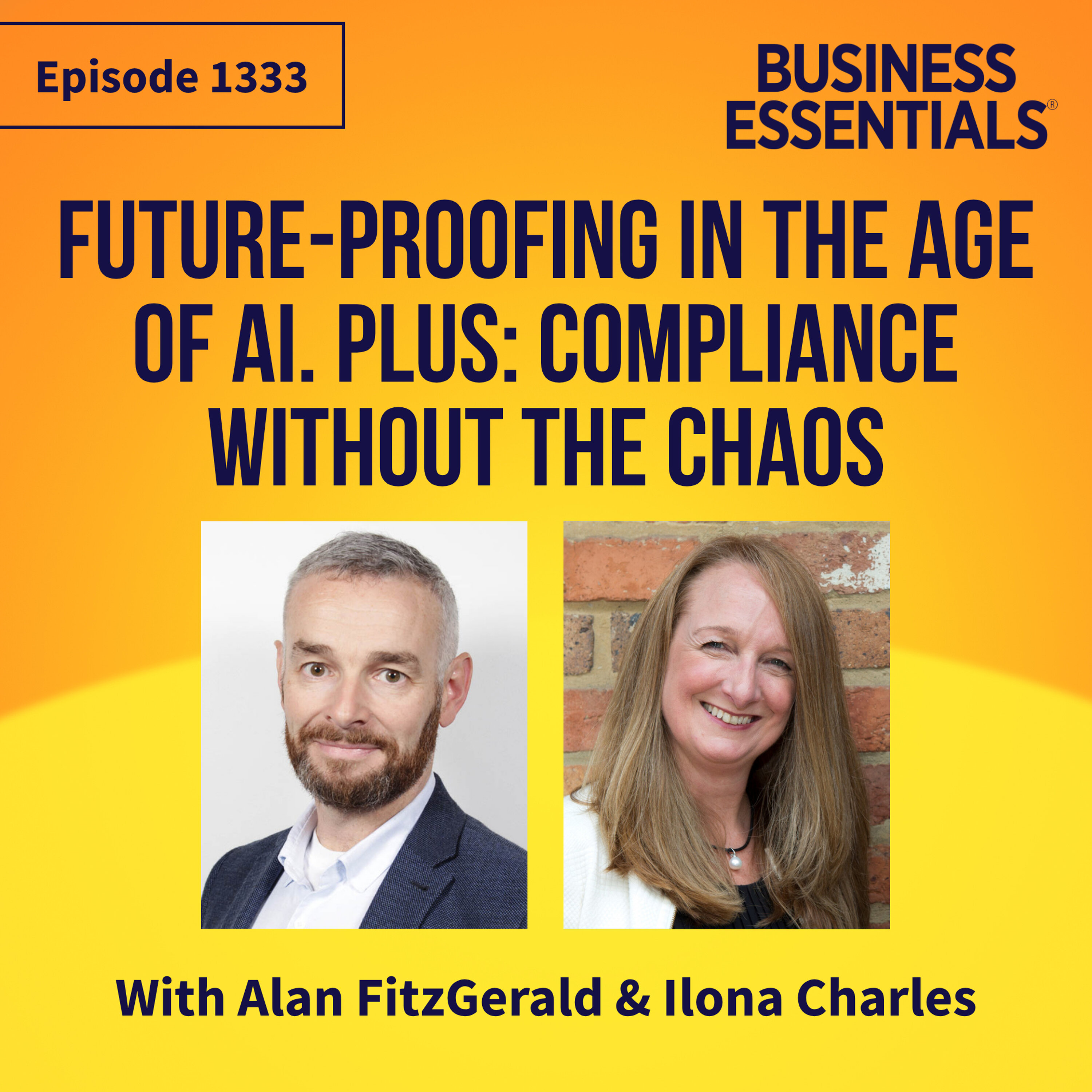
Speaker 1How can businesses stay future ready in the age of AI while keeping compliance under control? In today's episode, Alan Fitzgerald, CEO of Practicer Connections Advisory, outlines the tech trends every business owner should watch to future-proof their company. He shares advice on reviewing outdated systems, choosing the right technology, and balancing AI-driven efficiency with human expertise. Then, Elona Charles of HR consulting service Shiloh explains how businesses can simplify compliance at a time when many businesses are struggling to keep pace with constant compliance and employment law changes. Elona argues that most risks arise not from policies themselves, but from everyday decisions made by managers. And she shares practical guidance for managers that can support stronger workplace culture and performance. From Sound Cartel, I'm Grace Jennings-Edquist, and this is Business Essentials. Our first guest is Alan Fitzgerald, CEO of Practicer Connections Advisory. As AI rapidly reshapes the way businesses operate, many firms are grappling with which technologies to embrace and which legacy systems may be holding them back. Alan Fitzgerald says future-proofing a business is not just about adopting AI, but staying adaptable and open to change. He joins us to discuss how firms can modernise their systems, avoid becoming locked into outdated technology, and strike the right balance between automation and human expertise.
Speaker 2Alan Fitzgerald: The way that I look at things is that it is what firms have, but for me it's about the opportunity that firms should take the time to step out of what they've been using on a day-to-day basis, so to get away from that core software. And the reason why I say that is we often hear the phrase, or you may have heard the phrase in the past, called "drinking the Kool-Aid", and that's often related to, or interpreted as people who go to new versions of software, they go, "Oh, they've drunk the Kool-Aid, blah, blah, blah, blah." When in fact, when you think about it in a lot more detail, it's the people that have drunk the Kool-Aid are the ones that have stuck steadfast to older technologies, and older technologies might be something that may only be two or three years old. It's considered old. But there's a lot of firms in Australia today that have technologies going back 20, 30 years, and so the drinking of the Kool-Aid, in my view, is more about those firms that are going, "We are resolutely sticking with our vendor because we are a vendor-led decision firm," when in fact their loyalty to the vendors is not in fact reciprocated by the vendors to them. That is fascinating.
Speaker 1All right, so this brings me to my next question, which is how can a business decide which technologies they can afford to skip, at least for now, or perhaps which technologies might they consider giving up?
Speaker 2Yeah, well, the opportunity in the age of AI is that for a lot of the newer softwares, and these are softwares that have been created say in the last, let's pick five years as an example, is that for the most part, they have all gone back to starting with a clean slate, and have reimagined or looked at the process and reinterpreted what the process should be in order for them to create the software from go to woe. Now, the advantage of that is that you have a fresh mindset that are creating those particular tools. And going back to what I mentioned before about the Kool-Aid scenario, is that it's that when you have a fresh viewpoint as to how things are, how certain situations within firms and the county firms or within commercial businesses is looked at, it's actually, yeah, it's the grass may not be greener, generally is, but it's that opportunity about taking a look at what is possible for my business, and who do I best talk to in that moment. Yeah. Yeah. And I think that's really important is about stepping outside of your comfort zone, because too many firms, particularly, I focus primarily on accounting firms and their technology platforms. I had one a couple of weeks ago, they said, "Okay, we're going to do a complete technology change, but under no circumstances are we going to change those elements." It's like, doesn't work that way. You have to look at to see what else is out there so that your mind shift can be possibly changed. Or it may not be changed, but the thing is you have to look. And it's about opening the opportunity to seeing what can I do as an individual, because it is incumbent on me to have the best solutions for my team, for my business, and more importantly, for the clients.
Speaker 1So looking ahead, say, three to five years, and big question, because technology changes fast, but what tech trend or AI developments do you see most likely to transform how businesses are run? Oh, look, it's the tech trend.
Speaker 2It's the technology. It's the technology. It's the technology trends. I don't want to gaze into the crystal ball. It's very, very hard. I mean, AI really came into its own in '22. So it's three years ago. I mean, AI has been around for many, many decades, but really from an accessibility perspective, it was fully democratized with the release of ChatGPT. Then we had DeepSeek and we've got Copilot and the end is nigh, so to speak. I think what's going to happen over the next couple of years, though, is there's going to be a reckoning with regards to which vendor vendors are the ones that are going to survive in this market, because there's so much investment has been made. And one of the benefits of being at the age that I am is that I remember the tech wreck back in the 2000s and this investment and anything that mentioned back then, anything that mentioned the internet got vast amounts of funding, even if it wasn't a viable solution. And the reality of it was people just discovered it's like, oh, this is actually just because it's got the word internet in it, it's not viable. And it the market crashed. And I think there's going to be a day of reckoning with the AI because everybody's putting all the eggs into one basket, but it's not so much that, but it's also the platforms so that you're talking a lot more hardware is going into the back end of AI. And that's, there's going to be a day of reckoning. That's the first thing I think is going to happen, not wanting to be a doomsayer or whatever. The advantage of what happens in those scenarios is suddenly we have all of these platforms that have got an immense amount of capability and availability that will suddenly drop the price that you're currently paying. You might be paying $200 a month for AI. That's going to drop down to about a buck, maybe less because they're going to be desperate to have anybody using the systems. So what's going to happen is that there's going to be a reckoning, not only with the usage of the AI tools and they're not going to go away, but there's also going to be in my view, an absolute train wreck of what's going to happen to all of the vendors that are doing it. And only a handful of them will actually end up surviving. And so it's going to be really hard in the next couple of years to work out where that all lands. This is only blue sky. See what's going to happen because it's going to be something that there's going to be a day of reckoning. It's going to crash the market. We're all screwed basically, but it's out of the ashes of that will arise some phoenixes that will be beneficial. Hopefully what will have happened is that not everybody will have put, particularly in accounting firms, put all their eggs in one basket and sacked all of their staff and taken no juniors in and et cetera, et cetera, because there is actually a massive opportunity within the accounting market to provide those personalized services back to their clients.
Speaker 1So AI is becoming more accessible, but many business owners don't quite trust it yet. What is the right balance between human expertise and AI driven automation in a professional services business today?
Speaker 2Yeah, look, I use the analogy of Sir Richard Branson. And so the reason why I used him recently in a presentation, Sir Richard Branson is dyslexic. Okay. Not many people know that, but from a fascinating perspective is that he started his first business at about 15 or 16, the real creation of the Virgin empire. It was only in his early fifties. Did he actually understand the difference between gross and net profit? Right. But he created massive worldwide businesses, massive opportunities, massive businesses, paid business. Huge amounts of tax, et cetera, et cetera, all around the world, but doesn't know the fundamental building blocks of business, which is the gross and net profit. I know that accounting firms have got a lot of those clients as well. Not necessarily the Richard Branson style, but a lot of people who have got great ideas who want to put those ideas into action, but need an accountant to help them on the journey to enable them to go, am I going to run out of money? Do I have enough money in the bank? How do I pay my taxes? I don't know. I don't know. I don't know. I don't know. I don't know. I don't know. I don't know. And I think that is the opportunity from a professional services perspective is the client life cycle management. It's the cradle to grave, the womb to tomb, that whole management of where the business is going and how best to manage that. And so one of the things that I talk about accountants being is about being custodians of their clients, hopes and dreams, right? So an individual comes to an accountant and goes, I have got an amazing idea, good idea how to put it into action. But what I want you to do is to keep me out of jail and keep me out of the newspapers and help me on that particular journey going through. And the accountant then manages that relationship with the client. And every firm has clients that are like that. We call them the ideal client because they know that this person is heavily invested, not only in what the accounting firm is doing, but also that the accountant is invested in the direction that this client and or individual is going. And so they work harmoniously, it's the yin and yang, basically, to make a success of that business. Not every business will succeed, but by Jove, you know, the ones that work in that particular manner, they're the ones that are going to succeed. And to me, you cannot get away by putting the career of an accountant, which might stretch, I can say, 20, 30 years. You can't replace that with a graduate who comes out using a whole pile of AI tools offering advisory services. You need that lived experience. And that's where I think the opportunity is in the age of AI, absolutely, to shorten some of the deliverable cycles and so forth. But the opportunity is that one-on-one engagement.
Speaker 1I'm going to just move to the last question, which is you've seen the tech journeys of many practices. So what differentiates firms that successfully modernize and keep up with tech developments and so on from those that struggle or stagnate?
Speaker 2Look, I think it goes back to the point I made earlier on, which is about the Kool-Aid scenario. And I know that's. It's very Jim Jones and Jonestown Musker and all that sort of things. But the reality of it is, is that accounting firms are interesting beasts, for want of a better description. They tend to be very loyal to both their clients and to the vendors that support them. And assuming the software doesn't let them down or assuming that the relationship doesn't break down, and there's been a lot of relationship breakdowns recently, they'll just stick with the software. It doesn't necessarily have to do all the whiz-bang things. So long as they can get the work out the door, the bills out. And the client pays them, they're very difficult. It's kind of the analogy that I use is that I've seen continents drift faster than accounting firms change their technology platforms. Because when you have something that works and you're. Let's assume you're making a million bucks. Let's assume 30% of that is gross profit. It's kind of like, eh, why do I have to change system if the systems are effectively working? Where it will become a challenge is the expectations of those clients. The lowering of. Of the availability of staffing resources to do that work for those jobs. And that kind of forces the hand of the firm to go, you know what? We have. One of the things I've said for a long time is there isn't a shortage of work. There's an abundance of opportunities. The opportunity is to go, can we do something better? How can we get the better technology so we have less pressure on our team? The team will want to stay. We give them the right tools. And then we also then retain. Retain the clients that we most dearly want to work with or identify the ones that we want to work with and pass the other ones that we don't on to other firms. And I think that's the catalyst. I follow an American professor and one of the things he talks about is behavioural change. Three things have to occur simultaneously. You have to have the ability to make the change. You have to have the motivation to make the change. And you also have to have a trigger event. Now, those things can happen in any particular order. But they all have to. They have to happen simultaneously or nothing will change. So there's always a trigger event in these scenarios, which might be the fees are going up or the relationships have broken down or the software doesn't work. But that's the opportunity is that is understanding where do I sit in the trigger motivation ability, Trident, and what element is going to drive me to review what I've got next. Because most firms, unfortunately, they're really. They're putting their nose off to spite their face by not looking at what technologies are available out there to assist their practice grow and continue to attract and retain staff.
Speaker 1That was Alan Fitzgerald, CEO of Practice Connections Advisory.
Speaker 3If you're building a business, your reputation is everything. And a podcast can help build trust at scale and turn your expertise into authority. SoundCartel's new Thought Leader package is designed for business owners who want impact without the overwhelm. So we handle the strategy, production and launch while you can stay focused on what you do best. You can book your free 20-minute strategy call at soundcartel.com.au.
Speaker 1Employment laws are always evolving, with changing legislation a constant challenge. For many businesses, compliance can feel like a moving target. And given the excitement and panic around AI, it's no wonder that Deloitte found in November 2025 that only 41% of organisations feel ready to manage regulatory change effectively. But according to Alona Charles, CEO and co-founder of HR Consulting Services, Shiloh, the biggest risks aren't always in the policies. They're in how managers interpret and apply them. So Nicole Goodman asked Alona, where are organisations most exposed when it comes to compliance right now?
Speaker 4Nicole Goodman: Across the board from a compliance perspective, I think it's really challenging for businesses to stay across all of the regulations and changes that are constantly occurring. There's a lot of commentary in the media around over-regulation and over-compliance at the moment. And I think that's the challenge for businesses is just staying on top of everything. I mean, you mentioned the right to disconnect, but there's been lots of other employment law changes over the last 12 to 18 months. I'm not even across all of them, but there's a lot. Nicole Goodman: Well, some may impact companies, some may not, but you still need to be across them to know whether they have an impact. I think the other thing is that a lot of businesses may rely on the policies they already have written down and in place, but those policies are only as good as the paper they're written on. They may be compliant, they may not be if they haven't been reviewed or refreshed. And then there's so many new things like AI, for example, that you mentioned, probably a growing blind spot, I think, from a risk perspective for businesses. Just in terms of how people are already using it, what guidance is in place or lack of, and issues around risk, around privacy, bias, decision-making, all of those things. So I think that gap between what the law is sort of saying and the detail of the law and the regulations versus what's actually happening in practice is probably getting larger at the moment, I suspect, for most small business.
Speaker 3Heather Field: One of the things you've said, Elona, is that most compliance issues sit with managers, not really policies. Why is that?
Speaker 4Elona Well, the reality is that the managers are the one actually making the decisions. The policy can't make the decision for them. So in my experience, most compliance issues arise from everyday sort of situations where the manager perhaps has done something that they think is reasonable, but perhaps isn't reasonable. It's probably in the policy, but do they even look at the policies? You know, it might be simple things like sending messages after hours, which they think is fairly innocent or approving over time. Or how the feedback's given, could be a whole range of things. But at the end of the day, it's a person making those decisions. The policy's just a guide, to be honest. If managers don't understand what's reasonable, then that's where the risk creeps in. The policies could be the best policies in the world, but if you don't act on them, they're
Speaker 3pretty useless. Heather Field: So what does good look like then when it comes to giving managers practical guidance on what's reasonable or even urgent?
Speaker 4Elona White: Yeah, look, I think that's a really great question. I think so often we blame managers for not doing the right thing or it's the manager's fault. But if no one's taken the time to tell them how to do their job or give them the support they need or what looks good and what doesn't look good, then they're just going on their own experience or perhaps what they've seen in other organisations as well. And that's generally how we work. That's generally as individuals, how we work out what good leaders are and what good leaders are not, just based on what we've seen ourselves. But I think once again, looking at real life examples, you know, not legal language. Just what are the real examples in the workplace that make sense to the manager and the employees. Clear guidance on what counts as urgent, you know, what can wait, what will depend on the context they're working in, talking through some scenarios with managers face to face, not sort of outlier type conversations, you know, what's the norm. And I think just giving managers the confidence to make the call, you know, I think, I hate this word, but I'm going to use it, the sort of empowering people that they feel like they are equipped with the skills. With the right tools, resources, information to make those decisions themselves. And then when they do that, you actually back them. And if they don't get it right, then what are you doing to sort of help them get it right next time?
Speaker 3Given the amounts of regulation change and laws that are constantly coming in, how then can businesses stay on top of all the compliance without becoming reactive or overwhelming?
Speaker 4Yeah, I think it is hard to stay on top of it all. There's a couple of things I think, try and treat compliance as something that is ongoing throughout the year, instead of just doing a one big hit once a year, which then does feel extremely overwhelming and can be costly if you end up getting external people in to help you do that. Whereas there are some services out there, where you can actually subscribe to, you know, regulation changes, and they'll update you and send you if you wanted to go that far. But otherwise, I think just staying on top of what the media is pretty good at telling you where the changes are. So, just stay informed, regular check-ins, you know, refresh the policies, if you've got policies, rather than rewriting the whole thing from scratch, often they'll just need a tweak here and there. Small regular updates are far easier to stay on top of than, you know, one big hit, you know, once a year or once every two years. You know, it also puts you at risk if you're only doing it once a year that you're missing things along the way. Because unfortunately, you know, new regulations don't come out on one date every year, they spread out. Regularly. Would be helpful if they did. But you're right. Yeah. Yeah, exactly. Exactly. But I think you can also, compliance is often seen. as a burden and a chore. And I get that, you know, I think it can be often overcomplicated and is difficult for businesses to stay up on top of. But I think if you shift the mindset a little bit as well, it can actually help you and help provide clarity within your organisation, which actually has some positive effects on the culture too. So I think if you do one big bang once a year, then the employees will just see it as a compliance exercise. Whereas you build it into your systems and processes, it can help you build better performance. People are clear about their expectations, what's expected of them in core hours, you know, so it just gives that clarity to people. And I've just found clarity is, it's probably one of those under-talked about concepts because role clarity and clarity of expectations, I think can make a massive difference for everybody in the organisation. So, and I just think having those boundaries and seeing the leaders, behave in a way that meets what's stated as the objective for the organisation as well, that helps build a healthy culture. So I think staying on top of things, not letting it get out of control, and then shifting the mindset around the purpose of compliance within the organisation or business, not just as a something we have to do, but something that actually can help us and support our employees to do a better job overall.
Speaker 1That was Alona Charles, CEO and co-founder of HR Consulting. Thanks for joining us for this week's episode. Follow Business Essentials podcast across social media and head to businessessentialspodcast.au for more. Business Essentials is a Sound Cartel podcast. Producers are Nick Schildberger, Nicole Goodman and myself. Technical production is by Pete Letts. I'm Grace Jennings-Edquist. Thanks for listening. We'll bring you more Business Essentials next week.
 PodcastTranscript AI