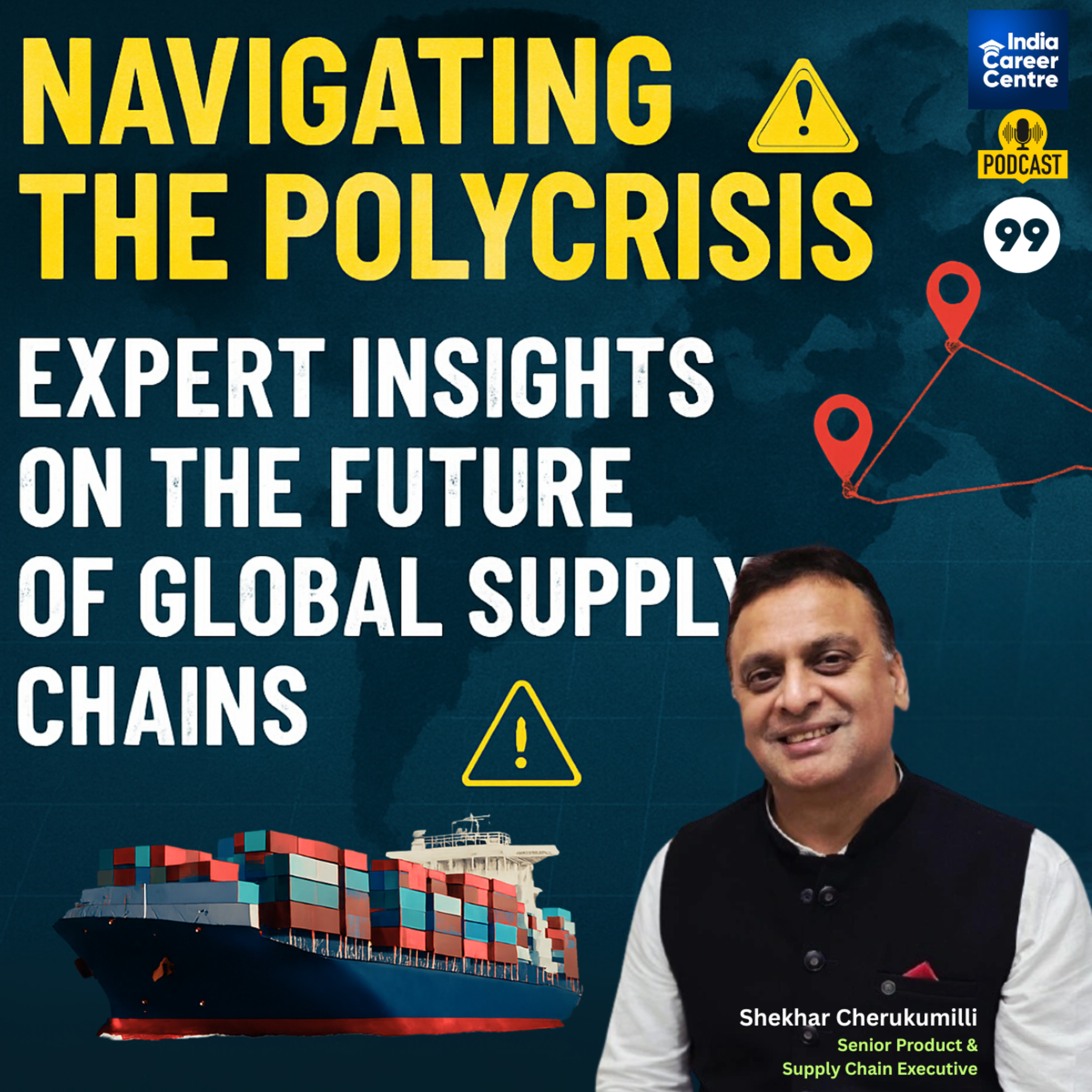
The discussion explores the evolution and current state of global supply chains, emphasizing their massive growth and complexity, illustrated by products like iPhones sourcing components from over 40 countries. Supply chains today confront a "polycrisis"—a convergence of geopolitical tensions, technological disruptions, skill shortages, and sustainability pressures—compelling a shift from traditional cost and efficiency optimization toward resilience and adaptability. While AI promises transformation, its high failure rate in supply chain projects underscores the need to integrate it as a tool to augment human decision-making, not as a replacement. Other technologies, such as digital twins for risk simulation and blockchain for transparency, are also becoming vital. Geopolitical dynamics are driving cyclical diversification strategies like nearshoring, with success hinging on a nation's technological and logistical capabilities. A central dichotomy persists between the economic benefits of globalized production and the imperative for sustainability, requiring continuous balancing of cost, speed, and environmental impact within supply chain operations.
Hello and welcome to India Carrier Centre. The one-stop podcast for students, professionals, parents and guardians. In every episode, we will try to deal with a current topic that needs expert advice related to career, career guidance and career methods. Please welcome your host Dr. S.P. Visher to the show and happy listening. Ladies and gentlemen, welcome to another episode on India Carrier Centre podcast. Today, I'm delighted to host my friend from Engineering College Shaker, who is based in Seattle and he is joining us from there today to discuss about a very interesting topic. It's about the supply chain. Now to give a context about supply chain, a few days back, I wrote a blog article regarding the global trade and just to quote some numbers, in this century, the 21st century from beginning of early 2000 till now, the global trade had grown from about $7.7 trillion in 2000 to about $33 trillion in 2024. So which means that global trade obviously means a lot of global supply chain also comes along with that. So to understand how this global supply chain has evolved over the years, and especially in this 21st century, we will learn it from Shaker, who has been in this industry for almost a two and a half decades with very, very reputed brands to where he has walked in his professional career. So to learn more, let's welcome Shaker. Shaker, thank you so much for being with us today to share your knowledge and insight into this fascinating world of global supply chain. Thank you, Michelle, for having me and first of all, it's great to be here and especially talking to you as not just my senior in college as a fellow engineer, but also as a fellow supply chain enthusiast as well. So thank you for having me. Fantastic. To kick off the conversation, Shaker, take us through your journey first. I know I remember the early years working together at Wittgen in 98. I think I remember once you passed out and immediately after that, you headed off to do your masters in the US. So from there, take us through your journey so far. Sure thing. Yes. Every left off, Michelle, so yeah, after my mechanical engineering, back in Bangalore, I went to Clemson University for my industry engineering masters. And that was where actually I was drawn into supply chain. It was my major and it was something that I was interested in because I always felt that supply chain was something that connected the different parts of how a product is brought together, which was primarily what my industry engineering was all about. But then also wanted to see it from a global standpoint as well. And my first career move after my masters was in the Silicon Valley, which was the happening place around that time and continues to be so even at this time, which was where I got very close to the high tech supply chain part of it. And I had some great mentors during that time who actually laid the foundation for what supply chain truly is, technology and how global the nature of supply chain itself is. That intern again took me to my first retail supply chain role at Gap Inc. This was back in 2004 and I would say that that was where pretty much I grew up learning all about global supply chains, how retail industry works. And actually over the next 13, 14 years, all it did was go to different parts of the Gap Inc. supply chain and learn what happens within those different processes. That was where for me it brought in a big appreciation for how critical people are to running a business and a supply chain, how technology can be used to enable a world class supply chain. And how do you bring the people and the technology together with the actual process of running a business and a supply chain itself. This is what has kept me actually passionate just in seeing how this overall global set of operations work. And just think of the shared complexity itself, right? You take an iPhone, it pulls components from over 43 countries. It is assembled in key factories around China, India and it reaches 100 plus markets around the world. This is around 2000 parts that cross different borders and finally gets to markets around the world. Or take a Nike shoe itself as an example, which operates around more than 40 plus factories with material suppliers in more than 500, 600 factories around the world, employing more than 1.1 million people, both directly and indirectly. Just look at the sheer size of all of this when it comes to economies, when it comes to cross-border trade and when you think of how a simple product like a shoe or even a complex product like an iPhone can actually go across the globe before it gets to you eventually. That's what keeps me passionate about the supply chain part of it, the human element, the technology element and the process elements. Fantastic. And you had the opportunity also to work with Amazon when it was really growing in its footprint across the world. So take us through that journey as well. Absolutely. Yeah, actually, as I was going through my career at Gap for almost 13 plus years, one thing that always struck me is supply chains are everywhere with all products and services that you can imagine. That was what drew me from Gap to Amazon. And that was when I moved from the barrier battle and I headed up the supply chain for one of the startups within Amazon, which is called the drop. And we were trying to do something very ambitious there. We tried to take the fashion industry and typically the supply chains there from the time when you receive a customer order, to when it is delivered to a consumer, it usually takes about three to six months, even in the best of cases. And you had large retailers like Zara who really took the best part in terms of how to do this most efficiently at the best speeds. And we were trying to beat that. So that was the challenge that we had is from the time when you receive a consumer order from anywhere in the world. Can you deliver that product to the consumer in less than two weeks time? And we hid it. And this got us to actually work across multiple factories, multiple design houses in Europe, in Asia, and bringing it all together for the consumers, not just in the US, but in Europe and Japan and Asia. And that was my stint with Amazon, where again, we were trying to push boundaries when it comes to fashion and when it comes to manufacturing and when it comes to actual logistics of delivering product to the consumers, when they truly need it. But rather than trying to store inventory for multiple months in warehouses and not just accumulating costs, but running sustainably incorrect process itself. So that was what we were trying to go away from to just build enough and to actually deliver at the right time for consumers when they need the product. Fantastic. You have obviously traveled across the world. So in your opinion, what are the most significant changes, which is shaping global supply chain today? For example, of course, we know that pandemic was one of the biggest event which actually shook up everybody in the supply chain. Geopolitics continues to be interesting even today as we speak. Digitization is obviously one of the important things and sustainability. It's actually quite bizarre for an ordinary citizen, ordinary person anywhere in the world to think about that in Apple phones, 2000 components are shows from 40 different countries to put together and then made and then shipped to hundreds of countries. So can you give some sense of what you understand from these complex situation of a supply chain? That's a great question. And it gets to the heart of what I call it, the poly crisis, if I may, because we are navigating in a very turbulent confluence of geopolitical fragmentation, if I may say so. We have technologically disruption that's happening at an exponential level. We have a widening human skills, as I call it, when it comes to, you have technologies like AI, but then you have people skills that probably are not there yet. And at the same time, you also have to your point that you just made about sustainability. There are multiple sustainability mandates that are coming across, take EU, for example, you will have multiple mandates that are causing enterprises to relook at how they do business, how they would want to contribute to reducing greenhouse gas emissions. All of this is what I believe is coming together as a perfect storm or a poly crisis as I mentioned earlier, which is challenging companies to relook at how they do business. And when it comes to the supply chain, the core challenge that you have here is not merely optimizing for efficiencies, which typically is how supply chains are looked at traditionally, at least, are you getting the best cost out of it, are you trying to get the best deal when you're working with your suppliers, are you trying to get it out of the consumers as quickly as possible, that's been the traditional way of looking at supply chains. But when you think of all these different dimensions coming together, whether it's the geopolitics, whether it is the technological disruptions that are happening, the human skills, the escalating, sustainability mandates, all of this is getting supply chains to look at future from a more resilient standpoint, and how do they get to be more intelligent when it comes to resilience, when it comes to adaptability to these different geopolitical changes that are happening, and how do they stay resilient through all of these changes. So that is what is getting companies to be looking at the future and saying we got to do differently how we set up and how we run supply chains. While AI is presented as a silver bullet, I would caution all of us that we would want to separate the hype from the actual ground reality. Yes, the AI market and supply chain is booming. The market is hitting almost 14 billion, I believe, in 2025. It's about a 23%-ish increase in Kager, and yet with all of that investment going on, we still see about 70 to 75% failures in projects of AI within the supply chain. And this is due to multiple reasons, which again, I won't go too deep into here, but from data silos to legacy systems, all of these contribute to systems not talking to each other. And therefore, even if you apply AI, it is mostly a garbage in garbage out scenario. So this is where I believe there is something called the frustration of automation that is happening, which is eroding some of the ROI that is going into all of the AI investments that are going into the supply chain itself. The real opportunity, in my mind, lies not in replacing humans with AI, but in actually bringing the human and the AI parts of it together cohesively. Technology is not going to be a substitute for human judgment, it's going to be an amplifier. The data that AI brings is going to be an amplifier to how well humans can make better judgments. The companies that are truly succeeding in this space are the ones that are using AI for routine tasks. So get humans who are doing the mundane everyday tasks help using AI and bots, whether you call it agentic AI or other terminologies, that is the place where you would want to bring in help to humans who are doing routine tasks. And then freeing up the humans to go after more of validations of decisions being made, looking at exceptions and making contextual based decisions to ensure that the right decisions are being made and the best solution is being gone after. This is what builds trust, this is what increases adoption, and that is what truly brings together the machine and the human together, which is what I would call as the more AI-powered supply chains. So, looking at the way we have progressed on interdependability across the world for the supply chain, are we in a situation where it would be very, very difficult or nearly impossible to go back and centralize production, especially product productions to respective geographies, which is being attempted right now. But do you think from the way you have seen the world to move towards a highly interdependent in terms of the supply chain, we have traveled too far now to go back to original native lens? I don't believe so, because I think even if you think of where traditionally supply chains have been at, the diversification part of supply chains have been in a cyclical nature, so to say. What I mean by that is, yes, we are in a geopolitical mess right now and people are looking at diversification options, whether you take iPhones and the production of iPhones moving from China to, let's say, India as an example, this has been there in the past as well. There used to be a parallel quarter limits back in the early 2000s, until the early 2000s. And this caused companies to diversify their manufacturing and assembly across multiple countries around the world. And that is how you would see many of the Asian and the Southeast Asian economies growing because of the manufacturing at that time. And that is happening again now with the geopolitical risks that are coming up and you are seeing moves towards more of new shoring, you're seeing more towards French shoring wherein if you have allies in other countries who have similar views, then you are looking at a potential collaboration within those countries itself. So these are things that are going to be happening on a cyclical nature. And I believe whether it is the newer shoring, whether it is the on-shoring or even the French shoring, these moves are going to happen. The key thing here that we would want to be looking at is are the countries that are bringing together technology, their manufacturing prowess, and the ability to actually create a well-established logistics hub. Those are the ones that could be at the forefront when it comes to supply chains and catering to global supply chains itself. Okay. So you are of the opinion that we will continue to see some kind of churn in the supply chain. It's not going to be ever at a constant thanks to what is happening around the world with respect to geopolitics and technology. Okay. Okay. So staying with technology, so you mentioned earlier about AI and its limitation in terms of how it is going to help. Of course one cannot but adapt using AI. But do you think technology like blockchain and advanced analytics also will be used or being used already in the supply chain already and how do you see that panning out? No. AI definitely seems to be taking the prize when it comes to the one that is most popular. But there are technologies like blockchain and advanced analytics, digital twins as an example that are very much prevalent. And I believe all of these will actually be part of the technology disruption that I was talking about earlier. So for example, we see a rise in the what if scenario planning solutions using comprehensive digital twins. These are basically virtual replicas of companies entire supply chain itself. These simulations allow leaders to model the impact of geopolitical shocks like the trade and the tariffs that we are seeing right now. It's 15 percent, it is 30 percent, it is no 5 percent. So how do you look at all of these from a what if scenario planning standpoint or you're seeing a lot of global conflicts. And as a result of which when it comes to logistics, you're seeing pot closures around the world. How do you scenario plan around these supply chain disruptions in a risk-free digital environment. That is what is coming together with some of these digital twins, advanced analytics. And helping companies make the right decisions based on the information that is presented to them. When it comes to something like blockchain again, you are seeing many countries looking at blockchain as a way to run their supply chains given the global nature of suppliers, clients and ensuring that while information is transparent, it is also coming with a high degree of accuracy. So the transparency and accuracy all coming together through the blockchain aspect is also going to be a key thing that is going to be coming up in the coming years and decades for sure. Staying with the digital twins, curious to know how in supply chain digital twins can be used. Sure. Yeah. Like the example that I just provided, wherein if I can model my supply chain transportation and logistics processes through a digital twin, that would be an example where I can build a digital replica of how my company's transportation routes are set up within my supply and network and where my markets from a demand standpoint are set up to. And then when I use these digital twins, I'm able to say, if I have my tariffs go from X to Y percent, what does that mean for me when it comes to my landed costs, which is basically what, when you think of your profit and last statement, if you have a cross margin, that is one of your key metrics that cross margin is nothing but the price at which you sell the product to the cost at which it is made, right? So that cost is where these digital twins come in and help you model it to say, what would happen if my tariffs went up from X percent to Y percent? And what will happen to all of my different trade routes from, let's say, to Asia, to my West Coast and the US or to Europe or to Japan? And what would those look like if instead of sourcing from X country, I would go to Y country? And what could that look like? So that would be one way where digital twins could be used. Another example, and this was something very recently when I was out in Vietnam and Cambodia, some of the factories that were really using technology to help have better efficiencies within their manufacturing production floors that I saw was using digital twins to mimic their entire production floor. And that helps them to say, if they were to make changes to their production floors in terms of how they, how many people do they have? What if some of their machines were to go down into maintenance? What would happen? What would be their productivity and efficiency for that particular day, that week or month? All of these can be simulated using digital twins, which helps make the right decisions of what time of the year, what time of the month would you want to go into maintenance? And if there are disruptions, what could be other alternatives that you could go after to get the best efficiencies out of those factories itself? So these could be a couple of good scenarios or good examples of how digital twins can be used within the supply chain to get the best efficiencies. At the end of the day, you're always looking at am I getting the best cost or the most optimal cost, the optimal speed, and also am I doing it at the most sustainable way from a production standpoint? Right. So, Shaker, what intrigues me is that while we talk about sustainability, which obviously means you are supposed to create less pollution, less carbon, and so on and so forth. At the same time, the global supply chain is exactly working in the other direction in terms of making the products to travel across the, I mean, the components to travel across the globe before it reaches to the end customer. So, is it not like a dichotomy, so to speak, in the supply chain, while the optimum cost, profitability, and those factors are important? But how do you think from a supply chain person on this aspect? Yeah, I know that's definitely one of the complexities that are front and center to the supply chain itself. While if you were to look at the different levels of the supply chain, cost, convenience, sustainability, speed, quality, right? These are your five key dimensions through which you look at your supply chain. Typically, you look at each one of these and say, hey, if I were to get the best cost out of it, I would be trading off on quality, or I would be trading off on sustainability, or on speed. What these different challenges that we currently have are doorsteps, whether it is geopolitical risks, which is forcing you to diversify, or tariffs, which is getting you to look at cost in a different way, conflicts, which is getting you to say, do I source from X region or do I go to Y region? All of these are forcing you to look at these different dimensions and saying, how do I optimize each of these dimensions? It is not that I'm going to trade off one against the other. It's not that I would want to continue to get the lowest cost and I'm going to compromise on quality, or I'm going to compromise on sustainability. For example, now consumers are very well versed with what needs to happen to actually bring the product to life, and they are going to companies that actually get the best sustainable value out of it, with reduced greenhouse gas emissions, having the lowest carbon footprint, and doing ethical sourcing, that is the product that they are going after. This is requiring companies to look at all of these dimensions together and saying, we will have to optimize towards that. That I believe is the complexity that we live in today and it's actually a good problem to go after with all of these different risks. How do you optimize your cost, your quality, your sustainability, your speed and convenience to the consumers so that you can get the best solutions out to them? Fantastic. I can imagine it's a very, very complex subject. It's not something which is straightforward. Moving on, how often do you have to in your last 25 years or more of your career, you had to travel to India for other than coming to your hometown, so in terms of your professional engagement, how India has been in terms of its engagement, and do you see India adapting to the new technologies and so on and so forth with respect to the global supply chain? How do you see that? Absolutely. Do your first question, yes, other than visiting my hometown back in India, which is Bangalore. I do have a close connection from a supply chain standpoint with India as well. I have many of my colleagues and very close friends with all of the interactions that I have had over the past two decades with multiple companies whenever I work with either Gap Inc or with Amazon or with Nike that I have interacted with folks within India, with factories and companies within India itself, and this is across the board South India, North India, all over India itself. And it's always been fascinating for me to see how India has adopted technologies, how it has adapted to all the different geopolitical risks and just the sheer amount of change that I have seen over the past two plus decades every time I visit India. And it's an incredible time the way I see when it comes to how India is positioned. It has a unique blend of scale that it can provide and the strategic positioning that it is going after, especially with more manufacturing happening in India with the Macon India initiative. Some of the national logistics policy decisions that have been made and providing major infrastructure investments which I believe is going into 100 billion plus in the recent years and coming years with modernizing ports and expanding highways. There is a lot that is going in India's favor, whether it is in terms of the human capital whether it is the physical infrastructure or the technology which has been a core part of at least where I come from in India, which is Bangalore, the Silicon Valley of India. A lot of these things are going in India's favor. So I truly see a lot of positivity when it comes to how things are headed, whether it is through the lens of supply chain or just in terms of global dynamics when it comes to doing business and looking at all the strengths that India brings to the table. But I'm sure you also have good exposure to China and other Asian market which are actually very, very crucial partners in the global supply chain today. So how do you see, I'm sure you have traveled to those countries as well quite often. So when you compare the other Asian countries and the Chinese, China versus India, so where are the areas where we could do slightly better so that we can catch up in terms of manufacturing and play a much bigger role in terms of the global supply chain. Yeah, I see this very much through the lens of collaborations and less in terms of competitors. Because each one of these countries actually have their sweet spot, have their unique strengths that they bring to the table, whether it is China when it comes to maturity in manufacturing. Or if you see some of the more up and coming economies in the Southeast Asian markets, Cambodia, for example, Thailand, Philippines, Vietnam, all of these are taking a share of the manufacturing pie from both China and India and they're doing pretty well. And the key strengths that they bring to the table again, it could be across mass manufacturing. But it is also in terms of how quickly they're able to adapt to newer technologies and proactively bring these technologies into their manufacturing environments. That is something that I have seen over the past 10 years, that has been extremely heartening for me at least as a supply chain professional. The places where for me, I think India could differentiate is more stability in its policy positioning, which will give a lot more stability. When it comes to other economies and large enterprises looking at India as a stable, consistent, go to manufacturing location, logistics hub, technological hub, that is where for me the policy side of things would be one of those things that India can continue to get better and better at because that will give the more predictiveness to the relationship and to how supply chains could look at India as a key hub itself. So now moving on, so geopolitics, shipping disruptions, I think those are some of the disruptions will continue to see all the time, so how the organizations continue to build some kind of resilience to address such disruptions? Yeah, I think that's been a core part of the discussions, not just at the boardroom levels, but across supply chains at all levels. Resilience in terms of cost, resilience in terms of logistics, resilience in terms of manufacturability, resilience in terms of being flexible when it comes to changing demand patterns. All of these are part of how you bring these different dimensions together within the supply chain itself. How technology can actually help with this is something that is getting to be a core part of the discussions, like I mentioned earlier, whether it is through advanced analytics, through digital twins, through AI, of course, currently, through building better manufacturing locations to go after some of the geopolitical risks through near-shoring, through front-shoring, these are all the different aspects that are coming together as we speak to go after the resilience part of it. So for example, given the recent geopolitical risks that we have all been facing, 69% of the US firms are looking at reshoring or have already started reshoring, with a bunch of that, I would say, almost 50% is for near-shoring. And that is across multiple retail companies within the US, and that is already happening. So these are some of the key things that companies are looking at when it comes to resilience itself. But looking at the global population, whether it is India, China, or the emerging Africa, so to speak, especially when it is low tech, day-to-day product, so does it make really sense for organizations across the world to look at their global supply chain to concentrate around these markets so that they are able to address to the three biggest pockets in the world in terms of the global population. Of course, we need to also look at the purchasing power which may not be so great compared to China. But I think both India as well as Africa are probably the opportunities for the future in terms of the purchasing power for the organizations to look at. So some of this reshoring and front-shoring will have the context of this lens also. Very differently word, and yes, you are right in terms of the three major pockets of demographics and population. But there is the aspect now with how logistics are set up is, are you able to actually bring some of those capabilities closer to the shores? And this is given again the geopolitical dynamics that we are seeing. This could again change in a few years from now. But I think what companies are looking at from a supply chain standpoint specifically is, how do they actually hedge against these different risks? And earlier traditional supply chains were going after just-in-time models. Now supply chains are looking at just-in-case models, which is, what if this political risk, geopolitical risk comes up? Or what if this conflict risk comes up, what are we going to do about it? That is what I call as the just-in-case modeling that is happening as well. So it is a combination of the just-in-time modeling, the traditional supply chains, and the just-in-case modeling given all the different risks that we are facing today. All of this is coming together, and that is what is getting companies to look at their supply chains differently. It could be reshoring, it could be near-shoring, and in the future, it could also be changing to where you have the best manufacturing as well. But I believe it's going to be a combination of all of these together. Fantastic. Now, for those young listeners and viewers who are watching us, are listening to our conversation, and who are aspiring to look at supply chains, one of their preferred career path, what would be your advice to them, and when you started of your masters, during that time, you realize that this is one area to focus. So for somebody who is currently, let's say, pursuing undergraduate in India, what would be your advice to them? The skills needed today, I believe, are a blend of both technical knowledge and human-centric soft skills. And this, of course, goes along with, if you are getting into the field of supply chain, being open to the supply chain, being a complex set of processes, and it takes literally years, if not decades, to experience different paths of the supply chain. So for all of your young listeners out there who are looking to make a career in supply chain, I would say go for it, but keep your eyes and ears wide open when it comes to blending your supply chain skills with technical knowledge and the human-centric soft skills as well. So for example, on the hard-skilled site, I would say being proficient with data analytics is going to be key, because the ability to collect, to interpret, and act on supply chain data is going to be critical. Technology proficiency, especially with foundation systems of your systems like ERP, which is your enterprise resource management systems, WMS, which is your warehouse management systems, or your transportation management systems, TMS. And being fluent with core technologies like AI and blockchain is going to be keeping you at a good step when it comes to technology proficiency. And how that end-to-end mindset is one other key advice I would have to all your young listeners, because the supply chain is very wide. It goes all the way from, for example, the farm, all the way to the consumer and back. So keep your end-to-end mindset open, because the more you can help connect the dots, the more successful you're going to be in a supply chain career. On the soft skills side, I didn't mention the human centric soft skills. So on the soft skills side, the key thing that supply chain professionals, and I think this is going to be common for many other fields as well, is problem solving, critical thinking. That needs to be part of your everyday job. How do you communicate and collaborate with teams with other humans, and not just humans also with machines, is going to be so very important. And lastly, I would say adaptability. Being comfortable with constant changes, especially in the supply chain, is going to be key. And that is going to keep you in good stead throughout your supply chain career. Okay, so now coming to the aspect of sustainability. So as a supply chain professional, how much do you think the supply chain industry is looking at sustainability in a very senior's manner? With respect to, for example, we hear about carbon credits and things like that. There's a carbon tax, which could become a reality probably in a decade's time across the world, I guess, it is there in some part of the countries. But if that comes into effect, then the supply chain will also be radically different. So as a professional from that industry, how do you see this impacting the supply chain or it is shaping the supply chain for the future? Yeah, that's a key question. And I know sometimes sustainability can be looked at as a buzzword. I don't believe it is a buzzword. There are two parts to the sustainability equation that I would want to tease out. One is the regulatory compliance piece of it, and the other is the true sustainability part of it. And the reason why I bring these two separate ones is, if you see with global trade and what countries are looking at in terms of what they allow into their country and the quality that they would allow into their country when it comes to products, there is the compliance and the regulatory part of it. And then there is a sustainability part of it, which is in terms of the carbon footprint itself. And these both are very critical because when you think of sustainability as a whole, supply chain itself takes up about 80% of a company's carbon footprint. That's a significant portion. So within the supply chain, you're always looking at in terms of how you design your product, where you source it from, is it being sourced ethically, are you able to trace the product to your tier 1, tier 2, tier 3, tier 4, and sometimes all the way to tier 7 of your suppliers. And then are they being made ethically, and then are you transporting it with the least amount of greenhouse gas emissions? These are all things that you look through the entire supply chain, including when you buy a product and you return that product, are you disposing of that product ethically and in the best and the most efficient form possible. So all of these are critical when it comes to the sustainability aspect of the supply chain itself. And it's not and it's not a buzzword, like I mentioned earlier because if you see companies like, whether it is Adidas, Unilever, Patagonia, they have all shown this thing that it doesn't have to be a trade-off. It is not sustainability or better cost. It can actually happen together. How do you use technology to gain real-time visibility into the supply chains? How do you use technology to reduce the number of unique raw materials that you use? How do you use technology to ensure that you are sourcing ethically and you are looking at reducing waste and inefficiencies on a continuous basis. All of these are part of your sustainable strategies. And that is where when I mentioned earlier the five things from a supply chain standpoint, you're continuously looking at an optimizing cost, your speed, your convenience, your quality and sustainability. And that sustainability again is getting to be a non-negotiable. Fantastic. So as a professional of supply chain, I will put you in a fix now and want you to predict about the supply chain of the world of 2035. I know forecasting is a dangerous business, but being there as a professional, how do you see that? I mean, for example, when it comes to sustainability, I do feel that more and more countries will adapt safer fuel, for example. And it is possible that some of the commercial ships will start using nuclear power rather than the traditional power. I don't know. Thinking out, but as a professional, how do you forecast supply chain of 2035? That's a loaded question. And I think 2035, 10 years from now, there are going to be a few things that are going to be different from where we are today. We spoke quite a bit about sustainability. Like all of the great examples that you just gave in terms of energy and how that is going to be used to run supply chains more efficiently. So let me not repeat those. And I would add to that because I see a confluence of more digital, more localization and also more collaboration. That is at least how I'm thinking of 10 years from now. And what it could mean is in specific spaces of the supply chain, some of the key things that come to mind would be more of autonomous demand intelligence as an example. The market for AI in demand sensing and inventory management is actually growing quite a bit. And just in 2025, it's close to about 10 billion, underscoring some of the key investments that are happening in this area. And this will just continue to grow and grow. This actually mitigates this investment in the space around demand intelligence is mitigating two major problems in retail supply chains at least. One is the stockouts and the other is the overstocking. And if you see companies like Walmart are already using some of this, they call it the self-healing inventory, which turns real time signals into actions, which reduces waste and improves efficiency. So I see this happening more and more when it comes to the demand side of things. We already spoke at nauseam about advanced analytics and digital twins, wherein we talked about what a scenario planning and how these can be used to simulate better impacts when you have geopolitical shocks or other conflict risks that are currently happening. So and we talked about the just in time as well as the just in case strategies. So that I believe is going to be enabled through advanced analytics and digital twins. The other prediction that I have and again, this is something that we are seeing happening. Yes, we have generative AI and the virtual AI that is happening currently. There is a high part to it, there is a reality part to it, which we already spoke about. But there is also going to be the rise of physical AI. What I mean by that is it's not just the virtual AI part of it. It is the symbiotic workforce as I call it, wherein humans and machines work together. And these could be collaborative robots or as they call it nowadays, co-bots. So these AI powered robots will help handle much of the repetitive, the physically strenuous tasks and allowing humans to focus on the more safer and the more complex of the tasks. When it comes to things like problem solving. So that is going to be an interesting thing to watch out for, the rise of physical AI. I know companies like XAI or Tesla have already invested $7 million billion, I should say, into this. So I think that is going to be a key thing I would watch out for in the next 10 years. Another thing that we have spoken about multiple times throughout our conversation is hyper-localization. When we talk about reshoring, when we talk about near-shoring or French-shoring and all of these coming together with the technologies that we have been talking about, I think it's going to be an important thing to watch out for in the coming years. So that sounds really interesting and exciting to look at the next decade into the supply chain. So on the closing remarks, would you like to give our audience about some three ideas or guiding principles for building a resilient and future-ready supply chain, if what would be that? Yeah, this would be my advice and this is again based on what I have been through and what I'm seeing coming up is number one, I would say embrace technology with a mindset of symbiosis, which is the future workforce should be prepared to work with machines and humans alike, not against them. And using automation to empower your teams and not replacing them, of course, and building a culture of trust and collaborations between the humans and AI. So I think that is going to be one guiding principle that I would have. The second one that I would have is being able to prioritize data and governance as foundational assets. Yes, you could have AI getting to our day-to-day working in the coming years for sure, but it's only as good as the data that it is trained on. So don't invest in shiny new technologies until you have done your real good homework on breaking down the data silos establishing your single source of truths and ensuring that you have a unified data strategy and it being governed as well. So that is going to be the second thing I would look at, which is your data and governance. And probably the third one I would leave you with is always leave with empathy and a people first vision. Ultimately supply chains are powered by people. And as a leader, you would always want to ensure that you're creating an environment of psychological safety and empowering the people behind the supply chain itself. So that would be the key thing that I would always do is to put people first. Yes, you could hear a lot about technology and all of these things. But your people are the most important part of your team. That's a very positive way to end our conversation today. And I learned a lot of new things which I had not imagined that I'll be learning today. You spoke about digital twin. You spoke about just in case which is absolutely new. These are some of the terms which I didn't know at all. So it was lovely to listen to you and learn from you about what's happening in the supply chain. And thank you for your time today. And I'm sure this will inspire a lot of our youngsters in India and across the world to take up supply chain as a profession in their careers. So thank you, Shikhar, for your time today. Absolutely. And thank you very much for having me. It's great to actually be talking about supply chain, which as you can tell I'm passionate about. And I wish all of your listeners all the very best when it comes to their careers and supply chain. And it's a world out there. So go and grab it. Right. Thank you. Thank you very much. Hope you enjoyed this episode. We sincerely wish you could take something from our conversation today and be able to apply it to your life in a positive way. We value your feedback. This can help us improve our future episodes. So share your thoughts to serve you better. If you want us to focus on a topic which you think is of importance, let us know. We will share our expertise in future episodes. So see you soon with a new topic and help you in your career journey.
Podcast Summary
Key Points:
Global supply chains have grown significantly, with trade increasing from $7.7 trillion in 2000 to $33 trillion in 2024, highlighting their complexity and interdependence.
Modern supply chains face a "polycrisis" of challenges
While AI investment is booming, its success in supply chains is limited by data silos and legacy systems; effective integration requires augmenting human judgment, not replacing it, with AI handling routine tasks.
Technologies like digital twins and blockchain are gaining traction for scenario planning, risk simulation, and enhancing transparency and accuracy across global networks.
Supply chain diversification (e.g., nearshoring, friendshoring) is cyclical and driven by geopolitical factors, with success depending on a country's blend of technology, manufacturing capability, and logistics infrastructure.
Balancing cost, speed, and sustainability remains a core tension, as globalized production often conflicts with environmental goals, requiring trade-offs and innovative approaches.
Summary:
The discussion explores the evolution and current state of global supply chains, emphasizing their massive growth and complexity, illustrated by products like iPhones sourcing components from over 40 countries. Supply chains today confront a "polycrisis"—a convergence of geopolitical tensions, technological disruptions, skill shortages, and sustainability pressures—compelling a shift from traditional cost and efficiency optimization toward resilience and adaptability. While AI promises transformation, its high failure rate in supply chain projects underscores the need to integrate it as a tool to augment human decision-making, not as a replacement.
Other technologies, such as digital twins for risk simulation and blockchain for transparency, are also becoming vital. Geopolitical dynamics are driving cyclical diversification strategies like nearshoring, with success hinging on a nation's technological and logistical capabilities. A central dichotomy persists between the economic benefits of globalized production and the imperative for sustainability, requiring continuous balancing of cost, speed, and environmental impact within supply chain operations.
FAQs
It's a podcast for students, professionals, parents, and guardians, focusing on career guidance and expert advice on current career-related topics.
Global trade has grown from about $7.7 trillion in 2000 to around $33 trillion in 2024, driving significant evolution and complexity in global supply chains.
Major challenges include geopolitical fragmentation, technological disruption, widening human skills gaps, and increasing sustainability mandates, creating a 'poly crisis' that demands more resilient and intelligent supply chains.
AI is used for routine tasks to assist humans, but projects often fail due to data silos and legacy systems. Success lies in combining AI with human judgment for better decision-making, not replacing humans entirely.
Digital twins create virtual replicas of supply chains, allowing companies to simulate scenarios like tariff changes or production disruptions to optimize costs, efficiency, and sustainability without real-world risks.
No, supply chain diversification is cyclical. While geopolitical shifts drive moves like nearshoring or friendshoring, interdependence remains high due to global manufacturing networks and logistics hubs.
Chat with AI
Loading...
Pro features
Go deeper with this episode
Unlock creator-grade tools that turn any transcript into show notes and subtitle files.
 PodcastTranscript AI