Future of flying? JetZero CEO takes on Airbus and Boeing with jet that aims to cut emissions in half
47m 13s
Tom O’Leary, co-founder and CEO of Jet Zero, is leading a transformative shift in aviation with the development of the Z-4, a blended wing-body aircraft designed to serve the under-served "middle of the market" segment with 250 passengers. By leveraging a revolutionary aerodynamic design, the plane promises up to 50% lower fuel burn and emissions, addressing key industry pain points like high fuel costs and environmental impact. Jet Zero’s success stems from a strategic combination of first-principles thinking, strong partnerships with NASA, the U.S. Air Force, and major airlines including United, Alaska, and Delta, and a focus on proven, reliable technology over speculative propulsion systems. The company prioritizes flexibility, allowing airlines to customize cabin layouts and passenger experiences, while maintaining a scalable, cost-effective production model. Rooted in Tom’s background in tech innovation, entrepreneurship, and coaching, the venture emphasizes team autonomy, collaborative problem-solving, and real-world problem-solving over traditional top-down management. With significant funding—including a $235 million U.S. Air Force grant—the Z-4 is set to enter service in the early 2030s, marking a pivotal step in sustainable commercial aviation and proving that disruptive innovation can emerge from strategic alliances and deep technical understanding.
Life is all about making decisions.
Sometimes you make questionable ones,
like buying a new TV that's too big for the wall
because the electronics store employee
was a little too good at their job.
Then, sometimes you make great ones,
like protecting your home and auto with Progressive.
You get customized coverage options
so you can be sure you have the right coverage.
Get your quote today at Progressive.com.
Progressive Casualty Insurance Company affiliates
and other insurers not available in all states.
You've been asked to run the company's social channels,
but company content plays by its own set of rules.
It needs a logo in the first three seconds,
but it can't feel like an ad.
It needs subtitles, except when it doesn't.
It needs to run at two times speed
and deliver a complex message,
simply, of course, within nine by 16.
Thankfully, your company has Canva,
so you can easily edit your video and every version of it.
What will you Canva today?
NASA put a billion dollars into researching these technologies.
Welcome.
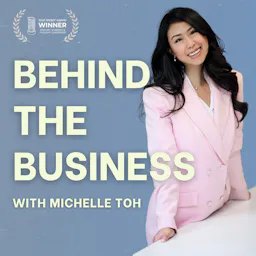
I'm Michelle Toh, a journalist most recently with CNN,
and this is Behind the Business,
a show about the people behind top consumer brands,
category creators, and emerging disruptors,
and how they push through to make the most
of both work and life each day.
Today's guest is a visionary leader
at the forefront of reshaping how we fly.
Tom O'Leary is the co-founder and CEO of Jet Zero,
the startup behind the Z-4,
a new aircraft that seeks to use up to 50% less fuel
than today's commercial jets.
This means it could in turn cut fuel burn and emissions in half,
making it cheaper and greener for airlines to operate.
Unlike your typical tube in the sky,
the Z-4 is shaped like a manta ray,
and unlike anything currently in service,
it's being called the widest body commercial plane
to take to the skies this decade.
The company is backed by the U.S. Air Force
and airlines like United and Delta.
It was a pinch me moment.
Before Jet Zero, Tom held leadership roles at Tesla,
as well as electric aviation startup Beta Technologies.
You were there like right before Elon took over.
Was there anything from seeing how he operated Tesla
that really gave you inspiration?
What he's best.
In the world that has been taking really big structural problems
in big, hard-to-disrupt industries
and just breaking it down to first principles.
What is the way we're going to get after this problem?
There's just an amazing unlock there
that really every entrepreneur, every investor is looking for.
Tom, welcome to the program.
Thank you so much. Great to be here with you.
So let's start with some context.
Can you walk us through your background,
where you grew up,
and what shaped your ambitions early on?
Oh, great.
Well, I grew up in the Northeast.
I was born in Connecticut and lived in Boston, Rhode Island,
basically everywhere in New England.
What shaped my sort of early development,
I think, as a person was being not a great student,
but very attentive.
So I paid a lot of attention in class,
but I didn't read a lot of books.
People know that as ADHD,
which is not uncommon for a lot of people who get into,
start-up business, right?
It's that like drive, go hard, go fast, but sports really.
So what engaged me was just that live action
and played pretty much every sport you can think of.
That was really a lot of my upbringing
and even my early career.
Oh, wow.
And growing up,
did you always have that itch to do something different,
something entrepreneurial?
Yeah, absolutely.
Was thinking about just products of the future was always,
thinking about future, future, future.
And I think that's pretty, it's sort of a Gen X thing, right?
Because you're, we were in this amazing time, right?
Where we were sort of pre-technology,
but coming of age with the technology.
I find it to be not unique, but very common amongst peers.
I know a lot of people who are in this sort of expansive, right?
You know, I was born right when we were landing on the moon
and then off we go, right?
Everything has changed in
this lifetime that I've lived.
And it's amazing to think about
what the future will bring even now.
Wow, so that's what you were focused on
as you were growing up.
You were already thinking,
what will the world look like,
you know, 20, 30 years from now?
Absolutely.
It's funny, you know, like one of early memories
was just thinking about the environment.
You know, that was something that from an early age,
all the way through my college studies
and into my professional career, I remember,
I remember writing a letter to President Jimmy Carter
at the time suggesting that he should urge people
to ride their bike more,
because I rode my bike a lot and I thought it was great.
It was kind of a naive, like,
why don't people ride their bike to work more?
Not really a cultural fit in the United States,
but I got a response that he sent me
the transportation policy.
I thought that was an interesting response
to a nine-year-old boy, but sure, go ahead.
Well, I love that.
So already thinking about ways you can get around in a more sustained,
sustainable way, I think I, like, see the inklings of,
you know, obviously where you are now back then already.
Yeah, exactly.
And very civically engaged, it sounds like.
That's really fascinating.
Well, Tom, looking at your resume,
you've had quite a range of experiences, right,
across industries before obviously getting to where you are today.
Before aviation, as I noted, you worked at both Tesla,
which at the time was a new market entrant.
That's right.
And Ford, which, of course, was an incumbent.
What aspects from these experiences kind of
influenced you the most in the way that you've now built your company?
Yeah, so they were all sort of cutting-edge learning experiences.
When I went to Ford, it was to work on the internet.
And at that time, the dealer locator was the internet for Ford.
It was sort of like you go to Ford.com and you type in your zip code
and you get a list of dealers and their fax numbers.
That was early, early days, late '90s.
And so it was breaking new ground.
And I worked for eBay Motors after that.
And that, again, was new ground.
And I was working for a company called Tesla.
dealers onto this platform where people are buying or selling. It's this live, real-time
virtual marketplace. With Tesla, it was also about how do we do something new, right? It's
groundbreaking. How do you go into the market with this new product and really focus on go-to-market
strategy? How do you go direct to the consumer, set up your own stores, your own sales process
direct through the website as opposed to going through the traditional retail network? That's
what I find engaging and the thing, right? How do you go to market with something that's in a whole
new space, right? You're trailblazing. It's fun. It's engaging. And that's really what's been a
consistent thing throughout. Yeah. Constantly seeking reinvention, whether it's with a bona
fide startup or a player that's been around for ages. Yeah, for sure. And that was certainly the
case with Ford. We covered a lot of ground in a very short period of time, basically rolled out
the internet to Ford Corporate and through the dealer network. It was great. But yeah,
with the Tesla program, it's been a huge success, right? I mean, what Tesla has been able to do
selling direct to the consumer is just a whole new way. That was amazing.
Yeah, absolutely. You were there through late 2008, right before basically Elon took over.
He took over right as you were leaving, I think, like fully a CEO. Is that right?
Yeah, he was involved from the beginning. Right. He was he was there at the beginning. Yeah. Investor board member basically helping that company formulate. But he wasn't CEO until until that period. And that was a really tough period, if you remember, because we went through the financial crisis and then it was how to keep not just Tesla, but Tesla and SpaceX for him at that time was that was that was a critical piece.
From seeing how he operated Tesla and kind of interacted with Tesla, that really gave you inspiration.
Yeah, for sure. I mean, what he's best in the world at and over the past couple of decades has been taking really big structural problems in big, hard to disrupt industries and just breaking it down to first principles.
Let's go back to first principle physics.
If you go to Jet Zero, like why did we believe that this was a challenge accepted, you know, right?
Why did we go after this?
It's because we felt that its root in first principles physics was undeniable.
There's just an amazing unlock there that really every entrepreneur, every investor is looking for, well, how are you going to unlock this disruption?
If you're tying all the way back to the basic, the absolute first principles in physics, then that's your best starting point.
And that's really what he has done in each of his businesses.
Go back to the basics.
Yeah.
Really interesting.
It's also fascinating to hear about how you describe yourself as not the best student, because I think that oftentimes, by the way, I was the same.
I was like a decidedly average student, but I was always like much better in the workplace and just like learning by doing.
Did you feel you were kind of the same?
- Yeah, learning by doing, engaging.
I really, what I was there in school to do
was to learn how to learn because you're,
and I've found that as an adult,
is that you're really just constantly learning new things.
And so you're learning how to learn.
Being a student was an interesting thing.
I think to be an engineer or a doctor are these things where you really have to get straight A's all the way through.
I had a different path.
You know, I would get A's, but it would sort of be on accident, you know, when things were, they just clicked.
And so, but by and large, it was more just like paying attention.
My first job actually out of college was as a school teacher and a coach.
I learned more from that experience than a lot of other things I did professionally, being a coach above all.
But being a teacher was really more of like, you know, learning something to take a test is one thing.
But learning something to communicate it and impart wisdom, experience, knowledge, know-how to another person, that's a whole different skill.
And once you learn that, it accentuates your ability to absorb new information.
Right. And what kind of teacher? What kind of coach?
Well, everything from fourth grade students all the way up through high school.
When I was in college, it was wonderful.
It was wild because when I was doing an environmental studies degree that was in political science, but I minored in environmental studies before there was such a thing, right?
I sort of cobbled it together by taking geology and geography and different classes that, that became environmental studies.
But I would end up giving lectures at the, you know, university level because there was so much interest in the topics that, that we were researching.
It really just worked out that way.
So really even up at the college level, and that was the most engaging thing.
That's what keeps you on your toes.
It wasn't, you know.
Studying for the test.
It was how do you study to prepare to explain to people what you've been working on?
Do you take that, the principles that you learned there from your time in teaching as a coach to your approach to corporate leadership now?
Coaching absolutely, positively.
I think the place where it comes out the most for me is just, and people, people often will ask about like, okay, where are you at with management?
How do you lead a startup?
And those are the two key words, right?
It's, it's management or leadership.
Right.
Leadership.
What you're looking for in a startup situation is you're looking for a team of leaders.
So it's different, like in football, for example, when you're coaching football, the coach is, you know, every play effectively is a timeout where the coach puts in a new play.
In basketball, you're constantly coaching and you're running an offense.
It may not look to, if you, if you're not a basketball aficionado, you don't, you may not realize that every time down the court, the offense is running a pattern play in high school.
It's a pattern play where I coached.
It's every single play, every inbounds pass.
It's all pattern play.
Soccer though, I think is the best analogy because there are no timeouts.
There's no stoppages, you know, stoppages of play where the coach has opportunity to go, okay, everybody set pieces fine.
That's the, that's the exception.
But what I learned coaching soccer is you, you, as a coach, you have to have your game plan understood.
We have a system of principles and then each player is, is challenged to be.
A leader on the field.
You don't get to manage them.
What you need is 11 leaders who all know the game plan and are, who are all executing and who are all actually also interacting and adapting.
So having coached is a big thing.
Cause there's about management of the players.
It's also about strategy, but it, it really gets into like what you're doing in a startup ultimately is building a team and the best teams are the ones that you're not micromanaging.
They're the ones who look at their individual.
Segment of the business as if they own that, that piece, right.
As if they're, you know, they're approaching it the way you would, you would approach that situation.
So can one expect a pep talk or a lot of hoorah when it comes to sitting down with you at jet zero?
Actually, no, I, I, I wasn't that type of coach in sports and I'm not that type of leader here at jet zero or, or in other places.
Of course we have our moments where we get together, but it's more the camaraderie.
We did this as opposed to.
Now the coach is gonna do the victory speech.
We've had some great victories.
We just designed an airplane.
So we had a, we have a four year program to build a full scale demonstrator.
That's what the air force is involved in.
That's what NASA is involved in now going back even further, but it was two years to design and two years to build.
So happily the team executed that design, uh, read it out to the air force and NASA in our CDR, critical design team.
We executed that and it's really more of the team coming together and all feeling good about the sense of accomplishment as opposed to, to big hoorahs.
Right.
Um, I'm sure those will spontaneously erupt at various points in the business as we achieve milestones.
No, exactly.
Are you ever shopping online and suddenly a discount that helps you save pops up?
It makes your day.
Sometimes even your week.
Want that feeling month after month?
Well, new customers who save by switching their home.
Your home and auto insurance to progressive save hundreds.
Cue your happy dance.
Get your quote today at progressive.com progressive casualty insurance company affiliates and other insurers not available in all States.
What will you brainstorm collaborate on present today?
What will you resize post edit?
Imagine what we research test switch and finally have the courage to pitch.
You got this.
What we visualize design brand, animate, create, generate what we translate, pour your heart into, or have a laugh doing whatever you want to make it's possible.
So what will you Canva today?
When I found out I was going to be a parent, I immediately felt a lot of anxiety and worry.
So I went on to a better help to try to look for a therapist to help me with that.
My relationship with my family and with my boyfriend and with myself were suffering.
I really needed help.
I was ruminating a lot, really getting those thoughts out to a therapist and getting feedback was just life changing.
Discover what better help online therapy can do for you.
Visit better help.com today.
Well, more on that later, but you know, this takes us to jet zero, right?
Yeah.
Before we dive in, Tom, can we break down some of the more technical terms for viewers that might not be familiar?
Sure.
Just to start off, what exactly is a blended wing body design?
And how does it differ from the traditional design?
Yeah.
So a blended wing body aircraft is generated from an all wing design.
So you think of all wing aircrafts, it goes back to people's frame of reference would be the stealth bomber, right?
The B two spirit that North or produce late eighties, early nineties is where we first started to see these in use.
And that was actually the genesis of the blended wing body, also an all wing design.
So that just means lift across the entire wing.
So that's, that's really what it means.
Lift across the entire wing span and an all wing design.
What's different between a B two that's a flying wing versus cause there's really no fuselage.
It's just wing.
And then on the other side, it, we have a fuselage that's meant to hold around 250 passengers.
So you have to blend that fuselage into the wing.
And I know that you've mentioned that this plane that you're developing, it's intended to serve, you know, a total of 250 passengers, right?
Yeah.
And that's, that's exactly what it's meant to be.
So that's, that's exactly what it's meant to be.
And I know that you've mentioned that this plane that you're developing, it's intended to serve what you guys call the middle of the market, correct?
Yeah.
Tell us what that is again.
Yeah.
So interesting thing that's even, even simpler than physics is geometry.
The interesting thing about the airplane market, it's kind of staggering to think about.
And it's one of the reasons why I was so excited to get into this particular market with this particular technology.
There are no planes from 200 to 250 passengers in the market today being sold.
This is a staggering thing.
Can you imagine if there were no four passenger cars?
We've got one, two and three, and we've got six and seven, but we've got five, six and seven.
We've got no four passenger cars.
If somebody then invented a four passenger car, you'd say, wow, that's in the middle of, you know, seat class.
You're probably going to do pretty well with that.
That's really what's happening here.
And when I say, okay, so you have to, you have to go apples to apples, right?
You're talking about three class, like you typically fly on United across the country.
Would be a three class, first class, a premium economy coach class.
So if you normalize for that, the single aisles tap out at about 200 passengers.
The wide body started about 250 passengers.
And so in that gap, you know, there's single aisles and twin aisles, but there's no such thing as an aisle and a half aircraft.
With this design, with a wider, shorter and wider, you can specifically design a plane to hit that middle of the market more efficiently.
And it's something that the airlines are, are really thirsty for.
Yeah. And I've seen that these are basically usually, you know, things like long transcontinental flights, right?
Like, let's say like LA to New York, would that be like an example of a route or like Boston to Dublin or something like that?
Where it's maybe too long for a narrow body, but it doesn't justify the wide body jets.
It doesn't justify, or it's just way more efficient to fly with this super aerodynamic shape.
So we can get up to 50% based on, on multiple factors, right?
So lift, weight, drag, and thrust.
Those are the four forces of flight.
So we speak to all of them.
It's a lifting body.
It's lower weight, all composite aircraft.
It has lower drag and it requires less thrust, which actually a smaller engine means also lower weight and lower drag.
So there's kind of a virtuous cycle there.
So that's inherently more efficient than a wide body flying.
A cross-country flight, for example, which both, both wide bodies and narrow bodies can fly a cross-country flight, but we can fit
more passengers than the narrow body and we can do it more efficiently than the wide body. That's
the middle market. So you're absolutely right. It goes effectively from a cross-country flight,
a North Atlantic flight, you know, a Boston to Dublin for sure. That's where the sweet spot for
this aircraft because middle of the market doesn't just mean passengers. It also has the connotation
of range. Right, exactly. So let's talk about the origin of the business. Right. What exact problem
did you and your co-founder Mark Page see that led you to the founding of the company in 2020
and how did you even go about getting started? Interesting. So I was working with an electric
aircraft company called Beta Technologies and we had hired Mark and his design firm,
which was called Design, D-Z-Y-N-E. We had hired him to design that aircraft. And so this was a
couple of years before we founded Jet Zero. So
in his portfolio, I had noticed this, wow, that plane is amazing. It looks like the future. What
is that? Oh, that's my blended wing body design. And so I asked him about it and I got really
curious and I really started to dive into the history of it, what it meant, what it could offer.
And that 30% aerodynamic efficiency number really shot out to me because I was fairly new to the
business. I've been in aerospace for about 10 years. So at that point, I was only a few years
in having worked previously. So I was like, okay, I'm going to do this. I'm going to do this. I'm
going to be in automotive and software. At that point, I'm just a sponge. And I'm noticing that
the airlines, they come out and you're sponging up all this information and you're starting to
see the trends in real time. You notice they are scratching and clawing to get 1% fuel burn benefit.
And they're also looking for a mid-market solution. So I went to Mark and I said, hey,
you're saying 30%. And over here, I'm seeing anywhere from 1% to 3% is worth an investment
of millions and millions of dollars. And I'm like, okay, I'm going to do this. And he's like,
why aren't you taking this to market? And I kept pushing him. And eventually he came back to me and
said, well, I'm on the engineering side. I've never built a business. You're the one who's
been with all these businesses that have grown. Beta has become a really successful company.
Before that, Tesla and some others that I had worked with. And he said, how do you do it?
Which was really your question. How did this happen? And my answer to him was simple. You
know, but what does that mean? And I said, that's the only explanation there is. Startups of this
nature do not come by sitting down, in my opinion anyway, and I haven't seen it this way, by sitting
down and putting your MBA hat on and writing this 400-page business plan. It starts by looking at
the basic building blocks of how you do something and just attacking them. You just go after the
most important things that allow you to build a story that you can take to really all the people
that it's going to take.
Because something, for example, with Jet Zero that's this big to go after building big aircraft,
you really have to build a broad coalition.
No, absolutely. So what, you guys had a conversation and then it was probably many
conversations. And then it was kind of off to the races, right? Like you decided to leave
your job and go off with him and start your own venture. That's essentially what happened.
Yeah, exactly. And the way it worked for me, he actually showed me a picture of this. He came
up to me and said, "Hey, I want to do this." So I thought of all the different things that had to be
done. I put each one of them on a post-it note, colorized them, and then I put them on the wall.
And so when he came over, he was like, "What is this?" He said, "All these post-it notes all over
the wall."
Kind of mad scientist vibes.
Exactly. And then he was like, "These are the things that we would have to do. Which of these
things seems impossible once you break it down to a thing on a post-it note?" And of course,
anything looks possible if you can break it down to a thing on a post-it note. So I think
that gave him the confidence of saying like, "Okay, I don't know how to build a business,
but clearly you know what the constituent parts of this thing are, and each of them
looks discreet and doable. We just have to attack them one by one." It's really actually
more just about belief. You have to believe that something's worth doing, and you have
to know that you don't know everything about it. You understand the destination and you
commit yourself to the journey, even though you don't know what the road is going to be
at the starting point and the destination. That's okay.
Just take the plunge.
Yeah, exactly. A lot of people want that certainty. In aerospace, it's called ATP,
authority to proceed. So that's what would normally happen in a big business, in a big
aerospace business, is you would go in and present your whole plan of how you're going
to, and then they would give you authority. And that basically means we're backing this
thing from the beginning until you're successful.
Well, it's funny you talk about belief because I was going to ask, we've heard so much about
the future of flying.
We've heard a lot about the future of flying in recent years. As a reporter, I've previously
covered flying taxis, autonomous passenger drones, China's effort to build the C919, its
first large homegrown passenger plane. I think the challenge is that sometimes people can
feel like this is literally a pie in the sky, right? In this specific case, how did you
convince folks to get on board? Did you have to grapple with that kind of skepticism?
Well, in our case, it's a piece of pie in the sky, right? Everyone likes to talk
about how it's a triangle-shaped plane. So not the whole thing.
Not the whole pie, just a piece.
A slice.
Yeah, just a slice of pie. The beauty of this is people like pie in the sky. They want you
to go after the future that we all want to live in. And we think of ourselves simply
as humble servants of a future that everybody wants. Who doesn't want to fly on a more efficient,
less polluting, less noise, more comfortable, more commodious, more future-oriented plane?
With better tech, everybody wants that. Without planes, what would our modern life look like?
What would the modern world be? It would be wholly different. I think people want that,
but they also want believability, right? They want the believability of, okay, you're not
just promising us flying cars. You're promising us something that we're going to see in our
lifetime, that we're going to feel comfortable and safe about, that's not going to create
this not-in-my-backyard thing. This really fits all that, right? Because we have airport
infrastructure, we have FAA guidelines that are already existing that we can design to.
And when people say, "Well, I don't know. I don't know. I don't know. I don't know."
They don't want to see the reality of what we're doing, the pragmatism of what we're doing.
That's where the belief connects to the reality, the pragmatic reality. And that's where I think
people helped us grow a really broad coalition to back the business, essentially.
No, absolutely. I want to ask you more about that in a second. But to your point earlier,
you decided to take on one of the toughest industries there is, right? It's one of the most
regulated industries that exists. What gave you confidence that you'd be able to overcome inherent
challenges? What was the biggest challenge that you faced?
Like, extremely slow innovation cycles compared to, let's say, software, right? Or potentially long
airworthiness certification process? What gave you that kind of confidence?
What most entrepreneurs and innovators do is they take a problem and turn it on its head and
shake it upside down until all the change comes out of its pockets, right? And then
they make something out of that. Now, in this case, it's pretty simple.
Certification is a challenge. And so people often speak of that as though it's an impediment,
we see it as an enabler. The reason being, it provides certainty. Whenever you're building
something, the perception is risky, and you yourself see that destination as inevitable.
I'm committed to that destination. This is where we're going. Then what you're looking for is
certain milestones along the way or certain things when you begin. Let me give you an example.
What's great about this market that we're entering is some things are absolutely
uncertain. The market is defined by moving people to destinations from one point to another point.
Those are called city pairs. They never change. LA is not getting any closer to New York,
and it's not getting any further from New York. So it helps us understand the certainty around that.
The FAA is not quite so certain, but it's on the same level, right? Because
we have this thing called Part 25, right? That's the regulation that governs certification of this
type of passenger aircraft. Those rules are written, and we get to use those as the enabler
of our business because we don't need to guess where the bar is that we need to clear. So everybody
that's working towards that, first part, second part, real quick, partners. Rather than design
everything ourselves, we're simply saying, there's three things about this plane, the aero,
the flight controls, the structures, all composite, right? Carbon fiber. That's what we're going to
in supply, our partners in design and development. Sometimes you
make questionable ones, like buying a new TV that's too big for the wall because the electronic
store employee was a little too good at their job. Then sometimes you make great ones, like
protecting your home and auto with Progressive. Progressive
Casualty Insurance Company affiliates and other insurers, not available in all states.
What will you brainstorm, collaborate on, present today?
What will you resize, post, edit, imagine? What will you research, test, switch, and finally have
the courage to pitch? You got this. What will you visualize, design, brand, animate, create,
generate? What will you translate, pour your heart into, or have a laugh doing?
Whatever you want to make, it's possible.
So what will you canvass?
today. Arthur Grumman and their subsidiary Scale Composites, the likes of RTX with Pratt & Whitney
and Collins. I could go on and on. There's a long list of partners that's supporting us.
They bring us the solidity of having parts that we can put out into our product that are already
certified. They've already been through that process. We have to integrate them and certify
it as one unit, but that is really the thing that gives us the sense of. Yeah, that's a big piece of it, isn't it, already?
Right now at Woodhouse Chrysler Dodge Jeep Ram, get 0% APR for 72 months on select 2026 Ram 1500
models during the Make This the Summer event. 10-year, 100,000 miles powertrain warranty now
at Woodhouse. With approved credit, tax title, license extra, $299 dock fee, do a signing. Offer
ends June 30th, 2026. See dealer for details. And I mean, similarly, you started one of the
most capital-intensive businesses there is. That has long been one of the biggest barriers to entry,
right? Not just for. Companies or individuals, but even countries, right? How did you feel prepared to tackle
financing? Did you go straight to the big airlines? You know, what did that process
kind of look like for you as you started to think about, how do I actually fund this whole thing?
When we started, it was 2020, the middle of the pandemic, which interestingly led to a different
kind of way to develop a company because we were able to recruit from anywhere. We didn't have a
headquarters. We were all working out of our home offices. And it was just a handful of us at the
beginning.
At that time, climate tech and climate investing was in a boom time. And so we went to climate tech
investors, but they had very little familiarity with this sort of thing. Now, obviously, in order
to address things in climate, you can't just solve it with software. You have to build big things like
power plants and boats and planes and, you know, trucks. And, you know, that's something that you
need to do. But the climate tech investment. And the community wasn't really set up for that. That's why we went directly to the Air Force,
to the airlines, to the supply chain. And we said, you on the supply side would love to have
more people to sell your products to. And on the demand side, the airlines really needed
a solution for the middle market. They needed a solution for lower fuel burn
and all sorts of other things. So we solve for supply and demand,
as opposed to doing the traditional venture. Hey, you know, here's the pie in the sky, million dollar
checks and we'll go in that direction. We really had to pull back, regroup and adjust, not pivot
because we're building planes and we're not going to pivot to building a video game. But we had that
opportunity to go back and say, OK, what's our best path?
Yeah, that's interesting. I was going to ask about investor appetite as well, but you've just
kind of answered it. And I assume that once you've made the case to airlines, right, hey, this will
help you reduce up to half of your number one line item cost, saving you millions of dollars a year. I
think that's a good thing. That's a good thing. I think
it is right while helping you meet your emissions goals. It's a win win for them. It's a no brainer.
Yeah, for sure. There's so many the more the more they scratch through the surface,
the more they realize the benefit. I mean, if you look at all of the top things that are what you
would call growth impediments to the business, this plane really addresses them. So I mean,
if you go if you go back, it depends if it depends on what your perspective is, right?
If you're if you ask the FAA, what's the impediment to growth? They might say, well, noise at the
airports, pollution at the airport particulates from emissions around the airport, the airlines
themselves would almost certainly say, fuel burn and emissions. Yes, the passenger, what's your
impediment to flying more often, they might say price linked to fuel burn. But they might also
say comfort, right? They might say, you know, if the experience was better, I would fly more,
you know, because that's discretionary income that that people are using to travel
if it's not a business. So all of those things we can address here, that ultimately will lead to
sustained growth. Amazingly, this industry, if you look over the past 25 years or so,
we've had our tough times, 911, financial crisis, COVID, right? The industry has weathered those
and doubled effectively, in that time period, at least. And so the industry
has a big question mark right now, which is, are we going to double again by 2050?
As is projected, are we not? And really, what Jet Zero offers is a solution to the to the
impediments to that growth, so that the industry can continue to grow at the sort of traditional
rate. Right. And speaking of funding, to date, you've raised, I think it's about $300 million,
including from some of the top airlines that we mentioned, as well as a $235 million grant
from the US Air Force that was awarded in 2023. That was a $235 million grant that was awarded in
2023 to produce and fly a demonstrator jet in 2027. That must have just been a pinch me moment.
How did that contract come about? Well, it was a long process. Thanks for seeing that. It was amazing. It's kind of surreal when you're
doing a press conference with the Secretary of the Air Force,
and he's extolling the virtues of this technology. That is a real
pinch me moment. There was a lot of work that went into that, right? Because
it actually started two years prior to that. In fact, in two years, it was August and August,
we announced the Air Force in 23 August. In 21 August, we announced our first big project since
launching the company was with NASA. And so for two years, we had been working with NASA on the
further development of the technologies that go into this. And effectively, it was NASA that ushered us straight into the
Pentagon. They basically said, "Look, we've been developing this technology for decades,
and we've proven it out. We've proven out aero structures and flight controls,
these three enabling technologies." So they walked into the Air Force and said,
"Hey, we heard you're looking for a 21st century plane for 21st century problems,
range, payload. You should be looking at blended wing." And they said, "We are looking at blended
wing. What is there?" And they said, "Well, here, Jet Zero is dedicated to it." So now when we're working
with the Air Force, there are certain NASA employees that are seconded to that program.
So it's kind of a joint effort. And also the FAA is involved already and certain research
institutions. Georgia Tech, for example, is a leading aerospace program among universities,
and they have representation on the program. You know, it's really interesting,
because obviously you talked about the importance of partnerships.
And one thing that I was really curious about was, you know, on the commercial
side of things, you've got these carriers like United, Alaska, Delta. What does their support
enable for you and what kind of feedback have they already given when it comes to
operations and design? I imagine it's so valuable. Well, a few things. They're all different.
They're all bringing what they're enthusiastic about. And that's the cool thing. So each of them
has been enthusiastic about different things. So, for example, United is the most recent
announcement. Great big order from them. And that signals demand for this product. When this
leading airline in the United States says we want to order a hundred of these aircraft and option
another hundred, that's a massive statement. So great. And we're working with them on the
financial front and really trying to connect the dots on a through line to a successful business,
because they have a venture group that's focused on that. So their venture group is working very
closely with us. On the Alaska side, they were the first airline in. Their venture group is
investing in what they think are the most innovative technologies. So we've been working
with them on the innovative technologies front and how that works. When it comes to Delta, they were
really interested in the cabin technology. They were interested in like, what's this going to mean?
Because they kind of looked at this and said, ultimately, we buy seats in a cabin on a plane,
right? That's what we sell to our customers is a seat. So they looked at this different shape and
have been now for a few years. And they said, we really want to lean into that. And so we've been
working with them.
We've been working with them very closely on what they would like to see
in a cabin. Fuel burn emissions reductions are awesome, but ultimately they want to know that
their passengers will get on and love the experience.
Right. Absolutely. Let's talk about the travel experience. For passengers,
what would it feel like to fly on this plane?
It'll be super comfortable. It's a spacious cabin. We've built multiple
full-scale mock-ups of it so that particularly our airlines can have a sense. The first question
people ask is, you know, how many windows are there? Are there windows when you're in the wing
and so forth? And the answer is, it's not about the windows because we have virtual windows all
around us in our hands, in our laps, on the seat back. And those have exterior views. It's really
more about how spacious is this? How comfortable is it? And so it's really bringing a premium
experience and upgrading really every seat class. That's the idea.
I've seen it described as
a so-called living room in the sky. I'm sure you don't hate that description.
No, no.
Is it true that the cabin will be open to all kinds of configuration options,
including a world with no dreaded middle seat?
That is absolutely true. There are six
separate compartments by design. And so they could be set up as six different seat classes.
That might be a little bit complex or a bridge too far, but maybe not. It's really up to the
airlines to make that decision.
Yeah. It's really fascinating to see
how you've been able to try to innovate in this way, but then make it clear that
that it's up to the carriers to kind of plug and play as they wish.
It seems like that's one of your approaches, right?
Balancing innovation with a flexibility to, you know,
if someone's resistant to change, maybe.
Exactly.
We want to be able to do kind of mass customization, right?
Where we give them a palette of choices to go to so that we can mass produce.
But we absolutely want to give them flexibility.
What about powering the plane?
You know, there's a lot of movement around sustainable aviation fuel
and hydrogen-powered aircraft.
You yourself have previously worked at an electric plane startup,
which we talked about.
What is your case for innovating around the airframe
and how that's a more urgent priority is a question that I got.
Yeah, I think that's, you just said it perfectly well.
Innovating the airframe is a more urgent priority than propulsion.
Using jet engines, the riskiest thing that you can have
in an aircraft development program is a new plane.
You need reliability in the engine.
So our choice was, let's use existing, burning, regular jet A, jet fuel.
That's the way to go.
You begin with the end in mind is you need a more efficient airframe.
Once you have that, you're lowering the cost to more expensive entrants, right?
Anything that enters the market tends to be a little bit more expensive
at the beginning until you get the economies of scale.
That's going to be true for sustainable aviation fuel, for hydrogen,
for hybrid electric, electric, I'm a fan of.
It just isn't going to be probably even in our lifetime.
It'd be remarkable if we have jets of this size flying on electric
unless we have some magic battery breakthrough.
Because of regulation, because of engineering.
Just because of battery energy.
Okay, got it.
And going forward, I suppose, is there anything to stop the he-mits
like Boeing and Airbus to start doing what you're doing?
And is there a reason that you think that?
Yeah.
Yeah.
This hasn't already been done.
No, not at all.
In fact, we expect them eventually to also be doing these.
But they're not set up to absorb the risk.
It's actually way easier for a startup to absorb the risk of change
than it is to move the big ship in a new direction.
I think that it serves the industry well.
I think actually, it's why I'm uncomfortable with the term disruption.
I think it fits.
But I think it's actually good for the entire industry, including Airbus and Boeing.
The same way the advent of Tesla was, you know, other car makers are now making electric cars.
I see this almost exactly the same.
This will be eventually, you'll see all plane makers in the space making these type of planes.
Just not yet.
Someone's got to do it first and we're up for the challenge.
You absolutely see this as the future of commercial flight.
Absolutely.
I see no reason why, you know, in the 2050 timeframe, for example, all big planes, all wing planes.
Yeah.
And to be clear, I think your current timeframe as well for going into service is in the 2030s, early 2030s.
That's right.
Okay.
Yeah.
And even the CEOs of Airbus and Boeing previously have said they see this as the future, but they're not ready for it now.
And that's fine.
Someone needs to prove it.
And we're happy for it to be us.
Right.
Yeah.
There you go.
All right.
This brings me to a segment we're calling What It Takes, where an audience member gets to hear more on what it takes to get where you are.
Great.
Today, Nico, a mobility consultant based in Orange County who previously worked for Lufthansa, asks,
what convinced you to move into launching a new aircraft maker when Boeing and Airbus have actually seen declines in demand in recent years?
Oh, I can tell you what convinced me, but it wasn't, there's nothing about declines in demand.
These,
these companies have thousands of aircraft in their order banks.
So demand is high.
We actually have way more demand than we can build to.
The question though, of what would motivate us to do this is it's never the one thing, right?
You, you always, anything that's big in your life, there better be more than one reason to do it.
Like you, we're, we're good as human beings of sort of connecting a bunch of dots and saying, okay, I've got a picture here.
And so for us, there were multiple pieces to that picture.
NASA had put a billion dollars into researching these technologies.
The supply chain was thirsty for some, someone new to sell to, and they had these parts on demand.
I had an amazing group of people come together and say, yeah, we want to join this mission.
The Air Force came, came to bear.
The airlines came to bear.
Like there are so many things that, that came to that it really put us in a position to go.
Yeah, we're ready.
Thank you, Tom.
Now we're going to do a quick rapid fire round.
Don't overthink it.
Just say whatever comes to mind.
Ready?
All right.
What is your favorite way to unwind after a long day?
Typically, I'm watching soccer.
You know, that's, that's the favorite way to unwind.
Liverpool's my team.
If they're playing a game, highlights, transfer news, that's my go-to.
Premier League fan.
Yeah.
How many hours of sleep do you get each night?
Oh, geez.
Depends on the night.
In the past week, it's been, the range has been between one, one and a half hours and nine hours.
That's a big range.
Yeah.
What do you like to ask when you're hiring?
What do you like to do on day one without any supervision or instruction?
Biggest pet peeve in the workplace?
A possessive mindset.
Like this is, this is my thing or my, my resource or my, you know, I'm, I'm really into a flat
organization and, and people working together cross-functionally, not a big fan of like
overt hierarchy, as little as possible.
Well, Tom, thank you so much.
I really enjoyed our conversation.
Had fun too.
Thanks, Michelle.
Thank you.
Thanks for joining us on Behind the Business.
For more stories on behind the business, visit behindthebusiness.com.
Follow our show on Apple Podcasts, Spotify, YouTube, or wherever you get your podcasts.
See you next week.
Like protecting your home and auto with Progressive, you get customized coverage options so you
can be sure you have the right coverage.
The secret society of semi-homemade?
Listen up.
Sam's Club has pre-made dishes for a Thanksgiving feast that's ready in two hours, all while
tasting suspiciously homemade.
Come join us.
Sam's Club.
Individual oven times.
May vary.
All new holiday drinks are now at McDonald's.
Like the Frosted Cranberry Splash with Sprite, the Red Bull Frosted Cranberry Energizer,
and Cookie Butter Coffees.
Tis the season for seasonal drinks at McDonald's.
Podcast Summary
Key Points:
Tom O’Leary, co-founder and CEO of Jet Zero, founded the company to address a critical gap in the aviation market by creating a more efficient, sustainable aircraft for the "middle of the market" segment.
The Z-4 aircraft uses a blended wing body design—inspired by stealth bombers—that offers up to 50% lower fuel burn and emissions, improving efficiency and reducing operating costs for airlines.
Jet Zero secured significant backing from the U.S. Air Force, NASA, and major airlines like United, Alaska, and Delta, leveraging partnerships to validate its technology and accelerate development.
The company’s approach emphasizes first-principles thinking, breaking complex problems into manageable components and building momentum through iterative innovation rather than traditional business plans.
Jet Zero prioritizes flexibility and collaboration, allowing airlines to customize cabin layouts and passenger experiences while maintaining a scalable, mass-producible design.
The startup chose to focus on airframe innovation over propulsion (like electric or hydrogen engines) to ensure reliability and faster market entry using existing jet fuel.
The project reflects a broader industry shift toward sustainable aviation, with existing giants like Boeing and Airbus not yet positioned to act quickly due to legacy structures and risk aversion.
Tom’s background in Tesla, Ford, and teaching shaped his leadership style—focused on hands-on learning, team autonomy, and coaching through shared ownership rather than top-down control.
Summary:
Tom O’Leary, co-founder and CEO of Jet Zero, is leading a transformative shift in aviation with the development of the Z-4, a blended wing-body aircraft designed to serve the under-served "middle of the market" segment with 250 passengers. By leveraging a revolutionary aerodynamic design, the plane promises up to 50% lower fuel burn and emissions, addressing key industry pain points like high fuel costs and environmental impact. S.
Air Force, and major airlines including United, Alaska, and Delta, and a focus on proven, reliable technology over speculative propulsion systems. The company prioritizes flexibility, allowing airlines to customize cabin layouts and passenger experiences, while maintaining a scalable, cost-effective production model. Rooted in Tom’s background in tech innovation, entrepreneurship, and coaching, the venture emphasizes team autonomy, collaborative problem-solving, and real-world problem-solving over traditional top-down management.
S. Air Force grant—the Z-4 is set to enter service in the early 2030s, marking a pivotal step in sustainable commercial aviation and proving that disruptive innovation can emerge from strategic alliances and deep technical understanding.
FAQs
The Z-4 is a blended wing body aircraft designed to use up to 50% less fuel than current jets. Unlike traditional planes, it has a manta ray-shaped design that blends the fuselage and wings for improved aerodynamics and efficiency.
It targets a critical gap in the market—there are no commercial planes designed for 200–250 passengers. The Z-4 offers a more efficient, sustainable, and comfortable option for mid-market travel, reducing fuel burn and emissions.
By using a more aerodynamic airframe that reduces drag and fuel consumption, and by operating on existing jet fuel, the Z-4 cuts fuel burn and emissions in half, helping airlines meet environmental goals.
Jet Zero collaborates with major partners like NASA, the U.S. Air Force, and airlines such as United and Delta. These partnerships provide technical validation, certification support, and real-world demand for the aircraft.
The Z-4 is targeted for entry into service in the early 2030s, with a full-scale demonstrator expected to fly by 2027.
Jet Zero is a startup that takes a first-principles approach, focusing on innovation in airframe design rather than propulsion. It also absorbs risk more easily and is positioned to lead the industry’s shift toward more efficient, sustainable flight.
Chat with AI
Loading...
Pro features
Go deeper with this episode
Unlock creator-grade tools that turn any transcript into show notes and subtitle files.
 PodcastTranscript AI