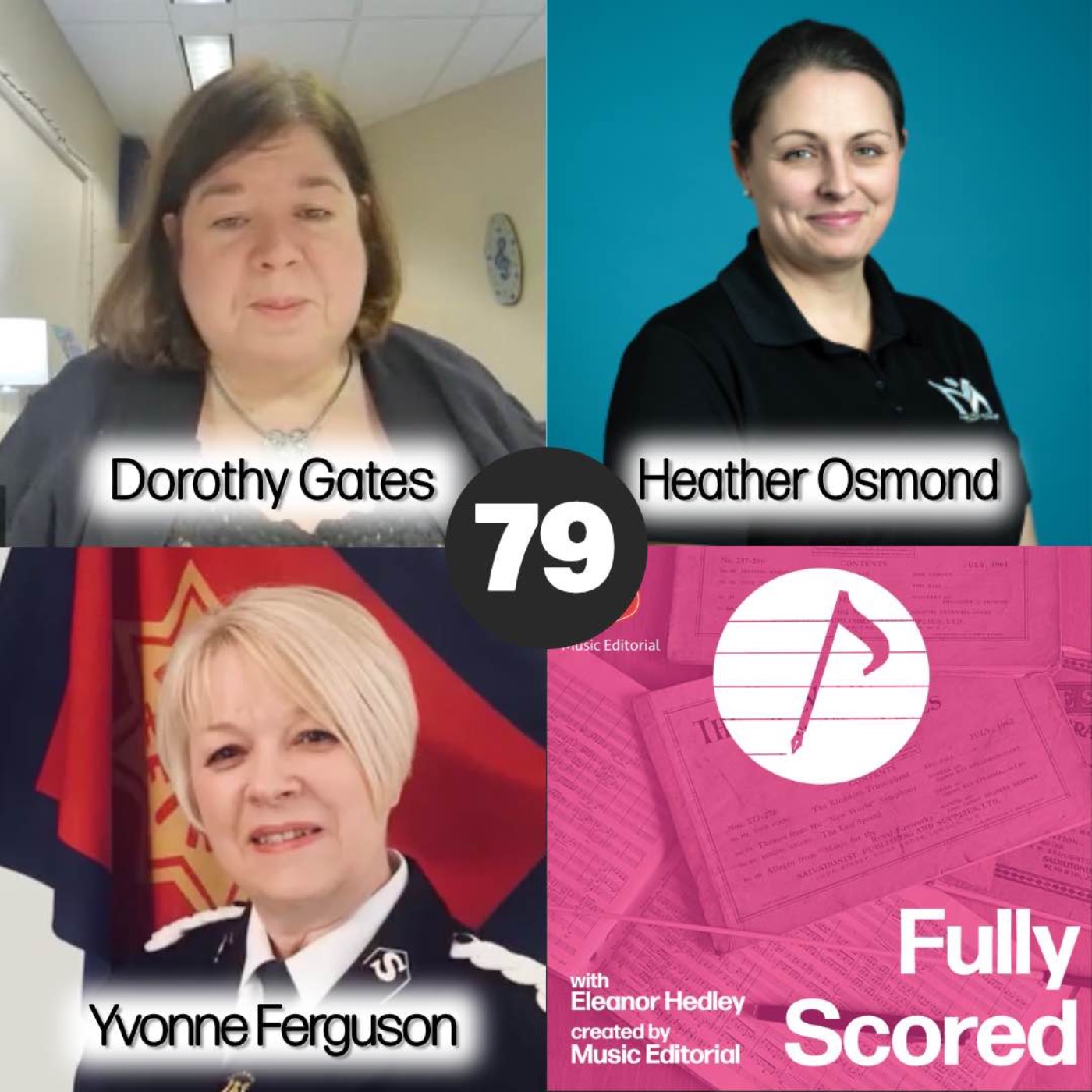
In this episode of Fully Scored, guest host Alan Aheadley speaks with three influential women in Salvation Army music: Dr. Dorothy Gates, Heather Osmond, and Ivon Ferguson. They discuss their faith journeys, leadership roles, and experiences as female role models. Dorothy, a composer and former senior music producer, notes the historical male dominance in brass bands but credits supportive mentors for her success. Heather, the first woman to serve as Territorial Music and Art Secretary in Canada and Bermuda, describes her diverse responsibilities, from team management to conducting. Ivon, a bandmaster in Scotland, shares personal stories of bias, such as being excluded from bands as a teenager, but emphasizes that faith and family support helped her persevere. All three acknowledge ongoing challenges, including having to prove themselves, but stress the importance of responding with grace and discernment rather than internalizing negativity. They advocate for Christ-centered leadership and equal opportunities for all, focusing on unity and mentorship. The conversation highlights the need to invest in young people and create inclusive environments, encouraging women to step into leadership roles with confidence rooted in God's calling.
[Music] Hello and welcome to episode 79 of Fully Scored. I'm your guest host, Alan Aheadley, and today we've got a very special episode lined up as we focus on female role models within Salvation Army Music in an episode we're calling Fully Female. So, without further ado, let's introduce today's panel. It's great to have auxiliary captain, Dr. Dorothy Gates, territorial music and art secretary for the Canada and the Muda Territory, Heather Osmond, and Bammaster Ivon Ferguson with us for this episode. I'm excited to talk with the three of them about being strong women of influence within Salvation Army and how we can encourage young women to step up into leadership and become role models. Dorothy Gates was born in Belfast, Northern Ireland, and received her Bachelor of Music degree in composition and trombone performance from Queen's University Belfast, her Master of Music degree in trombone performance from the University of Michigan, and her PhD in composition from the University of Salford. Dorothy was the senior music producer for the Salvation Army's USA East Interictory and the composer and residence for the New York staff band from 2002 to 2023 alongside playing trombone in the New York staff band. Heather Osmond is the territorial music and art secretary in the Canada and the Muda Territory and is the first woman to hold this kind of leadership role within the Salvation Army. Heather oversees the planning, organisation, and execution of various resources and learning opportunities for music and arts ministries all across the territory. Heather has her music degree from Memorial University in Newfoundland and has much experience across all genres of church music. Ivon Ferguson is one of the United Kingdom and Ireland territories most well-known female brass band leaders and has been the bandmaster of Belfast Health Salvation Army band since January 2013. Before this, she was the young people's band leader for ten years. Belfast Health Corps is in the Central and Southern Scotland division and is located a few miles southeast of Glasgow. Ivon studied trumpet and piano and was a music teacher by profession for a number of years before moving into her current role still within education. Dorothy, Heather and Ivon, welcome to Fully Scored and thank you for taking time out of your busy schedules to be with us. I'm going to start off by asking how each of you came to being a part of the Salvation Army and how you came to faith. Ivon, would you like to go first? Yes, I don't know. I'm actually a fourth-generation Salvationist so I came through the ranks of Sunday School, my pubancing company and then progressed into the senior sections. My faith, I guess my testimony is not one of these mind-blowing moments where I found faith. I think it was a gradual thing but I would certainly mention a Scottish Congress and a year that attended the Scottish Music School, a significant moments in my faith. Thank you. Heather. Yes, so my father's family was Salvation Army but he wasn't, my parents were in attending the Salvation Army or anything when I was born but they did have me dedicated there and they felt compelled to live up to some of the promises that we make in a dedication of a baby. And so my mother started bringing me to the core and as Salvation Army Corps tend to do, they get you in singing company and give you an instrument and all those things. So I remember the decisions on the Sunday and Sunday School when I was seven giving my life to Christ and so similar to Ivon, I sort of grew up experiencing all aspects of Salvation Army music making but my faith was sort of a journey from childhood to now and there's been special markers certainly along the way of where I felt. You know, my faith has sort of deepened but yeah for me it's been since a very young age and just a lifelong journey for me. And Dorothy, how did you go to be a part of the Salvation Army? Well very much like Ivon, I was born to this wonderful thing that we call the Army and I'm basically a fifth-generation Salvationist and so my parents, you know, they were officers at the time and they obviously took us along to the core and got us all involved and like everything my mom played piano, my dad played trombone and therein lies the mystery of what happens to children. And yeah my faith, let's see, I think as a young child I was very aware of Jesus so that in the home like dad would do like devotions with us and stuff. I did take him as my savior obviously when I became a junior soldier but didn't really fully understand what all that meant. And even as a young teen I was sort of just coasting along in the music sections. It wasn't really until I went to college that started to ask the deeper questions of life and faith and ended up going to a really cool Bible study at a rather large church near the university and that changed my life. So the Lord that spoke to me there for sure. Yeah, it's great hearing about all of that and hearing how music and faith just become so intertwined. A really young age, it's really encouraging. Heather, we are quite familiar with the roles that I've on and Dorothy have. So could you describe your day-to-day responsibilities as the territorial music and art secretary? Yeah, absolutely. When I stepped into the role a few years ago I was surprised at just how many various types of things that you get to do in this role. But I will do a showdown I work with a fantastic team of people who are extremely gifted and very mission-minded and our team focuses on core ministry first and foremost. So sort of what I do is manage our team and kind of set the direction as best I can. Asking questions like what resources and someone do we need to focus on and then making sure that we have the capacity to do that and sort of assigning that out to various people on the team to take control of. Looking for opportunities to do training weekends, leadership development across the territory. So talking to people and trying to get those things happening. I have a lot of conversations with various leaders and musicians across the territory. Sometimes it's just to talk about all things, you know, music making or leadership and sometimes it's a more focused development mentorship kind of piece. If you see large events we do support a lot of large events behind the scenes so sitting in meetings about, you know, all the logistics of that stuff I'll find myself involved in that. I'm very fortunate though I still get to do some conducting like I love the summer months when we. My husband and I and my family can go to these camps and spend time with musicians that way so it's wonderful to be able to do that. I sit in a few meetings on a regular basis, but it's good because those meetings are where we sort of chat about what's what's going well, what are the challenges the army is facing in our territory and and how music in arts can be a part of, you know, addressing some of those challenges and moving forward. So it's interesting. It can be it's sort of everything from like renewing copyright licenses for the territory to like one-on-one mentorship with a young developing leader to like conducting massed bands and choirs on, you know, the Roy Thompson Hall stage, right? So it's it's it's quite a variety of things and I enjoy a lot of that. Different every day then. Yeah, absolutely and even within the day, you know, I say sometimes my mind is going through, you know, going in, you know, five or six directions every day, but yeah, yeah, yeah, cool. So, I'm even here in the UK and Ireland territory, generally there's a bit of a trend where there's fewer women in the band than men. And why do you think that is here? That's a really difficult question to answer and I think the fact that we're talking about, I guess, maybe the imbalance of females, particularly within the brass atmosphere, tells us that there's we need to talk about it more perhaps. I think there's a little bit of historical legacy in terms of the broader brass band world in the sufficient army bands, I believe grew out of a 19th century British brass band culture, which was heavily male dominated in industrial workplaces, minds and factories, the often sponsored bands and those environments were overwhelmingly male. And I think even though the Salvation Army itself has been progressive in many ways, I suspect that musical
Ce arδ yn ar violationdlu pennio Palynas. Pro气wch chiedd Family Ngyehardwch cyd democratio pwb آtaf na ac istioαιs cyndi o'r dylete. Shrwawn wneud dig connectors a'r ekrinydd cyntaf 'ko s cellphone hebwch, cael AI'r rhywm cael ag bar�� y cyffぁwch a'r cyffぁwch, a'r cyffぁwch, a'r cyffぁwch, a'r cyffぁwch, a'r cyffぁwch, a'r cyffawn, a'r cyffawn, a'r cyffawn, a'r cyffawn, a'r cyffawn,
see the difference in the core that I have musicians because they just pour into the kids. You know they won't take no for an answer, so to speak. They just keep pouring into them and encouraging them to participate. Does it help? The key theme. Yeah. The key theme is just investing in the younger people. Definitely. Definitely. Definitely. For sure. Hello and welcome to Play a Profile. Ten questions in 90 seconds. Hi, what's your name? Katherine Wallace. What chord are you going to? Coventry City Coal. I'm the Corbain Master. What instrument do you play? Tenor horn. What mouthpiece are you using at the moment? A Dennis Wick 2. Roughly how long have you been playing? Started calling it lessons when I was five, so nearly 40 years. Who is your favourite Salvation Army composer? Lesslie Condon. Do you have a favourite Salvation Army piece to play or to listen to? The call of the righteous. What's your favourite band album right now? A SACE for Brass by Yorkshire Building Society. Do you have a favourite Bible verse? Proverbs chapter 3 verses 5 to 6, "Trust in the Lord with all your heart and He will direct your path." And finally, can you tell us your best or your worst joke? What musical instrument is found in the bathroom? A tubatif based. Dorothy, we'll go back to you again. You've given a lot to Salvation Army music through your composing, and it's blessed so many people across the world in so many different ways. In a space that's often been dominated by men, have you ever found that being a female composer has brought different experiences or challenges and have you ever felt that being a woman has shaped how people saw you and your work? Wow, that's a loaded question. (Laughter) It's not meant to be. Well, first off, yes, you're right. There's not many of us in the Brass band world, and there's certain moments when I started doing this. I felt compelled by the Lord to be true to myself, regardless of what was going on around me, regardless that there was no real model to follow within Brass. And I just felt strongly that if God threw me this desire to write something and get something off my chest onto paper, then I have to be true to that and committed to that and do that. So that's what it did. And then eventually I ended up in the position in New York, which I have to say, I'm really grateful for Ron Wicks' Norris for that, because he hired me, and he was probably a man before his time, because I don't think too many others would have in that role, considering who my predecessors were. It was definitely a testosterone world, which I really didn't feel like I was part of. But I didn't really care about that either. And maybe if Ron feels a bit like that too. But I think I just am grateful for Ron for opening that opportunity, and trying to make a level playing field, which is what it became. And it was much easier to be accepted within the role of a famous band, than being by myself in the division, trying to write whatever. Yeah. Yeah. I mean, you say it also casually, but it's really incredible what you've done to be that role model for people, and to make other women maybe be as frightened to put something out there. So it's really incredible. Yeah. If Ron and Heather, a bit of a similar question, have there been moments where you've had to quietly prove yourself, or push through barriers within your own settings to get to where you are now? I think it's important that I can frame this up by saying that anything I share today comes from my heart. I don't want to be contentious or appear to be arrogant, or that's not who I am. But I want to answer this question honestly, and I'm obviously a, I'm a little bit older than the rest of you on this panel. So, you know, there may be change through generations. However, I guess I was quietly conscious of a bias in my youth, and if I can, I'll share just a couple of examples. My first year as a brass player at Scottish Music Camp, I was 12 years old, and I was only a girl in the A band, playing solo horn. And that in itself raised a number of eyebrows. Some comments round about what she's sitting there, you know, like, "Get a woman, a woman, and playing solo horn." It's just a girl. And the fact that I actually survived the week was commented on by a number of male salvationists at the final. First of all, with almost a shocked surprise, that's me quoting some people that had actually managed to sit in the band and play my part in that band. As a teenager, I was excluded from our divisional youth band because girls weren't allowed to play. And at that point, I did turn to contesting banding, but my parents were very strong about the fact that my place was in the army, and I wasn't allowed to contest with the contesting band. I guess if I hadn't had that strong parent time, I'm not sure whether I would be part of this forum today, and I guess I'm not alone in that. When I was 18, I was commissioned as Deputy Bandham Master within my own core, and a few of the bands been left to band. That's a good thing. Thanks to God, they did eventually return, and I was commissioned as Bandmaster two years later. These are just a few examples of some of the challenges that are faced as a young female brass player. I'm grateful to God that he was, he was, I often say, by the grace of God I stand here today. Thank you for being honest about that. It can't have been easy to navigate through all of that, but we're grateful that he's stuck with it and he'll with us today. Thank you. Thank you. Heather, what about yourself? Yeah, the quick answer is yes. I mean, thankfully I have an experience sort of what Yvonne has in the same way in my younger years, but yeah, there was, there was oftentimes, you know, people sort of response to me leading the band now. That could have been being young as well, which is, but, you know, a young woman leading the band or leading the songsters or whatever. I mean, there were people who I don't think agreed with that decision at the time and had ways of making that known, but like Yvonne said, the grace of God, right? Like if God is calling you to it, he, he will make it happen, right? If you were answering God's call to step into leadership or something like that, he will, yeah, he will provide what you need and it's interesting as I look back through frustrating experiences along the way. There have been many others who stepped in and said, you know, you've got this. You're doing a great job. If you need to talk, if you need to, you know, so, yeah, those those challenges have definitely been there and there are lots of instances, still instances, actually, where I feel, you know, you have that human side of like, oh, I've got a prove that I'm meant to be here, but I think if you just keep going back to to God's calling on your life and following that, you know, he, he provides people and the encouragement that you need to keep going and he'll he'll provide a way forward. And, uh, but yeah, no, those situations have been there for sure. I, I think I just try and be very careful now to perceive it for what it actually is. Like I think it's very easy, especially as I think back to especially when I was younger in my leadership, like, it's very easy to take someone's response and say, oh, that's because I'm a girl, that's because I'm young, that's because, and really get your backup. Or blanket statement, like, oh, they don't, the band doesn't want me here because like, you know, just in your younger years and you're new to leadership and so on. So now I just really try and step back and go, okay, is that that's the individual that individual has a concern that how, you know, try and perceive the situation for what it really is. And then I can address it more effectively. And, and as you get get a little older, you're more willing to.
address it, you know, before I might shy away and just internalize that like, oh, they don't want me here. I must not be good enough. I must, you know, whereas now there's a little more of perceived the situation as it is and speak into the situation. Don't internalize, you know, the things that are coming at me, but kind of speak up against it in a, you know, in a good way, in a nice way. But yeah, yeah. Yeah, I think that's important for the younger girls to hear as well, because it can be tricky. Yeah. Yeah, but that comes with maturity and growing up a bit. Absolutely. Yeah. Yeah. You can't, and I think of, you know, one of your questions later kind of leads into this too, but, you know, I shouldn't have expected at 22 to have the same experience and knowledge I have at 42, you know, so time and experience and so on. Yeah, it's a big contributor. Absolutely. How do you think these experiences have shaped the way that you lead and support others now? This is for all of you. I think it speaks into our experience and enriches us, regardless of whatever pain or frustration we went through as younger female musicians within the army. I think we look beyond that. We look to Christ as our unifying factor, the fact that he brings us together, male and female, like to worship him. And I think it's just important to look beyond, because we could stay focused on the negativity and the past things that have happened. And there's no denying that they happened. I mean, I couldn't tell you for myself, my sister and I weren't able to join the senior band of the Corps. We attended when we were young, because they didn't have girls in. But my mom and dad didn't want us to lose us. So we changed the Corps to a Corps that did that girls in. So there was a lot of that in the 70s, 80s. So there's no denying that it existed, but I think that can't be our focus now. So many years further on, our focus has to be you know, we're in this together, we're a family united in Christ, and we just need to do this together. Absolutely. Thank you. If on how, how has these experiences that you grew up with, how have they shipped the way that you lead in support of those? I have to say that I couldn't do what I do if it wasn't for the relationship that I have with Christ. He has to be my focus, because there's no way that I would feel that I could do some of the things he asks me to do without him being that, that I've ever present part of my life. And I guess the good thing that came out of my experience as a young female, um, brass player was that I did turn to God, I was strung in my face. And you know, I hear myself over the years having conversations with not just with girls, because I don't, I'm not, I'm not a feminist, I've had a strongly believe in everybody being given an equal opportunity to be kind of the best person that they can be and have you know, the best, the best chances in life. But I often say to, to young people and that I come in contact with that God provides grace and tools and capability to those that He calls, to tasks regardless of your qualifications or your confidence. And that, that's rooted in biblical truth. Um, and so I guess as a, as a leader, I am guided all the time by, by God. Yeah, I think that Christ-centered leadership is just, that's what it's all about, isn't it? Yeah. How do you all balance vision with the practical realities of leadership? Yeah, I struggle with this. So, um, I, I am more of a logistics person. So when it comes to sort of coming out with that vision and sending the, you know, the vision for say our team, uh, that's challenging for me. Um, like I acknowledge that it's difficult for me. I acknowledge that that's not maybe necessarily my gifting, but it's the gifting of people around me. And so let's, let's, collectively talk about what we think that is, you know, let's come up with, you know, our vision together. Let's, let's ask God what it is He wants us to do and lean, you know, trying to turn what that is and lean into that. So honestly, like when it comes to, to balancing vision and, and the logistical piece, I mean, I'm often relying on others in a, in a big way to sort of speak into that, in my case. Yeah. Yeah. Yeah. All that teamwork. Yeah. Yeah. Yeah. For sure. Yeah. For sure. 10 questions in 90 seconds. Hi. Could you tell us your name? Naomi Hill. Which chord do you attend? Castleford Citadel. I play the euphonium and the baritone and a little bit of trombone too. What mouthpiece are you currently using? I use a K&G 3.5D on my euphonium and then a Denyswick Ultra 6 on my baritone. I've actually been playing since I was around four when I stole my dad's baritone. Without question, it's got to be heating. Do you have a favourite Salvation Army piece? Just as I am. What if you go to Band album? My favourite Band album is probably the heat and collection. Is there a Bible verse that means a lot to you? One Corinthians chapter 13 verses 1 to 2 and the message translation. If I speak with human elegance and angelic ecstasy but I don't love, I'm nothing but a creaking of a rustic gate. If I speak God's word with power revealing all his mysteries and making everything as plain as day, and if I have faith that says to a mountain jump and it jumps but I don't love, I'm nothing. And finally, what is your favourite joke? Well I do really like the joke about a TV pencil but to be honest there isn't really any point. So the Territory Youth Band is a course that's run by our territory that runs for 12 to 18 year olds on the south coast of England every February. This year has had the most female students in its 28 year history and were over one third of the course and were girls which I think are really exciting. I've asked some of the girls who are at the course this year for some questions and Dorothy the first one has come from Francesca who plays the tenor horn and she would like to know who is your favourite female composer and why. Well I have a few, I do like the writings of Rachel Portman, she wrote the music for Shakala, her stuff is just beautiful, she also wrote for Duchess and it's very ethereal, it's very light, I just love it, love her scoring. So does that help? Cool, yeah thank you, you're welcome. One for all of you comes from Ellen who plays the flue go horn and she would like to know who has been the biggest musical influence in your lives and what did they teach you. For me it was I studied piano and it was my my professor at way back when. It was more her like her desire to continue learning and at you know her own craft so what she was trying to develop herself but then she wanted to be a better teacher, a better educator and so on and so I was always in awe of how she was always trying to learn and develop and grow like oh wait we don't reach this pinnacle of like oh I finally have it all figured out, nope like there's always something to learn and grow into and that sort of something that was very impactful to me at the time and is a big part of my leadership now that learner mindset, growth mindset so I would say she had a really big impact on me. We all have that person don't we? That's shaped us in that way. Yeah that's really cool. If on what's about you? I'll try to be quick because I've got a few. I mentioned earlier that when I was beginning to play we didn't have a YP band leader and then we had a family and sure god sent to my home core and the guy there then became YP band leader and within about 18 months we had a YP band of 25 and as a Sunday school of probably 75 he was although a hard taskmaster he provided me with many opportunities to develop and to grow musically. My first brass teacher and piano teacher set very high standards but never allowed me to think that I wasn't capable of achieving the targets that they said.
I am a very young and enthusiastic corner player, I remember hearing Peggy Thomas play for the very first time, and I think that Wow! I went to play like that lady. Of course, I think it was 1976, she created quite a stir when she was appointed as the first female member of the staff band in history. This was the Chicago staff band and then a couple of usually a few years later, I think she was appointed as Deputy Bandmaster and Bandmaster of Norwich Citadel, I mean her reputation goes before her, so she was a great source of inspiration and belief I guess. Yeah, yeah, just ashamed she was never made a staff bandmaster, I just leave that in here. Dorothy, who is your biggest music influence? Well I give on, I have several and I will try to be quick too. My mom and dad for sure, my dad became a music teacher, my mom had taught piano from she was by 18, so they both taught me at a young age, but it's so much more than that. It was their way of life, it was their ethic really, their working ethic with regards to music. My dad was an arranger, I'd always see him sit at the table, doing arrangements for school bands and whatnot, and that must have been soaking in to my psyche because that's where I ended up, you know, starting sit at the table and dining and writing, arranging, doing stuff at the last minute for college, I just do. Then we had a wabi band leader too, quite an amazing one, David Catherwood, whose name I'm sure is familiar to you all. He was brilliant, I was an arranger, I was an arranger, and he really encouraged us and developed a program because there wasn't much of a program before he took it. I think our little core group of little Sally musicians, you know, we're still friends and still tight and still play and we're still involved in music somehow. Let's see, then at college, my first composition teacher was Kevin Volans, South African composer. He just exploded my mind to the point of possibility and yeah, he totally changed how I thought about music and writing and all that sort of stuff. I have to add if I can, I'll feel too guilty if I don't add this individual, who remain nameless, but it was also, it was my senior bandmaster and I was in high school and he was like, he's on a bit of a stern bandmaster, a little bit of healthy fear there, but I had gotten in a car accident with some friends when I was like 16 and the next morning, he was the only one from the core that actually showed up at the door to like check in and say hi and visit. And so I think that was also now, I didn't appreciate it for what it was at the time, but now I'm like, huh, right, the relationship piece of what we do as bandmasters to, right? Like so we're, you know, we have those musical mentors, but also those people who have taught us about the importance of relationship and, you know, being Christ to those that we oversee too. So I had to make sure I got in there. There is something amazing about that influence isn't that? Yeah. Yeah. If on Grace plays the corner and she has asked if there was a moment when you realised that God could use your musical gifts to influence others and what advice would you give to girls in my generation? Her generation, my generation, and her generation, who feel called to step up and lead in music ministry and in general within this whole vision on me. So the honest answer is that even today, a question my ability to influence others for using gifts that God's given to me. I said earlier, I'm also a personification of that phrase, who God calls the equips. And I guess despite the challenges of my youth in the army, banding, and my natural self-doubting characteristics of my personality, God has always placed people in my life at the right time in the right place as encaragers and enablers. And I think as well, I want to take the opportunity to say to stress that I actually rarely think of myself as a female bandmaster. It's only when other people comment on it that I remember. I think, "Oh yeah, yeah, I'm a female bandmaster." And I believe that the God she saved and gifted me called me regardless of my gender. And that's the advice that I would give to any young person. Again, regardless of gender, believe in yourself. Don't allow anyone to tell you that you're not good enough. Don't hold back and wait for your ability and achievements to be noticed. Speak out and show that you're good at what you're good at. And God will make it abundantly clear that He's calling you to a specific ministry if you keep him from the centre of your life. Absolutely. Thank you. There's so much wisdom in that. Thank you. "Have I any place the euphonium and would like to know if there is anyone or anything that motivates any of you to continue your work within the salvation of me?" Yeah, I think the Lord's not done with the army. I think this is in many ways the beginning again. He's equipping young people over here in the States. They're stepping up into leadership roles and that motivates me to see the growth, to see the excitement. Being in a core now as a core officer, being on the other side of the coin, so to speak, what motivates me is seeing our young people really come to groups with faith, really come to groups with who the Lord is and their own personal relationship with Him and how that can help their lives in general. And then just seeing that blossom into whatever it is they're good at, whether it be the arts or whatever, that's really exciting just to see people thrive. Yeah, absolutely. One last very quick one from Hermione, she had two questions. If any of you could take one treasured army song and make it reggae, which one would it be? And why? Well, my favourite song is "An Melody is Trusting God". I love the lyrics but I love the tunes well but I'd really love to hear it played in a register who left. I think it would work. I would know what you think don't you say but I think it would work and I would love to see some of our more mature congregations reaction if the band started to call to worship on a Sunday morning with a reggae version of "Trusting God". I think that would work to sure. I could hear some scar underneath that. Yeah, I was kidding. I don't know, you're dying tons of this one. Oh no, I don't know, I don't know. I was stuck on this. I was stuck. But my mind kept going back to old words by the pathway of duty, flows the river of God's grace. And I think because that's what I keep trying to tell myself that similar to what I've on with saying earlier, right? When we're called to something, relying on God to equip and provide and sustain us is how we do it. I similar to you, I feel underqualified, you'll equiped all the time. But God's grace sustains me. So I keep moving along the pathway of duty and His calling by His grace. So I honestly don't know how that would turn out in a way sort of. But maybe her mind is already thinking of ideas and she's going to get it, right? Absolutely. Dorothy, you've got plenty to get your teeth stuck into that. It sounds like it. Never challenge. If you could go back and give your younger self one piece of advice, what would it be? Believe in yourself. Yeah, never doubt that God's got a plan for your life. And I echo that. Both of these ladies have said, and then I would encourage myself to not equate my abilities or what I can or can't do with my value or my worth. I think when I felt like I was failing and whatnot, I took that and held it, right? But I am so valuable and cherished and loved just because. And that my achievements or my lack of achievements or what I do well or don't do well, my successes and failures don't define who I am in Christ. You know, at my younger self, you know, what even myself now is trying to to remind myself that it's His grace that sustains me and allows me to do what I do and my value, my worth, are not tied to what I. Do a doctor. Now to change the mood. No fully scored episode would be complete without a go up and mastermind. So we're going to put the three of you in the hot seats now. Oh, please. I've only got three questions for each of you and it's all about women in Salvation Army music. Dorothy, we'll let you go first. I'm not going to have the way. Oh, oh. So Dorothy, are you ready for the first fully female band mastermind? Oh, as ever as I can be here. So the first question is, who's the colonist solo jubilant by William Himes written for? None other than Peggy Thomas. Absolutely. You see, you've got one out of three already. That'll be it. Do you please help the rest of us in Nuck in all of these four? It'll be one and done. Tell me. The second question is, who is the first female appointed to the international staff band? Oh, is that band a spence? It is. November 1990, Van der Spence was appointed to the ISB. And the third one for you Dorothy, which of these joy web songs was published first in the musical Salvationist? Was it Cher Mayoke, the candle of the Lord, or it is Jesus? Let's just go with the candle of the Lord. It's the most popular, I suppose. Absolutely. Three out of three. Well done. Thanks, Dorothy. I'm not sure at all. Sorry for the pressure. Sorry. Heather O'Revon, who would like to go next? I probably won't get any necessarily. So if you want to. I'll not get any either, but I'll go for it. I'll go for it. Yeah. Who was the first commissioned female bandmaster in the UK? Was it Misee Viggins? It was. 1962 Misee Viggins was commissioned the first female bandmaster and she was the bandmaster at Canuck. How many Christmas tunes by Joy Webb are in the Christmas collection box? I'm sorry for laughing up there. No, I didn't. And the Christmas books. Joy Webb. I don't know. Six. Fortunately, there was only two. A Starry Night and Noelle. Oh. Noelle, I'm good with it. I would have. Who wrote the flue gohan solo through the fair? It wasn't Dorothy. You're not too far away though. Sorry, I shouldn't give you a clue. No, it's one friend. It's one friend. One friend. Dorothy, what's your number? I'm a single country. I'm giving you a clue, girl. I have. I have no idea. Sorry. Anybody else want to answer that one? Chelsea Pasco. It was. Chelsea Pasco. Oh, yeah. So you've got one out of three there, if only. Dorothy's in the lead at the moment. Heather. There have been three female generals in the Salvation Army. Firstly, can you name one of them? Linda Barnes, General Linda Barnes. Yeah. And from what year did she service General? Oh. I'm trying to go backwards. Oh, I don't know. Let's just say 98-2002. 2011-2013. Whoops. 95 feels like, you know, not that for. Not that long ago. What's that? Okay. And finally, Heather, can you name one of the current female members of the ISB? No. That's terrible. No, I don't think a name will come to me. No. If I'm in Dorothy, can you do one each? If I'm in the Salvation Army. Catherine Wallace? Yeah. I don't know. That's awful as well, but I don't. Tom Bohnplier from Coventry, the names of Eskips. So it's Catherine Wallace and Gemma Potter. Gemma Potter, that's it. Yeah. There you go. Catherine and Gemma showed up. Absolutely. I won't forget that now. I should've got Gemma. Sorry. But Dorothy won that one. Well done Dorothy. Make up for the last one I did. So is there anything on your heart that any of you would like to share with listeners today? I'd just simply like to say to the wider army world, encourage leadership teams within the core and our territory leadership level to have unbiased vision for all. And be an ableist and cutters and cutters in the image of Christ. Yeah, that's brilliant. I'm looking forward to that. Absolutely. And just since we've been focused on women and women in leadership just to say, don't let a woman ever deter you from answering God's call or leading. Yeah, definitely. Yeah. Absolutely. It's been such a privilege to hear from the three of you today. Thank you so much for sharing your experiences, your faith, your passion for music ministry. It's really inspiring hearing how God leads us and uses us in such different ways. But with a clear sense of purpose, even when it doesn't quite feel that clear. Thank you, everyone. A big thank you to Dorothy, Heather and Ivan. It's been such a privilege to hear your stories and your heart for music and ministry. I thanks God to the team at Wob Play for hosting this episode and the playlist that goes alongside it. And to the band nerds for keeping us all in our toes with the bandmaster, my questions. A special thank you to our producer, Simon Gash for bringing it all together. And to you and Matthew, for your encouragement and support as I've hosted this episode. And finally, thank you to you, our listeners. We hope this episode has encouraged and inspired you and we look forward to sharing the next one with you very soon.
Podcast Summary
Key Points:
The episode features three female leaders in Salvation Army music
Each shares their background
Heather describes her role as Territorial Music and Art Secretary, involving team management, resource development, training, event logistics, and mentorship.
The panel discusses historical gender imbalances in brass bands, rooted in 19th-century male-dominated culture, but notes progress.
Dorothy highlights challenges as a female composer in a male-dominated field, crediting Ron Wicks Norris for giving her an opportunity.
Ivon recounts facing bias as a young female brass player, including exclusion from bands and skeptical comments, but persevered through faith and family support.
Heather acknowledges similar challenges, emphasizing the need to discern situations and avoid internalizing negativity, while relying on God's calling.
All agree that Christ-centered leadership and focusing on unity are key, and that experiences of bias have shaped their supportive, inclusive leadership styles.
Summary:
In this episode of Fully Scored, guest host Alan Aheadley speaks with three influential women in Salvation Army music: Dr. Dorothy Gates, Heather Osmond, and Ivon Ferguson. They discuss their faith journeys, leadership roles, and experiences as female role models.
Dorothy, a composer and former senior music producer, notes the historical male dominance in brass bands but credits supportive mentors for her success. Heather, the first woman to serve as Territorial Music and Art Secretary in Canada and Bermuda, describes her diverse responsibilities, from team management to conducting. Ivon, a bandmaster in Scotland, shares personal stories of bias, such as being excluded from bands as a teenager, but emphasizes that faith and family support helped her persevere.
All three acknowledge ongoing challenges, including having to prove themselves, but stress the importance of responding with grace and discernment rather than internalizing negativity. They advocate for Christ-centered leadership and equal opportunities for all, focusing on unity and mentorship. The conversation highlights the need to invest in young people and create inclusive environments, encouraging women to step into leadership roles with confidence rooted in God's calling.
FAQs
It focuses on female role models within Salvation Army Music, featuring a panel of three influential women discussing leadership and encouraging young women.
The guests are Dr. Dorothy Gates, Heather Osmond, and Ivon Ferguson, all of whom hold significant leadership roles in Salvation Army music.
She is the territorial music and art secretary for the Canada and Bermuda Territory, the first woman in that leadership role, overseeing music and arts ministries.
She is a well-known female brass band leader and has been the bandmaster of Belfast Health Salvation Army band since January 2013.
She is a composer and former senior music producer for the USA East territory, known for her contributions to brass band music and being a role model for women.
She faced bias, such as being the only girl in an A band at age 12, being excluded from a divisional youth band, and dealing with skeptical comments about her abilities.
Chat with AI
Loading...
Pro features
Go deeper with this episode
Unlock creator-grade tools that turn any transcript into show notes and subtitle files.
 PodcastTranscript AI