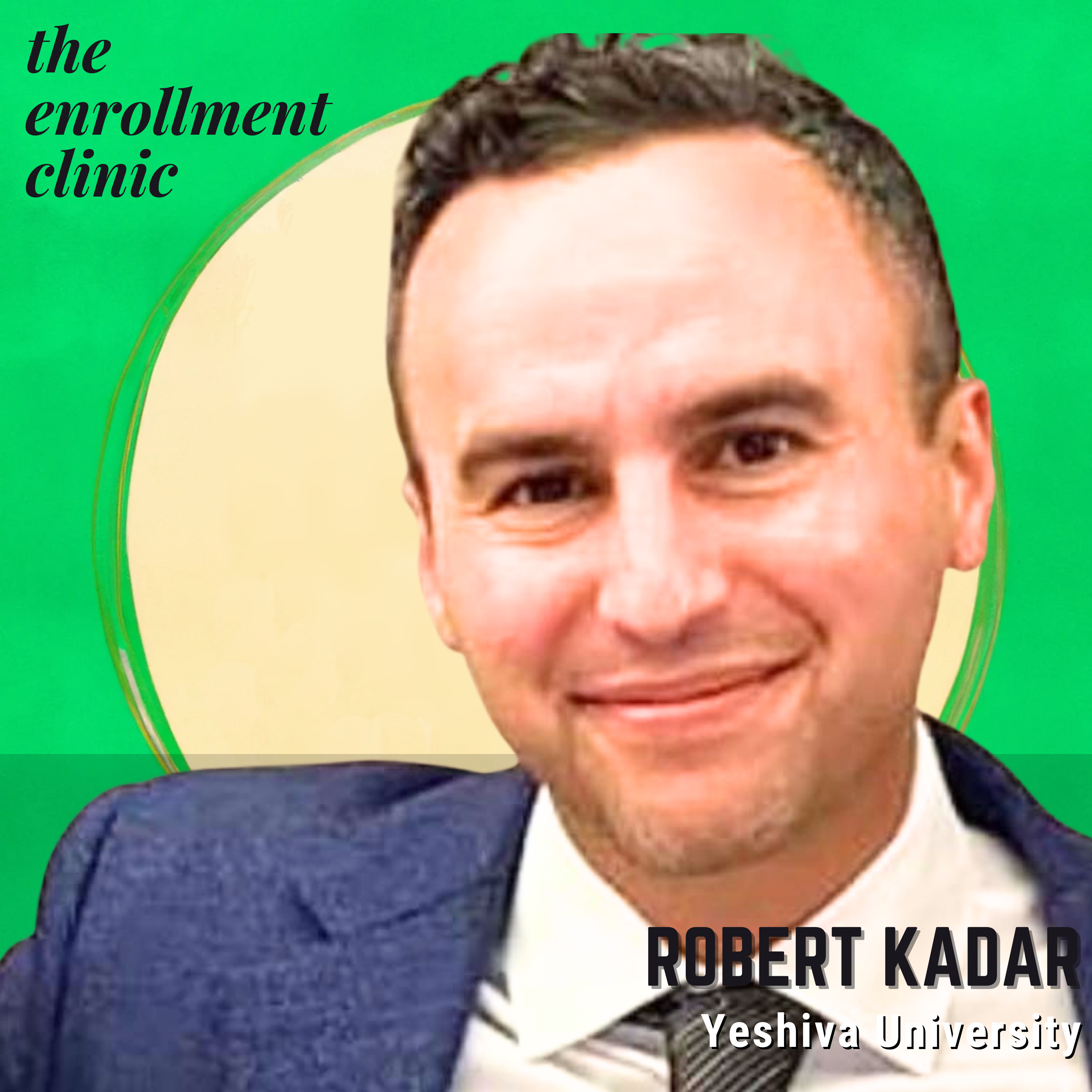
From Vanity Metrics to Real Results: Rethinking Higher Ed Marketing
from The Enrollment Clinic
42m 33s
In this podcast episode, Robert K. Dar, senior director of marketing at Yeshiva University, discusses his article on why higher ed digital tactics disrespect students. He argues that the industry's obsession with lead forms—sending prospective students to landing pages with forms to fill out—is misguided. Data from his experience shows that 85-90% of enrolled students never completed a lead form; instead, they research independently over months, visiting university websites extensively (up to 194 page views) without any direct contact. Traditional ad optimization for form submissions targets low-intent users, producing many leads but few quality applications. Dar advocates shifting focus to driving applications directly, using rich informational landing pages that highlight location, affordability, reputation, and job outcomes. By optimizing ad campaigns for application starts rather than leads, his team saw leads drop 95% but applications increase 20% across seven graduate programs. The cost per application ($1,500) is higher than cost per lead, but ROI is strong, as each application can lead to significant tuition revenue. He emphasizes the need for nuanced conversations with leadership, as tracked applications from ads may appear low in volume but underrepresent actual impact. This approach aligns marketing with genuine student behavior, moving away from a sales-centric model.
If you enjoyed this podcast, please like, subscribe and share it with friends who might find it valuable. Your support helps us reach more listeners and continue bringing you expert insights from the world of higher education. Welcome to the latest episode of the enrollment clinic. My guest today is Robert K. Dar. He is the senior director of marketing at Yashiva University in New York. Welcome Robert. Thanks for having me. It was great to have you here. And one of the things that drew me and I felt like I needed to reach out to you and do an episode together is I'd run into your article on Inside Higher Ed on why higher ed digital ed tactics disrespect students. And obviously the title grabbed me. I read the article. It was very interesting, but it was also a little counterintuitive in terms of what we do every day in admissions and enrollments, how we go about identifying the right target prospective students so that we can drive enrollments. Do you want to talk a little bit about that article? Yeah, sure. So the back story is that I've been doing digital marketing for quite some time over 10 years at different universities. But what I've learned over time is that really marketing, one of marketing's main function should be to drive enrollments, drive anything that actually keeps the lights on at universities. So a big part of what I wanted to excel in early in my career was to figure out how do you get, especially in the digital world, how do you get in front of prospective students, how do you get them to see who you are, your programs, whether they're undergraduate programs, how do you get them excited, how do you get them interested, and then how do you get them, what we call the funnel, how do you get them down funnel to eventually become students. So I've always been obsessed with digital advertising mainly. That's because I have kind of a science background. So I was asked a question, does any of this work and how do we know any of this stuff works? So early on in my career, I started setting up all of these digital marketing campaigns from Facebook to Google to using all the main platforms and trying to get people to convert. And learning the traditional approaches, what I call the traditional approach is what I was taught early on in my career, which is how do you drive a person a prospective student to a landing page and how do you get them to fill out a form. That was really the key optimization that everyone has been focused on. Well, I think I was focused on and the industry has been focused on. And I think what I learned over time was that I was wrong, that the focus should not be on that, that the data actually reveals something very different than what we've been doing across market across digital marketing. The data shows that, at least from institutions that I've been across different marketing programs from undergrad to grad, the data shows that about 85 to 90% of prospective students, I'm sorry, enrolled students. I want to make that point very clear, enrolled students have never filled out a lead form. The traditional lead form where you send person to a landing page, there's a giant form on it and it says, fill out this information and you'll get more information about this program. That's been our tactic for so long. When I looked at the data, my first shot at actually syncing data between our marketing CRM and our application CRM and our enrollment CRM, and looking back from enrolled students in their prior digital interactions or digital footprint, just tracking them back to where they came from, that's where I saw that number of 90%. I was just shocked at first. But now looking back, I'm not that shocked actually. I'm surprised I was shocked actually. That's what I should say. Just think about your everyday interactions with any consumer good or when you make purchases online, how many times are you actually filling out these type of forms to get more information about something before you make a purchase. That's what I found. I wrote a paper on it. I talked about, now this is a problem in higher ed. We all seem to be following this model that I think was passed down to us from maybe like the sales world. Every time I encounter folks in higher ed marketing, or after I give them this kind of presentation, a lot of them often say to me, "You know you're right. When I was in sales before, I was always told to get them to fill out a form and I'll call them or something. I need to call them." But I don't think a lot of prospective students actually like any of the stuff that I'm doing. I think there's a big issue with how we took on a sales philosophy into our marketing world and that we changed how things should be based on actual student behavior because we thought that this approach made the most sense for some reason. So I agree with you in obviously a lot of ways where I'm kind of thinking a little bit more traditionally is, and I know that I'm going to be thrown out of higher education for saying this, but at the end of the day, the job that we do, it's a sales job. Like we're selling a product. And it's not necessarily that we're selling education because education is something that the parents have sold to the kids since when there are five. Like the kid remembers when there are five, the parents arguing at the dinner table about whether they'll go to college or not and how we're going to save the money. So the expectation kind of growing up is that college has to be part of your growth process. So what we're selling is the brand. What we're selling is the university so that they come to you and not go to the other person because that purchase is going to be made one way or another. The question is which one do they buy? And that's where I feel like, and I saw your presentation specifically on the landing page where you're pointing out and correct me if I'm wrong, but you're pointing out what are some of the things that we currently do wrong, meaning like there's no links to information. There's no links to learn more about things, but it's just kind of like trying to drive people specifically to this form. And I call them blind alleys. Yeah, but I feel like that's the point, right? Like we try so hard to ensure that there's no, not a lot of CTAs because at the end of the day, you want to get that name because once you get that name, and this is not just in higher ed, I mean, I've seen this in other industries, once you get that contact form, you have much, much higher chances of converting, right? Then you would. So, so how do you, how do you kind of measure intent if you're not providing, you know, lead forms and things like that? Or if you're giving people more choices than just a subbit contact information? Yeah, I want to say, yeah, your point about this is kind of a provocative thing is really on point. The general point that I'm trying to make is we've been addicted to this kind of like very short term kind of, I call it like the crack of digital advertising where when you see a person fill out a form, you get really excited, right? Like everyone thinks like, oh my gosh, this person fill out a form and I can track them back to my ad. And you know, that's what I was doing for quite some time again. And I realized like when I looked at that number, that 90% of enrolled students have never filled out a form, that means what they're doing is not what you want them to do, which oftentimes we think we know what we want them to do, but we often are really wrong about that. But what they're doing is they're doing what we see what they're doing. They're visiting our main website many, many times over a course of, I mean, we know the data when they first clicked on our ad, how long does it take them to apply? And so that data is pretty darn clear. It says that on average, when they first visit our website from an ad to applying, it takes them over six months. Sometimes even eight months, sometimes many, in some cases in the like the lower end of the, or the smaller end of the pool, it takes them many years, like two to three years. So anyway, so what that's saying is that if they are really intent, they're really researching, they're really diving into all of the things that they're, that you offer, why are we sending them to landing pages, but there's barely any information on that, where you're gating all of that information and asking them to fill out a form. I'm not saying that we shouldn't be as mercenary salespeople as possible when it comes to even education. Those two things often conflict and a lot of academics don't like to hear that. I'm saying we just use the right, we use the data to make better marketing decisions.
than what we serve our audience in terms of messaging. And so in terms of, you mentioned like, well, what do we then measures our metric of success or KPI, right? It's pretty clear to me that the metric of success is can we drive prospective students to the application through all of the things that we offer from ads to emails to landing pages? Can we track them all the way from all of those different things that we put out there to them? Can we bring them to the application and see that they start an application? So at my team, we build our own campaigns internally. We do all this stuff ourselves. And what we-- our key focus is on two main metrics, two main metrics of success, which is the numbers of applications that we drove from our budget, our advertising budget. So that's the volume of what we call paid applications, how much should we spend to drive someone to an application. And then the second thing is our cost per application. So we do that in terms of those are the two main metrics. And then the sales people are called their missions or recruitment team. We expect them to then-- we hand that off after that point. I think that's generally how most places work is like marketing, has to draw a line in getting them to an application. And then from that application, the recruitment and sales people have to really try to help convert them to a student, deposit or student. And for us, we want to know those-- and for recruitment, do those applications that we drive, do they convert at a high or low rate? Because we also want to know quality, right? Quality of applications. We don't want to just say we're going to drive as many applications as possible. We want to know that do they yield at a high rate? Yeah, that's-- I mean, it's an interesting take. And I get it. I mean, at the end of the day, the way we would measure it is cost per lead, which is basically like form submission, and then cost per application. And then you kind of pair those up. As a marketer, you think, wow, this is working. Everything looks great. Like there's all of these people coming in. I mean, even if you look at-- we sometimes look up to people and say, what's their LinkedIn profiles look like? They're real people a lot of the time. I mean, there's a lot of click bots and fraud and all that stuff. But even when you get a lot of real people, you think, oh my gosh, this is working. We're having success. And what I often saw though is when you track them through, you track your thousands of leads through to the application or through actually becoming a student, the admissions team often came back and said, yeah, we got maybe a few good ones out of the 1000 you got. Maybe we got like 10 or something applied or something like that. So it feels like everything feels like it should be working. And sometimes your marketing team goes to sales team and says, maybe that's because you've never converted them the right way. You didn't follow up or say the right thing and how you communicated. So it might be your fault. That our fault. We delivered you so many leads. And I think at the higher level, like the leadership bosses and so on, they also believe in the whole idea of like, let's just get a bunch of leads because that's the best way we can convert them and so on. So across the board, this kind of tactic has infused itself in people's brains. And it's kind of like you do see in the short term, it feels right, it looks right. But when you look at the results at the end of the day, later on, it's just like those people clicking, the filling out the forms, they're really low intent and oftentimes even low quality submissions. Now even more deceiving is like how the ad platforms work, which is the ad platforms when you set up a campaign, you're supposed to set up a specific action. You're supposed to tell Facebook, what am I trying to optimize for? And so the platform itself will say, do you want to submit, do you want to optimize for form submissions? And so you set up the campaign and you know, the algorithm is trying to do is it's trying to look across the audience that you've selected and find the people that are most likely to submit a form. And it's supposed to be really good at finding those people to so you can get lower cost per lead, you know, as many leads as possible. And so what it's doing, in fact, is actually quite contrary to what you think it's doing. It's actually finding people who fill out leads in mission forms. But as I said before, 90% of your students, or your actual enrolled students, I should stop saying, "Perspect, in-rolled students, they've never filled out a lead form." So you're optimizing for something that feels right and your ad platform is doing a really good job at getting those results for you at low cost. So there's a lot of issues going on at once. - So how do you, I guess, how do you optimize your campaign so that you can go after the 90%. - That's a good question. - That are not feeling the forms. I mean, one of the interesting things that I saw in your research, I mean, it was that, I think before they become an applicant, they have seen your university pages 194 times. Or they've clicked on that. - Yeah, they've clicked on that. - They've clicked on that. And so, you know, it's the max time. - 90% of them have not communicated with you at all. You don't even know who they are. But they are on your website. They're going through 195, 94 pages on your website. So the question is, you know, if advertisement is not it, if paper click is not it because it's optimizing for the 10%. And if your lead form is not it because again, you're only capturing the, then how do you go about, and not just getting them, but how do you go about communicating to your boss that you're effectively going after the 90%. Right? Like how do you make that case for them? - Yeah, yeah, that's the, that's like the, that's where the rubber meets the road. Where like how do you actually optimize, like you said for that 90%. And I think the answer is, it's not that you don't have, like advertising doesn't work. It's just that when you set up that optimization and that campaign in that platform, you're not telling the platform, finding people who fill out lead forms, you're telling we set up campaigns to tell people to find people who either get to our application page, right? More likely to get to our application page. Or in some cases, if we have the volume for it, we'll say find people who start an application, meaning they actually create a user account and give us the information about which program they're interested in, you know, when they're interested, what term they're interested in and stuff like that. So it's really the optimization that really matters there. It's like where are you setting your success metric? Where are you setting that? So we, what we did at East Shoe University was we stopped optimizing for leads. We turned our landing pages into rich information, attractive pages that have as much information about what makes us great. And then providing every opportunity to get in touch with us, not just the lead form. We didn't kill lead forms, I just wanna make that very clear. We just pushed it to the bottom of the landing page. And then all anything on top of the page had just great information about location, affordability, reputation, job outcomes, like experience. Like those are the things that we've seen from surveys that that prospective students are looking for. Those are the four buckets of areas of content. So what we really decided to do, just highlight all that stuff in one place and give them every opportunity to reach out to us and track them to the application, optimize for the ad platforms. So the short answer is that, or the short story is that we stopped optimizing for leads. We can change our whole messaging around. Our leads dropped by year over year, I think by 95%. But our applications increased by almost 20%. Across, this is across seven graduate schools. This is across many different programs, from cyber security to speech language pathology to social work and nursing and all these different programs that we have. And so that was our strategy. It was like, if they're looking for all this information, our marketing can provide them a pathway to get as much information as possible. And we can still track them down funnel at the same time. Now you're not going to get the same volume of numbers, you're not going to say, it's not going to be like, oh, we got--
Tracking is very difficult because most things on the internet basically can't go track, right? So when we track them to the application, or maybe out of the total application pool, like let's say there's a hundred applications that get Submitted to one of our programs. We're probably only going to see the track pool from ads, the track applications that are tracked from ads at about like maybe 15 to 20 or something like that. So it doesn't look like a lot of volume, right? We know that's the only that's what is track. We know that it's probably double or three times that in terms of how much our ads should get credit for. So we have to all have those nuance conversations with leadership because when they see those numbers are like, oh, but I want a Thousand leads versus like 15 and trackable applications or something like that. And they're thinking, oh, thousand leads sounds better than 15 trackable up paid out like applications from ads. So those are the kinds of things we always got to think about. And we also look at cost per Application, right? And so like I said, because most things go and track that cost is like the most it costs us to get an Application. It's probably a lot cheaper than what are what we see a cost. So if we get like an application at like a thousand dollar per Application or $1,500 that's a big number compared to what traditional like lead generation costs us, which is anywhere between like $50 Lied and $150 a lead or something like that $1,500 per application big number, right? But that's still one thing to say is like that's at most It costs us that's probably a lot less. But if you do the ROI calculation and that $1,500 converts on a graduate program that costs anywhere between a 50, you know, 50,000 to $100,000. And if you could see that app to go to a student that return on your investment, right? Or to return on your Addspin, I should say is about it's over 5x is like, you know, so that's the kind of new approach we've taken. And for us, it's been very effective. And I think I'm giving away a lot of Strategy, but I think it's it's important for the industry to kind of be aware that that it doesn't have to be one way, right? Yeah, I think I remember this number is probably a couple of years old now, but the average cost for Application acquisition basically was somewhere around $2,300 to $2,400 for a medium-sized university, you know, somewhere between, you know, 10 to 15,000 students, right? So so being at $1,500, it's definitely, you know, a lot of bang for the buck. And the cost is also sometimes misleading. I just want to say that cost is is the It's not like we don't include like total like some people will take total marketing spend or total budget and divide it by the number of like, you know, Applications, blah blah blah and all that stuff. That's not what I'm talking about. I'm talking about a Cost is basically and this is another key thing about our advertising, which is it's the first time a person has been to our website. We track it's called the original source Field in our CRM. It's the very first time that our CRM sees a person that came from one of our ad campaigns and then converts an application. So like a big part of what we're trying to do, which often I got to say some agencies don't do this the right way is like we're after incremental students. So people who we want to spend our money on people who have never heard of us before, rather than spend on people like serve ads to people who are already coming down the pipeline. Yeah, I don't want to get into the whole like attribution issue, but there's there's some issues with how digital advertising often inflates numbers Because you're advertising to people who who would have already applied to your program regardless of the ad, but they clicked on the ad because it helped get them to where they want to go faster. Interesting. So you know, going back to that chart that slide you have showing the leads going down and showing your applications going up. Now I'm assuming your marketing budget didn't change or didn't shift in certain way. So it's kind of attributable to to that specific change. I don't I don't even want to say that we were we were I mean, I think we were responsible for that increase in applications, but that's not the point that charts really the point that charges to say that the leads have no effects. Yeah, an application. It makes sense. And did any other levers change? So in the long. Yeah, great question. Like what's the reason you're advertising before and then you went down to like search engine optimization, for example, SEO and you got rid of the big like, um, Yeah, the two optimizations that changed were really like I said, like we switched off. Um, we switched off the optimization in the app platform. We turned it. We didn't use lead submissions. Um, optimizing for lead submissions. We optimize it for optimized for people starting an application or getting to the application page. I can't. I think it's starting the application and the second thing, the only thing that else changed what the budget did not change, but the second thing that did change was, um, was the kind of landing pages that we produced. You know, we went from a blind alley landing page where there's barely any links on it and just a massive form to basically, um, to basically to basically have a great landing pages all that information on it. But actually, no, let me let me back up. There was one other thing, which is like audience selection. The audience selection is really important for marketers. I use a 60 30 10 rule in my market. It's kind of like the old school direct marketing method, which is like, um, the success of your campaign is based on 60% of it is based on your database or your audience who you target. 30% of it is based on your message or marketing, Lingo, they call it the offer. Like what do you got? Who you know, who are you? How much do you cost? What's your selling value props and all that kind of stuff? And then 10% of it is based based on your design, your aesthetics. How does the design help, um, talk about the message? And so we did focus a lot on audience, right? Audience is 60% of your campaign's success. So we took, we spent a huge, and that's what we do as a marketing team all the time is like, what's the cost per whatever? For our audience that we selected in meta or in Google or somewhere like that, because we know that audience can have a 20% increase in performance, whereas an ad and a good message can have anywhere between one to five X increase. So if we get in front of the right audience, we can really do do a lot of, um, have a have a big effect. Hmm, hmm, and how do you, how do you get in front of the right audience? How do you identify what is the right audience, you know, for your specific institution? Yeah, I mean, this is this goes to like, there's, I mean, there's, we kind of are limited by the platforms, you know, we spend, we spend significant amount of money on ad digital advertising and we're limiting by the platform options, right? So, um, if you're in meta, you have a different types of ways you can target, right? You have an interest audience based on people who say they're interested in cyber security and the master's degree within a geographic range or something like that, right? And then there's like look alike, everyone's obsessed with look alike audiences, which they should be because like, you could take for example your alumni, um, alumni data and upload them into meta and find people who look like your students, right? You could find people who look like perspective students, presiders, security and stuff like that. Um, so we're using all of those different, uh, ways to make audiences in meta and actually testing across them. So we can see which actually drives the highest, um, paid number of paid applications or applications and lowest cost for applications. And the same thing goes for Google. There's different, you know, there's different ways you can target keyword targeting, you know, um, you could do broad match, you could do, you know, uh, the different type of match types for keywords and stuff like that. And so we kind of want to test across those things and see which, which give us the best cost per application, highest. Those are the kinds of ways that we would test that out, which, which audiences are performing better than others. Yeah, it's interesting. There was a presentation at, um, edgy web, uh, I won't say many of you a couple of weeks ago, um, specifically on, um, you know, this, this idea of where do you spend your money? Do you spend them on paper click or do you spend them on SEO and the case, uh, the speaker was making is that. Paper click is not delivering kind of the, the results, uh, that people are expecting. It's kind of like almost like you're feeding a monster once you take the food away. You know, then it just goes away, right? Um, so the idea was, uh, you built through SEO, but I mean, SEO, I think right now is going through, I don't want to say existential crisis, but, but, uh, a big shift or like, what, what do we call it now? You know, like, yeah, what's happening? Uh,
I mean, I think it's both. I just don't think like if you have money spending it, I think SEO, everyone knows it's a long-term play. And the key for SEO is, right, is like, how are you differentiating yourself? SEO, I think actually disciplines your organization to make your product better, right? Because that's the point of SEO. If your product is, like, you're gonna show up hiring the rankings eventually. If your product and your faculty and your people are better at what, than everyone else. At the end of the day, when you have to spend money, like, you have a lot of money to spend, where you're gonna put it, I think you really still have to be where the audience is most likely to see you. And right now, the platforms, the ad platforms are so good at finding those people. And another thing is like, you probably don't know the indirect effects of advertising. There probably is a lot of things going on that are positive that we're not seeing through advertising, which is, if we're in front of a million people with our ads 10, 20 different times throughout the year, even more, over time, I think that's gonna have an effect. Those people are gonna show up eventually to your site that are not, and they're not gonna be tracked. And that's something that I struggle with actually as a digital advertiser. I know that our advertising has a pretty big effect, but you are not seeing the total effect. And so that's another thing that I'm still working on and figuring out how to get better at attributing those non-attributed applications to our advertising. So one kind of thought exercise that helps me, specifically with this, or in a past life, with this, especially trying to explain it to somebody, my boss is like, well, how do we know that our advertising is working? Because I think all of us, similar to what you were alluding earlier, where we were kind of trained to look for leads, and then try to convert those leads. All of us kind of, in a way or another, kind of look at an ad and go, well, that doesn't make me do anything, as if that ad is supposed to kind of grab and be like, get this goat, drink it right now. There was some research actually done that when somebody sees a coke ad, they have one in 300 chance of actually converting, buying a coke. But if they see it the second time, now it's two in 300. But if you spread it out over seven billion people that are in the world, that's doubling, kind of like the intent overall. So that's a lot of coke that's being sold. And the other thing is, there was something that said that a student goes through a thousand touch points before they become a student. So this ad is 20 of those thousand touch points. But it's kind of moving the need of the question is, and then I know that everybody's focused on their tribution, that how do you make sure that you can say, okay, well, this is time one, time two, and here's time 13 and time 20 of that journey where this ad kind of has played a role. So, I don't know, I mean, that's why. - Well, there's a no, just going to say your point. I wanted to talk about like the lead generation philosophy that I think is really some of the absurd, I think thinking behind it, which I was, again, I was a part of that so I could tell you, I was absurd. I'm not from claiming credit for being absurd. But basically, it's the idea that your ad is gonna change the game. It's like that one ad that you're gonna put out there is going to influence someone to actually convert to a student. There are people who actually think like that, which I think is, again, absurd. But for lack of a better word, but like, there's this philosophy in advertising that really, that advertisers have such a huge effect on people too. I mean, I do think there is obviously an effect as we're trying to get applications from people, but there's this idea that like we can control their decision making. And you know, the data that you should just said about like all of these touch points, all of these interactions that prospective students have, what it really is leading to is the idea that we have limited influence on people. We don't, we can't control their pathways. We can't make them make the decisions that we want them to have. We can't do a lot of that stuff. We can guide, a lot of times we can guide them on the path that we want them, but we can't just say like, oh yeah, like fill out this form and then that's it and then call it a day. Like that's just not how prospective students behave. I think that's another important point. Advertisers give themselves way too much credit in influencing people. - Yeah, yeah. And it's also an interesting thing, especially when you're kind of trying to manage up or manage down at our roles up, I've been in the situation where in a bravest life where the university was 100% focused on international students, right? But then you sit in these board meetings and there's a board member there who says, nobody knows who we are here. How come we don't advertise on the metro station? You know, like, why are you spending your money? And it's like, I talk to people and I don't know who this university is. And you're like, yeah, we only focus on the international students. So, if I put $30,000 for a week of just being at a metro station, it's just $30,000, I'm never gonna get back. But I mean, in a way, I think that's what makes our jobs interesting because it's part science, right? And a lot of it is art. The other thing is from a tracking standpoint, I actually wanted to ask you how do you measure that? So, when most people that I've talked to compare leads versus applications and close the year and say, look, when you generated, you know, a million leads and we generated 30,000 applications, right? And then you ask them, well, what's the timeframe? Right? Like, they're like, whoa, it's from January of 2024 to December of 2021, December 31st of 2024. And then you take a consideration that it takes what, seven months, you know, to two years and a half if you're recruiting graduate students. Then, you know, those leads that you actually are capturing this, you're not really gonna come live for eight months to two years from now, right? So, like, are we really kind of comparing apples to apples here, right? Like, do you take the leads from two years ago and say, here are the leads and here are the actual applications? Like, where do you draw the line? How do you kind of show that metric? Yeah, you're always gonna be delayed. I mean, in terms of like the, I think the effect of when someone submits starts an application, right? So, you get an application like July something and then later on they convert to student a year later or something like that. The idea is that we're trying to, I mean, we want to do an apples to apples comparison, right? Like, how many, how many apps did we get this time period? And then what did we do the same time last year? Is that kind of your question? I'm not, I'm not. Yeah, I'm trying to, yeah, I mean, it is. It is in a way. I'm just trying to look at which leads do you compare to which applications to say, look, this is the money we spend, these are the leads we generated with that money. And this is the applications that actually came up from those leads, right? What I think most, most people do is they, Oh, right. We don't do a lead to app. I mean, we don't care about that leads tab. Kind of leads are falling. They're kind of like the, I would say like the, it's the middle, the middle child of our, right now, analysis like that, like our, again, our KPIs are applications over time. We will look at leads just because, yeah, like there's a small first, very, very tiny percent that ever do become students, like six percent of our leads will enroll over time. Wow. 30, 30 percent of our application, our applicants will enroll. So like just those numbers alone tell you like where we should look at our performance, right? Because we're really care, we really care about those applications are five times more likely to convert down funnel to students. So we start with just looking at our applications year over year and seeing how they're progressing over time. And are we lowering our cost per application, which is what we want to do? Are we increasing the number of applications that we're getting year over year and can we find the levers that actually influence those numbers? So when you, when you, when you say applications, are you talking about a, a, a, a, a started application or are you talking about a completely started? Yeah, that's our main metric because once someone starts an application, they go through a process of reach of recruiters reaching out to them and then trying to help them submit complete and then deposit and ultimately register. Gotcha. All right. So as we're kind of,
wrapping this up, I have one question that I like to ask a lot. So aside from obviously, you know, the discussion that we had here where, you know, our focus on leads is kind of, you know, pushing us away from the 90% we should be actually focusing in. What do you think is something that we're not talking about enough, you know, in higher education? Hmm, that's a good question. I think, I mean, we're not talking about the silos that exist between the data systems that are in higher ed. So, you know, the big thing that I was able to solve was only because I was able to go into university and connect data points between them, marketing and enrollment. Traditionally, what we know, what I've seen across universities that I've been to, and I've been to many is that the marketing team sits in one physical, the marketing team sits in one building, then enrollment team sits in another building, and they have different tools and systems to deal with the people that they deal with, but they never connect the dots between the two. I think in the future, we can't have that kind of of silo because it's bad for our money and bad for understanding how students actually interact with us. It's bad because it doesn't tell us like, where did they come from? Like, how do they hear about us, where they come from? How are they going, like, how are they moving down the funnel? You know, what are they doing? What is the recruitment team? How do they know where they should be investing their time and energy? And how does the marketing team know where they should be investing their time and energy? Those two groups of people and systems, the data systems that connect the two are super important to really understanding how to improve your organization, how to make the student journey more effective. Awesome. Robert, it's been great talking to you, and I feel like we could go on for another hour of this, and I would love if at some other point, we could kind of get back into another conversation or even continue with this one. Great. I look forward to it. Thank you for having me.
Podcast Summary
Key Points:
Traditional higher ed digital marketing tactics, like lead forms and landing pages, disrespect students by prioritizing form submissions over genuine engagement.
Data shows 85-90% of enrolled students never filled out a lead form; they research independently over months, visiting websites many times (e.g., up to 194 page views).
Optimizing ad campaigns for lead forms targets the wrong audience (the 10%) and yields low-quality, low-intent leads.
A better approach is to optimize for applications or application starts, provide rich informational content, and push lead forms to the bottom of pages.
This strategy reduced leads by 95% but increased applications by 20% across seven graduate schools, with a cost per application around $1,500—offering strong ROI compared to industry averages.
Summary:
In this podcast episode, Robert K. Dar, senior director of marketing at Yeshiva University, discusses his article on why higher ed digital tactics disrespect students. He argues that the industry's obsession with lead forms—sending prospective students to landing pages with forms to fill out—is misguided.
Data from his experience shows that 85-90% of enrolled students never completed a lead form; instead, they research independently over months, visiting university websites extensively (up to 194 page views) without any direct contact. Traditional ad optimization for form submissions targets low-intent users, producing many leads but few quality applications. Dar advocates shifting focus to driving applications directly, using rich informational landing pages that highlight location, affordability, reputation, and job outcomes.
By optimizing ad campaigns for application starts rather than leads, his team saw leads drop 95% but applications increase 20% across seven graduate programs. The cost per application ($1,500) is higher than cost per lead, but ROI is strong, as each application can lead to significant tuition revenue. He emphasizes the need for nuanced conversations with leadership, as tracked applications from ads may appear low in volume but underrepresent actual impact.
This approach aligns marketing with genuine student behavior, moving away from a sales-centric model.
FAQs
He found that 85-90% of enrolled students never filled out a lead form, challenging traditional digital marketing tactics in higher education.
He argues that lead forms gate information and ignore actual student behavior, as most enrolled students research extensively on websites without submitting forms.
He recommends focusing on the number of applications driven from ads and cost per application, rather than lead form submissions.
They replaced lead-focused pages with rich information on location, affordability, reputation, and job outcomes, moving the lead form to the bottom.
Leads dropped by 95%, but applications increased by nearly 20% across seven graduate schools.
He tracks them to the application page or application start, using ad platform optimization for those actions, though many remain untrackable.
Chat with AI
Loading...
Pro features
Go deeper with this episode
Unlock creator-grade tools that turn any transcript into show notes and subtitle files.
 PodcastTranscript AI