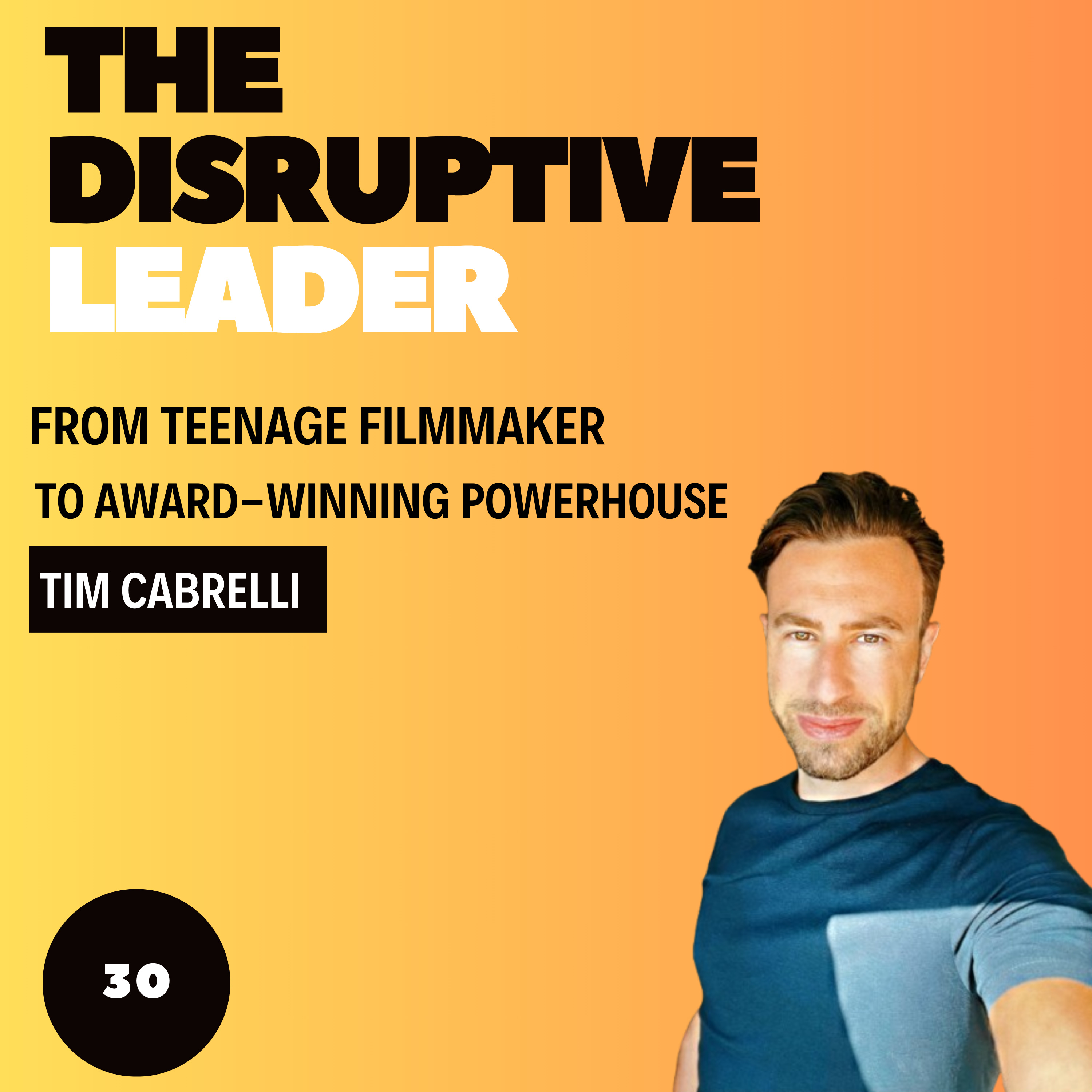
From Teenage Filmmaker To Award-winning Powerhouse
from The Disruptive Leader
48m 31s
Tom Cabrelli, co-founder of Fixia Stilves, discusses his journey from starting a film club at school to running a multi-award-winning production company. He highlights the company's unique edge: extensive technical knowledge spanning pre-digital formats like Umatic to modern digital tools, combined with a fully in-house team of 15 specialists and significant investment in equipment. This allows Fixia to manage projects end-to-end, unlike competitors relying on freelancers and multiple external vendors. Tom shares the intense experience of creating "Katie's Love Story," a film about a girl groomed and murdered online, made while the criminal case was active. The project, initially a training video, went viral, was adopted by police forces internationally, and led to numerous disclosures from at-risk children, demonstrating real-world impact. He advocates for calculated risk-taking in marketing, arguing that conservative approaches fail against viral content, and stresses the importance of personalized team management, acknowledging past mistakes but showing growth through long-term staff retention and tailored communication. Overall, Tom emphasizes blending creativity, technical expertise, and business acumen to deliver impactful, streamlined productions.
(upbeat music) - Good afternoon Tim, how are you doing today? - I'm great, doing really well actually. Yeah, considering it's the new year, we've seen to be starting pretty well. So yeah, very happy at the moment. - Yeah, what's happening? What's happening that started in well? - It's okay, that's fine. - Well, we've got a new project that's gonna come out in the next couple of weeks in the automotive sector, which we've never done before, which is great 'cause it's a really difficult sector to get into because it's one of those classic situations where unless you've worked in the industry before, you don't get the job, but how'd you get the job if you've never worked in an industry before? Yeah, we've finally got after 20 or 20 years that chance to make something in that sector. Yeah, that goes live in a couple of weeks and got some really interesting sports projects as well, which I'm a bit of a sport nut and always I've been. So whenever those jobs come around, it's I always like making them. - Brilliant, brilliant. Okay, I'm talking about projects and sports and motor two. For everyone listening to this episode, please meet Tom Cabrelli. He is the co-founder of a Fixia Stumps, I hope I pronounced that correctly. Fixia Stilves is a creative powerhouse in the UK. I always like to store these episodes, just asking that really typical question. Who are you? - Very good question. I wish I did, I knew my head had to once that one. Yeah, so who are my, I'm a co-founder of a creative production company, something I started from when I was, as very young really from 15 years old and I suppose it's become arguably part of my identity is because it's all I've ever done, it's all I've ever known. I think I've been useless in any other industry 'cause everything I've ever done. So yeah, who am I? I'm a guy that likes making films, watching films and has done it since the day, doc. - You mentioned you started doing this when you were really young and 15. What, were you at school? - I was at school, yeah, I was at school. - Yeah, I was quite lucky to be the school that had, had basically a film club. So yeah, I was one of those kind of nerdy kids that like making films, this school did them quite well over the years with, winning awards and things, and part of the winning awards, they won cameras and editing equipment and all these sorts of things. And that was the past kids. And so when I got to a certain age within school, you could basically get access to the being in the film club and you got to use all the equipment and, yeah, I just really enjoyed it. I was always, I always enjoyed films from when I was a kid anyways. I always felt like I wanted to do something with that. And yeah, I never thought I'd get to wear a hat now, but certainly that's where it was. Yeah, just, we got the off-treaches to make some, make some films at school really, and that's how it all came about. - Amazing. So it started at school and then you followed that passion and now you're running the multi-alward winning production company. - What's unique about affixias? What do you think is that secret sauce or that magic sort of power? - Yeah, there's a couple of things really. I think one of the unique things that I can honestly say that not many of them are not really kind of competitors that we have is basically the knowledge we've built over that time from when I was 15, we worked on something called a Umatik. So it was non-digital. It was I was using a camera that was three times the size of me and then I'd have a recorder over my shoulder and a cable that was like really sick and it was insane. Like it was a terrible way of working. Like you just couldn't fly now. It's crazy. And then about a couple of years after that, obviously the digital revolution kind of happened and there was mini-dv and dv cam and a few other things. So we've gradually, and then eventually we got to what I'd call like full digital kind of level and everything became a lot more mobile. But because of that, it meant that I fell in love with not just the visual side things, but the technicals and all that sort of stuff. I got to really understand, I think, my art's a lot better than I ever used to. And I think because I've got not just that kind of pre-digital knowledge, I've got that kind of digital knowledge now, I feel like I've got the knowledge of knowing what's been done, how things have been done and all that stuff, which if anybody comes into the industry, even four, five, six years in standard established, they didn't code their own DVD like I did. I quite literally, we didn't have to make a DVD. So we had to learn to code the actual codec, which went on to a DVD because it didn't exist. And then DVD now longer no longer exists. And I meet people that don't even know what DVD is, which is just terrifying. They're scaring that I now speak to people and they've got a bit like, kind of matching something on a disk. It's pretty mad. So I would say that's one of the unique things is that kind of knowledge. And I think the second thing is that because we've been saying control for it, because we always wanted to make sure that we really managed how this industry would work. And I think what we did was we brought in specials. So we now have 15 people in a fixious. And they are far more better skill filmmakers than I ever was, which I'm not afraid to admit. And we keep it in house. So we've got our in-house directors, the APs, producers, editors, official effects, all that sort of stuff. So we can manage a project from start to finish, whereas most people would just bring in a production company, which would be invariably freelancers. And then they would pass it to a post house, offline online. So there could be a 5, 6, 7, 8 companies involved in this, whereas we're trying to say we can streamline and be one company in this. And I think that's unique. There are a couple of others out there, but I don't think they certainly don't have the knowledge that we have, but they probably can't work to the scale that we do. Because we invested 100,000 pounds in our own camera equipment, so even our own areas, our own Sony's, our own lenses and lights, all that stuff. Even our image quality can be a TV level. We didn't need to hire in even a TV level. So that's pretty unique. So it's a mix of knowledge. It's a mix of having that specialised in-house team that you've built and scaled and molded and invested in to have the affix, the way that no one else can compete with when it comes to this just in a bunch of freelancers to make this happen. Is that right? But it is. But it doesn't come back by accidentally. You try to work out what you're comfortable with in your own skin of building your own company. And it took us a while to really work that. There was times where we'd gone, oh, we'll go, we'll use the freelance model. We will do this. And we're trying to find how we wanted to work. And also how we feel we could bring our own identity into things. And I think that we struggled with for a long time, really, was actually, do we do this? Because employees, 15 people, are hard. It's one of those things that it's not to be taken lightly, but at the same time, once you understand where you fit in the market, is it, and then, but easier to know who it is you need to speak to? Just shape it. I love to work that out. That's OK. You're the [AUDIO OUT] Christian here, and all those other worlds you're withing. I'm talking about the worlds. I've seen a little bit of research, just at least, what they've been up to. And credit me if I'm wrong, but you've run an award for your Kenji's Love Story project. Is that right? Yeah. Yeah. It was an incredibly intense project. Word. Tell me about it. What was it about? What was intense about it? Obviously, the subject matter itself was pretty hard work. When, say, that local towards there was, tragically, a girl murdered. She was screamed and murdered. And we were aware of the story, obviously, because it was very close to hype. And one day, we got a phone call from Lester Shipley, and they just said, can you come in and talk to us about a car and a bit? Or something like a training video? I don't know. They just said, there was nothing-- there was nothing major. We just thought we're going along to speak about a pretty box standard training video. We get in this room. And a guy called Matt Tapp, pretty well-money calling by name these days, because they're pretty well. Just Saneru's dead is dead in the eye. And turned over five newspapers. all had the story of.
K-Lion from Page. And it was just like, "Oh, I do something about this." A "Me and James" who also works with me is just like, "What's?" "What even is this?" "What do you mean?" And yeah, they obviously then told us, a lot of the sorry guys that did it, they'd been recently arrested, obviously, straight after the murder. So they hadn't even picked a call to anything at this point of view. It was an active criminal case, which we weren't aware of this at the time, but it's the first time I think anyone's ever done a film like this when the case hasn't even been heard yet. So much so that even went and spoke to the QC of the two defendants at the time, and actually said, "Look, just give your heads up. They're making a fool about this, and you will not be able to use it in court because they're going to be very factual about it, which we were." And we had to try and find something that could, I think, let 12, 13, 14-year-old girls know of the dangers of speaking to people online, and it's the classic age-old, they talk to strangers kind of thing, and you put it at the digital age, and I think at this time it was still relatively new, that people shouldn't do that. And what the hazards might be, her story is insane. I've seen, she only spoke to this person for two weeks, then those two weeks, they had thousands and thousands of messages shared between them and all this stuff. You really did a cool story to cover, so we had this girl, so we filmed it, and the whole narrative that we created was that, and what the sense that we got was that when you saw the messages that Katie was sharing and vice versa, she did feel like she was in love, she felt like there was a connection between this person, this guy once just grooming her, but there was this thing, so we created a film that basically the visual showed actually what was happening, but the audio that you heard was a bit like a love story, but was actually what she was probably thinking, and in that situation, and it hadn't really been done that way before, and it ended up getting way bigger traction, we ever thought it would, it actually got launched on the day that the two men that were involved in it were sent to prison, so it was everything, so let's just be police, literally launched on that day, and we logged on to Facebook in the morning, and it was had a few thousand views and all this sort of stuff, and then by lunchtime it was a well over a few million by lunchtime, so we're like, "oh, I'm going, I'm going, wow, this is going quite far," and then by the following day it was tens of millions, and we're thinking, "oh wow, like this is actually gone viral, and in a matter of times we were asked to make something go viral, and they never does." And so yeah, it took off from there, and then obviously we got a lot of requires from various people, even how see, "must you should please, Scott, a lot of inquiries from other police forces saying we wouldn't use this," but I think the most incredible thing we saw those have newspaper articles a few weeks after it, saying that because they showed it in schools, one of the girls had disclosed something, there was a police officer always in the room when they did it and disclosed it, and actually the police officer recognized the name of the person, and that afternoon they were in accident, knew it was breaking his parole or something like that, and yeah, he was brought into question in, and he was pretty much at the in front of a judge in the next morning, so it was literally making a difference from the day it was there, and I think they had, I think in the first few months they had over 50 disclosures of from children to police, or people that thought they were being groomed, and that's what stuff, so is the first time we all started to see, I think that, return on investment is the wrong word, but that return on like the impact or something like that, it was quite incredible, and then from there, the FBI contacted the police and said, "Look, we'd love to use this training tool." I think Australia police used it as well all over Australia, at one point it was actually, I believe it was brought into the national curriculum at one point as well as part of a training tool for basically all 12 to 13-year-olds, girls must watch this now, so yeah, from something that was just, we thought it was going to be a training video, or ended up escalating into something that's, I think genuinely made a difference, and that's quite a nice place to be. That's fascinating thing, I got goosebumps just as you were describing that, because it's like, you know, hitting so many sort of angles that you're helping 12-year-old girls, 13-year-old girls with such a critical topic, so there's a lot of purpose behind that, apart from how creative we are, what great equipment we have, and just, and I think it broke barriers within yourselves as a team, that you were just saying something we thought was training material, actually, with the ones in the national curriculum that's huge, was there at any point where you were making them? Did you feel there was a risk you were taking? Yeah, a huge risk. We changed the name of the project internally, because we were just really nervous of what we were talking about, and stuff we changed the name of the character internally as well, when we did castings, we changed the names of everything, so we really wanted to try and make sure we were protecting ourselves, protecting, we also had to protect the case, because everything that we were doing could potentially be used to prejudice the case, so we were being run whilst this legal thing was going on at the same time, we were trying to basically manage the whole thing, and obviously on the day of the announcement of what happened to the guys and that sentencing, we had to put that in the film, so we quite literally put it on the end of the film, fired it over, we went up onto Facebook and that was it, so yeah, it was always a concern as to what it was, but we were always assured by the police that these guys were acting arguably in isolation anyway, so there shouldn't be any backlash towards it, but I think ultimately, I think the importance was just making sure that actually that message got out there, and it held people. Yeah, it stopped from happening again, especially, can. And just echoing the concept of taking risks of work, and having a big risk taker is when I think it says risky, different unexpected projects that one works on is what some bristable does and expands. What's your philosophy on taking creative risks in an industry like yours, for example, if you want to draw inspiration for Christopher Nolan, it would really complex ariddits, like what you're describing, very different, what's your philosophy around that? Yeah, we always used to call ourselves calculator risk takers for a long time. I think we still do, we probably don't advertise it to that degree so much, because I still find that when speaking direct as people within marketing, the worst risk taker, they just, it arguably scarce, the more than just working with them and getting them on that line, and almost pitching them all the priorities known that wants risky and what say risky again, risk you within the world of marketing guys, let's be real about it. What we're trying to do here is you know, get your product service message, whatever it might be above someone else's, and at the end of day, some of the most liked videos and most watched videos were our people of their dogs and cats and if things their kids do and all this stuff, and then you've got a marketing message that needs to sit above it, you've got to take a risk to get above that sort of stuff. You've got to do something to give someone an idea as to why they would want to watch something about your product over watching something to do with anybody else or those dog videos. So I think from my point of view, I've always tried to push people in the direction of those things because I think it's only getting worse. It's only getting worse. Some of the content you see that goes viral on TikTok is some of the worst stuff I've ever seen produced, but it doesn't matter. It's what it's doing, it's filling a gap where people are sat there. There are some people that will quite an itch you're not watching TV anymore, they're just constantly ticked up. So we need to get in front of that and we need to stay on-log enough for them to either pick up the message, pick up the product or whatever it might be. So if you're trying to get into that space, I don't see how you can be conservative. I just don't see the point. Don't waste the money. You might as well take a risk. It's not going to cost you your job. It really isn't. And actually the worst that could happen is actually does really well. So you know, well, that's what you want, isn't it? We want results. So therefore if you want results, you've got to take a few risks. Yep, mix. Complete. So, boy, in an industry like as we were talking about risk-taking creators, chains for the Augustine teammates that you hired and that investment that you make, how do you manage that very thin line between I need to lead and not my creative team be creative and do what they need to do, but at the same time it's a business. So you also
me to take budget and deadlines and all of that. How are these in balance such different concepts, creativity, and relationships, time life? But really hard. I think it's probably some of my biggest failings in what I've done have been due to not managing people as well as I could have. And I think that's born from the fact of being a kid and starting a company and then having to manage people is just ridiculous. Like you have no concepts of how to do it. You just do things and you may say, "I'm the first one to bet. I've lost some really great staff because of my poll management." And I accept that. I'm really telling people I think probably would still be in our business if I've probably been better at managing them or being better at that kind of side of things. But you can't beat yourself up even that so many times. You've got to basically go, "Right. What can I do to do things better?" I say this now. Most of our staff will really say on the day of most of them being with us over nearly 10 years now. So I think nearly two years of the company have been with us over 10 years and the rest of it I think over three to five. So I'm not going to say I've got all the answers but I am starting. I feel like I've seen the results of learning from those mistakes. How'd you do it? It's actually trying to make sure that you manage people in their own way. I used to think it was like a cookie cutter kind of thing. This is how you manage people and you move on and it took me far too long to realize that everyone's different. So how I want to get something out of one person, how I want to get something out of them, I still got to communicate it differently to them. And it took me so long to realize that people work and have different drivers and different ways of talking to them. Where some person needs the kind of rally cry, the other person needs the equipment, the arm around the shoulder. Let's do this in some way. It took me too long to really work that out. I think I would say now I'm better at understanding and actually just being a bit more relaxed about it and trying to understand what these people want from their lives and how we can help them and internally helps the company because they're with us longer. Yeah, I think that's really one of the big kind of key takeaways for me in terms of of how to just manage those situations. And I think once you have that, whether you're talking about money, whether you're talking about creativity, whether you're talking about anything, it all falls into place because there's that mutual respect and it takes, you've got to earn it. There's no two ways about it, you've got to earn it, but I think people can see your sincere about what you want from them and how to deliver things. Then those things you don't almost have to think about become second nature in terms of having those conversations. So yeah, I think that's one of the big ones really. Yeah, if you've had seen them in the 10 years or even five or three, sounds like you've nailed it, you've found the right form. And I agree with you, I am leadership. I'd invite them what works well like with my team. They're thinking that you look first approach and rather than looking at as leadership, or manager as a role, but more of a type of relationship that you're establishing. That's a very well-to-well personal thing. Well, motivates people, what drives them, what frustrates them. And I think if we approach it like that, then we have that mutual respect with one another and everyone. Absolutely. Yeah. And you mentioned TikTok, people are not watching, movies or TV, any bull or anything, we'll just say there's growing in through TikTok, which is how, what do you see, or what are your predictions for the evolution of commercial filmmaking, taking in things like AI and you take technology and what do you think is going to have to? It's hard to really have no off to be head really, but I do feel like TikToks, five space, I know TikToks, supposedly going to be shut down in America in the next few weeks, so I don't know how that's going to be pleased or worked, but hey, that's over to Trump and Elon's or that one out I think. So we'll see what kind of happens there. I do think advertising is going to slightly change again like the platforms that using obviously traditionally it was always TV. Obviously the online platforms are doing a lot of this sort of stuff now. So Netflix and Prime, I actually think, I think Netflix and Prime will change their structures. I think they will go to a more structured subscription model. So I think you'll end up playing a premium if you don't want adverts and then you put your way down and in terms, oh, you get the most adverts in the cheapest package, you get medium level and so on. I think Prime will do the same thing. Obviously, they still put adverts at the beginning of prime, but I don't think that model's fully materialized yet. And I think then Prime essentially will put themselves in position a bit of broadcaster and end up being needing to do that. I think from a socials point of view, Facebook slowly dying and I think it will continue to slowly die. Instagram is the new Facebook. I think it's doing the same thing. I think Instagram is trying to be too much TikTok. I feel every video I see on TikTok has been shared on Instagram. I feel like they're the same streams. So that's a danger to both of them. If I'm honest, because whoever wins that market share will eventually win. I think TikTok will still win it because I still think some of the absolute rubbish content that kind of appears on there appeals to a certain demographic. And I think that's where that will go. And I think ultimately does that me advertising will appear more prevalent on TikTok probably at some point. I just think who's going to probably either end this probably a social media platform that we don't know about right now that's probably going to do what TikTok did, which kind of came out of nowhere during COVID didn't it. We see what happens really on that front, but that's where I feel I think a lot more advertising is going to go to what subscription model levels of areas and then beyond that. But then again, I might be thinking that is that if you're if they know who you are and where you're from and you're demographic and all that sort of stuff, then the app that's attracted that you. So you probably don't mind as much as nothing worse than when you're watching it and you get an adverb something you don't care about. At least the waste of time, isn't it? Whereas I think that advertising is already targeted, but I think targeted at a way higher level than what ever reach. Yeah, the algorithm sort of knows what you're messaging and scrolling and clicking and stopping out. And it also gives you I think the primary difference as well as on social channels, you can click and say, I don't want to see this out again because it's so reddable, you can't do that on a broadcast channel. No, you just it's TV and you accept whatever it is. Yeah, no, I get that. I know what about you know how they say, oh, AI is going to take over, you can use roles or any big chunk of it. What do you think like the role of AI is going to be in creating scripts, creating visuals, creating jingles, stuff like that. Yeah, I don't, it's obviously going to be big. There's no two ways about it. And it is going to damage the industry in some way shape or form the whole, when I say in the kind of creative sector, there is there's no two ways about it. I think there is just it goes back to levels where that lower tier work that might be done by the one man band or whatever, I think that slips because I love that could fall into those AI categories that someone want to logo doing. I'll go, I can't do that and it's you'll use AI to do it. Although I was doing it supposedly the day and I was using AI to create the images. So we still use AI to do that, we use AI to do the voiceover, which we used to do ourselves, which used to hate because you would send a film to someone or an advert and it would have like your voice on it and because it was just there to fill up. So now that AI does actually improve that system a little bit where you're like, now you hear my voice, imagine that being a woman in her 30s. It's an inbid easier doing it with AI than it is me pretending. So there are things that I think it feels void. You will take away work, it just naturally well, like I said, I was working on a roast of someone the other day and I was using AI to create images and I used an AI image to teach the next AI platform of the style and the approach and then another AI platform to do the rest so it was like, they were wrong, it took me like four hours. Maybe I'm just poor with AI at the moment but I was like, looking at going, I don't think this has saved me time. I just probably should have learned Photoshop at an earlier age but that's by the by. Because there is still skills in what we do and there is still skills that I don't think AI can completely replace although it is funny because I'm watching TV Adverts now and I'm going, oh that's an AI voice and my wife will be like, what? How do you know that? It's just like, you don't tell, I don't know, maybe it's just the way that we are but then
day I quite literally get better every day. You just got to exactly. Yeah, I think the AI voice you could detect it because it's very robotic and it lacks the emotion that you are human users when they communicate. Yeah, absolutely. Yeah, you can tell there's no soul can't you? There's no soul's form. That's good way to describe it. And Tim, so the beginning you mentioned you're excited because of the two months of others and you've done a lot of word in the sports and you're a fanatic. Tell me about your little experience that you had with Sky Sports. Yeah, yeah, so when I finished school like I fixed this with running but it was just two guys messing around with a camera and edit suite and just making corporate stuff and whatever it was. Yeah, he did feel like a job or anything like that and I finished going I ended up I didn't work it's for us with Sky when I was quite young. I literally just sent a letter in and they were this is how old I have isn't it? It's like I sent a letter in not an email and letter and I actually posted Johnny and everything was great. I was probably kind of written as well from really honest but let's not go that. And yeah, so I sent a letter in and this guy called Barney Francis. He's he was massive at Sky at the time. Not thinking I'd get a response. He was like, yeah, come on onto the cricket. So I didn't go on to trembarage which ironically we now sponsor a cricket team. So it's just a really weird universe like now live it. But yeah, like 15 years old I should sat in a cons box with these legends of cricket, watching them do commentary for a test match. It was just crazy. And then when I finished school, I think I said an email this time, nothing as a letter. I said an email to him thinking, oh, you probably won't remember me. That's actually a weird deal. Do you remember me? Yeah, come come down to Isleworth and do some work experience. So I was there for two weeks. They offered me a job at the end of it and said, oh, they're like, you're really good at stuff. So yeah, come and join it. I became a production junior there. I worked on netbusters, soccer, I am, you're say golf, but it was just there was insane hours. I was sleeping in my car in the car park. I fell asleep in a park once. I lost my toe. I was in my life in there because I was just working in like every shift they could give me because it was actually like the hourly rate was actually quite good. So I was just like, do as many hours as I can not thinking about actually, I probably do need to sleep. And yeah, I did that, but it got to a point where that exhaustion, I was like, it means we've seen everyone that was there at the time was actually going towards private production companies. And I didn't really know what they were. Obviously, I had a fix this in the background, but I didn't see it as the same thing. And I just, I think I just got to level of exhaustion and I remember sitting on a step on an OB truck. And it was pouring hour and I got told I couldn't sit in the OB trucks. It was, there was too many people. There wasn't at all, but there was just a really difficult direction at the time. I think you just want the space for yourself. And he said, you said, you can sit outside, you're not you needed a hand. I remember sitting on the step, they say, a vitro in pouring rain. I'm basically waiting for people to tell me, do they want a tea coffee or all this sort of stuff. And you're a general doctor, but you are a bummer of the ladder. And I just thought to myself, I don't really want to do this anymore. This is not something I, I'm unnecessarily like, I want to work in this industry. I don't want to be treated like this. And I appreciate that he's looking back at it in hindsight now going, I actually, it's the tough love that you need sometimes. But I obviously had a fix in the background. So it was just like, you know what, maybe just like all the effort I'm giving sky, why don't I just do that with a fix it. And so that's what I did. And yeah, I carried on doing that and moved away from sky, which for I think I was 19 at the time for 19 years, I was suddenly going, no, I'm not going to work for this huge conglomerate. The computer was really, I'll do my own thing and think that'd be okay. It looks like a great move now, but at the time it was probably my parents are probably thinking, what is this guy doing? Like, what are you mental? And they'd be right, because I now look at it, I'm like, why then I think I could do that. But it happened, you know. Yeah, and I think being interprenucia is not easy as well. And it's exhausting and it's great. But I followed that. I did corporate, maybe for, I did it for three years or whatnot. I was like, you know what, I'm down. I'm in the new Iron Pagan. I could, we could take me and you've been doing this since you were 15 and you said to me, so we could guess how old you are. How do you keep the passion for so long? How do you stay enthused? Yes, they. And what to do? Low 20 plus years in. How many do that? I feel, from really obvious, I don't know. Everyone always you say, like when we were young, they would give us jobs, but oh my god, you love what you do. And it's, yeah, I do. I always have done it. There's been difficult moments, certainly. They make you question why you're doing it, what you're doing it, doing it for and all those sorts of things. But I don't know, I've just always bought into, I have enjoyed it since I was a kid. I've never really lost that passion for it really. I've had moments where I've questioned my passion. I've never really, I've never really fell out of it because I think some people have set up what I did. I know when I was maybe in my mid 20s, I'm a web agency and they said to me, it's great you're doing film because that's going to be massive. Video is the next big website thing. And I was like, no, you, I can't see it because for me, I wasn't in it for the money or anything else. I was in it because I just like making films. I really weirdly couldn't care less about the money until probably I got to a point where I ended up having to pay for a light. You're like a house, a car, or almost a thing. You're like, okay, I actually need to let my parents get out of the house. You've got to job, but for some of the reason you're still here, go away. And I was like, yeah, good boy. So it wasn't until then I started having to do, but because I already had that passion was always there, it took over. And I think one of the big points in my life, and I don't talk about it much, and you won't find much of it in terms of in the public domain. When I was 29, I got diagnosed with chronic myloid leukemia, which was like unknown to me. I didn't know it's thing. It basically building my body for about five years and I was getting really ill. I wasn't aware of it. And I remember being, there's a whole huge story to the back of it. I'm not going to go to the detail, because it's quite a traumatic story to where I how I found out and all this stuff, but I remember that whole weekend, like I could literally feel like I could storyboard that Friday that I went to an audition with an eye problem. And then literally Friday night being in hospital being told, I don't understand how you're standing right now. It's like that. And I remember being in the hospital that weekend. And then for the first time, I'm like, no one should be questioning their own mortality at 29. No one should, I felt invincible. And then I got 29 and they're like, this weekend's going to be tough, because you're really ill. And I'm like, I'm not feeling really ill. Honestly, medically, this is not good. And I was like, okay, and that's like a massive smack to the face. And when I had that, I came out the other side. So I eventually got let to go home on like Monday night. And it made me just really realize all the things I hadn't done. I just sat in this hospital room for an entire weekend being told how ill I was. And basically, if this goes one way, you die in the other side, you don't. And then weirdly, another contact of mine that I knew at the time had come in with a slightly different version of what I did while I had sorry. So he had a AML. So I keep my lawyer keep an eye on chronic. So chronic's over time, she's very short. And he like died three weeks later. So I was like, oh God, like this is scary now because like I randomly sat in this hospital and saw someone I knew who had just been diagnosed as well with what I thought was similar to what I had. But he's was the very short form and basically killed him. And it was just like, okay, I'm not finished here. There's stuff I've got to do. It completely changed your outlook. And I don't feel like anybody should have to go through that to have to change their outlook at all. It is the worst way. I don't feel like I was a bad person before, but I do think kind of better person weirdly for it. But that is that kind of thing where it's these are things I want to achieve. I do the bucket list thing. I didn't write any of that stuff. I just felt like there were just things that kind of became very clear in my mind as to what I need to do, what I want to do. And I basically went back to work in two weeks because I was just
I can't sit at home just feeling sorry for myself and not physically and mentally great. But yeah, I just was like, that's it. I'm just going to go back to work and just going to do something with myself. So yeah, that I think really managed to be there. And I still have that passion because I still think there's still stuff I want to do. I never feel like I'm on that journey. Yeah, I need to finish it. Thank you for the sharing man and sharing your vulnerability and how it actually ended up going through something so awful, so traumatic, so unexpected and how I actually led to the wait a minute. I need more time here. The thing is, it's like, it's ridiculous. You shouldn't be doing that. And I mentioned it a long time to get into a space where I felt like I could really understand what I went through because for all the things, there's no doubt this one doctor spotted this thing and basically saved my life. But not only that, she created a situation for me where it was just like, oh my god, there's still 20 stick, but no one should ever have to go through that kind of trauma. It's a kind of work actually we're not done, but I don't know, I think there's there are times in your life where you do look back on and go, it was a kind of a moment, wasn't it? That was my thing. That was the thing that kind of probably gave me a kick at the back side to move faster. So yeah, it's crazy as a style that's uncombleasing in disguise. We would live or not. I don't know whatever. And then yeah, you could backstop. Yeah, whoa. Yeah. I hate people. Yeah, they hit people turn around and go, oh, how's lunch? You've got your health. And I'm like, absolutely. Yeah, you do not understand like how important that is. Like you take it so for granted until something happens in your life. It's just not even as severe as me. I can't bless things in terms of I see other people, what are you worse at conditions than I ever had? And today it happens for you like chemotherapy and the awfulness of all that. I only had very short stint on like tablets and all that. So I didn't have all of the terrible stuff that that kind of comes with that. So I feel like I need even on the time, my doctorate time such, you know what? And where you've got the good one, that's how she described it to me. That's how she sold being ill to me. She was like, oh, you've got the good one here. It's like, yeah. Great. Just what I want it. But yeah, it is one of those things which you know, you either use those things to beat yourself with or use it as the thing to kick you on and move that line. Yeah. And get that feeling going. Yeah, absolutely. Oh, wow. Okay. And just keeping the track of telling what would be key advice you would give to other aspiring creators and took progress. Like, what would you share with them? Why? I choose part of it. I think it's just experience, experience, you're getting yourself in that space. So whether you're starting out in the industry, I think it's, I look, going to universities are lovely thing and whatever, but I think our industries massively judged on experience, knowledge. It's too z-assam. All of those things that I think that actually an employer, someone that kind of works in this industry and has them for a while, kind of looks for it. I've employed many people that have got zero degrees as I do with ones that do. And that because I'm reading, are they? I like, for me, if they're doing it in their spare time, I'm more interested at that point. I'm like, oh, my god, what are you doing in your spare time? What are you working on? What's the thing? And even if the quality is not that good, I'm like, yeah, but that will come over time. I'm not too worried about that. What I want to know is that if I say, look, you're going to be up, we're going to be on shoot, we're going to be let's all seven eight clock at night. Are you still going to be as keen as you are when you turn up at night and then you leave at seven eight clock at night? Or is it going to be want to go home or more of that sort of stuff? Like, it's about that kind of like, you're either in it or you're out of it. Don't half-ass it. It doesn't matter what you're doing. It doesn't matter even if you've been in this industry 10, 50 years. It's the same kind of argument again. It's, you've got to be, you've got to be in it and you've got to completely engage yourself to it. You can't just think it's a nine to five because being honest, I don't think any job really is a nine to five for such like you have to. Yeah. Yeah, you have to think wrong. That involves a bit of self-management with your title. It's a bit of a critical of you to sit there and go, oh yeah, I'll go on holiday and I'll do all these other things, but actually it's really important to actually have the down times, which is to have the kind of time to do it, but it still doesn't stop you from having the enthusiasm to do it. And I think for me that that is a huge element of it. It's really just making sure that if you want to work in this industry or whatever, then yeah, go in with two feet. He just got to just absolutely go in there and then live and breathe that out. But yep, just jump in the water, be there for you present all day, every day. And when I, I, I completely respect and feel the same way about hiring people, learn no degrees because it really doesn't master you. And I'm, you know, all the degrees and PhDs, this degrees are not being it. I mean, not before you prove it. Absolutely. Yeah, yeah, yeah. Yeah. We've all met the people that've got like incredible degrees and hate their job. So, and it's just, that was a worthwhile. People didn't do it for seven, eight, like, like, doctor, like the litute doctor level, and then they go, I'm now going to become a tree surgeon because I actually really like trees and you're like, oh my god, you've just been how long they're in what? So become a tree surgeon. Like that's insane. But, you know, eventually the passion takes over because you realize that you do so much of your life working that, you know, it's the one thing my parents like, they both hated their jobs. They never ever visited the hated their jobs. And they'll always say to me like time and time again. And my sister was always like, it doesn't matter what you do. Just make sure you enjoy it because it's so much easy to get out of bed. And now that's a cliche. We've all kind of had it before. But like, when your parents are saying that to you and they're being actually quite vulnerable, saying, well, hey, what we do, but we do what we do to help you have a big, big thing. And then when they're saying, oh, we don't care what it is that you do in the future. Like, just please enjoy it because, you know, that will make you choose difference. And that's them giving their experience of of life back to you. And I suppose I think that they really instilled that. I'm assisted in listening to that, but I sadly, but like I did. So, yeah, she's listening to some points. She'll be enjoying it. And I'd like this to short to not be doing something that you love when you're passionate about. I mean, and if you while you don't give it to it as well. Yeah, I get it. Superb. This has been a wonderful conversation. Very inspiring, very I am. Of a big fan of the six years. You've done your story is compelling of how it just started. So young, you grew and you went after and you did everything and still going. So thank you for taking the time to speak with me and spend an absolute pleasure. And I hope you have a wonderful rest of the day. Thank you very much. To be fair to thank you, Ken.
Podcast Summary
Key Points:
Tom Cabrelli is co-founder of Fixia Stilves, a UK-based creative production company he started at age 15.
The company has secured a new automotive sector project, a difficult industry to enter, and also works on sports projects.
Unique strengths include deep technical knowledge from pre-digital to digital eras, plus a 15-person in-house team with invested equipment, allowing full project control.
The "Katie's Love Story" project, about a murdered girl groomed online, went viral, led to national curriculum inclusion, and generated over 50 disclosures to police.
Tom emphasizes calculated risk-taking as essential for standing out in marketing, especially against viral content like dog videos.
Managing creative teams requires personalized approaches, learning from past management failures, and balancing creativity with business needs.
Summary:
Tom Cabrelli, co-founder of Fixia Stilves, discusses his journey from starting a film club at school to running a multi-award-winning production company. He highlights the company's unique edge: extensive technical knowledge spanning pre-digital formats like Umatic to modern digital tools, combined with a fully in-house team of 15 specialists and significant investment in equipment. This allows Fixia to manage projects end-to-end, unlike competitors relying on freelancers and multiple external vendors.
Tom shares the intense experience of creating "Katie's Love Story," a film about a girl groomed and murdered online, made while the criminal case was active. The project, initially a training video, went viral, was adopted by police forces internationally, and led to numerous disclosures from at-risk children, demonstrating real-world impact. He advocates for calculated risk-taking in marketing, arguing that conservative approaches fail against viral content, and stresses the importance of personalized team management, acknowledging past mistakes but showing growth through long-term staff retention and tailored communication.
Overall, Tom emphasizes blending creativity, technical expertise, and business acumen to deliver impactful, streamlined productions.
FAQs
Tom Cabrelli is the co-founder of Fixia Stilves, a creative production company in the UK. He started making films at age 15 and has built a multi-award-winning company.
Fixia Stilves is unique due to its extensive technical knowledge from pre-digital to digital eras and its in-house team of 15 specialists. They manage projects from start to finish with their own £100,000 camera equipment, unlike competitors using freelancers.
Tom started at school in a film club that had won cameras and editing equipment. He enjoyed making films and pursued it as a career from a young age.
It was a training film for police about a girl groomed and murdered online. It showed the dangers of speaking to strangers digitally, using audio to depict her perception of love while visuals showed reality.
The film went viral, leading to over 50 disclosures from children to police and being used by the FBI and Australian police. It was also brought into the national curriculum for 12-13-year-olds.
The team took huge risks, changing project and character names internally to protect the active criminal case. They ensured the film was factual to avoid prejudicing the trial.
Chat with AI
Loading...
Pro features
Go deeper with this episode
Unlock creator-grade tools that turn any transcript into show notes and subtitle files.
 PodcastTranscript AI