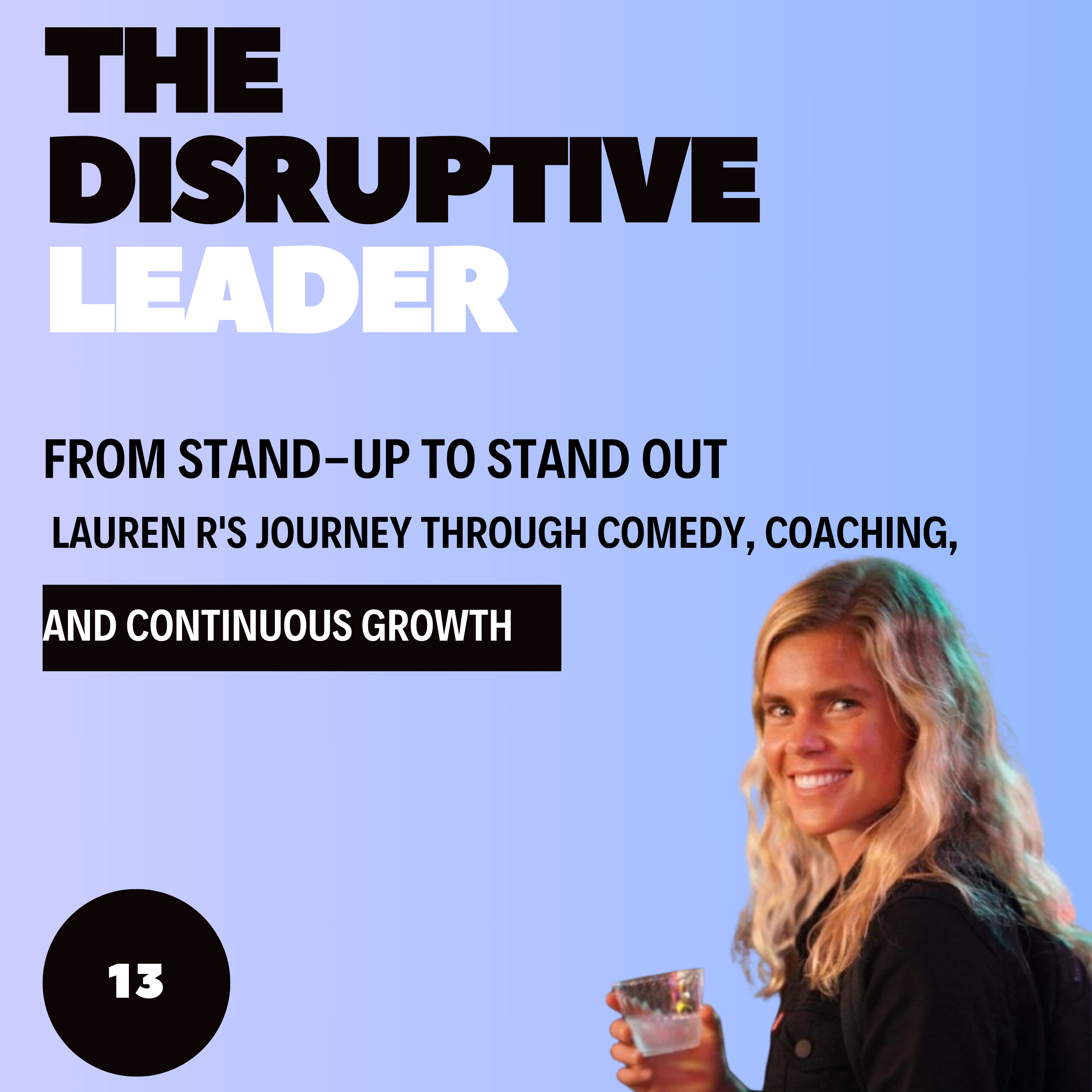
From Stand-up to Stand Out: Lauren R's Journey Through Comedy, Coaching, and Continuous Growth
from The Disruptive Leader
40m 15s
The transcript features a conversation between Ron and Lauren, focusing on resilience, personal growth, and the intersection of athletics, comedy, and coaching. Lauren, a former college runner and comedian, shares practical advice for crisis situations, such as hurricane preparedness, highlighting the importance of maintaining routines, packing essentials, and staying physically active. She credits running for instilling discipline and a long-term mindset, where consistent effort leads to progress, a principle she applies to her career and life coaching. Comedy, she explains, began as a coping mechanism for childhood trauma, evolving into a tool for connection and healing, both on stage and in professional settings. Lauren discusses her anti-bullying initiative, Lace Up Stand Up, which used positive psychology and humor to empower students. Her pivot to life coaching stemmed from early interest in positive psychology and personal experiences overcoming adversity, which she now uses to help others transform difficulties into strengths. Throughout, Lauren emphasizes the value of continuous learning and finding meaning in work, noting that curiosity and dedication keep passion alive. The dialogue also touches on the therapeutic role of laughter, the importance of processing trauma, and how diverse experiences—from sports to humor—contribute to a holistic approach to personal and professional development. Overall, the conversation underscores resilience, the power of humor, and the transformative potential of embracing challenges.
(upbeat music) - Good morning, Lauren. How are you today? - Good, hi, Ron here. - How are you? I'm sorry to hear about the hurricane that's approaching. Hope you're safe, everyone. - I know, we're as prepared as we can be. So I think we'll get out of here safely, but it is a little nerve-wracking. - I can imagine I completely understand them, sending you all my love. And maybe we start with that from a human sort of perspective. What should one do within this situation? What's the best way to approach this without collapsing? - Yeah, I think actually preparing is a really good thing to do. I know it depends on where you are in the hurricane zone, following the recommendations of evacuating in that type of thing. But then as far as like self-care, like I'm making sure I did as much of my routine as I could. And I'm like trying to make sure I'm still exercising, eating while and getting all the water I can on hand. So those things help when you're in a crisis mode. For sure. - Yeah, I remember once I, when I lived back in Chile, there was a forest farm, very close to our house. And at one point, they were like, oh, you might need to evacuate. You need to pack your bag. And I thought, what am I gonna put in it? - What would be your advice on what to put in your evacuation bag? - I mean, me personally, I don't go anywhere without running shoes. So however you like. First things first, exercise clothes are going in there. And then your basic necessities, if you have any medications, that type of thing, to brush and anything you need for an overnight stay. - Yeah. Okay, that's really solid approach to health and, I guess health and health. As you think about running shoes, you are a super high achieving athlete, comedian, all American athlete and comedian. Tell me, how do they go together? What's happening there or what happened there? - Yeah, I don't know that they necessarily go together. It's just like a weird combination of interests for me. I think when I was young, I got into running at a pretty early age. I guess I'd always loved it. And then I played soccer for a lot of years. And when I was like a junior in high school, my mom was like, hey, your soccer team is not too good. You want to try running? And I was like, I don't know. And so I just tried it at that time and ended up doing really well with it and got recruited to college. It was so funny when I actually started getting letters. I was like, oh, you can do this in college. I had no idea that was a thing. Like, just the whole world. Yeah, just completely oblivious. And so. - Yeah. - And like, as your passion and your success with running, has it like intersected with your career in any way or has it maybe influenced your approach to work or anything you do related to work? - Yeah, absolutely. It definitely, so running is a sport where it takes a long time to get good at it. So some people will naturally have that talent when they're young, but if you really want to get good at it, just in sports, it takes grinding it out day after day, year after year, and just putting in the work that most people don't want into. So it's like, fine tuning your warm up and focusing on the workout you have in front of you and then getting out for those long, easy miles when most people will be like, nah, no, thank you. And I think that applies to any work you do. If you're willing to put in the work it takes for one. - Yeah, yeah. It's just committing to the little things. When doing that with attention and focus and then knowing that eventually they're gonna take you where you wanna go, you're gonna keep building on what you've already developed and move forward that way. So it gives you this kind of way of thinking about things. Okay, it might not be good right now, but over time I should see progress if I keep doing it day by day to putting in the work here. - Yeah, it's like that consistency at doing it and continuing to do it. And maybe one day it's not gonna be your best running day, but if you keep at it the next day could be a really good running day. I was reading an article a few weeks ago where they were saying an attribute to look for when hiring, when you're doing the interviews and stuff is to try troubleshoot business candidate into sports. And if yes, which sport and to what degree? 'Cause it will show you things like you were just saying that ability to be consistent and build stamina or work in the team. So yeah, that makes a lot of sense. And when you were younger, doesn't it look research and just correct me from wrong? You started your journey with run and fun, with an emphasis on comedy. And tell me about the comedy. Like what drew you to discover you have this talent? - Yeah, so I was always known as the class clown, which seems funny to people like when they first meet me and they're like, no, you're like way too reserved. Like how could that be? But I was like the reserved class clown, I think that makes sense, I don't know. But as, and so people would always be like, oh, more than you're such an odd ball, wish we could just follow you around with a camera and put it on YouTube. Because I don't have the filter that most people have, I think I'm expressing my thoughts before people are expecting to hear my genuine thoughts. And so then that ends up being really funny. But I actually got into comedy for the first time when I had a pretty serious running injury, so I couldn't run anymore. And I am so used to having some sort of outlet, something that I'm shaping, maybe outside of work or my main job to do something creatively and get that energy out of my brain. And so that's how I fell into comedy. It was like a combination of things, realizing that people were always laughing at me and trying to see, oh, maybe I could translate them to listen to something else. And so at that point, I got into improv. And so that's how that started for me. And last clown, was that, is that like something? Is that because you just had a really free mind and would just voice and be what you felt at the spur of the moment without filtering and making it socially adequate and acceptable? Yeah, definitely. I think there's that. And then I think most class clowns, if you look at their childhood experience, have some sort of trauma, which becomes like a coping mechanism. So I think that was the case for me. I was like, I had a difficult relationship with my mom, and I could always ease tension there if I could make her laugh. And so from my perspective, I think that's really where that came from. And then it just became, oh, I can do this in every area of my life. So yeah. I've done like what you're saying resonates big time. I have a lot of those childhood traumas as well. And being the class clown or the Joker, it became a mechanism for survival. Yeah. You know what? I'm just going to laugh my way. You should do this and make fun of it. Because if I do, poorly, the other side of this scale will be that light. There's definitely a balance to it. You can't always laugh at it. You need to acknowledge, oh, OK. This was hard. And I need to like heal from it. But if you never laugh at it, it's way too sad. Yeah. Definitely. That's-- Yeah. And I guess the way, say, there's the ink in the yang. So the humor and the sadness go under that. And having a skill, it sounds painful that, yes, this ability to joke through life or be the class clown as a result of trauma. But that is a superpower because bringing humor into the workplace, I think that's a huge asset. Yeah. It definitely is. It's so wonderful because it connects people from every different lock of life. Like no matter what type of person you are, if you can laugh at something together with another person, you're bonded. That's something that was so powerful, feeling for me on stage to feel like everyone in the room was like on the same page of, oh, we're laughing at something terrible that happened to her. And I can relate to that because I've experienced something maybe not the same, but similar. And now that makes me feel like I can maybe laugh at my experience a little bit too. And then there's this like feeling of unity. So-- Yeah. Powerful in the way. And I think it's a really-- it's like a really beautiful healing aid that you can potentially provide your audience because some situations can be so hard to talk about. So if you laugh your way through it, you're actually going through awareness and release and processing. So I think that's a wonderful thing as I want to because it may sound being that class clown And I hope it.
people laugh because laughter is like one of the world's best medications in a way. Yeah, yeah and I think even at work sometimes things get so serious. I think you're always like do a very serious job. You don't get as much done and you're not as effective if you're not lightning and off or finding ways to inject the joy. Yeah and I think no matter what job you're in be a CRM or life coaching or sports, there's always a human to human element and so if laughter is a way of connecting, may there be more of it or more of it? Yeah. And I think it's also a really good way for individuals. If my therapist always says does take life so seriously. Oh, that's funny. Have you heard on EMBR? Are you familiar with that take off therapy? No. I movement. Yeah, it was funny. I did that for a while. I would love to start doing it again. It was very and it's has been very powerful for me but I have my therapist would always know when I had processed something because I would start to laugh and she would be like and what are you laughing at? And it would be the darkest thing and she was like okay, bring me. She didn't know how to take it. She was like okay, I guess it's resolved but you know somehow because you can now laugh. And I think scientifically laughing is a mechanism of the nervous system to release the same as crying in a way just the other side. Yeah. Oh nice, very nice. I've heard some great things about the eyeball. One of my friends is there's one specific trauma that I just can't get over. She's like maybe you should try this because it will help. I'm like, oh, okay. Yeah, that's the thing that's so important about what healing modality you choose is that it feels right for you and that when you'll know when the time is right because of that, I think I want to try that. Yeah. And what I'm finding really interesting like on the healing journey is once you do process and laugh your way through it and you realize, oh, that was way simpler. It was all in my head for the longest, not only my head of body, but a longer time. Yeah, that's so true how you like store it in other places in your body. You're going to be able to wear out. Yeah, the neck, the neck, the neck, the organs, everything. And I'm talking about traumas and things that we get exposed to as children or even as adults. You talked to me about your initiative in lace up stand up. That was against bullying. Yeah. So that was actually something we developed as undergraduates at the University of San Diego. So we were looking at as college students, we were thinking through like, where could we have an impact? We were coastal to one and we there's a lot of poverty there and then there's a lot of homelessness in the area. But we felt like our expertise at the time wasn't strong enough in those areas to be able to make a significant difference. And so you have thinking and we're like, oh, what about bullying? And so that's how we landed on that one. And I have been really in love with Phillips and Bartos work. I don't know if you're familiar with the same third. Like that type of research he did the prison experiment where you saw the worst of humanity and then ended up developing the heroic imagination project after that, which trains kids and people of all ages really to develop those qualities that help them stand up against bullying and like prevent the bissandry effect and that type of thing. So we took a lot of this teaching methodologies into building that program to bring it to the schools in the area of the university. So I love that and I want to thank you for investing time and energy into tackling bullying because it's it is detrimental to individuals and societies and it's something that you know you hear the term bully the first thing you think is oh, how old in school but it's not only at school it's at school and in the homes and in the workplace and it's all over the place and I feel if individuals are not actually taking actions to change this. Societies are just going to continue to find out. Yeah, worse. Yeah. Kudos to you all my respects for doing that and do you feel like you can stop bullying by including humor in a way? Do you think they come not in any way or form? I think so for sure. I think for if you're a victim of bullying you can definitely lighten the load of being able to roast yourself and be like okay we don't take things that other people say so seriously. Maybe we roast the bully or we think through what is the life experience of the bully and why would they maybe have that sort of reaction towards me? So yeah there's definitely ways to have humor help with processing that. Like if you've ever watched a roast that could be technically some pretty extreme bullying so there's definitely ways to have humor shipped it for people. I don't know if in the States when I was a little kid the cartoon Tom and Jerry. Yeah. So like I'm rewatching sort of skits of it now and I'm like oh my god why did I like Tom when I was a little kid? I'm in the mean bully. I know it's so funny. And so it takes me back to think did I like Tom because I was bullied at school as a little kid so I felt like I wanted to build my strength by being the bully back. Yeah it's an interesting because it just hit me I was having this conversation and my husband a few days ago I was like wait a minute this isn't right and then my daughter she's 18 now so she doesn't know Tom and Jerry right so I introred her to some of this and I'm like I think I like Jerry now and she was like do you realize that they're both bullies? I'm like well. Yeah they're just back and forth mean to each other. Yeah pretty much yeah okay sorry but it's like slapstick humor the type of bullying is so extreme that it becomes funny yeah yeah it's kind of dark humor in a way and what's crazy about it is there's no script there's no words so you can identify bullying just by looking at it without verbally yeah it's good it's very powerful and humor bullying mental health trauma did this sort of add fuel or energy to your pivot into life coaching like what drove you towards that direction? Yeah it definitely did I actually from a young age even in high school I was interested in positive psychology I think that was thanks and part to my mom she was very actively interested in it herself to try and heal what she had experiences with child as well you know we have those generational things that people are trying to heal and unfortunately like maybe she wasn't super successful with those modalities but it did introduce me to these things and these concepts at a very young age and so I was even like studying for named Brown as a high school kid so very early exposure to it and I don't know I would fill notebooks with notes from books I was reading on that type of topic even at that age and I think yes that all these topics naturally convene and I think that through the years people have seen the trauma that I experienced and also the success that I've experienced and haven't been able to like reconcile for themselves like how they could go together what are you doing that's different from how we're living yeah yeah exactly you're breaking the mom like I've had therapists feel like okay so who is your stable adult in your life that allows you to develop the efficiency and I was like yeah that didn't exist for me so something could what wasn't aligned there and so essentially I used these different modalities to heal myself and get myself to where I was and then I realized that because of that people were starting to come to me for that type of help as well because I was homeless and still like training to run fast and a 5k they're like how do you like pop out out of the car and go for a workout. Oh my goodness. So it needs going on for you, that's.
given you that sense of discipline still. That's huge. That's again, I'd say. It sounds like even through hardships, there's very positive attributes or lessons or concepts or principles that are ingrained into it that once you start to align vectors and heal. Yeah. Every all of that difficulty you went through converts into superpowers. Again, yeah. And as crazy as it may sound, it's to be this beautiful soul today, you got to go through that because if you don't, you're not really aware, we're thinking about it. Yeah, oh my goodness, no, I could not be the person I am at all, I have an experience. Yeah, I can, I echo that. I feel you on that one. And so as you started with this pivot into life coaching, what I'm, when I was doing research about your story and realizing, what is that one consistent thing that happens? Be it sports, be a humor, be it life coaching, and it's that continuous learning, it's like this diversity in educational background, in soft skills that you picked up from these different things that you were doing, pursuing an MA, talk to me about insights or share any info or your experience on how you were balancing academia with athletics with personal growth. What's driving this addiction for that continuous learning and education? Yeah, so that's a really good question. I think in college and high school, it was, that's just how I was raised to live. And so it was, there was no other option for my life. So at that time, it was like, okay, we work out hard, we do our schoolwork, and that's what I feel like. And then after graduating, I think my ideal path would have been like straight to a PhD, like I love learning. I was like such a nerd. I was always like, oh, I have something to say, professor, like all class and they're like, okay, let's let someone else stop. That type of student. Oh, you don't want to do the work? No problem. I'll do extra for a group to know because I get to learn more. But yeah, I think after I graduated, then I never lost that desire to keep learning. So I was looking for other avenues to learn no matter if I was in a class or not. Yeah. Or it would just be continuing to research. And then I ended up working at the running store like we talked about because I wanted to continue to compete. I felt like I didn't really see like limited to what I could do in college just because I had transferred a lot and kind of had families going on background. And so I still wanted to explore that. So I learned so much about running and training that way. And then also within the running store, I actually found that work very meaningful because people would come in with such a wide range of goals that they wanted to work towards. And so I would get to have these conversations about, okay, this is where you're at in life. This is why you're buying a pair of running shoes. Like the real why you're not just like trying to look better or whatever it's what's. So we were already having those conversations even at that time. And I would have people continuously coming in with similar knee or hip issues. And so I would go back and do research on my own to be like, okay, so how is football or affecting their movement pattern? So it was never any role in I'm like, how can I learn how can I do this better? And I think that's a part of what makes your work meaningful too is like the way it's to continue learning. And then actually finding where you really care about whatever it is that you're doing. Yeah. And I feel like if we stop learning that passionate flame goes out then it becomes really dull. Yeah. And you're not really like you said it's that work with meaning and purpose purposefulness. Yeah, that's. There's a like famous hashtag actually. #AlwaysBeLearning. On social media. And I definitely think like I. I always tell my daughter and even my parents, we're gonna be I want to be learning until the day I die. Yeah. After I die too because there's always something new to learn and we can always be a better version of ourselves and support people in a better way and show up in that best way. But to do that you need to have an open mind and and you know what else I think? Sometimes part of learning is unlearning. Oh my gosh, so often. Yeah. Yeah. I think the other thing that drives me to learn is I always have a new problem that I'm up against. And so my natural instinct is like, "Huh. Why?" For example, like, "Why am I spending so much time on social media?" So I'll go into this wormhole, like, of all the research on social media and what's going on in that world. My latest one is like consumerism and beauty ideals. That's my latest wormhole. Yeah. Very fun wormhole. Oh my goodness. I'm like, I'm not doing the hair. I'm not wearing makeup. It's. Yeah. It's definitely. But I think that's how you move yourself forward. And then people are like, "Huh. That person is doing something different. I think I want to follow that person so I'm like, "Okay. It's not easy, but it's worth it. Let's go." And I wonder if that's like also tied to learning who you really are inside as a soul, as a human. And then suddenly you start to realize, I don't need all of these fake additional sort of layers and paints and just fit into an image that some media company decided is what the definition is. And that would be the unlearning of what was considered good or acceptable. And then the learning of what you who you really are. And what makes you comfortable in your own feet, I think, is a really good one. And so if you talk like everything you've been through and learning and unlearning, there's almost like a strategy of reinvention like over and over. And I understand you have a certification in strategy execution discussion on applying strategic thinking. So talk to me about this. Yeah. That one I actually got when I was relatively young too, just out of college. This is how I give it good amount of my jobs. But this guy I just was like, "I like what he's doing." And I just approached him and was like, "Hey, can I do some work for you?" And then because of that work, I was able to get that certification. But it's essentially like leadership and strategic management. So yeah, he actually tours around giving like talks to different organizations on how they can help their teams function effectively. That was a very different experience. And that's to enable each individual to because the end game to consistently reinvent and be that better version of oneself. Yeah, I guess that certification doesn't necessarily apply to that. I think the reinvention of myself was when my running career ended, it was okay, who am I actually as a person if I'm not achieving good grades or I'm not achieving excellence in running. Like, where does my identity exist? And I think the more capable we are of recognizing it doesn't necessarily exist in any one thing we do, the more resilient we'll be and the more able we'll be to take on that next challenge. I think even for me when I pivoted from running the comedy people were like, "Whoa, what are you doing? And why are you doing that?" And then I was like, "I don't know, I really get it." And then I you discover as you go and to start to get really good at comedy and then to discover, okay, people who are at the top of their game are actually very lonely and disconnected people in comedy. And so that ultimately is in the lifestyle that I want to have. And so I need to pursue a different path. Although I find sort of strong and I don't think it's ultimately going to give me the lifestyle and the life that I want. Yeah. And I think what you were just describing of people in comedy at the top of it are lonely and disconnected. I think that wouldn't only be comedy. Like, if I just reflect on myself, like in a work environment you get applauded for overachieving, for working so hard, crushing your numbers.
But if you take a deeper look at that, it's the weight of it. What are you actually keeping? Yeah, yeah. Yeah, and that's really tough because like, how do you create a culture that encourages people to live with their values as a priority? I don't think it's an easy thing to do, but the leaders who are doing that while are gonna have really successful teens. Yeah, and I think you tapped on something when you were saying, you were questioning your identity when you stopped being a runner. I feel the same happens in a lot of corporate workplaces, like someone's identity becomes their title or their role. Yeah. Who are they without that? And I feel every human being needs to be more than just what they are at work. Because life is not really about just work. Yeah. But it's so easy and the grind and the hustle. To not even think about that. Yeah, totally. It can become like as addictive as any other substance or behavior to work that much and to keep going for the next title and next title without realizing, taking a second to say, hey, is this what I actually want my life to look like? Yeah. And we have a lot of pressures on this from the outside to tell us, this is what you want your life to look like. Like consumers on plays into that too. So that's what it's like. Yeah. And I think like one question I find myself asking myself is working so hard all the time. If you think of jugs and water, like which jug is empty, then I sort of I'm refining the work. And I don't think I've found the answer but I'll get there eventually. I think the answer changes sometimes too. Yeah, unlike different chapters and where we're at in where we're at in life or what we're in today's chapter of life, what is the meaning and purpose behind it? Yeah. First year and I think that's related to like our values change throughout our lives. And if we're not like okay of that and let it go of what used to be our most important value when it has changed, then it becomes like this confusing mess in your head. And talking about life and meaningful work, I know that you recently put together your life coaching venture. If I understand correctly. What do you share your vision on what it is you want to do when it comes to coaching and personal development? Yeah, my main vision is to help people live more fulfilling lives and lives they're more excited about help them face those barriers that are culturally in place and both be on them, get the mindfulness to be able to see how they genuinely want to live. And then also help them with habit building on really basic level because I think a lot of people aren't educated on that and how we live each day is going to be what is going to have the biggest impact on our entire lives. So that's a really important piece of it and then also considering their fitness and really basic, what is your sleep hygiene like in? How are you training? How can we build your training in a way that's sustainable and healthy? It's your lifestyle and your values because sometimes people don't consider that on their building and training program. Yeah, and in order to be able to deliver, be it a work or a home or in a relationship or whatever what it is, you need to be civically, emotionally, nutritionally, balanced and in a good place. But that needs a lot of conscious thought and prepping, and planning and working towards it like what you were saying at the start of the episode about being a runner. Yeah. And trying to build it up is the same thing. And my last question, sorry if I've taken a little bit extra of your time is, I read one of your posts on LinkedIn where you were saying you started and you rolled and I think two days into it, you were like, this is not for me. What was it that you saw or identified that led you to that conclusion? Yeah, so it honestly didn't feel like a place where I could take good care of myself and do the work that I needed to do. It felt like the expectations for how much I would work were beyond what I was comfortable with where my boundaries were, where I could say, okay, I need to make sure I'm eating, I'm sleeping, I have time to exercise, I didn't feel like I could but a healthier routine around the work expectations. Yeah, I was grateful it happened really fast. I was able to see really quickly hopefully this is how people here are working. And I think you do see that with some early stage start-ups. I love that and the reason I was asking that question is based on the answer that you just shared, putting yourself first and establishing that boundary. That is huge. Yeah, it's not- I think you either. Yeah. And it might sound easy to do but it's actually not. A lot of people could shy away from saying, you know what, no, this is not for me or I'll give it a shot or the attendance not there. So I, again, had so for the power and the awareness and the ability and the strength to do that and I feel just leading by example as you shift into your life coaching and fulfilling your mission, just observing you and your story, your great example of the outcome of what conscious meaningful planning and approach to life is, yeah, great job, Laura. I've learned so much from you on this conversation. You've left me with a lot to think about and I hope for the listeners as well. That's been the same. And so if you were to just summarize what would be your top three, or one or two pieces of advice you would give individuals and beautiful souls trying to just find a better path in life. So would you say to them? Yeah, my first thing that would be to start small is how many people like overwhelming cells with I wanna do all these different things I'm so excited about, a goal for every part of my life and it's scaled them back. Like one person I'm working with now, I was like, hey, you get up, all I want you to do is put your running shoes on. And that's it, or like the first week. If you happen to make it out the door, good, but if not, you're just putting your running shoes on because that seems like the leap for you. And then the other thing that is really important, I'm thinking in this age of all that incoming media we have or just like surrounded by distractions, it's finding space and time for yourself so that you can really get a sense of what's important to you. I, my biggest recommendation to people is to find even time limits when you wake up in the morning to journal and meditate whatever it is to check in with yourself before you check your phone, before you start talking to your family, you have some space to see. Because if you're not checking in, you don't have the awareness to be like, "Yeah, today at work, I didn't have time to take care of myself." And it was that because of my work environment or is that because of something that I'm doing. So just having those paws is built in your day really makes a big difference. So let you check in. So those are the biggest recommendations. - Nice ones. So put you first. Have small changes, like the running, reaching them. - Yeah. - I'm putting you first. As opposed to quickly running to the phone or checking emails or serving others. You gotta serve yourself first before anyone else. - Yeah. - I could do us a recovery and people please serve. It's possible. - Yeah, it's definitely possible. I echo you on that one. Super well, thank you Lauren for this great conversation for your great insight, for your openness, for your vulnerability. I feel it's these types of conversations that can hopefully inspire and enable other people to realize they're not alone and all of these struggles. And we can do what we need to do. If just step by step. And how come people reach out to you if they need help? Like what would be the best way if someone wants to join your program or anything? How can they find you? - Yeah, they can reach out to me through LinkedIn. Otherwise, there's a form on my website. They can fill out too. Pretty easy. - Awesome. - Yeah. Thank you so much for the great conversation. - My pleasure. Thank you Lauren. I hope you enjoyed it.
this conversation as much as I did. I will see you soon. Sounds good. Also, now.
Podcast Summary
Key Points:
The conversation begins with a discussion about hurricane preparedness, emphasizing routines, exercise, nutrition, and packing an evacuation bag with essentials like medications and running shoes.
Lauren, a former college athlete and comedian, explains how running taught her discipline, consistency, and the value of incremental progress, which she applies to all areas of work.
Comedy emerged as an outlet after a serious running injury; it originated from being a "class clown," partly as a coping mechanism for childhood trauma, and now serves as a tool for connection and healing.
Lauren discusses her anti-bullying initiative "Lace Up Stand Up," developed in college, which used positive psychology and humor to address bullying in schools.
Her journey into life coaching was driven by early exposure to positive psychology, personal healing from trauma, and a desire to help others reconcile hardship with success.
Continuous learning is a core value for Lauren, spanning academia, athletics, and professional roles, as she believes it keeps passion and meaning alive.
Summary:
The transcript features a conversation between Ron and Lauren, focusing on resilience, personal growth, and the intersection of athletics, comedy, and coaching. Lauren, a former college runner and comedian, shares practical advice for crisis situations, such as hurricane preparedness, highlighting the importance of maintaining routines, packing essentials, and staying physically active. She credits running for instilling discipline and a long-term mindset, where consistent effort leads to progress, a principle she applies to her career and life coaching.
Comedy, she explains, began as a coping mechanism for childhood trauma, evolving into a tool for connection and healing, both on stage and in professional settings. Lauren discusses her anti-bullying initiative, Lace Up Stand Up, which used positive psychology and humor to empower students. Her pivot to life coaching stemmed from early interest in positive psychology and personal experiences overcoming adversity, which she now uses to help others transform difficulties into strengths.
Throughout, Lauren emphasizes the value of continuous learning and finding meaning in work, noting that curiosity and dedication keep passion alive. The dialogue also touches on the therapeutic role of laughter, the importance of processing trauma, and how diverse experiences—from sports to humor—contribute to a holistic approach to personal and professional development. Overall, the conversation underscores resilience, the power of humor, and the transformative potential of embracing challenges.
FAQs
Follow evacuation recommendations, but also maintain routines like exercising, eating well, and stocking water to help manage crisis mode.
Include running shoes or exercise clothes, basic necessities, medications, toiletries, and anything needed for an overnight stay.
She started running young, played soccer, and switched to running in high school when her mom suggested it after her soccer team struggled. She found success and was recruited to college.
Running teaches consistency, grinding through hard work, and focusing on small details, which applies to any job by building stamina and a long-term progress mindset.
After a serious running injury, she needed an outlet and realized people laughed at her unfiltered thoughts. She started with improv, which became a creative and healing practice.
Humor connects people and helps process dark experiences by allowing laughter as a release, similar to crying. It can lighten bullying situations and aid healing.
Chat with AI
Loading...
Pro features
Go deeper with this episode
Unlock creator-grade tools that turn any transcript into show notes and subtitle files.
 PodcastTranscript AI