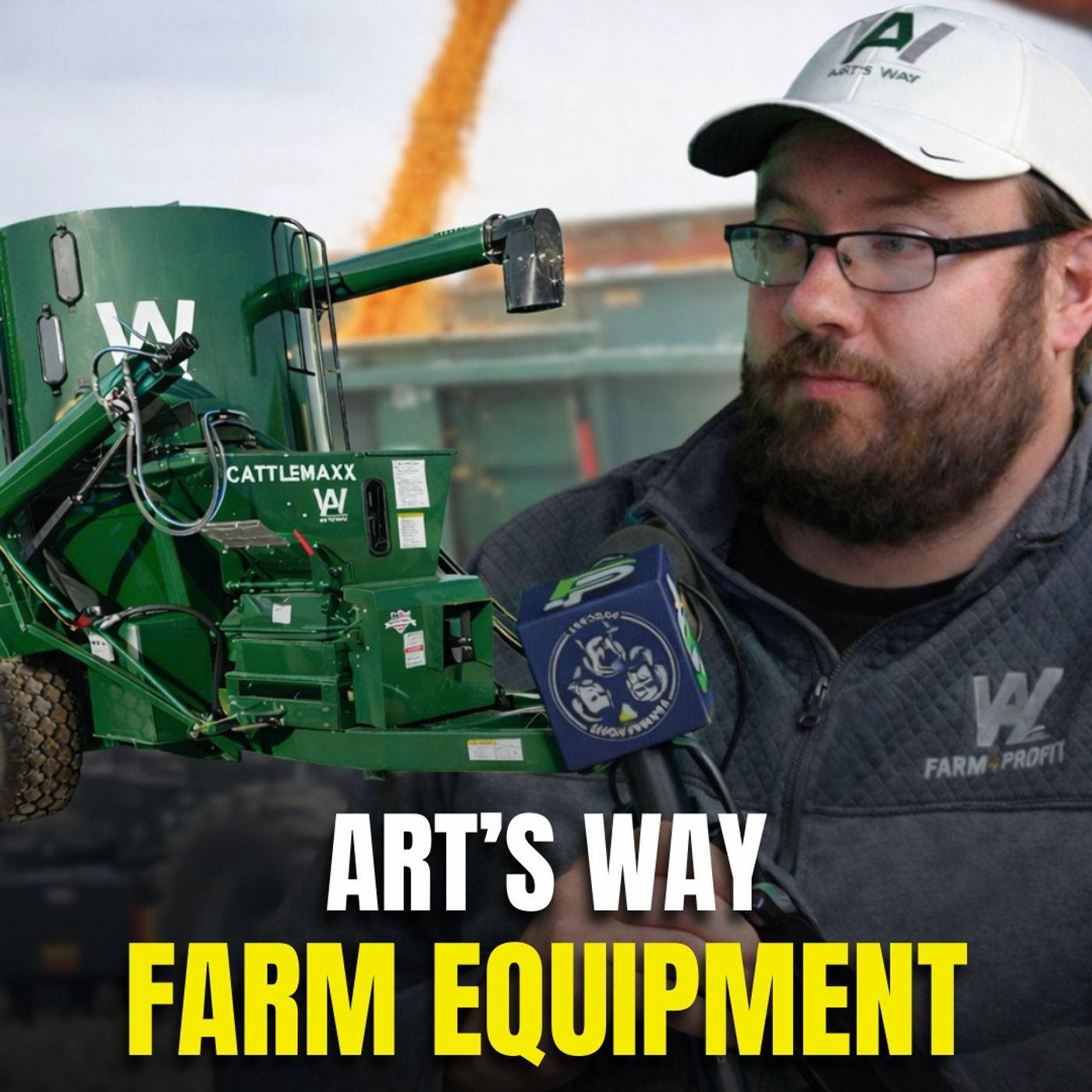
From PTO Grinder Mixer to Beat Harvesting : 70 Years of Art's Way
62m 22s
The transcription begins with an advertisement for the new John Deere 8R and 8RX 540 tractors, emphasizing their high horsepower, EVT transmission, and upgraded cab features. It then shifts to a podcast episode titled "Farm for Fun," which celebrates the 70th anniversary of Arts Way Manufacturing, a company founded by Art Luscomb in Armstrong, Iowa. The episode includes an interview with Jim Crock, an inside sales rep, who discusses the company's history, specializing in grinder mixers since 1956. Personal stories from the hosts recall using these machines for feed processing, highlighting their reliability and evolution from manual to hydraulic models. The discussion underscores the continued relevance of grinder mixers in modern farming for cost-effective, on-site feed preparation, with current models offering larger capacities and remote-control functionality. The episode also touches on promotional efforts for the podcast and engagements at industry events like the Commodity Classic.
The new John Deere 8R and 8RX 540 brings up to 634 horsepower from a 13.6 liter engine with the new EVT transmission you can now offload power for your implements. Now add reactive command steering, a redesigned cab with push button start, wireless charging, and next level comfort and you now have got high horsepower done right. Learn more from your John Deere dealer or at johndeer.com. You know those everyday changes that you're making to boost your yield. They're actually improving your bottom line in multiple ways. That's right our friends are on shore here to help you grab the tax incentives that you qualify for all while keeping your data right where it belongs on shore. They're here to help farmers identify and defend research and development tax credits using your real data. Learn more at onshore.com/farmforprofit. That's onshore.com/farmforprofit. From there, then it's a pretty healthy mix of dairy beef. There is some poultry still around that we we work with and from time to times I ran into a gentleman that had a deer farm in Texas like one of the game ranches and he used a grinder mixer to supplement his deer herd and fill up his feeders that he had out on this ranch. So there's some niche kind of uses of them. That's cool. So what came after the grinder mixer? The boy we knew conversations grew row and court even set up here. So won't you join dinner day corn group please like share with you soon made a farmer's come to bring us as a parent fun on their own son will take our mix and go. It's time for a party on today's farm for fun episode. We got a big celebration. It's not on your face. Other cheek. Oh, you're like a bug or something like your mascara is running. What? I thought shouldn't you like where's makeup? Where's making? Yeah, you got it. You're going to go now. We're having a party. We are. We're going to have a party celebrating. That was probably confetti from 70 years. That's what you hear. Oh, can a J would have to be really busy. Yeah, a J is our robot vacuum that messes up every time it works. So it doesn't work. No, just always messes out. I'll tell you the 70 years were celebrating today. They don't mess up. But before we get into that listeners conversations like this come because you suggest them connect at farm for profit.com or you send us a text 515 207 960. But this is the year of the subscription. And we're not talking about those fancy apps that tell you that you forgot to cancel your Netflix or you've got two subscriptions to Dave's auction website or whatever that is. We need you to hit subscribe on YouTube. How terrible was that? That was pretty terrible, but you did save me because I have to cancel my Apple TV. I wanted to watch F1 with Brad Pitt. I subscribe to it. And that I've probably paid for a month or two of it. Now that got me that's a habit now going and just check your subscriptions monthly to make sure you're not. I'm putting on my calendar. Yeah, so we do. We are sitting right now either at one of three locations at the commodity classic. So if you are there and for some reason the presentation you're listening to is boring enough that you've got to podcast pulled up. Come find us. John Deere, Corteva or I explore. We'll be there. You'll probably find at least one of us. If not all come and hang out. But we're excited to kick off today's conversation. Yep. Ready. Go for it. Today on the Farm for Fun Show, we meet up with a friend of the podcast that's representing a really cool Iowa company that's celebrating 70 years in business. This business was founded in 1956, specializing in grinder mixers, forage and hay equipment and crop and field tools. Also got some modular buildings and some other stuff that I'm sure we'll talk about. Please welcome the inside sales rep from Armstrong, Iowa for arts way manufacturing, Mr. Jim Crock. Thank you. Thank you. Welcome. I should have played. We're going to get Crock this party. We get it. The big one is Emperor's new groove, Cronk, Hold the lever. That has been one that has stayed with me since I don't know. I was like five, six years old when it came out. So I have a fun last name. You get to do a lot of quirky nicknames with itself. So several several months ago Jim DM me on X and see that I'm actually coming around to say Twitter. I always be Twitter and reached out and Jim Jim's a listener of the podcast and said, Hey, we're celebrating this at arts way and wonder if you guys could help us. Yeah. And Tanner goes, Oh, hell yeah. I, I, a Tanner spent many, he got really intimate with it with an arts way grinder mixer and his younger days. So he had a pretty good story. I want to get that out of the way. So I want to hear this story that you have. I think is like an Iowan. We all kind of have a story with an arts way grinder mixer. Yeah, it was one of those staples on the farm still is, but everyone has the story of that day. I mean that that job sucked so bad for Tanner that you drove him into banking. Oh man, it's about hot flashes. Yeah, we grew up for a finish hop far. You know, a lot of our listeners are familiar with that. New ones. This will probably one of the first times they got to hear that and with being fair, road to finish, you did everything. Obviously from we've been developed our own guilt. So the number of different feed rations that we had was was a laundry list. So yes, Saturdays and Sundays or if there was a day off of school or an afternoon of school when I got old enough and could lift a 50 pound bag of premix that just became my job. You know, whether the grinder mixer we had in our way was on the 4,000, you know, it didn't quite get the hammer mill spending as fast and cracking the corn as fine or you had it on the 4240 which made a little better feed. It was still a eight to 10 load Saturday, which took, you know, a good four to six hours of of your time. And I will tell you what the grinders that we had never missed a beat like it I would pray for it to break down and we'd have to order feed and they didn't and they wouldn't. Now I've screwed a lot of belts might have plugged a couple of hammer mills but ultimately you'll have that. And it was operator error more than anything or under horse power to the under 4,000 on it. But boy, oh boy, did I get really good at backing up to a bulk bin and being in just the right spot to swing that auger out. And for the longest time, we had one that was a manual swing. So you wanted to make sure you got it right with with the worm gear and the crank and everything. So I did it to where it hit and go. My favorite ones was, you know, you've seen the outside pin hog feeders and you tilt that big lid back at least you have a bigger opening. Oh yeah. As soon as we got to, you know, our gestation barn had larger bulk bins and it seemed like it the larger the bulk bin, the smaller the lid at the top got. Yes. I'm not sure who made that decision in the hog world, but your packs feeders and your two feeders that were outside. It was like a 18 foot radius you almost had to hit the target and then all your bulk bins and still still seems to be this way is like a pie plate. Yep. That's what you have to hit. So we got as I we got further into it and had more feed to grind. We did end up getting one with hydraulic swing on the auger, which I don't know if it made it easier because I felt like you just go past the whole and then you come back to the hole and you go past the hole. And so that was a game. I had some feed drivers that were pretty lazy that would try to open the bin lid with the auger and hydraulic auger. Yeah, I see that. Yeah, you ended up with a lot of ripped off bins. Yeah, yeah. So I have to crawl up every time to open them. No, they were out of the spring loaded. Yeah, did you have the handle on there? So like either we had the ones to where the handle was you pull down and then you shoved it up or you had a chain what was able to mount back. Because we were fair to finish for a long time as well. And we had the Gillis bins and they had the rod that you pull down and then you had to shove back up to get them to shut. So now there's there's a lot of memories and I still remember one Saturday morning. You know, I swear that this was a lot of the jobs that I was given as a kid was to make it so I was but I behaved like if you had responsibility. It's a lot of morning. You made choices to have your responsibility at this clock in the morning and I was I was throwing up. I didn't even make it through two bags of pre-mix, you know, trying to carry them out there. And I just was I was hurling and I was like, well, God dang, I can't he can't think I'm hung over. And turned out I just had to flew because I by the time I got to them, you know, the second load of feed, I was just shaking. I had to chill and I had a fever and it's like, I promise I'm not hung over. I am it's not the brown bottle flew. It's the regular. Yeah, no matter what fluid is it sucks. I had it. I had it a couple of times where my dad, you know, sweeping out of Ben in the middle of July is always a rough one. You're grinding feed depending on the temperature that can be a rough one to had a couple of times growing up that my dad decided to compound them. Yes. So it would be run the sweep and grind and grind feed at the same time because there's not that much left at the bottom of the Ben and we're going to do that at 630. It's not my fault that you were out till midnight one o'clock. No, I'd still remember those days, too. You run in the sweep auger and you you're constantly walking back to the door to make sure that you didn't put too much corn in. Yeah, scale. Yep. And yeah, it's there you go. That's a snapshot of my my childhood. But Dave had a very important question that he asked before we turn to mics on. And he goes, who is art because if it's arts way, we need to know who art is. So art is the founder of the company art. Luscom was his name was okay. He was up there at Armstrong Iowa technically farm near Dolver. So we're up there in northwest Iowa close to the Iowa Minnesota line. Art was a farmer that wanted a way to grind and mix feed on the farm himself have it PTO powered so actually built the first grinder mixer in his barn right up there. And it became the arts way grinder mixer because it was done arts way. Yeah. So it's kind of the first basis develop grinder mixers right just made his own. There is contention on that. So it being from Armstrong our standpoint is that art created the grinder mixer. There are a few other people out there. I believe that either new Holland or Gale. They claim that they had the first rights. As a gentleman from Northwest Iowa, I have to go with the hometown company. I'm going to say that art was the first one with the grinder mixer sell. Well, I guess listeners you should know who you think it is. If anyone has the information I will gladly be proven wrong. Oh, Google doesn't like it. It was a 1935. Oh 1935 was the Wagner wing mixer. There's no reason that they got any note or you can't even say the last name. See on the bottom there it says Herbert Johnson invented the first electric stand mixer leading to the KitchenAid brand. So I feel so A.I. is letting us down here. A.I. is letting it is actually given Arthur the first PTO powered grinder mixer. Yeah. Yeah, arts way manufacturing. Look at that. Go home and Gale's not even on there. So that's why we still make grinder mixers and they don't know. It is okay. So I stories I was telling were from 25 years ago. Okay. Do you still sell grinder mixers today still our number one line really. And in a normal year. So I've been with the company now four years, but I grew up in Armstrong. I live next to the plant my whole life. Normal year we will do anywhere between 110 to about 145 grinder mixers a year. Right now we're it's a little bit of a downturn in the ag economy. We've been shine towards the hundred 110 mark, but yes, still our number one seller. How many employees does it take to make something like that happen. So we have on staff about 65 employees. Okay. We've just got the one facility up there. That includes office people as well. So there's about another it'd be about 40 45 people in the back in production. So. So it's changed in 70 years to to the grinder mixer is still your number one line. There's got something new. Did they find a way to do rations different or better in in some sense is yes. I mean two of the biggest and like the easiest things that have progressed through the year has just been the size of the machine. So a lot of folks when they first started them, they're used to them being like 95 bushel tank machines and they had anywhere from 16 to 20 inch hammer mills on them. So we now have the 82 15 that's our largest grinder mixer that machine is a six will close to a six ton machine depends on what you have for feed stuffs what's in your diet. It's about a 215 bushel tank. It's got 26 inch hammer mill on it all self contained hydraulics on there. So you can hook that machine up to your your 40 20 your 1086. It's going to have all the capabilities to run it so as long as you got the power of the PTO. Yes. Yep. If you've got at least I like to see about 90 to 100 horsepower at the PTO, you can run that 82 15 grinder mixer. We've got a machine size smaller than that. That's about 165 bushel tank machine. That's also got a 26 inch hammer mill on it. Being as both those machines are fully self contained hydraulics, we actually send you out standard a remote control for all your discharge function. So you can stand 20 feet away from the machine, you can sit in the tractor cab, you can unload that machine with a touch of a button, swing your auger wherever you need it to go, start stop motors, open up the gate, whatever you need to do. If I had a grinder mixer that big when I was a kid, that would have taken a lot less time. You'd only need to do one load a week or a couple of loads. You still have your different rations. So I probably would have been able to break it down into four. Okay. So I've never ran a grinder mixer. I've been around them. I've never really loaded one. I get the jest. But like it's just for those that don't know, I guess, explain to me how how works. So what it does is you're starting with shell corn or barley, whatever you have for a main like source of energy, it's got an intake auger, just a little jump auger. They're now part of the self contained hydraulic systems there, hydraulically driven. You deliver corn into the hammer mill. So hammer mill is a shaft with plates on there. It's like a rotor system that has a series of different hammers blades on there. So I like to chop around a combine. It's very similar to the chopper on a combine. And that spins up and processes the grain. To get the size of micron size, grind size, you want you insert a screen just a sheet of metal with different holes punched into it that range from an eighth of an inch all the way up to two inches in diameter. With the tumbling action and kind of the spinning action as soon as the grain gets to be the right size, it falls down through the screen. It's taken away from another transfer auger and it's delivered to the mixing tank. So for example, there on a kind of cattle ration, you might want more crack corn instead of yes, you know, more of a fine. So you'd have a bigger screen. Yep, yep, go through and be cracked instead of a hog feed would be as fine as you possibly can get. And a lot of the dairy industry now wants a really fine grain in there. That leads towards it. I believe that helps a lot like the milk fat. So if it's a really fine grain, the dairy cows can get more out of it. They can absorb more of it. And that leads towards the milk fat levels. But then on the flip side, they want really high-reffaged diets. And that is then the volume of milk. So I'm not a nutritionist. I did go to school for animal science, but I did state a holiday in expression last night. Yep, one of those type of deals. But yeah, and then from there, it's got a center mixing auger in that tank that elevates and mixes the grain up. So it kind of pulls it up and then cascades it out on the sides. All of our machines come standard with a supplement hopper on the rear end so that you can add in your VTMs. Or if you're doing a protein palette, if you're doing a cattle ration, anything like that to mix that in. And then from there, it's just got a simple unloading auger and you don't really need to cracking or grinding is your bulk. Yeah. Or whatever. And then everything else is just thrown in the mix. Yep. Yep. Exactly. So. How long, how long like did you have to let it mix, Tanner to make sure you had a good ration? Yeah. So I'm not saying the way I did it. I would just leave the PTO on from what it took for me to go from the bin to the barn. Yep. And then it was mixed backed up and that was mixed. That's kind of the universal measurement of time. We state like five to ten minutes. But really, yeah, that's the universal stamp of time of I leave. I was not in road gear or nothing like I. Yeah. You took your sweet time together. Yeah. Yeah. Yeah. I mean, if you got an old corn crib and that's where you mix out of now, I leave the corn crib and it takes me five minutes to get to the barns. That's how long I mixed it for. Got it. So still kind of the same practice on that. Very cool. I just think it's cool that something that was developed 70 years ago in a way is I mean, not really that different and still your top selling items. Yes. Yep. Yep. It's it's it's good that it's our foundation. And I think it's really good that in my lifetime, I've been told two or three times that there will be never a need for a grinder mixer again with where we've taken like the chicken market, the hog market, even the cattle market, they'll never be a need for a grinder mixer again. It's been 70 years and it's still our number one seller because when I order feed for the hog side order 24 ton at a time, it gets made at a feed mill and put on a semi and brought out, you know, I don't know the pigs. I don't want the feed. I don't know. So I wonder what it would pay if you ground feed. I'd have talked to the guys. Maybe maybe you could get a second job. I could get the 40 second job. Go on. Of course job. There there's some serious benefits to grinding your own feed and I mean like the grind mix delivery a lot of times now. You're looking at anywhere between 10 to $16 a ton for grind mix delivery on a lot of custom feed mill operations. If you're own a new your own livestock say you're a decent sized hog operation still on your own hogs. If you are, you know, having a grain bank, you know, their storage involved with that as well. And there's the trucking of that corn and do it. So if you can use more of that product right on the farm less handling of it, there's a pretty good savings on it. So last couple of weeks were getting ready for marketing at a 4,000 head site. I've been ordering about 120 ton a week. Think you could get that done on Saturday morning, Tanner? Not a morning. Introducing this year's instinct next gen and insert nitrogen stabilizers featuring the same leading active as always. And now announcing nothing new because our performance still leads every competitor. Our nitrogen stabilizers aren't new. They're proven with thousands of field trials and decades of experience leading the competition. No gimmicks, no empty promises. Now that deserves some hype. Go to Corteva.us/hype to learn more. Is your main customer on that still? I'm here today 20 time hogs. Holy smokes. I mean, a lot of feed, but I mean, like an 8215, depending on your diet, close to a 6 ton machine, it take it if you're set up right with all the like how to put your beaming everything, you're making 6 ton of feed and about and unloaded in about a half hour now. Yeah. So you're talking 20 loads. If it was no transportation, you're talking about 10 hours of grinding for for like the week. Yeah. Yeah, for the week. So you could do a 20 hour job. If you just did two hours a day or two and a half hours a day, whatever. One weekend a month, two weeks a year. Yep. Yep. So is hogs still the main market or is it another guys? It's kind of a mix and it really depends on the area. So recently we've had quite a few getting sold into Ohio and like the Carolinas Virginia. A lot of that is cattle and like Ohio region. It's a lot of people that maybe used to milk. Now they're doing Holstines. So they're set up to use like steer stuffers, different things like that. So it really depends on the region. I would say it's probably pretty close to 40 to 50% of the new grinder mixture business we have is going to the swine side. There is some poultry still around that we work with and from time to times I ran into a gentleman that had a deer farm in Texas. Like one of the game ranches and he used a grinder mixer to supplement his deer herd and fill up his feeders that he had out on this ranch. That's cool. What came after the grinder mixer was well, we had the silomix feed wagon for a while. And then we also had a series of forage blowers. So many of them had a auction forage blowers or the mix wagon. They were kind of like a Kelly Ryan except like that. Their mixing action was the chain. It went over top as well. So a Kelly Ryan just delivers and then it has the lift chain. The silomix actually had a chain that went all the way around. So it actually would mix the silage. We produce those from what I think is like 1965 or 1966 till early 90s. So there's an Iowa like Southern Minnesota. There's a lot of those that are they show up on farm sales quite a bit. Yeah. That's cool. But you have a ton of other products. Tanner's got it pulled up here on the website. I mean we got dirt gra- gra- gra- gra- gra- gra- land plains. He has manure spreaders. That's the one that Tanner got all excited about too. They're always spreadin cattle manure. Up to Fargo he goes head sugar beet stuff. Yes. How does that- how does a company from the northern part of Iowa? It's- so at one point they're on the Iowa Minnesota line. There was sugar beets grown within a probably a half hour of Armstrong. I believe Mason City clear lake actually had a processing plant for quite some time. So they do the slicing or the juicing. There's a lot of different vernacular in the beet world which I'll get to kind of teach you guys now. But so in 1984 we got involved with Heath. They were a company that was a sugar beet lifting and then they also did potato equipment. And then roughly about two years after that, John Deere actually wanted to sell something. They wanted to get out of their sugar beet equipment. And that's where if you look at our design, we've got a giant wheel in the back. We call that the Ferris wheel. We got that portion of it from John Deere. Really? Yes. And so at the time the thought was that sugar beets were going to be another cash crop. That was going to be moving into Iowa more of the southern Minnesota region in it. When did you know it as soon as we get involved? At all when it- Then our normal sugar beets. Yeah. I actually had family on my mom's side from Winnebago, Minnesota. That they raised sugar beets for quite a while. My mom remembers them raising sugar beets. And it seemed to be something that we just took on this big investment. And, you know, we bought the Heath line. We got something from John Deere, which doesn't happen very often. So let's not get out of it. So we made it work. We got involved with it. And we've sold sugar beet equipment and be Minnesota, North Dakota, Michigan, Idaho, Southern California, western Nebraska, Eastern Colorado, Montana. That is interesting that John Deere wanted to sell something. Yeah, normally they don't want to do that. No one sat there and goes, hmm, wonder what's wrong here, you know. Yeah, I guess we looked the- We didn't look a gift horse in the mouth. It just took it in a random. That's interesting. Well, obviously it's still around. So it's worth it. Yes. And depending on the year the sugar beet line of things is normally our second or third highest dollar wise product line. So that kind of goes back and forth with manure spreaders. I've heard those guys are having a little tough time in the moment. Yes, I'm gonna- But it seems like it's mainly tied to again over production of- There's just no place to go. Yeah, it's- I'm limited. I've just been learning about sugarbeats here the past four years. A really good friend of mine. He married a girl from Ross, a Minnesota. So I called her up. She's in the research department for the Mendeck sugar co-op there near Wapatin, North Dakota. I call her up and pick her brain because I- Every time I preface it, I grew up with hogs, cows, corn, beans. Yeah. I don't understand this fully. It's a lot of over production in a sense. And then also I know in some areas they struggled with their sugar content this year. So it used to be the old adage in the sugar beet world was they wanted a 2020 crop. They wanted 20 ton and acre beets with 20% moisture, not 20% moisture, 20% sugar. Excuse me. There was a few guys in some areas this year that had 30, almost 40 ton beets. And then on the flip side they're getting below five year averages. They had 15 or 16% sugar. So that becomes really inefficient for the guy, your American crystals, your Mendecks, all the different co-ops that actually have to process it. It gets really inefficient when they have high tonnage and low sugar content. So it's a little bit of a rougher, rougher goal for them right now, but they're diversified in a lot of different other ways up in those like the Red River Valley and everything like that. No, wait a minute. This is an art's way sugar beet picker dumping into an art's way dump cart. But you don't have dump carts on the product page of your website. It should be on there. I didn't see him. Did you scroll far enough? That's a hate question. We do make dump carts. I'm at the bottom of the page. I'll go back up. Got my nurse spreaders, grinder mixers, landplanes. You have a silage wagon too? We have a silage wagon. We do have a series of forage boxes. They're just a different. I was interested in doing this interview to begin with because I like history and we get to celebrate 70 years. It's the all products. I wanted to talk about art and art's way. So this is a brochure. They have it on the literature. I'm going to have to get after having it. I've seen a couple of those. Skid loader style. Yep. You guys use that for bedding. Yep. Quite a bit. They're getting to be more and more common. Especially with guys getting bigger skid loaders or even like some of the smaller pay loaders on the farm now. What's the second one down? Is that like a more of a self contained unit? It's just got a two foot bigger bed. We run into a lot of guys like in the Canadian market or out west. They really like four by four by eight big squares. Oh yeah. So it's just a bigger bed on there. It's the same design. Yep. Still goes on a skid loader. The top one they can do four by four by six big squares. Most of the guys in the Midwest were all round bails nowadays. So that's what they use. What do guys use as a not an ag but for like roadside ditches and grass seeding. Yeah. We've got a mulch kit for them. That gets to be real common. Yeah. Just think about this company. It's green tack and absolute out here. And they do a lot of that. They'll get they'll buy some of the crappies bails around because they just want ground coverage. Yeah. I got a phone number. I can stop by them on my home. I do. I do. I do. I do. I do. I do. I do. I do. I do. That's fun. The company's evolved in and found different ways. Obviously, I assume the dump cart came with the harvester. I got a necessity of a pairing between the two. The dump cart actually came from a different acquisition. The dump cart came with in 2007. We acquired the Hay and Forge portion of Miller Pro. So that is where we got our forage box line and then the high dump cart line. So that was a continuation of that line. It just ended up being a natural fit with the sugar beet world that it kind of went hand in hand. Miller Pro had always used them with like some seed corn production and different things. But majority of their sales were towards silage, forage, different things like that. So we kind of introduced it into the beet world and it's been a pretty good seller for us in that area. So 900 cubic feet. If that was your grain cart, would that fill a semi? cubic feet. I've never measured. I guess we'd have to figure out the cubic feet of a bushel. I can tell you it's got 40,000 pounds of lift capacity. And so it's hard with shelled corn. But basically you'd be about two dumps and you'd have a full. That's what I was going to say. It seems like most of seed corn guys do about two dumps because you have 750 bushel fit into 930 cubic feet. And when they're doing seed corn is probably lighter. So they make sense, probably a dump and a half of. Sheld corn. We get some guys like guys that have decent sized feed lots or dairies or something like that. They end up being multi use machines. So I just want to know where you go and. We acquired this line of that company and sold this. It's like a marketplace for that. To a certain point, like when you're in the the farm equipment manufacturing kind of world. From what I've learned over the years is it's an incredibly small world, especially like the short line side of things. You know who everyone is. You know what they're doing. They have for a product line for a portfolio. They're dealer network, everything like that. So there's a lot of times that it's just kind of in passing. I believe that someone stops by and says, hey, we want to do something different. Are you looking to expand into this market? So the Miner spreaders. That's one where Roda, another good Iowa company up there in Northwest Iowa there in 2008. They wanted to go a different direction. We were the right fit. That's how we got involved with Miner spreaders. That's just a continuation of that Roda Miner spreader line. I would have thought that might have came sooner. We're making feed. What else could we do? Oh, now we need to spread the feed. We're putting it in the front side of the animal. How do we move the stuff on the backside? We vertically integrate this process. Yeah, that came around in 2008. We developed some more. So we've actually got a litter spreader now that does a lot of your poultry litter. We've done some testing with some guys using it for lime, a little bit of commercial fertilizer. Then we've also made some smaller vertical beater Miner spreaders now. So we got smaller ones for, you know, you're for Dave. For your average guy. Yeah, or like myself, because I mean, I run like 70 cows with my dad. I don't need a Miner spreader that's 1500 cubic foot. I want something that I can put behind the 4440, but still do a better job than the old. You don't want to get down on the loaders. You know, some days it'd be handy, but then it'd have to actually maybe work or fix on something around the farm. So if I spread out some of these jobs a little bit longer, I don't have to go fix something. Yeah. So this is again, something I've been around. I've never done, never owned. What is the difference between just regular manure spreader and a litter spreader? Litter spreader. It's got horizontal beaders on there, but they're a little bit different designed. They've actually got a little more of a knife and there's a little more of a, they're all kind of a cylindrical or can't pronounce right. It's cylindrical. Yeah. Thank you. Kind of design on there. With it being kind of serrated knives on there, what it does is help slice up and dice the material. It's already normally pretty fine material, but it can get clumpy at times. And then there's a back door on it with tail fins and then a series of pans on the bottom. When it kind of processes it through those horizontal beaders, it hits that back door, falls down on the pans. With the tail fins, it then allows it to get spread out completely evenly and like a further distance. How about, could you spread lime with it? Yes. We had a gentleman by Spencer Iowa that did some prototyping and testing for us. I think I've seen guys out there doing the chicken litter, new chicken litter after, but then put lime in it. Yep. Yep. It's a really good multi use machine like that. You got to be careful with lime for, you know, how much it weighs. Yep. It's a little, it's very dense compared to poultry and like chicken litter. So you have to be a little careful with that, but we have had a couple people use it for lime. Had really good success with it. So that's one that we actually came out with that. Be about two years ago was when we came out with the litter spreader. So, and we offer full rate control systems on there. So you can start off with either just a simple readout scale. All the way up to full rate control. So you can do like a variable rate. Yep. Yep. We've got a gun bore sensor in the slap gate cylinder on there. Then we also have a series of speed sensors on the apron chain motors. The also got to pick up sensor for the PTO shaft. The main shaft there. So you can do full variable rate with those machines. Gun bore sensor in the slap gate. Yep. It's a bit of a tongue teaser. I do find it fun that we're exploring the history, but part of the history is the features of the products. Because you can't stick around for 70 years and not have something that somebody wants. Yeah. Even if it's 15 of them, somebody still wanted 15 of them. Yes. And it's only more than 15, which is exciting. And I would argue it's not something Dave I or Corey set out to talk about seven years ago. But it's been fun getting to meet some of these. I'm going to say small and mid-sized manufacturers that you don't realize. Wow. You make all of this. There's an engineer somewhere that can engineer all of these different things where. You went to see the Maya Cornhead manufacturing facility in Spain. And that's what they do. That's just it. And your facility is pounding out beat harvesters next to shit slingers next to grinder mix. All done with American hard work. Yeah. Yeah. And not too many employees for as many products as you have, which is crazy. Yep. You know, we've got a it's an older facility, but we've got a very efficient facility. We've got a great team there. They're really good at what they do. We've got a lot of employees that have been with the company for 30 plus years. So I mean, our parts lady, Danette, she's been there for 30 plus years. I think she can rattle off part numbers to stock choppers from 25 years ago in her sleep. So we've got people that have just been around almost since the inception of our toy. And it is really interesting that it's like we're one of almost seemingly a dozen, if not 30 type of companies like that, especially in the northwest area of Iowa. You've got a lot of manufacturing in our area that's just been basically started out of necessity. Farmer decided I need something to make my life easier. I'm going to do it. And now it starts this publicly traded company. Is it still I was going to say is it still family owned or it's not family owned anymore. I believe they left kind of exited, went and did something different there late 90s, early 2000s. Okay. But they're still somewhat involved. They'll be around at our 50th anniversary. Art Luscombe did come and speaks to everyone kind of talked about his intentions of when he started the company and where it's gone from there. So art sadly isn't with us anymore, but plan on having a lot of the rest of the Luscombe family and attendance for the big 70s party. Yeah. What are the plans for the party? So we're going to have a quick little seminar, have a meal, going to have our local cattleman's association come make a meal for the community. And going to get a big tent and we're going to have a band. We're going to have a good old fashioned street dance. So that's kind of a summer staple in the Midwest and I, you know, for my money, there's nothing better than listening to a band drink and some bush light. So that's what we're going to do in Armstrong right in Armstrong. July 16th is a Thursday evening. So don't have too many bush lights and and ruin your Friday. Yeah. Some people you probably still have to go to work, but yeah, might have to still grind feed still might have to grind feed. Is that open to anybody or you got to like show proof that you have a grinder mixer? You get you get two free beers if you show proof of a grinder. No, no, it's open in the community open to all our vendors, different partners, everything like that. So should be a good time. We really look forward to that. So is that where you where you make them? Are you like batching building like all right, we're going to make grinder mixers this week and and maneuvers better this week or is there like certain. So the grinder mixer line pretty much we're constantly running that line all around a year. If we have enough backlog and ideal situation enough help in the floor, we can make a grinder mixer pretty much every single day if we needed to. We've got the capacity to do that with how we're set up right now. A lot of the other products like the sugar beet stuff, that's a gear up. So we're producing the sugar beet equipment for the 2026 season. We started producing a lot of the components about two months ago. We're going to start hitting welding up of frames sub frames this week and that'll lead into about two weeks. We'll start assembling beat harvesters. Is that by order only normally by order only we have had some stock inventory of it. Since I've started pretty much everything's been if it comes off the assembly line, it's sold. It's got a home. It's got a home. So some of the some of that stuff ends up being seasonal or batch made. I would say the bail processors and the grinder mixers they tend to just be kind of never stopping. It sounds like you guys are doing a lot of the parts in house between your manufacturing and all that. So that's cool. Yeah, we've got some newer end lasers and CNC lays. And then we do have some older equipment as well, but we're able to manufacture a lot of our pieces in our facility. So not quite to a point where we're trying to give Timkin around for their money and make bearings. But sometimes you don't want to reinvent the wheel. No, no, we don't need to we don't need to go after Timkin on bearing or anything like that. How hard was it during COVID to source materials? It was a challenge. You know, our purchasing group was really good. It just kind of also coincided that farmers were really looking to get a hold of some stuff. They're kind of coming two years off of COVID. So we ended up with a decent backlog from what I've heard of other manufacturing companies. I would say a lot of our products were about three to five months ahead of schedule compared to other competitors. Okay. So we got a great purchasing group. They really pulled out all the stops. We're able to find different vendors for us. That's still met the specs that we needed. I know that was always just a pinch point for a lot of manufacturers. You know, we talked to soup up about it and all that just trying to get it. You just couldn't get it. No matter what you could you could have played double or triple. Yeah, yeah, it's one of those things. Well, in the Mnur spreader world, a lot of guys that are running vertical beaters, different manufacturing groups. Burma out of Italy. I would say they have the lion share of all vertical beater business in the United States. So if you buy an RTEX, you buy a CUN, you buy an H&S, Myers, whatever company you can think of. That's a Italian Burma gearbox that's on the back end of that machine. We use one as well. That's still a lot of times the lead times are getting better, but a lot of times that's a 10 to 15 week lead time on there. And a lot of that stems from the tooling up to make that heavy flighting that people use for the vertical beaters. Nobody in the States is wanting to take that jump and get that infrastructure and start making them. It's really expensive machinery to make that really, really heavy flighting that goes inside there. Yeah, I can imagine because I've seen some Mnur spreaders. They put little small cars in or whatever. And there's some moving magic. A male processor and a Mnur spreader. I have Mnur spreader, the process is Bales. That one with the car, there's a little movie magic on that. If you watch it, that thing spliced about 15 different times. And I've heard that there was maybe one or two gear boxes harmed in the making of that one. So they did this job and made me a believer. I couldn't even tell you what brand that was. I could just tell you that every Mnur spreader that looks like that should be able to take a Geometro. It should. It really should. And as the sales guy, I believe that as well, is that I should be able to send Geometros out the back end of all Mnur spreaders. Our warranty department hates that. They genuinely hate it. I will tell you, this winter was tough because it's when it freezes and does like it has been. You end up with frozen chunks. And those can be detrimental as well. It's like throwing a rock out the back end of the spreader. We had, I think there's a correlation here. We had a dealer that had some issues with some spreaders. And I kind of know the area from selling feed. They have a lot of old concrete lots in that area. And I think the concrete guy in 1968 said, "Four inch, no rebar. Cattle will never get bigger than 1,300 pounds." And a lot of those lots are in pretty rough shape. You get some really heavy concrete in there. It's going to do some damage. Yeah, the loaders aren't small either. No, nothing. No, you scooped it out. No, nothing smaller anymore. That's kind of like spreading lime. It's close. Hard lime. Fee paris. The last couple of winters has been a really, have been really good winters to get some of them in their hauled out in the winter, especially in the upper Midwest because we haven't really, this year's a little closer to the true winter, but I don't know, the last two, three winters, we haven't really had a true winter. So when it's 40 degrees in the middle of January, you might as well go out and haul some shit. Yeah. I hope it stays like it has been. It kind of made me smile that other people were getting the snow this last week when Mike Burkehart sent 16 inches of, it's like, you know what? It's good for you guys to have a little bit of that because we had that way too early this year. Yeah, we had a lot of snow early. Yeah, thanksgiving. We had about a foot and a half right up there in Armstrong. It's always interesting to me the highway 20 line. And you can have guys will ride a snow bill on the north side of highway 20 in Iowa and on the south side it'll be perfectly clear. Probably any snow. And that one's always interesting to me that up where I'm at, I'm used to most winners, almost a foot of snow on the ground at all times, South Highway 20, nothing. Yeah. So when did you come to Artsway? So I came, would have been January of 2022. So it's been four years that I've been there now. But grew up right next to the facility. So my parents' home place is a mile outside of Armstrong. I grew up running an Artsway Grandeur mixture. We had a Artsway stock chopper. Still have that. Still have the Artsway Grandeur mixture. So I've been, been with them for only four years, but I've been kind of involved in handling the equipment since I was born. Okay. What did you do before that? I did about six years animal nutrition sales, that type of thing. So worked for a company. Did you learn animal nutritionists? I wasn't nutritionist, I was a salesman. Oh. And that's the same thing. I would bring the nutritionist with, nutritionist with and say, we can do all this stuff. They told me so. They told me so. So no, it did about six years of like feed sales. Armstrong, that's up towards Emmett County, isn't it? Yes. I'm going to go to the New York City, I'm going to go to the New York City, I'm going to go to the New York City, I'm going to go to the New York City, I want to be surprised if they come. So further than Slater. A little bit further than Slater. We might be able to try and get you some listeners there and see if we can get the furthest away award. If someone is willing to prove by driver's license, they have the furthest away award, we can make something happen. An extra free bush light. An extra. Is there any hotels and arms strong? Or were there the closest? There is a bunch of their buildings. There is a small little hotel. It's got, I don't know, five or six kind of little cabins. Your closest hotel would probably end up being Esterville or a Fairmont Minnesota. So we are a little barren for amenities up in that neck of the woods. Do you know who the entertainment's going to be? It's a local band that is going to be playing. Sometimes those are the best. Yep. Yeah. Yeah. Local cover band. Oh. That will be fun. That will be really fun. You guys got any more questions? How do we get one of these? I know, we're spreaders, so we can send a geometric through it. I think they should send us one out of everything on the website and we just play with them. We totally round on them. I've got some rental manure spreaders. I could drag you down on a manure spreader. Please don't put a Geo-material through it. If you get a toy one, go ahead. That'd be funny. We put one of those, what are the Fisher Price Kids' cars? Oh, yeah. The plastic ones, the red and yellow. Oh, yeah. Yep. Do you do any custom manufacturing for anybody else? No, we get that question quite a bit. If we do custom manufacturing, haven't really been doing much custom manufacturing for the last few years. So we try to be as efficient as we possibly can. So custom stuff doesn't always lead towards the question. I need some mini equipment for my John Deere 110 and 112. Oh, no words. You want a mini grinder mixer? I want a mini grinder mixer. Mini grinder mixer. Mini manure spreader. Yeah. We probably still have some, there are some ground drive smaller spreaders that we did when we got Rota that were like UTV pull behind stuff. We might have some parts sitting in the back and might be able to cobble one together for you. A mini beat harvester? I could come pick you potatoes. You could. You could. You could. You could. You could give it a whirl. Yeah. What about innovation? Anything new coming down the line? Are you guys kind of just sticking with status quo? We are doing some new things. So we actually came out. We were at a Sugar Beach show this last week. We actually have a new design. Did some new additions to our Sugar Beach harvester to our lifter. So we opened up the head frame and everything like that. That allows more dirt to kind of fall off or free flow through it. So with Sugar Beach equipment, it's got cast wheels that pinch and they're called lifter wheels. So it actually physically lifts that beat up out of the ground. Because of that and some guys call them diggers, they truly can dig. There ends up being a lot of dirt and mud on those machines. So by having more clearance in our head there, we're going to be able to allow more dirt and mud to fall off of it. So that's a big one that we just kind of rolled out with. Got a few things coming down the pipeline with the grinder mixer line. A few small things, few pretty big things. So tell me about this digital calculator you got on the website here with a grinder mixer. So that is a calculator that we put together that like we're all looking at the screen and it's not on the screen. It's got a map of Armstrong up right now. It was there at one point it was there. So that one, it's a calculator spreadsheet based helps you kind of figure out if a grinder mixer is a good fit for your operation. Based on how much feed you're making. So does it just always tell you yes, it's a good fit. Yes, you put in all that information. Yes, you need two grinder mixer and arts face comes up and says to grinder mixer. No, it's just some different spreadsheets based off of like beef rations. You can plug and play and put in the information that you have. So what you'd have for like a loan interest rate on there purchase price of the grinder mixer everything like that. So really helpful in determining on what size of grinder mixer you potentially might need for your operation. And really helpful for figuring out does this cash flow does this make sense to have on my operation. Nice little handy tool. It's like Tanner would geek out over that. I made it. I made it. It's a long standing. I did that while I was adding my 75,000th bag of premix into a load of feed. I was like, you know what? That day when he got the flu and he had the shivers it came in a premonition to build this spreadsheet. Must build spreadsheets. That's interesting. I've got some numbers or wording that you don't see very often. It's per pound of custom grinding feed and cost of growing corn per pound. We are usually talking bushels or acres or you know. Yep. Yep. It's yeah a little different because when you're looking at the feed side everything's tons pounds everything like that. So probably you do a little updating with it. But it's a good tool for for guys to use customers to use to just kind of understand what is the true cost of making feed or comparing it to getting it custom ground. If they're having like a big co-op or somebody like that, currently make their feed. Where does the ROI happen with it? Well, I mean obviously margins are tight in the row crop side of things. But the livestock guys have been doing pretty good. Yeah. And feeds cheap right now. So does that drive them to grind their feed or do they go, you guys can do it at the co-op. This fall I was pleasantly surprised with how many grinder mixtures we actually sold here towards the end of this fall. So now I'm close to at the point of recording here. I got close to about a three to four month backlog on grinder mixtures depending on what model you got. So yeah, I think it's kind of something that drove with it. It's really good cattle prices. You know, on big feed lots, a lot of guys went to TMR mixers. They're pre grinding and put into a bunker or something like that. But there's still some operations out there where it makes sense. One thing that I've, so I cover some of South Dakota, North Dakota, Nebraska for a territory as well. One thing I ran into is with some guys on some cow calf operations. They're two, three hours away from the nearest feed mill. So the creep feed kind of comes into play. Can they make creep feed for a decent price, reduce the amount of trucking, reduce the amount of grind mix delivery, and then have it there when they need it. And we all know that corn has gotten harder and it's easier to grow in certain places. There's a lot of corn in the West River, South Dakota now. If you can truck less less of it off the farm with a poor basis, use more of it on the farm. I think some of these cattle prices, it's leading, lending back towards an uptick of grinding more feed. Whatever that feed might be, grinding more feed on the farm. Sometimes what is old becomes new. You see another trends like that coming back? Yeah. I think we do. This is an art set at best. If our equipment works half as hard as you do, the job will get done twice as good as it needs to. Yeah. What a good slogan. What a good way to close her out. It's been a pleasure. I love the history. I love the trip down memory lane. And we love a good party. Perfect. July 16th. Yep. Be there or be square. Do you think it's RSVP? Do they need to do anything? Oh, it's going to be kind of open to the public. Okay. Yeah. Starting at what time? I believe at five. First beer is cracked at 10 a.m. No. No. Not quite that early. Maybe 459. I do appreciate you driving down and hanging out with us. It's always more fun in person. Listeners, we appreciate you. It's always for hanging out. Make sure you hit subscribe. Make sure you go to the party. And maybe we'll see you there. Yeah. Head up to the party. Crack a cold one. You deserve it. Remember, if you aren't farming for profit, you won't be farming for long. [MUSIC PLAYING] As a grower, when you take out a land loan with FBN Finance, you're borrowing more than money. You're borrowing expertise from loan advisors who are often farmers themselves. You're borrowing loan technology that makes smart decisions faster and easier. Don't just borrow money. Barrow more at fbn.com/farmforprofit. Offered by FBN Finance and its lending partners, NMLSID 163 1119, Terms and Restrictions Apply. This year, the farm economy is a tale of two realities. Livestock is holding strong, but crop producers are facing one of the sharpest income drops in decades. Interest only loans are helping producers reset. By offering three to five years of interest only payments, farmers can stabilize their finances and move forward with confidence. Visit CGB-agfy.com/farmforprofit. That's CGB-AGFI.com/farmforprofit. With the number four, to learn more, all offers to land are subject to approval, equal housing lender, NMLS number 1472. Hey Corey, remember that time you tried to get me to eat alligator? Yeah, that buzzard billy is a Des Moines. That's right. It's a great place to go, especially if you're going to be a KC Center or the Iowa Events Center or one of these farm shows, trade shows that are hitting up Des Moines, because it's just right across the street. Yeah, we know we've got a lot of listeners that are probably going to one of the farm shows or maybe even HECK, state wrestling, state basketball, all the events that are going on down there, even white toe classic. Great cocktails? Yeah, I was going to say one of the best burgers. Well, you never miss when you go to buzzard billy. So walk across the street and let them know that farm for profit centers.
Podcast Summary
Key Points:
John Deere introduces new high-horsepower 8R/8RX 540 tractors with advanced features like EVT transmission and enhanced cab comfort.
The podcast "Farm for Fun" features an interview celebrating Arts Way Manufacturing's 70th anniversary, highlighting its history and continued production of grinder mixers.
Grinder mixers remain popular for on-farm feed processing, offering cost savings and efficiency, with modern models featuring larger capacities and hydraulic controls.
Personal anecdotes illustrate the evolution and enduring role of grinder mixers in agriculture, from manual operation to today's technology.
Summary:
The transcription begins with an advertisement for the new John Deere 8R and 8RX 540 tractors, emphasizing their high horsepower, EVT transmission, and upgraded cab features. It then shifts to a podcast episode titled "Farm for Fun," which celebrates the 70th anniversary of Arts Way Manufacturing, a company founded by Art Luscomb in Armstrong, Iowa. The episode includes an interview with Jim Crock, an inside sales rep, who discusses the company's history, specializing in grinder mixers since 1956.
Personal stories from the hosts recall using these machines for feed processing, highlighting their reliability and evolution from manual to hydraulic models. The discussion underscores the continued relevance of grinder mixers in modern farming for cost-effective, on-site feed preparation, with current models offering larger capacities and remote-control functionality. The episode also touches on promotional efforts for the podcast and engagements at industry events like the Commodity Classic.
FAQs
The new John Deere 8R and 8RX 540 tractors offer up to 634 horsepower from a 13.6-liter engine, an EVT transmission for powering implements, reactive command steering, a redesigned cab with push-button start, wireless charging, and enhanced comfort.
Farmers can identify and defend research and development tax credits using their real data with help from Onshore, which assists in qualifying for tax incentives while keeping data secure onshore.
Arts Way Manufacturing was founded in 1956 by Art Luscom, a farmer who built the first PTO-powered grinder mixer in his barn in Armstrong, Iowa, to grind and mix feed on the farm.
Arts Way's largest grinder mixer, the 8215, has a 215-bushel tank, a 26-inch hammer mill, self-contained hydraulics, and requires 90-100 PTO horsepower. It includes a remote control for discharge functions.
A grinder mixer uses an intake auger to deliver grain to a hammer mill, where it is processed through a screen to achieve the desired grind size. The ground grain is then mixed in a tank with supplements and unloaded via an auger.
Grinding your own feed can save $10-$16 per ton on grind-mix delivery costs, reduce grain handling, and allow for more efficient use of farm-stored grain, especially for livestock operations.
Chat with AI
Loading...
Pro features
Go deeper with this episode
Unlock creator-grade tools that turn any transcript into show notes and subtitle files.
 PodcastTranscript AI