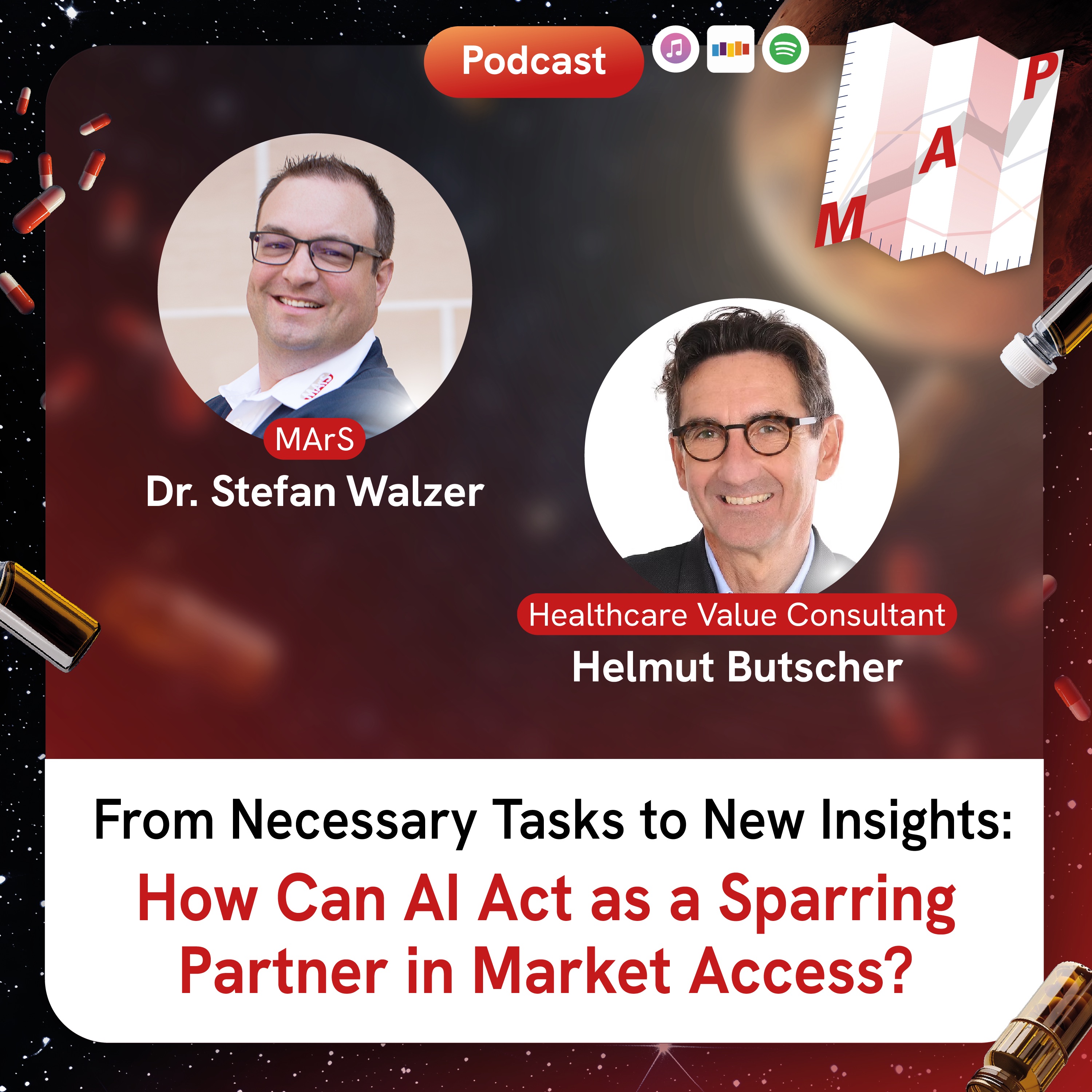
From Necessary Tasks to New Insights: How Can AI Act as a Sparring Partner in Market Access, Helmut Butscher?
39m 40s
This podcast episode discusses the role of artificial intelligence (AI) in market access, featuring insights from market access manager Elmut Butscher. AI is reshaping the field by speeding up evidence generation through automated literature reviews and real-world data analysis, improving predictive modeling for pricing and reimbursement, and enhancing operational efficiency by automating repetitive tasks. However, adoption remains cautious due to regulatory demands for transparency and explainability, as well as internal company acceptance. Butscher emphasizes that AI supports but does not replace human judgment, particularly in ethical decisions where utilitarian efficiency must balance with ontological considerations of justice and patient dignity. Looking ahead, market access managers will increasingly use AI as a collaborative tool to optimize global launch strategies, simulate scenarios, and manage stakeholder interactions, though data confidentiality and trust in AI outputs require ongoing attention. The discussion underscores that AI's value lies in augmenting human expertise to navigate complex, value-driven healthcare systems.
[MUSIC] Welcome to MAP, the bi-weekly market access podcast hosted by me, Dr. Stefan Valser. I am the innovator of market access 4.0 and the health economics by training and working in the fields of market access reimbursement pricing and health economics since 2004. Discover market access 4.0 and unveil the future with our innovative solutions. Max Insights are fast and easy AI-based reimbursement planning platform. Döbo, our new revolutionizing way of creating reimbursement dossiers across the globe with the first and only dossier writing AI bot. Cubao, our new AI-based objection-hunting platform and waffle. Train with Waffles virtual reality genius in an immersive environment and with an AI-based counterpart. We are market access 4.0. So check out our website market access 4-0.com. And now let's dive into the current discussions, processes and trends in market access across the globe. [MUSIC] Welcome to another episode of the market access podcast. Today we have a special guest, at least special guest for me, Elmut Butscher. I mean, we work as well together on a couple of different projects in the meantime and we always have had a lot of interesting and also deep discussions on the use of AI in market access. But also the topic is about for today. But before we jump into the details, I suggest him would please feel free to quickly introduce yourself that everybody knows you as well before we get into the contact. Thank you very much, Stefan, for this option to talk about AI in market access. I've been market access manager since 2009 and my role is in entry manager. I interest that all aspects of market access operations and reimbursement issues run smoothly in companies. I support organizations by integrating market access strategies with AI, design thinking and knowledge graphs that improve patient outcomes. Perfect, very good. Very good. Yeah, perfect. I think that already shows that I think you're a perfect fit this role to the topic. And I think the idea for today is probably also a bit too, let's say maybe discuss a bit or maybe a bit of a sense check as well. How well AI has already been implemented or maybe at all in the market access area. Of course, we will have a lot and big variety, a lot of heterogeneity between companies and even within companies I presume. But maybe we can take that as a kind of let's say key pathway for our discussion. But before we maybe get into some of those details, I would be very interested because I think you also see a lot of different companies, a lot of different impacts. And I think I know that you also prepared very well for the podcast. Where do you currently already see the impact of AI, a measurable impact in market access? So I mean, the field is wide, but where is it already gone beyond the hype? What we sometimes hear as well when we hear the buzzword AI? Yeah, it's a very good question. AI is reshaping, pricing, reimbursement, market access in a quite but powerful ways. It accelerates evidence generation and reads real world data at scale. And predicts pricing and reimbursement outcomes with new clarity. And I think this is a very good point, a new clarity. We have another perspective on on data. It's streamnumps workflows and supports smarter HDI preparation. Why reminding us that transparency bias and trust still matter. AI won't replace human touchment. This is a very important point for me. It amplifies it. And how we choose to use it will define the next decade of market access. And we have, I think we have three issues. Firstly, is the evidence generation. And secondly is pricing and reimbursement. And third, thirdly and finally operational efficiency. And there, we can go very deep in this cases. For example, evidence generation with systemic literature, if you use data extraction. This is a very important point for us for our daily work. And AI is already spring learning, evidence generation by automating literature, reviews and extracting relevant data from from clinical notes and research articles. This retuse manual workload and accelerates the creation of evidence packages for the market access submissions. And the real world evidence is with the idols, I think, are increasingly used to analyze real world data from electronic health records, claims and patient registries. I think this is an improvement to generate real world efficiency that informs pay-on pricing decisions, especially in areas like oncology and chronic disease or rare disease. And the second, secondly, the pricing reimbursement. It's a pleasure to have AI for protective modeling. PILOT, you have the chance to pilot it to forecast pricing outcomes, simulate reimbursement scenarios and optimize launch strategies. That's a great, very great support for me. And some health technology knowledge assessments, agency such as NICE in the UK are open to AI-generated evidence. If it is transparent and validated, automated dosy creation is also automated the creation of HDI, DOSI and other submissions. Material materials, you're choosing time. I think you're choosing time is for me a very good example how the efficiency is for AI. And resource demands for internal teams. We have the option to get new ideas for the approval for the HDI submission. And maybe you use the chance to find new data gaps to interpret it for the authorities. And the third one is the operational efficiency, the workflow automation. AI is improving operational efficiency by automating repetitive tasks, yes, the boring tasks, repetitive tasks, support decisions making and integrating predictive analytics into daily workflows. Yeah, no perfect. I think that's, this is giving a bit of a big frame. I have a couple of let's say points we can probably also discuss about it. The most evident one is probably, I mean, when we speak I know and when I follow you now, it sounds that all of those tools and platforms and whatever however you want to use or let's name it, software are being used regularly by market access managers. Is that the case from your experience or is it rather the opposite and maybe has a slow uptake or normal uptake? I don't know. Anything you can share a bit of light on that. Yes. At the moment, I see that we in the market access field, we are very transparent. We have a high transparency. And yes, there's another point is from the regulatory acceptance. And there we have, yeah, I think this is a dark hole for me because maybe they have limited adoption, the key pricing reimbursement market access. They have a look on a new AI but only a small fraction of HDI submissions currently incorporated AI generated evidence. And regulatory bodies require high transparency. We are high, we have a high transparency but there's transparency from the regulatory. We don't know exactly. So sometimes we don't understand the decisions making from the regulatorys at the moment. And the explainability is another challenge for us to show them the regulatory. And if we have AI data, if we show AI data, I don't know how is the acceptance from the regulatory for these data. But maybe we're looking to figure one step back. I mean, two things. One is transparency. Transparency is of course a little bit of a question when we use AI suddenly. I think you also mentioned potential risks like hallucination and the like. So that's maybe as well as something we would need to touch based on. So maybe the question is also how AI could influence the transparency what farmer maybe industry currently has, which is one point. And then just the other part is then also maybe before it comes to acceptability of agencies. What is the acceptability of market access manages within the industry? I mean, is everybody using it as of now and we're now just having a January 26 or is it rather still a bit of a convincing steps maybe to be made, especially when also speaking with those market access managers? What is your opinion on those two things? Yes, what's my experience since 2009? I mean, my market access experience was a very new department. So you have always the fight in the companies against the marketing and commercial departments. And it was very interesting. So in the last years, I see more acceptance of the market access managers in the companies. And they have a better, they would like to have the commercial and sites would like to have a better understanding of the way of the reimbursement, the way the way of the, well, the money is going through the healthcare system. This is very important for the decisions making. And normally, if you go, if you talk with the marketing expert, he said we have to do a lot of things with the field force to make a power in the market here. And they don't have any perspective on the reimbursement sites. And they are sometimes very astonished about if you showed them the regulatory framework for pricing all over in Europe. And where the decisions are going on and where the distance is making is done. And this is very, yes, every day, this is my every day experience of what I have. There's no sensitivity in the companies, but chances you have, if you have a look very early on the reimbursement of the trucks, the approval of the trucks, and about the stakeholders, which are included in all decisions making for prescription, often you often trucks generally. Yeah. Yeah. Okay. Yeah. So it's, I mean, it has been two components. One is the market access manager or the market access function itself and the acceptability, which might vary as well between companies I presume. And then the other one is the acceptability of AI within that kind of role. So I mean, I could imagine that of course AI can help shedding further light into the complex environment of market access and reimbursement, especially as let's say every country has its own system. But how how sure how certain can we be if we have an outcome by AI? And of course, I know that because we are that's we use and I know you do this as well. Use AI on various aspects, so it might heavily arise while on the different kind of let's take questions and areas and platforms you use. But just generally, I mean, what is your feeling of let's say trusting AI outputs in the area of market access reimbursement, especially in that's maybe as well in port consideration, what you said a bit earlier, when for example, the decision making rules or the the underlying reasons for payer decisions are not let's say not always transparent. I mean, we know what the drivers are, but it's not 100% transparent. Yeah, it's going to be. I'll give you an example. I have a story for this. Yes, imagine in a room an HDI committee is gathered. Europe is never behind. On the table lies a dossier for a new therapy, expensive, innovative, full of hope and the decision is anything but simple. In this room, two voices are present. You can't see them, but everyone feels them. The first voice is the voice of utilitarianism. Yeah, and it speaks calmly analytically, almost mathematically. And we must do what brings the greatest benefits to the greatest number of patients. Look at the qualities, look at the iser of resources are limited. So we must use the them efficiently. Yeah, this wise things in populations. It sees the big picture. This is very important, but it wants to keep as a system stable. It is the voice of the efficiency, rationality and health economics. And it's right, without efficiency and a solidarity based system collapses. The second voice is the voice of the ontology. It sounds different, warmer, more human, sometimes uncomfortable. And we have a duty to these patients, also, even if they are pure, even if the therapy is expensive, justice is not only it is about dignity and fairness. And this voice thinks in rights, principles, moral boundaries, and it sees individual. It refuses to leave anyone behind. And it's the right as well, with our justice system, it loses its soul. And this is where the true art of HDI and rising green versus market access emerges. HDI decisions are never good technical. They are moral decisions, varying technical disquease. And we often pretend the eyes are scolises, qualities, and budget impact models are objective. But they are embedded in valued attachments. What counts for whom and what costs? And now AI enters the room. AI simplifies the utilitarian voice, I think. It delivers better predictions, faster analyzes, clearer models. It shows us what is likely to happen. It makes the system more efficient and that is good. But AI cannot replace the second voice. It cannot decide what duties we have, what boundaries we draw, and what values we want to protect. Protect AI can tell us what is but not what ought to be. Yeah, no, no, I think that's a good kind of frame. I think just keeping in mind that, let's say, most of the, not most, I would guess all of the decisions are having such kind of frames. So I presume especially in the early planning, I think the input or simulations scenario planning, whatever you want to call it, can be at least supported by AI. And of course, well, we've done much faster than, let's say, what we as humans can maybe at least do as of now. So I think that is, that is of course very important. I mean, if we spin that frame a bit further, how would you see the role of market access managers in maybe five to 10 years time? I mean, you could as well be thinking about, what is it then? An AI market access manager or a market access AI manager? Or is it just a market access manager and we anyway all use AI for everything we do in this world? How would you envision that one? It's a very good question. I never thought about it. But we have to think or is the role of the market access manager in the future. I think the market access manager is the key person in a company who are responsible for the collaboration between all the internal and external decisions making for reimbursements. And he is playing with AI and finding out how we can, how suppressing is going on, your reimbursement, national, regional, European worldwide, worldwide and how we can use it for a globe for every launch. I think the market access manager will have another role must have in another role in a company. And he is, yeah, this is my experience. You have only always the collaboration with different stakeholders like GBA, like Kabeva, like Sikfan, Healthcare, Insurance companies, with the politicians sometimes. A lot of tasks to bring them together for the decisions making for the launch for new trucks. And it's a very good challenge to positioning the market access in a environment is very fast changing. And the cost, the cost pressure in the healthcare system is very, very high. So we need a louder voice in every company to be more present for the launches. And that we can support every other department to make a successful launch. For every truck, that's my opinion. I think you need to have the deconation from not only the HDI submission, it's very important to have a very good benefit assessment. But there's no pricing there. Very good pricing is not if you have a good benefit, that's a chance for a better pricing. But it's not it could be not real that you get the brass what you want. And my experience sometimes I did some launches and the CEO said to me, I would like to the price is a very high price. And I said to him, yeah, fine, I can give you the price. We can we can try it. But we have to only three or four patients. Then we get the price. And so this is the past for me. And now we are sometimes in a situation that pricing is not, yeah, they have they think in companies what we have for a new truck is the best one whatsoever have what the patients needs very high. But the price is what I very highly the relation between it's a big challenge pricing for for for me to to establish this in a normal expectation to the CEO sometimes. And I need I need more reality and more transparency in a company from a market access for reimbursement and for the HDA submissions. And I worked for a lot of companies in the past. And I see there a very big improvement for market access and more better improvement for AI generally. And so I think we we have a big field what we have where we have to work in the future. Yeah, no, I agree. I mean the the question of course always is where to where to include AI and how to best utilize it and in rich environments. I mean, would we do a lot and I think that's also probably a bit what you said in the very early part of the podcast is that we use it rather as a as a a challenging partner, right? As somebody who is basically kind of sparing partner maybe who is just discussing with us with maybe sometimes even bit of more and further knowledge than most of humans might be able to have. So otherwise I mean, market access is sounds like a clear frame, but it is very open very wide and depends also on the disease area in the country and all of the kind of different things, right? And I mean, if you sometimes have even specific very specific questions and you have an opinion, you can at least challenge yourself with of course being critical with AI, but you can have that kind of challenging sparing discussion with AI. And that's I think where I personally also use it quite a lot to further streamline the idea of course, they're still there that kind of let's say bit would we have not touched based on but would we always as well say we need to have the confidentiality in mind. Of course, we all do not want to have confidential data maybe being uploaded in jet GPT or Gemini or whatever else. I know that there are some private and commercial available tools and the like, but I think that's it's a specific to also the risk assessments within the different industry companies what they allow and what they do not allow, right? But that's something of course keeping in mind. So it's not just simply putting in a study report or a result out of the client study into such a conversation. It's rather about processes what I have just been speaking about. The same thing of course happens as well when you would want to maybe as well discuss about a potential price or pricing or an outcome of price negotiation. Of course, you can have as well given AI's, given open, or let's say publicly available AI systems as a sparring partner but do you need to as well be a bit cautious at least as of now what to use. But having said that even I think especially industry companies or they have already good internal sources of course as well. Maybe just going into one last bit which is the current discussion we all have is our primarily been driven not only by MFN in the US but I think it's reference pricing generally. MFN is nothing else that would we all know, ready since I would say centuries within Europe, right? Which is internet reference pricing. How do you think AI can streamline such a discussion or maybe even influence especially when you would be thinking maybe about global launch sequencing decisions, pricing corridors and their four as well different scenarios simulation because I think that's maybe one of the key parts where that could maybe as well help quite a lot. Yeah, this is a very good question because the launch sequence decisions are a big questions for a global launch strategy. predictive modus, I think this is a fear from AI. It enables companies to simulate launch sequences across multiple markets, factoring the regulatory timelines and payer requirements and competitive landscapes. This helps optimize the order and timing of launches to maximize access and revenue. Dynamic scenario planning with AI, market access teams can rapidly model the impact of new regulations. For example, GCR, what we have here in Europe and just launch plans in a real time. This ability is increasingly critical as country level HDI reforms introduce new uncertainties. Yes, because every new drug, a brutal worldwide and launch has a risk for the companies. And you have the chance to show them the pricing corridors with a different price optimization. AI tools analyze global pricing data, reimbursement outcomes and reference pricing use to recommend optimize pricing corridors, the different sessions between Europe, US or in Europe and reference prices from Germany and the impact for the other European country countries. For example, this helps companies anticipate price erosions and manage international reference pricing risks and line launch prices with higher expectations. You have a very good chance for modeling with AI. And the other one is the regulatory sensitivity. AI can flag a risk related to price transparency and cross-border price referencing, especially as US and EU reforms increase fraught tiny and on launch prices and price difference. And the other thing is the scenario simulations, multi-market simulations. AI powered platforms allow to complex scenario modeling, simulating the impact of different launch sequences, price and strategies and regulatory changes across markets. This supports evidence-based decisions making and risk mitigation. Policy impact analysis is also as AI and support can access the downstream effects of new policies. Now for example, US, EU, GCI, HDI reforms in different countries on market taxes. Pricing and reimbursement helping companies grow actively at debt strategies. And this very fast impact of new dynamics. It helps forecast the impact of US price controls on global launch strategies. Enabling companies to simulate alternative launch sequences and pricing scenarios to minimize negative effects. The impact and the opportunities, let's say, what AI can bring us about to that field are. The important consideration, of course, let's say how to really get into those kind of details and how to best use and utilize it in order than to frame it. And I think the time's already gone. So I think there was a lot of different insights, a lot of different thoughts how to also apply it and where to also apply it. I think that's probably also some further pieces where I think everybody in every listener can really get further and deeper into it. So I want to thank you. And of course, I'm happy to continue the discussion also beyond the podcast. Thank you, Hamlet. Yeah, thank you very much, Stefan. A further nice discussion with you. It was a pleasure for me to have the discussion about AI and market taxes. Thank you very much. AI beyond hype. That was maybe a small bit of the question of today's podcast. Key points, probably still, that a lot depends on the individual use. A lot depends also on the frameworks of the confidentiality of the security frames, which are given within a given industry and or even within a given company. Anyhow, I think what Helmut was clearly laying out, I think, was that AI can be used in a lot of different areas of market access in order to streamline, to save time and to also make the use of all of our resources, human resources, of course, included much more efficient. I think ultimately, at least as of now, we're speaking here in 2026, the human needs to be in the loop. I think that's quite clear. A very important as well is what Helmut also mentioned is these sometimes intransparent decision-making by HDA bodies, by payers, which is of course, and also the kind of question how clear and how certain AI outcomes, for example, in terms of pricing reimbursement simulations can be taken. So there are some risks, some kind of pitfalls to be taken to considerations, but clear use of AI in market access is recommended. Then finally, the kind of key question is also how does the future look like? I think ultimately, the importance of market access managers is already high and will still be at that pace, I would guess, under the role and the work of a market access manager might just simply have another tool in the full toolbox meaning AI in order to then provide the input and the strategies and the different kind of services and deliverables for the individual tasks, which need to be done by market access managers. That was an episode of MAP, the market access podcast provided by Mars, market access and pricing strategy, which is your healthcare consultancy in the German speaking markets. MAP is available every second week with a new episode, so watch out. In the case you might have questions, contact me directly and or visit our website on www.marketaccess-pricingstrategy.de. [Music]
Podcast Summary
Key Points:
AI is transforming market access by accelerating evidence generation, predicting pricing/reimbursement outcomes, and streamlining workflows, but it amplifies rather than replaces human roles.
Current adoption of AI in market access is limited due to regulatory transparency requirements, explainability challenges, and varying acceptance within companies.
AI excels at utilitarian tasks like efficiency and data analysis but cannot address ethical, moral, and justice-based aspects of healthcare decision-making.
The future market access manager will act as a key collaborator, using AI as a sparring partner to navigate complex global systems, launch strategies, and stakeholder negotiations.
AI supports global launch sequencing and dynamic scenario planning, helping model impacts of regulations like international reference pricing, but requires careful handling of confidential data.
Summary:
This podcast episode discusses the role of artificial intelligence (AI) in market access, featuring insights from market access manager Elmut Butscher. AI is reshaping the field by speeding up evidence generation through automated literature reviews and real-world data analysis, improving predictive modeling for pricing and reimbursement, and enhancing operational efficiency by automating repetitive tasks. However, adoption remains cautious due to regulatory demands for transparency and explainability, as well as internal company acceptance.
Butscher emphasizes that AI supports but does not replace human judgment, particularly in ethical decisions where utilitarian efficiency must balance with ontological considerations of justice and patient dignity. Looking ahead, market access managers will increasingly use AI as a collaborative tool to optimize global launch strategies, simulate scenarios, and manage stakeholder interactions, though data confidentiality and trust in AI outputs require ongoing attention. The discussion underscores that AI's value lies in augmenting human expertise to navigate complex, value-driven healthcare systems.
FAQs
Market Access 4.0 is an innovative approach to market access that includes AI-based platforms like Max Insights for reimbursement planning, Döbo for AI-driven dossier creation, Cubao for objection hunting, and Waffle for VR-based training.
AI is reshaping market access by accelerating evidence generation, analyzing real-world data at scale, predicting pricing and reimbursement outcomes, and streamlining workflows for tasks like dossier preparation and decision support.
AI is primarily applied in three areas: evidence generation (e.g., automating literature reviews), pricing and reimbursement (e.g., forecasting and scenario modeling), and operational efficiency (e.g., automating repetitive tasks and integrating predictive analytics).
Key challenges include regulatory acceptance due to requirements for transparency and explainability, limited current adoption in HTA submissions, and ensuring AI complements rather than replaces human judgment in ethical and moral decision-making.
AI uses predictive modeling to simulate launch sequences across markets, factoring in regulatory timelines, payer requirements, and competition. It enables dynamic scenario planning to optimize launch order and timing for better access and revenue.
The market access manager acts as a key collaborator, using AI to support reimbursement strategies and stakeholder engagement. Their role evolves to integrate AI tools for better decision-making while maintaining human oversight on ethical and value-based considerations.
Chat with AI
Loading...
Pro features
Go deeper with this episode
Unlock creator-grade tools that turn any transcript into show notes and subtitle files.
 PodcastTranscript AI