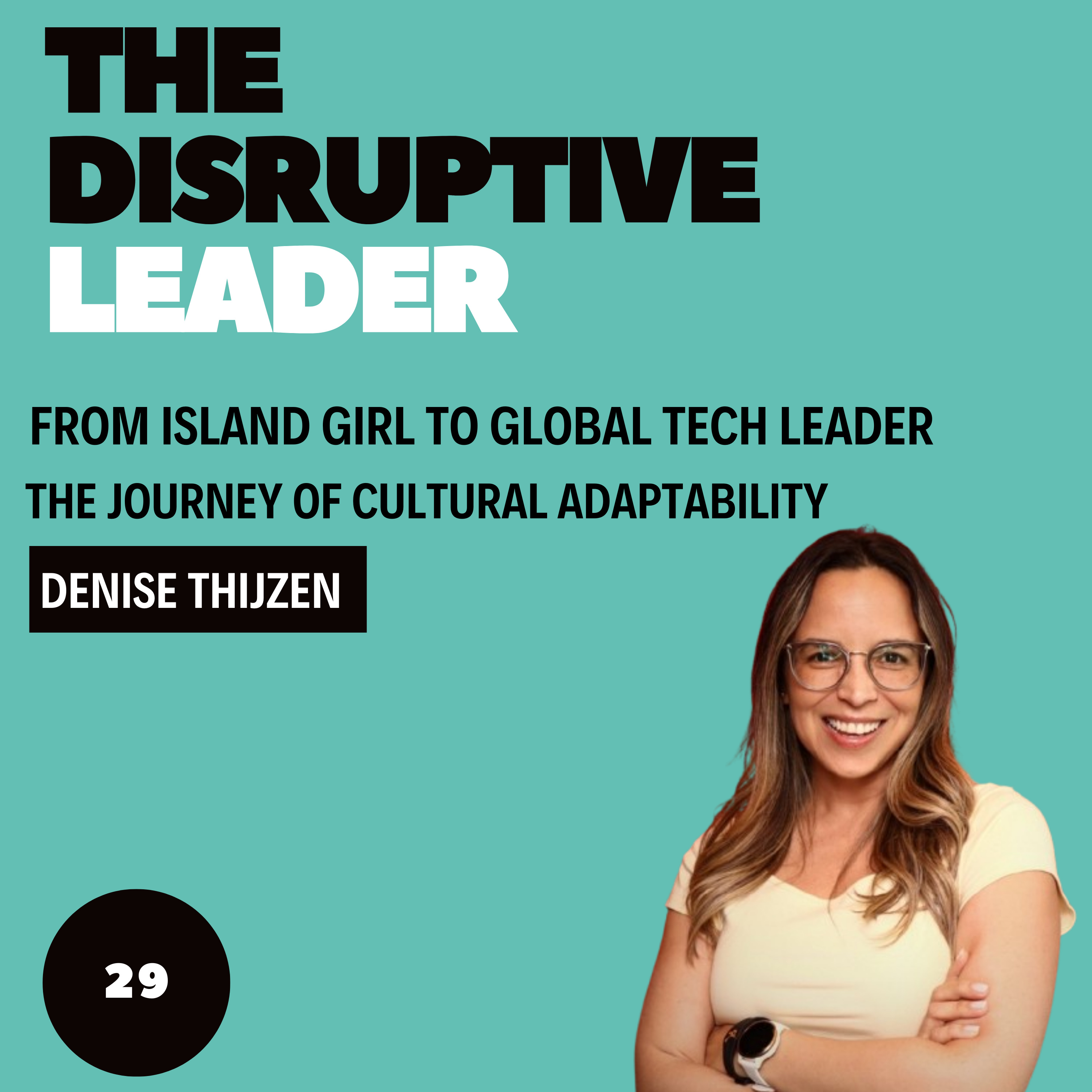
From Island Girl to Global Tech Leader: Denise Thijzen's Journey of Cultural Adaptability
from The Disruptive Leader
53m 19s
Denise Tyson, a product manager at HubSpot and former top customer success leader, shares her journey from Aruba to global tech leadership. She leads with "childlike wonder," which fuels resilience and curiosity in her work. Growing up on a Caribbean island without internet fostered creativity and community, but moving to the Netherlands at 18 for university was a major culture shock. Subsequent moves to Spain and Ireland, driven by love and career, shaped her ability to adapt across cultures. Speaking four languages—Papiamento, Dutch, English, and Spanish—enhances her product management by enabling deeper customer insights and cultural nuance, such as adjusting communication styles from direct (Dutch) to warm (Spanish). The main challenge of nomadism is the difficulty of maintaining a global network and rebuilding tribes, but she reframes home as a feeling of connection with loved ones rather than a place. At HubSpot, her success comes from a growth mindset, self-awareness, and a drive to improve daily, often by observing role models and embracing challenges. She views her multicultural background as a superpower that fosters adaptability and authenticity in both personal and professional life.
(upbeat music) - Good morning, Denise. How are you today? - I'm doing great, thanks. It's a beautiful day on my side of the world. So having a really excited to talk to you today. - Where have you done the new firm? - I'm actually in Aruba, sunny Caribbean, and spending Christmas with my family. I've always wanted to visit Aruba. I've seen pictures that beaches are really beautiful. - Yeah, they are. I went over the weekends for a quick swim and I actually swim with turtles. I cannot deny that I consider myself really lucky. So yeah. - And I think it's not only the beaches that are beautiful, it's also the food, the fruits, the peat rolls. - Yeah, for sure. - The coffee, they're really good coffee there, Rubo. - There is, but it's all imported, so we can't clean it as ours. (laughs) - Yeah, I, I, - Yeah, do you mind? - I follow. - Go ahead. - I'm gonna eat the rest. - I was gonna ask you to love coffee. - Oh, big time. I am. - Yes. (laughs) - Big time. I don't know, I feel really toast to Aruba, although I've never been there. - I'm a big yogi, so I follow a yoga. - I'm a yoga instructor, so a person in the industry, her name is yoga gol, and her husband is from Aruba. - Yep. - And so for the last 10 years, I've been here in the engineering, and it feels like home. - Yeah. - I think they moved. - I think they moved back to Denmark or Sweden. - They're Sweden? - Yeah, okay. - Do you follow her? - I know about her, yeah. - Yeah, I think I must have bumped into her at some point at some event when she was still here. Yeah. - Oh, I don't know why I'm a big big guy. The Houston-Evator Aruba, and they had the whole, (laughs) they had the Sean now. (clapping) - Yeah. - She, I learned a lot about Aruba through her. I will only bucket this book. - Amazing. - That's an amazing book. - Yeah. So for us, thank you for taking time to speak with me for everybody listening to this podcast. She's me, Denise, just did I pronounce that? - Tyson. - Just Tyson. - Tyson. - Yeah. - Denise Tyson. She is currently the product manager at HubSpot and a former top performing customer's success leader. And Denise has a very unique story that starts from European business communication all the way through to global tech product management. I don't know not only that as a career, but also as an individual and the most cultural in there. You know what, we're gonna talk about it. Yeah, I always like to start these episodes asking very well, sort of, don't know if it's an easier or difficult question that all depends. Who are you? - Who am I? Wow, yeah, that can be possibly easier complicated, depending on the day. I would say generally speaking, I am someone who leads with a tight-legged wonder in everything I do. It is like that kid that never really grows up but is now in a body of an adult kind of thing. So I think approaching life from that perspective allows you to have a lot of humor when things get rough. Obviously doesn't mean that you don't feel pain or have difficulties, but I think it helps you to at least be able to make sense of things that bounce back relatively easy. And I think it also allows you to lead into any situation with that your innate curiosity to understand why things are the way they are. And it also, I believe for me at least in my case, it allows others to feel a little bit more relaxed when coming and interacting with me. So I'd say that's on the, if I had to give myself a nutshell answer, that would be it, that child life wonder. - I love that. And they say the ultimate root to happiness is for that in your child in all of us to stay that intern. - Yeah. - Those things right here, you're the today on the head. Beautiful and out of curiosity, do you feel that child life wonder? As far as I understand, you were born and raised in a room bell, which for those of you who don't know, is a Dutch Caribbean island. What was it like growing up on an island in the Caribbean? - Oh yeah, wow, love this question. Love it because it's multi-leared, right? It's like growing up in the Caribbean. I funny enough grew up here and as a kid, I used to wonder why was I born on a hot island? Because I love cold. And I used to wonder why I wasn't born in Sweden, coincidentally, and I've never been to Sweden. And actually, I have to visit at some point. I have a good friend that lives, that is from there. We share that friend in sound. But yeah, so I used to wonder that. But at the same time, I am really aware of how lucky I was to grow up on an island where I had easy access to the beach and a really close community of people extended family. And I think the other interesting thing is that I was born and I grew up in the analog world, right? Where we, this was pre-internet. And so it was very much about going outside and playing a nature and being just very active. And I think I am now in hindsight, I'm aware of how privileged that was. And especially comparing myself to my nephew, for example, who's like digital born. I'm like, oh gosh, same island, but different perspectives. Yeah, I'd say that's it. Celebrating Christmas is weird. The Christmas tree turns brown in two weeks. But we still keep it standing there proudly. But yeah, it was beautiful. Yeah, yeah, yeah. I completely relate to that. I was born in a group at Kenyari in Lone. Fine, I'll say it in 1738 to the last thing. And it was amazing because it was literally about go out and play trees. Like we didn't have toys. We made toys out of rope and leaves. Yeah, same leaves were on the leaves. Well, our bills, we made it rain every day. Sparron, I feel what that gives you when is that in a curiosity, that sort of, I can make a lot out of, I don't want to say little, because leaves are the lost. And after that, you, well, as doing research, I understand like you moved to the Netherlands at the age of 18 and then to Spain and then to Ireland. Is that right? Yeah, you got it about right. Yeah, there may have been a few backs and forth between Spain and the Netherlands at some point. But yes, I left the island at 18 for university, which is a big shock. Going to, from Sonia, Ruba, one happy island to rainy Netherlands where happiness is depends on the sun. If it's shining or not. So that was a big culture shock, I'd say. And then yeah, I think my-- I don't know, it sounds like we're about the same age. We had to deal with a lot of recessions when I started from university. So I ended up in Spain. Love took me to Spain. I fell in love with a Spanish guy. And we'll move to Spain and fun enough because of my languages. I was able to find job really easily there. And I just stayed there for almost 10 years until I decided I needed to swap from traditional communication to digital communication. And as a result, I dipped my toes into digital advertising, publishing networks, and stuff like that, gaming sector. It was immensely fun. And that took me back to the Netherlands. And as a result, I eventually ended up in Ireland as I followed, let's say, my career path. And I think at the bottom of it, I'm like that the Arabian people, the native people from Aruba, the Indians that were born here, were no match. They used to go a lot between mainland and the islands. So I feel like that's just part of still who I am, maybe. It's just an example.
great. I, in Spanish, I say you have your butt is always moving. So that's, yeah, that's me. I feel you. I think that roofed so much. I was thinking up a song earlier this week and I'm like, if you can't live in there's being different homes. It's reached a point where once it starts feeling familiar around you, it's okay, wait a minute. It starts to move again. It's only related to that, yeah. Right. It's like the unknown is the Congress somehow. Yeah. And question, I'm guessing you speak four languages. So, I do, what's the language of a ruby? It's Papiamento. Papiamento. Yeah. So you speak Papiamento, Dutch, English, and Spanish? Yes. Yes. How do you feel if media is maybe, does it shape your approach to building global products in any way? Um, I think, I think it gives you an advantage, right? It gives you an advantage when it comes to quickly distilling feedback. It gives you an advantage when having conversations where people, when they speak their native language, are more confident and therefore probably give you get closer to their actual meaning than if they were speaking in a non-native language. So I think it gives you that advantage. But I think what it actually, I think what has actually given me the advantage is the fact that by having these languages and having lived in countries where the language was the native language has facilitated me to understand the cultural nuances. And also having worked in tech with a very broad, because I used to consult customers in Spain in the Nordics and also in the Netherlands and UKIE and even the US. So I guess that has also made me very much from a business perspective, very much aware of the economics that are involved. For example, how do you consult a customer in Spain, differs widely from in the Netherlands? And so it gives you that adaptability as well. So I think it just allows you to have context and to adapt more than the language in and of itself. Definitely and I feel that also enables problem solving skills. One of my fifth language is my brain cooperates. It's a bit of a strike, like, okay, I did just stuff with bridges. I feel, right? And I feel that in each language, like I've worked in all of these languages. And in each one, I don't want to say I'm a different person because I'm not, but I think the way I trouble shunned. Yeah. Yeah. The way I trouble each language is different than the other. So when you rub four or four and five put together, it's, yeah, it's, I don't know, you tell me. Yeah. Do you know if you didn't speak the four languages? Would your approach to problem solving building double products or leading double teams without? Yeah, I think I would say if we flip it, if I pretend to only have one language, I would think that it depends. Obviously, oh, I'm going to use the it depends in consulting. It obviously depends, but I can imagine that that having only one language does give you a bit more of a narrow way of going because that's just what you know. And so yeah, I'd say it does. I totally understand also what you said about you feel like almost like sometimes depending on the language, you may be a different person. I think I understand what you mean because for example, when I speak Dutch or I start speaking with someone who's Dutch, I can be more direct. But if I'm speaking to someone in Spain, I tend to be more warm and more collaborative, right? So I think it does. I think that's the cultural adaptability that comes with speaking language and having interacted with these with people from these countries as well. The native speaker dad gives you that edge. And then from a bit from like a I think from like more tangible for building products, it does also help you to be more mindful of, hey, for example, if my product is failing and it's having to throw an error, do we have a need, should we be prioritized in translating these error messages? Yes or no? Or are we confident with just generic ones? Is it helps you to prioritize as well, depending on the folks that typically use your product as well? Yeah. For sure. Yeah, absolutely. And on the other side of the skin, it was a super power to be able to think process work in four or five languages. But with that also comes, there's a hardship of moving so often. What do you, what has been like the hardest part of being a know-hat as you described it? Oh gosh, yeah, it's the fun, it's funny. I think I came to the realization, maybe a recent peak where I said, I'm always the one visiting my friends. I have so many friends across the globe. And I'm like, if I had to organize a birthday party for myself, it would be really hard to get maybe five of them in the place at the same time. So I think that's the hardest part is whenever you end up moving, you have to reinvent the wheel and find you're a tribe. And so it does give you that malencoly that you're like, I have all of these awesome people across the world and I get to see them maybe occasionally. I'd say that's been the hardest part. Obviously, in the case of Spain, I love Spain. I think the people are amazing. I lived a really good life there. I also miss the food and stain. So yeah, and the sunshine and just the lifestyle. Like in Spain, the work line balance was really clear. At five, you're out of there, you're going to go to grab beers with your buddies on a terrace and you're living the life. And whereas in countries like the US or Ireland, that wasn't. Ireland may be still a little bit, but it's definitely different. But yeah, those are things that I miss. Yeah. Yeah. I can relate to that. My mind, I was thinking, so I turned 46 this year. And I thought, oh, maybe I would have organized a big 50th from Rachel. But my fault. Oh, it's going to be a bit hard because people are stranded across four different continents. I think you're doing a year in advance. I have a friend who's doing it right now. She's in Germany and she's also like us. And she's already starting WhatsApp groups. Hey guys, next year and save the date. Please book your, so and people aren't going to be making it possible. So I think it's possible. You just need to start a year in advance. Yeah. That is a very good idea. They can be like start saving. Four years. Really. I know that one. And if I asked you, where's home? I would you describe them? Oh my goodness. Where is home? It's a question I honestly don't think I've been able to really answer yet. But I lean on thinking that home is when you're feeling, I think honestly, home is when you're with the people that allow you to be who you are. Right. So it can be regardless. If I'm in the Netherlands with my best friend who lives there now, the moment we're together, that's home. And so it really is, it changes, I think as long as you have people that you really can be yourself with. Yeah. So it's not a place. A feeling. It's a feeling or an experience or a connection. Yeah. Is that experience? Is that connection? Yeah, for sure. Yeah. Yeah. What about I ask that question. For me, I honestly, I struggled with it a lot. And then I think I came to the conclusion, actually, I'll tell you what happened when we were living in Chile, it's South America. When we were moving to Sweden and we had packed up everything. I remember looking at the space that we lived in. I thought, oh, my God, it's like, it's so there only for Southern, right? So then I realized, wait a minute, home isn't a place. It's not walls and roof. Home is as an individual within me. And then it's
that connection that you have with very many people in many different types of relationships around the world. So it's a big, me plus that connection with my community, my global community. And I came to the conclusion that when someone says, "Oh, so I'm very wrong." I'll be like, "Hi, I'm with Louisville, six of them." Yeah, you're right, right? Yeah, because it's like, it's self-cane. It's born and grew up in Kenya. So I'm a big part of me's Kenya. My parents are Egyptian. So I'm a big part of me's Egyptian. I did British school year, four or sixteen years, 12 years, and somebody in big part of me. And I did American University that I lived in last year. So it's a lot. Yeah. Also, describe myself. I think I had an old vintage postcard. I think it was a movie poster that had a woman on it. I think she was wearing like a hat and it was just the title was International Woman. And then we got to me, Citizen of the World. There's just no way to describe it. Yeah. And so the reason I was asking you that question is, I think at the age of 40, it fended to place and I was like, "Oh, yeah, this isn't so bad." But before that, it was a bit of a struggle. And I like to ask that question to a lot of the global citizens I am, because my daughter is 18 and I sometimes feel she's feeling why I used to feel. And so I always try to find the right answer to Gaiter. It's so bad. It's so bad. Yeah, for sure. Yeah. Okay. And then I talked a little bit about so what I understand based on the research I did, you have a remarkable achievement at HubSpot, Dublin. You won multiple awards. You're a global top performer. It'd be a hard champion in the year. Like, what's your secret sauce? Where is this coming from? Yeah. I think it's just like landing in a good place at the right time kind of thing. We're coming from. I consider what happened prior to me reaching that moment or the moment that I am in right now in my life was like a series of events, right? And having to take a lot of jobs where things were uncertain and coming from recession after recession and feeling like I wasn't maybe getting the opportunity to grow as a professional or as an individual. I think I'm very much about growth mindset. I like to be challenged as well. Moving to Dublin and starting the consulting role with a product that is so vast, there's literally so many use cases, so many type of customers. I think that was just the right scenario for me to really blossom. And it had the right amount of business, savviness that you need to come in with, the ability to have real authentic conversations and help others grow. And all of that and having that appreciation and coming in with that child, like wonder, I think is what made it really easy for me to. And also having really good people that challenged me, I had a manager that challenged me in ways where sometimes I didn't necessarily understand or agree with, but in hindsight I'm able to say that was actually a really good challenge because it really pushed me to prove that I could be on top of everything and really just that desire to grow. So I'd say that was what. That's a secret sauce. It's just walking into a situation and saying I want to learn, I want to be the best that I can be for myself and for everyone else. And having that curiosity to just. I'm very metrics driven too. So I just. It's like a competitive. I'm competing every day to win myself, right? So every day needs to be better than the day before. And so that's how all of those things came together. And when we say you've read that earlier, Jerry, who challenged you or you have done it, Growth Line Set, is that about unlearning what you already know to evolve into a newer version? How would you describe that challenging or growth line set approach? Yeah, so I think it's being open to, for example, feedback, right? You have opportunities where you're coming in with a certain way of doing things and someone may challenge you. And it may not be a direct obvious challenge, but it may be nuanced and you pick it up. I'm very. I think I'm happy, I'm very hyper-fixated on things that happen across. I won't. Any micro-expression, I pick it up and then I try to think what. I read the situation maybe. And maybe a lot of times I don't even know if I'm reading it, but I think that's the besides the point. I think the exercise is that it triggers inside me desire to say, let me. like self-awareness, right? And so with that self-awareness and that openness to feedback, it allows me to then say, how can I improve? And also the other thing is looking for people that I look up to and trying to see what do they have that I don't have and how can I attempt to emulate that by maybe observing a little bit more. So it's like very layered. So feedback can be either direct or through yourself or it can also be feedback from people you're observing. And so I'd say those are all part of the the factories that come together. Yeah. And do you think that in Benet's he to observe and pick up things as a result of moving to many new places where he was forced to be very observant and try to read the SMD and the vibe and like. Yeah, I'd say also there's a lot of family but I don't always want to. I feel like we could have a podcast focused on tech but we could also have one on growing and in different systems. But I think it's also a year starting at the family level, right? I come from a family I think this is my. I'm the only one diagnosed but very much neurodiverse and neurodiverse does give you that innate capacity to read the room. So I'd say that that is like where maybe it started and then it just continued to expand 100% as you said when I first moved to the Netherlands and even today when I first moved to a country I tend to be very quiet and I tend to just observe and once I start. Yeah, it's like almost like a little cat right in the corner just looking or out of a tree and then only when I'm starting I go, "Okay, I know it's not masking but comes with it, that chameleon perspective." So yeah, I'd say there is a fix later of that involved as well. Yeah. Are you called "chille?" You're hit a call. And Denise, so you have a lot of success customer-facing consulting and you need to shift it from without customer service helping people that amplitude of variations of personas and how you could set up a system like HubSpot to a whole technical product role which is HubSpot sound boxes and developer tools. What triggered that shift for people to help people in a way? Yeah, yeah, yeah, from consulting customers directly to wanting to go in seems basically a different approach. I'd say I think at the by the time I did the transition I had been consulting for maybe five years at the time and I had reached the principal level which meant that I was working with at the time the largest global account. And it was great. It was a great learning opportunity, got a lot of opportunities to engage with the exact C suite and HubSpot and across the customer base. But I also knew that personally I wanted, I felt like I could give much more and that I wasn't allowing my some of the parts that I really enjoy the space to grow. So think about things like being more data-driven. And being also more able to own something concrete and an attempt to build on it. So I also had preconceived ideas that for product management
Do you need to have studied like computer science or what have you? But I spoke to someone who to a friend of mine and she at the time said, why have you not attempted to switch to because you're like in consulting the only alternative is being a people manager. And whilst I think that's satisfying, I felt that I wanted maybe a different path. And so because of this conversation with this person who herself started as a marketing manager and slowly transitioned to product and is now actually at the director level, she was the one who made me start thinking, hey, maybe this is a possibility. And then, and then yeah, she threw my name in the hat and the rest was history. I joined on the sandboxes team and have been on it for three years now. Yeah, amazing. This will be a cheeky question. So how do you translate the developer speaks sandboxes? They don't know right? Different from persona into human language. Yeah. So the sandboxes story is interesting because there is an element of technical users and there's an element of non-technical users. And overwhelmingly, it is mainly used by non-technical users. Really, at those point, click users, or low-code users. And there is, let's say that part is the easy part, right? The new space is definitely the technical space, the technical user. And again, like I never remember sounding like a broken record, but it really is starting with that curiosity of, hey, and also be invulnerable, telling them, I have a little easier idea what you just said. Can you simplify it for me? Or can you give me a tangible example? Like, walk me through what it is, what, what is the problem that this would solve. So breaking it, bringing it back to the problem, because engineers can tend to, their minds are machines. And so they're thinking in patterns, they're thinking in code. And oftentimes, they may, they have a valid point that they're trying to get across, but maybe they forget to tell you what the problem is that this would solve. So it's really making sure that on the one hand, you're vulnerable and selling them, I don't understand. And on the other hand, it's also leaning into your consulting skills of bringing it back to what's the problem and trying to get to that shared ground so that you can confirm that you're understanding it. I also have to say, working with engineers has also allowed me to practice more. And I have one colleague who's amazing, Shannon, she's, she comes from a health background and she transitioned to engineering. And so I think because she's such a pathetic person and because she has that interesting path, whenever she sees engineers going into engineer speak, she will be like, this is what I'm hearing. And I'll be like, thank you, Shannon. I also use chat, I also use the Zoom AI these days. Just hit it. I'm like, please summarize this. And then I'm like, yeah, I understood all that. Yeah. And that being adaptable and being vulnerable and using consulting skills. It's a big spot on the mix of that consultic skill and working with engineers is I agree with you. I think because my role is primarily around inspirations. I'm like, gracious. I'll send them and communicating what you're trying to solve in the non-techie world, but also to engineers. It's a primal universe, but it's that ability to bridge. Yeah. You said you said something and I wanted to, I know I wrote it down. Whereas, yeah, it's what you're saying is you need to get to a point where from a technological standpoint, just enough. You need to be able to differentiate at which point you need to know just enough and at which point you need to go a little bit deeper to really be able to, for example, especially because if you have your gatekeeper for your team, I'm oftentimes having to vet. Is this this ask coming at me? Is this something that the team should be bothered with or should I, I'm like a Wonder Woman shielding things? And sometimes the ball needs to be kicked out and sometimes it needs to, right? So that's the logic. So in those moments, and sometimes you can be with just enough is good, but sometimes you need to be able to defend the deeper part. And so it's finding that balance to not shy away to go deeper. I think that's like critical. Yeah. Why not the same time avoiding going too deep so it doesn't get too complicated? Yes. Yes. Yes. I want to go back to the heart or because a lot of people might know what that is, like an Hobbespa ecosystem. It's a pixie. What is the heart award? Like what are heart values? How do they impact sort of day-to-day decisions? Honestly, I'm not going to lie. Heart was the reason why I was completely sold. I thought in love later on with the product, but what sold me was the freshness of heart. And so heart is the letters stand for humble, empathetic, adaptable, remarkable, and transparent. And actually, I think that E changed at some point. I can't remember what it was at the start, to be honest, but this is what it is. And how it translates into the day-to-day job is, for example, when there is, I think it's approaching work from a space of being humble, right? You don't know all the answers. And so sometimes leading, I think, leaving parking your ego outside the door when having conversations is essential. I'm not saying that it always is the case. Sometimes it's good to have a little bit of the determination that may come with ego, but it should be, it should come from a place of humbleness. And then I think personally for me, and transparency is another big one, right? Be really transparent as to the wise behind things. Transparency, allows people to be able to have agency and make decisions if this is okay or not, if you are hiding stuff, then they're making decisions without actually knowing the full fact. I think I lean on that a lot. I apologize when I have to, which comes with humbleness. And empathetic is really trying to understand why people are sometimes, I mean, they are. And yeah, I think the remarkable and adaptability are just, I think remarkable as a result, if you tie all of them together. And if you like are so driven that you're like every day, I want to be better, that's, but also like how you approach conversations, right? Like you can approach it from a place of curiosity and growth mindset, or you can approach it from a place of defensiveness and close-mindedness. And in those moments, you're just setting yourself short. So that's how I think about heart. I hope that makes sense to you. Yeah, that makes a lot of sense that I think what I love about it is, heart is a big context. And for example, the whole story consists of world with just the corporate environment. But what I love about it is before even talking work, it's like, how do I be a better version of myself as a human every day? Not human, centric approach. It's critical to, so I think any business succeeding, we're all big on metrics and don't raise in revenue or profitability. But without the human side, it's it falls apart somehow. Yeah, yeah. Yeah. And after you were in, you went from the Caribbean to the Netherlands to Spain, a bit of back and forth, then Ireland, you then moved to Boston in the US. I'm guessing with that, Kay, the need to build or work it across cultural team around globally. How, when you're in a role like that, we're in a position like that at work. How do you ensure that everyone's voice is heard and action, the ball, things are happened? When your team's fans, continents and cultures and languages and accents.
Oh yeah, gosh, that's so, there's so much there. I would say, I think the one thing about working in tech is especially the change that came with COVID, right? COVID made us all very much reliant on Zoom and that two-dimensional interaction, which is achy in and of itself. It removed the ability to have those conversations at the coffee machine where a lot of organic things, really good things happen. It's really difficult to emulate that. I also have to say working in products involves a mix of PM's, PM UX and, I'm just trying to be very much introverted. I think my team is highly introverted, actually. So it's really hard. You come in with that clown that is just part of who you are and you're a jokes-themed land and you're like, oh my goodness, guys, please talk to me. And I have, lucky I have a designer who's amazing, she's just Spanish and so her and I are the cheerleaders and stuff, but it makes it hard to get people, you really need to work at building psych safety, especially when you're working. You're relying on this type of engagement. And, but you also, there comes a moment where you're like, hey, if this is what I'm gonna get, then that's just it. The good thing is that we have started doing more in-person meetings and it's during those meetings that we make sure that we do a bunch of business stuff, but also after work things where we can really socialize. Yeah, it's a working progress. It's hard, it depends on the person, but I think the answer is approach it from that awareness and not giving up on still making sure that you're building the psych safety to allow people to show up as they want to and as they are. But it's tough. I have not a good answer on that. Other than psych's new city and working at it. I love that term psych safety. I think it nails it. That's exactly it. We shifted from fully remote back in 2018 'cause we couldn't hire as fast as we were growing. And it was really hard. You're a spot on it. It's hard at the beginning. But the conclusion I came to was, when you work in this digital two-diped world where you can't touch and feel and see body language and movement and smell. Yeah, it's a lot. It's great. It's, I found the, what sort of makes or breaks it is apart from having bullet proof documentation of processes and so on and so forth is, what does it take for that individual behind the screen to trust you, pick up to show up in their best or worst because we're all humanly have good days, bad days. To trust you that, 'cause you don't know what other tabs they have open, right? Yeah, you don't know what they're dealing with. You don't know what they're doing. You don't have any different slacks there, I've opened, it's a whole other world. And I think what ties it down in that trust. Yeah. It can be broken, right? It can be, especially on the digital world that we're living in, right? It can be broken literally with one thing, with one misunderstanding and it takes a lot to rebuild. And so it, I think is having that awareness of, are I am I showing up with that awareness that the person could be dealing with stuff? So I think from me, for example, I tried to lead with questions like, hey, what's going on? Do you need any help? And then, and then also sometimes daring to have it key conversations that maybe we don't wanna have, but I think having it key conversations also allow us all to come together and have understanding since yeah, it's 100%. Yeah, but you know what else I, like the flip side, 'cause I always like to, everything that was just inside the corner. One thing that I find really empowering and amazing about the sort of to the digital world is, when you're online, managing the team online, because the way it is, is a face, yeah, these are shoulders, it creates a, equality, right? Yeah, yeah. Because it's all about what it is you're saying. Yeah, yeah, yeah. I'm very sorry about it that way. Yeah. Right? When you're in a meeting room with people, it's your body posture, how are you sitting? What are you wearing? What do your nails look like? What, how tall are you? What's your physique? There's so many other contributing factors that can impact the ability for somebody to speak up or not. But when it's like just a screen, it's literally, it democratizes for power. Yeah, yeah. Yeah, and it makes, and maybe because of that, it also sometimes, if you're dealing with a group of introverts, and everybody feels like they're on the same turf, then no one really wants to, it's like when your planes skip the rope, and you need to like jump in, and you decide, and if you're doing it with various people, maybe if you wanna, is that person gonna go, or like when can it go, so it's, it just adds a layer of complexity because people are like, I don't know if I should speak up, because maybe that person will always speak up, we'll do it, and then I can plus one it with an emoji. So yeah, it definitely, it makes it, it changes the whole dynamic, I think. It's a tough one, it's a tough one. It's, yeah, it is better to say, it's a tough one, I agree, and it's also when I feel that has, like that ability to have these global teams is, it's priceless. - Yeah, yes. On the flip side of that, I think the thing that I really, have, you asked, I think you asked me, and when we were talking about this, what are some of the things that, the things you've noticed in tech, and I think one thing to piggyback off of the global aspect is I think it's just so very humbling to have, to see so many people, like someone, for example, I work with people that like a Spanish person, right, or people that have Asian heritage, and they were born and raised in a completely different country as I was, and different times of different culture, not different culture only, but different generation, and yet we all come together and we all have that desire to build and to solve problems. And so that's where all of the cultural differences and the accent or whatnot are like secondary because there's a really clear thing that we're going after, and I think it's really beautiful to see that all come together. There's obviously some of the hiccups that can happen as a result of your background, et cetera, but I think having that joint mission it makes all of these things more, yeah. - Brilliant, spot on, spot on. - And just keep a track of time like I took a few from, or it took a great, - One last question for to close this. If you were to give advice to somebody, to younger you, let's put it that way. The younger you, who was, were on that site, leaving the Caribbean, heading to the Netherlands. What would it be and why? - Oh gosh. I would say, I can answer it both in two ways. I can answer it in the way. I think I'll try to make a mix of what I'm trying to say here. I'd say, listen to those who know you best sometimes. My dad, when I was 14, 15, it was just the start of computers at the house and internet to dial up. And my dad had an HTML book and he started coding his website on a note bet on Windows. And he told me this was super difficult and there was no way I would be able to do it again challenge. And I said, okay, and I took the HTML when he wasn't using it and I started building my website. It was a, a Sailor Moon website. I just had pictures of Sailor Moon, but it had deep links in it. It was a complex thing. And then I showed it to him. And once it was done, I had to like, FTP, like all of the things, like everything. And when you saw it, he was like, wow, you.
did this. So he had me presented to his group of friends at work to show them that if a 15-year-old can do this, all of you can. And so he was very proud. And then he said to me, "This is going to be the future." But of course, I didn't listen to that. And I regret that. I think maybe had I listened to him, maybe I would have been an engineer possibly could be. But I went into the communication direction. So I'd say that's one of them. Sometimes as a kid, you don't really have a lot of sense yet. And so sometimes it's so forward thinking like my dad was, maybe that could have helped me make better decisions. I don't regret that the season that I made, but I'd say that was one thing. But then on the other side, I think the other thing that I would say is, you at the end of the day, throughout your life, you should feel empowered to make decisions that align with who you are and your values as an individual. And so it may feel scary and may bring a lot of fear and anxiety with it. If it aligns with your values and if one of my values is integrity, I am very much, I lean heavily on integrity and I cannot stand injustice. So those are the two things that I really lean on when I need to make decisions that to make sure that is this a place where I still want to continue at, is this a situation I can, I want to continue dealing with. So having, I'd say listen to those who may have good points and then at the same time always make sure that you honor your core values in any step that you take in life. So yeah, I have a little bit because that's your true sort of core purpose. And if you're not aligned with that, you're like not really living. Yeah, I don't want to be losing sleep. When a lot of times you end up losing sleep when your actions are not aligned with your values. Yeah. You're having a problem with that of this favorite point. So for a great, you need, this has been an incredible conversation. It's really, it's really refreshing. Thank you. Yeah, thank you for inviting me. I was really looking forward to this. I think this is a beautiful way for me to wrap up my year. I love having authentic conversations. So I appreciate you inviting me to dig into a lot of the topics. So appreciate it. Super happy to end up posting you and have a wonderful vacation, the beautiful Karen Bid, keeping that curious child, - Thank you. - Thank you. - Thank you, Denise. And see you soon. Let's stay connected. - Alrighty. Thank you. - Thank you. - Thank you. (upbeat music)
Podcast Summary
Key Points:
Denise Tyson, a product manager at HubSpot, discusses her multicultural background, having been born on Aruba and lived in the Netherlands, Spain, and Ireland.
She emphasizes leading with "childlike wonder" and curiosity, which helps her navigate challenges and fosters authentic connections.
Speaking four languages (Papiamento, Dutch, English, Spanish) has given her cultural adaptability, aiding in product management and customer consultation across different regions.
The hardest part of being a global nomad is maintaining relationships across continents and constantly rebuilding social circles.
She defines "home" as a feeling or connection with people who allow her to be herself, rather than a fixed location.
Her success at HubSpot stems from a growth mindset, willingness to be challenged, metrics-driven approach, and self-awareness gained from observing others.
Summary:
Denise Tyson, a product manager at HubSpot and former top customer success leader, shares her journey from Aruba to global tech leadership. She leads with "childlike wonder," which fuels resilience and curiosity in her work. Growing up on a Caribbean island without internet fostered creativity and community, but moving to the Netherlands at 18 for university was a major culture shock.
Subsequent moves to Spain and Ireland, driven by love and career, shaped her ability to adapt across cultures. Speaking four languages—Papiamento, Dutch, English, and Spanish—enhances her product management by enabling deeper customer insights and cultural nuance, such as adjusting communication styles from direct (Dutch) to warm (Spanish). The main challenge of nomadism is the difficulty of maintaining a global network and rebuilding tribes, but she reframes home as a feeling of connection with loved ones rather than a place.
At HubSpot, her success comes from a growth mindset, self-awareness, and a drive to improve daily, often by observing role models and embracing challenges. She views her multicultural background as a superpower that fosters adaptability and authenticity in both personal and professional life.
FAQs
Denise Tyson is a product manager at HubSpot and a former top-performing customer success leader with a unique career path from European business communication to global tech product management.
She is from Aruba, a Dutch Caribbean island, and speaks Papiamento, Dutch, English, and Spanish.
It provides an advantage in distilling feedback, understanding cultural nuances, and adapting to different business contexts, such as consulting customers in Spain versus the Netherlands.
The hardest part is having to reinvent the wheel and find a new tribe each time she moves, which can lead to melancholy from having friends scattered across the globe.
Home is not a place but a feeling or connection—being with people who allow you to be yourself, regardless of location.
Her success comes from a growth mindset, childlike wonder, being metrics-driven, and having managers who challenged her to improve, combined with a desire to learn and compete with herself daily.
Chat with AI
Loading...
Pro features
Go deeper with this episode
Unlock creator-grade tools that turn any transcript into show notes and subtitle files.
 PodcastTranscript AI