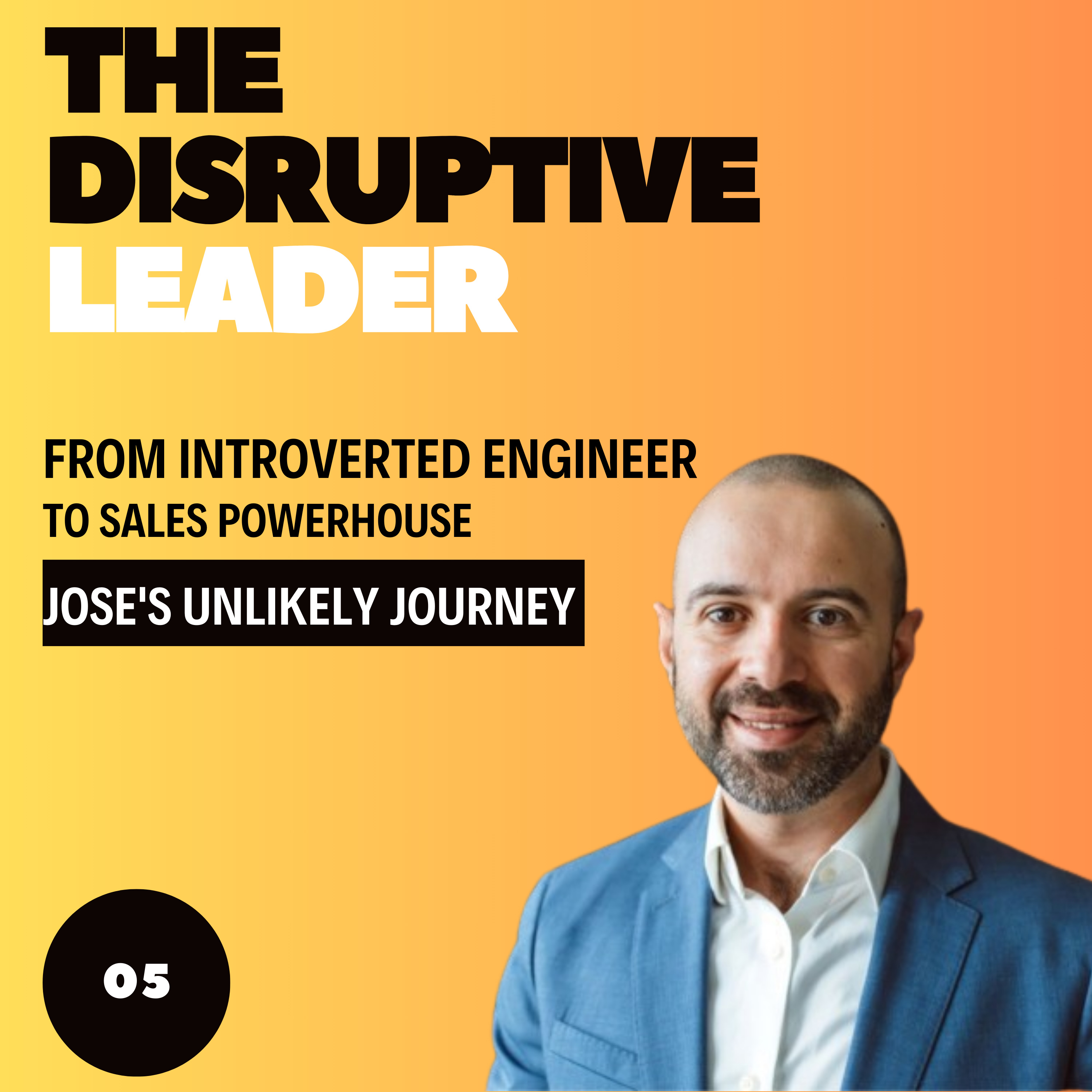
From Introverted Engineer to Sales Powerhouse: Jose's Unlikely Journey
from The Disruptive Leader
24m 14s
In this conversation, Jose shares his journey from being an introverted engineer in Venezuela to a top 1% sales performer at HubSpot and now a sales manager at Datadog. He explains that his initial engineering path was not financially rewarding, prompting a shift to business via an MBA and migration to the US. Embracing discomfort, he uses a "minimization of regret" framework, inspired by Jeff Bezos, to make bold career changes, acknowledging the fear of future regret but prioritizing growth. In sales, Jose notes that standard performers follow the playbook, while top 1% break it by innovating—like his strategy of coaching partners instead of handling all discovery calls, which scaled his influence and led to consistent success. As an introvert, he distinguishes introversion from shyness, emphasizing that social interactions deplete his energy. To cope, he creates recharging spaces, such as taking 15-minute breaks in restrooms or using meditation apps like Calm to center himself. He advises other introverted salespeople to prioritize self-care through short breathing exercises or walks. The discussion highlights the importance of self-awareness, humility, and adapting strategies to thrive in competitive environments while managing personal energy.
Hey Jose, good morning. How are you today? Hey, Rania. Good afternoon, I think. Yep, that's right. Hello. How are you? How are you doing? I'm doing very well. It's so great to see you. It's been, it's been a while. It's been, how many years has it been? I've been thinking about that lately because I got a couple of people who I used to work with and did that and helps, but from partners reaching out. I'm like, wow, it's so cool that we developed these relationships and we went through so much together. And it's been a while and then I started counting years. I left the partnership team for LaRam in 2019. It's been five years, more than five years. And I still will talk with you with some of the other really good relationships that I built that we've built during those years. I think we've won't see us today. I won't work together. I can, I can not totally resonate and I think what was different five, six years ago is the human somehow was still a little bit of work and what I'm finding. The human is slowly disappearing. And I think we all need to just come back and have a bit of a reality check. And yeah, so a thank you for taking time to speak with me. I really appreciate it. And I'm sure the listeners of this podcast will appreciate it because I say, you have an amazing journey at least the one that I've gotten to share with you. As an introverted engineer. Transitioning to sales powerhouse. Yeah, one of what top one percent sales performer, a hop spa and everyone knows it's super competitive there. And now sales manager, a data dog, so kudos to that. So why don't we start with why don't you share your background as an introverted engineer. Yeah, of course, I know far back, I would start, but yeah, my training is an engineer and the introverted has nothing to do with the professional right? The introverted is something that you just grow with and it's called like, I know you. Your family, you have your kids and your husband, I have my daughters and I have two daughters, but I can see how we give them. The same opportunity, same love, same information, same everything and they just have completely different personalities. The same for me, me and my sister, we had very different personalities. It was interesting because I think I grew up in the 80s and back then the extrovert personality was like the most popular one. The introvert part was really not, I wouldn't say it was just eyes or frowned upon, but it wasn't like cool to be introverted, it wasn't cool to be an nerd. I was, so that meant a pretty, pretty lonely childhood, right? For me it was just a very few friends. Two or three, two these days, very few friends. One thing that I have to grow with is that fact that it's a more of a lonelier person, more of a enjoy more of my time alone. I enjoy human beings, I enjoy being with them, it just drains your energy. And so when you go to school, those systems are not set up for introverts. Schools are not set up for introverts. Colleges are definitely not set up for introverts. But if you're in engineering, it's a little bit easier, right? Because you have to start a lot, you have to be lapse a lot by yourself. So that makes it a little bit easier to be an introvert. And so, earlier in my career, I was working at a manufacturing facility and I was enjoying just going on their machines and seeing how they worked and, in diagrams and figuring out how to make them work better. And I realized one day, I get a sense of how much the plan manager was making and, and then I realized, wow, it's like a really successful career to get there. And it's just not very well rewarded as a career. And then when I was seeing people in business that like wow, they're like making a ton of money from the get go. And so for like a financial perspective, I realized pretty early in my career that engineering path, at least where I was, what I was, which wasn't Venezuela was not a financially smart path to pursue and business was more like it is. What I found was that business has a lot of like scientific thinking behind it and there's a lot of like problem solving behind it. So like you can actually apply a lot of the engineering skills to business and then perhaps have a more financially rewarding career. So I switched to business. I did an MBA migrated to the US in part because I think you probably and I you and I share a little bit of the same story where with our countries were going to hell. So I like there's no future here. So where do we go? And in my case, I migrated to the US, an MBA and start working in business. And as you would think coming to this new country with all the opportunities, my biggest draw was entrepreneurship. And I want to start something from zero and blank page and build a business and it was really. Immediately what I found out that in first is really hard to be an introvert entrepreneur. And second part of the reason is there is no entrepreneurship and there is no growth in a company if you cannot sell. And thankfully that that venture failed pretty quickly. And my first move after that was I need to find a job in sales and to develop this skill somehow. And then after I do this for two years, I'll go back and start a company. And then of course, three years became 15 years and now I'm here. It's pretty cool because you get to do a lot of the entrepreneurship stuff. You have a little bit of control of your career financial success in sales. We got a lot of the stress that comes with being an entrepreneur, which is a lot. It's not for everyone for sure. So that's how I got here. Oh, well, that's. That's pretty outstanding. And as you were talking, there's a couple of things that sort of cross my mind is like you that transition from Venezuela to the US from engineer to business from business to sales. That's like popping a comfort zone over and over. What's the scariest part of leaving your comfort zone and how did you overcome it? That's a great question. The toughest part is. The toughest part is the feeling of future regret. So will I regret this change? And so what one one framework of like decision making that I've always loved is by someone that made it today is not as well like maybe he was 10 or 20 years ago, but like Jeff Bezos. When they asked him, hey, Jeff, I don't know if you know the story, but he was like a very successful BC person or financial person. Very successful career of fast track to be a B p and financially just be very well well done. And he decided to leave a very short. Astronomic career and finance where he was going to make. And start this company selling books online with something named the internet that wasn't like really. No one was really sure what was going to happen was. And they asked him how they made he made that with decision and he talked about the minimization of regret and it's like, alright, what am I going to regret? Now I'm the line when I'm like 60 or 70 and I look back at these decisions that I had to make. And he said, what I do is I want to say, what would I regret the most doing? And so I use that a lot too is what would I regret most doing? And it is hard because when you make a choice of change like recently this year I left helps.
but for after eight years, that is a big change to a new industry. And when you're in a company for eight years to build a lot of brand, a personal brand, you build a lot of network and relationships. And it's really hard to live that behind. And so I came back to this framework of minimization of regret. What will I regret more having done this new adventure going to a new industry and maybe prove to myself that I can succeed somewhere else and I just succeed once at this great company in the HubSpot. But it's still scary. It's still scary because on the other side of a minimization of regret is the possibility that you actually will regret making that move. Yeah, that's how I look at it. That's the first thing. The second thing is as you probably have gone through this as well, it takes a lot of humility to make change. It's the way you get used to be successful in a certain context may not work at all in a new context. So you have to come humble and realize there may be some there's real things here. But for the most part, there are a bunch of new things that will have to develop from zero and make mistakes and make a full out of myself at times and you have to be okay with it. And so once you get used to that and you do that a few times, then it becomes a bit easier to make these big changes. No, that's really solid. Both sort of approaches that you mentioned are on point. Like minimizing what am I going to regret more? Doing this or not doing this. What's the worst that can happen? Yeah, that's it. I'm talking about your like taking that decision to leave Hubsbot after eight years. You were a top 1% sales performer at Hubsbot. What does it take to excel in such a competitive sales environment? What's the superpower that's needed? Wow. Sadly for people listening to this podcast, a lot of it is just luck. Right. It's just things are lining at the right time. A lot of it is that. And the only thing is of course you and what's in your control. And so. Or me and I've actually shared this with like SDRs and data. And I've been thinking about their careers. And being a top performer. The way I see it is to be like a standard performer at a company. Let's say in sales, you want to just get to your quarter. You have to do the things that are in the playbook. You have to do the things in the playbook and you have to do them well. And then you'll be a good solid performer. 100% secure job. Nobody's going to like. You're not going to get fired. And the second like degrees like in sales. I'm going to only talk about sales is that fresh is club level. Well, you're like the top 20%. Top 20%. Yes, you're doing that playbook, but you're just doing it significantly better than the rest. And you're just doing it more. So like either you're out working everyone else, but you're also like. Remarkable at doing the same things that other people are doing. If I think of someone that comes to mind in that area, it's like the big tors, which you know. And so like when I saw the beat run a discovery call versus like anyone else that was good, it was just like lights out better. So she's like doing those foundational things just much better than the rest. So one percent requires doing something different. So you break the playbook a little bit and you just do something that no one else is doing that's. There's just no way to stand out in a very competitive environment doing the things that everybody's. You just have to do something different. And I think that's where luck came for me. And I think that great partners like included you and an easy. Or just very smart driven individuals who wanted to be very successful and that was very helpful. And the second thing is in a line with me meeting John Machado, who was a great teammate. And with both were looking for just something different to do. And then we also coincidentally met this person that you also known in the entire who was developing this training programs for partners. And they were doing this kind of as a as an added benefit for the partner program. But then John and I saw that and took it as something programmatic that we wanted to do with all of our partners. And we started doing that. Then it just took off. So as most. Sales people in a role that I have were just very good at this cover calls and driving an opportunity and helping partner schools deals. We completely changed. We're like we're not going to be any of those discovery calls are mostly not. So we're going to spend 80% of our time just coaching and training partners so that they can do it by themselves. So now I didn't need to be in a discovery call, which there's a limit to that I can only be in like probably 20 discovery calls every week. And that's a lot. But if I can train partners to do it by themselves, then I could influence 100 discovery calls every week. So just the amount of opportunity and pipeline and growth that came from that was just remarkable. That's where both John and I were just. Probably close to 100% of for attainment every year after that. Yeah. That's good. That's that's very wise. It's assist coach empower train. And I like that you use the word influence those discovery calls because you don't have to do the discovery call. But if you influence your partner to do it really well, you succeed with them. And as you were talking about training the partners and coaching. How. How easy or not. Or what does it take to coach extrovert personalities when you're an introvert yourself. Because sales. Sales people like. I don't like to generalize, but in general, there's a sales personality. And it's sort of given this definition of what a salesperson is like. And not often you think an introverted salesperson, although now we know actually that. Introverted salespeople are much more successful than extroverted because of the active listening. How do you coach extroverted salespeople as an introvert? How do you bridge those two worlds together? That is a great question is potentially easier than introverted people. I probably should clarify what it means to me to be introvert an extrovert. There's an I there's this great book called. I think quiet. And. And it talks about introversion and extroversion and it talks about shyness as two different things. And so it talks about someone like Bill Gates is an introvert but a non shy introvert. And the reason that's important is. When I think of introvert and extrovert is an introvert will have the same human interaction with an extrovert. I don't have a human interaction. I don't have a discussion or whatever conversation at the end of the conversation. The extrovert is more energize. At the end of the conversation the introvert is depleted. So for me was not so much about how do I handle others is how do I handle myself. So the way I found to handle myself is how I had to create spaces to recharge alone. Now in and off is that was hard. So my trick which I guess is a little funny and awkward but I'll share it anyway. It was I would go to the restroom and lock myself in a stall for 15 minutes. Is to just reenergize back up and so I think probably people probably thought I had a gastrointestinal problem because I was going to. I'm so much and for so long. And to this day they still do that I still will go to now that we're. After COVID there are some companies come back to the office definitely data dog is one where we go to the office. Three of the five times. Of the week of the season by days. I'm taking care of myself and it's going to help me be more effective in my job. Back to your original question. Yes. How do I handle those conversations with the actress is more about handling.
myself and recognizing I am going to be depleted at the end of those conversations. If I have back to back meetings, I need to build spaces so I need to manage my calendar. I build spaces to go and not talk with a human being. It's been challenging in my personal life because when I come home after all they interacted with people and my wife is an extrovert, you know her right? She's an extrovert. And so she wants to talk and when I become home I want to just not talk with anyone. So sometimes I'll just stay a little longer in the car before I come in or if I come in and no one sees me I just go into the restroom real quick and I'll be there for like 15 minutes and I'll reach out before I actually speak with her. I love that and I love the self-awareness that you have and that you're describing and what you need because to be a good coach, to be a good leader, to be a 1% achiever, you need to have that self-awareness because you need to take care of yourself first before taking care of other people just like in the plane. You go to put the oxygen mask on you first before someone next to you. And I'll ask you one more question. You mentioned you go to the restroom and lock yourself in there for 15 minutes to recharge which I could as you're talking I'm like, oh maybe I am an introvert too. What is one tool apart from the restroom that you feel would add value to other introverted salespeople besides that really good hiding spot? What's like an essential tool that you would recommend someone to use to help? Meditation the calm app has been incredibly helpful for me because it's just it's pure alone time with your thoughts and it's helped me recharge a lot. I just center myself back again. That is hard to do. What I've learned is to not think of meditation as first you need to be in a room with candles and like music in and have 30 minutes although that would be great if you could have that as well during the day that's hard. See even if you can just go out on a walk around the block I've done that. Take the elevator, go downstairs, just walk around the block for 10-15 minutes and just breathe. That's helpful. And if you don't have that take two to three minutes, close your eyes and just breathe. That's been helpful too. And that breathing will silence the mind, it will bring you back to center, it will ground you and then you can start cold two or cold three and so on and so forth. Okay that's take your advice on that one. How it works out. Super, we have to summarize this because I have to start a discovery call. Yeah but this has been really helpful. I appreciate the very valuable insight that you shared I'll say I'm sure the listeners to this episode have no doubt we'll appreciate it because this is all very high-value human-centric experience and suggestions that you're providing. So thank you for that and thanks for your time. It's been really nice talking with you again. And mehunoz maybe in a couple more weeks we do another episode and take another deep dive into other topics that I feel you could add a lot of value. I would love it. Thank you Ranya. Thanks so much Jose. It's been really good to connect with you and I will see you soon. All right bye. All right bye.
Podcast Summary
Key Points:
Jose, an introverted engineer, transitioned to a top 1% sales performer and later a sales manager, using engineering skills in business for financial growth.
Leaving comfort zones, like migrating from Venezuela to the US and switching careers, is driven by minimizing future regret (inspired by Jeff Bezos) and requires humility.
In competitive sales, standard performers follow the playbook, top 20% excel at it, but top 1% break the playbook by doing something different, such as coaching partners to scale influence.
Introversion means being depleted by social interaction, not avoiding it; Jose recharges by taking breaks (e.g., in restrooms) and using meditation apps like Calm to manage energy.
Coaching extroverted salespeople as an introvert is manageable by focusing on self-care, such as managing one's calendar and creating quiet spaces to recharge.
Summary:
In this conversation, Jose shares his journey from being an introverted engineer in Venezuela to a top 1% sales performer at HubSpot and now a sales manager at Datadog. He explains that his initial engineering path was not financially rewarding, prompting a shift to business via an MBA and migration to the US. Embracing discomfort, he uses a "minimization of regret" framework, inspired by Jeff Bezos, to make bold career changes, acknowledging the fear of future regret but prioritizing growth.
In sales, Jose notes that standard performers follow the playbook, while top 1% break it by innovating—like his strategy of coaching partners instead of handling all discovery calls, which scaled his influence and led to consistent success. As an introvert, he distinguishes introversion from shyness, emphasizing that social interactions deplete his energy. To cope, he creates recharging spaces, such as taking 15-minute breaks in restrooms or using meditation apps like Calm to center himself.
He advises other introverted salespeople to prioritize self-care through short breathing exercises or walks. The discussion highlights the importance of self-awareness, humility, and adapting strategies to thrive in competitive environments while managing personal energy.
FAQs
The speaker realized engineering was not financially rewarding, so they switched to business via an MBA, then into sales to develop selling skills. They applied engineering problem-solving to sales, which helped them succeed.
They used Jeff Bezos' 'minimization of regret' framework, asking what they would regret more at age 60 or 70: making the change or not. This helped them decide to leave a stable role for new opportunities.
Standard performers follow the playbook well, but top 1% requires doing something different, like breaking the playbook. The speaker found success by coaching partners instead of doing discovery calls, influencing more deals.
The key is managing one's own energy, not changing others. The speaker creates recharge spaces, like locking themselves in a restroom stall for 15 minutes, to avoid depletion after interactions.
Meditation, using apps like Calm, is helpful. Even short breaks like a 10-15 minute walk or 2-3 minutes of focused breathing can silence the mind and ground you.
They spent 80% of their time training and coaching partners to run discovery calls themselves. This allowed them to influence 100 calls per week instead of just 20, boosting pipeline and growth.
Chat with AI
Loading...
Pro features
Go deeper with this episode
Unlock creator-grade tools that turn any transcript into show notes and subtitle files.
 PodcastTranscript AI