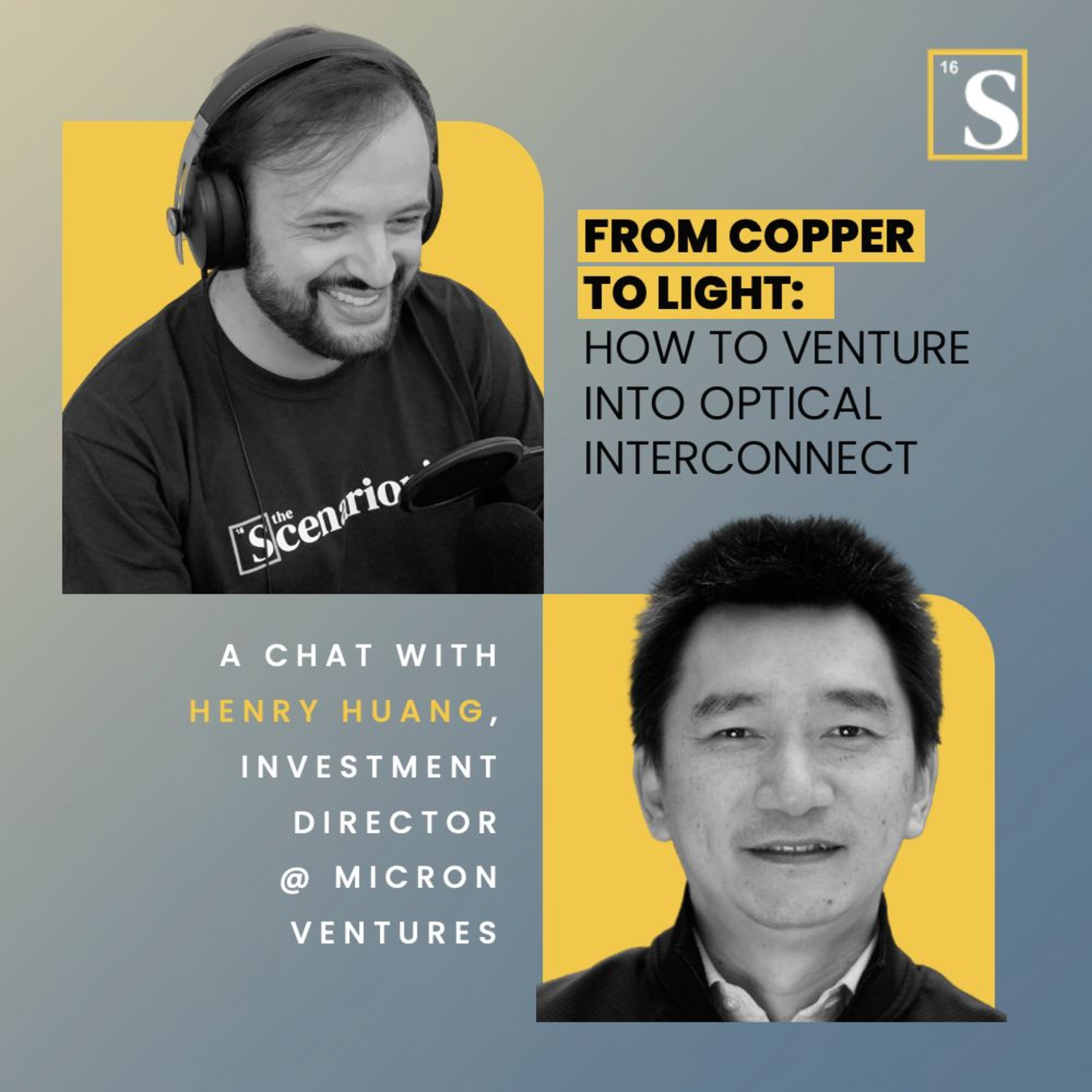
From Copper to Light: How to Venture into Optical Interconnect. A chat with Henry Huang, Investment Director @ Micron Ventures
from Deep Tech Catalyst
23m 6s
The conversation with Henry Wang, Investment Director at Micron Ventures, explores the role and challenges of optical interconnect in AI infrastructure. Optical interconnect uses light to transmit data, offering significant power efficiency and speed advantages over copper, but its higher cost remains a barrier to widespread adoption. Technical challenges include developing reliable light sources, modulators, waveguides, and managing thermal issues, all while ensuring manufacturability at scale. Innovation spans component-level solutions, such as micro-LEDs or thin-film lithium niobate modulators, and holistic system approaches, with startups choosing between niche or broad market strategies. To succeed, startups must meet evolving speed standards (e.g., 1.6T), demonstrate superior energy efficiency and bandwidth density, and prove cost-effective manufacturing through high yields and fab partnerships. Hyperscalers often have in-house expertise, so startups need to align with their roadmaps and find appropriate manufacturing partners at their stage. A practical example is HyperLight, which targeted test equipment applications to refine its process and revenue before expanding into larger markets. Ultimately, success depends on balancing technical innovation with cost, scalability, and strategic go-to-market planning, as the ecosystem improves with large players like TSMC entering silicon photonics manufacturing.
Some companies focus on one specific component or one specific stage of the overall fiber optics link and could be very successful. Some companies focus on the four holistic solutions. It's a much bigger vision. If it works, the 10 is much bigger, but it's also much harder as well. Welcome to Deep Tech Catalyst, the channel by the Sinehrinist for Science, Meet Venture. Together with global investors and experts, we uncover how to turn breakthrough scientific discoveries into investible deep tech startups. Welcome back to Deep Tech Catalyst. Today we have Beckwith As Erie Wang, Investment Director at Micron Venture. Sinehri is fantastic and we look back with us today. Yeah, same here. Thank you Nikola for having me. Really appreciate it. So to start, can you let's say recap a little bit your background and your investment focus for those joining our community later? And maybe you can refresh your focus of investment before them into the exciting conversation about optical interconnect. Sure, of course. So my name is Henry Wang. I'm with Micron Ventures. We are the investment of Micron Technology, the world leader in computer chip providing providers. And we focus on early stage deep tech startup. The investment scope is pretty broad. AI is the main focus right now, but nowadays everything is really AI. So we look at really startup from the silicon level to system, to data center, all the way to software stack. We also look at applications that we believe can be enabled by AI technology for example, like robotics, advanced manufacturing, mobility. So it's pretty broad. Of course, photonics and optical interconnect sitting the middle of the AI hardware infrastructure layer. A bit on myself electrical and computer engineer by training. Made a pivot to investment a few years ago, always doing early stage deep tech investment. Yeah, fantastic. And thank you for your introduction. And so to start, we have not only say semi conductors, founder investor in our audience. So to you, let's say, decode a little bit the sentence, what is optical interconnected wise important today, start in a say framing our conversation and then I'm keen to dig dive with you in this topic. Yes, the way I see optical interconnect is a communication link that used light to transmit data between different component in assistant. And so comparing to an electrical system, which use electrical signals traveling through copper wires optical interconnect use millions like fiber optical fibers and waveguide or even free space optics to carry information. If you look at like in a tailcoat, telecommunication industry, the core network already heavily relied on the optical link for long distance long haul communications in the data center and in the high performance computing space optical interconnect really links the servers, the switch and the storage. And I want to bring it up is a emerging chain is is the thing called like chip communication, which is to you know pushing the optical interconnect into the silicon photonics so that it can enable optical communications between semiconductor chips. Yeah, thank you very much. And just a question more about the say a generalistic approach on the optical interconnect. Why it is maybe is obvious, but why is so important for the efficiency of for instance a data center today and so in why today the rule of stamp is copper. Yeah, so this is a very good question and I would say that the key drivers of optical interconnect is the power efficiency and the speed. So as you mentioned currently the default method is still copper. Electrical signal is very reliable. People have been using the technology for decades, but it is now really hit the war of power efficiency because to set signals through couple while it's basically charge and discharge electrical wires. The physics tell us that you will consume some of the energies. But the power efficiency of transmitting information through the optical link is auto magnitude more power efficient than the electrical wire just by physics because you know more data is generated more data need to begin communicated between the component inside the data center. This is not just AI and the optical present as a much better solutions from both throughput and and power efficiency perspective. Yeah, thank you and I know I'm not a technical expert in the field like you. So I I asked you to decode a little bit also some new emerging and let's say the status of the art of technical challenges in the field, especially as we mentioned several times in the tech catalyst, the technological bottleneck to hit with new startups. You talk about let's say modules, switching thermal management. So can you let's say frame a little bit, let's say, a little bit of the kind of application in applying to connect very close to let's say new emerging areas of innovation and then we can maybe chat a little bit about the innovation emerging in the field. Yeah, the way I look at this is the biggest challenge for optical interconnect as of right now is the cost. I want to look at from the business side and then benefit of optics is very obvious and the reason that copper still have a dominant position, mainly because copper is much cheaper than then optical. And then I would like to look deeper at like why optics is more expensive than then copper, right? And then the technical challenges you mentioned start to ticking. And one thing is to make a optical link works first, you need light source. A lot of time it's laser, but it doesn't have to be laser could be micro LED different kind of light sources. Number one, number two, you need to modulate the light source to let it carry information. So as a modulators and you have waveguide and photon detectors at the receiver side, all these components in the optical link has its own unique challenge. And when you put all these things together, if we talk about think about the yield or the cost of making the whole system, I think it becomes just much more challenging than the electrical system. I want to add another layer on this and we mentioned thermal, right? Thermal is another thing. It's like, even if you can make individual component work reasonably well, but when you put all the thing together and for example, modulators are typically more sensitive to temperature in terms of optical communication. But the light source by itself generate energy, because it's right. So putting those things together is very hard. These are the challenges I see from the technical perspective. And another thing is like the process of the manufacturing of optical solutions, that is another big challenge for the cost. The whole semiconductor industry as of right now is still built on the CMOS process, which is which fit better for like silicon and copper kind of solutions. The if we look at startup and the players here, we still need like, you know, large players that are really good at manufacturing, the packaging manufacturing of fiber optics and solutions to have the same cost and structure like a copper. There are several, it's a areas of innovation. Can you let's say, at least them and comment on them, they say, talking about maybe a kind of startups, you are mostly secured about and they kind of new solution they are working on. Yeah. So, so the way I look at this as mentioned before, a four optical link, really have multiple components, right? When it comes to the innovation or startup innovation, what I see most common is, you know, you have, you innovate of one or two, or several component of the four link.
For example, some companies innovate from the light source. And you have different light source to enable the optical interconnect technology. One of the micro-mentures, portfolio company, Avisina, really pioneered in the micro LED based approach. So instead of using laser, which is the main string, it used the micro LED at the light source to carry information. And another example I'll give you is, modulator is not a very important component. Another startup company called Hyperlight, they really specialized the thing film, living now, will be. And it's a different material that could have a good characteristic and to achieve high modulation rate at a power efficiency. And they innovate for that segment. And there are other places in the ecosystem you can think of for innovation. You can innovate for the fiber attachment, which is not modulation, just like attachment fiber. The paramount is the really company. They recently raised a good amount of money as well. Also, there are companies that really innovating at the four scale, right? Really have a solution covers end to end. Companies like Light Matter and Celestia are innovating from that space. So at high level, I will say that innovation come from multiple aspects. And some are at a component level, some are at the assistant level. But at a little in the day, you need to make the whole like optical interconnect problem like make it work. - Yeah, and exactly. And the next question is exactly about this point. So in terms of navigating the early stages of a project, so especially navigated early interaction with the customer, the solution here is to, as we maybe discussed in our previous epitons together, let's say hook a great hyperscaler, a big hyperscaler and find a way to let's say, alone or join forces with other projects, maybe in a strongest proposal, close this kind of deal. But in an earlier conversation with me, you mentioned that the manufacturing path, it's very hard to integrate, especially in the optical interconnect more than semiconductor. So can you explain me why? And especially how maybe the approach of the proposal can be more framed, let's say, in order to say, overcome the problem of integration. So they say the body of integration with the first B2B adapter. - Yes, so this is a very good question here. First I want to look at like, you know, the bigger picture, right? And in this AI parallel infrastructure space, the hyperscalers and the HPC providers, a lot of them have in-house optical interconnect expertise that they're putting their own solutions. Right, they also work with startup innovators and outside vendors, right? So in order for startup to work with those very important customers, you really need to understand their unique need and their roadmap and how you're fitting to their sometime internal development program. That's very important. You mentioned about the manufacturability of the system, which is a big challenge right now. From the startup perspective, you know, the constraint here is just that there are not that many large fabs specialized in silicon photonics, right? And in most of the fabs that are like small media size people, they are good, but not like large scale. The good news here is, you know, the whole ecosystem sees opportunities in optical interconnect, large companies like even TSMC is pushing out the silicon photonics, packaging and manufacturing capabilities. So from that perspective, the whole ecosystem is improving, which is good for the industry. However, from the startup perspective, you know, the large guy is going to steal work with large customers like, you know, a median and Google side of work, right? It's good that more players, more in terms of manufacturing ecosystem players are in the market. But for startup, you still need to, you know, find the right partner for you, which is, which fit at the right stage of the company. Just if you're very early, very early, that's what it's hard for the big guys to look at you. And of course, they're going to serve with the big customers, they're big customers, right? And you probably have to work with smaller, smaller factory partners, which is okay, right? But you always need to keep an eye on how do I bring this to mass production? Because I go back to the cost, cost, cost. A big part of the cost is, you know, the manufacturing of your technology. The guy is how different, how different shade it is. Yeah, thank you. I have a curiosity about the cost. So you mentioned the most important, let's say, two most important dimension are the latencies or the speed of the communication and the energy consumption. So basically, when you, if you were a founder with a prototype on the table, let's say, right in the optical interconnect field, the point is, when you build your value, unique value proposition for the provider, you can target several dimension, probably potentially, let's say, you should, you will, let's say, advise them to address on the energy consumption, let's say, the value proposition and then to justify the topics of integrating such a very complex manufacturing, let's say, let's say, investment for the B2B provider or are there some specific dimension to take in mind also before approaching this kind of conversation with the B2B provider? Yeah, so this is a very good point. So I would look at it this way. So in terms of speed, right? The main industry is basically driving the requirement of speed and it's, you know, as a startup, you don't, you don't control this. So I don't know right now, 800 gig, link is gone. I mean, when I say gone, it's like, this is commodity, right? 1.6 is the state of art. So if a startup, you cannot do 1.6 and per a bit per second link. I mean, you don't, you're not in the game, right? Your part has to get there, right? And actually, as a matter of fact, if you just show, if 1.6 is not good enough, you'll need to show, I mean, the free-pro-run roadmap that you are able to deliver that through that speed. In the rational way. Yeah. And that, like how the industry is adopting on different speed, it's just how the ecosystem is evolving. You have to keep that up. If you don't, if you cannot keep up with that, you don't, you don't have a chance, right? After you can keep up that, then let's talk about energy efficiency, right? You compare, you compare with other players in the 1.6T. What are the energy efficiency in terms of the pickled your per-bit per second and bandwidth density, which means like how dense you can, you can do your chip. I mean, those matrix coming to play. After you can demonstrate, you can achieve certain, you know, pickled your per-bit per second energy efficiency, then goes to the cost, right? You can demonstrate your customer that, hey, I can make this work. But what is your yield? I mean, you need to reach through certain percentage yield to make it like a sellable product, right? So I want to, I mean, there are really like three main things here. As you mentioned, it's the throughput, right? It's the bell minima, you have to hit the bar. And the energy efficiency and bandwidth density, you know, you need to be ahead of the pack, right? Then when you can demonstrate that, then it goes to the manufacturer ability and scalability of your manufacturing, then goes to the founder, your founder partners to make sure that your yield is good enough so that you have a cost advantage in terms of your product. You're an economics, yeah, okay. And another question about the proposal, the B2B proposal is a better idea to provide a solution for all the potential applications to try to be generalistic in the sense or try to focus on a specific niche. Yeah, yeah, yeah. So different companies take a different technical rod and also different go-to-market rod. I mean, there's no like one way fit or, right? And as you mentioned, you know, some companies focus on like one specific component or one specific. stage of the overall fiber optics link and could be very successful. In some companies, focus on the four holistic solutions. If it works, the TAM is much bigger, but it's also much harder as well. To give you an example here, I mentioned this company before HyperLite. They specialize in Thinkfield, Lithing, and the core advantage here is a modulator. They can modulate high efficiency and high throughput using a different, Lithing, and now we're basically a novel material innovation. They take a very clever approach that targeting the test equipment application use cases. It's just not big volume, but big enough so that they can develop their maturity process at the same time, meaning for a amount of revenue. After they prove their technology, prove their process, improve the cost structure. Now they can go after a bigger segment of the market. Which part of the scale, if you can ask, the scale of the prototype or the application they demonstrate in industry settings? It's like testing equipment. Think about their test equipment vendors. You need to test other optical components. In order to do that, you need to generate your life source and do things efficiently. This company was focussing on that specific niche. Test equipment is never big enough. It's a high volume applications use cases. If you can demonstrate your unique value proposition, they go after that niche and then really do it well and using that to improve the technology, the technology, the process, after they get into a certain level, they can say, "Okay, I can make plug-ables. I can make communication link." Test equipment is not communication link. It generates something to test communication equipment. you when they accomplished this kind of test which were the stage of the company. Or a stage C to C or C or C or C. Thank you for showing it, very interesting and very, very, it was the great case study to conclude our conversation. I thank you a lot for your time again in for showing a ton of valuable thoughts with us. Same here, really appreciate you inviting me and it's always good to learn from you as well.
Podcast Summary
Key Points:
Optical interconnect uses light to transmit data between components, offering superior power efficiency and speed compared to copper, which is currently the default due to lower cost.
The main challenge for optical interconnect is cost, driven by technical hurdles like light sources, modulators, waveguides, thermal management, and manufacturing scalability, especially outside the CMOS process.
Innovation occurs at both component levels (e.g., micro-LED light sources, thin-film lithium niobate modulators) and holistic system levels (e.g., end-to-end solutions from companies like Light Matter).
Startups must align with hyperscaler roadmaps, partner with fabs at the right stage, and prioritize manufacturability to reduce costs and achieve mass production.
Key metrics for success include meeting speed benchmarks (e.g., 1.6T per bit per second), demonstrating energy efficiency and bandwidth density, then proving yield and cost advantages.
Go-to-market strategies vary
Summary:
The conversation with Henry Wang, Investment Director at Micron Ventures, explores the role and challenges of optical interconnect in AI infrastructure. Optical interconnect uses light to transmit data, offering significant power efficiency and speed advantages over copper, but its higher cost remains a barrier to widespread adoption. Technical challenges include developing reliable light sources, modulators, waveguides, and managing thermal issues, all while ensuring manufacturability at scale.
Innovation spans component-level solutions, such as micro-LEDs or thin-film lithium niobate modulators, and holistic system approaches, with startups choosing between niche or broad market strategies. 6T), demonstrate superior energy efficiency and bandwidth density, and prove cost-effective manufacturing through high yields and fab partnerships. Hyperscalers often have in-house expertise, so startups need to align with their roadmaps and find appropriate manufacturing partners at their stage.
A practical example is HyperLight, which targeted test equipment applications to refine its process and revenue before expanding into larger markets. Ultimately, success depends on balancing technical innovation with cost, scalability, and strategic go-to-market planning, as the ecosystem improves with large players like TSMC entering silicon photonics manufacturing.
FAQs
Optical interconnect uses light to transmit data between components in a system, offering higher speed and power efficiency compared to electrical copper wires. It's crucial for data centers and high-performance computing, especially with the rise of AI and data-intensive workloads.
Copper remains dominant mainly because it's much cheaper than optical solutions. While optical links are more power-efficient and faster, the cost of components like lasers, modulators, and packaging makes them more expensive, which hinders widespread adoption.
The biggest challenge is cost, driven by the complexity of components like light sources, modulators, and detectors, as well as manufacturing yield. Thermal management is also difficult because modulators are temperature-sensitive, and the light source generates heat, making system integration hard.
Startups innovate at different levels: some focus on components like light sources (e.g., micro-LEDs) or modulators (e.g., thin-film lithium niobate), while others target system-level solutions covering the entire optical link. Examples include Avisina, Hyperlight, and Light Matter.
Startups need to understand the unique needs and roadmaps of hyperscalers and how their solution fits into internal development programs. For early-stage startups, partnering with smaller manufacturers can help, but they must keep an eye on scaling to mass production to address cost concerns.
Founders must first meet the speed bar (e.g., 1.6T links) and show a roadmap for future speeds. Then, they need to demonstrate superior energy efficiency (picojoules per bit) and bandwidth density, followed by manufacturability and yield to prove cost advantages.
Chat with AI
Loading...
Pro features
Go deeper with this episode
Unlock creator-grade tools that turn any transcript into show notes and subtitle files.
 PodcastTranscript AI