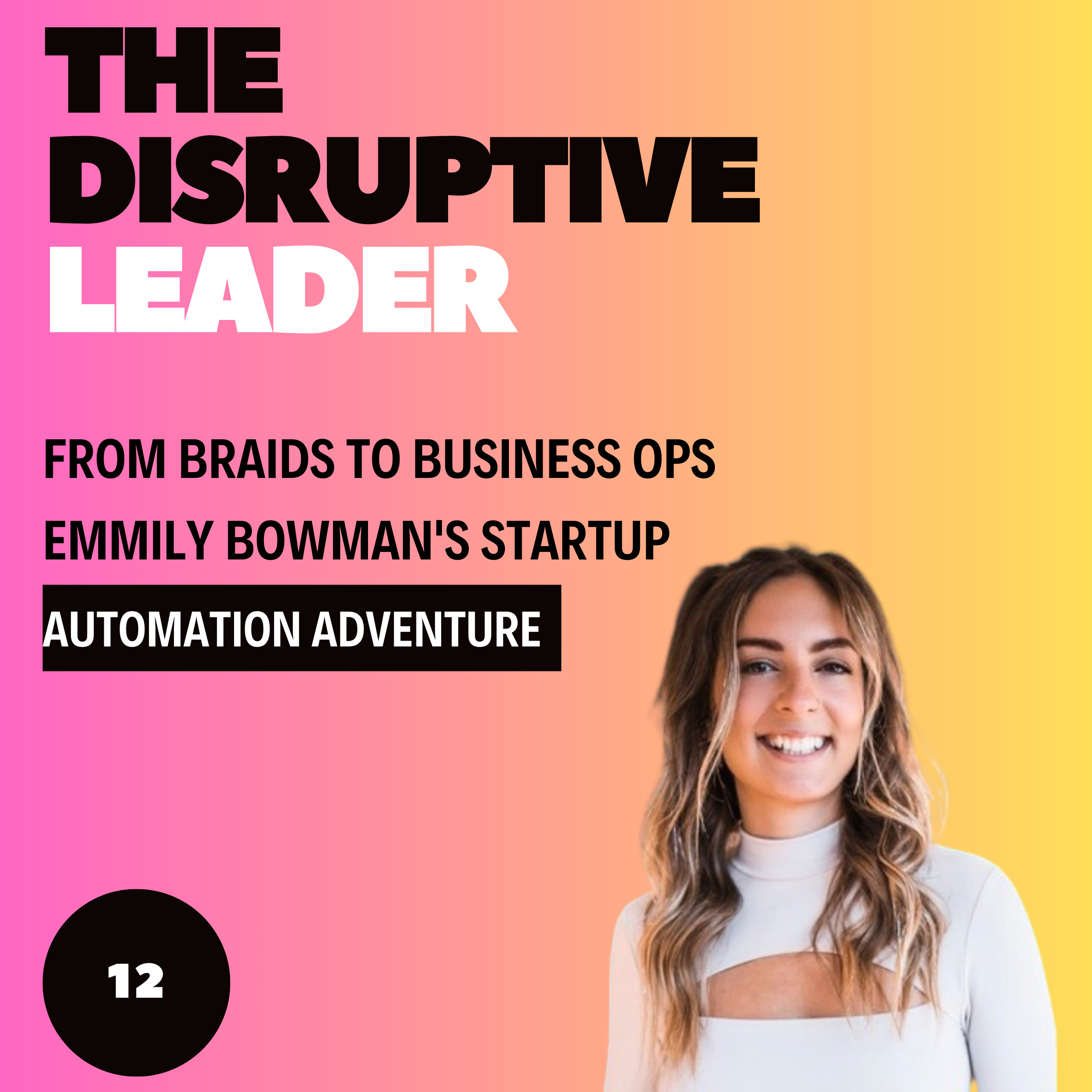
From Braids to Business Ops: Emmily Bowman's Startup Automation Adventure
from The Disruptive Leader
44m 9s
Emily Bowman's journey from a data analyst to a tech operations manager at Satham is a story of accidental entrepreneurship and systematic building. After feeling lost in her corporate job, she discovered hair braiding through a 30-day Instagram challenge, leading to the creation of Brave Beaves (originally Buffalo Braid Bar). She embraced saying "yes" to opportunities, which fueled rapid growth through word-of-mouth. Emily applied her analytical background to automate every aspect of the business, from scheduling and payments to customer communication, ensuring a frictionless experience—like booking with just a few clicks. She stresses the importance of using existing tools, googling for solutions, and hiring assistants for manual tasks rather than overcomplicating processes. Her technical skills, including spreadsheet mastery and pivot tables, helped her track revenue, predict seasonal trends, and scale to 70 employees across multiple cities. Managing this team involved using Facebook Workplace for communication and weekly live updates to reinforce customer experience standards. Emily also successfully raised $800,000 by building relationships with investors early, practicing her pitch, and asking for advice before formally seeking funding. Her story highlights how combining technical skills, a builder's mindset, and a willingness to learn can drive entrepreneurial success.
(upbeat music) - Hello Emily, how are you? How are you doing today? - I'm doing good, how are you? - I am good, I'm complaining. It's almost Friday, which always puts a smile on my face. - Yeah, I know the same. This week and should be a good one. I'm in Arizona and it's the perfect season to be in Arizona. Okay, that's nice, it's warm, clear, fresh. Super, well thank you for taking time to speak with me. I appreciate your time, I appreciate all the insight that you're gonna share with all of the listeners of this podcast, so for everyone out there, please me, Emily Bowman, I hope I'm pronouncing that correctly. She is currently the business operations manager at Satham and has a compelling story, former founder of Brave Beaves. So I'm gonna dig into that. And Emily does always doing research on to learn more about you. Your journey has been from a hair braiding interpreter into a tech operations expert. Tell me about that, let's start there. - Yeah, yeah, yeah, it really has been a while to ride. I was an employee in data analytics before Brave Beaves found my way into braiding hair, which is a story itself. And then I grew that for about five years and decided it was time for what was next. And I was a user of Satham and so that's how I ended up with Satham, I emailed them like, hey, are you guys hiring? And the founder appreciated that I was an ex-founder. He found value in that and hired me. And it's been some really interesting transitions. And one of the biggest things is that I love building. And in this new role at Fatham, that's exactly what I get to do. I get to build and without all the pressure on my shoulders. And that's what I really loved at Brave Beaves. I loved automating our processes and building our systems and building the website and the booking system and the wait line process in a way that could capture the most leads from any braid we did at an event. I loved building all those things. And now that's my job all day is building. And so I'm really loving it. And how did you get into breeding? How did you discover that was a talent and a passion that you would spin off the company around it? Yeah, it was interesting. I knew that I wanted to do more than the data analyst job I was currently in. For a while, I was actually working on a different company. It still has an Instagram. It's called Peepups that was going to be a dog cafe. Eventually I decided to spin that down so I didn't know how to raise money for something. And I didn't have the money to open a cafe, especially if I was going to open a dog cafe, it was going to be like a really nice one. So it was going to take some money to implement. So I spun that down, but I was going to events and it was going to be bubble tea and it was fun. It was a good time. Then once I spun that down and decided not to move forward with Peepups, I was feeling a little bit unfulfilled. I was a little bit lost. I watched a lot of grades in that. I watched all of grades in that of me. If you know how much grades in that of me is, then you know the level of lost that I wanted. And so I started listening to business podcasts and one of them said to say yes to new hobbies, like just say yes to everything. When you're feeling lost and you maybe want a business or you want something, you don't know what could turn into a business. But it's really interesting that's what ended up happening for me. One day, there were a lot of hobbies I was digging into. I started paddle boarding. I got really into rollerblading. And then one day I had this breakbook. It had been under my bed and it had been forever. Hold that out. And I was thinking this author probably has an Instagram. And so I pulled it up and she did. And she was starting a braid challenge in the next month. There's a 30 day braid challenge where you do a different braid every day on yourself and post a photo of it. And so I didn't even read the book, but I joined this Instagram challenge. And I just started posting my braids on my own head. It's so fun. You can go back to my Instagram back then. It was midway through 2018. And I had just got a new phone the same week that had portrait mode. That was before portrait mode existed. And so I was posting these really great photos. I was asking people at my office job, I'd be like, hey, can we go up on the roof? Can you take a picture of my braid? But like at this corporate office, and I have these big buns on top of my head, my manager one day when he's working with me, he was like, I can't take you seriously with your hair like that. And I was like, okay, I'm too bad. I don't know. So it was a fun experience. I've just posted the photos online. And then from that, people started asking me to braid their hair. I was getting a lot of messages of people saying, I want to braid like that. Our Halloween's coming. Can you braid my hair? And then this one store reached out and asked me to braid at their grand opening. So that day I braided about 30 people. And that was a huge learning experience. Yet everyone's hair is very different. And so I'm learning how to braid thin hair, thick hair, very curly hair, all the different types of hair. And that was fun. It also was like, they'd show me a random picture. And now all of a sudden, I didn't just need to know how to do braids. I needed to know how to do different types of buns and different types. Eventually I got into curling and had to learn how to curl hair really well. So it was really a fun time and braid. At that time, it was called Buffalo braid bar. When I first started it, it was in Buffalo, New York. And word of mouth took off like wildfire. Everyone was talking about Buffalo braid bar. And everyone was getting braids or learning how to braid. I was doing tutorials online at the time as well. It was just a magical time where I just kept saying yes. If someone asked me to braid their hair or if someone asked me to go braid a party, I'd never braided a party. What do I charge you? I don't know. I'll put it in a spreadsheet and figure it out. And there was a lot of that in all of 2019. It was a fun year of saying yes. And I hired a couple of employees that year as well. Wow, that's fascinating. That's such a beautiful story. And the more I talk to people and the good sense, like becoming an accidental entrepreneur, by literally just saying yes and bursting your bubble and trying something new that's, wow, all my respect, that's all. And you went from braiding hair into, if I made braiding business processes, how did that transition happen? Yeah. I think from day one, I was into processes because I was working a nine to five previously in doing data analysis. I already loved spreadsheets and I loved automating. And so in my previous job, I would take a process from someone that took them 10 hours once a month. And I would turn it into a click of a button. And that was my favorite thing. I was like, keep handing them to me. I'll keep turning them into clicks of buttons to get them done. And so once I started braid babes, I was immediately excited on, OK, what scheduling system am I going to use? What payment system? How can we automate this? I wanted everything for the customer to be so automated and seamless. And I wanted it to just be you come in, you click a couple buttons and the braider shows up. You could book us one hour out and that braider is going to show up by your door five minutes early. And so that was how I built the business from day one, was just the thumbs and processes and automating. So the point where when I filled the company this year, I transitioned the company to her in one week. And she really didn't have to reach out again after that. Everything was running smoothly. Oh, wow. That's-- that's-- I love hearing that. And what would be key advice or suggestions that you would give entrepreneurs and founders and business owners when it comes to developing key strategies to have a self-sustainable business? What would you advise them with your background and building processes and making things so efficient? Great question. I think it's using the tools available, really googling. If there's something you need done, just do a bunch of googling, try to find-- maybe Reddit people talking about how to solve what you're looking to improve. Finding the right software to implement. A lot of it is like people have created tools for these things. And so I had a lot of little softwares inside tools that would fix a lot of these things. And where we couldn't automate it, I would hire an assistant. So we always had a customer service that could automate some of the more manual tasks that there wasn't an easy software to implement for. And so it's also-- don't get too hung up on creating a software solution. If you can delegate to someone, these more manual tasks, that's a solution in and of itself. Having great documentation, having someone manually doing the thing is also a great solution. To me, it was always-- if it takes us five times the amount of time to do it on our
end versus the customer having to do on their end, we're going to do it. It was like anything that we can do or figure out without the customer having to do or figure out we're going to do that. And that was the main thing. So it's really googling and searching and looking for solutions for what you need to do. I've seen I've talked to a lot of service businesses and a lot of them will say a lot of them will say in their profile DM for an appointment. No one wants the DM for an appointment. I don't want to message back and forth if you five times. I want to click your link. I want to click book now and I want to select a time and that's it. And then I don't want to touch it again. So that's my number one for service companies is it should be a couple clicks of a button and they have an appointment. They shouldn't have to wait for someone to reply, talk about what time are you free. We could do this time. What services do you want? You've really got to build your service system up so the customer is just clicking. Yeah, so it becomes like frictionless. It becomes like stuck and it's done. That's probably why I'm addicted to shopping on Amazon. It's literally even. Oh, it's so easy, right? You don't yeah, you don't have to remember your login. You just click a couple of yes. That's the type of system you need to build. You have to make it so easy for the customer, especially their booking break bids when they're planning a party, planning an event they're going to they're busy. They're also thinking about their outfit, their makeup, their plans on how they're going to get there for the breathing. Yeah, and what I was doing research and create me find wrong. You also have a lot of SQL background. So as far as I understand, you've developed complex SQL code and you've transformed that data into a spreadsheet. So you've mastered Excel formulas and pivot tables and VBAs. Talk to me about how technical skills like being able to do something like that impacts and translates into entrepreneurial success. So much so I had so many spreadsheets for break bids. I didn't use SQL even once, but the spreadsheets. So yeah, my jobs were always we would build SQL in the database to get the data out and then we would use spreadsheets to manipulate that data and analyze it. And so on top of that, braid bids, there was all kinds of things like we used Wix as our booking system and to get good reporting from that, we had to manipulate the data a lot because we're shoving our services the way they worked into Wix. And so we had to build categories and pivot tables in spreadsheets and then same for tracking our revenue. And then same for projecting out our revenue. I had a couple of really cool projections spreadsheets where I could see, are we on track to hit our number for this month? All it would do is say, okay, we're on the 10th of the month, take our current revenue, divide by 10. That's what we're making per day. Multiply that by 31 days in this month. That's what we're projecting to make this month. Now, of course, if you do that on the third of the month, that's not going to be a great projection. Sometimes it would be very low or very high. You don't put a lot of, I'll put a lot into that. Once you hit the 15th, 20th, 25th, you know we are heading for the month and you can tell, oh, we're heading for a down month or an up month. And then I would do very similar logic. There was a lot of seasonality in braid bids. And so I would do a lot of similar logic that said, okay, if our January was 20% more than last year's January and our February was also 20, 25% more than last year's February. I can predict that the next year we're going to follow similar trends. So we take each month and multiply by 20%. And that's probably what will hit the next year. Of course, sometimes it got really complicated. We were opening new cities and those calculations would take a lot more analysis and predictions. But you can use spreadsheets to get a lot of things. So my advice would be at the very least, really learn spreadsheets. We used Google sheets for everything because you can share it so easily with your team. And then learn your pivot tables and V-lookups can be wildly helpful as well. When you've got a list of emails and then a list of anything else that you want to pull into those emails, your V-lookups are going to help you. And you can learn those few things in a week. Pivot tables, V-lookups, watch a couple of YouTube videos and you'll understand it. And I love that you found this need to learn it. You just said, like, what you can learn on YouTube videos. So that's like self-learning and then applying this knowledge to your company. And at the end, this sort of ties in really nicely with that click of a button. So it's all very efficient, saving time. And I guess when you tie all of those pieces together, not only do you know a technical skill that you're applying an entrepreneurial sort of startup, but this is also a mindset and a framework I'm guessing that would make you a really good leader and manager for your customers, be them employees or your internal customers, your like internal and external customers. And so also while I was doing research, I understand at some point you were leading a team of 70 employees across multiple cities. And so my question is, how do you maintain something like that when you're growing so fast? How do you tie all those pieces together? Yeah, great question. I think one of the biggest things is your company chat. Like when you have your employees, you've got out of your company chat. If Adam, we use Slack at Braid Babes, I had tried to implement Slack and no one adopted it. No one would use it. It felt too foreign to everyone. And Facebook actually has a software called Workplace. A lot like Slack, but it feels like Facebook. And my 70 employees, they were actually all women, which I didn't love. We always wanted to hire man and we had a couple that got really close to getting good at braiding and being hired didn't quite happen. But they really loved using Workplace because it felt like Facebook. And then everyone's just chatting in there all the time. Each team had their own chat. And then a lot of company updates. We would go live on every Tuesday and go over what was new with the company where we were heading. And then we'd always give them reminders. We're really big on the customer experience. So a lot of our reminders were like, okay, this week we're focusing on always handing the customer a clean mirror. We have little mirrors in the kit where they could look and put it up against a big mirror and look at both sides. And I'm like, we don't want to hand them a mirror with hairspray and fingerprints all over it. So this week, make sure to clean your mirrors. And every time you hand your customer a mirror, you wipe the mirror off. Small things like that. I was very meticulous about the experience. But and then as far as employees, when we were at 70, I think we had between eight and 10 internal admin like HQ employees, we would call them. And so each team had a manager. And then I had action hadn't operations manager as well. Then I would hand our different operations processes down to. Oh, fascinating. Because it's one thing to know technical skills and run a company, but also managing people's remote and across different cultures and bringing the old together. That's a superpower. And then your superpowers don't only end there. You raised $800,000 from angel investors. Is that right? Yeah, a mix mostly angel investors and a touch of leaf funder. Yeah, that was fun. Is there anything you don't do? Let's think of being a founder, right? You really have no choice but to do it all. And like what were some of the challenges or strategies that you faced or used while seeking this early stage fundraising? Yeah, that's a good question. I've been wanting to do a post about this because I didn't get very nifty about my raise. One of the things that really played on my side is with COVID, we were shut down. And New York had a lot of shutdowns. And so there was multiple waves of shutdowns for a whole year. And so the first shutdown, I built a couple of our systems that allowed us to scale and have all these employees. So it was actually a really magical process. So our, the higher we would run Facebook ads. And they weren't so much about working at braid baves. It was about learning how to braid and we sold it course. And so we would run that. So for example, Nashville was our first city we expanded to from Buffalo. We did these ads learn how to braid for $275. And then if we hired them out of that, if they wanted to work first at the end of it, we would give them $200 back. So we recorded all of the videos and built that system during the first shutdown. And then the day we were allowed to reopen, we had a bigger team in Buffalo. That one, so Nashville wasn't opening at that point, but we had a team of 12 in Buffalo that went through that training all during the first shutdown. And then our appointment skyrocketed, which probably was a bad thing because that was when house parties were skyrocketing. And then if you remember, the government was like, stop having house parties. Yeah, we were a part of that. We read all the house parties, braiding everyone's hair. But it was fun. And so our revenue skyrocketed. And then I had a mentor that had worked that was working at tech stars. And I have missed the next time in a cafe one day.
I said, "Have this company. I wanted to be national, but I have no idea how to make a company national." Like, no clue where to start. And he was like, "Oh, that's exactly what I do. I mentor people to help them raise money and scale their company." And so he ended up being my mentor all the way until the end, and now we're still really close friends. He really opened up his network to me, and so a lot of my investors were from his network. He taught me how to create a pitch deck. We practiced my pitch together. A couple of the tips I have. One is, once you create your list of who you're going to want to raise money from, I started reaching out to them before I had a pitch really ready. And I started building that relationship with them. And as soon as I had a V1 of a pitch, I was like, "Hey, I'm working on my pitch. I'd love to practice it with you and get your advice." So I just started asking these investors for advice, and they really loved that. And then a few months later, once the pitch was really polished, I went back to them again, and then at the end said, "There's a couple of tricks to it." Would you be interested in investing versus what's holding you back? I received all yeses from pitches. Everyone ended up investing. And one of the tricks there is getting them to say a number, even if it's a soft number, meaning like, "I would probably invest 10,000." You can add that to your total. So when you go to the next investor, you can say, "I've got a commitment of 10,000." And you just keep that going. Even if it's soft commitments, smart angel investors will say, "How much of that is a hard commitment versus soft commitment?" And you can tell the truth. But in general, just call them commitments and keep that number going up because that's what's going to drive that FOMO when you can say, "Oh, it's almost full." So my first round, my goal was 200,000, and I ended up raising 500,000 in that first round, because I just started creating a bunch of FOMO around the race. Oh, wow. So it's being in a way like I liked what you were saying, reaching out and saying, "Hey, I have my version one of my pitch kind of practice with you." That's like putting yourself out there in a really agile and vulnerable way, because it's not perfect. But hey, if we're going to wait for perfection, we're going to go nowhere. We'll be waiting a very long time. So that's really solid advice. Exactly. So we've been talking about how you built all of this. And it sounds like you had an amazing run and built something really unique and powerful. There was a huge success. Tell me about the parts, the hurts. And I say hurts just because I've also been start up and gone through a lot of existing strategies. What made you decide to sell break babes? I started to get burnt out. And it's funny because this time last year, a little bit before this time last year, I hired a coach and he was amazing. Except I didn't think he was amazing. And I said, "I don't want your coaching anymore." But looking back, he was amazing. And he was exactly what I needed. And after our first meeting, he said, "Hey, I need you to look up, burn out." Like I'm not saying anything, but just do some research for me, just look it up. And I remember writing them off. And I was like, "I'm not burnt out. I get out of here. I'm a hard worker. I'm going to get this done. I'm going to keep pushing. Because he said something else too. Sometimes you've got to know the right time to move on to what's next." And that same thing. I'm like, break babes is life. That's what we always say. Break babes is life. Or we'd say, "Baby 4L, break babes 4 life." I was like, "Get out of here. I'm not moving on from break babes. This is my baby." And then the burnout started to get worse. I was really waking up at two in the morning. My head was just spinning through worst case scenarios. And I just was really struggling to remain passionate about the problems we are solving. And the business wasn't scaling the way I wanted it to scale. I really wanted break babes in the top 50 cities. And we just couldn't quite nail down the right model to scale break babes. We were like, "Should we franchise? Should we do a model where anyone can work for break babes in any city?" We just couldn't quite nail down the model to scale with. And our current model where all of the breeders were employees and they all had managers. It just wasn't scaling the way that we needed it to. And so, me personally from day one when I started braid babes, I had a vision of being in the top 50 or top 100 cities. And so when it was becoming pretty clear that the harder I pushed, we weren't getting closer to that. It just was harder and harder. I started to get discouraged and not as passionate and burnt out quite frankly. And I wasn't able to pay myself very much. And so that was getting really discouraging too. I'm working so hard and I can barely afford a normal life here. It was time for what was next. And I thought that was going to be the end of me. I thought that I was going to go into a deep depression and be very lost. And luckily it has not gone that way. I've actually been very happy. Yeah. And sometimes it's those hard decisions that just as the whole thing was an accidental entrepreneurship coming out of it the same way is also just as rewarding. And what do you think your mentor, like what signals do you think your mentor's soul in you before you did where he guided you to say, you know what, research burnout. What do you think he saw? Yeah. Yeah, when I hired him as a coach I thought he was going to help coach me to make the business better. Like I said, I was struggling to get it to scale. I wanted to raise I think a million for breed babies, but we raised another 300,000. And so I was getting a lot of nose from investors. It just like I said, it was not scaling the way I wanted to scale. And I wasn't scaling the way that an investor would need to see to be able to invest that much money. And so my friend recommended him to me. And I think that friend knew what I was going through. So I thought my friend recommended him to help me scale the company and get out of this rut where I think my friend really saw that I was reaching burnout. And this coach actually specializes in founder wellness and finding your passions and living in your passions. And so yeah, so immediately with the discussion it was like, I was trying to tell him the business problems and he's, but what about you? Like how are you feeling? And I'm like, no, get out of here. That's on point. Like it's so easy as that startup founder to forget about you. Yeah. That was definitely happening on my journey of breed babes when I was, when everything was scaling and going amazing, I lived at the computer and I gained weight. I gained 40 pounds over that time because I just was door dashing food and just working on the computer and building those systems. And yeah, I really needed to focus on me in my life. I wasn't putting effort into dating. I wasn't putting effort into friendships. I wasn't putting effort into hobbies. The weirdest thing is once breed babes, once I sold it, I was hanging out with friends and realizing I had nothing to talk about. I'm like, the only thing I had and the only thing I've done for the last five and a half years has just been all breed babes. I would like, don't talk to me about small talk. I don't want to hear it. If it doesn't have to do with breed babes, I'm not interested. And so when breed babes ended, I was like, wait, who am I? Who do I like to do? What are you? Yeah, it was weird. That's so funny that you say that. I can relate to that. I've been there. It slaps you in the face. Hey, wait a minute. But what's my identity without that? If you scroll back on my Instagram, I was breed babes. And breed babes was me. It was nothing. Yeah. That's like healthy for a while and then it turns on healthy. I think the coach that gave you that advice, and why did you Google burnout was spot on? And then so you sold breed babes and then you joined Fathom as the business operations manager. What was it like realigning sort of your mindset from boss to joining a team? How did it feel for you to go from someone calling the shots and driving and doing everything to being part of someone else's vision? Yeah. Very interesting. So when I started, I actually started in customer success because I sold the founder on this idea because I'm like, "Oh, you can work with the product. You also work with people. I want to make sure I'm working with people and not just like coding away on the computer." And so I landed on customer success. So when I emailed the founder, I was like, "I think my skills line up with customer success." And so when I started, I had a different manager. I didn't do very well having a manager at first. But yeah, I done.
I've definitely made some mistakes that I now look back on. And I'm like, oh, I could have been so much better to that manager. I just came in like a blazing ball of fire and really shouldn't have done that. I should have come in a little bit more. Ready to help my manager and help their vision. It was a weird time too though. The founders saw like the operation capabilities in me. And so while I had the customer success role, I was also getting projects from him. And what was happening is the operations automating processes that was getting from the founder are what really excited me. Those were the ones that without thinking. I would stay up till 10 p.m. working out and building. And so my customer success projects didn't quite have that energy behind them. So it was a little bit of a weird time, but I think I worked with the company for five weeks before the founder came to me and said I have this operations role that I think you'd be. I think it should be. And so then I think a month later, I fully started in the operations role and then the rest of the history. Now all day, every day I just have completely different projects that are essentially anything that used to land on the founders plate of building a HubSpot workflow or negotiating a contract or automating this thing that takes too long. Now goes into the business operations team. We now have a second way that just started as well. So both of us are tackling this projects. I love that and that's the new yeses that you're saying you're going to use to. So your energy and your passion and then it's all coming back. And finally, I mean, I've been using note takers for a while and I got to say it is by far the most brilliant note taker out there on the market. And so talk to me about like your impact at the father and including like you've always, but it's always been we got to make it frictionless and I just want my customer to click on the button. Talk to me about how you're bringing that to father. Yeah, absolutely. I have to one more thing to add on your last question to about the vision since working under the founder. Or honestly, since I started the company, I've paid attention to everything the founder says. I've a running document of quotes by him and it's just that shift. I just want to talk about a little bit more where I used to just have to pay attention to my own vision, which was just in my head. Now I studied the founders vision and studied how he makes decisions. And now a lot of times I'll call it my rich brain. Like my Emily brain might do something a little bit differently, but I need to put on my rich brain. I need to follow his vision because I've seen in operations when you have different visions going, they could both be right, but you have to follow one. And so that's been a shift, but it's actually fun because I think, oh, when I was a founder, how would I like my direct report to reply? Or how would I like them to accept feedback? Or how would I like them to keep me in the loop? And so now I do all of those things as an employee and it's fun. And then on the impact side, it's, the fathoms an amazing company where you can bring an idea and they really will hear it out. So I also used fathom, loved fathom. That's why I ended up here. And so being a user and coming in, there was a few things I already knew that I wanted to be a little bit different with the product. For one, if your, if fathom didn't join the call with you, you couldn't get fathom into the call. Or if it dropped for some reason or say something that happens all the time, maybe the host denies fathom from coming into the call. You then couldn't get fathom back in unless you closed completely out of the Zoom and restarted it. Then fathom would come back in with you. And that was not a great user experience. A lot of people didn't know that's what they needed to do. And now their call's not recorded. And so I've really pushed for a button. So now whenever you're on the fathom, best stop, there's button that says add to meeting and you can put in the Zoom link. And so anytime your fathom's not there, you can get it into that call. It took me a couple of messages back and forth. I think it took three weeks to get it implemented. At first, engineering was like, well, I'm like, why do the bot drops from the call everyone's noile or why it doesn't join the Zoom? And I'm like, no, it's not a bugs issue. It's a usability. We need to be able to get it into a call at any time. And pretty quickly, they turned around that button. I was pretty happy. But that's a fun part of the role. Yeah. Nice one. Yeah. Yeah, the other place that I is my favorite part, really, to have impact in this role is I listen for frustrations from the founder. We have our projects that either I'll come up with or he'll come up with. But then also sometimes we'll just mention something that really annoys him or mentions that he wishes we had something for one they used to have an artist doing the headshots. And they'd be like eight-bit headshots of everyone. They feel like old school video game style. And then we kept hearing all these people that artist wasn't willing to create those headshots anymore. And so I just saw on an old post where he was like, oh, someday we really need to just build like AI or something to automatically create these headshots. And so without telling anyone, I stayed up late one night and created a custom GPT that will pick in our headshots and create professional video game type headshots. And now we use those for the entire company. And the little part is like that I love just like listening for a little thing and then being like, here it is. So it sounds like problem solving is in your DNA somehow it's, it's your pick. I love that. And as you were talking and explaining everything you've done and been through, I can really feel your energy and it makes me realize or sense would be a better word that you have like a joy. There's a joy of the hustle is and working hard. And it sounds like when you work hard, it's fun for you. Talk to me about finding purpose and enjoyment in intense working environments because being the startup founder is intense and super hard same thing I'm sure in a scaling company. Talk to me about that purpose and that drive. I did a post about this recently because when I was a founder of Brave Babes, I knew why I was staying up late and working all the time. It was very obvious. This is my company. This is my baby. I'm of course going to sampling and pour everything I have into this company. Then when I started working for Fathom, I still was doing the same thing. And then I started asking myself some questions in my head. I'm like, okay, but why? I remember just asking myself why? Why am I working so hard? I don't, I love Fathom, but I don't owe Fathom anything beyond a normal work schedule. And I just kept thinking why am I doing this? Why am I working so late? Why do I work on a Saturday? Why do I constantly check Slack and see where I can help? Why do I why? And then I did a breath work session and that same question popped into my head and this word just very strongly came through and it was the word fun. This is my enjoyment. This is my fun. So like when it's, oh, what are your hobbies? I have hobbies that I love, but work is one of the things that I love. So when I do it on a Saturday and I'm building a new process, I'm getting enjoyment and fun out of that. So it makes sense to do on a Saturday for me. That's really all it is for me is like when you become a founder or a startup employee, you can't quite bake that because you're not going to want to pull out your computer on a Saturday. If you don't think it's fun, you have to like really enjoy this stuff to really pour yourself into it. You can't, I don't think you could force it unless you truly found enjoyment in it. Definitely. And I think that's something that you either have it or you don't. I think so, but I also do think it's a lining with your passion in some way too. Like towards the end of Braids, I wasn't working late quite as much and that's when I really was losing my passion for it. So do you think there is a part in there too where it's okay, maybe what you're working on right now isn't your passion and maybe you can keep looking and really find what excites you like that? Yeah, and so that's a lining with the purpose. So because you're seeing purpose and enjoyment and excitement and what you're doing, it doesn't matter if it's Friday or Saturday or late or early because you're getting your kick out of it. Yeah, because a lot of the times people ask me, but you live in Sweden, why are you working the North American market and how do you manage the times? I just start my day a bit later and the later is 9/10. I'm like, why am I doing this? But it's very similar to what you're saying. It's that inner joy. So it's not a burden. It's actually something you want to be doing. Okay. And then as we come to an end of this discussion, if you were to pick three key pieces of advice or closing thoughts for aspiring entrepreneurs and professionals in the operations sort of area, what would they be? Yeah. I think one is building your network.
And on that, it's really building real relationships. I don't like, when you say build network, people think, "Okay, I'm going to sign up for networking events." Maybe you could do that, but I find networking events to feel very forced. I think it's truly like striking up conversations wherever you go and really talking to people. My network just helped me ridiculous amounts. Like that mentor, like I said, there was an open chair next to me at the cafe and he said, "Can I sit here?" And I said, "Yeah, it might have been the reverse." I might have said, "Can I sit here?" It might have been that one. And then he was like, "What do you work on?" I said, "Payroll for my company." And then the conversation just went from there. So it's really like, those relationships will become endlessly valuable and you don't know which relationships will become valuable. So just start making relationships with people. For example, the woman that bought braid babes, she was a customer of braid babes. And I just really had great conversations with her when I would go to her house and braid her and her employees for different events. And that relationship grew into so much. So that's one. Number two is always be learning whether it's, I did a lot of audiobooks and a lot of YouTube. So we already mentioned the YouTube. Back in the day, I didn't know marketing. And so I listened to a ton of YouTube on how to grow your Instagram, how to grow your TikTok. And we were able to get some virality on those platforms too. And it really was because I was listening to these YouTube and learning on how to grow these things. And so always be listening to something, whether you're driving in the car or you're going to walk the dog, always just put on something you can learn from. And then I'm not exactly sure I'm the third one, but the first one that's coming to me is they can care of yourself. Yeah, for a minute, their things got dark when I wasn't working out, gained weight, wasn't eating right. My iron went extreme low and I didn't know. And I should have gone to the doctor and the doctor could have figured that out. But I was just running anemic for a long time and getting very sick and just thinking I just had a low immune system. But it really was, yeah, just anemia. I just needed to have some more iron. And so there's really prioritized taking care of yourself or your business will struggle. So what I noticed happened is I didn't take care of myself. And when it got really bad with the bad anemia and sick all the time, that's when all of a sudden that amazing scaling stopped. And now I can't say what causes what, but when I was really sick, I couldn't quite get the business up and scaling again after that point. I was really struggling. Oh wow, yeah, because you need to be in a good physical, mentally, emotional place to be able to be productive and deliver and creative and maintain that passion and energy. Those are all really solid. The three of them. So thank you for sharing that. Thank you for the conversation, for your time, for your insight. I thoroughly enjoyed this conversation. I've learned to ton. I have no doubt that listeners will be learning a ton. And if people want to reach out to you, A, or you open to that. And if yes, what's the best way for them to get in touch with you? Yeah, I would absolutely love that. The best one right now is LinkedIn. So LinkedIn, I'm Emily Bowman. Emily has two ends. Once you type Emily of two ends, I'm probably coming right up. Right now my background is the feather blue background. So you'll see that right away. Which has been a funny shift. I was always Instagram with braid bids. And now I'm getting a lot more into LinkedIn. Yeah, super perfect. We'll add the link to your LinkedIn in the description of this episode. Once it goes live and once again, thank you for your time. This has been awesome. Thank you. It was awesome. Thanks for your deep research too. This was fun. Yeah, yeah. Awesome. Happy to have hosted you. See you soon. Thank you. (upbeat music)
Podcast Summary
Key Points:
Emily Bowman transitioned from a data analyst role to founding Brave Beaves, a hair braiding company, after feeling unfulfilled and saying "yes" to new hobbies.
She built the business with a focus on automation and processes, making booking and customer interactions seamless with minimal friction.
Emily emphasizes using available tools, googling solutions, and delegating manual tasks to assistants rather than over-engineering software.
Technical skills like spreadsheets, pivot tables, and V-lookups were crucial for tracking revenue, projecting trends, and managing seasonality in her business.
She led a team of 70 employees across multiple cities using Facebook Workplace for communication and weekly live updates to maintain culture and customer experience standards.
Emily raised $800,000 from angel investors and a leaf funder, leveraging a mentor's network and practicing her pitch with potential investors early.
Key fundraising strategies included building relationships before pitching, asking for advice, and getting soft commitments on investment amounts.
Summary:
Emily Bowman's journey from a data analyst to a tech operations manager at Satham is a story of accidental entrepreneurship and systematic building. After feeling lost in her corporate job, she discovered hair braiding through a 30-day Instagram challenge, leading to the creation of Brave Beaves (originally Buffalo Braid Bar). She embraced saying "yes" to opportunities, which fueled rapid growth through word-of-mouth.
Emily applied her analytical background to automate every aspect of the business, from scheduling and payments to customer communication, ensuring a frictionless experience—like booking with just a few clicks. She stresses the importance of using existing tools, googling for solutions, and hiring assistants for manual tasks rather than overcomplicating processes. Her technical skills, including spreadsheet mastery and pivot tables, helped her track revenue, predict seasonal trends, and scale to 70 employees across multiple cities.
Managing this team involved using Facebook Workplace for communication and weekly live updates to reinforce customer experience standards. Emily also successfully raised $800,000 by building relationships with investors early, practicing her pitch, and asking for advice before formally seeking funding. Her story highlights how combining technical skills, a builder's mindset, and a willingness to learn can drive entrepreneurial success.
FAQs
She felt unfulfilled in her data analyst job and, after listening to business podcasts, said yes to new hobbies. She joined a 30-day braid challenge on Instagram, which led to requests to braid hair and eventually the creation of Buffalo Braid Bar.
She focused on automating processes using available tools, googling for solutions, and delegating manual tasks to assistants. Her goal was to make the customer experience frictionless, like booking an appointment with just a few clicks.
She used Google Sheets for everything, including tracking revenue and projecting monthly performance. She recommends learning pivot tables and V-lookups, which can be mastered in a week through YouTube videos.
She used Facebook's Workplace as a company chat, which felt familiar to her team. Each team had a manager, and she conducted weekly live updates to communicate company news and focus on customer experience improvements.
She built relationships with potential investors before her pitch was ready by asking for advice. She practiced her pitch with a mentor, and used tricks like getting investors to commit to soft numbers, which helped her secure investments from all pitches.
During the first shutdown, she built systems to scale, including an online braiding course. This allowed her to train a larger team and be ready to reopen with skyrocketing appointments when restrictions lifted.
Chat with AI
Loading...
Pro features
Go deeper with this episode
Unlock creator-grade tools that turn any transcript into show notes and subtitle files.
 PodcastTranscript AI