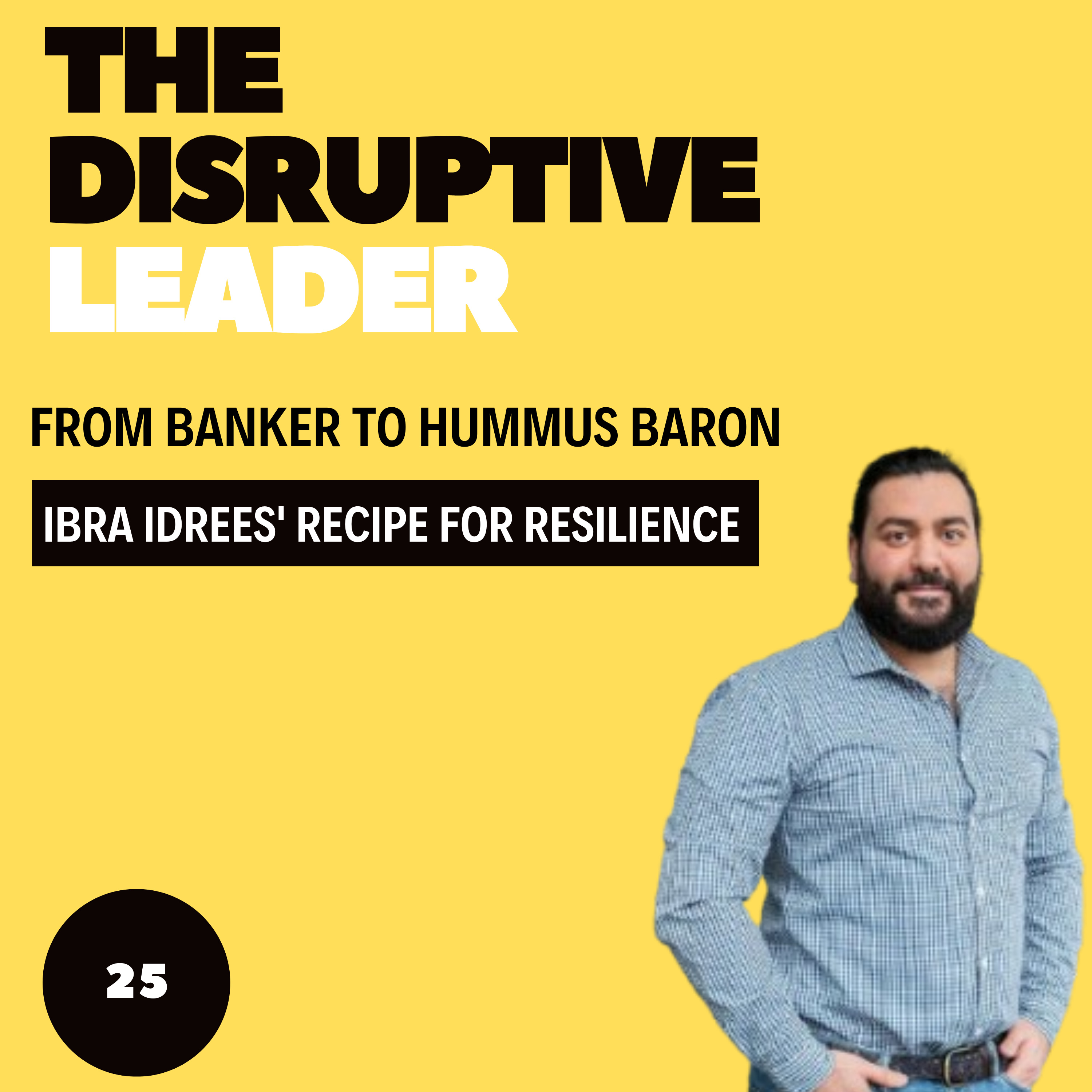
From Banker to Hummus Baron: Ibra Idrees' Recipe for Resilience
from The Disruptive Leader
38m 50s
Ibra Idris, founder of Malmose, recounts his transformative journey from Syria to Sweden. At 27, he left Syria, driven by his role as the sole financial supporter of his family and his strategic, finance-oriented mindset, which anticipated the coming conflict. He moved to Doha, Qatar, where he continued his banking career, working with startups and entrepreneurs. However, the lack of long-term residency rights and dependence on employer sponsorship created constant anxiety, prompting him to seek a more stable future.
Choosing Sweden, he faced a harsh reality: despite 17 years of experience, he submitted over 2,000 job applications over two years without success. This period of rejection was the most hopeless of his life, though he never regretted his decision. Volunteering with the Red Cross kept him active, but financial strain pushed him to rethink his goals. Realizing that his strategies were sound, he decided to change the goal from finding a job to creating one.
Drawing on his passion for hospitality and Mediterranean warmth, he opened a food business. He secured a microfinance loan of 200,000 crowns and, through persistence and LinkedIn networking, found a location. His journey highlights resilience, adaptability, and the importance of turning challenges into opportunities, emphasizing that starting over can mean moving from a negative situation to a neutral, hopeful one.
(upbeat music) - Hello. (laughing) - Hey, hello. - Showtime. - 3, 2, 1, I was at the club. Was gonna happen now. - Right. - It feels very cool. - Who know? - We're gonna have a great conversation. That's what we're gonna do. - Absolutely. - How are you today, Hugh Brown? - I'm doing really good. I would say way better after seeing you hearing your positive voice and also I can see your smiley face at the same time. So I feel it's way better. - Okay. - Were you having the best start to the day? - Or. - Oh, yeah, I mean, it's all about challenges and I love challenges. So it's, I started my day with a meeting. A very important meeting and I could, for some reason I couldn't join the link and I was late for four minutes. And you know, but I had to explain myself because if I wasn't there, I'm so sorry, but I have to say I would have judged anyone late on the meeting. - Now I'm feeling really bad because of my huge mess up. - I'm just trying to. - I was so happy last time because I had the time to spend with my mother because I can't sit in that day. And then mom, I give me two a year. So it's quite. - Oh, nice, super. Everything happens for a reason. - Sput-on, true. - Ibra, thank you for taking time to speak for everybody listening to this podcast. Meet Ibra Idris. He is the founder of Malmose, if not Sweden. Both, or. Homo's place in the world which we're gonna have a conversation around. And his amazing journey where starting off as banking executive, moving to a new country, I don't wanna give you the spoiler, but Ibra will be walking us through it. And so what I wanna talk to you about Ibra is, let's start with a brief overview of your journey. If I got it right when I was doing my research from Syria to Sweden. - There was a transitory thing between as well. Which is Doha, we're gonna talk about that as well. - Yeah, so let's start with like, how old were you when you realized, oh no, we need to leave home? - First of all, please allow me to thank you for the very. Very. I don't want to say overstated, but thank you so much for the grit and production about our Homo's. And if it's really. It's, I always say, it's made with love. It's mom, dad, and aunt, so it's. We do it from scratch, from my dad picking up every single cheek to my mom soaking in the mineral water, to wait on fixing it to the mixer. So I would say this is what makes it taste. It's not the best, but you can taste the love that this famous is made with. But thank you so much for the great production. - Yes, so how. Maybe we talked about this before. You ask how old I was when I left Syria. And I always tend to ask people how young are you? Because I believe that older we grow, the younger inspirates we become. But I think this is how I feel it. And it's an interesting to be honest. I don't ever feel that out. Sometimes I have to convince myself, "Ibra, you're too much for this, or you're too old for this." But the self-debate out. - No, actually I left my great home country when I was 27. - Oh, if I'm not mistaken. But I need to get back in 27. - Yes, yes, yes. It's on 27. Sorry, times flying. So yeah, that was 27, actually, when I left Syria. And it wasn't early 2011. And to be honest, it was. There was no proper or like the war. Was not like there yet, like the proper war. But since I'm someone who worked with numbers, finance, budgeting, forecast, you always need to think on the long run and get the alerts and make some decisions accordingly. As a time, actually, I was the only financial supporter of my parents and my dad had some issues with his work situation. And my mom was not working at the time. So I was the only financial supporter and I was always thinking ahead, I really need to plan ahead. If something bad happens, I can't just. Yeah, it would be so difficult for all of us. So I don't want to sound selfish, but unfortunately, I decided that I had to leave at the time because I always have been always making my decision based on the family aspect. It's not me only who can decide. So I always think of the. For the sake of the whole family. So I left when I was 27, actually. And to be honest, I left and I never. So I would not go back. So I never expected myself staying abroad until now. I never believed between me and myself that proper war would happen in there. I said, "No, maybe it's just a few months. "I'll just go explore, work abroad, "some more experience, etc. "and then I can come back." But unfortunately, the case was not. As I hoped for. And almost a few months later, the things became more serious. And I had. To also some planning ahead. I worked my family for a reunion, a kind of family visa. As soon as I moved to Doha in Qatar. So I thought, "Whatever happened, they can just come and join me." And this is what happened, actually. So I left when we were 27. And it was very difficult for my. with my parents to leave. And I never ever told them that we were leaving. Actually, I went back to Syria and I attended my best friend wedding. And then I told my mom, "Come, let's go for. "Come and spend few days with me." And those few days are more than 12 years now, actually. Oh. It's hard, yeah. We lived home with all the memories, with all the pictures, all the frames. But that's a completely different day. I don't want to get into those details. Yeah, and then I moved to Doha, actually. In Syria, I started my career in banking and finance. And I was working for the first private bank in Syria. And I spent there almost seven years. And then it was so sad to leave. We were from the very. kept the very first people's bejewying. We were having numbers in one and two digits. Oh, my God, it's now a huge bank. So it was so nice to get. to learn all the private banking from A to Z, all the challenges with the government, with the old system and et cetera. And then after seven years, I moved to Doha, where I continued my banking career in the National Bank of the State. In Syria, I was working in a French bank, Puerto Rico, in Saudi-Franced Bank. And then I managed to move to work with the. QNB Qatar National Bank, like the National Bank of the State, within the same field, with startups, entrepreneurs, business incubators, development banks. So it was the one award of working with those entrepreneurs all the time. And being the consultant, the strategist, the founder, the finance analyst, although this. I'm so sorry, I forgot these things stopped me anytime. And yeah, and to be honest, I have to admit that when you work with entrepreneurs, you always ask yourself, "Oh, I'm helping all those people and all those businesses to grow, and have a better business." And you. You come with them on the journey and you experience, or you do experience like a lot of failures through a journey, but also a successful one. So you always ask yourself when, and then you remind yourself all the failures they go through. So it's very difficult. And I always say, for us, who, like we work in the big business or the finance, it's even more difficult for us to make a decision to start our own business. Because you're more aware of all the risks before I started this little small, homeless place, I was dealing with it as if I'm starting one of the biggest factories on planet. Because all kind of risk, and everyone was just making fun and laughing at me, "Ah, what kind of risk are you thinking to account?" But this is how it is. - And what prompted you to move from Doha to Sweden? What was that shift like? - That's also a very good question. In Doha, again, I never been able to get rid of my business-minded-minded. This is what I studied for the difficult to isolate myself from that structure of thinking.
I don't know if I should say, fortunately, or everything has frozen code. So, and also in the how I was working for the National Bank of the State, I was like a great position, great bank, great market, super booming economy. I've learned a lot, such a lot of expats, the family population, 90% of which are expats, a lot of the national project, a lot to learn and who have a larger on. However, there was something called localization, such as catarization, like catarization thing, but they always need to try of course, which is very logical. So, they want the locals take over the expats positions and so on. Our work permit was being renewed on a yearly basis. And yearly basis, it's like it's still in the finance and the accounting term, one year still considered as a short term. As if you imagine you're only securing your state or residency for one year. And the thing that you can only live in Doha or in Qatar or in those countries as long as you're sponsored by your employer, like your work permit sponsorship, or if you own your own business and you need to have, so there must be some sort of sponsorship. And my work at the time was my my sponsorship. So, if I don't get my work permit renewed, that means I can't stay. And if I can't stay, that means I have to go back to Syria for my own country. And at the time I can't go back home. Again, I'm sorry, I don't just sound selfish, but I still I live with my parents. And of course, unfortunately, the problem in Doha for my parents where they were not having any privilege of residency or work permit or driving license. So, I had to again, I was still the only financial supporter. It was very challenging times. Yeah, I was always thinking of what would happen equally. So, if I lose my sponsorship, my parents lose their visa and we have to leave. So, I've always been thinking of this. And then until I really decided to, I can't just live in this uncertainty. I have also to admit that like when I they started to renew with two years, but still it's still even if you live forever there, you won't be eligible for any kind of residency, even if you worked all your life. And at the time, I had some of my colleagues who have been working with the bank for 20, 20 plus years. And they're still on get terminated or of the retire. They don't have the right to reside in the country. So, that's so it's been killing me a lot and creating a lot of anxiety for me. And again, we should not be thinking of the future, but the I had because I believe that securing the future at, but as like with minimum rights, like residents makes your life way easier. So, I decided to, a lot of people they say starting over from the scratch, but for me, I didn't look at it this way because I always thought if I don't have the right for a residency on a longer term. And even if whatever I do, I won't be able to get it. That made me feel that I'm in minus. So, I thought if I start over, I'll be in zero and zero, it's neutral. I'm not in the minus zone anymore. And there's always risk, of course, I might be in minus again, but then I'll get back to where I was. There are a lot of people who are against me with this decision, but eventually, when I feel that I need to do it, I feel that I get a lot of signs around me telling me there was a lot there were a lot of signs at the time. Thanks. So, yes, that's why is that for the reason I want to start? I can completely relate to that. Like I know that feeling of your living in transit the whole time, it's mentally very exhausting. But I completely understand. And then when you came to Sweden, weren't there due to shift from someone in the finance industry, the banking industry to, you know what, I'm going to be an entrepreneur, I'm going to open with sustainable food through the place. What triggered that shift? Oh, that's also a great question. The thing I never had the option, I would say. So, if I understood you correctly, first of all, when also when I decided to move, I had to see where which country I need to move to. I need to check like the finance career here, where it's booming, where the frantic is, where I had to do a research where that I didn't just come to Sweden because, okay, it's Sweden. Of course, I had some relatives here before they've been living here for a lot of years, but this was never like the reason I moved to Sweden. I had to choose where and how. And I've been to Sweden like three or four times even before I visiting my friend, my family. And I so the thing that I started applying for jobs even before I lived or how. And the super funny or nice part about it that I got a job offer from Nordea in Sweden before I moved to Sweden. However, I was not ready at the time. I need to do, I need to plan properly. And I said, sorry, I can't join this. I can't join later, but then later was, but then I said, it's fine. If I got a job offer when I'm in Doha, so how easy would be get a job offer when I'm in Sweden, you know, I'm coming. And this was a statement because simply when you're applying from abroad, they look at you as a skilled worker. But when you come without a job and apply for jobs in Sweden, they look at you as immigrant. So this is a bit sad, but it's how it is. So when I moved in here and I started applying for jobs, and after 17 years of of of working and experience, you know what you want to apply for. So when I was reading some like job descriptions, that when we were for a graduate and we read the job description, we get come back, oh my god, it's weird and anxious was what they're talking about. But when now, after a few years of work, the straight that like, oh, what's this? This is so easy. And so that was some job descriptions where literally they are fed. I should be like, oh, as if really is me, like experience from the main region experience in this, that those projects, I really, I'm a fit. And I was so naive, I would say, expecting a call or like, okay, and I was like literally working up and we're waiting all the day just to for my phone to ring because I thought I would be getting a phone call, two years passed and literally two thousand job applications, if not more, in two years time I applied for and this is not really a lot, this three to four jobs per day, but it sounds a lot. And it was so my my kind of full time job at the time to apply. And then I, of course I started with the banking and finance and and I ended up literally knocking on every single restaurant bar just, just give me this whatever job and I never, ever been accepted unfortunately. And and that just made and I never, ever been that hopeless in my whole life. And usually I'm enough, a very extreme and like an extremely positive person, always, always, all what I believe is everything happens for reason and the tighter it gets, the more challenging it gets like the better the China would be later on. But I never, ever been the bad focus, but I never, ever regretted my decision because I always was comparing with. So and then I thought, I mean, I'm nothing on all doors and no door opens for me. And then I thought, I'm the I'm the strategy planner, I'm the consultant. I'm the one who's who solves problems for for business. What's the problem in my case? If I applied for those jobs and I tried all the strategies and I connected on all professional like platform and I also offered myself for three as a practice for nothing. And I didn't get a job. So there's nothing wrong in the strategy because all the strategies where where I tried it out. And then I thought then what I need to change maybe is the goal. And the goal, what's the goal is like the goal is getting a job. How can I change this getting a job at creating my own job? What's creating my own job? I've been always working with, but I can't open a bag from my own and I can't open a consulting firm because I don't have any clients in this market. I would have done this.
if I was maybe back in the office because I have my clients, I have my portfolio, I have my connections, but not in a market that I'm not experienced there. And so then it's helped me seeing, okay, what I'm passionate about. I've been always thinking that when I get to older and retired, I've been always thinking of opening like a little small nice restaurants like the Tavierna and the nice Greek islands where like, I come to you super nice address, they smell really nice, all the nice, everything, they explain to you about the hood, they make you drool just with them talking about it. I can't say that I'm well dressed or good looking as they right now, but it doesn't matter. I put on 35 kilograms since I started the restaurant. I believe that you should not press a skinny beef anyway. So then I thought, yeah, that's great. If I don't, why would I need to wait until I'm retired? Let me just do this when I have the energy for that. However, I'll be always thinking that I wanted this to happen as a choice, not as a thing that I was forced, but still, I'm something that I'm passionate for. I'm super hospitable. We are very, we are very much to Drennan. Our balcony, as our second living room on the street, we say hi to everyone, we wave to everyone, we invite everyone. Some people avoid passing under our balcony, not to be invited because we don't invite, we insist for people to come. I have a meeting, I live here meeting, the scum of a meeting is way more important. So yeah, and I came from this, from this environment, from this mentality, from this Mediterranean warm vibes that I come, help it myself. Yeah, then I started, I decided on starting this and where, and this is how it started and I just sort of, I have no money because also during that time for two years, I'm not someone, I'm not, I'm not someone who can sit at home. I was volunteering for the time at Red Cross for the three years, I was in here, I want to contribute, I'm someone that I get my energy from contributing, I'm a giver person in a generator, but I believe we as a human being, if we don't do something, we don't feel that we deserve to continue, it's something that it's very satisfying, very feeding for your soul, for your mind. And I've been always thinking, I have a lot to give and I read to, so I was volunteering with Red Cross, I was like the one responsible for their financials, from the second store in Malmo looking after the design of the windows, and then also going to entertain the refugee children in the camps, that's a completely different story, I had a story on it, no one, I don't want to talk more, I know that we are already talking a lot. So I was not sitting doing anything, I was always doing something, then I decided I ran out of my thing, I was staying on my own place for a year and then I moved to my own place, thankfully, I don't say thank you for her hosting me, they were so happy, I try to run out of money, so I'm going to go and say that then because they never agreed on me staying on my own. And then for, and then I had no money and then I decided, okay now it's time to do something, I need to turn the table around and I need to get like a microfinance loan and maybe to become the anchor printer and approach banks actually. And this is what happened, so I applied for a 200,000 crown microfinance loan and you know I'm the one who was studying and those proposals, so I submitted my proposal and I was told that we get back to you in two, three months time, you know how things, how fast things are, things we think and then actually after two, three hours I got a call, like you've done our job, everything is in the year, this is what I've been working on all my life and then I got the loan and I had a lot of challenges also I have to admit that me on my, on my bike, just knocking on doors, asking for a call and then who are you, where do you live, what's your name, all those questions and then until and no one believed in me till and then until thankfully I'm an a professional big one of the biggest real estate company and you know when you reach out to them you can always use your LinkedIn so they can have, okay, who is that over there, yeah, exactly and I was so lucky and then I got to to find the little small corner with a bad luck as they called it was three different businesses closed down in Lisbon, one year but for me I just saw all the potential in that and we've been up and running there five years and counting still. Yeah, I'm so sorry, I took a lot I know, this is exactly what this is about, it's such an inspiring beautiful story in so many ways because it's like professionally, personally, it's what amazes me about your story, he brought his, you had a role, it's a profession that you were obviously very good at and you got your microprion after two three hours, you take everything, check through it, when you did it but the part that sort of really inspires me and I'm sure a lot of people that will be listening to this episode is it's not perseverance, it's that I'm taking care of my family, I need to secure the future, I have a good job in Qatar, I'm willing to take a risk because I need stability, I'm willing to go back and start from zero, I'm willing to apply to two thousand jobs, I'm, it's like you're like you're a super human, I still have this big bubbly smile and what I like about your homeless shop is it's one thing to create food but it's one thing as you were saying at the beginning to create food with love with a concept and you can see that in the way put the plate together, the decoration of the little corner that you were describing the fact that you managed to position it in scale as a sustainable product because it is the fact that you brought in the Mediterranean culture through food into a European culture and it's so many things together and I, the reason I like, I'd love to have Ibron the podcast is what is, how do you find that energy to just keep at it and do it well? Good, good point and thank you so much. I don't want to, I would say circumstances make us super humans, I would say, there's always, I don't want to sound, of course it's been super extremely hard and I don't say, I never say that, oh you should do this, you should not give up, this is just, as it's from lecturing someone, I had to repeat this sentence to me thousand because I give up millions of time and I say I will never go and knock on any door tomorrow, I'm not gonna apply for any job tomorrow, I didn't with those thoughts, I put it with them, I go to my bed, I hug them and then in the morning I can't stay in bed with them, I have to say I need to jump on my pipe and then no I have to, I can't stay, I had to fight with myself, I swear, I had to like lift my legs in my hands to put it on the floor, get out of the bed, I had, I was creating all kinds of, I used it, not believe home, it's rainy, it's cold, I have a back pain, I was like, no, get on the pipe, so I think of course I failed, sometimes some days I could then, I was just getting back and cuddling and hugging those thoughts because it's so easy, I thought they'll hang hug with them, because they're, so calms me, unfortunately, the thing that I hate the most about giving up is how easy it is, it's being so easy to do, so I have to admit that all the circumstances, again me having responsibilities, me feeling that I have someone like to support, I can't just give up, I have to create something and other circumstances I was put on was always influencing me, and when I did also, when I was, when I was sitting up
this little small corner, the one you go talked about. I got to know a lot of people, they call me now the mayor, to be honest, and not from whom is on. I am a super social person. In the building I lived at the first building I lived in Palmo, I had to meet, get to know all the neighbors in our culture. It's either you go and know knock on the doors and introduce yourselves, which I will never go inside them, or the neighbors will come and knock on the door to you and welcome you, which is a culture of things or nothing. So in order for me to do so, I had to think of how can I meet the neighbors, I need to. And then I found the this common area thing, like the laundry room, which I went down there and I put a nice box of chocolate and I wrote a letter that's hey, it's Ibra, your new neighbor, please treat yourself with the chocolate, knock on my door, feel free to chat, grab a glass of wine in the garden or just come over for a cup of coffee. And I was so happy every time I went to the laundry and I see that the chocolate is in place. Once I was caught with one of my neighbors, you must be the chocolate mat. And then and then I just feel like it's like an title for a novel that chocolate mat. So before so then when I opened all the neighbors knew about it and what's the community's then newspaper that to know about I'm opening. I got a call from the newspaper and I felt like so important that I was just like doing all like being handy for the very first time at this corner painting and doing and I never ever used my hands. I used to have one of the softest skin ever and now I can't tell you about what I didn't think it is. So then I got a call from the newspaper like oh Ibra, we hear that you're going to open the first time it's barry manlo. Would you like what would you mind coming and I'm sorry, you're super much welcome and a great fantastic guy stepped in that to the you and I said he's such a fantastic guy. And then I was in such a low energy. I also felt that I have like a huge responsibility. I have all the passion for this by never words. Was it myself before I was so anxious. I never felt that I'm ready. And then he stepped in and he asked me like oh yes, so we hear that you're opening this. Could you please tell me about it? And I was so straight forward. I hope you would ask for forgiveness about this. I tell you on us you're super much welcome. Thank you so much for coming. Appreciate your time. But if you're here, do you know about me opening a hummus bar? Please use Google, do a hummus bar and write whatever you want. But if you want to listen to my story that I would love to share your super most welcome and you're not. He took off his shoes and he sat on the store just next to all like all the messages. Now I'm way more interested, Ibra. Go ahead. The second day, or the third day, I received the article from my friends. I was on the bus running. I swear to God, I swear or to life to karma, whatever I'm not sure what I do believe in right now. I was crying loudly when I was reading. I said oh, down. This guy brings through a lot. And it was the first time me reading my story in someone else's pen. Yeah. And I just sorry, I just mentioned this story because when you mentioned oh, you Ibra, you said like you're super hummus. I really been through a lot. What's really great out us, my dad, tells, keeps tells me this in Arabic is called in San Nenusian. That means like we tend to forget because of our nature. And we forget our pain. When we get some hope, we really get free boost. So yeah, when I read it, I said oh, if I was having all those like memories in my head every day, I won't be able to get up. I won't be able to continue. So once again, I stopped apologizing for talking a lot, but I would say thanks for listening, right? That's an amazing perspective. Now that you say it that way, like it's I'm a big believer you'll have to celebrate your wins and you have a lot of wins to celebrate. I also understand how circumstance can lead you to give you that tune. Like, we have my partner and I, we have a super similar story. And there was always the need to survive the gift that it's the human. But I also learned that sometimes when we're only in survival mode, we also need to just stop and pause for a moment and look back and be like, oh, wow, I made it. I made it this far. Give yourself like a little pal. Super. Well, we've gone five minutes over time. I could talk to you for hours and hours. We could always do nothing to be sorry about no blames. This is very inspiring story. If you're up to it one day, we can do a part two. I'm sure you have. I want to know about the refugee children story. And I, yeah, but we have to do that another one. And I want to know what would be the advice you would give to new for the use of a term immigrants coming into Sweden so that they do believe in themselves and they do go out and do and succeed and change. But save that for another conversation because you could, and you could help hundreds if not thousands and thousands of people. Yeah, absolutely. And I have a lot to contribute to that subject and talk about this in a super little small sentence, I would say, never, ever underestimate yourself or think that someone like it's a new country, then they're differently way better than you. Never, ever, never. Because by time you would realize that you're just underestimating yourself because, honestly, I don't want, but it needs a lot and another one. But the longer, like the more I deal with businesses and experiences here, the more I realize that I never, ever expected this to happen in this country. So never, ever underestimate yourself. Believe in yourself. Because what you know, what you've been through, the survivor mode that Rania said is something that no one would be able to keep it on for a long time. It's a survival mode should be like with a very low battery mode. But we keep it forever. We do it for a year. Exactly. Really? It's our renewable energy. It's the hope, it's the belief, it's the responsibility that this year is beautiful. Super. Thank you, I have absolutely loved this conversation. I'm very grateful like you're sharing your story. You are an individual and how that sort of contribute to a wider collection. So thank you for being you. Stay wonderful. Stay hopeful and everything and I will see you. I hope so. Thank you so much for your time. Thanks for reaching out. Thank you for having a nice, this great podcast with me and looking forward for more. And I'm so sorry I have to apologize. I wore the report. I'm scared I won't be sticking to the kind of the man. Yeah, this is what this podcast is for. Do more episodes. Yep. And this is what it's for. Beautiful souls sharing their story. So thank you. Thank you so much. Thank you for being that beautiful minded and soul person. Thanks.
Podcast Summary
Key Points:
Ibra Idris, founder of Malmose, shares his journey from Syria to Doha, Qatar, and finally to Sweden.
He left Syria at age 27 due to financial responsibilities and foresight about potential conflict, later reuniting his family abroad.
In Doha, he worked in banking with entrepreneurs but faced uncertainty from yearly work permits and no path to residency.
He moved to Sweden, where despite 17 years of experience, he faced over 2,000 job rejections over two years, leading to hopelessness.
He shifted from seeking employment to entrepreneurship, opening a food place inspired by his passion for hospitality and Mediterranean culture.
He secured a 200,000 crown microfinance loan and found a location through persistence and professional networking.
Summary:
Ibra Idris, founder of Malmose, recounts his transformative journey from Syria to Sweden. At 27, he left Syria, driven by his role as the sole financial supporter of his family and his strategic, finance-oriented mindset, which anticipated the coming conflict. He moved to Doha, Qatar, where he continued his banking career, working with startups and entrepreneurs. However, the lack of long-term residency rights and dependence on employer sponsorship created constant anxiety, prompting him to seek a more stable future.
Choosing Sweden, he faced a harsh reality: despite 17 years of experience, he submitted over 2,000 job applications over two years without success. This period of rejection was the most hopeless of his life, though he never regretted his decision. Volunteering with the Red Cross kept him active, but financial strain pushed him to rethink his goals. Realizing that his strategies were sound, he decided to change the goal from finding a job to creating one.
Drawing on his passion for hospitality and Mediterranean warmth, he opened a food business. He secured a microfinance loan of 200,000 crowns and, through persistence and LinkedIn networking, found a location. His journey highlights resilience, adaptability, and the importance of turning challenges into opportunities, emphasizing that starting over can mean moving from a negative situation to a neutral, hopeful one.
FAQs
Ibra Idris is the founder of a homemade food business in Sweden. He started his career in banking and finance in Syria, worked at QNB in Doha, and later moved to Sweden.
He left due to the early signs of conflict in 2011 and because he was the sole financial supporter of his family. He planned ahead to ensure their safety and future.
He faced uncertainty with yearly work permit renewals and no path to permanent residency in Qatar. He wanted to secure a stable future for himself and his family.
He applied for over 2,000 jobs over two years without success, despite his extensive experience. This led him to pivot from finding a job to creating his own.
After failing to find employment, he decided to change his goal from getting a job to creating one. He pursued his passion for hospitality and Mediterranean food, which he had always wanted to do.
He applied for a 200,000 Swedish krona microfinance loan and received approval within hours. He then found a small location with the help of a real estate company.
Chat with AI
Loading...
Pro features
Go deeper with this episode
Unlock creator-grade tools that turn any transcript into show notes and subtitle files.
 PodcastTranscript AI