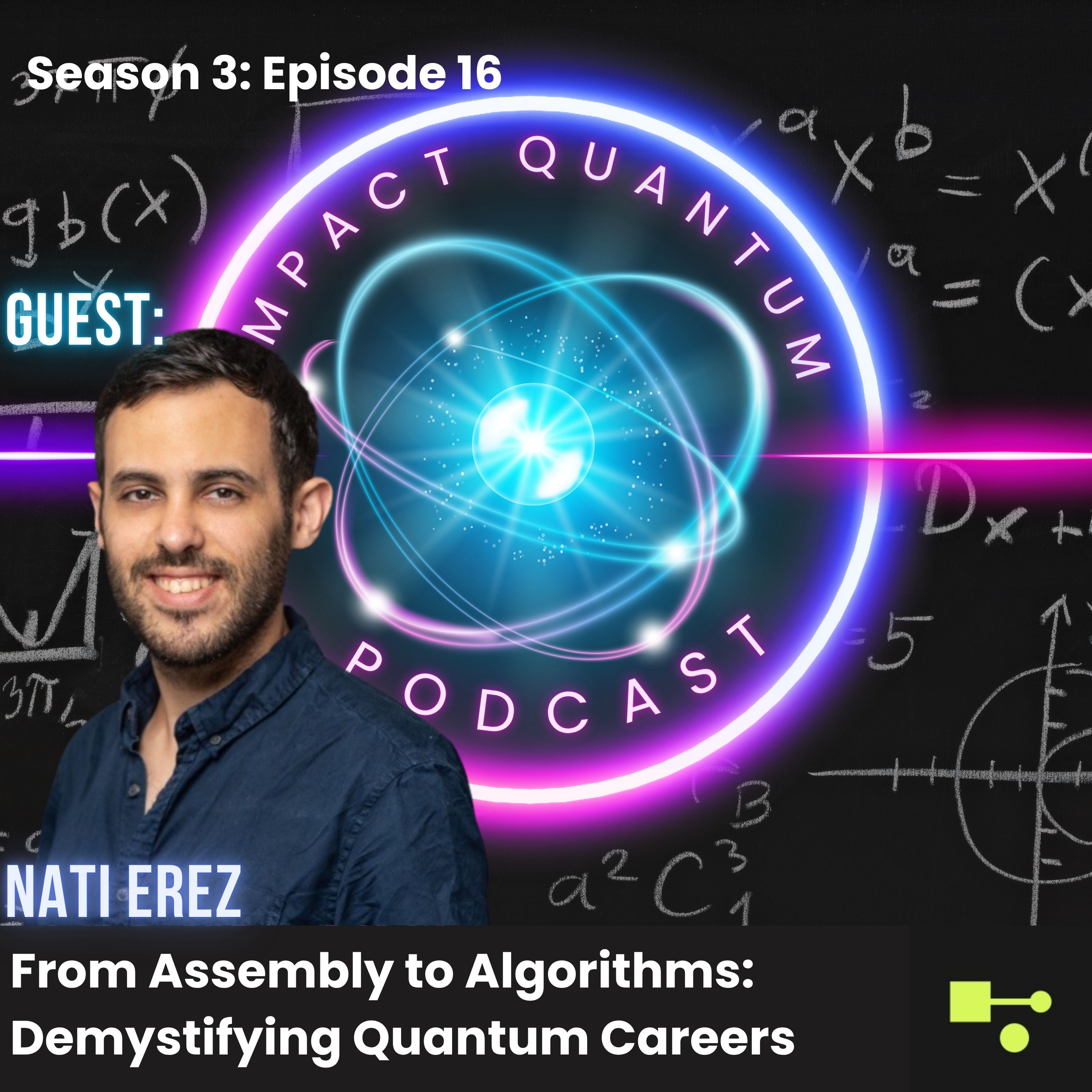
Welcome to Impact Quantum The Podcast, where quantum computing isn't just theoretical. It's practical, or at least, we hope it will be before your washing machine becomes self-aware. I'm your ever-curious, semi-senscient hostess, Bailey. Here to guide you through the squiggly universe of qubits. And quantum algorithms without requiring a PhD in astrophysics or a working flux capacitor. Today, we're joined by Nottia Rez, director of quantum applications at Classic Technologies A Company that's taking quantum software. From lab coats to laptops. From abstraction layers to real-world enterprise impact. Nottia helps us bridge the gap between quantum hype and actual progress. Spoiler alert, it's not about doing everything faster, it's about doing the right things better. So buckle in or entangle yourself because things are about to get wonderfully weird. Delightfully nerdy, and impactfully quantum. Hello and welcome back to Impact Quantum, the podcast where we explore the emerging field of quantum computers where you don't need to be a physicist, you just need to be a little bit of curious about quantum. And the most quantum-curious person I know is as with me as always, Candice Cahouli, how's it going, Candice? It's going great. Thank you so much. I appreciate the great introduction. Hey, any time, any time. I'm excited to have our guest because I know that we had a bit of scheduling staff ooze and all that. But who are we speaking with today, Candice? We're speaking with Nati Errez. He is the director of quantum applications and he is coming to us all the way from Israel today. So it's very exciting to speak to someone on the other side of the world. Absolutely. And it is classic technologies, which in the virtual green room, Candice got right on the first try. I will talk it up to her living in Montreal. I'll take it. I'll take it. Well, welcome to the show, Nati. And what exactly does classic technologies do? Thank you, Frank. Very nice to meet you. So classic technologies is the leading quantum software company. And what we try to do, you can think about it as extending the quantum stack in order to provide quantum software at K. Here's the quantum hardware layers, the quantum controllers, their own correction, and the quantum gate level software. And then we try to extend it into a higher level of abstraction. So it will be able to exactly like the audience of this podcast, low people in with other backgrounds that are not only physicists. However, software language, try to focus on the application and algorithm that you'll trying to solve, rather than the specific gate level design of the quantum circuit. And once we do that, when you're creating a functional description of what you'll find to do, there's room for optimization as part of the compile. So you take this high level description and compile it to any hardware that you'd like while choosing the optimal gate level implementation. Interesting. And so the g-stone. Interesting. So it's proper software engineering, I suppose. Yeah. Definitely. With some hardware specific knowledge, but yeah, definitely. I like the fact that you're working on abstraction layer, because one of the things that I think a lot of people may not realize is that there's different types of quantum hardware underlying. And that's something that I'm really curious, like, has that been a barrier towards innovation or development of quantum applications thus far, or is it going to be like, is it already a problem or will it be a problem soon? So I think that one thing that really helps, I counted seven different types of quantum computers with a bit over 50 companies worldwide. Some of them are big like IBM and Microsoft. Some of them are big startups, like Continuum and Thank you. And we always see new, small startups forming out mostly from universities. So the variety is huge. And everyone is a little bit different, even those that occupy the same quantum modality. But one thing that's common for all of them is the fact that we use universal gate sets in order to program the code. So you can use even a gate level that's universal. I think that's good. Okay. Can I have you explain a little bit more the whole gate set idea, can you can you explain that a little bit more? I'm not familiar, so I would be interested in that. So part of my background is in classical assembly language. And when you think about how regular classical computers work, there are eventually built from a single logical gate called the non gate, the not and gate. Every other logical gate can be built using variations of this gate. And when we go to quantum, it's a little bit more complicated. We can't have a single gate that describes, describes the entire possibilities of traveling over the possibilities of different states. And for that, for that, we developed a language that encompasses the different logical gates. And those gates, each computer has its own different set of universal basis gates. And then we can take a single program and transpile it between those different computers. So this is possible without classic. It's been possible for around 10, 15 years, I think. And it allows you to explore the different modalities. The problem becomes once you try to optimize the circuit for this specific modality. Your circuit creation techniques should be different if your computer is, for example, fully connected, or as a limited connectivity map, where you can only activate gates between neighboring qubits, or sometimes if a controlled not gate is the basis gate compared to a control phase gate, the design choices can differ. As a programmer, you usually only care about one parameter. And that's the total fidelity of the algorithm. You want to have the least amount of errors as possible. And those parameters differ from different algorithm. So while you can use any quantum circuit on any quantum hardware, you'd like to optimize it for this specific algorithm knowledge. I see. So every computer, and I think this probably ties in nicely with your history in classical assembly language, right? Like, where there's a common instruction set, and then underneath the instruction set that goes into, so you write in Python, you write in C#, you write in C, whatever, and ultimately, my background is software engineering. So for me, I knew what you're talking about, but not every well. And I often forget that, you know, we catered to everybody here, but basically it's an abstraction layer below every computer that you have, whether it's your phone or whatever, and ultimately gets down to what, you know, we call the assembly level, but below the assembly level is where you're dealing with logic gates. And one of the interesting things about quantum computing is the introduction of new types of logic gates that are possible only with quantum computing right now. And are those like a standard set, like I know, Hadamard, there's Poly, X, Y, and Z, and there's probably a few other ones, I know I'm leaving out, are there a, are we still discovering new gates or like the fundamentals have been kind of laid down and, and, and whatever, or where do we stand with that? So I guess the answer is a bit of both. When it's more of a hardware oriented question, so I'm not truly an expert, but sometimes this new hardware gets released to production from different companies. We can see that they're using new types of gates that they manage to optimize their specific errors. So, so I always get acquainted with new types of logical quantum gates, but generally everything can be described using the gates that we already know. Okay. Does that answer the question, Candace? Yes, it does. No, no, no, no, it doesn't, it gave me a little more facilitation that I needed, 100%. So how do you, I'm sorry, go ahead, Candace. No, no, no, go ahead. Have you found that your background in such, it sounds like this is kind of dealing with low level problems, right, like from a, from a tech stack, and, and I have a couple questions about that. But the first is, obviously it seems like having experience in classical assembly gave you an advantage in, in, in transitioning to this. But true statement or false statement? Definitely from my perspective, being acquainted with low level languages allowed me to debug quantum code better and to find, find errors and ways to improve them by directly looking at the quantum circuit ever since my first day is at classic, I started by, I started at the R&D section, working on the synthesis center, the compiler field. And I remember that every time that I synthesized a quantum circuit, I, I looked deeply at it and I tried to figure out if I could design it better and if I could, I changed the synthesis center to improve. And this is a scale I got from, from looking at assembly code. Interesting. By the way, I would say something that's hopefully cheerful, I, I'm not the typical quantum oriented employee because I only have a bachelor in physics. Okay. Yeah, I mean, do you think that so, so part of the people that are in our audience are people that want to break into the quantum field, right? So, you know, you have a, I think you're making a joke about, you know, you don't have an advanced PhD in physics and things like that. But obviously, that probably helps. But one of the things that I think is interesting is how do you get non-physicistic into this field, right? And, you know, one of our, a couple of our guests actually independently has said like there's enough PhDs already, right? In the space. Like that, that really was an inspiration for us to restart the show and kick off this season was the idea that, you know, you're going to need an ecosystem, you're going to need sales reps, you're going to need customer service reps, you're going to need, you know, Microsoft calls them CSAs or the company called CSEs for customer support engineers, right? To go face to face with the customers and help them out and get the installs go in. We're going to need marketers, you're going to need people that understand how to sell this technology. You're going to need people that can pitch this account execs to pitch it to the executive level and the C-suite, things like that. For you, obviously, it seemed like it was a pretty natural jump from, you're working with traditional classical assembly language. Now you're doing kind of quantum, not quite quantum assembly language, but really low-level programming. And did you feel that having that degree in physics was helpful, didn't help, or just helped a lot, yeah, it's a very good question for me. It helped me mostly due to the understanding of what quantum is. Usually when you first hear of quantum mechanics, your first thought is, it's not possible. It doesn't make any sense. And you need to digest it and sleep on it for a couple of days until you're saying, okay, they proved it. It's really. Now, let's see what we can do with it. And I get lucky, by the way, because one of my hobbies is getting people into quantum. And my job at classic is exactly that is working with enterprises that some of them are already quantum experts, but some of them want to get into the quantum field and don't know how. And we help them by training their new quantum team, which is usually scrapped off different people from the organization, some with machine learning background, some with computer science background, some mathematicians, some physicists, and try to merge them all together to get into this new field, which all of those areas of expertise can really help getting into this field. And everything from its own angle. And the training is not that hard, really. If I had to choose one tip, it's practice. The internet is full of materials, full of tutorials. And until you're not practicing and trying to code it yourself, it won't make any sense. But once you do, it's working, it's there. So what would you say are the biggest challenges that you have to prepare for? Is it scaling software? Is it the continued education of customers? Is it hardware limitations? You know, what are your biggest challenges? So I think it's basically a combination of everything you said. We're taking part of scaling the software, and we're getting really interesting results. I think the major challenge right now in quantum computing is scaling the hardware. And luckily there are a lot of really, really smart people that are focused entirely on that. And I'm no profit, but when you start looking at the road maps that all of these, both startups and corporates are publishing, you can see a convergence point in the next two to five years about the beginning of the quantum advantage era. And it's really interesting because what I expect will happen is that if you count all of the enterprises in the world that got into quantum already, I think you'll be in the lower hundreds era, but there are thousands and tens of thousands and more enterprises in the world. So why everyone that don't go into quantum right now, that's because they don't quite see the need to get into it right now. But all of the convergence of all of these road maps tells me that in the next couple of years we'll see a very large wave of industries that are trying to understand what is quantum and what can quantum do to their business, once it's in the fall down around there. And I think this is going to be a major milestone for the industry. And we need to prepare for that both with the main power and with the educational capabilities. Interesting. How do you think that could be done? Right, I know that's kind of a small question with a big answer. But how do you think that could be done? How do you think that can be like, what is the quantum industry need? Right. That's a big, that's a tough one, yeah, yeah, yeah. I genuinely believe this is the toughest part of my of my job. It's not talking about why quantum is useful, it's not about talking about quantum algorithms and how to use the algorithms to solve application. That's the easier part. The harder part is to find those applications that can really bring value to the industry. It combines the need for a single person to have a quantum toolbox from the standard of the algorithms that they can use. And then understand all of the applications in that area of expertise. Let's say we're talking about a hospital. So we need to understand all of the tough problems that the hospital can handle with or don't handle with because they're too hard or handles them approximately and would very much like to get a better approximation. And then not only connect the dots between these applications and the algorithmic toolbox, but understand the actual, I call it business value, it can bring to the hospital because this is usually what talks to them, what talks to the enterprises, what makes them get into quantum. That's the point where they say, yes, this is what I need. Even though I can't use it right now, I want to be able to use it when it's available. That makes a lot of sense because I think that's where the gap is now, personally, just like as I wouldn't call myself an outsider, but I mean, kind of someone who was really excited about this space, I think that how do you explain this to the C suite? How do you explain the value of what it actually provides? And I think that that is, I can see that being a challenge and how do you get people that are comfortable talking about very in-depth physics concepts, but also in a way that can go very high level for people who are not background in physics. People who wait to check, but also do it in a way that, and also speak to kind of the more lower level technology concerns. I can imagine that would be a pretty severe problem, actually, or challenge, depending on how you want to phrase that. Definitely challenge. Nothing in quantum computing is a problem, right? In your opinion, what's one popular misconception about quantum computing you wish people would stop promulgating? Well, I think that it would be the speeding up factor. If you'd ask the average person what quantum computer can bring, they'll say that it can solve problems really fast. But if you ask someone who understands quantum, they'll tell you that it solves specific problems really fast. I think that's not the main point of quantum computing. It's not solving problem faster. It's solving problem usually with more accuracy, because let's talk, for example, about combinatorial optimization problems. And really, hard problems in combinatorial optimization are usually NP-hard. So we don't solve them precisely. We use approximated algorithms to get some solution, probably not the best, but also not the worst in a reasonable time. So if quantum computing can solve combinatorial optimization faster, even up to some level that can get into the answer, the point is not that it solves it faster. That in the same time, we can find the more accurate solution. And this is what can really translate into the business value eventually. Interesting. And just for those NP-hard versus P-hard, just can you explain that in terms of the more people will like, I know where you're going, but not everyone will know. No, no, it's very important. So in classical computing, in complexity theory, we usually divide the problems into several complexity groups. And by complexity group, I mean, how hard is it to solve the problem? How much time will it take based on the size of the problem of the input? So one of the simplest types of problems is called P, where we can solve the problem in polynomial time based on the input. A very hard problem is exp, which is solving the problems in exponential time. And a very interesting type of problem is NP problems. Our problems that it's very hard to solve, they're very hard to solve, but once we are given a specific solution, we can verify that it is the solution in polynomial time. So you can, the first example of why we need NP-hard problems is when you think about entering the path for identification, and we currently, in classical complexity theory, don't have any idea if the class of NP problems equals the class of NP problems or not. So we don't know if there is a polynomial reduction between every problem in NP to a problem in NP, which allows us to solve these problems in polynomial time. This is one of the major questions in computer science today. When you're talking about quantum, it's a bit more complicated. There's also quantum complexity theory with other types of problems. But the general belief, I think, is that some of the problems can be solved a little bit more efficiently in quantum computing. Now, it's a good way to put it. And then this is the whole thing of, you know, it's hard to factor primes, right? It would probably be an example, right, and then this is the thing, right, and there's a whole thing about, this has been an un, like you said, like an unresolved question in computer science in general is like, does P1, P, right, like kind of like that sort of thing? And I think that's right. I think a lot of people think quantum computing won't do everything, but it won't do everything. It's really good at certain types of problems, protein folding, probably a good example, chemical interactions, that sort of thing, factoring primes, like I already said, you know, so it's not going to, you know, it's not going to do everything, but what it does do, it does really fast. Um, and I think that's, I think that's the important thing that people don't realize. Like I talked to a lot of different people, you know, on the show and about quantum computing or why I'm excited about it. And it's like, so it'll do everything faster. So I'll get a queue phone and say, you know, the, where I can get a queue for you and play, you know, grand theft auto six, you know, it'll be that much better. I was like, not really like that. But I do also wonder, right, since we're, we're still early in on this, right? Are there going to be other types of problems that could be potentially sped up that we don't really realize yet? I think that that's, um, I think that's the exciting part, like in a lot of ways, we just don't know what we don't know about implementing quantum computing at any kind of scale. I completely agree that's super exciting and I think there's even two types of, of interpreting this phrase, like one of them is that we have today a set of quantum algorithms that we know of. Grovers algorithm and shows algorithm and phase estimation and, and QSVT and a lot of others, other very interesting algorithms. And we can take them and try to understand which applications we can solve with them. So even with what we know today, we don't necessarily fully understand how to use it. It's very similar to the early stages of classical computing, where no one would have imagined something like the internet or, or, or, or, don't even think of CGPT. Yeah. Or like YouTube or, you know, Netflix, right? Like, definitely would have thought when they were, you know, probably during or right after World War II, like putting together these vacuum tubes, like, oh, no, you'll be able to watch TV on this one day, like, you don't even need to go that far. I have a computer in my washing machine, right? Right. Right. Everyone has a computer on your washing machine. It's the same semiconductor machine that runs a processing unit eventually. That's true. That's true. Your washing machine probably has the equivalent or more power than the Apollo guidance computer, right? Right. Right. Who, who would have thought about that? Like, even as recently as like the 60s, right? Yeah. So I think that we just don't know what we're opening up. I think in that, that, that's really exciting. Like, we really, I think we really are kind of in that transistor phase here. So one of the things you said was interesting. And I really want to know, you said debugging quantum algorithms. It's my understanding that if, if once a qubit gets measured or analyzed, like, the state will collapse, like, how do you debug a quantum program? That seems very, I mean, is it, do you have to debug in simulation? And then run on a real machine? That's a perfect question. And if you get creative enough, there might be ways of debugging what we call dynamic debugging, translating to debugging by running the code. But it's indeed very hard and very non-trivial due to collapsing the states. What I talked about is what I call static debugging. When you're looking at the code and trying to find levels or trying to understand the behavior of the, of the program. So it's something that's very hard on classical computing. And probably extremely hard on quantum computing. Unless you're, unless you're understanding the, the basics, like, how are the gates operate on the qubit, what are they doing to them? What's the connection between different qubits? Right. So one of the things we developed as part of our platform classic is a visualization engine that shows you the quantum circuits with the lower gates, lower level gates that act on the qubit, but also incorporates the information from the high level language. So you're not only seeing qubits, you're looking at variables, and you're looking at function that act on those variables. And you can zoom in to look at specific gates from specific functions, or you can zoom out to scope something a bit larger and understand the functional behavior of the code. So combining both the low level and the high level information together really helps you to statically debug to find the errors in your original code by only by looking at the circuit. Interesting. So how can regular people spot the difference between quantum hype and genuine progress? And I never thought about it. That's a very good question. Thank you Candace. So the first sentence that I say to every even potential customer that we meet is just making sure you know you can't get any value from quantum today. I don't know what you know already or what you think you know, but we're not yet at the quantum advantage Landmark. So once you start from there, you're already in a good spot, like you know you won't get any advantage. Let's understand that we're in the exploratory phase. And now let's start to explore. After you're there, there's a variety of quantum algorithms that you can explore. And it's also important to distinguish the ones that are proven, the advantage is proven like phase estimation and amplitude estimation and Grover and Schoer and others. And also understand their limitations compared to programs that are more heuristic like we have a reason to believe that they can be more efficient. We didn't prove it yet. So they may be more efficient in some senses to some specific problems and may not like QA away, which is not, which is not a guess, it's quantum algorithm that has something physical behind it. It's called the adiabatic theorem. It talks about slowly transitioning between a quantum system that we know its optimal solution to a quantum system that we don't know its optimal solution. And theoretically, if we do it slowly enough, we'll get from this optimal solution to our desired optimal solution. Practice them. Practically, we're not doing it infinitely slow, so we need to do it in the right way. But it's a quantum algorithm that's not actually proven to provide advantage, but it has some smart heuristics behind it or a variational circuits. Not all variational circuits are equal either in match to the problem or in match to the hardware. And sometimes you'd like to use this one and sometimes you'd like to use that one, and it's important to understand the parameters of the problems when you're starting to solve it using quantum. And I guess these are the main points. Okay. That's interesting. That's interesting. So I saw on your LinkedIn, speaking of quantum careers, you posted that you are hiring. And it looked like there were some pretty interesting roles that you were hiring for. So if you want to use this as an opportunity to do some recruiting, I can feel free. Thank you. No problem. No, because I think, I just glanced at the post, and it wasn't, I didn't look too closely, but I didn't see any hard requirements for somebody who has a PhD in physics, right? It seemed like you do need to have people, one of them was something like a customer success engineer, and there were a couple other ones. So tell me about, like, who are you looking for these days? Right. So even more generally, classic finished it's around CEO funding, around a month or a couple of months ago, we raised $110 million in this round, and now we're growing, thank you very much. Now we're growing and we're growing on basically every group in class. So my group is the technical group that supports customers and partners and business engagements. And when we are growing, we are looking for people who are very much oriented into quantum algorithms. We can teach them the classic product and how to use it in the best possible way, but they will need to do the same for all of our customers. And they can be customers that are very quantum, proficient like BMW, where we had a mutual research that was really top notch. It wasn't myself, so I feel, so I feel okay to say it, but the team both in BMW and our personal world did a fantastic research, very interesting. And it can be with a bank or a hospital or an automotive company that wants to get into quantum, but don't know how. And we need to help them walk in the path and train their quantum, their newly quantum team and make some projects together to make them successful. So this is the core idea, I'm looking for people who understand quantum information and quantum algorithms and may have some experience with quantum machine learning or with quantum chemistry or generally in a variety of quantum algorithms. This is basically what I mean. We are also hiring for product roles and for education, leading roles, and for definitely for R&D roles. People who know classical software programming very well, but are also one to more intense. They can speak the language of quantum software. And also something very interesting is that we're starting to hire a lot of business representatives around the world, we're creating hubs in different locations. Just go to classic.io and look at all of the jobs that we currently have and apply. Very cool. Very cool. I think that's encouraging that not only you're growing and congrats once again, but also that you're not just looking for, whenever I mentioned quantum computing, a lot of even smart technical people. I'm talking data scientists, AI engineers, DevOps folks, they just kind of like tune out. That's not for me, I can't get my head around that. And yes, you're right, there are a lot of things about quantum physics that it's hard to get you head around because what we think of as reality and kind of, we live in a note, we live in a Newtonian world, right, or at least the world we perceive is pretty much Newtonian physics, right? But turns out that reality, one of the best quotes I've ever heard was that what we perceive is real, maybe being made up of things that may or may not be real. I thought that was like that really blew my mind. I know that's a little fluff science, pop science type stuff. But I mean, there's a lot of, there's a little bit of truth in that, right? And I think that this is hard and to quote Richard Feynman, if you think you understand quantum physics, you don't understand quantum physics. I also think that it's encouraging that folks to explore a career in this, particularly as it's, you know, it's about to take off, hype or no hype. I think there's something very real here that's going to happen, you know, in a very near future, right? And clearly your company's raising money. So clearly, you know, it's not just me saying there's venture capitalists, there's actual money on this. And Candace was telling me that the G7 summit was, had a big focus on quantum computing. Yeah, no, it's very exciting. I mean, and there's a lot of, there's been a lot of noise that's been coming out of Israel for what they're doing in the quantum sector, which I think is super exciting. So let me ask you, let me ask you, you know, Nancy, if you could fast forward five years, let's you hope people would be doing with quantum that they can't do today. Right. So quantum computing is a revolution, and the revolution really takes time to kickstart. I very hope that in five years, we'll already see quantum advantage, at least for some of the problems that we face with today, meaning better hardware, better error correction algorithms, better software. A lot of different companies involved in this effort, a lot of different research institutions that are striving towards that point. And with that, I hope that we'll see a couple of movements in the industry. First of all, definitely all of the fortune of 500 companies are already deep. They have quantum teams, quantum groups, maybe, that are not only under the CTO and innovation departments, but they are actually starting to generate revenue. With that, I hope to see a lot of new startups in the professional service area. To help all of the new, the smaller enterprises that don't yet get the benefits of using quantum computing compared to the, maybe, hopefully not so high cost of starting. The other thing is that, as a worldwide society, we need to find a solution to the main power who joins quantum computing. We need to, when I started at Classic Friend a half years ago, I already at that point thought that it's about time to start teaching quantum computing in high school. You can do it to some degree of understanding without knowing linear algebra, for example. Start learning about quantum algorithms and learning algorithms is definitely possible. It's possible to understand and grasp and implement and execute and see the results on actual quantum computers even back then. So in five years, I hope that we'll already be there. Because those high school students will eventually develop a career in quantum computing in the next 10 years, where it will be a lot more relevant. And we can't wait for everyone to have a PhD in physics, obviously. That's there. I like that. That's a good answer, because we do need, this is revolution is coming. We need to get ready for it, right? When my son, my oldest, decided to take AP physics over, well, first I found out that he was opting out of AP computer science or something like that and then he, I was like, why did you do that? He goes, 'cause I want to take AP physics. I was like, I can't argue with that. So, yeah, I want to be respectful of your time. Do you have any questions, Candace? I totally hog the mic. Sorry. I just was curious. I don't know if this is easier hard to answer. But do you think quantum will be more like the cloud or AI, like a tool that is used behind the scenes or something that users will interact with directly someday? Right. So, the answer is divided into phases. In the first phase, it will definitely be on the cloud. I think that some organizations, though a very small portion, has a true motivation of having a quantum computer, a personal quantum computer. But I think that we won't be there at least five years is the very optimistic guess I can think of. And regarding a lot more, let's say, 10, 15 years, I already said that I'm not a profit. So, it's very hard to predict because we don't even, we probably can't even imagine the applications that we'll be able to solve with a quantum computer. So, yeah. Now, that's totally there, right? We can't, I'm not even talking about the physical challenges of cooling everything and maintaining everything and putting everything with high punctual and accuracy. Using that on a wrist, I think it's an incredible output of the challenge. Okay. Oh, that's a good point. And you're right. Like, who would have thought, I mean, I stream all my media over the internet, right? People who created the internet probably didn't imagine that. And I doubt that they imagined that, right? But I also think that the people that were working on vacuum tubes and the original kind of computers did not think of that, right? Certainly, charge Babbage and Ada Lovelace did not imagine that, right? So, like, we're going to find ways to use this new technology in ways just really outside of our imagination right now. That's interesting. Awesome. And where can folks find out more about you? You can find more about me on my LinkedIn page or on classic.io. You can contact me directly, the email address is very easy, it's
[email protected]. I'll be very happy to answer any questions. Awesome. Thank you so much for coming today and speaking with us. I really enjoyed this. I think this will be exciting for our audience, for sure. And if you're looking for a career, yeah, no problem. If you're looking for a career in quantum, definitely reach out to nati. That's right. No, I know how hard it is to recruit people, especially in this field, right? It's got to be, got to be really tough. Yeah, it's going to be a challenge, but very often. Awesome. But I really like that he mentioned, oh, I'm sorry, I really like the fact that he mentioned understanding a lot of, a lot of languages in, as a base, you know, even to say, well, you can start out knowing all, you can start out knowing, you know, you know, basic languages and then you could actually move into quantum because you just understand more. I just like the fact that it seemed like it was open to many more people than I thought. Yeah. That's cool. That's cool. That's, that's the core message of our show, so I love it. And with that, I'll let R.A.I. finish the show. And there you have it. [Music] [Music] I've made you consider a career in quantum even if just a sound clever at parties be sure to like. Share, and follow us on all your preferred platforms. We're available wherever fine quantum content is algorithmically served. Until next time, remember, in the quantum realm, everything's possible just not always observable. Impact quantum where possibility meets probability, and somehow still ends up on Spotify.
 PodcastTranscript AI