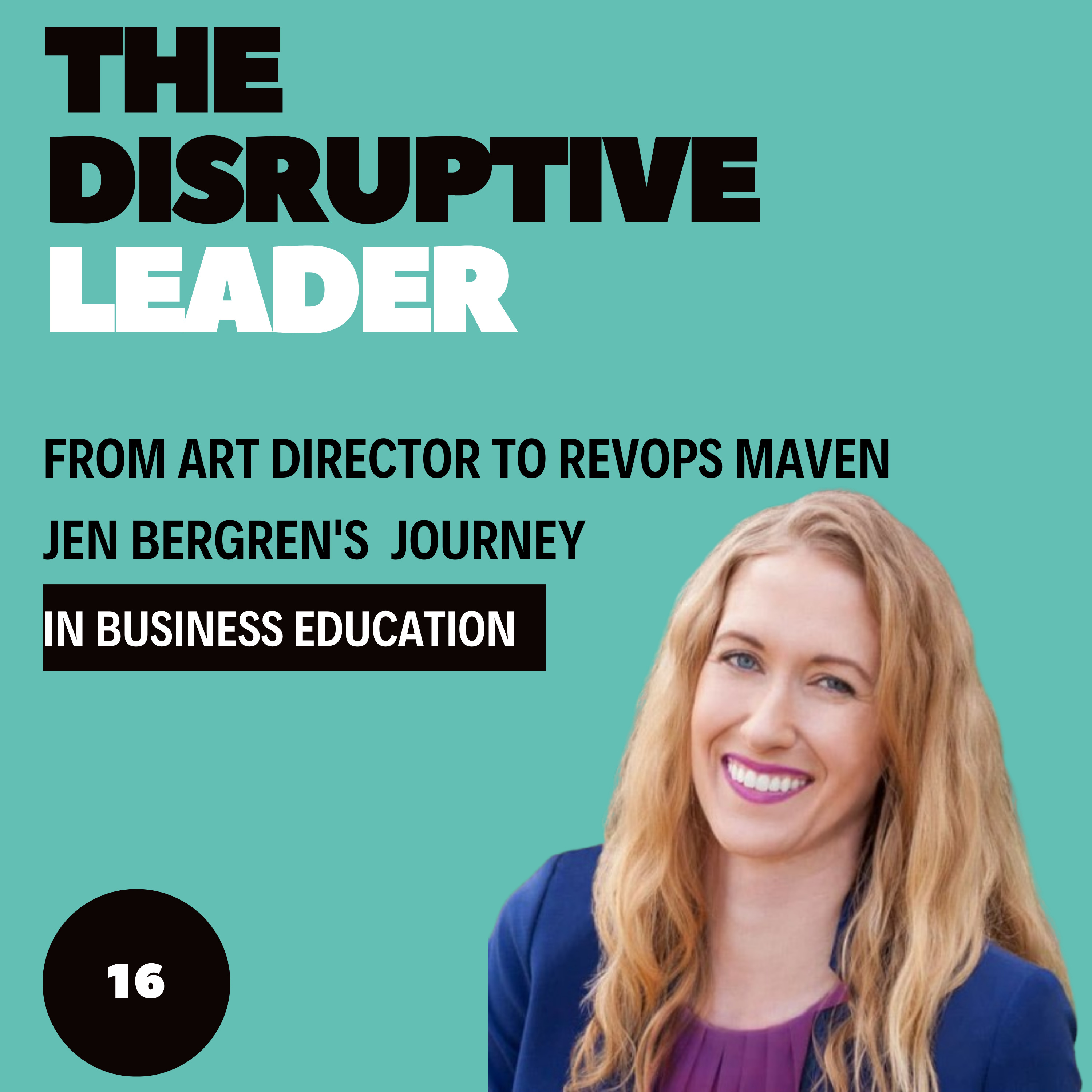
From Art Director to RevOps Maven: Jen Bergren's Multifaceted Journey in Business Education
from The Disruptive Leader
45m 30s
The transcription features a conversation with Jen Bergerne, who shares her career journey from graphic design and photography to revops and business education. She highlights how her early creative roles involved problem-solving, time management, and operational thinking, which seamlessly transferred to operations work. Key lessons from scaling a revops agency include the importance of people management, robust onboarding programs, and discipline in documentation and processes. A pivotal moment was improving a three-month onboarding program to double the team size, which ignited her passion for training. The discussion contrasts scaling by hiring more people versus specializing through technology, with the latter enabling growth without increasing headcount. Jen later transitioned to creating educational content, such as a revops bootcamp and a course on documentation, driven by her interest in instructional design. She compares traditional and online education, noting that online learning is more inclusive and flexible, while in-person delivery offers accountability and the impact of physical presence. Overall, Jen emphasizes the value of transferable skills, structured training, and adapting to different learning formats.
Good morning afternoon. Still morning here, but it's evening there, isn't it? Are you in Sweden? I'm still in Sweden. It's evening and it's pitch black already. Here we go. How are you? Good to see you again. I'm doing all right. How are you doing? I am good. It's nice to see you are still in Paris. I'm still, I'm not curiously in Paris from my background, but otherwise still in San Diego. Yeah, no, super. Wonderful. I just want to start by saying thank you for taking the time to speak with me. I'm sure this is going to be a really great conversation when I was doing research. Prior to helping onto the call, you're like, well, Jen has a really brilliant. Brilliant story. So yeah, thank you for being here for everybody listening to this episode. I'd like to start by introducing Jen Bergerne. I hope I pronounced that correctly. Jen is a versatile educator and operations expert. The as a very unique career path, which I actually then jump into. And let me just start by saying Jen's journey as far as I understood and correctly if I'm wrong. You started with graphic design, then went into revops and now business education. Did they get that right? Yes. So tell me about that journey. How what happened? What how did you get there? What started? It's a great question. Thank you for having me on the podcast here to talk about it. My first career was in graphic design, mostly for print graphic design, like a daily newspaper and weekly magazines, like fast pace work. High volume with real deadlines. I think you're familiar with. And things that require lots of project management and using templates and ops things I can see now, like looking back on it and tying my journey together. But while working out those design jobs. I was directing photo shoots and I got really interested in photography. So I started a photography art business and through that I was learning all about business and marketing, which was super interesting because it was like this whole new area I was learning about and I love learning. So my favorite part of that job again was learning about the business and learning about marketing. So I went back to school to get an MBA to learn about larger than one person business and some business foundations to help me transition into a third career. I guess it would be which I thought it would be marketing, but then after grad school and if I'm getting a job at an agency that was called remote ish for my. And so I was one of the first employees and I started in a client facing role doing a little bit of creative work using that background. But also doing technical work inside HubSpot and we went more and more towards the technical direction as time went on and I got into a manager role for the service team. And then eventually my final two years we split off operations into its own role or department. And so I had a official operations title, which I know a lot of operations people don't often have people doing a lot of that foundational building work for the company. And then I left about two years ago to focus my time on building education about apps topics that things I wish I would have found when I was building things from scratch. I'm like, why do we have to build from scratch. It's 2020 and things should be available online like best practices for documentation and employee onboarding was actually employee onboarding building and play onboarding program is what got me interested in making classes and instruction design. And so I started building classes and volunteered with house about book and so where I met you. So that's a very short version. I love that journey and what sort of what what intrigues me is like you were it started off in sort of creativity arts. And then transitioned into business processes and operations and if I think right brain left brain. That transition from the creative world to a more boxed operation structure processes. What's what are like the transferable skills between those two worlds they cut where what soft skill or hard skill for that matter would apply to both of those worlds. And a great question. I think a lot of it was at my skills were like in print design and not digital design. So that was maybe a little more relevant for the transition but like problem solving balancing time and budget and skills and the tools available could fill or fit with either creative work or operations work. So what I was working for is when I was working for pet co corporate doing their circular add like that multi page ad that used to be in newspapers and at the front of the store. They had 60 different pricing versions and you had to figure out how to fit everything together on the page so it made sense. And like sometimes there were different photos like different animals are allowed in certain states and not other states so you had to deal with all this burgeoning. And that was very operational thinking back. So even though it was creative, it was already like I'm not just designing something that looks good, but I'm also thinking how am I going to solve and engineer in a way. Especially with print specifications and mailing and distribution. I know you worked at a publication as well for a while. I saw you probably very familiar with real dead last. I just will put it in the project management system that we'd like to have it done but serious consequences to not getting things done. It's crazy that you say that because now that I reflect back to those days, it was literally we have to get the file out on time has to go to the print shop because it has to be. And we have to ship it like 500 kilometers because we live away from the rain city. You're right, it is a lot easier now. I was trying to think of some other skills like documentation still played a role like the less creative side of things to allow more like brain space and time for the creative parts. So all those technical details like the timing that things have to be done like the specifications where you're going to print in the margins and brand style guides for consistency. That was all technically documentation looking back on it. Planning, planning, photography work from all of the planning, like controlling the things I could control because I couldn't control usually what the subject did too much because my subject was actually pets usually dogs. Trying to find the right location with the right light at the right time and all these different techniques to try to get like the right colors for the person's house because the things were going to be printed afterwards and. So there's a lot of operations went into it wasn't just creative side. What I'm finding the more conversations and episodes to undoing everyone's journey has always been like oh I did this and then it led me to that. And it takes me to the same with him bound agencies where it's like oh but the buyer journeys never did. That's true. And my dad talking about inbound agencies like we've both been through the aches and pains of building an agency ground up and you were literally employee number one. Yes, I started as a contractor so I was a little tricky with the employee word but we say approximately number one. So like human number one that you were what are like critical lessons you've learned in scaling a revs up agency. This is a great question I wrote down some notes so hopefully my insights are clear hope so but. Even though I know the definition of scale is simplified to doing more with less making more profits using less resources not always hiring more people to add agency like your product is your people you do need to hire people to deliver the service when you think you're going to have more clients. So keeping that in mind that the people side is always super important for the people side of scaling and related to people hiring people can be really difficult especially in a new ish kind of industry like revops. It's different every company you can't expect anyone to know how to do 100% of the job that your definition of revops excuse me.
And also with like a smaller agency affording people who can quickly self-teach at any company, like the company differences, may not be possible, though all of our people obviously were great and good at learning. But you might not be able to afford people who already know how to do 100% or close to 100% of the job. You need to build in time to train people and let them get up to speed and make sure you have a good onboarding and training program to account for those months in your forecasting and planning when you're planning headcount and revenue and bringing in new clients. And I think discipline is something that plays a big role in successful scaling that I'm not sure is talked about a lot. Like documentation following processes, communication processes such as transparency and visible project management and time tracking and analyzing that time and constantly improving processes to make them repeatable and predictable and scaled, scaled a little. Yeah. That's a lot of things. I'm going to stop for you. Ask questions. And while you were going through that experience and that's a lot of moving pieces at the same time, there's humans, there's processes, there's documentation, there's revenue, there's a lot going on. What was your sort of like biggest aha moment or oh shit. Like if you could pick one, what would it be? It was probably my CEO Nicole's moment, but we realized that we've been need to scale and double the size of our team like from 10 to 20 in six months. I'm not sure it was the biggest, but maybe it's the most memorable at the moment for me because I'm not sure if it meant improving that onboarding program to be more robust in program that lasted three months and the first month of learning about the company and the second month more about the role and the third month of just filling in all the pieces to ramp up to 100% of their role. And that really sparked my interest in creating training. So that's top of mind for me always been I'd love to hear your biggest, though, shit moment and money. I think mine or like it's very similar to what you're saying, but we did it the other way when we started to get into the oh shit, we need more people to be able to continue to scale. It was like, was I going round and round in circles? So we, I think our biggest moment was like, what do we need to do to not be in this situation and keep scaling and that's when we pivoted completely from sort of full service into only doing migrations, integrations, you know, just very specialized service. And our hypothesis was we can scale the agency without the dependency of hiring more people by using technology. Sounds a bit mean now that I say that. So we actually scaled by reducing people. So I think that like I definitely hear you when it's oh no, we either have to take that path of hiring more people all the time, which we used to find really hard because finding good talent and retaining good talent and then it's a lot. And it was we went the other way, I think that was one and I think another one was coming to that conclusion or realization that not all revenues healthy and just because you have a client that's you know, paying you that's not a reason for you to accept sort of them building your team or. I think that was a bigger one before me like because I had to come to this decision of it's either they might team keeps getting bullied or we tell this fine, you know, we're not really right fit for each other. That was new. Yeah, I was always grateful for my CEO Nicole for firing clients who are not treating the team. Yeah. And I had a question for you and I'm trying to form it in my mind about what you said about meashing down was it easier to find people or train people once you had that more specific focus instead of trying to train people across 10,000 different tasks. So that's a great question. We already had the tech team because we were already doing that service as well as the content and the marketing and the training and the. So we kept that part of the theme and then what we did with the services was crazy actually. I'll never forget like done tired. I was like, you know, working with him through this transition and he was like, don't give up revenue. I'm like, no, we're going to do it. He's don't give up. I'm pretty good. I was like, no, we have to do it. So we actually, we literally reached out to the other agencies as messaging them or emailing them saying, hey, do you want a client? They were like, what's going on? That's a thrill. So we did that with our clients and with our team as well. We just paired them up with other agencies because it wasn't anything bad or anything. It was just, is he an eye where like we're so done with this? We need more people. We need more people. Maybe we're not people. So he came up with this crazy hypothesis, but we managed. We did it. We pivoted. I remember when we hit a lead, a lot of people that have swaped were like, but your team is only 14 people. And we were like, yeah, that was. Yeah, that was. So I think if we didn't have the tech team, it definitely would have been very hard to find them, onboard them, train, and so on and so forth before making that pivot. I think. And so talking about onboarding, training and all of that comes the need for education. And I know from previous conversations with you doing bootcamp with you, I call you G of education. Thank you. Talk to me about the transition from going from agency operations that you're rolling remote to shifting into sort of creating educational content and launching your own newsletter with all of everything you're putting together. What was that like? Yeah. As I mentioned and hopefully don't mention too many times. I've been creating that onboarding program has sparked my interesting creating like official structured training and curriculums. And then I got a certification from the Association of Talent Development and trying to think of the acronym words, yes, Association of Talent Development about instructional design because I really like that sort of official learning to make me feel more confident in what I'm doing and more structure. And training was always an interest for me personally, take classes on learning all the time. And it's how it was interesting to be like on the other side of it, helping other people learn by creating and delivering this type of content. It was pretty rewarding. And I think part of being a manager when I was a manager at this agency as well, I liked helping people learn, helping people improve in their roles like mentoring and my Boston Cole and I were trying to figure out the next step for me because our agency was not big enough for me to go up any further upwards. And she was helping me figure out the next step because we weren't going to have a COO or any kind of executive related to ops. Just we're just too small. So she really encouraged me to pursue this path of creating education. And it was right after I took that certification. And there was that call out for assisting with HubSpot bootcans and like, oh, that would be interesting to learn like how those are delivered, how they work. I'm always curious about how anything works. I was working with you on what was called sales skills, but now I think it's discovery call bootcamp. Is that right? Yep, that's right. And documenting that work there, of course, the handoff to the next producer because I was pretty sure I'd be like teaching or doing something else next. And that's true because there was a call for, hey, the somebody went and we'll make a Revops bootcamp. I'm like, oh, I have all this content from this book that's taking me many years to try to publish. I think I could use that to make a Revops bootcamp. That would be super interesting. And now that bootcamp is the enormous. Yeah, it's between, it's usually about 200 to 300 people each time. It's like a conference. That's seven times way for us. We just started today. So that's been super interesting making that bootcamp. And that was at the same time I was making my own class about documentation because this company called Maven that as cohort classes targeted me really well. They did a good job with their marketing. About, hey, here's an accelerator for building a course. And I ended up actually building a course. I thought I was just going to like practice and learn about it. And I'm like, oh, I have some presentations that I have been doing some content I have made about the importance of documentation.
because that's information I never found anywhere when I was creating documentation and processes and all that maintenance at the previous company. And so first I had live classes and then I started creating on demand versions once I had some iterations and improvements from the live feedback. And if you could choose between traditional offline education versus online. What would you choose in mind? So personally I like taking the on demand online classes. But I think any some sort of live format, whether it's in person or online is more helpful for like accountability. A little more fun to deliver because you can interact with the audience also. I hate making videos and editing videos of myself hearing myself talking for hours and hours. And I think that is not a fun time for me from that standpoint. But I think your question more about traditional education versus online in general. So I also work for a university. So that's more traditional, but they've been online all classes have been online since the 90s. And they have this really interesting competency based program where you can move as fast as slow as you want to. And that's not super traditional, even though it's more traditional education of like regular degrees accredited degrees. But I think that in person our live classes are good. Again, accountability we mentioned knowing somebody's relying on you to show up. That can be easier in person or live as opposed to asynchronous with other kinds of on demand learning in that structure of traditional education like the curriculum that set out can be more helpful than trying to find bits and pieces of. Different types of online learning. So I think both have a time and place. Yeah, I think a mix is like it's not really black or white either or it's. Each one of them has its pros and cons. I just find online learning provides a. It's more inclusive. Yes. Then the offline. But I said the more traditional sort of on premises. It's fine. I don't know actually I'm not sure because like sometimes I wonder if delivering anything in person be it a course or a presentation or a talk. It's not only your brain and mouth that's delivering. It's also the way you move and your clothes and the stage and the lights and the production and so on and so forth. Whereas online it's literally. Yeah. So I somehow I always think to myself. I don't know if the remote world, the whole even remote work, not necessarily related to learning. Is it higher sort of brain power than being in a physical space where your charisma will play a part of it? You know what I mean? I feel like there's more operations that to the online learning delivering part than in person in person is more like just. I have people to show up and maybe like the tech of the presentation if you have a screen. I have my first in person presentation in a couple weeks. So I'm worried about that. I'm sure the tech part will be fine because I don't have to handle that myself. But like as you're talking about walking around the stage in the body language and all that thing. I have to practice. We'll see how it goes. That's a. I'm off the police it made me over by the time this is. And if that was online, would you be out worried? I would not be as worried because I've had a lot of practice delivering kind of online talks and I can have like my notes how I want and again, I'm only seeing this part. So I'm not as worried about what my hands are doing though. I know they do a lot of this. And you can be in sweatpants and flip flops. I have my dog on my foot like all kinds of me. I have my plants around me and my crystal. And so as you. I'm just a little bit more focused on what I'm doing.
about that human connection that I definitely echo in what you're saying is you got to happen it at least daily. And as we you mentioned you were writing a book that's taking you years and years. So more education. What's your, if you want to share it like what are the key themes or insights so in your book or the research you're doing about the book and when they're coming out and how can people pre-book. Hopefully it's coming out early next year. I hope to have the draft finally done as end of this year. It's not like I've been writing it for years. It's like I've been procrastinating it because of other jobs. But this year I really want to get the draft done. It's maybe about halfway done right now. Not with the other half being very messy, but the themes are it's called what is Revops both for SEO and because even several years later after doing the initial research that is still a question a lot of people have is different definitions of revops. Certain industries just not aware of it yet. For example, I know there are some experts who have been talking about every day for years, but that's such a small portion of the population that I think it's still a relevant question. So the themes are like why can't we agree on what Revops is, what is it, a creating shared definition out of all these different inputs, all the principles of people process and tools. And then I also talk about things for needed for Revops department success, for success of the individuals, the professionals working in the field, the success of the industry, elevating apps in general. And then the future of Revops what much which might be like right now because of the research being here two years ago, but hopefully I am trying to find my goal here. The goal is like elevating operations and getting a mutual understanding of Revops will help people build career paths and help it be easier to be successful if other departments and other teens and people understand what you're doing if you work in Revops. And so I interviewed like 35 people and asked them a set of 15 questions. And that's what I'm trying to form into a book which is much more difficult than just writing my own thoughts. For sure. And then the time. But I'm thinking together. How do you think that as a question of the year about everything and anything? How do you think AI is good at impact? I'm sure about. I think AI is good impact. I don't really like answering AI's questions, but I will answer like related to the documentation and all the questions that you usually pose to Revops or ops people. If you have documentation and AI can dig through it and answer those questions. So you don't have to answer the same question a thousand times. So that's one maybe small way. I think you can use AI's. I have like a chatbot or agent. I'm going to try to think of the new word agent. It's a new word. That goes through your documentation. But then of course you still have to train people to use that instead of just slacking you a message. So there's still a human side. Back to human. You're right. That's the insanity of it. You think technology and you think software and AI and agents, but it all boils back to that human brain. And based on everything that you've been talking about. So from photography to design, to prince, to processes, to building an agency, to getting an MA, to a lot going on. It sounds like to be able to do that as an individual. There's a lot of personal strength and inner drive and purpose that gives you the fuel to to keep evolving and progressing and doing more and more. And while being a leader. So if I was to ask you what are your favorite, these are two questions. What are your favorite resources for finding personal strength and purpose? And then once you've found those strengths and purpose, how do you tie that self-awareness that you've just found and learned into your leadership? These are great questions. I think I have a few tools or resources I talk about linked in, including howtofascinate.com. It tells you like your advantages. And I think mine were prestige and innovation and passion. I'm like, that makes sense. So I believe that. And 16 personalities is a great site for telling you like what is it called? Myers-Briggs are like the four-letter personality type. And there are also resources like startwithy.com can help you find like what or why mine are creating and improving and discovering. And I'm also hired a business coach and leadership coach and therapists and all these different kinds of help. So that is my biggest one besides the free help online with these personality types of tests and free resources. If you have the resources to hire some help or maybe you trade help with a friend or a peer or a mentorship group that's super helpful, especially for leadership, where there isn't often a lot of education like howto be a manager. It's probably something a lot of people were not trained to do. They were just like promoted from individual contributor. Your second question is more about how to apply this as a leader. Yeah. And I would say knowing your strengths, even if these aren't like super accurate, like getting an idea of what your strengths are can either inform you about what you need to either improve like your weaknesses to be a better leader or makes you aware that you can communicate better like your communication style and sharing that with people like knowing and knowing how to communicate how you communicate. That's got a little meta, but some people understand you better and you understand other people better and it can also help prompt you to collaborate with people who strengths are your weaknesses because leadership is not usually like a one person situation. You need a team of leaders. Start on. And like all of these resources that you were sharing around purpose and drive and motivation and self-discovery and so on and so forth, would you ever include that in onboarding? Support your team and also having a bit of that? Yeah. So in our onboarding program, we had no work. How to work with me kind of document. And I believe that was like an optional part. Like you can share your personality type or notes about various tests that they could take. It wasn't like mandatory, but if they wanted to share, they could. And it also had notes about communication styles and preferences. So that was a good way to start to get to know someone. Like giving people a jump up on how people communicate or how they like to be recognized. And maybe the cliff notes if you're familiar with that for starting communication instead of trying to build all that information up in your head about that person over time. Like just by noticing it. And out of curiosity, why is that part optional? I think just like this specific test were optional, but like the how to work with me document in general was not optional. We made sure people got that done and shared it. And then they could also read all their teammates who were on board before them and learn about their team that way. Maybe that gives them some topics that to chat about. And they're one-on-one calls with their teams, like meeting their teams. People like me have to make a bunch of notes before calls. Yeah. And it goes back to what we were saying where, you're regardless of the technology, advancements, AI, and so on and so forth. You still got to go back to that human and really connect with them. Yeah. Yeah. And one last question. I know. We're part of you. I'm happy to hear that. What are your predictions for the evolution and the future of professional development business education? Where do you think, what do you think is going to change when, how and why? It might be more hopes than prediction, but hopefully professional development becomes more affordable options become available and more widespread. And hopefully more companies will offer people that time and their resources to get the professional education, professional development in the ideal world. I know there are more, we'll say, organizations offering education now about operations topics, which
which is great to see in general business knowledge, things that are helpful for all people to see how their role fits into their company and feel more values and do more valuable work. And there's also a trend of more practitioners, like individuals making classes and less often on professional educators that have like doctorate degrees in education, which is just smaller for people. So that creates a wider range of topics for people to learn from in different budgets and types of classes as well. - Yeah, and one more little question. Do you feel the part of the professional development has to also include awareness and effort and contribution from the employer or the teammate around psychology and mental health? - I think that's really important and it's part of self-awareness. I think we were trying to hit on there with the personality talk, but I think mental health part is really important and it's great to see some companies offering that type of education along with the other types of traditional maybe isn't the right word, but maybe more things people think of more as professional business type of development. - Yeah, and then the reason I was asking I woke up today and just checked the news and one of the, okay, now you're gonna know I'm into boy bands. One of the things is from one direction, either fell off a balcony or don't talk about canyons. So let's just, - And then you hear, yeah. - Again and again and it's, what is going wrong in this world? So that's why I always wonder how close knit that relationship is between personal mental health and what inmates, leaders need to do to contribute to building something a bit more healthy for everyone. And just keeping that track of time, what would be like your top three takeaways to someone that is considering either growing in a role of remalms or education? Like what would be the key things you would advise them on? - I think one will be never stop learning. I could interested in education that's probably already a given, but never stop learning yourself. Then share your learnings with others, pay it forward and writing it down and documenting on a cover of both of those things. It's a way to help yourself learn, just to act in writing and organizing your thoughts or organizing a video of thoughts, if you video's more your thing. I don't know, healthy learning improve. And also if you share it, then it helps other people learn and improve. - And do you think it's easy for people to share considering the amount of time they put into, but I learned this I research this, I, I'm easy or not. And I ask that in sort of team perspective where you have some players that are like, "Me, my mind is going to go away too." - I was definitely going to depend on the person, like you mentioned, but encouraging people to share, encouraging it to be like, okay, if you have some typos, it's fine, it's still going to be useful for people, making it more of a safe place to share and thinking of it more as, "Hey, this information means somebody else doesn't have to go do all that same research that you were talking about." For example, helping to help their team, even if it's not super perfect. - Yeah, makes sense. Super, this has been a really great conversation. I've definitely learned to turn from you while you were speaking. I was like, "Oh, documentation." (laughing) - Oh, my least favorite thing in the world but the more you talk about it, I'm like, "She is so right." So thank you for the A, the time B for the inspiration and sharing your knowledge. I really appreciate that. And if some listeners that hear this episode would like to reach out to you, what's the best way for them to find you? - I will find you. - And we'll hide it in the description. - Yeah. - Link, down the line. - Okay, super. I also advise in the episode description for people to sign up to your newsletter 'cause it's super informative. - Oh, thank you. Another sharing of re-sharing of information, sharing of resources. - You gotta spread the knowledge. You gotta spread the knowledge. (laughing) - Super. Thank you Jen for your time in this episode. I really enjoyed this conversation. I hope you have two. - Thanks so much for having me here. - My pleasure anytime and I will see you soon. - Bye. - Bye. (upbeat music)
Podcast Summary
Key Points:
Jen Bergerne transitioned from graphic design and photography to operations and business education, highlighting transferable skills like problem-solving and project management.
Scaling a revops agency requires balancing people and processes, with key lessons including building robust onboarding programs, training for ramp-up time, and maintaining discipline in documentation and communication.
Jen's "aha moment" was improving an onboarding program to scale a team from 10 to 20 in six months, sparking her interest in creating training content.
The conversation contrasts scaling via hiring versus specialization through technology, with the latter allowing scaling without increasing headcount.
Jen shifted from agency operations to creating educational content, including a revops bootcamp and a course on documentation, driven by her passion for instructional design.
Both in-person and online learning have pros and cons; online offers inclusivity and convenience, while in-person provides accountability and richer delivery through body language and stage presence.
Summary:
The transcription features a conversation with Jen Bergerne, who shares her career journey from graphic design and photography to revops and business education. She highlights how her early creative roles involved problem-solving, time management, and operational thinking, which seamlessly transferred to operations work. Key lessons from scaling a revops agency include the importance of people management, robust onboarding programs, and discipline in documentation and processes.
A pivotal moment was improving a three-month onboarding program to double the team size, which ignited her passion for training. The discussion contrasts scaling by hiring more people versus specializing through technology, with the latter enabling growth without increasing headcount. Jen later transitioned to creating educational content, such as a revops bootcamp and a course on documentation, driven by her interest in instructional design.
She compares traditional and online education, noting that online learning is more inclusive and flexible, while in-person delivery offers accountability and the impact of physical presence. Overall, Jen emphasizes the value of transferable skills, structured training, and adapting to different learning formats.
FAQs
Jen started in print graphic design, then ran a photography art business where she learned business and marketing. She earned an MBA, worked at a HubSpot agency from early stages, moved into operations, and later focused on creating educational content about ops topics.
Problem-solving, balancing time, budget, and tools, documentation, planning, and project management are key transferable skills. For example, designing multi-page ads with pricing versions required operational thinking similar to ops work.
Scaling requires hiring people, building time for training and onboarding, and discipline in documentation, processes, and communication. You cannot expect new hires to know 100% of the job, so plan for ramp-up time.
A key moment was realizing the need to double the team from 10 to 20 in six months, which led to creating a robust three-month onboarding program to improve employee ramp-up.
Jen's interest in training grew from building an onboarding program. She got an instructional design certification, volunteered with HubSpot bootcamps, and later created her own courses on documentation and a RevOps bootcamp.
Online education is more inclusive and convenient, while live or in-person formats provide accountability and interaction. Jen prefers on-demand classes personally but finds live formats more engaging for delivery.
Chat with AI
Loading...
Pro features
Go deeper with this episode
Unlock creator-grade tools that turn any transcript into show notes and subtitle files.
 PodcastTranscript AI