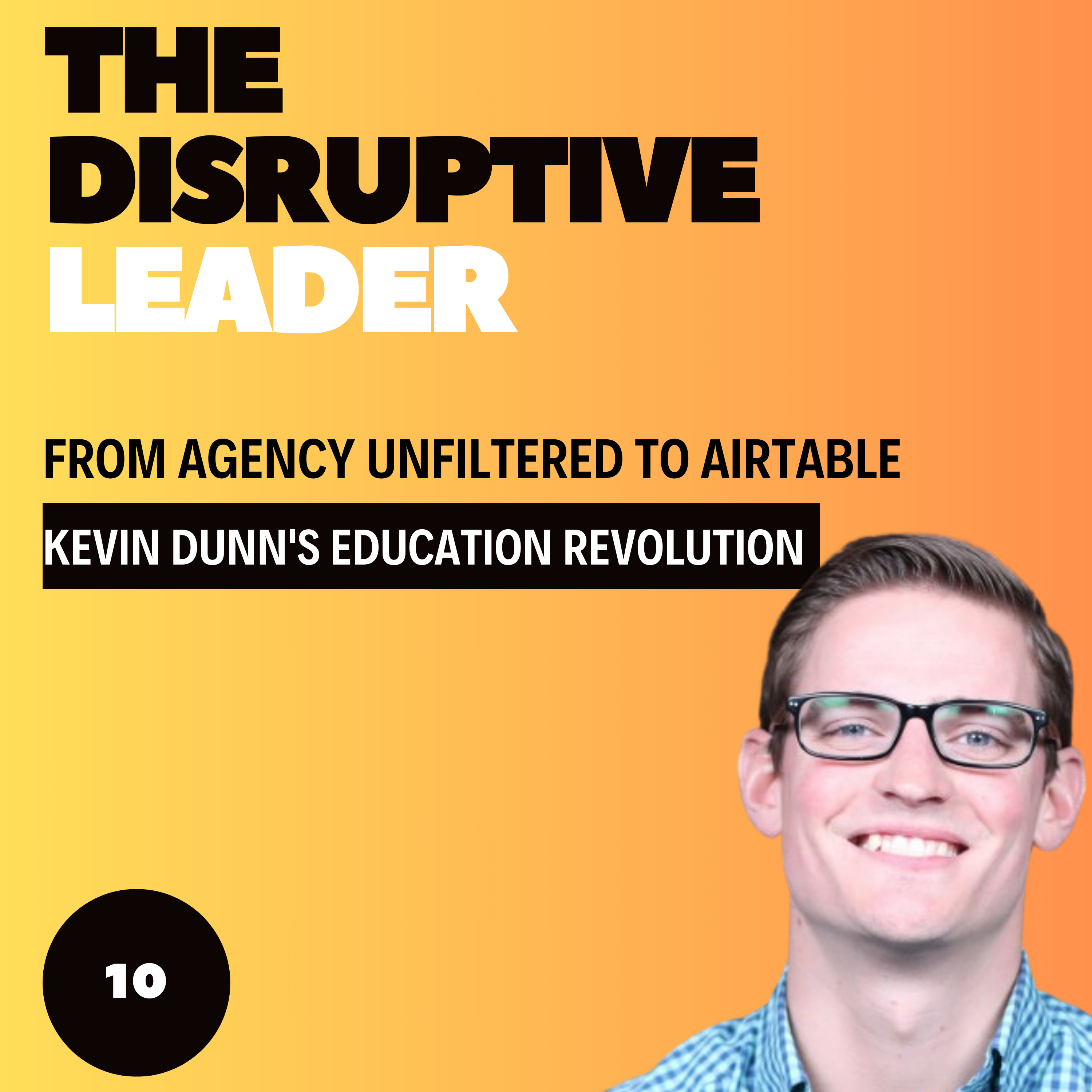
From Agency Unfiltered to Airtable: Kevin Dunn's Education Revolution
from The Disruptive Leader
34m 7s
Kevin Dunn, now Senior Manager of Customer Education and Community at Airtable, transitioned from eight years at HubSpot Academy to build Airtable's customer education program from scratch. He launched Airtable Academy in June for enterprise users, with a public rollout planned for October, and also manages the company's 70,000+ member online community. Kevin emphasizes that customer education serves a dual purpose: empowering individuals with skills and career growth while driving tangible business outcomes like revenue, retention, and product adoption. Key challenges include keeping content current with rapid product changes, proving ROI through integrated data systems, and scaling resources efficiently. Drawing from his experience hosting "Agency Unfiltered," a podcast for partners, Kevin learned to adapt formats to audience needs. He stresses the importance of integrating LMS with CRM and product data to measure impact, comparing educated vs. non-educated users on metrics like activation and renewal. Project management principles from his PMP certification help structure curriculum development, balancing process with creative flexibility. Kevin is bullish on AI for streamlining content creation—using it for needs analysis, outlining, scenario-building, and quiz generation—while maintaining human oversight. He believes AI adoption in customer education will separate innovative programs from stagnant ones.
(upbeat music) - Hi Kevin, good afternoon, how are you? - Hey Ronnie, how are you? I'm doing great, how you guys doing? - I am good, it's really nice to reconnect with you again. I think it's probably been two years, three years. - Yeah, wait too long, it's been. I feel we were on a pretty good cadence. We were great about keeping in touch and staying in the known what's going on. So long overdue, but excited to get the band back together. - Yeah, absolutely, and I just wanna start by thanking you for your time for agreeing to do this episode for all of the listeners on the disruptive leader podcast. And for everyone listening, I'd just like to intro Kevin. Some of you may already know him, for those of you who don't. Kevin Dunn is currently the senior manager of customer education and community at AirTable. Former Upsport Academy leader and host of the agency and the culture, so he is the OG, when it comes to these kinds of sessions and recordings. Kevin, why don't we start with you just sharing like a brief overview of your journey, making that transition from Hubsport to AirTable and how that's impacted customer education. - Absolutely, yes. I started at AirTable back in February. My first week actually with the company was their sales kickoff in New York. So trial by fire, right? What's the adage like drinking from the fire hose, like right from the get? I found it super helpful to just like orient day one around OKRs and long-term projections and plans and priorities for the business. But when I joined AirTable, they were looking to build a customer education program. They didn't have a holistic strategy in place. They had done some educational video based content, but it didn't have user level tracking. Again, it wasn't consistent format and location and delivery. And so they were hoping for someone to come in and help implement an LMS platform, populate it with contents and then integrate it and be able to report back on its impacted influence across the work. From February for the first couple of months, it was just about building this program and working with the folks that were on the team. And so it was maybe June, we launched AirTable Academy, opened it up for our enterprise, the customers. And so actually, I don't know exactly when this recording will go out, but in October, so maybe right around when folks are listening in, we'll have AirTable Academy opened up for everybody. So regardless of plan, you could be a free AirTable user or somebody within an enterprise organization and we'll open it up free. And then since I've joined AirTable, I've also brought in the AirTable community under my fold as well. And so we have an online based forum sort of community, 70,000 plus members. And so we're looking to really revitalize that. But we have some really interesting programs and ideas that we're excited to launch. And so if it's been an eventful first handful of months and obviously as you alluded to, I've spent the previous eight years prior to AirTable at HubSpot, mostly on the HubSpot Academy team, working with some of the brightest minds in the business. And so it's been fun to make the shift and take what I've learned or see what I would want to do differently and try and build the next great education program. - Nice one. And who better than you to be doing that in Kevin? What is it about education and community that sort of gives you that kick? What's driving you towards that? - Yeah, I think there's like the human component to it. Just like you are, just like I am, folks are looking to hone their skills, develop, grow in their careers, build a series of accomplishments and a robust career portfolio, right? Knowing that, if you build the right sort of educational experiences or educational contents here, whatever it is, you can make tangible impact on folks. And we certainly did that. They continue to do it on HubSpot Academy and some really powerful stories, but it's also super impactful and valuable for the business as well. There's real like revenue driving impact for educating and enabling and empowering users, whether they're brand new and they're onboarding and they're getting acclimated or they're longtime customers looking to just broaden their deep in their use of the tool. Again, I always come in with like the SaaS perspective that's just where I grew up in the customer education space. But again, you can impact the human, you can change lives and careers. But again, there's quantifiable impact on pipe gen, on demand gen, on account growth, on product utilization, retention and renewal. And yeah, it's a great program to be a part of. - Yeah, so it's like twofold. The psych empowering, the individual, but at the same time also empowering the company with all of the potential revenue, traction growth and so on. - Yeah, absolutely. - Two birds with one stone. And you mentioned your eight years at HubSpot working on building the academy. Were there any like challenges or like, what was really steep in a learning curve for gaining traction, building educational content for rapidly growing company like HubSpot? - Yeah, I also, if anybody that knows me, here's you say two birds one stone. And I'd be remiss. Then probably my number one used metaphor, feed two birds with one stone. I can't help myself. You teed that up almost perfectly. So I had to say, we always love feed two birds with a stone. Honestly, again, eight years at HubSpot and building supporting the growth and maturation of HubSpot Academy. A lot of the pain points and challenges and problems that we were looking to solve weren't unlike any other customer education program. I'm sure, right? It's, hey, especially in SaaS or technology, the product is rapidly changing, right? There could be some really large scale feature rollouts. There could also be small little quality of life improvements or UX redesigns or nav changes. In regardless, you need to ensure that your education catalog you're asked that's remaining up to date and are accurate, right? To the current version of the product. And so that's a problem we all have. And I think not only that, you're trying to prove out the impact of the businesses we talked about. You also are just continuing to find ways to be strategic with how are you building processes or investing in technology that's gonna allow you to scale? How are you allocating your resources? How are you empowering your team to be as efficient as possible? And so a lot of that, we were looking to solve. And over the time at HubSpot Academy, it was an immense amount of growth. Not only at HubSpot, when I started at HubSpot, wasn't the two point more billion dollars in trailing 12 month revenue in February 2016. And so you rode the wave of the company in that product, but in HubSpot Academy, launching the first half dozen certifications to something like 40, at the end of my time there. Growing a team from 10 to 15 to upwards of, I don't know, 60 or something. Not only supporting English learners, but French speaking, German Spanish, Japanese speaking, different personas and audience types and proficiency levels of HubSpot. The teams that you interlock with cross functionally, the documentation that you write and standardize and circulate and how modular and repurposible is the content. And these are all things I think that customer education programs are gonna have to solve throughout their maturation. And so it was fun to be a part of a lot of that with HubSpot and a place small part in helping that program grow. - And just hearing it from that perspective, like the Academy to me was always, oh, I'll just go and do that certification or that lesson. But when you explain like everything you just said, I'm like, whoa, that's a lot, that's a lot. - And I think with HubSpot's Academy team, and I think we're starting to see some early innings with now AirTables Customer Education program is, once you show the value of what you're able to build, who you're able to build it more and the impact it can have on learners in the company, there's never gonna be a shortage of things you can do, right? There's a million different topics that we can build customer education and ask the videos on right now. We could, but you have to have an iron tight, objective prioritization framework and means for analysis, right? How do we take ideas that are, are intake process? How do we then decide what our capacity is or what our sprint size is? How do we decide what to then build? And then how do we, when it's being really tight and objective and what's gonna lie to scale? - Yeah. And you mentioned growth. And I remember back when we, years ago, when we had a session together on agency, unfiltered the web series podcast, that what I used to watch those episodes, it was you primarily interviewing agencies around growth and scale. What was it like running a show for at the time marketing nerds? - Yeah. - If I had to. - How do you prepare that? How do you prepare them for the real world? - And I think that was one of the most exciting intriguing parts of working not only at HubSpot, but on the
Academy team and for that leadership group and with those colleagues is that there was always room for innovation and experimentation, right? I think at the time we're self-paced on-demand videos organized into courses and we're going to attach a certification at the end or that was the bread and butter for a long time. And obviously there's been a ton of new additions to the catalog and there's a lot of innovations still going on, but you know at the time it was twofold, right? We knew partners wanted to hear from other partners, right? So agency unfiltered was very much content geared towards the solutions partners ecosystem. And so we need to find a way so we to highlight our broadcasts, the stories of real partners so that other partners can learn from that and find ways to apply to themselves. And so that was the genesis of the podcast and the second thing was what does it mean to actually record and format and produce and deliver that content and we had some initial ideas and they didn't stick right at the time it was Facebook, Facebook live. Oh, you can live stream and Facebook and we were like, this is going to be great. We're going to do that. It's going to be a live broadcast. We're going to take questions in real time to be super engaging. And then really quickly we found out that nobody wants to dedicate an hour of their lunch break or whenever to this content to just sit on their laptop launch content. And I think it was too much to ask of like those agency owners and those agency leaders that we were trying to attract and. The technology wasn't the perfect fit. And so we adapted and we pivoted and so we're like, all right, it's not going to be live. It is going to be on demand recorded. It's not just going to be video. We're going to really circulate this through our assess feeds and through the traditional podcast apps and channels. So that's where the latest rendition of agency on filtered landed. But I think your question about. Interviewing marketing nerds. It was it was it was honestly a huge learning opportunity for me when I joined HubSpot and in the Academy. My initial remit was to help incubate a partner education program, right. We want to dedicate educational content to our partners. And so I thought the best way for me to learn some of the nuts and bolts on growing and scaling and driving process and improving profit margins and building scaling growing or charts and. All these different considerations for running it is there's a million different things. That was the best way for me to learn and that ended up allowing me to become a better educator on the Academy for that audience because I became so familiar with those experiences. It was great content. It was fun to record a lot of positive relationships. Relationships still have been and so it was a huge career on law for me. And that's like hitting three birds with one stone because you were learning the partners were learning. And there's obviously the ROI for companies having that type of content. Honestly, the podcast is always the trickiest part was we had the. Not the quantitative impact necessarily, but the qualitative right we knew from our listeners we knew from partners we had the sound bites. We knew that they found that content immensely valuable. But it's always at the time it was tricky to pull Spotify listeners ship on to contact your account level data. And so being able to attach a dollars and cents ROI on something like agency on filtered was always a little tricky. But again, we knew partners needed that stuff. They told us they needed they told us they enjoyed it. Whenever we asked them about it and so yeah, again, it's all about just figuring out what your learners or what your audience needs and what's going to be the best format to get that to them. Yeah, I learned a lot from agency on filtered remember I used to get very excited when the episodes were coming out. Just for what you were saying as an agency owner what better way than to learn from other agency owners in the ecosystem. I'm talking about ROI and and measuring ROI and how these customer education initiatives impacts companies. And it sounds like what you're saying is by educating people companies make money. Would that be a correct statement? Yeah, and maybe both the companies that that learner works for, but also the company who's producing the academy or that customer education program. But I think yeah, you're spot on again, the podcast was always a little tricky, but with a traditional LMS or learning management system. Right, and you're populating it with self-paced on demand courses right folks can enroll in courses they can complete they can go through exams to achieve certifications. Like as long as you're integrating your LMS and to the rest of your tech stack with your CRM data with your data warehouse wherever you keep like product utilization data. Right now you're getting into this place where you can tell the story of what having an educated, you know user does right. Okay, we can tell that if a customer has a certified user or a user that has three plus course enrollments or a company that has five registered students with our LMS like you can pull that information. And then you can overlay it to folks, you know, either benchmarks or customers that don't have those things right companies with a certified user versus companies that don't have a certified user. So let's just overlay that on time to value or your activation metric, the various aspects of your product utilization product usage. And then ultimately active usage daily weekly monthly active usage whatever it is for your company and ultimately account growth and retention and renewal. And if you have the systems integrated the way you needed to in the data in the places you needed to you can tell that story. And again early innings with air table but certified or educated customers yields better more sophisticated product usage and we anticipate that to yield a positive delta on things like retention or no. Yeah, that makes a lot of sense and just as you were describing all of those moving pieces when I was doing a little bit of research on you. I know that you you have the PMP certification. So I'm just wondering if you're really well structured approach project management those principles impact how you are putting together all of these educational initiatives. Yeah, I honestly think like reporting and analysis is one of those core principles. And again, the ideal state is to be able to report on the impact on the business right because that's like we're real like influence an impact on revenue happens. But those that's not where our reporting framework starts and stops. So the flow chart we have the creator capacity and the creator outputs right we have the learner sentiment right so are they enrolling in the courses what's the feedback on the courses what's the NPS or CSAT. We look at like the learner experience the waterfall from course enrollment to completion right what percentage of users start a course on air table one on one and what percentage of complete it. We talk about like credentials growth or growth and our certificates or our builder certification or admin certification and we track KPIs and we set targets and goals and and we're reporting on all five layers of that reporting framework. But again to your point project management isn't just reporting and analysis and we're. Air table academies launched. And so now we're actually starting to get really good sense on okay what is our process soup to not start to finish what is the creation of asset X look like how much time does that take who are all the parties that need to be invited in who needs to be informed. So we're going to order the templates or documents that we use to drive a lot of those like phases within the curriculum development process and so yeah that's all baked in project management or the PMP certification. Now I also think that there's a balance of process versus a little fluidity for flexibility and so we're going to. We want to try and thread the needle perfectly where there's enough process so folks have ambiguity removed there's clarity. There's efficiency gains. But at the same time we don't want to over engineer too much process in front of them where it actually detracts from the actual curriculum development and so it's. It's going to be a little bit of art a little bit of science but having that process and having those project management principles are are key right curriculum development customer education. This project management really yeah and I think you also enabling a little bit of space where you come potentially pivot or try something different or experiment which takes me to my next question. With all of. It's taking the world to storm how do you see AI impacting academies and communities and the whole educational. Yeah the whole process honestly I'm as many are I'm incredibly bullish on AI like generative AI. The usage of like a chat GPT or something like that and a lot of folks are always like oh AI is here to take our jobs they're going to dominate the world and. I don't. I don't think that's true. I do think though like in customer education. I think that are able to embed AI into the curriculum development process are going to replace the ones that don't right. And when we look at our entire process for content creation educational content creation. We have found ways to leverage AI and we try and templatize the prompts that we use because we know now that they yield the best outputs and it standardizes across. matter who's using.
it's consistent. And so things like job task analysis and needs assessment, outlining, like provisional outlining and lesson planning, right? It's been huge in like scenarios, right? We try and attach scenarios to every asset that we build, every exam has scenario-based questions. Like we want to try and surface hypothetical customer stories that are representative of the customers that use their table. And so AI has been tremendous at helping create that. Knowledge check questions, quiz questions, a lot of like boiler plate asset descriptions, right? We can feed it our transcripts. When we give it some guardrails in our prompt, it helps us build some knowledge check questions and we keep a human in the loop and we verify and we still tweak, but it's just still immense efficiency gains there. And then for some of our content as well, we've trained an AI tool or like an LLM on the voices of our program managers or our content creators. And so if there's like a little patchwork update that needs to happen or hey, if it's the product tutorial segment of one of our lessons, we can actually feed AI our script and it's text to audio and it's indistinguishable from microphone recording like real voice capture. And so again, just efficiency gains where you can find it. It's been huge for us. That's that's pretty amazing. What you just described. And do you think it would ever reach the stage where the whole course, the curriculum, the production, all of that would be AI generated? I don't know if we'll ever completely remove like humans, but I think what we'll see at least in our process, but I think you're going to see a substantial amount of the process supplemented with AI. And again, still I've said early innings a couple of different times. We're still trying to like nail down exact our approaches and what we want to continue to use for scale, but being able to track time and effort and hours for delivering your standard processes today. All right. Quiz questions. You have to build eight quiz questions for that course. How much time does that take your career today? And then after we've leveraged AI and we have templates and it's standardized, what does the time savings look like? And then what sort of capacity does that now create for the more human intensive aspects of the field? And there's a ROI element here too, right? Capacity creation hours saved. And we're trying to find all the right places to embed, right? Four birds with one. Yeah, it's a whole, yeah, it's the whole flying V of birds. It's going through all. It's amazing. Like every sort of question we've gone through, there's an additional bird sort of. Yeah, which kind of takes me to my next question. Your profile like yours, Kevin, you were someone who's got various rewards and recognition. But you've been on the HubSpotFellow. What's the secret? What's the secret to be Mr. Award winner? I wish there was a secret. I think it's all about building the right team around you. I think you need your front line or second line leaders to be your advocates, to be your evangelists. You need champions across the organization. But I think you don't get those unless you're working on the right type of projects. You're producing the right type of output, highly visible but highly impactful projects. So I think it starts with your relationship with your leadership team, your closest contributors, or your collaborators. But I think it's also about at least from like a people management perspective, building the right team to help scale the output and the impact of your work. And again, if I were to win an award at HubSpot or Air Table or any whatever, I feel like I can only take such a small percent of the credit on that because it really just feels representative of the total collaborative work of the team that I led or lead. Again, the folks that I work closely with. And so I don't know, some of the core things that that have benefited me in my relationships with others. And then I think it yields that type of work is just transparency. It's open book. Right. We always say, hey, work in public. Right. I don't care if anybody at Air Table right now wants to take a look at any single script in draft mode or anything on our prioritization roadmap or like any work process in flight document or to like work completely open book. And so we want folks to just know what we have going on always at all times. And then I think a part of that too is the team of folks that we have running Academy and Community at Air Table, we want them to be fully autonomous. Right. We want them to have decision ownership, right. And that's going to allow them to yield their best work not to have them be on an island. Right. Hey, they're still an important layer of like support and access and communication. But yeah, you want folks to be, you know, they're high performers. You want them to be autonomous and be able to drive the ship. And so anyway, all of that to be said, enabling and empowering a high performing team, visibility and transparency into your team's work with cross functional collaborators and colleagues. And then having leaders who are evangelists and advocates for your work, all of those things tend to be the inputs. And it can be high visible, high impact work and maybe some awards. Yeah. And then the output of that is having that team that's accountable that trusts you that you can scale with that you don't need to micromanage. Yeah. That trust is really the underlying factor of all of that autonomy, decisions like that. If there's no trust that those aren't going to happen. I think textbook Kim Scott's radical candor before you can challenge directly, but you have to show that you care personally. So I really care about I think it's probably her x-axis, not her y-axis. And so yeah, you got to just treat your teams and your collaborators, your direct reports, their humans, care deeply about them and their work. And I would be able to get better and more direct at feedback and create a culture of high performance. And I think also part of creating that culture of high performance is also showing vulnerability. Because I think like a big part of leadership is also enabling your team to be vulnerable and put their hand up and say, I don't feel good today. Because it's always rosy. So I know it's so true. And I think there's no secret sauce there. It just starts with yourself, right? Yeah. And my team meetings and my one-on-ones with my direct report, like we do a pulse check. I did it with my team at pub spot. I do it still with my team at air table and hey, just score it. As you're coming into this one-on-one today, where are you and how would you, what are the adjectives, what are the descriptors and why are you coming in that way? I think like our one-on-one and what we looked to accomplish and how we handle the time together now and the rest of the week, it's going to be dependent. And it's like, yeah, yeah, I know we were talking. I have two little ones. My one-year-old was up at three in the morning. Nobody has slept in my house. I'm starving. I'm tired. Like, I'm not coming in with my best today. And I think sometimes managers want to protrude this image of, hey, everything's going great, everything's going fine. I know we're all super busy, but like I'm at optimal peak performance at all time. And you just got to be vulnerable, start, set the tone, and allow others to fall suit. Absolutely. I hold my respect on that statement. And then my last question, what would be takeaways or top tips or must-do's for individuals that are, or other aspiring people trying to launch academies or communities? What would you suggest that they do so that they get it right? Yeah. Honestly, it's, I don't know how textbook this is, but it really does start with the customer. And so there's a number of different ways that should manifest, right? Before you actually put any pen to paper on a course curriculum or what the content you want to end up posting in your LMS, you have to first just deeply fully understand the customer experience, what they're looking to accomplish. Again, I'm coming from the SaaS angle. What are customers looking to accomplish with their table? They are most, they are most successful when X, Y and Z occur. These are the biggest, most frequent or most disruptive pain points or challenges that folks face that they would love to have a solution for. And so you have to have all of that input before you can decide what we should train or educate or help folks set out to do with the tool, right? And then on the other side of that, not even just having that be an input into the content, but the content itself should surface customer examples, right? And so obviously just to get going, we're going from zero to one, regenerative AI has helped us with some hypothetical stories and some scenarios that again, a representative of our table customers. The intention is to have a customer example, a real-world story practical application of a air table, right? Here's the note, here's the app they've built to solution this. And we want that in every single course across the entire catalog, right? We want to surface real customer stories, right? The champions, the power users, the folks that are driving real change at their companies because they've been able to build these solutions with their table. That's going to manifest in the catalog. We want to continue to surface those stories in the community. We want them to be highly contextual.
Visualize and things like user groups or their vertical aligned or use case aligned or rolling and so again It's the customer experience right that should inform the content you create how you prioritize content But then the actual content itself right practical application and Agents and filtered was an entire podcast onto that sentiment. So yeah, and I think That keyword there unfiltered Yeah It's very strategic and key because It enables everything you were just describing From the agency leader or owner's perspective Yeah It's not unlike I think the vulnerability discussion right and it's hey In the case of agency and filtered yeah starting an agency or building growing scaling an agency It's not always like sunshine and roses and so let's get real about the experience and the Distrived for the friction and at least what was your approach to solving that and It's I think two sides of the same coin and I'll tell you this in in one of the courses we've launched But I think one of the learner like I had learner feedback and it was hey, this was really helpful If this was going to be the process of Affrictionless process it's not always as efficient or streamlined or as you've described it and I thought that was super valuable and it's yeah You have to be able to help folks understand like what to do when things don't happen Perfectly and I think your education should follow suit right I think For developer education we we're built the team is built a ton of developer content for the academy and Hey debugging is part of the process and so we can't have a developer content Devoid or with debugging Absent it's part of the process. Oh, yeah, unfiltered vulnerable has to be a part of the story. Yeah, that's to be has to be real Otherwise, it's it I feel it's not really complete. It's Sort of one side of the coin you need the other one Yeah, this has been a really Interesting conversation Kevin. I personally learned to Tana. I'm sitting here thinking oh my god The way I've approached this podcast is just totally wrong What am I doing? No, you're doing great. This is great. Yeah, honestly But if we want to get met on a podcast for a second. I always joke I thought the best episodes of agency unfiltered were when I spoke as the host you heard for me the least Because like when as I start weighing in my opinion that's when the content is going to start going south you're just Framing up, teeing up folks that to share their experiences and getting out of the way and Anyways, I think this podcast is great. We're doing a great job. I appreciate you having me on Thank you, Kevin. I appreciate you being here and with that in mind We will add this podcast now and we will I hope all of the listeners who listen to this Find it helpful in the description. They'll be I don't want to speak on your behalf Kevin. It's okay for you You're linked in if people want to reach out ask you questions. You are this champ. You are this leader When it comes to building academies and communities and I feel You know the world needs a lot more of that and you're an awesome go-to source for that. So thank you Yeah, I would say if anybody tunes in and wants to talk more. I love presenting this stuff at events like I I'm always again To the idea of being transparent and working in public like I'm always happy to share my experiences and what has gone well for us so far where would we have pivoted or tried something different So yeah, anybody ever want to talk education community 100% would love to chat more so Kevin's the man super Thank you Kevin. Thank you for that. Have a wonderful day. Yeah, you too Ronnie. Thank you so much. Yeah, I appreciate you having me on
Podcast Summary
Key Points:
Kevin Dunn transitioned from HubSpot Academy (8 years) to Airtable as Senior Manager of Customer Education and Community, building a customer education program from scratch.
Airtable Academy launched in June for enterprise customers, with a public rollout planned for October, and Kevin also oversees the 70,000+ member Airtable community.
Customer education drives both human impact (career growth, skill development) and business value (revenue, retention, product utilization).
Key challenges include keeping content updated with rapid product changes, proving ROI, scaling resources, and managing cross-functional collaboration.
Kevin's podcast "Agency Unfiltered" evolved from live Facebook streams to on-demand content, highlighting the need for audience-centric formats.
ROI measurement requires integrating LMS with CRM and product data to compare educated vs. non-educated users on metrics like time-to-value and retention.
Project management principles (PMP certification) help structure curriculum development, balancing process with flexibility.
AI (e.g., ChatGPT) is used to streamline content creation—job analysis, outlining, scenarios, quiz questions—while keeping human oversight for quality.
Summary:
Kevin Dunn, now Senior Manager of Customer Education and Community at Airtable, transitioned from eight years at HubSpot Academy to build Airtable's customer education program from scratch. He launched Airtable Academy in June for enterprise users, with a public rollout planned for October, and also manages the company's 70,000+ member online community. Kevin emphasizes that customer education serves a dual purpose: empowering individuals with skills and career growth while driving tangible business outcomes like revenue, retention, and product adoption.
Key challenges include keeping content current with rapid product changes, proving ROI through integrated data systems, and scaling resources efficiently. Drawing from his experience hosting "Agency Unfiltered," a podcast for partners, Kevin learned to adapt formats to audience needs. He stresses the importance of integrating LMS with CRM and product data to measure impact, comparing educated vs.
non-educated users on metrics like activation and renewal. Project management principles from his PMP certification help structure curriculum development, balancing process with creative flexibility. Kevin is bullish on AI for streamlining content creation—using it for needs analysis, outlining, scenario-building, and quiz generation—while maintaining human oversight.
He believes AI adoption in customer education will separate innovative programs from stagnant ones.
FAQs
Kevin Dunn is the senior manager of customer education and community at Airtable. When he joined in February, his main task was to build a customer education program from scratch, including implementing an LMS, populating it with content, and integrating it for reporting.
Airtable Academy launched in June for enterprise customers, and by October it opened for all users, including free users, regardless of their plan.
Customer education impacts individuals by helping them develop skills and grow careers, and it drives business value through revenue, demand generation, account growth, product utilization, retention, and renewal.
A key challenge was keeping educational content up to date with rapidly changing products, including large feature rollouts and small UX changes, while proving business impact and scaling resources.
It started as a live Facebook broadcast but shifted to on-demand recorded video and audio distributed through podcast apps because the live format required too much time commitment from agency leaders.
By integrating the LMS with CRM and product data, he compares metrics like time to value, product usage, and retention between customers with certified users and those without.
Chat with AI
Loading...
Pro features
Go deeper with this episode
Unlock creator-grade tools that turn any transcript into show notes and subtitle files.
 PodcastTranscript AI