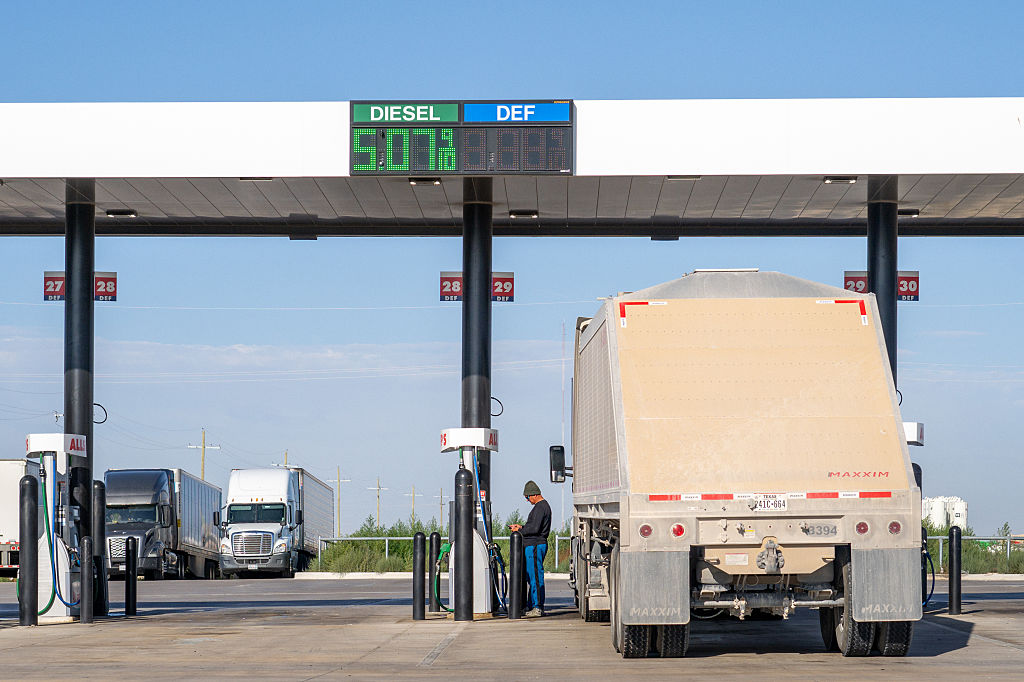
Diesel fuel has surged in price, triggering a cascading economic effect that raises transportation costs across the U.S. and globally. As a foundational fuel for trucks, farm equipment, and supply chains, diesel powers nearly every product reaching consumers. Despite its high cost, most Americans only perceive a minor price increase due to cost-sharing across vast supply chains. This situation highlights the disproportionate burden on producers like farmers and truck drivers, who face financial strain while consumers remain largely unaffected. The briefing also addresses key ethical and societal issues: modern finance, though rooted in interest, is not usury when grounded in fair risk-sharing and market competition, unlike predatory lending. A Christian pharmacist’s challenge over dispensing abortion medication reveals the moral erosion in professions amid secular pressures. Concerns about Muslim political influence in U.S. institutions are presented as real and urgent, emphasizing the need for open, respectful dialogue. Finally, a thoughtful question from a nine-year-old about Bibles in heaven underscores a profound biblical truth: while the Bible records sin and sorrow, in the new heavens and earth, these will be transformed into eternal glory, and God’s Word will be fully understood through glorified, renewed eyes. This reflects a deeper Christian worldview that sees economic systems, moral integrity, and eternal hope as interconnected.
It's Friday, October 16, 2026. I'm Albert Moeller, and this is The Briefing, a daily
analysis of news and events from a Christian worldview. You know, there's so many big things
happening in the world. You think about wars and rumors of wars. You think about massive
economic shifts. You think about big foreign policy issues and, of course, elections coming
up and all the rest. And by the way, big elections are coming up, not only in the United States,
but in Europe and also in Israel. So lots of things to think about. But few people wake up
in the morning thinking about diesel fuel. I think that's a safe thing. But you know,
if you're driving a big truck, if you are a farmer in the Midwest, if you are involved in
many activities of life, guess what? You do wake up in the morning thinking about the price of
diesel. And that is because it has skyrocketed. And now diesel fuel is one of the major issues
driving a price crisis in the United States of America. And by the way, it will not be
limited to the United States because the global market for fuel for petroleum products is basically
an international market. If not immediately, then eventually. But, you know, I think a lot
of Americans know that there are two kinds of petroleum fuel they often think about. There's
gasoline that goes in, you know, internal combustion engines, you know, car engines.
And most of us are driving vehicles that use gasoline. But then we also know there are
diesel engines. You think of diesel trucks and combines.
Big farm equipment and all the rest of the diesel world. I think most people don't have to think
about what's different. It is very interesting that just this week, USA Today ran a front page
article. Diesel is economy's workhorse fuel. That's just a reminder of the fact that just
about everything you have in your house, just about everything you buy in a store at some point
was transported somewhere by some vehicle or some means of transportation burning diesel. And so you
can look at shipping fuel. You can look at river barges. You can look at combines, you know, there
that are working in wheat fields. All these engines are diesel engines. Now, why are they
diesel engines? Why is the diesel different than the gasoline fueled engines? They are internal
combustion engines. Yes. But the way a diesel engine works is just mechanically different
in terms of the operation is different than the way a gasoline engine works.
So the gasoline engine is, you know, your car has spark plugs. And so you have a cylinder in which
there is the fuel that is put in. And then there's a spark that creates the expansion that creates
the energy that used in an internal combustion engine fueled by gasoline starts to turn
everything in such a way that eventually you're able to hit the accelerator and your car moves
forward or your lawnmower begins to spin and cut grass. You just go down the list. That is the way
it works. And we take it for granted until it doesn't work. And then we have to make it work.
I think a lot of Americans are probably wondering why is there a different fuel system for big trucks
and combines and things like that? It is because the engine is different. The engine is different.
The fuel is still petroleum based, but it's different. Diesel fuel is a different fuel
than gasoline that is put into cars. And that's because the diesel engine works differently.
Instead of having a spark plug that creates the spark for the explosion,
that creates the compression and all the rest in the movement. Instead, in a diesel
system, the combustion happens when the air reaches, oxygen reaches a certain temperature,
which causes the same kind of explosion. And it also has the same kind of mechanism turning
things. But there is no spark plug. Instead, there is a mechanism for increasing, radically
increasing the heat that is in the process and all of a sudden creates a situation in which you
have diesel engines. By the way, that's one of the reasons why diesel engines respond more slowly
in very cold contexts. And so if you have a big semi-tractor,
trailer rig, you know, parked at the same hotel you are, or you look out and it's parked there,
you go to your internal combustion engine, your gasoline fueled engine, you put the key and you
turn it. Well, hopefully your car starts rather immediately. But in some cases, you really have
to have a warmup, a physical warmup of the engine block when it comes to diesel engines for you to
have the right kind of context for everything to work. And all this, by the way, goes back
to Rudolf Diesel, who basically, you could say, invented the diesel engine and the mechanism.
He was born in 1858. He died in 1913. And it really is a very interesting development because
the transportation of goods, as we know it, would not happen efficiently without diesel engines and
diesel fuel. And you say, well, why not? Why not gas? Well, it is because the diesel engine
provides greater traction for really heavy things to be moved. And that means at a lower cost,
you can fill up one of these massive tractor trailer rigs. You can fill that trailer with a
decent amount of product. And you can get it to where it can be, well, say, warehoused and
distributed and labeled and marked and then put into a store where you can buy it. And, you know,
most of us don't think much about that because most of the time, diesel has been, you know,
at least far more economical than it is right now. It hasn't been something that's been passed down
to us in surcharges. But right now, if you go to mail some things, certainly in some carriers,
including right now, at least temporarily, the U.S. Postal Service, you may be charged a
fuel surcharge. And it's because of diesel. And it's because of the price of diesel. And the price
of diesel has just skyrocketed because with the situation in the Middle East and with the,
especially that's the big issue, but there are other issues that are playing into this as well.
It just turns out that a shortage of diesel means things are going to cost more money.
And so you have the Wall Street Journal with a front page article in the exchange section.
Just in recent days, the cost of transporting pretty much everything is going up. And, you know,
transport things. Well, guess what? You buy things that require transportation.
According to the Wall Street Journal, and by the way, the Wall Street Journal only works if it's
the Wall Street Journal, it says that you can look at annual expenditures of about $1 trillion
in terms of this kind of economy that is carried largely by diesel. And so just a little bit of
change, say in the cost of fuel, can just ricochet throughout the entire economy. That's why the
subhead in the article at the Wall Street Journal is the cost of transporting just about everything
is rising. The USA Today article, front page, the subhead cost touch consumers via goods and
services. So here's where things get even more complicated. When you think about how consumer
goods get to us, and we really take it for granted that we can walk into a store and we not only can
find pickles, we can find 30 varieties of pickles. We can not only go in and, you know, buy a cushion
or buy a pillow, but you got all kinds of choices in terms of all of this. But it didn't arrive
there without transportation. You're not able to go pick the can off the shelf or the jar off the
shelf without a lot of transportation. And the more complex the situation is, the more complex
the product is, the more complex the consumer choice is, it's likely the more transportation
complex the transportation picture was. Maybe this is something you're buying as a toy and it was
put together with pieces and the pieces and the materials all got shipped to somewhere in the
east. Someone in a factory helps to make the parts and someone puts them together and you got the
toy and then it has to get on a ship. It has to be taken on a truck to the ship. And then on the
ship, it crosses the Pacific Ocean and then it then unloads somewhere on the West Coast. And then
you've got trains involved. You've got semi-tractor trailer rigs involved. And this is one of the
other things that's happening. This rise, this rather significant, very limitable rise in the
market. You know, a lot of Americans aren't really going to think themselves immediately touched by it
because they won't do the math. But some of the people we rely upon, for instance, to drive these
trucks and to operate independent, you know, tractor trailer rigs or to operate transportation
companies, they're really in a very difficult position and they're going to have to pass the
along. For most Americans, it's also interesting. The Wall Street Journal is very, very honest about
this. Most Americans really won't notice the full impact of all of this because if you're going to
buy one, say, stuffed friend for a child in terms of the toy section, then it is likely that that
was shipped with all kinds of others and other products and an entire truck that was filled and
then a train car that was filled and a ship that was filled and all the rest. So prorated out to
all of those, say, teddy bears, prorated out to those teddy bears, it's not going to be that big
an increase. But when it comes to what it takes to produce the lighting in the store, what it takes
to get people there, and especially the goods in the store, think about the big box, you know,
hypermarkets that are now very much a part of the American landscape. How many trucks a day does it
take? Well, one of the big interesting things to look at here is that when you are looking at how
many miles are driven in terms of the carrying of these things, the transportation and the shipping
of these things that get to your store, it's absolutely massive. David Ortega,
who is a food economist at Michigan State University, says, quote, diesel is the workhorse
fuel of the economy. Quote, semi-trucks, freight trains, barges, and farm machinery run on it.
Most consumers never buy a gallon of diesel, but almost everything they do buy moved on diesel at
some point, often several times between production and the store shelf, end quote.
Now, the reason I'm bringing this up is not because diesel in itself is a huge worldview issue,
but how we actually operate in society is a big worldview issue. How an economy is
a huge worldview issue. And the fact that in an economy, everything is eventually tied to
everything else, that's also a big worldview issue. It's also a very significant issue for
us to understand that the impact of this is disproportionate throughout society. Farmers
are at far greater risk than the rest of us. So those of us who are buying a loaf of bread,
we're at far less economic risk than the farmers who are producing the wheat and then those who
are involved in other stages of that production. And that's just something morally Christians do
need to take into consideration. We can sometimes look at an equation and say, you know, I don't
have to fill, you know, a combine on a farm with fuel. I don't have to fill a diesel truck with
fuel, which, by the way, can now be over a thousand dollars a fill up. We don't have to do those
things. And so we can just think it's somebody else's problem. And then we might find some
comfort in the fact that even as this is going to fuel inflation and prices will go up, it's going
to be disproportionate in that those who are buying the items, they're not going to bear
the cost of the product. And so we can sometimes look at an equation and say, you know, I don't
we're not going to bear the full weight of this for some time. It also points out that there are
jobs in our society. There are roles in our society that make other roles possible, that make
life possible as we know it. And we tend to take them for granted. We see these big trucks on the
highway and we just don't ponder the fact that somebody's got to drive those trucks. Someone's
got to take care of them. Someone's got to buy the fuel that goes into them. Someone's got to load
them and unload them. It just points to the fact that an economy such as the economy we enjoy is
based upon all kinds of things. And so I think it's important to think about that. And I think
people, fulfilling all kinds of jobs and so many different roles, and that includes driving these
trucks and so many of these drivers and others are a part of a system that's rather precarious
financially. They're trying to feed their families as well. I guess the biggest worldview point I
want to make is this. It is interesting that only when you have such a significant rise in the price
of diesel that it's beginning to be felt in the, say, the checkout lane. Only then do you see these
articles appearing in the mainstream media saying, oh, by the way, what is diesel? What's diesel fuel?
What does a diesel engine need and how does it work? All of a sudden that gets asked when the
price of diesel just skyrockets as it has lately in a way that honestly threatens the American
economy. But the worldview impact of all of this just reminds us that we are most of us not on the
production side of the consumer economy. We're most of us on the consumer side of this kind of
society, and we can take for granted that all the rest of this just happens. It doesn't just happen.
And I'll just say out loud, it makes me thankful for a lot of people right now who are taking an
outsized hit in terms of the higher diesel prices and are having to take even greater risk and have
far more at stake than most of us who are primarily concerned about whether or not the
consumer items we buy are going to go up or not. And the answer is yes. But the greatest risk is
experienced by someone else. By the way, what is the scale of all of this? I'm going to leave this
part of the briefing by telling you that the most astounding number I've seen in all of this
is that on an annual basis, American diesel usage, just to get the stuff we need from where it is to
where we need it, it runs about 59.6 billion gallons a year. That's billion gallons a year.
That means that every single week of the year, more than a billion
gallons of diesel fuel are consumed just to make this society and its economy work.
And that also tells us that it's got to come from somewhere. It's got to be produced somehow,
and someone's going to have to pay for it. But next, we're going to turn to questions. And as
always, I'm just thankful for the questions that listeners send in. And you can send your own. Just
write me at mail at albertmuller.com. And I'm always fascinated to see the issues that are
raised. The first question for today is sent in by a 19-year-old young man. He's in Texas,
and he asks,
Okay, so that's very, very interesting. And indeed, throughout the history of the Christian
church, usury has been defined as a sin. Okay, now, so what's usury? Usury is the profiting from
someone else's misery. That's the bottom line. So, what's usury? Usury is the profiting from
And so, if you lend money in a predatory sort of way, in which case you're really charging
an interest rate that is only going to be paid by someone who's desperate, and if the conditions
are there's no real value in which you've got a stake, then the reality is that that can turn
into a very oppressive system. And you certainly see this in the ancient economies. You see this
in medieval economies. And then something changed. Something changed,
between the ancient world and the modern world when it comes to economics. And by the way,
at least part of this has to do with the Protestant Reformation. And it's because
the Catholic Church classically defined any borrowing of money at interest as a form of
usury. But you wouldn't have a modern economy if borrowing money at interest or lending money
at interest is categorically wrong. You couldn't have the modern economy. You couldn't have your
or all the rest. So what's the difference between the modern system of finance, which includes
charging interest and the interest that was a part of usury? Well, for one thing, when you are
looking at modern finance, the whole idea is it's a pooling of money in order to make money available
to people who are going to use it for their own purposes. It can be buying a house or establishing
a business or whatever. And it is fair use of the money at this rate of interest. And so there's
really no difference between the modern system of finance, which includes charging interest and
lending money at interest. And so there's really no difference
That's something a lot of people haven't thought about. And, you know, throughout centuries,
money didn't have an inherent value other than just whatever the coin was. But in modern economies,
it's very different than that. And so let's just say that you are in a situation in which you want
to start a business. The fact is that under usury, you had to take all the risk and you had to find
someone who would lend you the money. And then they could call it at any time and you could
basically just have everything you've done. And then you could call it at any time and you could
confiscated in a system of usury. And a system of modern finance is very different. And so,
for instance, you have the pooling of money by people who are investing the money. And what
they're saying is not that this company idea, this idea of producing, I'm going to say, you know,
a kite that flies, you're going to sell kites. It's not that it's a matter of life and death or
eating or not eating. It's a matter of whether or not you can get the capital to start a business
because you have to have some money as a seed money to start a business making kites. Okay,
so you have over here people who've said, you know, I've got money I don't need
in another investment. And so I can invest this money in a finance system, which is going to
allow someone to borrow that money. And they're going to pay me prevailing interest rates for the
borrowing of that money because the use of the money comes with a real cost. That's why modern
finance is so different. In the ancient world, they weren't thinking about value over time,
the way modern finance just obviously thinks about money over time. You
have a 30 year mortgage or you have a five year auto loan or something like this. What you say in
a modern economy, which is not usury, what you say in a modern economy is I want that car and I'm
willing to take out a loan for that car for five years. And I'm willing to pay for that knowing I
have to borrow the money. If I want the car right now, then I've got to borrow money and I'm going
to have to pay for the borrowing of that money. And here's what the interest rate is going to be.
And that's why in such a transaction, you see, here's the cost of the car. Here is the borrowing
chart. Here is the amortization.
Table here. Here is how that that loan is going to work. Now, you look at that and you say, well,
the only alternative to this is saying you can't buy that car unless you have the cash right now
to come buy that car. And, you know, if you're operating in a very primitive economy, you might
be able to get by that way. But if you're going to operate in a modern expanding economy. And by
the way, the great economic miracle is that in the last several centuries, you have this vast
expansion of human wealth. And that can only happen because finance is a
part of a working economy. That finance only works if people can charge appropriate interest.
This is why, by the way, in most situations, you have a market for interest. And so you do right
now. You don't have to go to this lender. You can go to another lender. You can even look at an
international context if that's what you want to do. Now, I'm not saying there's no opportunity
for sin in modern finance. It is to say that it's a reconceptualization of the whole thing
such that money becomes a part of the economy that can be
bought. And that's why, by the way, in most situations, you have a market for interest.
You can't borrow just like anything else, but at a cost because there's a return that is due those
who are lending the money. But it has to be a fair rate of return. And here's where in the modern
system of finance, the assumption is that consumers, if they have alternatives to borrow from X or Y
or Z, they will eventually force a fair market set of conditions upon the lending industry.
So I appreciate this young man sending the question. And yes, there can be forms of usury. I will say,
maybe the most classic example of this right now would be the loan shark down the street.
There can be threats that are a part of this. There can be exorbitant interest that is charged
in this and even the confiscation of the original good and value. All that is put at risk. Usury is
a real thing. And I think the church was right to say usury is a sin. Modern finance is something
quite different. It's voluntary. By the way, that also means that if you look at the housing market,
the average person in even modern economy,
would never be able to buy a house, but for the fact that
there is a mortgage market and they can get a loan in order to buy the house. And by the way,
the house generally, and over the course of the last several decades, has appreciated in value,
often to the point that far exceeds even the total cost of the mortgage by the time you add
the whole thing up and pay a whole thing off. I appreciate this young man asking an honest
question. He's right to point to the sin of greed and the idolization of money. And yet,
I just want to say to this young man, when you put $100 in the bank, you do expect rightful
interest on it. And that rightful interest is in a system of finance that also includes
lending and borrowing. And it does need to be monitored such that bad actors are identified
as bad actors. But I do say, I do think it's true that over time, the market where you have choices
in such matters does tend to produce a far fairer system. But by the way, one of the terms to listen
for, just in terms of even the media conversation, is predatory lenders. The reason the term is out
there is because they still exist.
Next, let me say I really was moved by a question sent in by a listener in Australia who is a
pharmacist. And he is raising a very important issue. He says this. He says recent changes to
the abortion pill legislation is troubling. But what is more troubling is the total absence of
pushback within the profession or society. He says that an anti-abortion activist handed a
staff member a pro-life card. He says most Australians are reluctant to engage in any
discussion that could cause conflict both in public and at home. As a profession, I'm not
alone. As a professional, I decline to dispense this medication. But one of my colleagues will
dispense when turning away a patient. I find it difficult not to appear judgmental. Do you have
any advice? He says this is just another example of the secular world hijacking my everyday life.
You know, I really appreciate the candor of that last line. And I think operating in the modern
world with all of its moral complications, it can certainly seem that way. I want to say to this
Christian pharmacist, I'm very glad for you and for your convictions and for the fact you are in
this profession. And I think it's a very important thing to do. And I think you're right to say the problem is that the professions are caving. And it's not just
the pharmacy profession. It's also the medical profession in so many ways. And you just go down
the list. Pharmaceutical makers, I'll just go down the entire list. There is enormous complicity in
the culture of death, particularly in so-called medical abortion or the abortion pill. I also
appreciate this pharmacist being honest to say that when he turns away a patient, he finds it
difficult not to appear judgmental. I mean, you are talking about life and death. I realize that
you're talking about life and death. I realize in a social context, this can be very
difficult. But I think it is an odd and unusual, unexpected and unwanted opportunity for Christian
witness, or at least for moral witness in this situation, because you can't do this as a matter
of conviction. And that raises huge questions. What would that conviction be? Where would that
conviction come from? And so I just want to say, I'm thankful for you. I just want you to hear that
all the way across the United States and across the Pacific to Australia. I'm thankful for you.
I'm thankful for the way you are thinking about this. And I sympathize with you,
when you say this is just another example of the secular world hijacking everyday life.
And I think one of the most important things this question writer underlines is the fact
that what we are seeing right now is the moral corruption of an entire sector of
American professions. And it is just an incredibly injurious thing. It's very sad to see. And quite
frankly, it's going to create a context of great moral challenge, a challenge of conviction and
conscience for many Americans as well as Australians in many different areas of life. But next, I'm
taking a question I also appreciate from a listener in New York State. And he's asking how a Christian
worldview would apply to how one should address and think about certain matters concerning the
rise of Islam in the United States. I really talked about that yesterday on the briefing.
And so I'm going to raise this today, because this man's asking in a very personal situation,
what do you do with understanding so many of the Muslims who are coming? And of course,
this is in New York, as I said. And
he says, I've read the Koran and its teachings, and I do not believe they are compatible with
the principles upon which the United States was founded, as well as the tenets and teachings of
Christianity. And I say, you're absolutely right. And I think there are huge foreign policy and
immigration policy issues for the United States here. But I think one of the first things we can
do is talk openly. And that's why I wanted to turn to this question. I appreciate your courage in
asking this question out loud. I appreciate your conviction in framing the question very, very
carefully. And I also appreciate the fact that you care about your neighbors, and you want to see
your Muslim neighbors confronted with the gospel, and you want to see them come to faith in the Lord
Jesus Christ. You're also right theologically to say that if you understand Islam and Christianity,
we're talking about two very different understandings of God, absolutely incompatible
renderings and understandings of God. And this listener also says, I've heard Muslim leaders
detail plans for using the democratic process to basically achieve goals for Islam by filling local,
state, and national elected posts and school boards. I hear some of that conversation,
especially about school boards, by the way, in a very explicit way. I do think this is very,
very interesting. We're going to have to follow all of this. I'm raising this because I talked
about it on the briefing yesterday in One Dimension. This is just another reminder that
this is not a hypothetical question. This is something that is real on the ground in many
parts of the United States right now. I also appreciate the fact that this kind listener
is also an admirer of Winston Churchill.
And about that, I'm always glad to be reminded.
But I want to end today on a question, a very smart question from a nine-year-old girl.
And she writes from Texas saying, I've been thinking about the new heavens and the new earth.
Do you think there will be Bibles in heaven? I'm wondering because there are many sins recorded
in the Bible, and if everything is perfect, how can we have something written down about sin and
sadness? End quote. Okay. I want to say it's a very smart question coming from someone of any
age, but particularly from a nine-year-old girl. And I think it's very sweet because it's based upon,
the understanding of the promise of the gospel of the new heavens and the new earth. And then she
asked the question, well, you know, if everything's going to be perfect in heaven, what about the
Bible? Because the Bible includes explicit words about sin and sadness. You know, that's a well
framed question. And I want to say that I think the most important response I can possibly give
is that the word of the Lord will endure forever. And thus, I do believe that God's word will endure
forever. I believe God's people will revere it as God's word forever. I believe
that God's people will revere it as God's word forever. But you know what? We'll be reading the Bible with fully sanctified, glorified eyes.
We will be understanding the Bible with a glorified mind. And so even, I think, what you
rightly refer to, for instance, what's testified in Scripture and described in Scripture as sin
and sadness, I think all of that will be transformed into a vision of glory. I can't
tell you about that because I'm not glorified yet. We're not in heaven yet. I'm not in the
new heaven or the new earth, but I'm so thankful for that promise. I just know that the Bible says,
and God has declared, the word of the Lord endures forever. And I'm counting on the fact
that forever means forever. But I also want to say that one of my hopes for the future of the
Christian church is when I see a letter like this coming in from a nine-year-old girl. It is so
deeply thoughtful and so based in biblical conviction. And it's got to say, something's
going right in the church of the Lord Jesus Christ. Something's going right in a family
that a nine-year-old girl is asking this kind of question to the glory of God.
Thanks for listening to The Briefing. For more information, go to my website,
at albertmohler.com. You can follow me on X or Twitter by going to x.com forward slash
albertmohler. For information on the Southern Baptist Theological Seminary, go to sbts.edu.
For information on Boyce College, just go to boycecollege.com.
I'll meet you again on Monday for The Briefing.
Podcast Summary
Key Points:
Diesel fuel has skyrocketed in price, driving a global transportation cost crisis that impacts nearly every aspect of consumer goods.
Diesel is the workhorse of modern economies, powering trucks, trains, barges, and farm machinery, with over 59.6 billion gallons used annually in the U.S. alone.
The rise in diesel prices disproportionately affects producers and frontline workers, such as farmers and truck drivers, while consumers face only minor, prorated cost increases.
The economic system relies on interdependent roles—despite consumers not directly bearing the burden, the cost is ultimately passed through supply chains.
Modern finance, including interest-based lending, differs from ancient usury in that it is based on risk-sharing and real value, not exploitation.
Christian ethics must address moral compromise in professions like pharmacy, where religious convictions conflict with societal norms.
The rise of Islam in U.S. communities raises concerns about democratic influence and cultural values, prompting calls for open, respectful dialogue.
A nine-year-old’s question about Bibles in heaven reflects deep biblical understanding, suggesting that sin and sorrow will be transformed in the new earth.
Summary:
S. and globally. As a foundational fuel for trucks, farm equipment, and supply chains, diesel powers nearly every product reaching consumers.
Despite its high cost, most Americans only perceive a minor price increase due to cost-sharing across vast supply chains. This situation highlights the disproportionate burden on producers like farmers and truck drivers, who face financial strain while consumers remain largely unaffected. The briefing also addresses key ethical and societal issues: modern finance, though rooted in interest, is not usury when grounded in fair risk-sharing and market competition, unlike predatory lending.
A Christian pharmacist’s challenge over dispensing abortion medication reveals the moral erosion in professions amid secular pressures. S. institutions are presented as real and urgent, emphasizing the need for open, respectful dialogue.
Finally, a thoughtful question from a nine-year-old about Bibles in heaven underscores a profound biblical truth: while the Bible records sin and sorrow, in the new heavens and earth, these will be transformed into eternal glory, and God’s Word will be fully understood through glorified, renewed eyes. This reflects a deeper Christian worldview that sees economic systems, moral integrity, and eternal hope as interconnected.
FAQs
Diesel fuel is a petroleum-based fuel used in heavy-duty engines like trucks and farm equipment. Unlike gasoline engines, which use spark plugs to ignite fuel, diesel engines rely on compression to heat air to a point where diesel fuel ignites spontaneously, creating power without spark plugs.
Diesel engines power critical transportation systems such as semi-trucks, freight trains, barges, and farm machinery. These systems move goods and food across the world, making diesel a vital workhorse fuel that supports nearly every aspect of modern supply chains and retail availability.
Higher diesel prices have led to increased transportation costs, which are passed on to consumers through higher prices for goods and services. While most people don't directly pay for diesel, the cost is embedded in the price of products like food, toys, and household items.
Farmers and truck drivers depend directly on diesel for their operations. As fuel costs rise, their expenses increase significantly, leading to higher production costs that are often passed on to consumers, making them more vulnerable than those who only purchase goods.
Usury historically meant profiting from someone’s misery, especially through excessive interest. In modern finance, interest is seen as a fair return for lending money, enabling economic growth and access to capital. Modern systems allow for interest when money is used for legitimate, long-term investments.
Yes, Christians can hold moral convictions, though it may create tension. The challenge lies in balancing personal beliefs with professional responsibilities, and many find that acting with integrity, even when it causes discomfort, is a form of Christian witness.
Chat with AI
Loading...
Pro features
Go deeper with this episode
Unlock creator-grade tools that turn any transcript into show notes and subtitle files.
 PodcastTranscript AI