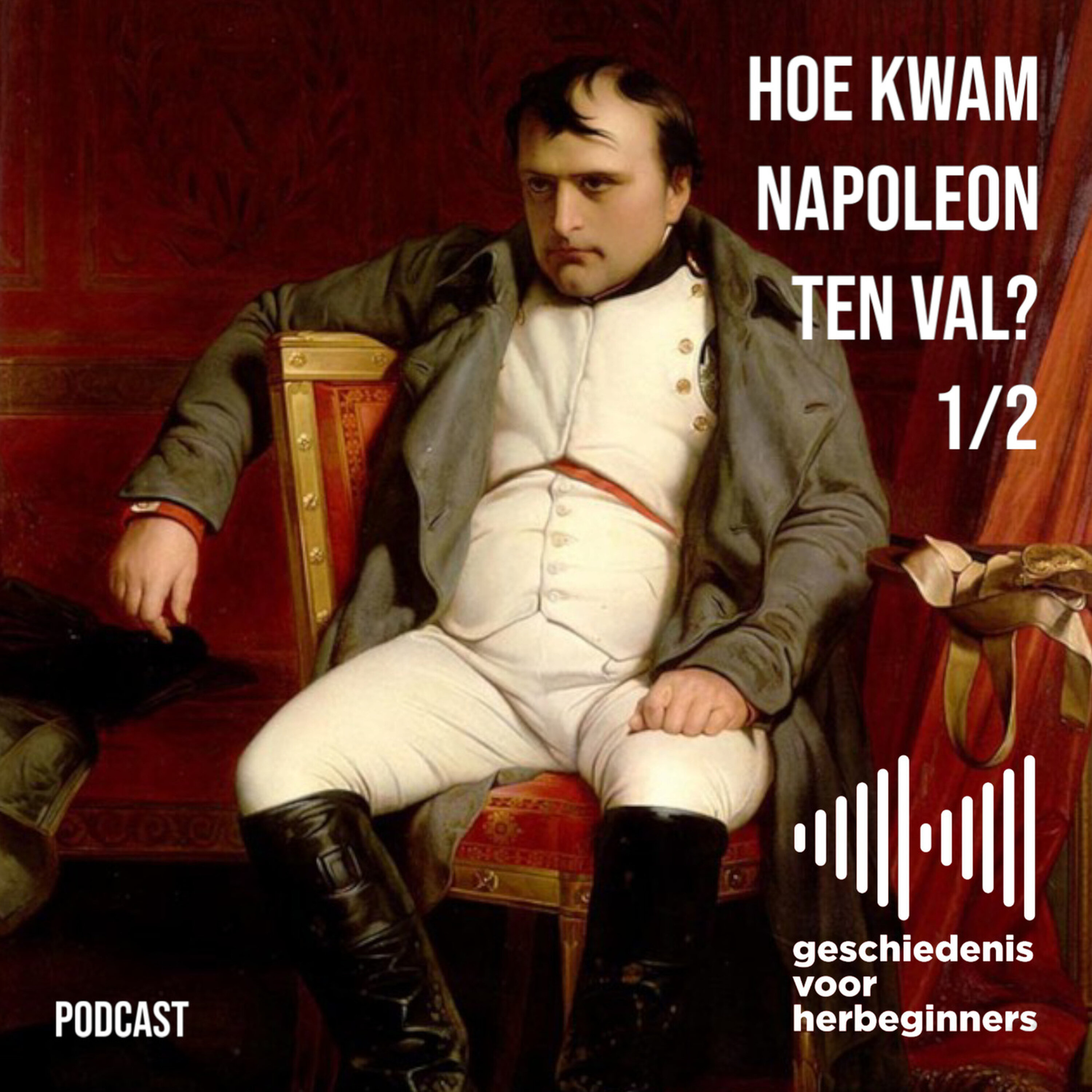
13. Franse Revolutie - deel 7: Hoe kwam Napoleon ten val? (1/2)
25m 8s
The transcript features Laura and Silke discussing unsolved murder cases on their podcast "De Volksjurie" before transitioning to a detailed account of Napoleon's military campaign in Russia in 1812. They describe Napoleon's strategic moves, the challenges faced by his army in Russia's harsh winter, and the eventual defeat of the French forces. The transcript highlights the brutal conditions faced by soldiers, including extreme cold, sickness, and starvation. The narration concludes with Napoleon's capture in 1814 and exile to the island of Elba. The podcast hosts provide historical insights and engage listeners with a mix of true crime stories and historical events, offering a captivating blend of narratives.
Transcription
2717 Words, 15482 Characters
Hi, we are Laura and Silke from the podcast "De Volksjurie".
We speculate in an unanswered way about unanswered and unanswered murder cases.
We can believe it ourselves, but apparently we are one of the most popular podcasts in Flanders.
So if you are interested in true crime and you can do this in Flanders, try to listen to one of our episodes.
Bye!
[Music]
[Music]
Welcome back everyone! Together, we saw Napoleon launch himself.
After that, we studied his flight and today we look at his crash.
And that was at least as epic as the rest.
The least we can say is that Napoleon gave himself, so we will not win.
Where are we? We write the year 1812 and Napoleon's power is unwavering.
He holds the keys of continental Europe tightly in his hands.
Don't forget that for example the French, Spanish and Dutch colonies have to be added.
We can speak of a world empire.
We saw the ingrained determination of his power in the previous two episodes.
He was countable, he fought one victory after the other.
He was a strategist and sometimes he took a step back.
Just good.
And then in 1812 he played his hand.
[Music]
[Music]
[Music]
[Music]
[Music]
[Music]
[Music]
[Music]
[Music]
[Music]
[Music]
[Music]
[Music]
[Music]
[Music]
[Music]
[Music]
[Music]
[Music]
[Music]
[Music]
[Music]
[Music]
[Music]
[Music]
[Music]
[Music]
[Music]
[Music]
[Music]
[Music]
[Music]
[Music]
[Music]
[Music]
[Music]
[Music]
[Music]
[Music]
[Music]
[Music]
[Music]
[Music]
[Music]
[Music]
[Music]
[Music]
[Music]
[Music]
[Music]
[Music]
[Music]
[Music]
[Music]
[Music]
[Music]
[Music]
[Music]
[Music]
[Music]
[Music]
[Music]
[Music]
[Music]
[Music]
[Music]
to Moscow, where 500 km of the city was very poor, under the mountainous area, full of moorish and a war of rivers and forests.
The roads in Russia were rudimentary, and that's a compliment.
The distances outside the city were very large, the land was thin, and the streets were poor.
This time the Grand Army would not be able to deliver the land they could live on, as much as they could.
It is by the way for the Napoleonic military campaigns, that the maintenance technique was invented in glass bottles.
In that way, it was less dependent on local acres, but in the case of the Russian field, the advance lines were unreachable.
Fastness was always crucial in the execution of Napoleon's plans, but it was now more than ever challenging.
The ground burned the Grand Army under the feet, as never before.
Counting down quickly with the torch was the only option.
But that was when the shoe knelt down.
That was exactly what the opponent expected, and the opponent did not let himself be seen.
The Russians went every decisive battle out of the way,
and in that way they locked France deeper and deeper, mother Russia, into an execution war.
And it worked. Soldiers were sick in the woods, and the advance lines began to sink.
Everything that could now be for the French was burned or burned by the Russian Cossacks.
This is the technique of the distorted lands.
They were burned, horses slaughtered, their corpses watered, and what more can we say about them?
The Russians roared as they were, their country, for time,
so that even in St. Petersburg, the capital, there was a lot to talk about.
When will we attack those French soldiers?
French soldiers also stood for their pleasure, houses and shoes in fire,
and piqued the way for seconds, not only the owners,
but also their rear-guards, with the soldiers who needed the goods.
The first city to be burned was Smolensk,
and that city could also be taken in very easily.
But day after day, time began to run out.
Napoleon had to move forward so that he could get back in power in Paris,
and the French border, Spain, still so black as Damocles.
But for Moscow, as he said, he had to fight those Russians in the end.
The French units were seriously exhausted, had lost a lot of good power,
and were now even numerically in the minority.
Until then, the great army.
But they were led by Napoleon.
In Borodino, finally, not far from Moscow,
the French and Russians delivered an amazing battle,
which even proved to be the first world war.
Between Daghraat and the Sonnezondergang,
and yes, the good military has it in between already,
a battle in that time lasts about a day,
74,000 soldiers came around, no less than 71 generals.
So that's about every eight minutes,
a full airbus falls down on an area not larger than Pact Deurne.
The Russians flew, but they weren't actually defeated,
and for France it wasn't a pirous victory.
Another such battle, and they were the Philistines.
For Kutuzov, and that's Napoleon's antagonist,
actually goes for the same thing.
On a new fight against the French, that was Jerein's suicide.
Napoleon is a flood of storms, he didn't draw up.
And we are not strong enough yet to dam that flood of storms.
That's how his explanation sounds.
Moscow is the sponsor that will suck him up.
Now that analysis has taken control of Napoleon in Russia.
He approached the legendary Middle-East Moscow,
but in the end he saw a smoke plume on the horizon.
We weren't even awaited by an absence that changed our plans for the city.
So I sent in a few adjudicers to take the traitors.
But the city was not only dead and abandoned.
The Russians also put them in fire.
Those barbarians gave their beautiful city to us all.
I took an injection into the Kremlin,
but when the angry fires spread over the city
and the walls of the Kremlin leaked,
the city lost its way through the bustle in the basement.
You can believe it.
So far, the Russians went in their tactics of the distorted lands.
They offered Moscow a language-like city
with Austrian allure, century old, on the flames.
Once within the walls, the French soldiers made one big orgy of it.
They made all kinds of plumes.
Bond-jasses, vodka, Jewels, Hermalines or Nertze Bond-jasses.
They bought and smoked themselves to the buttons.
Napoleon knew that he had to return.
The head of the city, Saint Petersburg,
had to forget about it.
Now he had to blow off a glass of glass
because the French themselves had plundered it.
But now he had to pierce the fleshy Russian winter on top of it.
His qualities as a leader
and the strengths of the French army
crumbled into the extreme geographical, climatological circumstances of Russia.
Now that the temperature has reached,
it was easy to reach 25 degrees below zero today.
And here the story is told.
Bad horror.
I warn you, don't listen further if it's already after 10 o'clock.
Maybe this is one of the reasons
why Napoleon was never made as a film.
The dead daughter who is now following.
The daughter of Nergis.
The random season finale
of The Walking Dead on the road to Mary Poppins' Leipzig.
Soldiers were screaming as ephemeral leipzig.
Horses swung down because they had no foot.
Left and right of the March of the Dead
were left behind cannon shells,
corpses that worked not necessarily motivating.
How much of the manhood did I not think of?
Tomorrow I will be there.
The snow often.
Soldiers were almost getting angry.
And when they slipped,
their laces of their feet were stolen,
they were forced to freeze.
By the snow falling on the snow, they were blinded by the snow.
They were beaten by men who fell before their death
as drunken zombies with an empty look around.
You have the stories of men who fled again
when their sanitary stops healed.
There are very few stories with that weight.
But think for yourself, what would you do yourself?
There are stories of cannibalism.
The road was a mother flat when it was wet
and the road damaged as the floor.
Once I have read a memory of a soldier
who cut a piece of flesh out of the muzzle of a horse
that crashed in front of him.
And the horse did not even feel that way through the freeze.
The wounds were unbearably close
and later it would crumpled, swollen to cold fire or so.
Stories of men who lost mass the empty.
Also known as drossarts.
Or men who were kidnapped by khazakhs
who disappeared from the Dennebosse.
Sometimes they just made a scene.
Listen for the terror they saw there among the French men.
And then at a given moment,
and I have always found it so poetic,
stop for both the French and the Russians
all logbooks, all letters, all orders
and no more books are filled in.
With everyone.
And I always ask, and now the podcast is on pause,
think about it. How could this be?
That's a very good quiz question.
While I will tell you now,
because over all the empty units,
over the two empty ones,
a concert must have been made
of floating ink pots
because the temperature that day
must have been frozen.
But Schalke Kutuzov was no longer the proe,
but the hunter.
And the proe, Napoleon,
he worked himself in his grave.
The Bérezina.
Until today in the French synonym for drama.
The Bérezina was a river
where he came with the remains of his body
and which he had to overcome.
A river of nearly two meters deep,
about twenty meters wide,
but with marvellous oeuvres.
In a race against the clock,
on the horizon of Schalke Kutuzov's body,
visible and audible,
were made by the Pontonnieres
with two nooks.
The men were standing in the water,
while shooting the ice.
A war in Ferno broke loose.
Everyone had to go over the narrow bridges,
while the Russian cannons were on fire.
Thousands of soldiers stood over it,
but the price was gigantic.
Many were trampled on the bridge,
in panic or in the water.
I don't know, there were about 25,000 active soldiers
who came, but also remains and burglars.
I haven't said that yet.
With such a large army in that time,
there were also traders,
the black market,
horses, with russians with them,
who also fell in the water and froze to death.
The following morning,
my dead children
and bastard sleighmen
arrived at the oeuvres of the Bérezina.
Yes, film that, Maris.
Napoleon had to go to Paris
for a coup d'etat
because in Paris I had already heard of the drama.
Well, it must be said,
the Russians also had formidable blows,
but at least 300,000 dead,
about 175,000,
during their fights.
The losses were so huge
that Marshal Kutuzov,
he didn't even dare to tell his own officers.
By the way, for the Russians,
it is in history
the fatherland war, as they call it.
Not to be surprised with the Second World War,
that's the big fatherland war.
It was in 1812,
the first time since the Mongolian conquest,
that the country was so tested.
I was once in St. Petersburg,
and there is a cathedral,
our dear wife of Kazan,
where Marshal Kutuzov has his tomb.
You really can't look at it,
and the tomb is flanked
by external French flags
and Christian worshipers,
and on that grave there were
various people to pray,
as if they were a holy one.
The Russian field was still done.
In time for an end balance,
so on June 24,
a slurred 600,000 French troops
overthrown the memo.
Against the new year,
there were 93,000 men left.
Depending on the different accounts,
the history of the destroyed land,
the losses on the French side
were at least 250,000,
up to 400,000 people.
Only a quarter of the victims
would fall into real fights.
The rest of them were suffering
from sickness and cold.
At least 50,000 men deserted.
It was the largest military ramp
out of history.
Do you know who read a good book
about Napoleon?
Adolf Hitler.
In 1941, he also thought
that he could defeat the Soviet Union.
He also made a single success,
and he was also unbeatable.
He fell into the country
with the largest military operation
out of history, with 3,000,000 men.
This time to clean up the ethnic
from the living room
of the German colonists.
The earth grew cold,
it all came back.
Zemberesina was Stalingrad,
and it was also the beginning
of Zem-Einde.
Look, I'm going to give you
the listener a warning as well.
If one thing is that we want
that you pick up from our spoken chat,
then it is the following.
If Russia just doesn't win.
Restantabouat.
I mean it.
That doesn't work.
You put it on for the trouble.
And call an army of ghettos over you.
The country is too big.
The country is a continental party,
and it can get super cold.
And the Russians are so motivated
to keep their motherland.
Well, it's over.
I don't see how you have to say that.
[Music]
So it was the beginning
of the end for the French army.
In the kiosk of the road,
the French army freed
the Prussians and the Russians,
among other things, the Dutch.
Us.
So we didn't belong
to the Kaisenreich-Frankrijk anymore.
The anti-stamming was enormous,
and everyone felt the momentum.
We are helping them now, to the buttons.
In October 1813,
Napoleon was captured in Saxe,
with the battle at Leipzig,
the so-called Volkrenslag,
against the Russians, Prussians,
Austrians, Swedens and Saxes,
the defeat that he had
from the French saddle.
I call the battle at Leipzig
always his first
definitive defeat.
And I understand how paradoxical that sounds.
And then it all goes very fast.
In March 1814,
Paris was conquered.
The Russians are in Paris, literally.
Apparently, I read that somewhere online.
In West Flanders, a way to say
that someone stood there for months.
The red flag.
Sorry, I didn't mean that.
It has also been said for a very long time
that the word "bistro"
would arise in these periods.
That is not a French word,
but it would come from the Russian army.
"Vluch."
Russian soldiers called that in Paris
when they wanted to serve the army in the Horeca.
And the French then falsely put the link
between the word "bouistre" and "eaten."
And overall, "bistro" would then
travel like paddles out of the ground.
Now, it is probably
a broad story.
The word comes only at the end of the 19th century.
"In zwang," so it is drawn in doubt.
Well, it is all a small story.
Back to the essence.
"Napolion" means the lower layer.
It does the removal of the throne.
It is linked to an island on the Tuscany coast.
Elba.
Where it is placed under house arrest.
In Vienna, a large congress is organized
where the future of Europe
would be founded
on the regime of the four great powers.
They set the tone.
Everything is opposed to Napoleon.
On the way to Elba, it is almost launched
by a monarchistic monarch.
The bourbons
become kings again.
In the figure of the
late 18th century.
It is immediately unpopular
by the Bonapartisians
to clean up the road
and to turn the clock back two decades.
By the way, the late 18th century
was by the way the younger brother
of the late 16th century.
Because the late 17th century, the son of Van,
died at the age of 10 in prison.
This led to King Zeer
suffering from a disease.
I think we should
take a short break.
We've heard a lot.
Let's have a drink.
Our audio files are too big.
Too many megabytes to upload.
See you in part two.
[Music]
Help an ice-cream bar, really.
You need 160 grams of protein per day.
And how much coffee is still healthy?
Online, we must hit the trends.
But what helps now, really?
As a test rabbit, I test a new hype every week.
And I think as a doctor to find out
so that you know what works
and what makes no sense.
Know how it is?
Read every Tuesday
to a new episode of "Lang Sey Leven".
Podcast Summary
Key Points:
Laura and Silke host the podcast "De Volksjurie" discussing unsolved murder cases.
The podcast explores Napoleon's life and military campaigns.
The podcast delves into Napoleon's invasion of Russia in 1812, leading to his defeat.
Summary:
The transcript features Laura and Silke discussing unsolved murder cases on their podcast "De Volksjurie" before transitioning to a detailed account of Napoleon's military campaign in Russia in 1812. They describe Napoleon's strategic moves, the challenges faced by his army in Russia's harsh winter, and the eventual defeat of the French forces. The transcript highlights the brutal conditions faced by soldiers, including extreme cold, sickness, and starvation.
The narration concludes with Napoleon's capture in 1814 and exile to the island of Elba. The podcast hosts provide historical insights and engage listeners with a mix of true crime stories and historical events, offering a captivating blend of narratives.
FAQs
The podcast speculates about unsolved murder cases in an engaging way.
The podcast has gained popularity for its content on true crime and engaging storytelling.
The podcast delves into the events surrounding Napoleon's campaign in Russia in 1812.
Napoleon's army encountered extreme geographical and climatological conditions, leading to massive losses.
The French army suffered significant losses and was ultimately defeated in the campaign.
Napoleon was captured in 1814 and exiled to the island of Elba.
Chat with AI
Loading...
Pro features
Go deeper with this episode
Unlock creator-grade tools that turn any transcript into show notes and subtitle files.
 PodcastTranscript AI