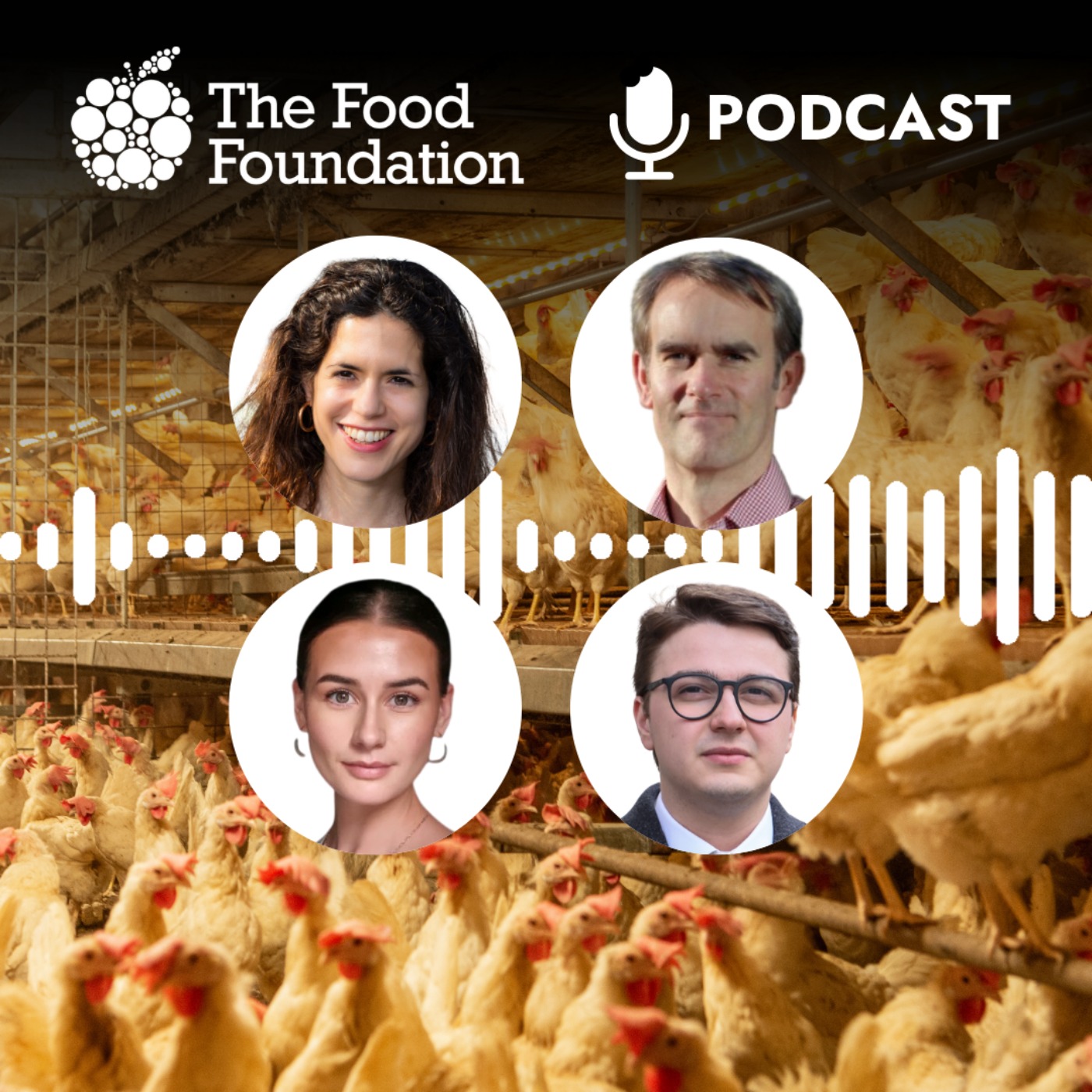
Fowl play? The UK's insatiable appetite for chicken
from The Food Foundation Podcast
42m 49s
The podcast discusses the complexities of chicken production in the UK, highlighting its dominance in meat consumption and the environmental and welfare trade-offs involved. Chicken is often seen as a lower-carbon meat, but intensive farming brings severe issues: over 85% of farm animals are factory-farmed, with 1.1 billion chickens reared annually in confined sheds. Welfare concerns include fast-growing breeds prone to health problems, high stocking densities, and lack of natural conditions. The Better Chicken Commitment, which set higher welfare standards, has been abandoned by some major companies, raising transparency concerns. Environmentally, the focus on carbon overlooks other impacts like water pollution from manure runoff, antibiotic resistance, and biodiversity loss. The UK imports a quarter of its chicken, and debates continue over whether expanding domestic production can improve welfare or merely perpetuate industrial methods. Consumer demand for higher welfare exists, but labeling is inadequate. Climate change poses additional risks, with heatwaves causing mass poultry deaths. The discussion emphasizes the need for systemic change, moving away from industrial models toward more sustainable, nature-friendly systems that benefit animals, the environment, and public health.
Welcome to the Food Foundation podcast, the award-winning voice of the charity which campaigns for better access to healthy food for everyone in the UK. I'm Rebecca Toby, Head of Food Business Transformation at the Food Foundation and this week I'm delighted to be joined for our 200th episode, which is a quite an exciting milestone by really far panel of experts to discuss the next question of chicken in the UK. I promise we're not just hosting this podcast simply to let me squeeze in a pun into the title about chicken, but today we're going to be thinking about questions like, how are we producing our chicken in the UK? Is it possible to do this sustainably? What trade-offs do we need to be considering when we're trying to achieve both environmental, animal welfare and domestic food security objectives? And why is our appetite for chicken? So insatiably high, you just have to walk down any British high street and you'll be inundated with fried chicken shops, as well as a lot of advertising, particularly on outdoor kind of advertising spaces for chicken. Joining me today to discuss all that and more are Anthony Fields, Head of Compassionate and World Farming UK, Myrtle Gregory, Research and Policy Officer at the Eating Better Alliance, and last but definitely not least, Merzant, who's one of the Food Foundations young food ambassadors. So I'll kick us off just by setting a bit of kind of, I guess, scene setting and then really keen to kind of dive into conversation. So I think certainly from the Food Foundations perspective, eating less meat, produced a better standards and shifting towards diets that have more plant foods in them is going to be good for our health, it's definitely good for the environment, and it's something that both health and environmental organisations globally are agreed needs to happen. But I think whilst we're kind of seeing some growing consensus around the health and environmental benefits of reducing process, particularly processed red meat, chicken often seems to get a bit of a sort of get out of jail free card in these conversations, or it seems a bit of an exception. And this matters because we eat a lot of chicken in the UK, so almost half 42% of all the meat we eat in the UK is poultry meats, so that's chicken with a little bit of turkey, usually a Christmas thrown in. And what's more, it's very much kind of bucking the trends. So generally speaking over the last decade or so, we've seen a decline in kind of meat consumption rates in the UK, even though that consumption level, we're not declining at the pace we need to in order to meet environmental targets, but it is declining. But actually, white meat consumption in the UK is actually increasing, so it increased by 10% between 2008 and 2019. So there's clearly kind of different trends at play here, and this really matters because the majority of the chicken we eat is intensively red, so less than 4% of all the chicken we eat in the UK is free range. And that's a figure that's actually fallen slightly in the last few years, so there's a number of real concerns around the welfare of these animals. And certainly from an environmental perspective, it gets kind of quite nuanced. So intensively-rear chickens produce kind of lower greenhouse gas emissions and waste per unit of meat compared to grass-fed or extensively-reared meat production systems, which makes them sort of technically speaking a relatively low carbon meat in contrast to beef, for example. But there are a number of kind of other really big environmental trade-offs that need to be considered when it comes to chicken production. So waste runoff into rivers, antibiotic resistance, all of these are things that are quite closely associated with intensive chicken production. And certainly I would say it can be quite a tricky area to navigate, so I often speak with a lot of food businesses at the Food Foundation. And there's quite a lot of mixed views and I think trade-offs for the government and businesses to consider. So for example, many businesses at the moment are actively advocating for the government to increase support for the expansion of the British poultry sector. And actually deafers, new food and farming board, and one of the first things they're going to be looking at is a sort of growth plan for the poultry or chicken sector. And they would argue that expansion is necessary because to meet higher welfare standards and provide chickens with more space, you need more and bigger sheds, et cetera, et cetera. And if we don't expand the sector, that may just see us importing more chickens from places like Ukraine or Brazil, which may very well have lower welfare standards than UK-produced chicken. Currently we import about a quarter of the chicken we eat, so we're by no means self-sufficient. So you get sort of questions around food security and British self-sufficiency coming into play here as well. So some nuances here, but I'd like to kick off by coming first to you Anthony. So Anthony, the issue of chicken welfare has very much been in the news of late after the decision by kind of several leading hospitality and fast food brands to quit the better chicken commitment and set up their own sustainable chicken forum, which has led to some widespread accusations of potential greenwashing. Can you tell us a bit more about the better chicken commitment and also what's led us here? Yes, thank you. So if we take a step back, we've got to look at the industrialisation of our livestock sector. And you've got to look at the numbers of animals involved here. You've talked about the expansion of the sector and you've talked about the need for more sheds, but you haven't talked about the number of animals and the sheer quantity of it. We now have over 1.1 billion animals kept in factory farms in sheds every year in the UK. That's 85% of our farm yard animals. And compassion has done research and it shows that we must change this system not just for the animal welfare side of things, but for the environmental side of things and the impacts on our health as well. And we have a mission of of ending factory farming by 2040 or we're going to start to face some serious consequences around loss of soil fertility, the loss of nature and the greater climate change impacts or climate breakdown. Some people call it. So whilst compassion is working on that strand to change the system and go to a system that is more nature friendly, getting the animals out on the land, mix crop rotation. So the animals and all of their manure actually benefits the plants and is a sustainable circular system. We cannot forget about these 1.1 billion animals are in sheds. And that's really what leads us and led us to the better chicken commitment. And it was about setting scientifically proven higher welfare indicators and practices for companies to adhere to that would drive better welfare. And those are things like increasing the light that the birds have. So windows in in sheds it may sound like a very basic thing, but it's a real thing giving birds more room to move around so a lower stocking density. And and maybe the most critical one we've got is around slower growing breeds and using slower growing breeds because the birds that we currently have the majority vast majority in our in our factory farm system are birds that are genetically bred to put on as much weight. As possible they live for 35 37 days. They put on so much weight and meat that they start to have heart and lung complications. There's die of heart attacks by the time they get to 35 days they can't stand up and and actually some of them are so heavy and their and their bones aren't formed enough that they actually break their legs their fractures and their legs. And that is not good for animal welfare and actually if you start to look at the other indicators so that the maximum stocking density what is the point of having more room if you don't have a bird can actually take advantage of that and move around more things. So we pulled together with other organizations the better chicken commitment to address that and that was in 2018 and and we've got over 200 leading food companies across Europe who have signed up to it and committed to the better chicken commitment. So it's a little bit of a backward step as you say for these companies to to to in February pull out of the the better chicken commitment especially the time where the animal welfare strategy the government's own strategy that are released less than two months earlier in December 2025 said we will support voluntary efforts to move away from the use of fast growing meat chicken breeds. And it looks to us as if as if the sticking point around these companies moving away is around those fast growing breeds and slow growing breeds and and it may well just simply ball down to finances and money and that's not where we need to be as a society. Yeah, no, that's really helpful and I mean obviously the the sustainable chicken forum is is quite new. Do you know if they're they're planning on you know publicly reporting in any way some people saying well is this not just industry marking their own homework. Are you kind of do you have concerns in that respect? We have serious concerns around the sustainable chicken forum and about the metrics they're using and the reporting they're doing and and the transparency of it because you know one one aspect of the better chicken commitment is that companies have to report annually on it and it has to be audited. So absolutely is it is about giving that transparency and giving the British public and we know the British public are animal lovers and we know that they want.
better welfare and they will buy better welfare meat. They're a Reading University study done in October last year that was commissioned by DEFRA said that UK consumers would spend billions of pounds more if they knew that it was higher welfare meat. That's billions of pounds more. We're at a point where the government is looking for growth and if for example a pull factor for that would be if we had honest labeling on the packets of meat in our supermarkets and retailers that actually showed you the method of production and showed you the different levels of it and allowed you to make a decision on whether you want higher welfare or not. That would be a real pull for retailers to start stocking it. And we've got testimony from companies and Weight Trows said that they've seen a growth in chicken sales since they switched to the better chicken commitment and they take that as a clear sign from their customers that they want higher welfare. It's not just coming from retailers. If you talk to farmers, there's a farmer said that when he switched to slower growing breeds the birds are more robust. They seem happier. They act more like chickens and that's quite a statement when you're talking about chickens. They act like chickens rather than the fast growing breeds which may not. They have a lower mortality rate and they are a better built bird. Really it's about giving the poultry the best lives they can have and allowing us the transparency to buy the products and the produce that we want. So that consumer demand is there. And actually I guess I'm also interested in the fact that actually relatively few retailers are signed up to the better chicken commitment, even though most of the food that we buy in this country we're getting from supermarkets. How do you think we shift things there? Well I've touched on honest labeling already. I genuinely believe we need better transparency in the system. If you, as I do, talk to my family and friends and I talk about the conditions that the poultry's kept. They're shocked. They still believe the images of their children's books of old MacDonald and his farm with the animals out on the countryside roaming around and living a good life. And when I tell them that there are 85% of fond animals are confined in sheds, don't see pasture, don't feel the grass under the feet, don't feel the sun on them. They are absolutely shocked by it. And then they go on to immediately say well how can we find out the better systems? How can we buy the better produce? It's about labeling. And so I think I think how do we get retailers to do it? One pull factor labeling. Two, we know Norway in February announced by the end of 2027 they will only be growing, slower growing breeds. So there is a move away from these fast breeds. And then if you start to think of the push factors as well, climate change. So you've got to ask the question whether factory farms are fit for a climate hit future. And if you look back to the 2022 heat wave that we had where we had a maximum temperature on one day of 40.3 degrees, millions of poultry died during those heat waves. And in July production of chickens was down 9%. Well if you go on the Met Office website and you look at one high emissions scenario prediction they've got, they've got a prediction of two weeks of 40 degrees plus temperatures by 2050. If we're seeing one day of 40.3 degrees and millions of birds dying, how is the current system going to survive that? And again coming back to the government's animal welfare strategy, they talk about the need to go to lower stocking densities because of the climate impacts because these birds with higher metabolisms have a higher temperature. If you just compound that with the ambient temperature of heat waves, you are going to get higher mortality rates and you've got to start questioning, is this system fit for the future? Yeah, there's a question of resilience here I guess as well. And Merkel coming to you now, I mean it's sort of, I'm just sort of started to touch on this. But can you tell us a bit more about the environmental impact of chicken production as well? I think a lot of businesses do see chicken as a key part of meeting their net zero goals because it is a lower carbon maze and push back in that respect and some of the welfare commitments that we've just heard about. But I think if we look beyond carbon, what are those wider environmental impacts associated with kind of intensive chicken farming that you're worried about? The environmental impacts are massively far reaching and they're far more severe than we've been led to believe. But quickly before I jump into them, Anthony caveated his answer with a caveat around scale and I would quite like to do the same with a bit of an uncomfortable topic around blame because I think when we talk about the impacts of industrial production, it's really easy to sound as though we're blaming farmers. And I think a framing that we use eating better that's really, really important we use throughout this conversation is the recognition that over the past 50 years, our farmers have been led down a pathway of industrialisation and in order to compete in a market which is basically based solely around efficiency, our farmers have either had to take a massive huge risk and go in an opposite direction or to intensify. And we've got the growth of these huge, huge US style mega farms which are putting small and medium sized farmers out of profit, out of business. And when it comes to chicken, actually putting up a chicken shed is often sold as the most viable way of maintaining profitable. And once that shed is up, our farmers actually have really little autonomy over how the animals are raised, they have little no autonomy over the impacts of it. But those who do hold the power, as Anthony's already spoken about, is the food system actors. It's our retailers, it's our food service, it's manufacturers, it's the suppliers. And the burden and responsibility and finance of change needs to be recognised with those players. And actually, we need to recognise that our farmers are a small cog in the much wider system of industrial livestock production. And I would really like that to be remembered as I talk about the on-farm implications of production. No, absolutely. This is kind of systemic, you know, it's not I don't think it's being driven by any one actor. Absolutely, absolutely. And again, the environmental implications happen as a result of the scale of the system. It's not just one farm, it's, you know, accountless countless farms across the UK who are just responding to the demand. So the environmental claims around industrial poultry. Poultry has gained itself a branding around being environmentally sustainable. And that's because of this carbon tunnel vision lens that has been applied. And eating better, we recognise that this was a problem. So eating better, we're an alliance of about 72 organisations, compassion and food foundation, we're very proud to have as our members. And our membership spans food justice, it spans climate, nature, biodiversity, farming organisations, a whole host. And so what we've done is we've taken sector-based expertise across all of these sectors. And we've stitched together a case for change, which basically debunks these claims around sustainability. And it's based on the premise that when you view carbon as the sole metric of sustainability, you miss out on the implications for nature for biodiversity and for ecosystem function. So when it comes to poultry, the environmental implications stem from sort of two key parts of the process. One part is feed production, the impacts of that are largely off-shored, and we can probably come on to speak on that in a bit. And then the second part is the manure, the amount of manure that is produced from these systems and the pollution that arises as a result. So we see water pollution, air pollution, and we see loss of habitat and biodiversity. Now, sustain, the alliance for better food and farming, did a great piece of research, which found from industrially produced poultry pigs and dairy. The equivalent of 100 double-decker buses of manure are produced every hour in the UK. And yeah, this is for three species, but in 2023, 1.1 billion of the 1.2 billion animals slaughtered for meat, were poultry, were chickens. So you can imagine that this flock represents the majority of this manure footprint in the UK. Now obviously, this manure has to be disposed of and the best practice recommendation is that it's spread on fields as a fertilizer, but in quantities this fast, it's no longer a fertilizer, it is a pollutant. So what we see is we see damaged ecosystems. So 63% of the UK's most sensitive wildlife habitats are now impacted by excessive nitrogen deposition from manure. We see soil degradation. So soil in every region in England is now too high in nitrogen. This leads to leaching and runoff and the big boy, which is water pollution. And this is a really hot topic. So, you know, people will have seen in the news, it's made in mainstream media headlines around the Y Valley and the illness and the pollution that agricultural runoff has caused. I think it's only 14% of rivers in England are now in good ecological health. And two thirds of those who have failed have failed due to agricultural activities. And we all have seen sort of a murky, a cloudy river in our country side walks, but the real issue and the real damage comes from the invisible pollutants. So we have the runoff, we have the cloudiness, all of that. But we also have pathogen runoff from animal waste.
So it's poultry manure is full of pathogens like E. coli, like salmonella. And what we're finding is these are entering our waterways and now entering our food system into animal food webs and we have proliferation of disease based on these pathogens. And second to this, we also have antibiotics, hormones and antibiotic resistant bacteria entering our waterways from the manure that's running off from the fields. And again, we know antibiotic resistance is one of the biggest threats to global modern medicine. We absolutely cannot be perpetuating that risk by the expansion of industrial livestock of poultry production in the UK. It deposes an unbelievably massive risk to human health. There's quite striking facts there. And I think if we could return as well, you mentioned it as well, the issue of a feed which always really fascinates me when you kind of talk about chicken. So obviously most chicken feed is soy. Why does this matter when thinking about the environmental impacts not just within the UK but globally of chicken production? Again, it's a really huge one. We, almost all poultry feed is imported and there's 23 billion chickens on earth. So that's three chickens per person basically. And it's not a surprise that the biggest user of crop based animal feed is poultry. So I think it's around 75% of global soy goes towards pig and poultry or perhaps just under. And this feed production, it's associated with deforestation, it's associated with land use change, climate change, it's got a massively high water footprint, high fertiliser use and high pesticide use as well. And you know, we could do a podcast just talking about those issues alone. Can we just? But there's two fundamental things that eating better, we think are crucially injust in this. And the first is the impacts of these things are being off-shored from the UK. So we grow the food in a region, we don't feel the impacts of it. And this has huge connotations of colonialism. We pass the environmental burden onto those who have no stake in it, they have no power in the system and they don't receive any of the benefits. This is completely unjust. And then really crucially as well, the industrial production of poultry is based on a linear system. So we see a really high input for a high output, but we disregard all of these environmental externalities. So they're uncosted in relation to the final product. So that, I mean, that in itself is an injustice because the cost, the price that we're paying doesn't reflect the cost of production. But we're a linear system that's so reliant on feed inputs. You have a really vulnerable system. It's often, chicken is often sold, as you said in your opening, Rebecca. It's sold as an answer to food security. It's sold as more climate friendly, all of these things. But it's so, so vulnerable to disruption. We're living in an age where we're in a climate crisis, we've got a nature crisis, we're now in a geopolitical crisis, and relying on a system which has to import feed through vulnerable trade routes from climate-ly vulnerable regions. You know, that's really risky. That's a supply chain that's ready for collapse. So eating better, we advocate for circular systems. We need to transition towards livestock where we reuse the inputs, the externalities that are accounted for, and we work with nature, and we use feed that can be grown and that is resistant. So we need to be investing in local, resilient supply chains instead. Before I move on to you, Mersen, Anthony, did you want to add anything here in terms of this kind of feed food issue and the impacts globally? Yeah, absolutely. There's a narrative here that Mertel touched on that this is about food security and about us being secure in our own food. And that's purely smoke and mirrors. I mean, if you actually expanded out beyond poultry and you look at the amount of grain that we grow in the UK to feed our factory farms, 52.8% of the grain grown in the UK goes to feed factory-farmed animals. That is grown on land that the size of Norfolk and Cambridge had combined, which is good farmland. We compassion have done the calculations and we believe that if you grew human edible crops on that land, you could feed 16.8 million more people than feeding the growing grain to animals and then eating the animal products. And that's because for every 100 calories of human edible food fed to animals, only 3 to 25 calories of meat are produced. So we are actually in built in food inefficiency in the system. If you look as well as a poultry growth plan that the government's committed to, they're also talked about a horticultural growth plan. That's where our efforts need to be. We are short on fibre in our diets. The UK produces 100% of the protein we need for our population. If you include imports, that doubles to 200%. Why do we need to have more protein? We don't. We need to be growing healthier food more rounded. We've got to educate ourselves on how to eat those foods again because we're starting to lose that knowledge. Yeah, and it's a good point to come to you, Maza. And so I think we obviously covered production of chicken in quite some detail. But actually, it's hard to start to think about how do we shift production of chicken when demand is just so high. And to me, this kind of lies at the heart of the issue. I think business has faced some quite difficult decisions about sourcing and production. If we don't take a really hard look at the amount of chicken we're eating and Maza and I'd really love to hear from you about, why do you think chicken is so popular? And especially among young men, the largest amount of me on average of all age groups in the UK. And that's driven in large part by how much chicken they're eating. Why do you think that is? It's seen as something that I like to refer to as the golden protein. From my experience and looking at young men at my age, I can see that one of the main factors is social media. Social media and dalsi play the large one, all of our lives now. But the fact that we see it's more children at greater level, there's a very large gym culture that we see on social media these days. And many people with large volumes like the push young men towards eating more protein. And the main source of protein that's advertised as being the best is chicken. Whenever I'm scoring three ticks or I see chicken and rice bowl or chicken and potato. And this really does influence young men. I've seen it with my friends, they always post thing going to the gym or what they're eating and it's always almost always chicken. Since I started university, I can also understand it's not only social media which is creating with popularity and chicken, but chicken is affordable, compared to other meat. As a student now, I have the budget with my shopping. And I'm rarely ever left with the budget to buy other proteins and chicken is always death to go for and many of the recipes that we know, easier recipes of a revolve around chicken. I always find it interesting that you talked about, you know, chickens almost seen as this kind of like one true protein to roll them all on social media. And I think it's got quite a reputation of being a kind of a healthy meat or a healthy source of protein. I mean, do you think that's true? Because I think we also need to acknowledge that, you know, whilst many gym bros are cooking kind of lean chicken breast salads or chicken and rice or what have you. You know, a lot of the chicken we're eating nowadays is processed chicken nuggets or it's fried chicken. Do you think that gets overlooked? Yeah, definitely. We're from a young age. At secondary school, we expose to chicken shops. We go that after school, during our breaks to get cheap food and it fills us up, but we feel terrible afterwards. We know we're not being healthy, but we also don't understand that we're being unhealthy because we're at such a young age. We're not aware of those effects that's having on our health at that age. When we're going out, chicken generally tends to be the cheaper option. These big chicken companies, they entice us like, for example, 20 nuggets for eight pounds. So we have the smallest chicken shops, two burgers and fries for a five, etc. And that's sort of what young people look at. It's the food ability side of things. They're not really focusing on the health because they're not aware. They haven't got that education or they're not doing their research. And I want to talk about some of the influx of wingstop and pop-ups into the UK. You can see that wingstop has done a brand deal with JD and they're targeting the younger audience whenever I'm in wingstop in central London or I'm going outside of it. There's always a massive line of young people waiting outside to buy chicken, which is going over from the US and it's so popular here now. So many children now are obese or overweight and the chicken shop culture just needs countering. Young people need more things to do. And I'd be interested actually to discuss that in a bit more detail because I think we've obviously seen in recent years, there are far fewer kind of youth centres or community centres or even sports grounds that young people can go to. I mean, do you think some of these kind of fried chicken shops are they playing a role in the community or social life of young people? Definitely well. No, it's our secondary school. The chicken shop was right there. They actually had one minute walk and it's always a rampacked and it's over a quick past time before we have to get home. In my area we had a really good youth centre and people loved it. It was just really far and you had to pay to get in, etc. But the people who are just going to enjoy their time.
They would talk how to cook different proteins and different meals and I was really helpful, but it's just that it's so close to our school, everyone would just go there because that's the easier option and we're seeing not as many use centres now. Yeah, for sure. And it's interesting to hear about the advertising as well that you've seen. Do you feel like it's noticeable that there's been a kind of increase in advertising for chicken in recent years? I think particularly I'm always struck by how much outdoor advertising there is for chicken these days. So, you know, that sort of advertising on billboards or, you know, at bus stations or train stations, that seems to be sort of quite endemic at the minute. Yeah, definitely. Especially on social media as well, from the billboards, it's these chicken shots so we can see that there's large chicken companies that are targeting new trends like hot honey, for example, or this pickle thing that KFC have now come up with, they're trying to entice the younger audience with these newer trends and we can definitely see that happening on social media. Yeah, really interesting. So thinking now about, you know, how do we start to shift the dial on some of these issues and what are the potential solutions here? And I think we've kind of touched on this a bit as part of our conversation, but I'd like to come to each of you in turn and let us all have a think. You know, what needs to happen at a policy level? What should businesses be doing differently and how do we start to shift British diets and kind of, I guess, British food culture from being so reliant on chicken? Should we start with you, Anthony? Yeah, I'm going to come back to a point, myrtle mate. This is about the system. It's not about the farmers and one actor in the system who is a leader is the government. Now the government don't have a lot of money to throw around solutions. We know that with the last few budgets that we've had. But the government can make signals and the government did in their animal welfare make a signal to move away from the use of fast growing breeds. They can see that Norway is going to end the use of fast growing breeds in their country. So actually the government should look to push for a transition to more mixed farming, nature friendly farming where the animals are not kept indoors, they're kept outdoors. That will necessarily mean that there are less animals around and that touches on the size of the flock, if you like, because we've talked about the industry arguing we've got to have more sheds for our birds because we've got to give them more space. Absolutely fine to have more space, but it's about the flock size and what we're seeing in some planning applications is potentially welfare washing and trying to increase the flock size through the back door by saying we're going to apply for this at low stocking densities, but actually we're going to apply for this at the maximum stocking density just in case. Well, you know, that's not on you know, we've got to and the government has got to incentivize farms to move into nature friendly farming systems. That is more resilient in climate in terms of climate change. I was talking to a company the other day who said they visited a farm last summer and you got a bear in mind that farmers, English farmers over the last five years have had three of the worst harvest on record. They are at the front end of climate change and this person said they visited two farms who are supplies to them. One farm was a nature friendly farmer and you could you could see the crop was wasn't doing massively well, but it was there and they will get crop off it. The other farmer just had brown fields and they were not resilient and they were not a nature friendly farmer. So, you know, I think not just around chicken, but as a whole the farming system has got to change and that necessitates our diets have got to change. But a key actor in this is government to send those systemic signals to farmers, to retailers that the public don't want this sort of food anymore. The public want higher welfare and we've really got to take the public on a journey about what is healthier for us because you know, Mertel touched on the pollution of our rivers, our land, you touched on the air. This week we launched an ammonia map that maps out the air pollution from chicken and pig factory farms. Ammonia itself, okay, it's a gas, it's not nice, but it actually reacts with other pollutants in the atmosphere to create a really fine pollutant called PM 2.5. That is small enough for us to breathe in to get into our bloodstreams and it's been directly linked to some serious health issues around respiratory diseases, lung cancer, strokes, heart diseases and there's emerging science that is starting to link long term exposure to dementia and type 2 diabetes. This pollution goes not just locally, I mean I've spoken to communities whose lives are being ruined by being in close proximity of these factory farms, but in the middle of London, 25% of this particular pollution comes from UK agriculture and again, coming back to Mertel's point, it's not the farmers, it's the system we've got to look at. So we need to redesign the system with kind of different regulation and legislation. Absolutely. And Mertel, what would you add? What do we need to, what are the solutions, what do we need to do differently? Yeah, well, and it's quite hard to follow that because that was really competitive and I back everything you just said. You touched on a really important point there around policy coherence between farming measures and diet side measures and that's something that we advocate for so strongly. So eating better alongside four other alliances, food and farming alliances in the UK have recently set out a series of policy asks of what we want from this national food strategy that's being developed at the moment. And together we represent over 160 organisations and one of the key asks in that document is policy coherence between government departments and policy coherence between farming, food, diet. So it's all joined up. So we're producing what we need to be eating. We're producing it in environmentally friendly way, in a healthy way and what we produce goes on to make healthy food for everyone. So that's a really fundamental piece of the puzzle. There's a hesitation within government, a fear to put in dietary side measures and you know we know this government is quite scared of accusations of Nanny's state. We know that there is a fear and there is emotional connection to food which makes working on food policy appear to be really difficult but consistently impoling. We're seeing the public, as Anthony has said, we've seen the public want implementation of policy measures. In our latest public attitude survey, 60% of the public poll that they would be willing to reduce their meat consumption. And as Anthony has also said, we know they're willing to spend more on better, on high welfare, on nature friendly food as well. So the appetite is there. The bulk of the population wants it and it just takes a little bit of bravery from our policy makers and from industry to step into that space where they can deliver. Yeah and I guess also support, you know, we've touched on the price issue but it's tricky because I think there's that willingness, behaviour gap isn't there where people would like to and if most people had a choice they would be very willing to opt for a higher quality meat but ultimately in a time when food budgets are squeezed, there's Merzans said it's tricky when chicken is so often. The cheaper option even though that isn't factoring in the true cost of all the externalities it produces. Absolutely. I mean, this is one of the reasons why conversations around chicken is so hard because undeniable at the moment, it is providing essential nutrients to those people who are living with food insecurity. It is a protein option which is the most economically accessible for many, many people which is why we need the system actors, why we need the retailers and food service operators to put better options on the shelves and on the menus so people can have the option of choosing something that's more affordable that actually doesn't come associated with a huge environmental or health based price tag. So there's a huge movement in the eating better alliance at the moment which, you know, food foundation are part of which is asking retailers to commit towards rebalancing the basket away from animal protein towards plant based protein. So we make plant based proteins affordable, accessible, available, convenient, easy tasty, all of those things for consumers. And you know, in the words of the Food Ethics Council, people can't make good choices if there aren't good options. All we're asking is that those who have the power put the good options on the shelves. So that for me is a really key point. And you know, we're talking about curbing the growth of the poultry sector to engage industry on a conversation around stopping the expansion of anything is really difficult. So until we have ideally mandatory but voluntary at a minimum commitments in place that say we will commit to rebalancing the basket, it's really difficult to engage industry on conversations around curbing that growth. And then my final point would be around the expansion of the poultry industry. Like we need to have a really honest conversation and call for no more expansion in the UK. And we're seeing some really worrying signs coming from a policy perspective. So there's a planning review at the moment going on which has the potential to increase how easy it is to get planning permission to put up an industrial trick and shed or to build it to build a big farm. And that's on the basis of food security which you know, we've spoken about. It can be debunked. We need to be thinking about long term food security. And while eating better lines absolutely advocates for good
would agriculture infrastructure and investment into agriculture, we need to be thinking about what that actually means and what that is. So that's a point of concern and needs to be addressed. And then equally Oxford Farm in Conference this year, Defer announced a potential poultry sector growth plan across the eating better alliance. This is really raised alarm bells and has triggered a fairly big movement and objection to this plan. And so the fundamental ask really of eating better is no more expansion. Thanks, Metal, lots, lots of food for thought there. And Merzan, I'd love to give you the last word. What do you think needs to change? How do we, how do we, how do we shake the system out? Well firstly I think of this government need to understand that having a healthy, a population helps us all, attacking these issues from the start from primary school is going to help us all because it also takes a burden off the NHS. Having healthier children means we're having a healthier population, meaning that the NHS has left us of a burden. Secondly, I think we need to amplify more positive food role models on social media, so you're using a variety of stability and nutrition and fairly junk food advertising on social media or in person, it needs to be regulated better. Thanks Merzan. Thanks for listening. As we wait the government's upcoming food strategy, the Food Foundation is calling on policy makers to recognise the central importance the food system has in shaping the nation's health and wealth. Click on the link to our meat facts report in the show notes and subscribe to this podcast and on use letter to keep up to date with the latest analysis of what makes healthy food really matter. you you
Podcast Summary
Key Points:
Chicken accounts for 42% of all meat eaten in the UK, and white meat consumption increased by 10% between 2008 and 2019, bucking overall declining meat trends.
Less than 4% of UK chicken is free-range; the vast majority is intensively reared, raising concerns about animal welfare, antibiotic resistance, and environmental pollution.
The Better Chicken Commitment, which promoted higher welfare standards (e.g., slower-growing breeds, lower stocking density, natural light), has been abandoned by several major food companies, sparking accusations of greenwashing.
Intensive chicken production has significant environmental impacts beyond carbon, including water and air pollution from manure runoff, soil degradation, and loss of biodiversity.
The UK imports about 25% of its chicken, raising food security and self-sufficiency questions, with some arguing that expanding domestic production could improve welfare standards compared to imports.
Consumers express willingness to pay more for higher-welfare chicken, but lack of transparent labeling hinders informed choices.
Industrial chicken farming is vulnerable to climate change, as seen in heatwaves causing mass poultry deaths, questioning the system's long-term resilience.
Summary:
The podcast discusses the complexities of chicken production in the UK, highlighting its dominance in meat consumption and the environmental and welfare trade-offs involved. 1 billion chickens reared annually in confined sheds. Welfare concerns include fast-growing breeds prone to health problems, high stocking densities, and lack of natural conditions.
The Better Chicken Commitment, which set higher welfare standards, has been abandoned by some major companies, raising transparency concerns. Environmentally, the focus on carbon overlooks other impacts like water pollution from manure runoff, antibiotic resistance, and biodiversity loss. The UK imports a quarter of its chicken, and debates continue over whether expanding domestic production can improve welfare or merely perpetuate industrial methods.
Consumer demand for higher welfare exists, but labeling is inadequate. Climate change poses additional risks, with heatwaves causing mass poultry deaths. The discussion emphasizes the need for systemic change, moving away from industrial models toward more sustainable, nature-friendly systems that benefit animals, the environment, and public health.
FAQs
The Better Chicken Commitment is a set of higher welfare standards for chicken production, including more space, natural light, and slower-growing breeds to improve animal welfare.
Some companies, like those forming the Sustainable Chicken Forum, left due to concerns over costs, particularly around switching to slower-growing breeds, leading to accusations of greenwashing.
Intensive chicken farming causes water pollution from manure runoff, air pollution, antibiotic resistance, and damage to ecosystems, despite having lower carbon emissions per unit of meat compared to beef.
Almost half (42%) of all meat consumed in the UK is poultry, with white meat consumption increasing by 10% between 2008 and 2019.
No, the UK imports about a quarter of its chicken, primarily from countries like Ukraine and Brazil, which may have lower welfare standards.
Consumers want higher welfare meat and would spend more if labeling were transparent, but currently only a small fraction of chicken is free-range, and labeling is often unclear.
Chat with AI
Loading...
Pro features
Go deeper with this episode
Unlock creator-grade tools that turn any transcript into show notes and subtitle files.
 PodcastTranscript AI