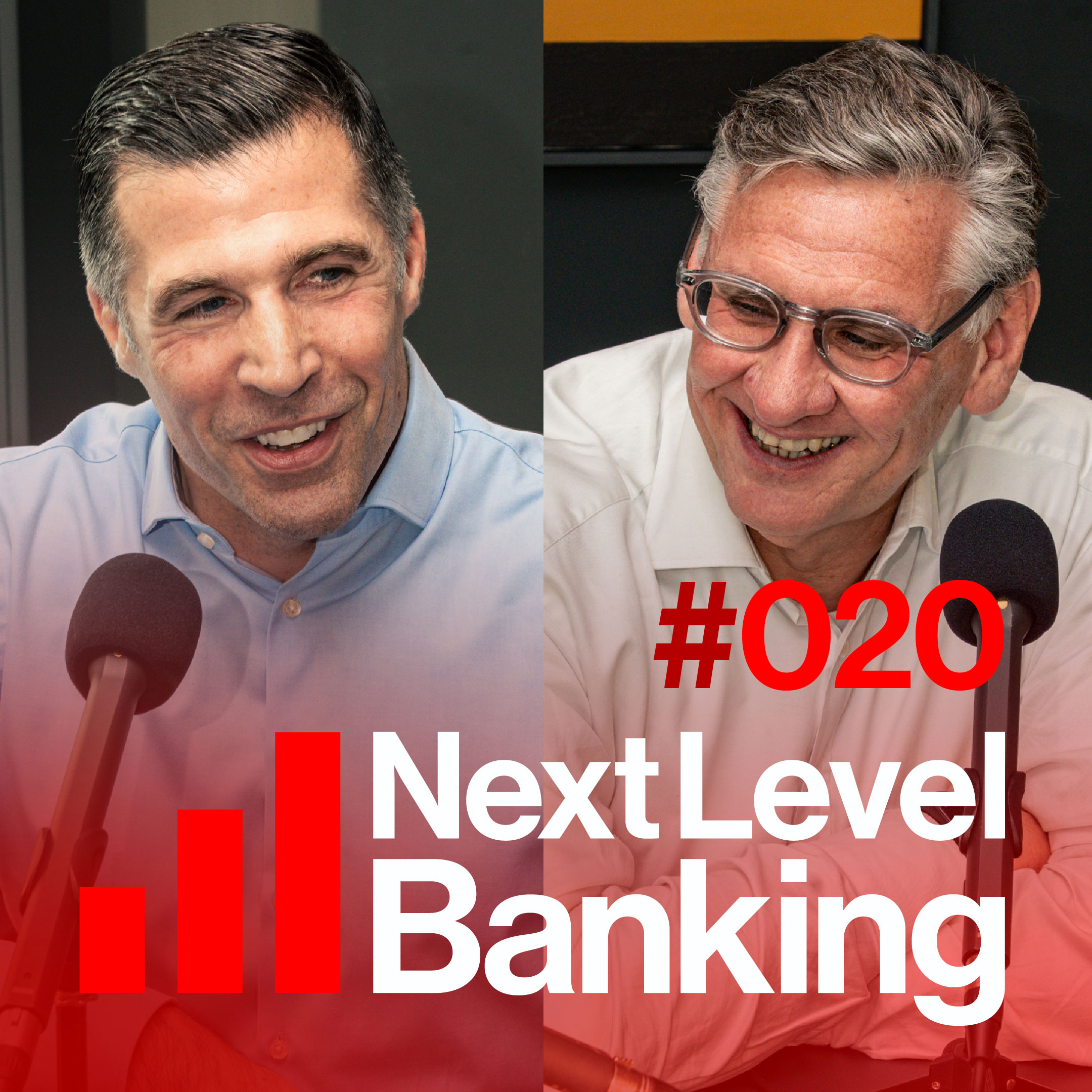
Folge 020 - AI-First or AI-Fairness? The digital transformation at BNY and Deka
from Next Level Banking – Der Deka-Podcast zu Technologie und digitalen Assets
40m 34s
The podcast explores how BNY and DZ Bank are integrating AI into their operations. BNY’s "Eliza" platform, named after founder Alexander Hamilton’s wife, serves as an internal generative AI hub where employees can create personal or enterprise agents. The bank has 140 digital employees with distinct identities, functioning as teammates to handle complex tasks. Both speakers emphasize that AI success relies on business-side employees identifying practical applications, not just engineers. DZ Bank uses similar tools like DZ GPT and DZ RAG, focusing on specialized agents rather than general chat tools. The rapid pace of AI development—doubling in capability every six months—necessitates continuous upskilling. BNY achieved 99% AI literacy training and over 70% daily active users, with more than half creating their own agents. Culture and democratization are critical, but central governance ensures compliance and scalability. Without proper training, AI projects face high failure rates (80% per MIT). The speakers stress that AI frees capacity for higher-value human work, and success is measured through adoption and usage metrics, not just training completion.
Next level banking, the DECA podcast on technology and digital assets. The full with the tools to the full, just saying here's a piece of technology and find out how to use it is obviously not very helpful. Daniel Kappfer, in conversation with Christopher Porter, managing director and regional executive at BNY. The best ideas for the usage of AI will not come from engineers. Your presenter is Marcus Schultt. Welcome to next level banking. Today we're asking how much innovation can the budget handle in economically challenging times and, Mr. Porter, let's start by talking about relationships. Who is Eliza and what connects you to her? Eliza is our internal generative AI platform. We are a platform company and our generative AI platform is named after the wife of the founder of BNY. And we were founded by Alexander Hamilton, wife Eliza. So in 2023, when we took the decision to create our own internal generative AI platform, leveraging hybrid solutions of the language models externally that we wanted to incorporate and roll it out actually to all of our employees. And two different capacities and Eliza really accompanies me every day. And it has really two aspects. Number one, it has a workbench. You can create your own agents or you can leverage enterprise agents. And if you want to create your own enterprise agents, we do have an AI hub that can assist you on that in a very selective basis. But we also have, it's almost like an app store, but it's for AI agents. And these are ready to go. They're embedded in Eliza. They're not something that you would download. But Eliza is fully equipped with a vast array. It's almost the marketplace of AI solutions that you can leverage on every day basis. So many of us are working every day alongside Eliza as our tool and enabler in many ways. But do I find the digital employees in the internal phone book? Yes, you certainly can. So our digital employees that we would have in the firm. We've approached digital employees very intentionally. They are relatively new. And as of last year, we introduced the first autonomous AI agents in the firm to perform complex rule based cognitive tasks alongside their human colleagues. We have 140 digital employees in the firm on lock-in capacity for their human colleagues. These are multi agent systems distinct personas, scoped roles with unique IDs and supervised access designed to work narrowly within teams. And they really function as teammates. So with their own personas and their own employee numbers, they are identifiable in the firm. And this was actually a very intentional approach to it. We call them digital employees because we believe that visibility helps to lead to adoption. So you would say it's an identity strategy. It is partially an identity strategy, certainly. And it's also a comfort strategy. And it is also raising awareness at the around the capacity that our digital employees are opening up for our employees themselves, the human employees. B&Y has created an AI first contract. Is this a Silicon Valley slogan for traditional bank or would you say it is a radical survival strategy? I think we would refer to it instead of an AI first strategy. You would say an AI enabled or AI embedded strategy. And it may be worth just taking a step back and looking at who B&Y is and what the function is that we play in the marketplace. So we function very much as sort of the plumbing wiring in the engine room for so much of the financial industry globally with roughly $60 trillion under custody and administration. Our function is to enable our clients in moving their money, managing their money, but also protecting their assets. So our clients tend to be the largest financial institutions around the world. And they will look to us to enable them in this process. So this has a very heavy tech component. And if you look at our tech spend, it is the equivalent of roughly 19% of our annual revenues go back, goes back into technology. So technology becomes really fundamental to what we do for our client base and for the financial industry itself. So with our platform model strategy enabled by AI, AI becomes very fundamental to what we do. And why is that important because we believe that the winners going forward will be those who unlock capacity for their employees, for the human employees to do more to do more interesting things to really leverage human skills in working beside their AI counterparts. We will come back to the human aspect of the AI in the later talk. Mr. Kaffir, how much of this AI first culture is actually already present in Dekar? Yeah, I think a lot of components are there. And I think the one thing and we may come back to that is certainly that I think AI is different in one aspect if you take it in terms of the technology. And the one aspect is that we would like to have every employee being a user. If you talk about blockchain, more traditional technologies, then really there's somebody in the business doing a specification that's very much the old way, but just to make the point giving it to some IT guys who actually have the know how about the technology and then developing an application and giving that application back to the business guys. And that's that's where you basically like in order and somebody else builds it for you, but for AI. It's fundamentally different. I think you want to have every employee being enabled. And because for us, there might be the researcher in the investment process that actually says it's much easier now to get the relevant information. There might be the operations guy who's actually opening up a securities account. And he has to go through the identification documents. All those kind of things are things where you could actually say that's in each process there's basically I would say there's a possibility for application. And that's why we said it's and I love the word enabled by Chris. It's really people using the technology as an enabler to do the process differently, maybe more client centric, more efficient. I think it's it's pretty much there and we're also working on the tool base to actually not only say people well, you should use it somehow, but to give them a controlled environment in which you can do it. Using tools sounds a bit different than digital employee we've heard about digital employees. When or at what size does a digital employee make sense and until when it is better to use, for instance, customer GPT or agents? I love the idea of a digital employee, but I think we'll have to I always try in this podcast to boil things down a bit. I think at the beginning we were all using chat tools to ask a very broad range of questions and then the the analogy I like currently is I'm not going to ask somebody about sales, about markets and about settlement and expect that one person to give an good answer. But that's what we do with chat tools. We ask them this broad range of topics. So I think one of the and then we're surprised that there's maybe a wrong answer or not correct answer. And therefore I think what we've done in AI we've actually said well you are not answering all those questions, but you're only asking the says questions to keep that picture. So we make you more specialized on a certain topic. That's also how we treat people basically. And in order to do your work you get specific information. You're not just having the general training based on every good and rubbish that is out there. But you're having specific information on which you should use primarily to answer that question. And then you get into quality and that's where I think the whole flow goes from having general chat tools to what we are currently doing something called custom GPT down to agents. And then I think you guys it be in while also doing that very well. Then enabling people to share their solutions. I actually say I've built a wonderful agent for whatever kind of task and I'm I shared with somebody else. That's I think that's where we're all going currently. But I guess we come also back to that is bit harder in terms of how quick you get. Let's talk about the timing aspect a bit later, but with Dika GPT and Dika R. A. G. you have your own tools in use which are developed by the Dika AI competence center and collaboration with the specific subject unit. Are these tools to solve customers' pain points or
So is the primary goal to ensure internal efficiency in existing businesses? I would refer back to Chris there, the fundamental platform, and you can do different things based on them. And I think also maybe you could either have a good idea on how to give better advice to a client because you're better able to analyze his investments or you might do what I said earlier, the famous Noia customer process more efficiently because it helps you to process unstructured data in a more efficient way. So I think their tools as a platform and then comes the intelligence on how I can apply them within my business process. And I think fun fact about it is I'm getting a larger tendency each day to say, yeah, this is the defined tool set, but I would like people to also experiment with other tools. Obviously adhering to whatever kind of regulation we have to, but maybe use, I'm putting an aim perplexity for research or whatever. So I think the challenge is even bigger to actually still have a defined tool set, but maybe enlarge that to public cloud tools, whether there's no sensible information involved or even on-prem if there's very sensitive information involved. So I think the real, it's hard to have this one fundamental and then the real intelligence starts when the business says I got a good idea on how to use it in my process. You mentioned the timing. What is the reason for the long development time before an AI like Dicca GPT becomes productive? I'm happy to see what Chris also says about it in a minute, but I think technology, there's a tendency out there to say what, things suddenly happen and everything's quick. But if you then take a step back, you sometimes find out that the very fundamental of it is even taking longer. You could even argue for AI cloud is the fundamental because otherwise you wouldn't be able to share the information you wouldn't be able to get the processing power. So if you hadn't had a good cloud strategy or AI strategy would be difficult and that obviously started earlier and also Chris mentioned it already. We are now these days we're only talking about generative AI, but there was something before and we watched machine learning and for us the asset management guys laughed machine learning also before generative AI because they said I can analyze large amount of data with it and obviously that's tons of market data to look at. But I think your story was similar and B&Y, right? Yeah, it certainly is and I think the speed with which we're seeing this take off at the moment is actually faster than we would have predicted it even a year ago. Many things in terms of adoption rates and also some of the things that we wanted to achieve in the firm, I think we're very happy with it came faster than what we had expected. We like to quote Moore's law and compare it to the speed around AI and Moore's law talking about the advances in chip technology and computing power and that would say over the last 50 years that we have roughly doubled our computing power every two years. And what we're seeing right now is an advancement in artificial intelligence of roughly doubling every six months at the latest. So we're just somewhere around ten times the speed, these have either equivalent of Moore's law. So the speed with which it's happening is very noticeable at the moment. We're up to 170 enterprise wide deployments around agents. So we have two ways to do agents. You can do your own personal agent and up to now I've only created personal agents for myself and for for my own everyday needs and my clients everyday needs. But outside of that, you can go into an enterprise wide agent deployment. Now we do have a team that looks at it. Not every individual can do it. We have very clear data sets, very clear rails. We have very clear governance. But we also have a team that we would call it's a very small being and nimble team that we would call our AI hub that will help you to scale up an enterprise. So something comparable to the AI competition? Yeah, I use that similar thing. And also the decentralized centralized approach is very important because obviously like I said earlier, I want to enable people to do things. But then again, you find out you need special competency. You need a governance around it to know what's happening where. And so there's a central component, but if you think you can do everything centrally, then your bound to fail because obviously there's too many ideas out there. So I think the decentralized seems to be similar. I think Daniel hit the nail on the head with that. That's so important and they would align perfectly to our own philosophy. That the best ideas, the way that we've approached AI, we've said the best ideas for the usage of AI will not come from engineers. Those ideas will come from people who are actually working on the platforms themselves, interfacing with the clients, they're involved in operational processes because they have a much better understanding of the challenges they face in the ways to leverage AI for efficiency. So we've gone with the full democratization of the program. Now you do need central governance, right? And we've gone with one instance that's referred to as a license. That's very beneficial when it comes to governance and oversight and risk and transparency. Because we have a single pane into it and that's very helpful for us when it comes to governance and control, which is very important to this. But it also gives us the scalability. So when you identify the use cases and you can get to that point of reuse, you have the scalability when you have the single instances that you can ramp up. And that's where AI gets very, very powerful and very interesting. What's the translation of from predictive analytics and machine learning to generate AI in natural step or a sudden change? What would you say? Well, being a bit in my history, being technology driven, I think it was always there and it's one of those things that was enabled by the speed of the development of technology. By the way, Moore's Law, I was studying electrical engineering quite a while ago. I don't count the years better. And in this time, people were already saying Moore's Law has come, should be coming to an end in some time. But it didn't, I think. And having the computational power at hand, I think, was first to enable what we are using today. Because I'm not sure everybody's aware of it. The way that the output is produced that I'm asking myself after every word, what's the next likely word? In order to produce that output, I'm solving basically a function of depending on the model of billions of variables. So one has to think about this is not like, okay, it's looking at predefined textures or whatever is generating it out of a series of likelihood calculations. And that's why I think it requires enormous power. I'm even sometimes concerned about what it's used for for very trivial things using this amount of power. But that's what it is, right? Because people maybe don't understand what's behind it. Yes, but that brings us to the human factor. You mentioned the importance of the people working with the clients and how they contribute to the development of any AI platform or solution. How can you get your employees excited about AI instead of stoking fears? We've actually had very positive experiences. And I think one of the main focal points is culture. When you come down to the approach from the employees and particularly the topic of adoption, right, and adoption and usage, this is a culture question. So what we have done is we've focused very heavily on the human factor. And as I mentioned, we've focused on the democratization of AI and the only way to be successful with that is through upskilling education. And we spent actually the last 18 months trying to make our staff AI literate. By the middle of last year, we had set a goal for ourselves to have two thirds of our employees globally trained on AI internally. And by that time, we had actually hit 99%. So there was a lot of willingness to go through the training program. There was a lot of curiosity. And at this point, we have practically 100% access and training for all of our staff, at least for the basic usage of AI. And now we've put a lot more focus on the cohesiveness of the program as well as adoption and roll out. So we're entering as of 2026, a next phase around this. And the culture piece remains very, very focal to it. So we look at metrics around it that would be not just training metrics, but we'll also look at usage metrics and these are very important.
important to us. How often are they going in every day and in terms of daily usage, we're seeing over 70% of staff and these are what we would call active users. We also have a different level to that that we would call power users and these are people really creating their own agents, rolling things out that are a little bit more intricate and complicated and that's over half the staff at this point have created their own agents to help their every day and this is important to us because it means they're freeing up capacity to do other things that humans should be doing and that word capacity is very fundamental to the way that we approach it. Frankie Spoken, it's fairly solid full, but just to differentiate the different types of users you have, the other day I read some news from Microsoft they had, they are set had some difficulties just to launch co-worker because most of their employees were reluctant to use it until Microsoft launched a certain program just to train them. How would you estimate the danger just to fail without any program to train the employees? I think that's pretty high and if you look at I think the last one I see was an MIT statistics saying about 80% fail basically of AI projects and I think that's but that's not AI specific it's usually a thing, a fool with the tools to the fool so by just saying here's a piece of technology and find out how to use it is obviously not very helpful and there so training is important but I also I think Chris touched on a different point how do people's work profile skill profiles change because that's what I realized in the last couple of months we are thinking about well this type of profiles maybe not necessary anymore and that might be right but we're not at the point where things are what's the desired profile and that profile I guess that's for sure does have less to do with acquiring knowledge because that's why we feel this is the biggest change in AI that not some simple thing is automated but acquiring knowledge is much easier and so it's actually what do I do with the knowledge and maybe that's where the skill profiles get different so how how's my level of proficiency and that's what you talked about the users and actually using the technology that may be the development steps for people then and not for the traditional skill profiles so I think that was also the Microsoft part I really have to rethink what a skill profiles within the company and then coming back to the junior senior questions maybe more easier again than just how we do it today and today we're saying I don't require any juniors anymore because knowledge is readily available I think that's the wrong one because thinking in the current school profiles listening to you I come to the conclusion we're currently experiencing a period of an enthusiasm but questions to both of you how exactly do you measure success in that pace so I think you'd be surprised at our primary measures that we've been using and we really have focused very heavily on things like upskilling how many people are completing their training how many people are utilizing AI how many people have created agents right and what we do go one step beyond that we will look amongst the 170 enterprise wide AI enabled solutions that we have rolled out we do obviously want to measure what has been the impact is it faster is it a better outcome is there some sort of efficiency that we're gaining one that's become widely quoted recently has been around onboarding onboarding for us is generally or traditionally it's been a very manual and complex process it would take up to up to nine days maybe about seven or eight days being the average and we had a recent very complex onboarding that we completed in eight hours so from roughly eight days that we would have expected from this onboarding we were able to shorten the window to eight hours and we do want manageable sorry miserable and clear outcomes around all of the instances that we roll out but there is a lot of focus on upskilling and usage to make certain that we're achieving adoption right now and this is just a recognition of where we are in the journey in wanting to achieve democratization and make certain that our employees are in a position to deliver that change over time sounds a bit like not using hard KPIs is it always necessary to measure innovation using hard KPIs or is intelligent failure the answer is this already a success in itself or what would you say so I would say that in observation that we that we've made is that we've seen many organizations almost get stuck on the ROI question right one euro into AI will I get two euros out of it right and if I can't measure this bit of AI so that I want to do value approach yeah and we're our view is slightly different on this we see AI as part of an overall technology and transformation story and we're not going to micromanage every single piece of it we believe this has a lot of power it's one of the most promising and disruptive technologies of our generation or maybe ever and it's something that we recognize is going to be very existential for our segment of the industry so we're concerned at this point much more with adoption and smart usage in a well-governed environment in achieving scalability through time than every single euro that we're putting into it so what would you say is it intelligent failure as an answer or is yeah innovation already a success in itself well I say I would say there's three components and then the direct answers obviously that intelligent failure as part of it I think for all those things that are pretty new we have to accept that we might go the wrong direction we just have to find out out quickly enough that's what we discussed in the recent episode and we have to take the lessons learned out of it I think I would like to add I think the the approach is pretty similar between the two companies because if you start measuring ROI on single case level then I think that kills initiative and people and maybe you get too short-sighted on things that seem to be helpful maybe they aren't and you're not thinking about the more fundamental things so I think also being the finance guy I think there's there's activity based KPIs which I think are very important to see how's application but at the end of the day is the finance guy I would say they have financial KPIs so where's my cost is it increasing because I have so many investments in AI is a decreasing where's my client satisfaction so I would say at the end of the day all has come back to the things I would like to achieve financially and see whether it helps me or not and that's I think also the way you can look again at the economic impact not on a case by case but maybe on a mile I created level but mr. Kaffir as you started comparison if you look at the US Germany and Asia are we in Europe simply to paint tolerant do we regulate us to death while us is just bad on with that you know that's my most favorite question so you have to live my with my answer now no I think in Europe I think we have a bias towards downside once we look at regulation I always call these textures and they have a motivation basically on the first 10 pages for setting up the rule and the motivation is two sentences on the yes there are opportunities but there are lots of risks and nine pages are the risks basically and I think that gives us a strange way to look at things and keeps us back from innovation I think for example AIX couldn't we have done that in a situation where we know more about the technology about its application there are tons of things where you would say the all the discussion about sovereignty I know people love that discussion but still you have to think about where the tools coming from if I take that series am I limiting myself by not using things that are out there is it really a good idea to do everything yourself again or are these people already also 10 years ahead like we said earlier so I think you have to think really careful about where we're standing in Europe I think we have to focus on being the masters of adoption because I think in terms of being the masters of new tools that's already a hard play to be in and I would love us to change minds there and be a bit more focused on the opportunities the other day also I'm taking the risk of taking all of these same examples here I have to admit but I was talking about somebody with rainbow again
and having been in the robot taxi last year in December, it was now going over a highway and also outside the city. And then I started looking it up and thought, "Yeah, there might be about 300 of them. You know there are 600 or 900 in the Bay area. So if you look at it and we're talking, what are we doing here? We're talking about whether my car is allowed to drive for three seconds autonomously." So I think that's still the most plastic example. And a bank managing risk is the job. How does Dika prevent enthusiasm for Dika GPT from turning into institutionalized risk a version as soon as the AI gives the wrong answer? Yeah, I think part of it is what we had earlier. I think we just have to find out how to use the technology properly. And if I ask general questions based on general training materials, then I get what people call hallucination, even though that has gone very better. If I start tailoring things and saying, for example, in our case, we are working on the end, that may be also similar to others for credit approval. And we're doing what people call specialized landing. So it's a bit more complex to actually talk about the market and the environment there. And that is actually now filled by a credit research assistant. It's not actually doing the judgment whether the boroughs worth getting the loan, it's more or less the environment. And that works fine as long as you say, "Well, this is your particular task, not also answering what a nice trip through Peru maybe." But also asking this specific question and also having always documents in the same sources. And I think it's actually not so much an issue anymore. But I think there's a fundamental issue, like you say. How do we keep people skilled enough to judge whether the result is correct? That's something which I think philosophically is a very fundamental question because everybody tends to believe what comes out of it. It is formulated in a very nicely, very plausible manner, but it may still be deadly wrong. So I think it's very hard to keep people skilled enough to question it. So how do you solve these problems as BN1 of skilling, investing in people? We recognize that particularly in this portion of the journey, I think this will continue to evolve. But when we think about AI and what the impact will be, "Yes, this is the transformation of workplaces and we want our employees to transform the workplaces. We want them to lean into it. We want them to facilitate it. And we want them to reap the benefits of doing so, so that they, through the implementation of AI, the leveraging of AI, they can free up capacity to do the things that they should be doing." So yes, it is a workplace transformation, but there's an interesting component to this as they go through the journey. And part of it is education, but part of it is going to be an evolutionary process. And that is what else is possible? What else is possible through the leveraging of AI when it comes to our own growth and our own innovation? So as we free up capacity, what else can we do with this technology? What else can we innovate? And these are very fundamental questions. Sometimes we get a little bit stuck on that first part of the equation, which is workplace transformation. But the art of the possible, whether it's growing your business, new products, new client solutions, new things that we can do together in the marketplace, with the basic concept of innovation, we see that as a very exciting next phase of this as we progress. So in that respect, let's be a bit brave and fast forward. Being why manage trillions of assets if Eliza and any AI solution at yours really do take the reins in, for instance, five years. Will there even be a need for a country manager in Frankfurt? Or will the banks simply be highly efficient algorithm within the U.S. IP address on answering on that one? Might be a bit biased on the question. No. So first of all, when it comes to the country manager role, this is actually something that we're strengthening and investing into as a firm because we believe local leadership and regional leadership is becoming increasingly important through time. So it still needs someone who's here. If I was to look into the future, I would expect us for the foreseeable future to continue to invest into this concept of, yes, leveraging somebody here for local leadership. I think the role is already changing. It's not just going to change five years out. I'm working very differently today with different expectations, leveraging AI very differently than what I did a year ago. And I think to this issue of speed and looking at Moore's law and what it means for AI as a comparison, I think as we look into the future, this will continue to accelerate and the country manager role five years from now will be fundamentally very different with very different expectations. I think for all of the leaders as we look into the future, a couple of things are very, very important, but they fall under this topic of cohesiveness. So as we think about the leadership that we provide around AI, how are we ensuring that it is cohesive? Why is this important? When we think about cohesiveness, it's everything from architecture to our own leadership itself, to the platforms, to the data, to the governance that we're providing in our AI programs. Because without cohesiveness, we're just going to have individual one-off point targeted AI use cases that are not achieving scale. And unless you can get into reuse and replicating your use cases, you will not hit scalability, then you're missing the entire opportunity around AI. So as we look into the future, we're at this point where we would say the firms who are leaning into AI are those that will have the greatest opportunity going forward. They will not just survive in the future, but they will shape what we're doing in the financial industry. Those who are not leading into it, and particularly now where the speed is picking up, they could be endangered. But if you really want to leverage it, come back to the topic of cohesiveness, ensuring that you have the scalability, you can replicate your solutions. And reap the benefits of what you're doing. Otherwise, you just have an entire series of one-off AI use cases, and you're probably going to end up in that endangered category. So that's just our look out towards the future. Dika is the house of values for saving banks. If Dika GPT and Dika are AG, take over the consulting and analysis. Just to cover how much of a human element must remain in Dika's DNA, so that the trust of saving banks' customers isn't replaced by cold-blooded mathematical calculation. What's your conclusion? Yeah, I think you had it in the question already. I think if you look at what we're doing, we have to take investment decisions based on expectations where the future goes. And maybe that's already -- you could argue that's a contradiction to how AI works being trained on backward knowledge. So I think it's -- I'm not trying to be a technology skeptical here, obviously. But I'm trying to make the point, taking that decision, I think, still requires a special skill profile. Again, yes, it could be much easier to get research, to get information on the company, to read company statements through AI and get sentiment analysis. But I strongly believe there's a human element in taking the investment decision. I think all the things we've seen, the hard things in financial markets, obviously, were disruptive events where nobody knew this will be the next event. And we're all thinking very hard about what the next event will be. But I fear we will not hit the specific ones. So I think there's a very specific component about it. And maybe all those things you have to do around it to make it work will get much easier. But I think there's still a component to it which requires human beings. And then, like Chris said, I think there's a whole client in action piece, which is, I think we are human beings. I think we love to interact with human beings. We like to use all of our non- or cognitive abilities. I don't know whether that's language, whether that's behavior, whether that's other things. Which then enable trust, I think trust, as we all know, is enabled on different levels. And therefore, I think we'll also see a desire to interact with humans. Maybe not if I want to answer a short question very quickly. Then I'd love to have a chat spot, which is really worth its name. And it gives me a specific answer quickly. But I think there's also human component to it. So I strongly believe we have to think on how does work look like in those five years and not what is not part of work anymore.
and maybe there's new parts of work because they haven't been possible beforehand. - So we're still on the journey and-- - This journey is beating up yet, so thank you. - Thank you very much for having me. - It was a pleasure and thanks to Chris for being here. - Thank you Daniel for the invitation. It's an exciting time to talk about AI. - Yeah, for sure. - That was next level banking. The DAKA podcast on technology and digital assets. Daniel Kappfer in conversation with Christopher Porter. (upbeat music) (upbeat music)
Podcast Summary
Key Points:
BNY created an internal generative AI platform named "Eliza" (after Alexander Hamilton's wife) and introduced 140 digital employees with unique IDs and roles.
The best AI use cases come from business-side employees, not engineers, and democratization with central governance is key.
DZ Bank uses tools like DZ GPT and DZ RAG, focusing on enabling employees to create specialized agents for specific tasks.
Rapid AI advancement (doubling every six months) requires upskilling
Success is measured by adoption and usage metrics, not just training, and failure risk is high without proper training and cultural change.
Summary:
The podcast explores how BNY and DZ Bank are integrating AI into their operations. BNY’s "Eliza" platform, named after founder Alexander Hamilton’s wife, serves as an internal generative AI hub where employees can create personal or enterprise agents. The bank has 140 digital employees with distinct identities, functioning as teammates to handle complex tasks.
Both speakers emphasize that AI success relies on business-side employees identifying practical applications, not just engineers. DZ Bank uses similar tools like DZ GPT and DZ RAG, focusing on specialized agents rather than general chat tools. The rapid pace of AI development—doubling in capability every six months—necessitates continuous upskilling.
BNY achieved 99% AI literacy training and over 70% daily active users, with more than half creating their own agents. Culture and democratization are critical, but central governance ensures compliance and scalability. Without proper training, AI projects face high failure rates (80% per MIT).
The speakers stress that AI frees capacity for higher-value human work, and success is measured through adoption and usage metrics, not just training completion.
FAQs
Eliza is BNY's internal generative AI platform, named after the wife of founder Alexander Hamilton. It includes a workbench for creating agents and an app-store-like marketplace for AI solutions.
Digital employees are autonomous AI agents with unique IDs and personas, designed to perform complex rule-based tasks alongside human colleagues. BNY has 140 digital employees to enhance capacity within teams.
BNY uses a single-instance license for central oversight, risk, and scalability, while allowing employees to create personal agents. This approach combines governance with democratization, as best ideas come from users, not engineers.
Personal agents are created by individuals for their own needs, while enterprise-wide agents are deployed by a central AI hub with clear data sets and governance. Both are part of BNY's 170 enterprise-wide agent deployments.
BNY measures success through training metrics and usage metrics, with over 70% of staff as active daily users and over half creating their own agents. The focus is on freeing up human capacity for higher-value tasks.
The risk is high, with about 80% of AI projects failing due to lack of training. Providing tools without guidance is ineffective, so upskilling and rethinking skill profiles are crucial for adoption.
Chat with AI
Loading...
Pro features
Go deeper with this episode
Unlock creator-grade tools that turn any transcript into show notes and subtitle files.
 PodcastTranscript AI