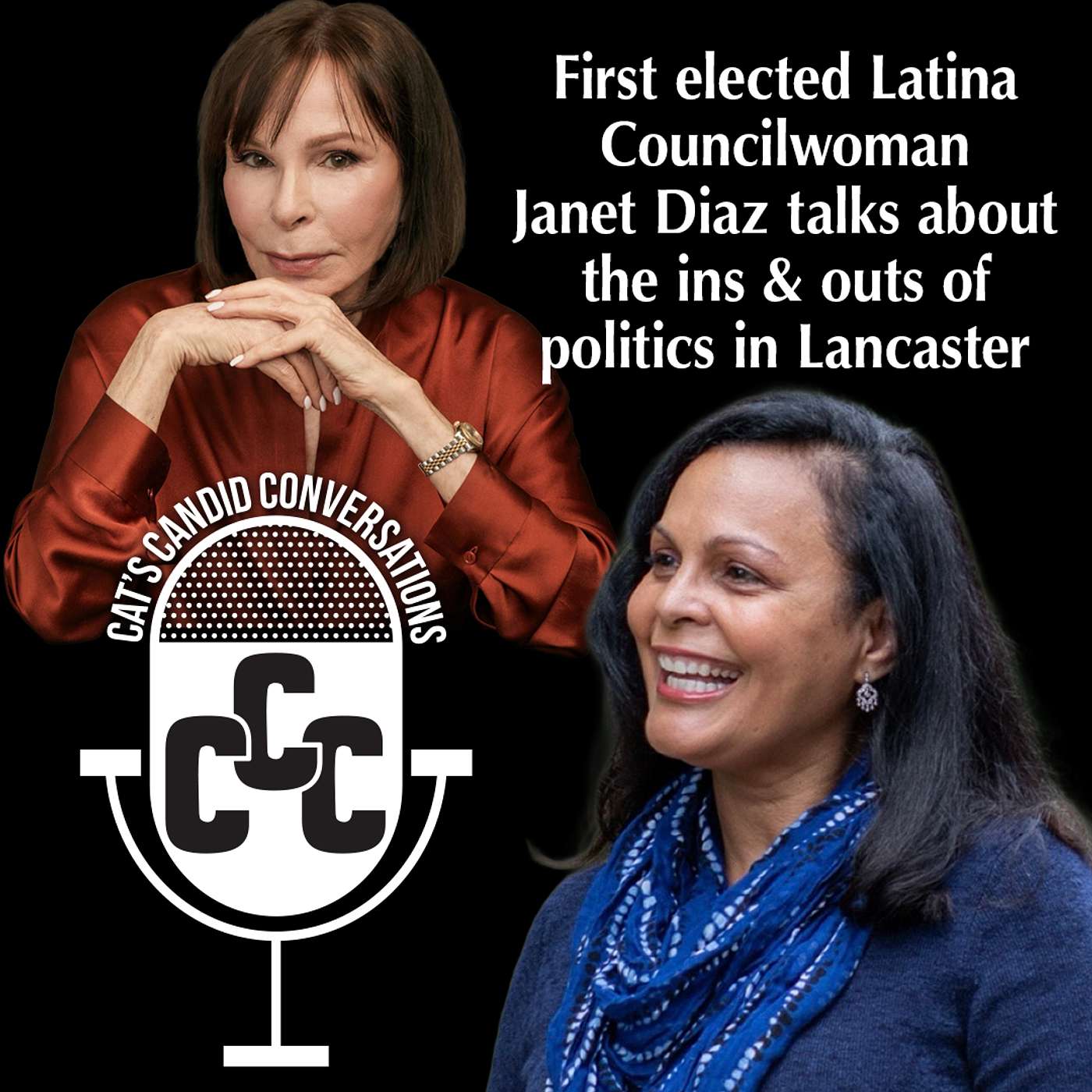
First elected Latina Councilwoman Janet Diaz talks about the ins and outs of politics in Lancaster
62m 9s
Janet Diaz, a two-term councilwoman in Lancaster, discusses her political journey and conflicts with the Democratic Party. Elected in 2018 and re-elected without party backing, she credits her success to grassroots efforts and direct engagement with constituents. Her platform focused on affordable housing, opposing tax hikes, and protecting residents, notably intervening to prevent water shutoffs for Latino tenants who lacked Spanish-language notices. Diaz faced significant party opposition for refusing to rubber-stamp policies, experiencing tactics like exclusion from events and harassment during her mayoral bid. Her resilience stems from personal experiences, including childhood homelessness and work as a sexual assault counselor, which informed her advocacy. Despite these challenges, she won a state Senate primary with limited funding, highlighting healthcare and community needs. Diaz’s story underscores her commitment to constituent-driven representation amid political adversity.
Welcome to Kat's candid conversations. Kat Makino is an award-winning journalist who has interviewed compelling people and organizations from around the world who make a difference. Democratic Janet Diaz was the first Latino councilwoman to be elected twice in Lancaster. She also ran for state senator, then in 2025 she lost her bid to be mayor. She accused the Democratic leaders of turning against her and not supporting her in the elections because she refused to rub her stamp all of their policies. The former medical analyst and YMCA sexual assault counselor is now writing a tell-all book about what she went through. So Janet, you've been councilwoman of Lancaster City twice. The first time was in 2018 and you won, although you didn't have the backing of the Democratic Party. That is correct. But yeah, you ran as a Democrat. That is correct. How does that happen? Grassroots, knocking doors, talking to constituents, listening to constituents is like number one. I'm a person that I do as I say. I am not a person that is going to run and say that I am going to support getting rid of, let's say, plastic, which is something that I've been, I've fought for for years and it's still plastic bags are still there and nothing has been resolved. So when I say I'm going to do something, I mean I'm going to do something. What did you run on? What were you saying that you wanted to change or you were for? In 2008. As someone that experienced homelessness when I moved to Lancaster, that was the number one issue. Being as a person that's compassionate and understanding that we don't have affordable housing. So those are the two main things. I also don't believe that we should constantly increase taxes on our constituents, especially those that are hurting because they're working to a three jobs and they're not able to support their cells, let alone pay for childcare. And there is a lot of parents that are single parents, just like my mother. So those are the things that not only I ran for, but I believed in. Since you experienced it yourself. That is correct. So you came to the city when you were three years old with your mother and you didn't have a home, your homeless? Let me explain. I was actually like nine, nine years old. My mother ran from a situation which was a life and death situation. And when we moved here, my mom thought that she could just rent something with cash. And as she didn't understand it, you needed a background check. New York is different. It's totally a different breed. So at that time, we had to live in a U-Haul talk for three months. We had an aunt that was called La Pachanga, a very well-known Latina woman that owned a business and was very well-known in the Catholic Church, which is San Juan Bautista La Pachanga. And at that time, she just didn't have enough room because she was helping men and women that were coming out of jail. And there was halfway houses basically what it was. So we lived in the U-Haul truck until there was a room available for us to stay. So she let us stay. So that's where my life started a little bit more comfortable even though it wasn't. Was she running away from a domestic situation in New York? It was. Something that she doesn't like to talk about. And it's her story. But the only thing that the glimpse that I can give you is that I got hit with a rock inch here trying to protect her. And there was enough violence that I saw people getting stabbed. I mean, my life story is something that nobody knows that I really didn't hone into. But the trauma as a child was surprising for me to even get out of my introvert personality to run for office. What that's interesting, it kind of makes sense now because you went into the medical profession. Helping women and sexual assaults and counseling. Is that what you feel while you went into it because you experienced it and you knew what it was like? I would say yes because I can connect those that are moving into the city or those that live in the city that are dealing with domestic violence that they can go comfortably to, to speak to an officer or direct them to the why, which is as a sexual counselor. I was there for six years, which was an opportunity to help those that are in need. I'm very compassionate about what I say and what I do. It's from my heart and my spirit. I look at it as a spiritual thing to help women and even men. I know if men that have been molested as child or raped. So yeah, people, even today, not being a city council person, someone said, look, I have a 19 year old with a child. She's in Jersey. She needs to place the stage. She's running away. And even though I'm no longer a councilwoman, I still give her three organizations and I'm like, here's the numbers in the address. Those are who you need to contact. And you just completed your second term as councilwoman. Your first term was in 2018. What have you accomplished as councilwoman to help these people or to work on issues that you believe in? Well, I would say that supporting and voting for grants for some of these organizations like the Y and some other organizations, even for World Church Service, they got grants for those that are immigrants in Lancaster is very high in immigration. And it's technically it's kind of like a sanctuary city, you know. Is it still high in immigration? It's one of the highest immigrants in the state because they're in Pennsylvania. In Pennsylvania. I know 40% of Lancaster city is Latino, correct? That is correct. And you were the first Latino councilwoman to be voted, even though you said that the Democratic Party didn't support you. They didn't. How did you get elected without the backup of the Democratic Party when you're running as a Democrat? Just talking to the people, listening, very honest. They said that they're tired of people being rubber stampers and I said that I would not, which I was not. And to be vocal when things were, came into a heated discussion whether it was about tax increases or one thing was shutting off water. We had over 3,000 people that they got their water shut off because a lot of them received either the actual person that owned a property, which was the owner and they were renting and didn't receive a response from them and they were shutting them off to put new meters in. Well I was very, very highly upset because I'm like, no, you can't do this. And many constituents, especially Latinos that ran a lot that didn't understand what was going on because the notices they weren't in Spanish. So that's one thing that I can say that I stopped. I stopped them from shutting the water off and giving them some time to speak with their landlords and also understanding what they were planning to do. How long was the water shut off for? They wanted to shut the water off probably like, I would say, three months until they got the meters put in. And three months living without water. No showers, no water for cooking. It was very interesting the way that they tell you they're going to shut the water off and that's also another way of getting people out of rental properties. If they shut your water off, you basically have to move out. That is how? Yeah. And you were able to stop that. I was loud enough to say no. There were actually people on the council who would vote for shutting the water off for three months of some of the citizens and residents that live in the city. All I can say is as President Reckonbarg at that time, you vote for what the mayor wants. I'm not voting for the mayor wants. I vote for what the constituents need. How did you cope with the Democratic Party as you say, not supporting you and actually working against you? I guess it's the New York City Bronx thick skin that I have being Puerto Rican that has a father that's in the military and along with a brother that was a police officer retiree now. And members of the military, there were uncles and cousins and I can go on. I have five generations of police officers in my family. Why would the Democratic Party go against you? Did you not agree with their platform? Did you go didn't go with them? Why would they go against you? They expected that whatever the mayor wanted is what I would vote for and that's not what my oath was. My oath is to support the community and that's what I did. What other issues came up as a councilwoman that you went against what the party wanted to do? Well, there was one of the things that I noticed was the taxes were just way
too high. It was like one point, I think it was 1.1 mil the first time and we had constituents come in, there were retirees, there were single elderly and I voted against it. I could see that the mayor was like-- You voted against increasing the taxes. Yes, it wasn't the first time. I voted a few times not to increase it. I also vote, I asked if there was a possibility to do it in increments because you're going to increase it anyway but can we do it at least in small increments to help whether it's increasing it like every other, you know, or every year or certain percentage but they didn't want that either. They didn't want to listen to me at anything that I might have offered as an idea or a solution. I see. And what was the outcome of it? Did they raise the taxes? They still raise the taxes yet. I see. Are there other incidents that you recall that you-- When I guess I'm ending, they put pressure on you as well. Did they put pressure on you to change your voting or not being so vocal? Well, and what did they do? Did they come and tell you directly or how did that-- I just noticed that they slowly stopped me from going to events by sending emails that were laid, which was very interesting. Did they send the emails to the other council people laid? Absolutely. Because I saw the event and the locations and the time and pictures. So you mean they sent it to the other council members on time? And you saw that. But they didn't send it to you on time. You were the one that did not get it. That's correct. You actually have proof of that? Yes, I do. What's the proof? I have my emails approve it. You have to match up their times and the dates. And at times, I noticed that they would switch events. For example, being a committee person, the chair of safety, I went to the awards for the police officers and fire department. And then they would switch the time. So I wouldn't be able to attend because, hey, I have to ask time off from work, which was-- they allowed me-- they're always allowed at me time. But if you get this email a day before, it's not feasible for me working at the hospital. It's 24/7. So sometimes I just wasn't able to attend. But they had the votes. So you were just one vote that they didn't have, right? Yeah, that's that's-- And they would go to this extent to excite, do you think that is? Because it made them look bad. It's all emotions and psychologically damaging to them just because I would vote no, which is very bizarre because it would still go through. For example, resident-- nobody wants to be taxed higher. So the fact that you said no, we're not going to tax the U-voted no. No for an increase in taxes. It doesn't make them look good because they voted for it. Exactly. I say. What did you do about that? How did you feel when you were being excluded and other measures were taken against you? Oh, there were many things that I saw that was very-- to me, it was almost childish. I took it as your child, your habitat from, and you think that that bothers me? Never. It didn't really bother you? I lived in the streets. I know how to survive. Do you think that a vote and their childish behavior by excluding me for certain things is going to bother me? I have more important things in life to be concerned about. Did you have a support system? I had my mother, my husband, and the constituents that voted for me that said Janet, you know, we're here for you. So you had this strength to continue to go against the majority? Oh, hell yeah. How come the second time then you didn't run as a Republican or an independence since you didn't have the support of the party? Well, the city is predominantly Democrat. That's number one. Number two, I already had ran for state committee and one number one. So I was already entrenched. And I was part of a Latino caucus in the state as well. And then there was 2020 when I ran for a Senate, which was really record breaking in the primary. And what said? Well, I was the first Latino in the state to ever run for a Senate position, a state Senate position. I was asked by Senator Street who was chair of the Democratic Party. So I said, yes, I would run. But I was I going to win? I don't know because it's pretty predominantly red in the county. But the fact that I was the first one to do it without their endorsement, I won by 2000 votes against Craig Layman, who was a commissioner. In the primary, so the Democratic Party. In the primary, which I did not believe that I would win because of not having endorsement, really supporting Craig Layman, commissioner Craig Layman at that time. And when I saw it and the funny part is every time I win, I usually just go home and go to bed, like give it an election. And I've done that with all of them. Everybody was completely shocked calling me on the phone and they go, "Janna, you won the primary." And I'm like, "I did?" He goes, "Yeah." I thought, "Well, maybe 100 points. I don't even look at the scores. I just win or not. They were in shock. They were completely shocked." And it was with only $7,000 that I can raise. I raised it just to bring about how that happened. How about your opponent? How much did your opponent raise? Thousands of dollars, thousands of dollars. How did you do it? How did you manage to win? If you're not familiar with Emerge, which is an national, but also Emerge Pennsylvania. And I took the class during my City Council race at 2017 and 2018. So with their assistance and the alumnas, which was a class, I think, of 30 or 40 girls, they helped me. They gave me donations along with Representative A. And when I met Christine, she was the one that met me at one of the organizations or one of the events. And Christine, she is the director of Representative Pennsylvania. But with her assistance, she also donated. She donated like $3,000. I was shocked. So with $7,000 with the girls and some other friends, obviously, fans and family that I contacted, with the help also with Cornell Wilson and my husband. We pulled it. We did another grassroots, which was shocking. I mean, it was crazy. I was completely shocked. And then, of course, I think at that time, Biden was running with Kamala Harris. So I got to sit. I actually got in the stage with her husband, opened up for them. And also for my, I spoke regarding my campaign at that time after I ran and won. But yeah, I always said. What was your message? Why do you think you won? There must have been a message there that resonated with the voters. Well, one of the things my platform was, healthcare. One of the things that community was concerned about, which I took like three months prior running and making that decision. I went out and did a survey on my own and spoke to people and asked, "What is your major concern?" And it was healthcare, wages, the environment, obviously. So my knowledge is what I brought. I always bring my knowledge. What do I know about healthcare? Well, I worked in health insurance. I worked as a billing manager at a practice of five physicians. And I've been, you know, a LGH for as an abstractor, which is medical analyst, Ben Cardiac. And I knew the system of the, I knew healthcare system. I worked three years in what they used to call health card. And I knew ways that especially small businesses that don't have to provide their employees healthcare. If we push an agenda where and, you know, a policy where all the small businesses can come under one umbrella, then they would have a contractual negotiations with the healthcare insurance. So that resonated with the people who were voting? Yeah, because I believed in it. Because I knew it could happen. It seems like it's still major issues today. Oh my God, yes. It's just unbelievable. And it can be done. So what happened when you ran against the mayor, Arroyo? Well, in the primaries. In the, because you were running for primary, for Democrat, for the mayor of Lancaster, just recently, right? Well, it was, this was planned like two years before for mayor Srirachi to bring him forward. I knew it because they were doing everything humanly possible. That was a previous mayor. Oh my God, yes. Okay. Yeah, Doreen Srirachi. Okay. Yeah. So they had already started attacking me on City Council. They were belittling me. They had a felon come in and attack me with their socialist groups. Can you prove that they did that? Of course. Well, somebody that was friends of the girl that would come in.
to attack me on City Council. You can see all the City Council for two months. - So she was actually attacking you? - Oh yeah. - What was she saying about that? - She brought a group and she says that I'm no good, that she doesn't want me as a mayor, that, I mean, she-- - Why are you no good? Why did she say you're no good? - Like I said, they had this already scheduled to occur as a, I call it road playing, you know? They just had this acting. And I could see right through it. I could see that they actually accused you in public. - Oh, they accused me about a lot of things. - I read that you were accused of being a racist. - Yeah, I was a-- - And because of something with a mud or a mud. - Yeah, a mud. And also that you were homophobic. - Oh yeah. You know what's so funny? My 2020 race, my campaign manager, okay, the assistant was gay. That field director was gay. And then I finally told my board from the campaign, which was a general, I said, we gotta do something. Are they gonna say that I'm a racist? Because everybody else I have a gay. - Well, what I read is that homage. He, you said that he wasn't born in Lancaster. - No, let me just, just so-- - That's what I read. - They took a post, which unfortunately, I-- - I read it, I read the post. The post is not racist. It's basically saying, I, myself, it looks like it's me saying that you need to be born and raised in the United States to run. - Right. And you said he wasn't. - Well, I said, no, I didn't say anything. I just said, it just basically said that you should be-- that there are other candidates. And that's what they twisted. Where does it say that that's racist? It's not racist at all. Isn't that I say-- - Well, what I read, and this is just what I read, is that you would said in the email that we should go with someone who's born in Lancaster and raised in the city. But then you weren't, because you lived in the Bronx. So you weren't born here. So where did they get that from then? - That's how they twisted what was said, what was posted at that point. - So you don't believe in order to run that you have to be born and raised in Lancaster. - No. - And how about the homophobic? What would you say that you were homophobic? - If I was homophobic, then I must hate my uncle, because my uncle that shared a crib with me when he was little. And he is so flamboyant that I call him Thia Thia, which he's uncle and Thia Thia. He was a hair designer in New York. He did a lot of art artists and actors and just a lot of, a lot of very famous people. - So you really said that they were harassing you. - Oh my God, I even had people following me. - What do you mean you had people following you? - I had people following me. They were using every scare tactic for me to get out of my race. I'm like-- - To get out of the mayor race. - To get out of all the races I ran-- - They would actually follow you. - Who would follow you? - I'm from my house. Let me go to this one. This one's really interesting. So I get up in the morning, it's five o'clock in the morning and I know all the cars. It's a call to sack. It's only a block long. So when I go out, there's this person there and I'm like, what the heck is that person there? And so I kind of backed up. I took a picture of the license plate. I saw the person who it is and I knew the person and they don't live in that block. So I contacted Chief Bay, who by the way, left two days after retired, left. He said, I'm done. And I said, if this person has anything to do with, is he why Dow's campaign? I'm gonna file lawsuit for harassment. Two days later, Chief Bay's gone. So it makes you think. - Are you saying he's gone because-- - I'm saying he probably left because that was the last straw that broke the back, that broke his back, because he had also mentioned to Darlene Bird when she went after he left, he had came for an event. And that was a police chief, by the way. So the police chief told Darlene that the mayor would let him do his job. And I said, well, it was a coincidence that after I called him and left a message that I was coming to file a complaint because I had the license plate and the car and the person. And then he left two days later-- - This is when you're running for mayor. - That was kind of recently. - No, that was when I ran for house. I ran for five different positions. - Oh, that's a lot. - Well, I look at it this way. People kept asking me to run, community people, the people in NIGASTER City, the constituents asked me to run for these positions. So I still have money. I was like, all right, I'll run. Did I know I was gonna win? Not with the party, not with the people on city council. Not with that mayor that she would do anything humanly possible. Make sure that I didn't win. And I could prove that. Why did they dislike you so much? - Because I would not conform. I am not gonna push shackles and be told to vote for something just so you can make you feel good. Oh hell no. - But didn't they feel as a Democrat that you had to go along with their platform that you needed to compromise? - No, they don't believe in compromise. It's not, and it wasn't only me. There were two other council people, one that left after what, a year or two. And then the other person was going to run again and they didn't even want her to, they didn't even notify her that for her to apply for an endorsement. And she also was shunned because she had disagreed on something that the mayor, that the mayor was like, trying to push forward. Anything you did, Mayor Srirachi, you would go against her? She'd do anything to make you look bad. Or anything to get you out of the way. Which is, which I like again. - What did she specifically do to make you look bad besides, okay, so. - We had the racism, we have the homophobic, we have, they're following you to your house. They're parking outside your house. So they were harassing you. - They were harassing you. - And you had proof that all these things were happening. - Mm-hmm. - But it didn't get you down. You kept running. - You kept running. - You know, if anything, it made me more stronger. It made me feel like, all right, I'm David. Keep messing with me, 'cause I'm all hit you with that rock. - You know, I can kind of relate to that, because I did a story and the person I was writing about did not want me to write it. So he started threatening me. But my attitude was, I'm gonna write this story for sure now. - Well, I'm writing a book and trust me, every meeting that I went against something, something happened, and I'm bringing it forward. - Are you worried about libel or lawsuits? - Nope. - Not at all. - You have proof that you were being harassed? - I have proof. - I think you mentioned that the mayor, the current, the mayor who just won, Oroyo, harassed you as well. - Oh, there was a time where he, they tried to block me on what I wanted to do on City Council regarding a policy. - What was a policy? - I can't recall. I'm going through all the policies as I'm writing my book. So you'll get more information on that. But yeah, and you can see it, you can watch some of the City Council meetings and see how they react. One that was interesting, this is with Mayor Sriracha and also Oroyo, which was very, it was the most-- - He was on the council before. - Yeah. - So the mayor, I asked the question regarding ARPA. Why do I ask the question about ARPA? Because he was the-- - What's ARPA? ARPA was the money that was the stimulus money that was given to Lancaster, it was $38 million regarding COVID. So my question, because of constituents over two older mature ladies discussing it and they kept ignoring the questions that she was asking. - And she was asking in a council meeting. - Public council meeting. So since Oroyo said that he provided the ARPA money to everybody, I-- - What do you mean he provided? - That's exactly what he said at the meeting. Even though it wasn't his money, it was money that taxpayer for people to receive grants during COVID. - During COVID. - So the question had was, you know, risen in regards to applying for it. They weren't very savvy with the computer. They obviously didn't understand how to go through the process of application for grants. So there was a question they came up. So I asked the question because I'm pretty smart, even though they think that I'm not smart enough. So I said, can someone please explain in a short sentence how this can transpire to answer the question for Dileene Bird and Dana London? - I mean, where the money went? - No, for the application to receive money. - The grant to get the grant, okay. - So Mayor Srirachi chimes in and says, well, to me, in front of everyone in city council, then I get the memo, then I get the email, did I read my email? - About the applications. - Right, because she wanted me to answer it.
The strategy was not for me to answer, but to see if they will answer and know it, and also if it was incorrect, so I can correct them. See, I was always strategizing. The funny part was, she couldn't, Denise Srirachi couldn't answer that question. So she gives it to Arroyo to answer the question. And I'm saying to myself, if she intervened, then she know the question. To make a long story short, the question was answered by Arroyo technically. And after the meeting, I was heading out. So the mayor Srirachi, she stops me and she goes, why are you trying to make me look bad? I was completely, just perplexed because I'm like, say to myself, how can I make you look bad when you were trying to make me look bad? This was all the time. But what the comebacks is that what they don't expect, 'cause I always have a strong comeback and proof. And I'd said to her, I'm not trying to make you look bad, whatsoever. And the more I thought about it, I'm like, you know what? Never mind, and I walked out because I couldn't figure out why should I explain myself when she was trying to belittle me in front of the public. I'm a little confused. So two women, two constituents ask about, how do I apply for a grant? 'Cause there's 38 million that was given to the city. Correct. Lancaster City. And they asked you, you were supposed to, I don't understand what happened. I asked the questions for them because no one's was responding to them. What do you mean? But they stand up and there's a microphone and they said, this is my question. And nobody answered. They just, everybody was just quiet. Yeah, nobody answered the question, they sat down. So why did you answer it? Or why did you participate in that? Because it's not fair to the constituents that they come to City Council to ask a question and nobody's responding to them. So you said, let the mayor answer it? No. What did you say? I asked the question. So somebody, especially a royal that was part of giving out these grants or part of the group to have the grants out there for those people to apply for and also to see who would actually receive them because he would vote also, him, Amanda, which I found it's ridiculous that they had employees in City Council people and set up people from the public to be part of those decision making. But nevertheless, when I asked the question, I want somebody to answer the question. So you repeated the question to the board. So I asked the question on City Council. Oh, you said, does anybody know the answer to this because I don't? Exactly. And then, Oroio said, I know the answer. No, it was to mean that time didn't, when I asked the question, she came forward and she couldn't even answer the question. All she did was try to belittle me and tell me if I read the email. In other words, she wanted me to answer the question. Oh, I get it. So she said to you, you should have known this answer. Didn't you read what I sent you? But you never got it. No, I did receive that because it was Arpa and it was sent to me. Then you could have answered it. I didn't want to answer. I wanted Oroio to answer the question. Why? Because I wanted to see if he knew exactly. Why, though? He never answers a question. He goes around and around. In fact, you should look at some of his videos. Just he never answers a question. He just, he goes in circles. He never, it's like me. If you ask me a question, I'm going to say yes or no. So you were kind of belittling him then. In a sense, you wanted to belittle him because-- I did not. --did he have the answer? He did answer. Oh, he did answer. I wanted to make sure that number one that I didn't answer incorrectly. It sounds a little petty, though, because-- No, that's the key. He was there to play. You were kind of playing-- You were playing a game with them instead of just having him answer. He was the one that was part of the group. So how did you belittle the mayor at that time? Why would she say that to you? You didn't belittle her? I did not. She belittled me. That's the thing. They were trying to attack me by making me look bad because I didn't answer the question. I didn't want to answer the question because I was not part of the decision making of who was getting the armor money. I understand that. But I think it would have been OK for you to answer it instead of playing the same games that you're saying that they play. Well, sometimes you have to play the game too. And I got to the point where it's like, all right, you think I'm dumb? All right, let's play this game. I don't like playing the little-- Did it get to the point where the harassment got too much? Where it just-- that was it. That was-- No. They harassed me. In fact, they told me to step down to City Council. They really wanted-- What did they say? Who exactly is they? The community, City Council, the mayor, the Democratic party. They told me to step down from my mayor raise. They wanted me to step down from City Council. Why did they say you should step down running from mayor? Because I'm a mayor. It's because I'm-- We already talked about that. Oh my goodness. I was everything under the sun. But none of all. But you're Latino and you're a racist. I know. It's not funny. What are you a racist against? Against too. I don't know. Maybe rice and beans. [LAUGHTER] Rice and beans. It was funny because when they were attacking me at City Hall because of being a racist form of-- I would say a total of 50 people came to stand up. 11 or 15 of them spoke on my behalf. And they were surprised. They were playing this game, Continuity, and attacking me and bringing all these people out. They wanted you out. They did. But guess what? I did not step down. You had said to me before this interview that the current mayor now, Oroio, actually paid someone a woman to harass you. Yeah, there was a-- Do you stand by that? I mean, that's-- That could be very liable, is. I believe 100% the person that told me that the person that was attacking me, she got an apartment and she was getting paid for his campaign. But is there any proof of that? I can't personally prove it. But I believe the person that told me because she says I'm a friend for both of yous. So this harassment, according to you, the harassment has been going on for how many years? Oh my god. I would say total four years more. But you still won when you ran for a council woman the second time. What year was that? I think it's 2020-- I don't see 2021. That's about four years ago. Three and a half, four years ago. Yeah, because I ran 2021 and then I started my second term on 2022. So how did you win that when you had so many people who in the Democratic Party, the leaders of the Democratic Party here, against you? How did you manage to win that? Well, I believe that being part of the state committee, I was very-- I was no nationally after my Senate race. And the Consistions saw that I was supporting them and I stood up for them. And I knocked doors again. I did my grassroots. And I still had money. In fact, there was fun running for all these positions because I was like, you know what? I'm just going to run for the hell of it, win or lose. At least I can get rid of all this money that I have. I remember you had said to me that you actually went around to 10,000 homes. I did my first-- And knocked on doors. Yep, 10,000. So why do you think you didn't win for mayor when you-- How can you win for mayor when you have people attacking you? How can you win for mayor when they wanted to bring forward someone else and they had them so highlighted in every-- or every meaning, every event that I did not participate because I didn't even know about it. Yeah, I read in one. You were in no show. There was going to be a debate between you and Aurora, but you didn't show up. No, I didn't, because I requested for Aurora to apologize for me to step down. But he didn't have the guts to do that either. You asked him to-- Because they were asking you to-- Yeah, to step down. You want me to debate you, but you can't apologize for-- They had to come to you. The Democratic leaders came to you and said, step down. We don't want you. Oh, no, they had it all in the newspaper. They made it this big-- Oh, they used to resign. They used to resign. I think I heard that. That you should resign. Yes. They were also afraid that I was winning, too. That's why they kept pushing-- that's why they kept taking the narrative and switching it and making it look like I was a racist, which just-- Yeah. You couldn't-- did you ever think about suing them for Aurora? I thought about it. I did think about the formation of character, but I always believe that the truth comes out to the light. And with my book, it will come out to the light. Are people coming up to you now and saying anything about the race or-- Well, you also have to look at another thing for the primary. People didn't come out to vote. They did not come-- What was the percentage of people that came out to vote? I would say 35%.
Is that unusual for this area? 35 percent? Any election other than other, any election other than the presidents and the governors, they don't come out for city council, they don't come out for school board, they just don't come out. And for mayor as well, it was, it was a low turnout. For primary, and then people would call me and say, Janet, I'm going to go out and vote for you in November, I kind of chock on and just let them go because, you know, some of them are not very, they just don't have enough knowledge that there's a primary that in Lancaster, if you're a Democrat, you have to vote in the primary because 9 out of 10, there's not going to be a Republican running because it's predominantly Democrat in the city, in the city. So when it comes to running, this is my, I don't say feelings, but I would say that losing is nothing for me to cry about. I always look at it as when I was in school, I was in track and sometimes you went some as you were telling you to lose some. So you don't seem crushed to me at all, you seem and you, I mean, because you lost by, I mean, I lost by 85 percent. You got the votes and you got 15 percent. That doesn't discourage you. Never because you're a city girl from the Bronx. Yeah, I'm a city girl from a homeless. You've lived in, he's just born with a solar spoon in his mouth, you know, he was, he was pushed by the mayor. She did everything he was really possible to get people, she gave people, art, but money to make sure they supported him. I mean, that it wasn't, it wasn't something that I said to myself, I'm going to win this. And I never thought of that with any of my races. I never, in fact, when I ran for city council, one of the endorses got kicked out by me. Like in other words, three of their, three of them won of their endorses and I won as an unendorse. I know. I know. You know, they're supported all. No. And nine people ran for that race at that time. So the fact that I won and then when the general came one number one was, it went, it went nationally. I got Huffington Post and all these people, the first Latina, the first Latina. I mean, I was inundated with all, and I don't, I'm not crazy about being in the media or the news or anything, but, but I talked to them and I'm like, yeah, I won. And you think you won because you knocked on doors, you listened to people and saying things about healthcare and helping people in need resonated with the voters. And that's why you won, do you? Definitely. Because I was genuine, I was honest, I was respectful. And listening to what the community wanted. And I did everything humanly possible to help. One person, let me, let me look, this one really kind of put a thorn on Mayor Srirachi was, there was an organization that was, that basically flips homes and sells them at a reasonable rate. Well, this young lady was being pushed around because nobody would respond to the organization that had the woman that was part of the organization. No, she was just, she was, she was a Latina woman with kids that wanted to buy this property. Okay. The organization, the mission had an agreement with the city. So the city provides them a small loan so they can fix the home so they can sell them. Make it affordable. Exactly. Affordability. Okay. So when that happened, the, when, when COVID happened, they had stopped. So they had to go back and ask if they can, if they can please process that after they sell the property because of the fact that they had stopped so they didn't have enough revenue. Well, the mayor and the person that took over for the contracts was a solicitor were ignoring and we're not going to go fall through with the contract of loaning the money to the mission in order for Ruby to get her house. Well, the realtor sent me a message, an email. So I sent a message to the mayor and then I still didn't get anything. So the second time around, I put an email together. This is why they didn't like me, but I had to ruffle the feathers. And I said, it's very interesting that this woman, this young woman that's a single mother, a Latina with two kids, have been pushed aside. But if it would have been a white, wealthy woman, you would have went ahead and made sure that that wealthy woman would have gotten that property and settled with this, this organization. I said to me, and to me, you're just basically I was calling her a racist, but I didn't call her director. I said, this is racism. I said it. I said, this is right down racism. 20 minutes later, I get an email with the missions, the mission and the realtor. And she says, please have the organization, the mission to come in and fill out a new form and get the, you know, so they can settle with the loan and go through the whole process of the woman can settle because she had already given up her apartment. So she was basically homeless at that time. And that's what really, that's what anger me the most. And that's where I said, you know what? I'm gonna call her a racist. So every time they do something like this and this, and that's just one story. Do you think they were really racist though? No. I just think that it was because they were selling a home, not at the price that they wanted. It was about money. It was all about the money. The house went for 150, the organization, that's what they sell it. But I'm sure if it would have been 300,000, you have to think about this too. $300,000 home is gonna give 3,000 in taxes to the city versus 150,000. So it's about the money. It's all about the money. I learned this, I think I learned this second year, I was in city council. I knew it was all about the money. And I'm like, that's why I'm, I'm not anti-paying taxes. I'm anti-the amount of taxes that you're pushing through so many of our community members. There are so many women and men that are single parents. There are so many retirees and you're gonna raise trash, sewer, water. Oh, but wait, we're gonna put another 1.2 million. But don't you think they need to raise the taxes in order to provide public services? If it was just the public services, but you should see all the consultants and the amounts that they pay them. We're talking there overpaying the consultants. Consultants and also the people that work there. If you're a mayor and you're making less than $100,000, so roughly $89,000. And somebody is the director, Duff, that's making $200,000. Who? Director Duff. He's the economic, economic development director. And I'm saying to myself, why is he making more than the mayor? And that's just one person. If I were to go through the whole list, it would make you wonder why. She gave tons of races. She gave the director of neighborhood engagement who only had six people versus the fire chief that had like 60 people. She gave her 85% race. She went from 60,000. Who's this? Her name is Melzie Carrasco. What is she in charge? Neighborhood engagement. People keep asking me what she does to be honest with you. I have no idea what is neighborhood engagement. Somebody that goes out there and campaigns for the mayor, that's the way I look at it because it's part of the city. It's part of the city. And that's where taxes are going to. Oh yeah. So it's like all the waste is what you're talking about. The increase is for other people rather than the working citizens. And even the union employees, now get this, they all campaign for unions, unions, union workers. But when you go back, you can see how many times they even took the city to arbitration and to basically lawsuits because they won't raise, they won't increase the union workers, but the administration. Oh yeah. What do you mean the workers what? The workers wages. Well, wages, yeah. They won't do it. Well, they fight for it. They fight in order to get a raise. In fact, there was the unions are fighting take what kind of unions, which, which union, the city unions, they take care of like public works, anybody that you know, patches the cities, streets, they don't have an increase in wages, but yet our increase in taxes are paying for that, are helping with that. Is there public services? Because they're increasing the administrations, the white, that what they, I consider the white collars and the blue collars are set aside and say, you'll just have to wait when we have money will raise your, but get their way, they're raising their wages for themselves. And that's what you were fighting against. Oh yeah, I, I publicize that. Oh yeah, I publicize everybody they got reasons and how much they made that made her even more angry.
I said, that's why they harass me. Well, think about it. The employees that are digging the trenches to put the border main and the infrastructure, they're not getting a raise, but hey, let's get the secretary a $60,000 a year versus, well, I think she was making like 40,000. - Isn't the minimum wage in Pennsylvania $6 and 20 cents? - $7.24. - Yeah, that's the minimum wage. - How long has it been that wage for? - 1989 or something? I don't know, it's been years. That's another reason why I ran also for House Representative N, also for Senator to raise wages. I think $7.24 is not enough. And it's pitiful, especially if you're a single parent, like my mom was, making $3.35 in Conestoga View. And she would have to work double shifts at times. - That was a long time ago, wasn't it? - It was a long time ago, yeah, but it's the same now. I mean, it's just a different era, but the wages are still low and it's hard for people to survive. - So your mother was homeless, not making a lot of money, working two jobs. - Mm-hmm. - So how did you get out of that and say, I'm gonna do better? I'm gonna have a career. And then you decided to run for office. What was it about that time and going through that, that got you to get higher schooling and to have a career? - I just worked hard. My mom, watching my mother sacrifice herself, even to buy me a pair of shoes or my siblings, or she did everything humanly possible, even through some of the most worse relationships she could have, just so we could succeed. And her everyday lecture was, I want you to study. I want you to make sure you come home and study. I cooked, I cleaned. - How many siblings did you have? - Two at the time here. I have others that live with my dad in Puerto Rico. So not only did I have to cook and clean, to help my mother, but I had to study. And make sure that the other siblings studied and got to eat and go to bed on time. - So it was with your mother's encouragement? - It was my mother. - And her support that got you to where you are, do you think? - Yep, and her Puerto Rican New York attitude. Even though she was born in Puerto Rico, she was, they migrated to New York in the '60s. - What was her attitude? - Don't, can I speak? - Blurly? - Yeah, go for it. - Yeah, of course. - Don't fuck with Clarita. (laughing) - And you don't. - You're just like your mother. - Well, as you said, you have the same attitude, don't you? - No, I'm not saying that is a bad thing. - No, I'm more conservative. My mother is somebody you don't mess with. She suffered enough that if anything would happen to me or any of our siblings, she will come at you. - Do you see yourself as diplomatic? Are you willing to compromise? - Yeah. - Were you willing to compromise with the board? - I had. - I mean, I didn't vote no for everything. I voted yes for many things. Many things. It was just certain things that I knew it was gonna affect the community where I would vote no. - And they got very upset just because of that? - Yeah, that's what I said. It was emotions. They had everything emotional. I did not come to the city council with emotions. I came to the city council to do my job. - So they had an internal reaction to you? - Yeah, 'cause it made her look bad. That's what she kept saying. Why are you trying to make me look bad? Oh my God, I'm not making you bad. You make yourself look bad. - I see. - I see. Are you gonna run for office again? - Well, at this point, I'm gonna do my book first. - When do you have a name for it? Do you have a title for your book? - Let me see if I have it. - She's looking in her purse for the title of the book. - Well, 'cause I'm still-- - I'm still okay. - I'm between titles. - Okay. - But one that kind of stuck out was something that I wanted to say like behind the black curtain, but I kept switching back. Refusing to be the face of someone's else's political strategy behind the blue curtain. - Okay. - So, and then after that, now that I can say that I'm no longer part of the Democratic Party. I believe that after seeing the far left become too critical and attacking, and we see it on TV, I saw it on City Council attacking me, and then after the death of Charlie Kirk, that did it. - What would you run out? - That's a Republican. If I decide to run. - What would you run for? - I don't know. I would have to talk to the Republican Party and say, "What would you like me to run for?" - Okay. - And by the way, they had been pushing for me to be Republican for, I don't know how many years. - But the city itself is very blue, so. - Yeah, but I'm moving out of the city. - Where are you gonna move to? - I don't know yet. Some place in suburbia. - Come to township. - And again, what would it be in Lancaster County? - Yeah, Lancaster County. - Where's Redder? - Not so much as being the Redder part of it. I just don't wanna live in a city where I have to hear the sirens, people shooting each other, people hearing, stabbing. - I think anybody wants that. - No, but this is what's happening in the city. You hear it all the time. - But I think the murder rate is decreased from what I just read. - I don't know. There was a stabbing, but a month ago, across the street from city hall, while I was on city council. I sent a text to my husband, "Hey, "and what does that coffee place? "Something one." - Square one. - Square one. There was a stabbing right there. My car was always parked my car. (laughing) - By the way, you mentioned, reminds me before our interview that you felt the Democratic Party didn't like your religion. - Oh, sad. - What did I do? - You said you're-- - Remember selling love, yeah. - You're Protestant, correct? - I would say no. And I'm kind of hesitant of talking about my faith, only because I've been attacked. - Are you Christian? - I don't say that either. (laughing) - But you have faith. - I have a faith in God that moves mountains. - Okay. - And you said your husband is actually Jewish, right? - His family is Jewish. - And was your, what family religion were you brought up? - My father's Catholic. - Uh-huh. - Which yes, I was baptized Catholic. And then my mom is Protestant. And then I got baptized Protestant. So it's kind of like wherever I go. - I get that. - It's just, I just believe in God. I don't have to be, I mean, I do go, what I would say, like a temple, you know. I do go because I believe in fellowship and talking to people and learning and listening to people in need. - But the Democratic Party didn't like that. They wanted, why wouldn't they like that? - Which was, it was just interesting to hear that the chair of the county, which was Sally Lao, had told somebody that I was too religious. And I'm like, I never had spoken about my religion. I have never spoken about anything other than God. I do believe that there is a God. - Do you think it was word of mouth somebody telling you, she said that maybe she didn't say that? Maybe it was just-- - No, I believe her. She even said that the reason I won for the commission, not the commission, for the Senate race was because my last name was Diaz. And I'm the, and I'm the races. (laughing) - Before we end, and I have one more question for you. Do you want to ask her anything, Danielle? - Well, I mean, you covered most of what I was interested in. You talked a little bit about your male race in the state center race. Well, I wanted to ask you about the, is 2022 when you ran for a state house, was it a case where he was also like the chosen candidate, or can you describe anything that was interesting about that particular race? - Well, the endorsement obviously went to him, but what was interesting, this is interesting, how they played this game. So they had a group of people vote. So it was, the first vote was for it to be an open race. So they said, no, but we have to vote again. And I'm like, well, you already voted to be an open race. There was about a 15 minute lag before they did the second vote. Well, half of the people left. So the second round, it went to him as an endorsement. So that's the games they play. No, there was just a game they play. I know it because I've seen it more than once. The house race, a lot, the reason why I ran was because somebody asked me from soccer to run the race. And I said, okay, I have money, I'll run the race. But yeah, it was the same scenario, attacking me, making me look bad. It wasn't as harsh as the Mayr race. And they used, like I said, certain tactics.
It's to me is a stupid game. And you you have proof. It happened. You can see it on city council meetings. I'm totally digressing. But is your husband in the medical profession as well? My husband is a he's an owner of a old what they call locksmith auto auto locksmith. He's a technician. Oh, okay. He owns the own his own business. Do you children? I could never have children. Okay. I just have animals. How many animals do you have? Two. Dogs of cats. Dogs and a cat. (laughing) Dogs of cats. Is there a message that you want to leave the listeners with that you would like them to know about you? I'm the real deal. I don't pick party over people. I don't discriminate because you're living in a apartment that's fallen apart or a house versus living in the street or going to Kamala Harris's mansion, which I did because I was invited to. I am a person that cares, generally cares about how you feel and how you're doing. Okay, well, it's been a pleasure talking to you. Well, thank you very much. To know you. So thank you very much. And thank you to Danielle, our tech guy. And thank you. All right, stay tuned for our next podcast. (upbeat music) (upbeat music)
Podcast Summary
Key Points:
Janet Diaz, a former councilwoman in Lancaster, was elected twice without Democratic Party support, relying on grassroots campaigning and constituent engagement.
Her political priorities included affordable housing, opposing tax increases, and protecting vulnerable residents, such as preventing water shutoffs for non-English-speaking tenants.
She faced opposition from party leaders for refusing to align with their policies, experiencing exclusion from events and harassment during her mayoral campaign.
Diaz’s personal background—including childhood homelessness and work as a sexual assault counselor—shaped her advocacy and resilience in politics.
Despite challenges, she achieved electoral successes, such as winning a state Senate primary with minimal funding, emphasizing healthcare and community-driven platforms.
Summary:
Janet Diaz, a two-term councilwoman in Lancaster, discusses her political journey and conflicts with the Democratic Party. Elected in 2018 and re-elected without party backing, she credits her success to grassroots efforts and direct engagement with constituents. Her platform focused on affordable housing, opposing tax hikes, and protecting residents, notably intervening to prevent water shutoffs for Latino tenants who lacked Spanish-language notices.
Diaz faced significant party opposition for refusing to rubber-stamp policies, experiencing tactics like exclusion from events and harassment during her mayoral bid. Her resilience stems from personal experiences, including childhood homelessness and work as a sexual assault counselor, which informed her advocacy. Despite these challenges, she won a state Senate primary with limited funding, highlighting healthcare and community needs.
Diaz’s story underscores her commitment to constituent-driven representation amid political adversity.
FAQs
She won through grassroots efforts, including door-knocking and listening to constituents, emphasizing honesty and a commitment to not being a rubber stamp for party policies.
Her main issues were addressing homelessness, advocating for affordable housing, and opposing tax increases that burdened working families and single parents.
Her childhood experiences with homelessness and domestic violence led her to work as a sexual assault counselor and advocate for vulnerable populations, including immigrants and victims of violence.
She successfully stopped a plan to shut off water for three months by advocating for residents, ensuring notices were in Spanish, and giving them time to communicate with landlords.
They opposed her because she refused to vote as a rubber stamp for the mayor's agenda, instead prioritizing community needs, such as voting against tax increases.
She relied on her resilience from past hardships, support from family and constituents, and did not let childish tactics like event exclusions affect her focus on important issues.
Chat with AI
Loading...
Pro features
Go deeper with this episode
Unlock creator-grade tools that turn any transcript into show notes and subtitle files.
 PodcastTranscript AI